
The Web3 ecosystem is expanding at an unprecedented rate, creating immense opportunities for professionals across engineering, marketing, operations, and more. Landing a role in this dynamic space, however, requires more than just technical expertise; it demands meticulous preparation. A common pitfall for many talented candidates is underestimating the nuances of the Web3 interview process, which often blends traditional behavioral questions with deep, domain-specific inquiries about blockchain, DeFi, or the metaverse. This comprehensive interview preparation checklist is designed to guide you through every critical stage, from deep-diving into a company’s on-chain activity to mastering your personal narrative.
This is not a list of generic tips. Instead, it is a strategic blueprint to help you build confidence and demonstrate your unique value proposition. We will cover eight essential steps, providing actionable advice and specific examples for each. You will learn how to:
- Research a company beyond its website, exploring its protocols and community engagement.
- Craft compelling stories that showcase your skills using the STAR method.
- Develop insightful questions that prove your genuine interest and strategic thinking.
- Master the details of your resume and prepare your professional portfolio.
By following this checklist, you'll move beyond surface-level preparation and build a framework to confidently navigate complex technical discussions, articulate your experience, and make a lasting impression on your future employer. This guide is your key to transforming potential into a successful career move in the decentralized world.
1. Deep Dive: Company and Role Research (Web3 Edition)
In the Web3 space, standard company research is table stakes. To truly stand out in your interview, you need to go beyond their "About Us" page and immerse yourself in their digital ecosystem. This deep-dive approach involves a multi-layered investigation into the project’s core technology, on-chain activity, and community dynamics. This level of preparation is a critical part of any comprehensive interview preparation checklist and signals that you are a serious, invested candidate, not just another applicant.

This process demonstrates you understand the unique, transparent nature of Web3. You’re not just looking for a job; you're evaluating a potential long-term contribution to a mission you believe in.
Why It's Crucial for Web3 Roles
Unlike traditional tech companies where most data is proprietary, Web3 projects live in the open. Their source code, transaction history, governance decisions, and community discussions are often public. Ignoring this wealth of information is a missed opportunity to showcase your initiative and analytical skills.
How to Execute Your Deep Dive
Your research should be structured and methodical. Focus on these key areas to build a complete picture of the organization and your potential role within it.
- Protocol & Technology: Start with the whitepaper. Understand the problem they are solving and the technical solution they propose. Review their GitHub repository to see the development cadence, key contributors, and open issues. Is the project actively being developed and maintained?
- On-Chain Data Analysis: Use tools like Dune Analytics, Nansen, or Etherscan to analyze their on-chain metrics. For a DeFi protocol, this could mean tracking their Total Value Locked (TVL), transaction volume, and unique active wallets. For a Web3 gaming company, it might be daily active users (DAU) and user retention rates.
- Community & Governance: Join their Discord and Telegram channels. Observe the discussions, understand the community's pain points, and note the overall sentiment. If it’s a DAO, review recent governance proposals on platforms like Tally or Snapshot. Understanding contentious debates shows you are engaged with the project’s evolution.
Pro Tip: When you bring up your findings, frame them as thoughtful questions. For instance, instead of saying "Your TVL is down," ask, "I noticed a recent dip in TVL, which seems to be a sector-wide trend. What are the team's strategies for enhancing capital efficiency in the current market?"
This proactive research equips you to ask insightful questions, discuss strategy, and demonstrate a level of commitment that separates you from the competition.
2. Prepare and Practice Your STAR Stories
Behavioral questions like "Tell me about a time you faced a challenge" are designed to predict future performance based on past behavior. The STAR method (Situation, Task, Action, Result) provides a structured framework for answering these questions with clarity and impact. Mastering this technique is a non-negotiable step in any thorough interview preparation checklist, allowing you to present compelling, evidence-backed narratives of your accomplishments.

This approach, popularized by leading firms like Amazon, transforms your answers from vague claims into concrete case studies that showcase your skills in action. It demonstrates self-awareness, strategic thinking, and a focus on measurable outcomes.
Why It's Crucial for Web3 Roles
In the fast-paced and often ambiguous Web3 environment, companies need team members who can navigate complexity, take ownership, and deliver results. The STAR method is the perfect tool to prove you possess these qualities. It allows you to illustrate how you’ve handled situations analogous to the challenges you’ll face in a decentralized, rapidly evolving industry.
How to Execute Your STAR Preparation
The goal is to build a "portfolio" of 5-7 versatile stories that you can adapt to various questions. Your preparation should be deliberate and focused on showcasing relevant competencies.
- Deconstruct the Method: Break down each story into its four components. Situation: Set the scene and provide context. Task: Describe your specific responsibility or goal. Action: Detail the concrete steps you took to address the task. Result: Quantify the outcome and explain the impact.
- Align with Role Requirements: Analyze the job description for key skills like "problem-solving," "leadership," or "innovation." Craft stories that directly demonstrate these traits. For instance, to show leadership, detail how you managed a team through a difficult product launch, reallocating resources to meet the deadline.
- Quantify Everything: Numbers add credibility. Instead of saying a project was successful, state that your new process "reduced operational costs by 15% within one quarter" or "improved user retention by 25%." This shows you are data-driven and results-oriented.
Pro Tip: Practice your stories out loud, timing them to stay under three minutes. This ensures your delivery is confident and concise. Record yourself to check for pacing, clarity, and body language, ensuring your narrative is as powerful in its delivery as it is on paper.
By preparing your STAR stories, you move beyond simply listing skills on a resume. You provide undeniable proof of your capabilities, making it easy for the interviewer to envision you succeeding in the role.
3. Develop Thoughtful Questions for the Interviewer
The interview is a two-way street. While the company assesses your fit, you must also evaluate if the role, team, and culture align with your career ambitions. Preparing a slate of insightful, research-backed questions is not just about showing interest; it’s a strategic tool for uncovering the reality of the position. This step is a non-negotiable part of any serious interview preparation checklist, transforming you from a passive interviewee into an engaged, critical thinker.
Asking quality questions demonstrates that you have done your homework and possess the foresight to consider your long-term impact. It shows you are looking for a partnership, not just a paycheck, and helps you make a fully informed decision if an offer is extended.
Why It's Crucial for Web3 Roles
In the fast-evolving Web3 landscape, a company's direction can pivot quickly based on market trends, technological breakthroughs, or community feedback. Your questions can reveal the team's agility, strategic clarity, and cultural resilience. Understanding how a project navigates challenges, defines success, and supports its team is vital for your own success and job satisfaction in a volatile industry.
How to Prepare Your Questions
Your questions should be open-ended and designed to spark a genuine conversation. Aim to cover the role's specifics, team dynamics, and the company's broader strategic vision.
- Role and Performance: Focus on understanding expectations and success metrics. Ask, "How is success measured for this role in the first 90 days, and what does exceptional performance look like after a year?" or "What are the most significant technical or strategic challenges the person in this role will face?"
- Team and Culture: Inquire about the team’s workflow and collaborative environment. Good examples include, "Could you describe the team's approach to decision-making, especially when there are differing technical opinions?" or "What opportunities for mentorship and professional development are available to the team?"
- Company Strategy and Vision: Show you are thinking about the bigger picture. Ask, "How has the project's roadmap adapted to recent market shifts or competitor movements?" or "What is the biggest challenge the company needs to overcome in the next 6-12 months to achieve its goals?"
Pro Tip: Have a list of 8-10 questions ready, but don't force them. Listen actively to the interviewer's responses and ask natural follow-up questions. Save any discussions about compensation or benefits for later stages, once mutual interest has been firmly established.
4. Plan Your Interview Attire and Professional Appearance
While the Web3 world often champions a casual and decentralized ethos, your professional appearance in an interview still sends a powerful, non-verbal message. How you present yourself is an immediate reflection of your professionalism, attention to detail, and respect for the opportunity. Planning your attire is a non-negotiable step on any serious interview preparation checklist, ensuring your first impression is polished and positive, whether the meeting is virtual or in person.

This preparation demonstrates that you understand professional context and can adapt your personal style to meet expectations. It’s not about conforming to a rigid corporate standard but about showing you take the role, the company, and the interviewer's time seriously.
Why It's Crucial for Web3 Roles
In a domain that moves at lightning speed, interviewers make quick judgments. Your appearance can instantly build or erode credibility. A sloppy look might suggest sloppy work, while a thoughtful outfit signals conscientiousness. For remote interviews, this extends to your background and framing; a clean, professional setting is paramount.
How to Execute Your Appearance Plan
A strategic approach to your appearance minimizes stress on interview day and ensures you project confidence. Focus on aligning with the company's culture while maintaining a professional standard.
- Cultural Reconnaissance: Use your research from step one. Scrutinize the company’s website, social media, and conference photos. Look at employee profiles on LinkedIn to gauge the typical office dress code. Is it startup casual (hoodies and tees) or business casual (collared shirts and blazers)? When in doubt, always aim one level higher.
- The Virtual Interview Wardrobe: For video calls, focus on what's visible from the waist up. Opt for solid, neutral colors like blue, gray, or black, as they display best on camera and avoid distracting patterns. For optimal comfort and a professional appearance during your virtual interviews, consulting an Office Ergonomics Checklist for a Healthier Workspace can be invaluable.
- The Full Ensemble Test: A day or two before the interview, try on your entire outfit, including shoes and any accessories. Ensure everything is clean, wrinkle-free, and fits well. This trial run prevents last-minute wardrobe malfunctions and lets you focus solely on your performance.
Pro Tip: Prepare a backup outfit. A coffee spill or a stuck zipper minutes before you need to leave or log on can cause unnecessary panic. Having a second, equally professional option ready provides peace of mind and keeps you in control.
5. Master Your Resume and Be Ready to Elaborate
Your resume is the document that earned you the interview, but its job isn't done. Thorough familiarity with every word on your resume is essential for success, as interviewers will use it as a roadmap for their questions. You must be prepared to discuss every listed item in detail, from job responsibilities to specific achievements, and connect those past experiences directly to the needs of the target role. This step is a cornerstone of any effective interview preparation checklist, proving you are articulate and have a strong command of your own career narrative.
A well-rehearsed resume discussion demonstrates ownership and authenticity. It shows the interviewer that the accomplishments listed aren't just buzzwords but are backed by real-world actions, results, and learnings.
Why It's Crucial for Interview Success
Hiring managers use your resume to probe for consistency, depth, and relevance. Being unable to elaborate on a bullet point, fumbling over dates, or failing to explain a career transition can raise red flags about your credibility and preparation. Conversely, confidently detailing your experiences builds trust and reinforces your qualifications. A polished online presence is equally important; to ensure your professional profile is complete, consider this guide on how to add a resume to LinkedIn, making your qualifications easily accessible to recruiters.
How to Execute Your Resume Mastery
Treat your resume not as a static document but as a script of talking points. Your goal is to bring each entry to life with compelling context and measurable outcomes.
- Deconstruct Every Bullet Point: For each achievement, prepare a STAR (Situation, Task, Action, Result) story. If you wrote "Increased user engagement," be ready to explain the situation (e.g., low retention), the task (e.g., improve the onboarding flow), the specific actions you took, and the result with hard numbers (e.g., "resulting in a 15% increase in Day 7 retention over Q3").
- Explain Transitions and Gaps: Career changes are opportunities to showcase transferable skills. A shift from teaching to sales, for instance, highlights your expertise in communication, persuasion, and building rapport. Address employment gaps proactively and positively, focusing on what you learned or accomplished during that time, such as upskilling, personal projects, or travel.
- Connect Past to Future: Explicitly draw lines between your previous roles and the one you're interviewing for. If the job requires cross-functional collaboration, bring up a past project where you successfully coordinated with marketing, engineering, and design teams to launch a feature. Make it easy for the interviewer to see you in the role.
Pro Tip: Print a fresh copy of the resume you submitted and annotate it with key metrics, project names, and specific examples. Review it thoroughly 24 hours before the interview to refresh your memory. This practice ensures your answers are sharp, specific, and aligned with what the interviewer has in front of them.
6. Conduct Mock Interviews and Practice Sessions
Theory and research can only take you so far. To bridge the gap between knowing the answers and delivering them effectively under pressure, you must simulate the real thing. Conducting mock interviews is a non-negotiable step in any serious interview preparation checklist, transforming your abstract knowledge into polished, confident responses. This practice builds muscle memory for articulating your thoughts clearly and concisely.
This process allows you to stress-test your preparation in a low-stakes environment. It's where you identify awkward phrasing, uncover gaps in your storytelling, and learn to manage the nervous energy that can derail an otherwise strong candidate.
Why It's Crucial for Web3 Roles
In a fast-evolving field like Web3, you will likely face questions that test your ability to think on your feet, from hypothetical technical challenges to complex market scenarios. Mock interviews prepare you for this spontaneity. They give you a safe space to practice explaining intricate concepts like DAOs, zk-proofs, or tokenomics to different audiences, a skill highly valued in collaborative, cross-functional Web3 teams.
How to Execute Your Practice Sessions
A structured approach to practice will yield the best results. Don't just "wing it"; create a deliberate plan to identify and address your weaknesses.
- Diversify Your Interviewers: Don't rely on just one person for feedback. Practice with a trusted peer for comfort, a career coach or mentor for professional polish, and use platforms like Pramp for unbiased technical feedback. Each will offer a unique perspective on your performance.
- Simulate Real Conditions: Treat the mock interview as if it were the real one. Dress the part, set up your tech just as you would for the actual call, and ask your practice partner to adhere to a strict time limit. This helps you get comfortable with the real-world constraints.
- Record and Review: This is the most crucial, and often overlooked, step. Recording your sessions allows you to self-critique your body language, verbal tics (like "um" or "like"), and the overall clarity of your answers. It’s hard to see these things in the moment, but they become obvious on video.
The following process flow visualizes a simple yet effective cycle for improving through practice.
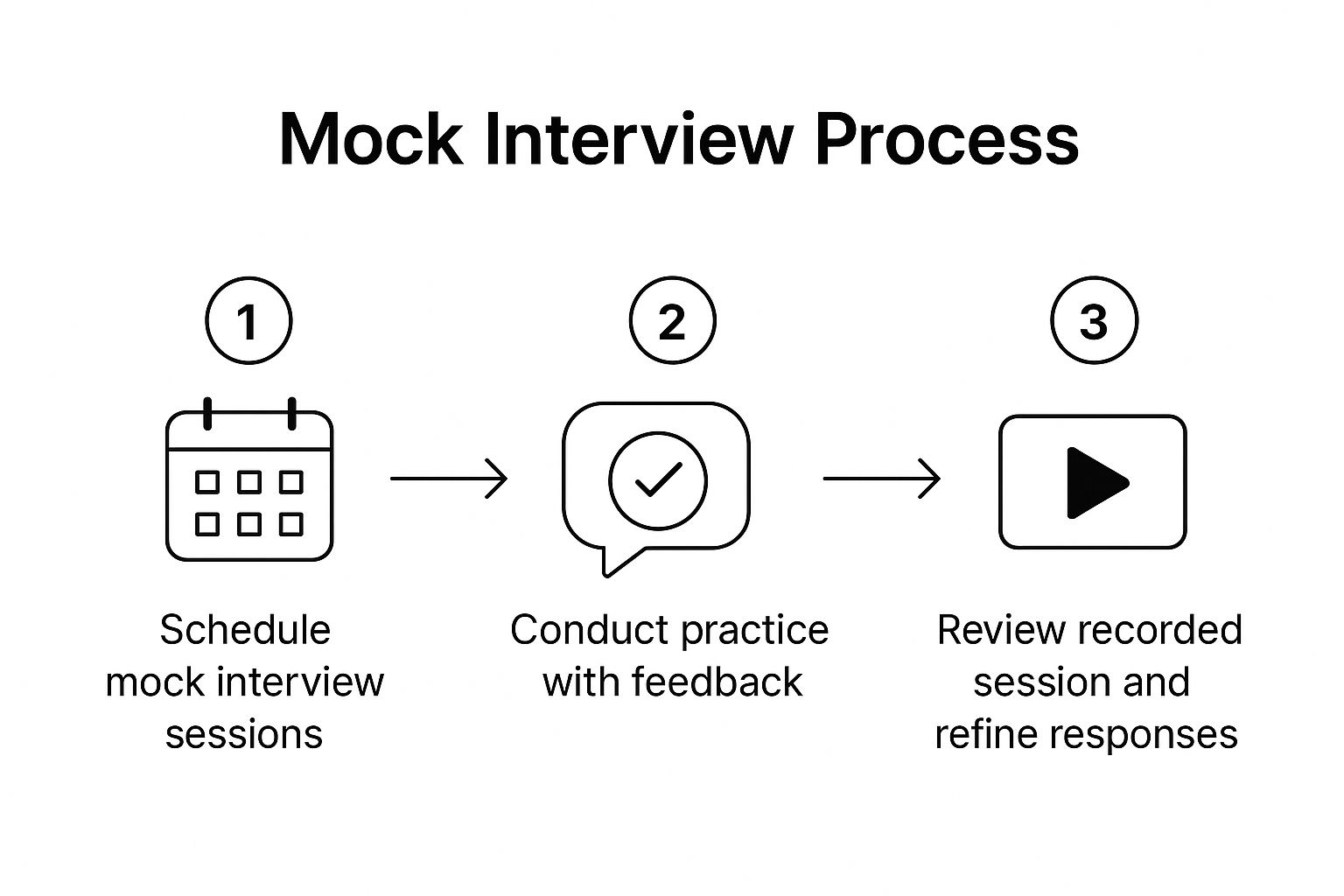
This iterative loop of scheduling, practicing, and refining ensures that each session builds upon the last, leading to measurable improvement.
Pro Tip: When seeking feedback, ask for specifics. Instead of "How did I do?", ask "Was my answer to the 'tell me about yourself' question compelling and concise? Did my explanation of the smart contract logic make sense from a non-technical perspective?" This prompts actionable advice.
7. Prepare Your References and Professional Portfolio
While your interview performance is key, tangible proof of your past successes and endorsements from trusted colleagues can be the deciding factor. Preparing your professional references and a polished portfolio transforms abstract claims into concrete evidence of your capabilities. This step is a non-negotiable part of a thorough interview preparation checklist, showcasing a level of organization and forethought that impresses hiring managers.
This preparation demonstrates that you respect your professional network and are confident in the quality of your work. It allows interviewers to easily validate your experience and visualize your potential contributions to their team.
Why It's Crucial for Web3 Roles
In a fast-moving industry like Web3, trust and verified results are paramount. A strong portfolio, whether it's a GitHub repository for a developer or a campaign analysis for a marketer, provides objective proof of your skills. Well-briefed references who can speak to your adaptability, collaborative spirit, and technical acumen add a powerful layer of social proof, which is highly valued in a community-centric ecosystem.
How to Execute Your Preparation
A strategic approach ensures both your portfolio and references are primed to support your candidacy effectively. This isn't just about listing names or projects; it's about curating a compelling narrative of your professional journey.
- Select and Brief Your References: Choose former managers, senior colleagues, or key collaborators who have witnessed your best work. Contact them in advance to ask for permission and brief them on the specific role and company. Provide them with your updated resume and the job description so they can highlight your most relevant skills and achievements.
- Curate a Targeted Portfolio: Your portfolio should be a highlight reel, not a complete archive. A software developer might showcase GitHub repos with clean code and detailed READMEs. A marketing professional could present a deck with campaign results, ROI metrics, and creative samples. Tailor the content to align directly with the requirements of the job you're pursuing.
- Organize for Accessibility: Create both digital and physical versions of your portfolio and reference list. A personal website or a dedicated link (e.g., via Linktree or a PDF on Google Drive) makes it easy to share digitally. Having a clean, printed copy of your references ready to hand over if requested shows you are prepared for any scenario.
Pro Tip: When selecting references, aim for variety. A former manager can speak to your performance and work ethic, a peer can attest to your collaboration skills, and a direct report can highlight your leadership style. This provides a 360-degree view of you as a professional.
By investing time in this area, you provide the hiring team with a seamless way to verify your qualifications, reinforcing the positive impression you made during the interview.
8. Plan Logistics and Arrive Early
While technical skills and project knowledge are paramount, neglecting the fundamentals of logistics can derail your interview before it even begins. Proper planning ensures you arrive on time, calm, and collected, allowing you to focus entirely on the conversation. This step is a non-negotiable part of any interview preparation checklist, as it demonstrates professionalism, reliability, and respect for the interviewer's time.
Failing to plan for travel can introduce unnecessary stress, making you appear flustered and unprepared. A smooth arrival sets a positive tone and provides a crucial window for last-minute mental preparation, ensuring you are at your best when you walk through the door.
Why It's Crucial for In-Person Interviews
In an era of remote work, an in-person interview carries significant weight. The company has invested time and resources to meet you face-to-face, and your punctuality is the first impression you make. Arriving late suggests poor time management, a critical flaw in any fast-paced Web3 environment where deadlines are tight and coordination is key.
How to Execute Your Logistical Plan
A thorough logistical plan accounts for every variable and has multiple contingencies. This isn't about simply knowing the address; it's about mastering the journey.
- The Reconnaissance Run: If possible, do a trial run to the interview location at the same time of day as your scheduled meeting. This helps you realistically gauge traffic patterns, identify the correct building entrance, and scope out parking options and their associated costs.
- Layered Transportation Strategy: Don't rely on a single mode of transport. If you plan to drive, have a ride-sharing app ready as a backup. If using public transit, know the schedule for the next train or bus in case you miss your intended one. Have cash on hand for unexpected costs like parking meters or tolls.
- Technology and Timing Buffers: Download offline maps and have a printed copy of the directions as a failsafe against a dead phone battery or poor signal. Plan to arrive at the building 15-20 minutes early, but only enter the office 5-10 minutes before your scheduled interview time. This buffer allows you to use the restroom, check your appearance, and mentally review your key talking points.
Pro Tip: Have the interviewer's direct phone number or the main office line saved in your phone. If an unavoidable delay occurs, a timely and professional call to inform them is far better than an unexplained late arrival.
Remember, your professionalism extends beyond the interview itself. After your meeting, a well-crafted thank-you note is essential. To ensure your post-interview communication leaves a lasting positive impression, consider these essential professional email writing tips to articulate your gratitude and reiterate your interest effectively.
Interview Preparation Checklist Comparison
| Preparation Item | Implementation Complexity 🔄 | Resource Requirements ⚡ | Expected Outcomes 📊 | Ideal Use Cases 💡 | Key Advantages ⭐ |
|---|---|---|---|---|---|
| Research the Company and Position Thoroughly | Medium to High 🔄 (2-4 hours of research) | Moderate ⚡ (Internet access, LinkedIn, reports) | High 📊 (Improves chances of advancing) | Job seekers aiming to tailor responses and demonstrate genuine company interest | Shows commitment; builds confidence; tailored answers |
| Prepare and Practice Your STAR Stories | Medium 🔄 (Significant prep & practice time) | Low to Moderate ⚡ (Time, notes, rehearsal space) | High 📊 (Improves behavioral question performance ~60-80%) | Candidates facing behavioral interviews requiring structured answers | Clear structure; shows achievements; builds confidence |
| Develop Thoughtful Questions for the Interviewer | Low to Medium 🔄 (Question preparation) | Low ⚡ (Research, note-taking) | Medium to High 📊 (Enhances interview rapport and info gathering) | Candidates wanting to impress and assess cultural & role fit | Demonstrates interest; strategic thinking; aids decision-making |
| Plan Your Interview Attire and Professional Appearance | Low 🔄 (Clothing and grooming planning) | Moderate ⚡ (Investment in clothing & grooming) | Medium 📊 (Positive first impression) | All interviewees, especially in professional industries | Enhances credibility; boosts confidence; shows attention to detail |
| Master Your Resume and Be Ready to Elaborate | Low to Medium 🔄 (1-2 hours review & practice) | Low ⚡ (Personal materials & time) | High 📊 (Smooth qualification discussions) | Candidates needing to clearly communicate experience and career narrative | Builds credibility; enables rich examples; shows growth trajectory |
| Conduct Mock Interviews and Practice Sessions | High 🔄 (Scheduling and multiple sessions) | Moderate to High ⚡ (Partners, platforms, time) | High 📊 (Reduces anxiety; improves delivery) | Candidates wanting realistic practice and feedback before real interviews | Identifies weaknesses; builds confidence; provides feedback |
| Prepare Your References and Professional Portfolio | Medium 🔄 (Organizing references and portfolio) | Moderate ⚡ (Time, portfolio materials, contacts) | Medium to High 📊 (External validation; professionalism) | Candidates with portfolios or needing strong references | Demonstrates professionalism; provides tangible proof; differentiates |
| Plan Logistics and Arrive Early | Low 🔄 (Route and timing planning) | Low ⚡ (Transport and time buffer planning) | Medium 📊 (Reduces stress; shows reliability) | All candidates aiming for punctuality and stress-free arrival | Ensures punctuality; reduces travel stress; allows mental prep |
From Checklist to Job Offer: Your Path Forward
Navigating the competitive landscape of the Web3 industry requires more than just technical expertise or a passion for decentralized technology. It demands strategy, foresight, and meticulous preparation. This comprehensive interview preparation checklist was designed not just as a list of tasks to complete, but as a strategic framework to transform you from a hopeful applicant into a standout candidate. By moving beyond generic advice, you've equipped yourself with a repeatable system for success that addresses every facet of the modern interview process, from deep-dive company research to the critical post-interview follow-up.
The journey we've covered is a testament to the idea that preparation is the ultimate career accelerator. You now have the tools to dissect a job description, align your skills with a company's mission, and articulate your value proposition with confidence and clarity. Remember, the goal is not to memorize scripts but to internalize a methodology that allows you to be authentic, agile, and impactful in any interview setting.
Key Takeaways: From Passive Applicant to Strategic Partner
Recapping the core pillars of our checklist reveals a clear path to building interview mastery. Each step is a building block, creating a solid foundation for your success.
- Strategic Research: You've learned to go beyond the homepage, diving into a company's on-chain activity, community sentiment, and competitive positioning. This level of diligence allows you to ask insightful questions and demonstrate a genuine, vested interest.
- Narrative Control: The STAR method isn't just a storytelling technique; it's a framework for proving your impact. By preparing specific, data-backed examples of your accomplishments, you replace vague claims with undeniable evidence of your capabilities.
- Proactive Engagement: Developing thoughtful questions for your interviewers fundamentally changes the dynamic. You shift from being passively evaluated to actively participating in a two-way conversation, assessing if the company is the right fit for you while showcasing your critical thinking.
- Operational Excellence: Mastering logistics, from your technical setup for a remote call to planning your commute for an in-person meeting, eliminates last-minute stress. This operational readiness ensures that your mental energy is focused entirely on communicating your value, not on trivial distractions.
Key Insight: The most successful candidates don't just answer questions well; they demonstrate that they have prepared for the entire experience. They show respect for the interviewer's time, an understanding of the company's challenges, and a clear vision for how they can contribute from day one.
Actionable Next Steps: Turning Preparation into Opportunity
Knowledge is only potential power; action is what unlocks it. As you move forward, your focus should be on implementation and refinement. Don't wait for an interview to be scheduled to begin your practice.
- Build Your Story Bank: Dedicate a document to cataloging your career wins using the STAR format. For every project or accomplishment on your resume, write a corresponding STAR story. This "story bank" will become an invaluable resource you can pull from for any interview.
- Conduct a "Low-Stakes" Mock Interview: Ask a trusted peer or mentor to conduct a mock interview with you for a role you are not intensely passionate about. This low-pressure environment is perfect for identifying weak spots in your delivery and refining your answers without the stress of a high-stakes opportunity.
- Schedule a Portfolio Review: Revisit your professional portfolio or GitHub profile with a critical eye. Ask yourself: "Does this clearly and immediately demonstrate my most relevant skills for the roles I am targeting?" Update your READMEs, polish your case studies, and ensure your best work is front and center.
This interview preparation checklist is more than a guide; it’s a commitment to your professional growth. Each item you master builds not just competence, but also the unshakable confidence needed to excel in high-pressure situations. Approaching your next Web3 interview with this level of preparation will not only increase your chances of landing the job but will also set a new standard for how you approach every professional opportunity in your career.
Now that you have the ultimate interview preparation checklist, it's time to find the opportunities where you can put it to work. Find Web3 aggregates thousands of roles across the blockchain, crypto, and NFT space, connecting prepared candidates like you with innovative companies. Stop searching and start interviewing by exploring the latest Web3 jobs on Find Web3 today.