
If you're looking to learn Solidity, it's smart to focus on where the action is: high-growth sectors like DeFi and NFTs. That's where the real career opportunities are. Getting good at Solidity means more than just learning syntax; it's about mastering the tools of the trade, like Hardhat and OpenZeppelin, to build secure and efficient applications on the blockchain.
Why Learning Solidity Is a Smart Move

Before you write a single line of code, let's talk about why adding Solidity to your skillset is such a game-changer. This isn't just about learning another programming language. It's about getting the keys to one of the fastest-moving tech sectors out there.
The explosive growth in Decentralized Finance (DeFi), Non-Fungible Tokens (NFTs), and GameFi has created a massive demand for developers who know their stuff. Startups and big companies alike are scrambling to find talent, which has created a pretty rewarding career path. This scarcity is reflected in compensation, with average US salaries sitting around $110,000 and senior developers often pulling in up to $225,000 per year.
The Ecosystem You Will Master
Learning Solidity is only half the battle. To be truly effective, you need to get comfortable with the whole ecosystem of tools that professional developers use every single day. This is about more than just writing code; it's about adopting a full workflow for building, testing, and deploying decentralized applications (dApps).
You'll quickly find a few tools are essential for making development secure and manageable:
- Hardhat and Foundry: These are the go-to development environments. They give you a local blockchain for testing, simple scripting for deployments, and a solid framework for keeping complex projects organized.
- OpenZeppelin: This is a lifesaver. It’s a library of pre-built, audited, and community-vetted smart contracts. Instead of building common things like tokens (ERC20, ERC721) or access controls from scratch, you can use these battle-tested components.
- Ethers.js: A lean and powerful JavaScript library for talking to the Ethereum blockchain. This is how you'll connect the smart contracts you write to the websites your users interact with.
The real value isn't just knowing what these tools are, but understanding how they all click together. A developer who can write a contract, test it inside and out with Hardhat, secure it with OpenZeppelin, and wire it up to a frontend with Ethers.js is a force to be reckoned with.
Unlocking a Multi-Chain Future
Solidity got its start on Ethereum, but its reach has grown far beyond a single network. The Ethereum Virtual Machine (EVM) is now the industry standard, and countless other blockchains have adopted it. This is great news for you because it means your Solidity skills are portable.
Once you know Solidity, you can build on a whole host of EVM-compatible chains. For a real-world example, just look at Kyve's integration with Moonbeam and Moonriver, which are EVM-compatible parachains on the Polkadot network.
This multi-chain world opens up opportunities to build for diverse ecosystems like Avalanche, Polygon, and Binance Smart Chain. If you want to see the numbers behind this expansion, check out these essential Web3 statistics that show the growth across these different platforms. The bottom line is that the time you invest to learn Solidity now sets you up for a decentralized future that's much bigger than any one blockchain.
Building Your Local Development Environment
It's time to graduate from browser-based editors. If you're serious about building real-world projects, setting up a proper local environment is the single most important step you can take. This is your personal workshop—a place where you have complete control to write, test, and deploy smart contracts efficiently.
The bedrock of any modern development setup, whether for web or blockchain, starts with a couple of essential tools. First, you'll need Node.js, which is the JavaScript runtime that powers almost everything in this space. Next, grab a good code editor. Visual Studio Code (VS Code) is the undisputed king here, loved for its speed and massive library of helpful extensions.
Choosing Your Solidity Framework
With the basics installed, you face your first big decision: picking a development framework. This isn't just about choosing a tool; it's about choosing a workflow. A framework gives you an entire structure for compiling, testing, and deploying your contracts. It's the difference between trying to build furniture with a rusty handsaw versus having a fully equipped, modern workshop.
The three main players you'll hear about constantly are Hardhat, Truffle, and Foundry. Each comes with its own philosophy and strengths, and your choice will directly shape your day-to-day experience as a developer.
- Hardhat: The current heavyweight champion. It's built on JavaScript/TypeScript and is celebrated for its incredible flexibility, a fantastic local testing network, and a huge ecosystem of plugins for just about any task.
- Truffle: One of the originals. Truffle is also JavaScript-based and has been around for a long time, so it's mature and well-documented. While it has lost some ground to newer tools, it's still a solid option.
- Foundry: The fast-rising star. This Rust-based toolkit is gaining a ton of traction, primarily because it lets you write your tests in Solidity. For many developers, keeping everything in one language just clicks.
This chart paints a clear picture of the current landscape.
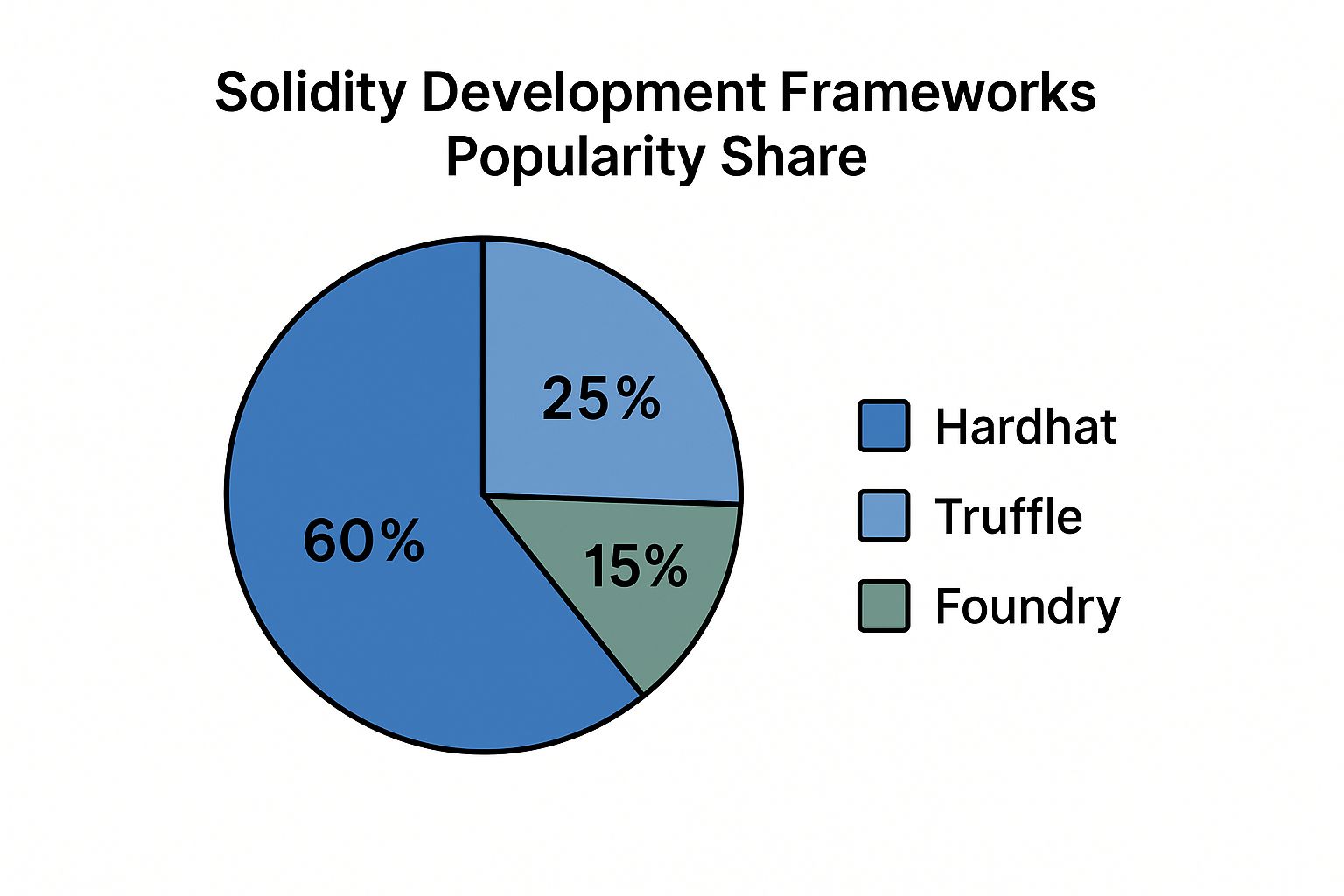
As you can see, Hardhat's dominance at 60% makes it a very safe and reliable bet, especially when you're just starting to learn the Solidity language.
Comparing Top Solidity Development Frameworks
Let's break down the key differences between these frameworks. Choosing the right one often comes down to your background and what feels most intuitive to you.
| Feature | Hardhat | Truffle | Foundry |
|---|---|---|---|
| Primary Language | JavaScript / TypeScript | JavaScript | Solidity / Rust |
| Testing Approach | Tests written in JavaScript | Tests written in JavaScript | Tests written in Solidity |
| Ecosystem | Massive plugin ecosystem | Mature, but less active | Growing rapidly, but smaller |
| Performance | Generally fast | Can be slower for large projects | Extremely fast (built in Rust) |
If you come from a web development background, Hardhat will feel like slipping on a comfortable pair of shoes; the JavaScript-based workflow is familiar. But if the idea of writing your tests in the same language as your smart contracts sounds appealing, you should absolutely give Foundry a look. It can really simplify your mental model.
My Advice for Beginners: Start with Hardhat. Its massive community means you'll find a tutorial, forum post, or Stack Overflow answer for almost any problem you run into. Once you've got the hang of the compile-test-deploy cycle, then try building a small project in Foundry. Seeing a different workflow will make you a much more well-rounded developer.
No matter which you pick, getting started is simple. For Hardhat, you just use npm (the package manager that comes with Node.js) to install it. From there, a single command scaffolds a sample project with all the configuration files you need. Just like that, you have a complete environment ready to compile and test contracts on a local blockchain.
Understanding Core Solidity Concepts

Alright, with your development environment set up and ready to go, it's time to get into the good stuff: learning the Solidity language itself. The best way to think about a smart contract is as a small, self-governing program that lives forever on the blockchain. Like any other program, it needs a way to store information, run logic, and interact with users. Solidity is the toolkit for doing all of that within the unique, constrained world of the blockchain.
At its heart, Solidity is a statically-typed, contract-oriented language. The "statically-typed" part is important—it means you have to declare the type of every variable before you use it. This catches a whole category of potential bugs before your code is ever deployed. It’s no surprise that as of 2025, an estimated 65% of all smart contracts are written in Solidity, making it the undeniable king of the hill for blockchain developers.
Designed by Gavin Wood back in 2014, its syntax borrows heavily from C++ and JavaScript, so it might feel a bit familiar if you've worked with those. It was built from the ground up to create secure, reliable smart contracts on Ethereum. For more stats on language popularity and other interesting contract data, the folks at Metana.io have some great insights.
The Building Blocks: Variables and Data Types
Everything a smart contract does revolves around its "state"—the data it permanently stores on the blockchain. This information is held in what we call state variables. The key difference here, compared to a regular web app, is that these variables aren't tucked away on a private server; they're public and written into the immutable ledger of the blockchain.
Solidity gives you a few fundamental data types that you'll be using constantly:
uint: This is short for "unsigned integer," and it’s your go-to for any non-negative whole numbers. You'll almost always seeuint256, which is a 256-bit integer perfect for things like token balances or simple counters.address: This special type holds a 20-byte Ethereum address. It’s how your contract knows about user wallets or even other contracts. A variation,address payable, is used for addresses that are allowed to receive Ether.bool: A straightforwardtrueorfalsevalue. You’ll use these all the time for feature flags, checking conditions, or tracking states.string: Used for text data. A word of caution: strings can be surprisingly expensive to store and manipulate on-chain, so use them wisely.mapping: This is an incredibly useful key-value store, much like a hash map or dictionary from other languages. A classic example ismapping(address => uint), which could map a user's wallet address to their token balance.
Getting a firm grasp of these types is non-negotiable. If you run into other blockchain-specific terms, our extensive Web3 dictionary is a fantastic resource to keep open in another tab.
Controlling Access with Visibility Specifiers
You wouldn't want just anyone to be able to access all the functions or data in your contract. That’s where visibility specifiers come into play. They are absolutely critical for writing secure, well-designed contracts.
Think of them as permission levels for different parts of your code:
public: Anyone can access this—other contracts, user wallets, you name it. It's wide open.private: The complete opposite. Private functions and variables can only be accessed from inside the contract where they are defined. Not even child contracts can see them.internal: This is likeprivate, but with one key exception: contracts that inherit from the base contract can also access these functions and variables.external: These functions are designed to be called only from outside the contract. You can't call them from another function within the same contract. This can sometimes lead to gas savings.
Choosing the right visibility is a security-first decision. Your default mindset should be to make everything
privateorinternalunless it absolutely needs to be exposed to the outside world. This principle of least privilege is a cornerstone of secure smart contract development.
Bringing Contracts to Life with Functions, Modifiers, and Events
If variables are the nouns of Solidity, then functions are the verbs. They are the blocks of code that actually do things—transfer tokens, update a user's profile, or cast a vote in a DAO. Functions are what change the contract's state.
To make our functions cleaner and more reusable, Solidity gives us modifiers. A modifier is essentially a wrapper around a function that can run some checks before or after the function's code executes. They are most often used to handle access control, like ensuring only the contract owner can call a certain function.
// SPDX-License-Identifier: MIT
pragma solidity ^0.8.20;
contract SimpleAuction {
address public owner;
bool public auctionEnded;
constructor() {
    owner = msg.sender;
}
// This modifier checks if the caller is the contract owner
modifier onlyOwner() {
    require(msg.sender == owner, "You are not the owner.");
    _; // This special symbol means "run the function body"
}
// This function can only be called by the owner
function endAuction() public onlyOwner {
    auctionEnded = true;
}
}
Last but not least, we have events. Transactions that change the blockchain's state don't really return values in the way you might expect. So how does your frontend application know something happened? Events. An event is a signal the contract emits to the outside world, like a broadcast saying, "Hey, a token was just transferred!" or "The auction is officially over!" Your dApp can listen for these events and update the user interface in real time, which is essential for building a responsive experience.
Building and Deploying Your First Smart Contract

Alright, this is where the rubber meets the road. We've talked a lot about theory, but now it's time to take those concepts and build something real. We're going to code a simple but fully functional smart contract—a basic voting dApp.
The goal here isn't just to copy and paste code. I want to walk you through the entire lifecycle of a smart contract: thinking through the logic, writing the code, testing it until it’s bulletproof, and finally deploying it to a local blockchain. Let’s get our hands dirty.
Designing Our Voting Contract
Before a single line of Solidity is written, we need a plan. A great smart contract starts with a clear design. So, what does a simple voting contract actually need to do?
- It has to maintain a list of candidates.
- It needs to keep a running tally of votes for each candidate.
- It must allow someone to vote, but only let them vote once.
- We need a way to see the final results.
This simple breakdown gives us a clear path. We’ll need state variables to store the data, functions to manage the voting process, and a mechanism—like a mapping—to prevent people from voting multiple times.
Writing the Smart Contract Code
Now, let's turn that design into Solidity. We'll be using Hardhat for this project. It's become the industry standard for a reason; in fact, 51.1% of developers in a recent survey named it their go-to tool.
First up are the state variables. We'll define a struct to hold candidate information and an array to store all our candidates. We'll also set up that mapping I mentioned to track voter addresses.
// SPDX-License-Identifier: MIT
pragma solidity ^0.8.20;
contract SimpleVoting {
struct Candidate {
string name;
uint voteCount;
}
Candidate[] public candidates;
mapping(address => bool) public hasVoted;
constructor(string[] memory _candidateNames) {
    for (uint i = 0; i < _candidateNames.length; i++) {
        candidates.push(Candidate({
            name: _candidateNames[i],
            voteCount: 0
        }));
    }
}
}
With the data structure in place, we can add the core voting logic. This function will accept a candidate's index, verify the sender hasn't already voted, and then add one to the vote count.
function vote(uint _candidateIndex) public {
// Check if the address has already voted
require(!hasVoted[msg.sender], "You have already voted.");
// Check for a valid candidate index
require(_candidateIndex < candidates.length, "Invalid candidate.");
    candidates[_candidateIndex].voteCount++;
    hasVoted[msg.sender] = true;
}
And just like that, we have a working contract. It initializes with candidates, counts votes, and prevents basic cheating.
Compiling and Testing Your Contract
Writing the code is only half the battle. If you truly want to learn the Solidity language, you have to live and breathe testing. Bugs in smart contracts are not just inconvenient; they can be financially catastrophic.
Once your contract file is saved, you can compile it right from the terminal with npx hardhat compile. This simple command checks your code for errors and turns it into bytecode for the Ethereum Virtual Machine (EVM) to execute.
Next comes the crucial part: writing tests. A great starting point is to verify that the contract initializes correctly. You can write a quick JavaScript test to deploy the contract and confirm the candidate names were set as expected.
Testing isn't just about finding bugs; it’s about proving your code does what you claim it does. A well-tested contract is a trustworthy contract. This mindset is what separates hobbyists from professional blockchain developers.
Another essential test involves simulating the vote itself. Write a test that calls the vote function and then asserts that the correct candidate's voteCount went up by one. You also need to test your failure conditions—make sure the require statements properly block someone from voting twice or for a candidate that doesn't exist.
Deploying to a Local Network
Once your tests are all green, it's time for deployment. Hardhat includes a local Ethereum network that’s perfect for this. It simulates the real network without you having to spend any actual ETH on gas fees.
To deploy, we’ll need a simple script that tells Hardhat to take our compiled bytecode and put it on the blockchain. It looks something like this:
async function main() {
const [deployer] = await ethers.getSigners();
console.log("Deploying contracts with the account:", deployer.address);
const Voting = await ethers.getContractFactory("SimpleVoting");
// Pass candidate names to the constructor
const votingContract = await Voting.deploy(["Alice", "Bob", "Charlie"]);
console.log("Contract deployed to address:", votingContract.address);
}
main()
.then(() => process.exit(0))
.catch((error) => {
console.error(error);
process.exit(1);
});
Run this script using npx hardhat run scripts/deploy.js --network localhost, and your smart contract will be live on your local network. You've officially completed the entire development workflow—from a simple idea to a running blockchain application. Congratulations
Writing Secure and Efficient Smart Contracts
https://www.youtube.com/embed/pUWmJ86X_do
Getting a smart contract to simply work is one thing. Making it secure and efficient is a completely different ballgame. In the world of blockchain, a sloppy piece of code isn't just a bug—it's a potential multi-million dollar vulnerability waiting to be exploited. This is the point where you move past hobbyist-level coding and start thinking like a professional.
This shift requires a new mindset. You have to become defensively-minded, questioning every single line of code for potential security holes and unnecessary costs. It's here that you truly begin to master Solidity, understanding the quirks and risks that make it so unique.
Mastering Gas Optimization
Think of gas as the fuel that powers the Ethereum network. Every single operation, from a basic token transfer to a complex financial transaction, has a cost. If your contract is a gas-guzzler, users will simply go elsewhere. Lean, efficient code isn't just a "nice-to-have"; it's a critical competitive advantage.
So, where do you start trimming the fat? A few core habits can make a world of difference:
- Be Stingy with Storage: Writing data to the blockchain (i.e., changing state) is by far the most expensive thing you can do. If you can calculate a value on the fly without storing it, do it. Avoid writing to state unless it's absolutely necessary.
- Choose the Right Data Types: This is a classic trick of the trade. Solidity can often pack smaller data types into a single 256-bit storage slot. For instance, using two adjacent
uint128variables instead of twouint256s can literally cut your storage cost for those variables in half. - Watch Your Loops: Unbounded loops are a ticking time bomb for gas fees. A loop that runs over an array that can grow indefinitely is a recipe for disaster. One day a user might add too many elements, and suddenly every transaction that calls that function fails because it runs out of gas.
These practices might seem small, but they add up fast. Meticulous gas management is one of the clearest signs of a seasoned Solidity developer.
Defending Against Common Attacks
Security is everything. The blockchain is unforgiving—once a vulnerable contract is deployed, there’s often no going back without a messy and dangerous migration. Knowing what you're up against is the first step to building strong defenses.
The most infamous vulnerability is the reentrancy attack. This is where a malicious contract calls back into your function before the first call has finished, letting it repeatedly withdraw funds until your contract is drained dry.
The gold standard for preventing reentrancy is the Checks-Effects-Interactions pattern. The order is crucial: First, perform all your checks (e.g.,
require(balance >= amount)). Second, apply the effects by updating your internal state (e.g.,balance -= amount). Only then, as the very last step, do you interact with the external contract (e.g., send the Ether).
Another classic blunder to avoid is integer overflow and underflow. This happens when a calculation goes above the maximum or below the minimum value for a data type, causing it to "wrap around" with disastrous results. Thankfully, Solidity version 0.8.0 and newer have built-in protection against this, but you absolutely must understand the concept, especially if you ever work on older codebases.
Leveraging Battle-Tested Tools
The good news is you don't have to face these challenges alone. The developer community has built some incredible tools and libraries to help you write safer, more reliable code.
- OpenZeppelin Contracts: This is the industry-standard library of audited, secure, and community-trusted smart contracts. It covers everything from basic ERC20 tokens and ERC721 NFTs to complex access control. Never roll your own crypto; always use a trusted library like this.
- Slither & Mythril: These are static analysis tools that act like a spell-checker for security vulnerabilities. They automatically scan your code and flag common issues. Making these tools a regular part of your development process will save you from countless headaches.
Solidity was designed specifically for the Ethereum Virtual Machine, which allows for deep code verification. The language's focus on static typing and its ability to support formal verification are essential for securing the DeFi and NFT platforms that collectively manage billions of dollars in assets.
To really level up your skills and build truly sophisticated applications, you'll eventually want to dive into advanced smart contract programming techniques. Mastering these core principles of security and efficiency is what separates the beginners from the pros who build applications that are not only powerful but also safe enough for people to trust with their money.
Common Questions About Learning Solidity
As you start digging into Solidity, you're bound to have questions. It’s a whole new paradigm. Over the years, I've noticed the same handful of queries pop up from almost every new developer. Let's tackle them head-on so you can move forward with a clear path.
Do I Need Programming Experience First?
This is a big one. While you can technically start from zero, having some prior coding experience—especially with a C-style language like JavaScript or C++—gives you a massive leg up.
If you’ve coded before, you’ll recognize familiar patterns like loops and functions. This lets you skip the basics and focus your brainpower on the truly unique parts of blockchain development, like understanding gas, the EVM, and managing state on-chain.
If you are coming in completely fresh, my advice is to spend a little time learning basic JavaScript first. It’s a smart move because you’ll need it anyway to build the dApp frontends that interact with your smart contracts. You end up killing two birds with one stone.
What Is the Best Way to Practice Solidity?
Tutorials are great, but the real learning happens when you start building. The single most effective way to get good at Solidity is to build real things.
- Start Small: Don't try to build the next Uniswap on day one. Create a simple ERC20 token or a "time-lock" contract that only releases Ether after a specific date. These small wins build momentum.
- Level Up: Once you have the basics down, find interactive platforms that push you. CryptoZombies is fantastic for drilling fundamentals in a gamified way.
- Think Like a Hacker: To truly understand security, you need to know how things break. Work through the challenges on Ethernaut. It’s designed to teach you how to spot and exploit vulnerabilities—an absolutely critical skill.
Here's a pro tip: Find a popular DeFi protocol you admire and try to recreate a stripped-down version of it. You'll learn an incredible amount about real-world contract architecture and design patterns.
How Long Does It Take to Become Proficient?
Ah, the million-dollar question. The honest answer is it completely depends on your background and how much time you dedicate. There's no magic number.
For a developer with some prior experience who can commit a consistent 10-15 hours per week, you can probably grasp the core concepts and build simple, functional contracts in about 2-3 months.
However, getting to a professional, job-ready level is a much longer road. We're talking about the ability to design, build, and secure complex, optimized applications. That kind of proficiency often takes 6-12 months of focused, hands-on building. Don't rush it. Consistency beats cramming every single time. The demand for true experts is high, and a quick look at the latest blockchain jobs shows that companies are seeking people with solid, proven skills.
What Are the Most Important Tools to Master?
Writing Solidity code is just one piece of the puzzle. An effective smart contract developer is a master of their toolchain. Your entire workflow will revolve around a few key pieces of software, so get comfortable with them early.
Here are my non-negotiable recommendations:
- A Development Framework: Hardhat is the industry standard for a reason. It handles compiling, testing, and deploying your code and just makes life easier.
- Testing Libraries: Learn a library like Chai for writing your tests. This is not optional for any serious project.
- A Frontend Library: Ethers.js is the go-to for connecting your smart contracts to a website and creating a real user interface.
- Contract Libraries: Don't reinvent the wheel. Get deeply familiar with OpenZeppelin's library of audited, secure, and battle-tested contracts for things like tokens and access control.
At Find Web3, we connect talented developers with leading companies in the blockchain space. Start exploring your next career move at https://findweb3.com and find the perfect role to put your new Solidity skills to work.