
Let's be clear: working in blockchain isn't some niche hobby for crypto fanatics anymore. It's a full-blown professional field, with serious roles spanning finance, tech, and even the creative arts. If you're looking for a career with massive growth potential and a chance to actually build the next version of the internet, this is one of the most exciting places to be right now.
Understanding the New Frontier of Blockchain Careers
Try to forget the wild price charts and speculative frenzy you see in the news. At its heart, blockchain technology is a fundamental change, much like how the internet rewired society back in the 90s. It’s creating a new digital foundation—one that’s more transparent, secure, and user-owned. Just as the early internet needed web developers, designers, and marketers, Web3 is building its own bustling ecosystem of professionals that goes way beyond just coding.
This guide is your roadmap. The demand for skilled people is absolutely exploding, and that creates a golden opportunity for anyone ready to dive in and learn. We're going to cut through the buzzwords and get straight to what it actually takes to build a career in this space.
It's Not Just About Developers
While engineers are the architects of this new world, the ecosystem is growing up fast. To build, market, and manage these new decentralized projects, companies need a whole spectrum of talent. This is great news because it means the doors are wide open for people from all sorts of professional backgrounds.
Here’s where we’re seeing a ton of growth:
- Strategic Roles: Think product managers who can map out the vision for a decentralized app (dApp) or tokenomics experts who design the economic engine that makes a project sustainable.
- Creative Roles: Community managers are the lifeblood, building devoted user bases. Content creators are needed to translate complex ideas into simple terms, and UX/UI designers are critical for making Web3 platforms something a normal person can actually use.
- Operational Roles: This space needs legal minds who understand digital assets, compliance officers to navigate the changing rules, and finance pros to manage the treasuries of DAOs (Decentralized Autonomous Organizations).
To give you a clearer picture, let's break down these categories.
At-a-Glance Guide to Web3 Job Categories
This table summarizes the main career paths in the blockchain and Web3 world. Use it to quickly see where your skills and interests might fit in.
| Job Category | Primary Focus | Example Roles |
|---|---|---|
| Technical & Development | Building and maintaining the core infrastructure and applications of Web3. | Blockchain Developer, Smart Contract Engineer, Protocol Engineer, Full-Stack Developer |
| Product & Strategy | Defining the vision, user experience, and economic models for Web3 projects. | Product Manager, Tokenomics Expert, Ecosystem Manager, Head of Strategy |
| Community & Marketing | Growing and engaging user bases, and communicating a project's value. | Community Manager, Head of Growth, Content Creator, Social Media Manager, Marketing Lead |
| Design & User Experience | Making decentralized applications intuitive, accessible, and visually appealing. | UX/UI Designer, Product Designer, Brand Designer, User Researcher |
| Operations & Finance | Managing the business, legal, and financial aspects of a Web3 organization. | Operations Manager, Legal Counsel, Compliance Officer, DAO Treasurer, Financial Analyst |
| Data & Analytics | Interpreting on-chain and off-chain data to drive strategic decisions. | Data Scientist, On-Chain Analyst, Business Intelligence Analyst, Research Analyst |
As you can see, the industry requires a diverse mix of talent to succeed, from the people writing the code to those building the community around it.
A Rapidly Expanding Job Market
This isn't just a feeling; the numbers back it up. The global crypto industry now has around 1.6 million professionals, and that figure comes after a 47% year-over-year jump in job openings. This boom is fueled by blockchain technology making its way into everything from finance to supply chain logistics. In fact, the demand for blockchain developers alone is expected to climb by another 22%. You can dig deeper into these figures in the latest crypto industry employment statistics.
This isn't a flash in the pan. We're watching the foundation of a new professional world being laid. Companies are shifting from just playing around with the tech to building real, large-scale products, which creates a long-term need for people who get it.
Ultimately, a career in blockchain is more than just a paycheck. It's a chance to be on the front lines of innovation, work on fascinating problems, and help shape a more open and decentralized internet. Whether your talent lies in code, communication, or strategy, there’s a good chance there’s a spot for you on this new frontier.
Mapping the Most In-Demand Blockchain Roles
Diving into the world of blockchain careers can feel overwhelming at first. The job titles sound foreign, and it’s tough to figure out where your own skills might fit into this new landscape. But here’s the secret: most Web3 jobs are simply the next evolution of roles you already know, just retooled for a decentralized world.
The trick is to stop focusing on specific, jargon-heavy titles and instead think in broader categories. Ask yourself what you fundamentally do best. Are you a builder who loves crafting technology? A strategist who sees the bigger picture? Or a communicator who can rally a community? Answering that question is your first real step to finding your niche.
This simple breakdown shows how nearly every job in Web3 fits into one of three buckets: technical, strategic, or creative.
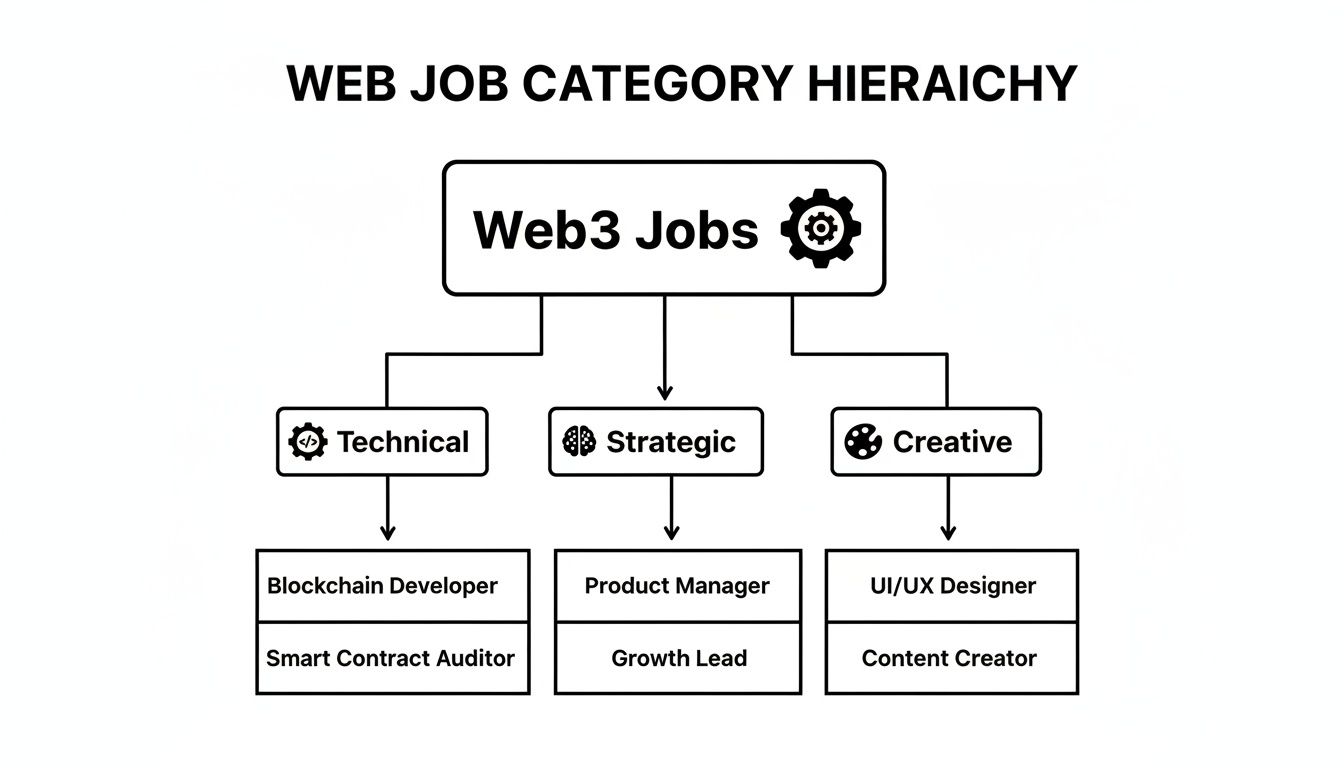
As you can see, you don't have to be a hardcore coder to make a huge impact. This ecosystem is just as dependent on sharp strategic minds and authentic communicators as it is on brilliant engineers.
The Technical Architects
This is the category most people think of first—the builders who are literally writing the code that makes Web3 tick. These roles are the bedrock of the industry, responsible for creating the secure, transparent, and automated systems that define blockchain. They’re the digital engineers and construction crews of this new frontier.
Blockchain Engineer: Think of this person as the civil engineer of a new digital nation. They don't just build a single application; they design and construct the foundational blockchain protocol itself. Their work involves deep-level tasks like developing consensus algorithms (the rules for how the network agrees on truth) and maintaining the core infrastructure. It’s a demanding role that often requires expertise in languages like Rust or C++.
Smart Contract Developer: If the Blockchain Engineer builds the highway, the Smart Contract Developer builds the automated systems that run on it. They write the self-executing code—the "smart contracts"—that automate everything from simple token swaps to the intricate logic of a DeFi lending platform. Their go-to language is typically Solidity, which is the standard for the Ethereum Virtual Machine (EVM).
A Quick Analogy: A Blockchain Engineer builds the entire highway system—the roads, bridges, and traffic laws. A Smart Contract Developer then creates the automated toll booths and smart traffic lights that operate on top of that highway.
The Strategic Visionaries
Let's be real: technology alone doesn't guarantee success. You need people who can answer the "why," understand the user, and map out a sustainable path forward. That's where the strategic visionaries come in, bridging the gap between brilliant code and real-world value.
Web3 Product Manager
A Web3 Product Manager (PM) guides the 'why' and 'what' behind a product, much like in traditional tech. But their world is far more complex. They aren't just thinking about user clicks and conversion rates; they're designing entire economies. This means they have to be experts in tokenomics—the economic incentives hardwired into a project's token—and community governance.
A Web3 PM is constantly asking questions like:
- How do we make this dApp feel intuitive for someone who’s never used a crypto wallet?
- What token rewards will actually encourage people to contribute to the network's health?
- How will we transition decision-making power to the community as we decentralize?
They are master coordinators, making sure the engineering, marketing, and community teams are all pulling in the same direction. It’s a unique role that demands a blend of technical fluency, business savvy, and a gut-level understanding of decentralized communities.
The Community Builders and Communicators
In Web3, your community isn't just a bunch of customers. They're often co-owners, evangelists, and an essential part of the product itself. A project with a dead community is a dead project, period. That makes the people who build and nurture that community absolutely indispensable.
Crypto Marketing Specialist
Marketing in Web3 throws the traditional playbook out the window. Forget about running splashy ad campaigns. A great Crypto Marketing Specialist knows how to start a movement from the ground up. Their work is all about authentic storytelling, sparking conversations on platforms like X (Twitter) and Discord, and creating content that actually educates people. It's about earning trust, not buying attention.
Community Manager
This role is the absolute heart and soul of any Web3 project. A Community Manager is the first person users talk to, the moderator of the Discord server, and the community's staunchest advocate within the core team. They foster a welcoming and vibrant environment where newcomers feel supported and regulars feel valued. An amazing Community Manager can turn passive users into passionate contributors, and that’s a kind of magic you can’t put a price on.
The best way to see these roles in action is to see what companies are actually hiring for. Take a look at the wide array of blockchain job listings to get a feel for the real-world demand for talent across all of these categories.
Getting the Right Skills for Your Web3 Journey
If you want to break into one of the many exciting blockchain careers, you’ll need more than just technical chops. It's a world that demands a specific mix of hard skills and a decentralized mindset. It's not just about what you can build; it's about how you think and work within a community-driven ecosystem.
Think of it this way: your hard skills are the concrete, measurable abilities that get you in the door for an interview. These are the programming languages and security protocols you need to build, audit, and manage Web3 projects. Your soft skills, on the other hand, define how you operate within a culture that prizes transparency, collaboration, and constant change.
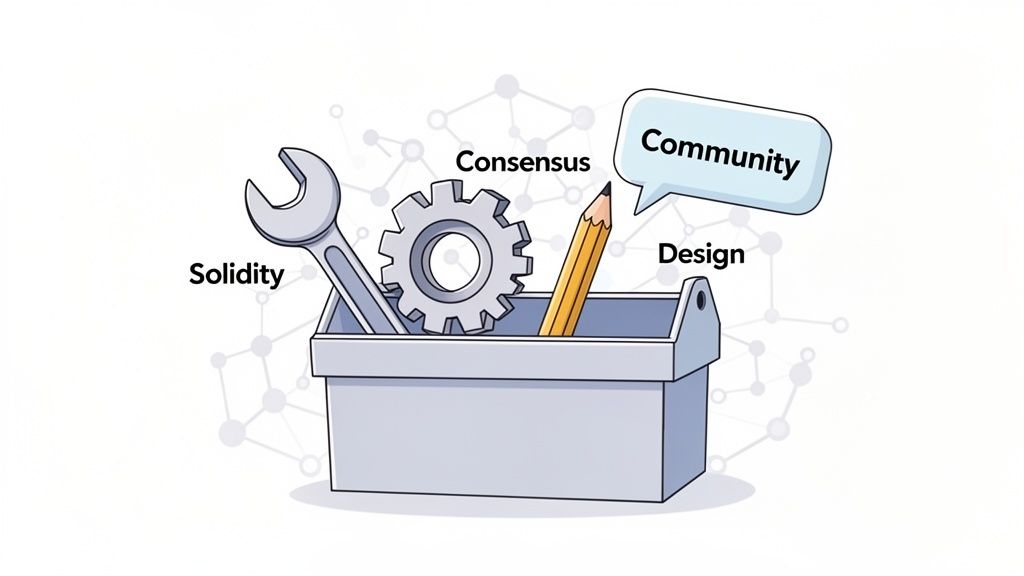
It's like building a house. The code, platforms, and security principles are your power tools and raw materials—those are the hard skills. But the architectural vision, your ability to work with a global crew, and the problem-solving needed to bring it all to life? Those are the soft skills. You absolutely need both.
Mastering the Technical Hard Skills
For anyone looking to become a developer, a few core technologies are the bedrock of almost every Web3 application. You'll be working with these day in and day out.
Solidity: This is the big one. It's the go-to programming language for writing smart contracts on Ethereum and other compatible blockchains. For a smart contract developer, knowing Solidity isn't optional.
JavaScript/TypeScript: While the smart contract logic lives on the blockchain, people need a way to interact with it. That's where front-end development comes in, making these languages critical for building the user-facing side of dApps.
Blockchain Fundamentals: You have to understand the engine under the hood. This means getting comfortable with core concepts like consensus mechanisms (think Proof-of-Work vs. Proof-of-Stake), the basics of cryptography, and how blocks are actually structured. You can dive deeper into these terms in our comprehensive https://findweb3.com/posts/web3-dictionary.
Development Frameworks: Writing code is one thing, but deploying it safely and efficiently is another. Tools like Hardhat and Foundry are indispensable for testing, compiling, and launching smart contracts.
Given how quickly things change, it's also worth looking into how micro-credentialing to boost your career can help you pick up specialized skills that employers are actively looking for.
Cultivating Essential Soft Skills
Technical ability gets your foot in the door, but the people who truly succeed in Web3 are the ones who master the skills you can't learn in a coding bootcamp. The culture here is just different, and to thrive, you need to adopt a new way of working.
In Web3, your ability to communicate asynchronously, build trust in a trustless environment, and adapt to constant change is just as valuable as your ability to write clean code. Projects are often community-led and globally distributed, making these skills a necessity, not a luxury.
This is a key point. A fantastic developer who can't communicate clearly in a public Discord channel will hit a wall. So will a brilliant strategist who doesn't quite grasp the core ideas of decentralization.
Top Soft Skills for a Web3 Career
Here are the interpersonal skills that will really make you stand out from the crowd:
Decentralized Thinking: This is all about learning to see the world in terms of systems that don't have a central boss. It's about designing incentives that get a community involved and building products that can’t be shut down by a single point of failure.
Community-First Mindset: The best Web3 projects are built with their communities, not just for them. That means you need empathy, you need to be a great listener, and you have to genuinely want to engage with people on platforms like Discord and X (formerly Twitter).
Adaptability and Continuous Learning: The tech in this space moves at a breakneck speed. A new Layer-2 or a game-changing DeFi protocol can pop up overnight. Your most valuable skill will be a real passion for learning and the humility to accept you'll never know it all.
Asynchronous Communication: Teams are often remote and scattered across every time zone imaginable. This makes clear, concise writing an absolute superpower. If you can articulate a complex idea in a pull request, a short blog post, or a Discord message, you're ahead of the game.
Ultimately, getting ready for a Web3 career is a two-track process. You have to put in the time to learn the tech, but you also need to immerse yourself in the culture to develop the right mindset. Nail both, and you’ll be a well-rounded candidate who can make a real impact.
Crafting a Portfolio That Gets You Noticed
When you're trying to land a job in the blockchain world, your resume is often the second thing a recruiter looks at. The first? Your portfolio. In a space built on the principle of "don't trust, verify," a solid portfolio is the ultimate proof of what you can do. It speaks volumes more than any cover letter or degree ever could.
Think of it as your living resume—a showcase of what you can actually build and contribute. A traditional resume is just a list of ingredients, but your portfolio is the fully cooked, delicious meal. It proves to employers that you not only have the raw skills but can also combine them to create something real and valuable. This is absolutely critical in an industry where practical application is everything.
Go Beyond the Code Repository
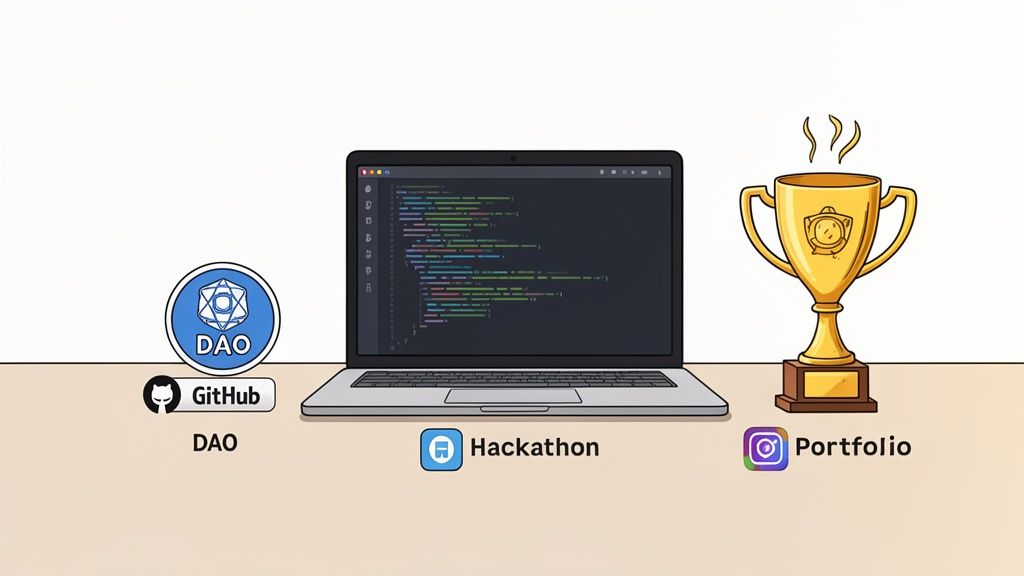
A top-tier Web3 portfolio is much more than a collection of code sitting on GitHub. It needs to be a well-rounded presentation of your deep engagement with the entire decentralized ecosystem. Recruiters are looking for signs that you live and breathe this stuff, not just punch a clock.
For example, contributing to open-source projects or a Decentralized Autonomous Organization (DAO) sends an incredibly powerful signal. Fixing a small bug in a well-known protocol or helping a DAO manage its treasury demonstrates initiative, a collaborative spirit, and a genuine commitment to the industry's core values.
Jumping into hackathons is another fantastic way to beef up your portfolio. These events force you to build something functional under pressure, proving you can innovate, work with a team, and actually ship a product. A project you build over a single weekend hackathon can often be more impressive than a personal project that dragged on for months.
Actionable Steps to Build a Standout Portfolio
Ready to get started? Remember, it's about quality over quantity. Two polished, well-documented projects will always beat ten half-finished experiments.
- Polish Your GitHub Profile: Your GitHub is your professional landing page. Write a clear bio, pin your best repositories, and—most importantly—create detailed
README.mdfiles for each project. Explain what it does, the tech you used, and how someone else can run it. - Show Your Work in Public: Don't just build things in a vacuum. Share what you're doing! Write a blog post on a platform like Medium or Dev.to about a tough concept you figured out. Record a quick video walkthrough. This demonstrates communication skills, which are a massive asset.
- Contribute to a DAO: Find a DAO that aligns with your interests and start hanging out in their Discord. Many have bounties for small tasks—marketing, content, or tech support—that offer a perfect way to get your foot in the door.
- Build a Personal Brand on X (Twitter): For better or worse, X is the town square for Web3. Follow key people, jump into thoughtful discussions, and share what you’re learning. It’s an amazing way to build your network and become visible to hiring managers.
Your portfolio isn't just a gallery of past work; it's a forward-looking statement about your potential. It should tell a story of continuous learning, active participation, and a deep-seated passion for building the future of the internet.
Future-Proofing Your Career Portfolio
The demand for talent in this space is changing fast. The global blockchain-as-a-service market is projected to skyrocket from $3.25 billion to a staggering $199.15 billion by 2033, which is fueling a huge need for hybrid, cross-functional professionals.
This means your portfolio needs to show more than just one niche skill. By highlighting your GitHub activity, DAO contributions, and strategic thinking on social platforms, you create a well-rounded professional identity that truly stands out. To dig deeper into this, you can check out some detailed insights on emerging job market trends. This approach will ensure you're not just another name in the competitive pile of block chain careers.
Understanding Web3 Salaries and Remote Work Culture
If you're exploring a career in blockchain, two things probably stand out: the money and the lifestyle. The Web3 world isn't just known for its forward-thinking tech; it’s also changing the game when it comes to how and where we work. Getting a real sense of these trends is crucial for figuring out if this industry aligns with what you want for your life and your bank account.
Let's be blunt: Web3 salaries are competitive. In many cases, they blow comparable roles in traditional tech (Web2) out of the water. It all comes down to basic economics—there's a massive demand for people with these niche skills, but the talent pool is still relatively small. That scarcity puts a premium on qualified professionals, and companies are willing to pay up to get them.
This creates a pretty great situation for job seekers. Even junior-level positions can pull in impressive starting salaries. And if you're an experienced developer, product manager, or marketer? You could be looking at some of the highest paychecks in the entire tech industry.
Why Web3 Pays a Premium
So, what’s driving these high salaries? It’s not just hype. A few key factors are at play. First, the industry is flush with cash from venture capital and massive project treasuries, giving companies the firepower to make very attractive offers. Second, the work itself is often incredibly complex. Roles like Smart Contract Developer or Protocol Engineer demand a unique blend of skills that simply isn't common, which naturally drives up their value.
But it’s not just about the base salary. A huge part of the compensation package in Web3 often comes in the form of project tokens or equity. This is a game-changer because it gives you a direct financial stake in the project's success. Your incentives are perfectly aligned with the company's, and the potential upside can easily dwarf what you might get from traditional stock options.
The Web3 hiring scene is in a full-blown talent crunch. A staggering 87% of blockchain companies are now fully remote-first. Salaries reflect this, with U.S. blockchain developers earning an average of $105,000 annually—and senior experts pulling in much more. Technical roles dominate, making up 60% of all hires, with 65% of those positions targeting mid-to-senior level talent. You can dig deeper into these Web3 hiring trends to see the full picture.
The Dominance of Remote-First Culture
The salary is a huge draw, but the industry's commitment to remote work is arguably just as powerful. The core idea of decentralization isn't just for the technology; it’s baked right into the organizational culture. Teams are spread all over the world, collaborating across time zones using tools like Discord, Telegram, and GitHub.
This remote-first mindset offers a level of flexibility that's hard to find anywhere else. It completely removes geography from the equation, meaning you can work for a top-tier project from literally anywhere with an internet connection. This culture is built on trust and autonomy. What matters is the quality of your work and your contributions, not the hours you spend at a desk. For many people, that freedom is every bit as valuable as a high salary.
Web3 vs. Web2 Average Salary Comparison
To make this more concrete, let's see how Web3 salaries stack up against their counterparts in the traditional tech world. The numbers really highlight the financial edge that a career in blockchain can provide.
| Role | Average Web3 Salary (USD) | Average Web2 Salary (USD) |
|---|---|---|
| Blockchain Developer | $150,000 | $120,000 (Software Engineer) |
| Product Manager (Web3) | $145,000 | $125,000 |
| Community Manager | $90,000 | $70,000 (Social Media Manager) |
| Marketing Lead (Web3) | $135,000 | $115,000 |
A quick note: These are general estimates. Your actual salary will depend on your experience, the company's size, and where you're located.
As you weigh your options in a blockchain career, it's vital to look at the whole package. The combination of strong salaries, the potential for life-changing token incentives, and an inherently flexible, remote-first culture makes Web3 a uniquely compelling place to be right now.
How to Find and Land Your Dream Web3 Job
Alright, you've put in the work, built up your skills, and your portfolio is looking sharp. Now for the exciting part: actually landing a role in this space. Think of this next phase as a strategic campaign—it’s not just about firing off applications. It's about becoming a visible, valued member of the Web3 community and showing you belong.
Here’s a game plan to help you navigate the job market, find the right opportunities, and nail the unique interview process you'll find in Web3.
Optimize Your Professional Profiles
Your resume and online profiles are your handshake. They're often the very first impression a recruiter or hiring manager will have of you. One of the most important things you can do is learn how to optimize your LinkedIn profile to attract the right kind of attention. Make sure your Web3 skills and projects are front and center, not buried at the bottom.
When it comes to your resume, a few tweaks can make a massive difference:
- Speak Their Language: Sprinkle in keywords that recruiters and automated systems are looking for. Terms like "Smart Contract Development," "Solidity," "DeFi," and "DAO Contributor" will help you pop up in their searches.
- Show, Don't Just Tell: Instead of just listing what you did, highlight the impact you made. "Optimized smart contract gas fees, reducing transaction costs by 15%" is a world away from "Wrote smart contracts." The first one shows value.
- Make It Easy for Them: Include direct links to your GitHub, your portfolio, and any public contributions you've made. Don't make them hunt for proof of your skills.
Finding the Best Opportunities
Forget the giant, generic job boards. The real action in Web3 happens on specialized platforms where serious projects go to find top-tier talent.
This screenshot shows exactly what I mean. On a dedicated Web3 job board, the search is far more targeted.
See how you can filter by specific roles, must-have skills, and even how you get paid? This helps you cut through the noise and find roles that are a genuine match. When you’re ready to dive in, you can browse thousands of vetted Web3 job openings on Find Web3.
Nailing the Web3 Interview
A Web3 interview isn't your typical corporate sit-down. It's usually a blend of a tough technical screening and a serious cultural vibe check. Be ready to talk about your passion for decentralization just as much as your coding abilities.
Be prepared to talk about more than just your skills. Interviewers want to know why you're passionate about Web3. They are looking for people who understand the ethos of decentralization, community ownership, and transparency.
Come prepared with opinions. Have a favorite dApp? Be ready to explain why. Have thoughts on a recent DAO governance vote? Share them. This shows you're not just here for a paycheck; you're genuinely part of the culture.
Finally, remember that you're interviewing them, too. Do your homework. Check out their community engagement on Discord or Twitter, read through their project roadmap, and look into their funding. You want to make sure you're joining a project that’s healthy, active, and built to last.
Got Questions About Blockchain Careers? We’ve Got Answers.
Jumping into any new field brings up a ton of questions. To help clear things up, I’ve put together some straight answers to the things people ask most often about starting a career in Web3.
Do I Really Need a Computer Science Degree to Work in Blockchain?
Honestly? Not really. While a formal CS degree certainly gives you a solid base for highly technical jobs like core protocol engineering, the Web3 world cares way more about what you can do. It's a results-driven space.
Plenty of top-tier developers and non-tech pros are self-taught or came out of specialized bootcamps. What really gets a hiring manager’s attention is a portfolio that shows you can deliver. A busy GitHub profile with cool projects, contributions to open-source protocols, or real involvement in a DAO often speaks louder than a diploma. For non-tech roles like marketing or community, it's all about your relevant experience and genuinely understanding the culture—not the degree on your wall.
What Are the Hottest Non-Technical Roles Right Now?
As the industry grows up, the need for sharp, non-technical talent is exploding. It’s not just about coders anymore. Some of the roles seeing the biggest growth are the ones focused on building and nurturing the communities that make projects tick.
- Community Managers: These folks are the heart and soul of a project. They build, engage, and support the user base, turning passive users into passionate advocates.
- Web3 Marketing Specialists: This isn't your typical marketing gig. They create growth plans rooted in the community-first mindset of Web3, often weaving in tokenomics and driving organic buzz.
- DeFi Analysts: These are the numbers people who dive deep into protocol performance, analyze risk, and deliver the insights that shape investment strategies and product roadmaps.
And with regulators paying more and more attention, roles in Legal and Compliance have become absolutely essential for any project trying to navigate the tricky global landscape.
How Do I Get My Foot in the Door With No Experience?
This is where Web3 truly shines. Getting real, hands-on experience without a formal job is easier here than almost anywhere else. The secret is to just show up and start doing things. Find projects you’re passionate about and jump into their Discord or Telegram channels. Don't just lurk—ask smart questions and contribute to the conversation.
A fantastic way to start is by tackling paid bounties. Many DAOs will pay you to complete small tasks in writing, design, research, or even bug testing. It's the perfect way to build your portfolio, get paid for real work, and make a name for yourself.
Another great move is to join an online hackathon. They’re a whirlwind of learning, building cool stuff on a tight deadline, and connecting with other people who are just as excited about building the future as you are.
Is It All Just Startups, or Are Big Companies Hiring Too?
It used to be all about the scrappy startups, but that's definitely changed. While startups are still a huge part of the ecosystem, the big players have officially entered the game. Tech giants like Google, Amazon, and IBM have their own blockchain teams and are constantly hiring.
Even major banks and big-name consulting firms are building out their blockchain practices to help their enterprise clients. This means you can find block chain careers in all sorts of environments, from the fast-and-furious startup world to more traditional corporate settings. You can pick the culture that feels right for you.
Ready to find your spot in this dynamic industry? Find Web3 is your launchpad, bringing together thousands of the latest job openings in blockchain, crypto, DeFi, and beyond. Start exploring your options and kick off your Web3 career today at https://findweb3.com.