
Tackling technical debt is so much more than just a code cleanup exercise. It's a fundamental business strategy that safeguards your project's long-term health, security, and ability to innovate. It's all about methodically finding, prioritizing, and fixing those suboptimal code and architectural decisions that slow you down and open you up to risk.
The High-Stakes Game of Technical Debt in Web3
In the Web3 world, technical debt isn't just a headache—it's a ticking time bomb with potentially irreversible consequences.
Traditional software can usually absorb the cost of a few shortcuts. But when you're working with immutable smart contracts and DeFi protocols, the stakes are astronomically higher. A simple bug or an unoptimized function doesn't just crash a server; it can trigger catastrophic financial losses and errors that can never be undone.
This is where Silicon Valley's "move fast and break things" mantra hits a brick wall. The pressure to launch the next big dApp or protocol is immense, and it’s tempting to cut corners. Maybe you skip a few tests, hardcode a value that should be dynamic, or cram everything into one giant, monolithic contract to save time. Each one of these decisions feels small in the moment, but they add up, compounding into a crippling burden of technical debt.
How a Small Shortcut Becomes a Major Flaw
What starts as a "temporary" workaround can quickly morph into a glaring security hole or a deep-rooted architectural problem.
For example, a poorly optimized smart contract doesn't just run inefficiently. It can lead to sky-high gas fees that make your dApp completely unusable for your community. Even worse, old logic that never got a proper refactor could be hiding a classic vulnerability like a reentrancy bug—the very kind that has been used to drain millions of dollars from otherwise solid protocols.
Technical debt is no longer just a developer's problem; it's a core business risk. It silently eats away at a project's foundation, affecting everything from user trust to your team's ability to ship new features. Being proactive about managing it isn't just good practice; it's essential for survival.
The Real Cost of Looking the Other Way
When you let this debt pile up, the consequences are severe and widespread. It shows up in a few key ways:
- Security Vulnerabilities: Outdated libraries or hastily written contracts are open invitations for attackers.
- Slower Development: Your team will spend more time fighting with confusing, undocumented code than building things that matter.
- Eroding User Trust: High gas fees, constant bugs, or a security breach will send users running—and they probably won't come back. For a closer look at user behavior, our collection of Web3 statistics offers valuable insights.
- Direct Financial Drain: Inefficiencies and vulnerabilities can lead to real, tangible losses, whether from an exploit or just operational waste.
This isn't a minor issue. Some research suggests that technical debt can eat up a huge chunk of a company's resources. In fact, it can account for up to 40% of an organization's entire technology estate, which just goes to show how quickly these problems can spiral if you don't stay on top of them. You can learn more about how leading teams are treating this as a top-level concern and making technical debt a strategic business priority on vfunction.com.
Finding and Measuring Technical Debt in Your dApp

Before you can fix your technical debt, you have to find it. And more importantly, you need to understand just how much it's really costing you. In Web3, this is much deeper than just messy code. We're talking about everything from on-chain inefficiencies to shaky off-chain architecture.
The first real step is to move past that nagging feeling that "our codebase is a bit of a mess" and create a concrete list of problems. It’s about actively hunting for the specific symptoms of debt that are unique to decentralized applications.
What Technical Debt Looks Like in Web3
In a dApp, technical debt doesn't just slow down developers—it can directly hurt your users and create massive security holes. If you see any of these red flags, it’s a sure sign that past shortcuts are catching up with you.
- Bloated Gas Fees: Are some of your functions surprisingly expensive to run? That’s a classic sign of unoptimized smart contract code. This isn't just an internal problem; it’s a tax you're passing directly to your users, which can kill adoption.
- Convoluted Contract Logic: If your frontend needs to make a crazy chain of calls just to perform one simple action, you’re looking at poorly designed contracts. It's a symptom of architecture that wasn't planned for real-world use.
- Spotty Test Coverage: In the high-stakes world of Web3, missing tests for edge cases isn't just sloppy—it's a ticking time bomb. Low test coverage, especially for your critical functions, is a major liability.
- Outdated Dependencies: Still running on old versions of Hardhat, Truffle, or key libraries like Ethers.js? You might as well be advertising known vulnerabilities to attackers.
To help your team get on the same page, I've found it incredibly useful to create a simple matrix that connects these symptoms to their potential impact.
Web3 Technical Debt Indicator Matrix
This matrix is a great starting point for team discussions. Use it to map out where you're feeling the most pain and what kinds of debt might be causing it.
| Debt Category | Common Indicators | Potential Impact |
|---|---|---|
| Smart Contract Code | High gas usage, complex loops, lack of comments, redundant storage writes. | Poor user experience, increased user costs, potential for re-entrancy or integer overflow bugs. |
| Protocol Architecture | Tightly coupled contracts, monolithic design, poor upgradeability patterns. | Difficult to maintain and update, high risk during migrations, stifles future feature development. |
| Testing & Verification | Low test coverage (<80-90% for critical paths), no formal verification, missing fuzz tests. | High risk of security vulnerabilities, exploits, and financial loss. Brittle code that breaks easily. |
| Off-Chain Infrastructure | Outdated libraries/frameworks, fragile indexing services, lack of monitoring. | Inaccurate dApp state, poor performance, downtime, and potential for security breaches. |
| Documentation | Missing NatSpec comments, outdated architecture diagrams, no clear developer onboarding docs. | Slows down new developers, increases the risk of mistakes, creates knowledge silos. |
By categorizing the issues you find, you can start to see patterns and prioritize more effectively.
Your Technical Debt Registry: Making Debt Visible
Once you start spotting these issues, you need a place to track them. This is where a Technical Debt Registry comes in. It doesn't need to be complicated; a simple spreadsheet or a dedicated board in Jira or Trello works perfectly. The whole point is to make the debt visible and trackable for everyone.
Expert Tip: Treat each piece of technical debt like a bug report or a user story. This simple shift in mindset helps the team see it as real, actionable work, not just a vague complaint.
For every piece of debt you log, make sure to capture the essentials:
- A Crystal-Clear Description: What is the problem? Be specific. "The
claimRewardsfunction uses an unbounded for-loop that will fail with an out-of-gas error once we have more than ~500 users." - The Exact Location: Where does this problem live? Note the contract, the file, and even the line numbers if you can.
- The Type of Debt: Categorize it. Is it a code smell found by a tool like Slither? An architectural flaw like a monolithic contract? Or a gap in your test suite?
This registry transforms those abstract problems into a concrete backlog. It becomes the single source of truth you can use to plan sprints, allocate resources, and finally start making informed decisions about where to focus your refactoring efforts.
A Prioritization Framework for Smart Contract Refactoring
So, you’ve cataloged your technical debt. Now what? The real challenge isn't just knowing the problems exist; it's deciding what to tackle first. In a world of immutable contracts and high-stakes finance, this isn't a trivial decision.
A minor gas inefficiency is an annoyance. A potential reentrancy vector is a ticking time bomb. This is exactly why every serious Web3 team needs a clear, repeatable framework for prioritization. Trying to fix things randomly just won't cut it. You need a systematic way to weigh the risk of each issue against the effort required to fix it. This ensures your team’s precious time is spent on changes that actually move the needle on security and operational stability.
The Web3 Debt Quadrant
To make this process tangible, we can borrow a classic project management tool and adapt it for our unique context: the Quadrant Method. Picture a simple chart where you plot every item from your debt registry. It has two axes:
- Security & Financial Risk (Y-axis): How likely is this issue to cause a catastrophic loss of funds, data corruption, or total protocol failure? This is always your primary concern.
- Effort to Remediate (X-axis): How much developer time, testing, and migration effort will it take to resolve this?
This simple visualization helps you sort tasks into four distinct buckets, which immediately clarifies your strategy for chipping away at that debt.
Key Takeaway: The goal isn't just to fix bugs. It's about making strategic decisions that systematically de-risk your protocol and improve its long-term health. It’s about tackling the most critical fires first.
From Quadrants to Action
Once your debt is mapped out, a clear action plan starts to form. Your items will fall into one of four areas:
- High Risk, Low Effort (Quick Wins): These are your immediate priorities. No question. Think of patching a known vulnerability in a dependency or fixing a critical access control flaw. These tasks offer the biggest bang for your buck in risk reduction.
- High Risk, High Effort (Major Overhauls): These are the big, scary projects. We're talking about refactoring a monolithic contract riddled with potential reentrancy issues. These require careful planning, exhaustive testing, and often a complex, multi-stage migration strategy.
- Low Risk, Low Effort (Low-Hanging Fruit): This is the "housekeeping" bucket. It includes things like improving code comments, refactoring for minor gas savings, or cleaning up redundant functions. These are great tasks to knock out between larger projects or during dedicated "cleanup" sprints.
- Low Risk, High Effort (Strategic Reconsideration): If a task requires a massive amount of work but doesn't significantly reduce risk, you have to ask if it's even worth doing. It might be better to consciously accept it for now and focus your energy elsewhere. If you need a refresher on some of these core concepts, check out our Web3 dictionary for detailed explanations.
Getting Buy-In from Stakeholders
To get the green light from leadership, you have to frame technical debt correctly. Don't pitch it as "cleaning up messy code." Instead, present it as a feature that delivers tangible value, like "enhancing protocol security" or "reducing operational risk."
This infographic perfectly illustrates the trade-off at the heart of prioritizing technical debt.
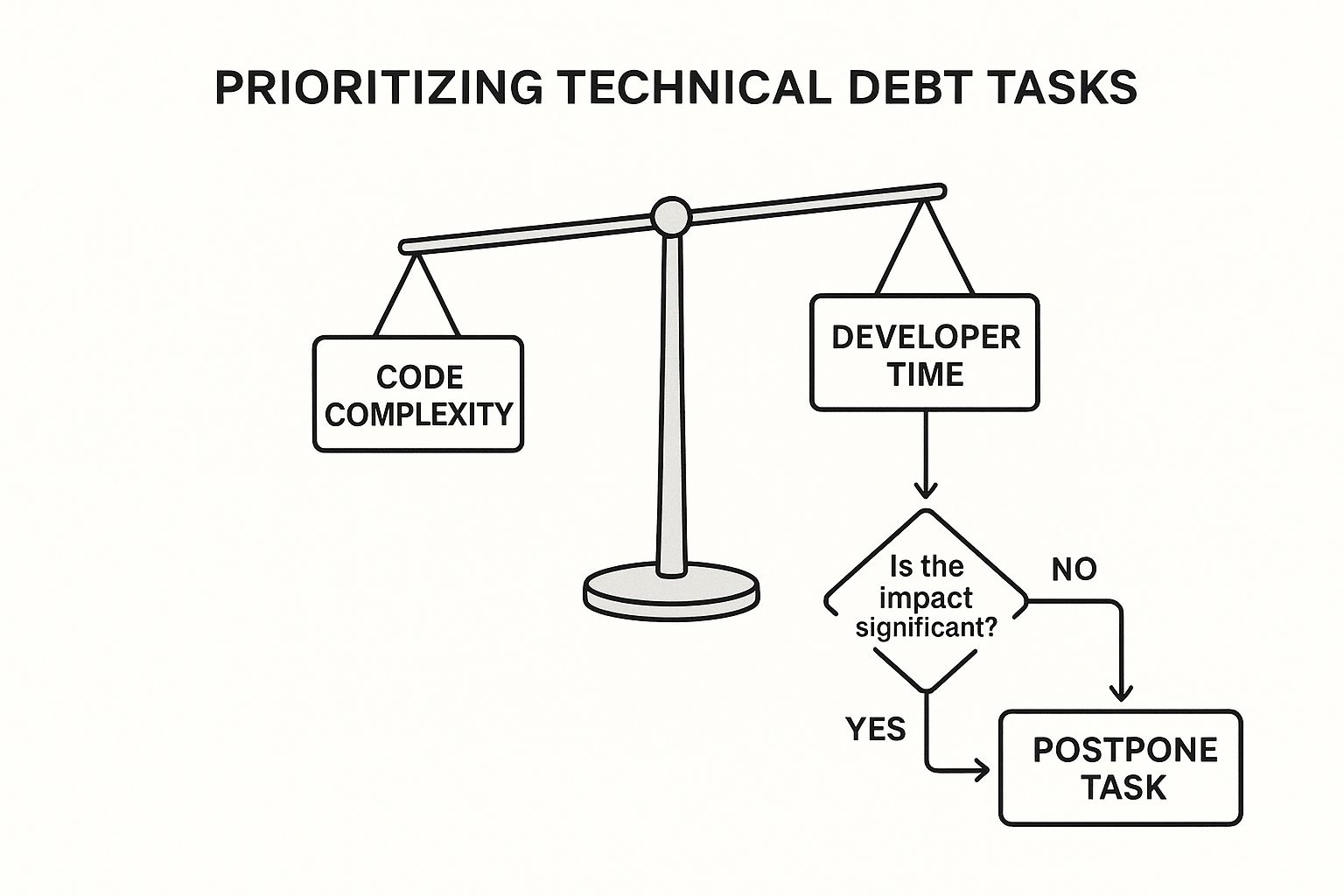
This balance makes it clear: paying down technical debt is an investment in your project's future speed and security.
This strategic mindset is becoming the norm. By 2025, many top companies are expected to dedicate around 15% of their IT budgets specifically to managing technical debt. It's a smart move—organizations that do this systematically have seen a nearly 30% reduction in complexity by phasing out outdated systems. You can read the full research about managing technical debt on netguru.com to see how this proactive approach is paying off.
Actionable Techniques for Reducing Technical Debt
Alright, you’ve identified and prioritized your technical debt. Now for the hard part: actually paying it down. Moving from theory to practice means rolling up your sleeves and using concrete strategies that work for the unique parts of a Web3 stack—from the immutable logic on-chain to the off-chain services that make your dApp usable.
The trick is to be systematic. Random, ad-hoc fixes often create more problems than they solve. You need a structured approach that chips away at debt without introducing new risks. This means careful planning, rigorous testing, and clear documentation at every turn.
Refactoring Smart Contracts Safely
Let’s be honest: refactoring a live smart contract is the developer equivalent of performing open-heart surgery. With immutability, you don't just "edit" the code. The process involves migrating both logic and state to a new, better contract, which is inherently risky.
The Strangler Fig Pattern is one of the best mental models for this. Picture a fig vine slowly wrapping around an old tree, eventually replacing it entirely. In software, this means you gradually replace pieces of the old contract's functionality with calls to a new, refactored one.
This is where proxy patterns really shine. A stable proxy contract points to your logic contract. To fix debt, you deploy a new, improved logic contract and simply update the proxy's pointer to the new address. This isolates the change and de-risks the migration, giving you a controlled, phased rollout.
Improving Your Off-Chain Components
Technical debt isn’t just a smart contract problem. Your off-chain infrastructure—from indexing services and APIs to frontend libraries—can accumulate a ton of cruft that slows down development and hurts user experience.
Here are a few common areas ripe for improvement:
- Complex Indexing Services: Is your subgraph from The Graph slow, buggy, or overly complicated? It's time to refactor it. This usually involves simplifying your data models and optimizing query logic for speed and efficiency.
- Frontend Library Cleanup: Take a hard look at how your frontend interacts with libraries like Ethers.js or Web3.js. Standardizing function calls, cutting out redundant code, and building reusable components will make your frontend far more maintainable.
- CI/CD Pipeline Optimization: A solid CI/CD pipeline is your best defense against new debt. Automating tests, security scans, and deployment checks ensures quality is baked into your workflow right from the start, not bolted on as an afterthought.
Key takeaway: Automation and modernization are non-negotiable for managing debt. By 2025, top CIOs are focusing on integrating CI/CD pipelines, automated testing, and static analysis tools like SonarQube to catch issues early. These tools embed quality and agility directly into your development process.
Adopting Proactive Development Practices
Clearing out old debt is great, but the real win is preventing it in the first place. Adopting better development habits is essential for the long-term health of your project.
Start by breaking down monolithic contracts. Instead of one giant contract doing everything, split it into smaller, single-responsibility modules. For example, keep your token logic completely separate from your governance logic. This makes the code easier to understand, test, and audit.
Ramping up your unit test coverage is also critical. Aim for high coverage on any complex logic, especially functions that handle user funds or critical state changes.
Finally, get in the habit of documenting key architectural decisions with Architecture Decision Records (ADRs). These are simple markdown files explaining why a certain technical choice was made. This context is invaluable for future developers and helps prevent them from unknowingly repeating past mistakes.
Beyond just refactoring code, tackling technical debt often requires looking at the bigger picture of how your team works. For a deeper look at improving overall efficiency, you might find it helpful to explore some practical business process optimization strategies.
Building a Culture That Prevents Future Technical Debt
Ultimately, the best way to deal with technical debt is to stop creating it. While tackling existing issues is a must, the only way to guarantee a project's long-term health is by building a team culture that prioritizes quality right from the get-go. It's a fundamental shift from constantly putting out fires to proactively preventing them.
This change has to start with how your team writes and reviews code. Rigorous, peer-led code reviews are simply non-negotiable. And these can't just be a quick scan for bugs; they need to be a deep dive, explicitly looking for signs of technical debt—things like poor documentation, convoluted logic, or potential gas inefficiencies. This creates a culture of shared ownership, where every engineer feels responsible for the health of the codebase.
Weaving Maintenance into Your Workflow
To make this stick, you have to treat debt reduction as a fundamental part of your development process, not just something you'll "get to later." A huge piece of this puzzle involves defining project scope effectively from day one. When you have clear boundaries, you avoid the scope creep that so often forces developers to rush and cut corners.
Many of the sharpest teams I've seen formalize this with a simple rule: they dedicate 20% of every sprint to refactoring and maintenance.
This isn't lost time. Think of it as an investment in your future speed. By consistently tidying up small messes, you stop them from snowballing into massive architectural headaches that could halt your roadmap for months.
Having this time blocked off ensures maintenance doesn't get kicked down the road every time a new feature request comes in. It becomes a predictable, respected part of the team's rhythm.
Fostering a Mentorship Mindset
Of course, even the most perfect processes won't work without the right people and guidance. This is where mentorship becomes critical, especially for junior developers who might not yet understand the long-term pain caused by taking shortcuts.
A solid mentorship program should focus on a few key things:
- The "Why" Behind Best Practices: Don't just tell junior devs to write clean code. You have to explain why—how messy code can introduce security holes or grind future development to a halt.
- Secure Coding from Day One: In Web3, security isn't just a feature; it's everything. Mentors need to drill in the importance of writing secure, maintainable, and well-documented smart contracts right from the start.
- Long-Term Project Vision: Help new team members think beyond the current sprint. Show them how the code they write today directly impacts the project’s ability to grow and adapt over the next few years.
When you embed these values into your team, you create an environment where people instinctively avoid creating debt. For anyone looking to build a team like this—or join one—checking out specialized engineering roles in the Web3 space is a great way to find companies that truly get it.
Frequently Asked Questions
Still have a few questions about tackling technical debt in your Web3 project? You're definitely not the only one. This is a tricky area where the stakes are high, so let's walk through some of the most common things we see engineering managers and developers grappling with.
Is All Technical Debt Actually Bad?
Not at all. I find it helpful to think of it in the same way you'd think about financial debt. Sometimes, taking out a strategic, calculated loan to jump on a major opportunity is a brilliant business decision.
The same logic applies here. Intentionally taking on some prudent technical debt to get your MVP out the door and start collecting real-world user feedback can be the smartest move you make.
The real trouble starts with reckless debt—the kind of messy shortcuts you take with no real plan to ever go back and clean them up. That’s the stuff that snowballs, eventually bogging down your development cycles and, even worse, opening up potential security holes.
How Can I Get My Non-Technical Manager to Care About This?
You have to translate the problem into a language they understand: business impact. Forget talking about code complexity or how "coupled" a contract is. That's just noise to them. Instead, show them how it hits the bottom line.
Frame the issue with cold, hard numbers. Instead of a technical explanation, try this: "This inefficient smart contract is costing our users an extra $5,000 in gas fees every single week. If we refactor it, we can slash those costs and boost our user retention." Suddenly, a technical problem becomes a smart business solution.
How Often Should We Deal With Technical Debt?
The trick is to be consistent. Don't fall into the trap of planning a massive "cleanup phase" that somehow never makes it onto the roadmap. Instead, weave debt reduction right into your everyday workflow.
A great rule of thumb is to dedicate a set chunk of every sprint—usually around 15-20% of your team's capacity—to refactoring, testing, and other maintenance tasks.
This small, steady investment keeps your codebase healthy and stops minor annoyances from ballooning into project-killing architectural disasters. It’s all about treating your code's health as a continuous responsibility, not a one-off chore.
Ready to build or join a team that prioritizes quality development from day one? At Find Web3, we specialize in connecting top-tier talent with the best companies in the blockchain industry. Explore thousands of engineering, design, and marketing roles at https://findweb3.com.