
At its heart, understanding distributed systems is about grasping how a bunch of independent computers can team up and act like a single, powerful machine.
Imagine a huge kitchen with a team of chefs. One handles the grill, another preps the salads, and a third works on desserts. They all communicate and coordinate to serve what looks like one perfectly crafted meal. That’s the core idea—this collaborative power is what keeps everything from Netflix to your online bank running smoothly.
What Are Distributed Systems Really
A distributed system is essentially a collection of separate computing components, which we call nodes, all connected and talking to each other over a network. To you, the end-user, this web of machines just looks like one simple, reliable service. When you hit play on a movie, you aren't aware of the dozens of servers working in the background; you just see the film start.
This illusion of a single, unified system is a crucial feature known as transparency.
These systems aren't just some abstract concept; they are the invisible engine of the modern internet. They exist because the demands we place on applications today are way too big for any one computer to handle alone. By spreading the work across many machines, companies can build services that are both incredibly powerful and resilient.
Why This Approach Is Essential
The move to distributed systems wasn't a random choice. It was a necessary evolution driven by three core needs that a single, centralized computer just can't meet effectively.
- Scalability: When your app goes viral, you can't just keep upgrading a single computer forever. With a distributed system, you simply add more machines (nodes) to the network. This "scaling out" lets you handle more traffic by sharing the load.
- Fault Tolerance: In a distributed world, you have to assume things will break. If one computer in the network crashes, the others are designed to pick up the slack. This built-in redundancy means a single point of failure won't take down your entire service.
- Performance: Spreading your system across the globe puts data and computing power closer to your users. Think of Content Delivery Networks (CDNs) that store videos on servers near you. This cuts down on lag and makes the whole experience faster and smoother.
A distributed system is one in which the failure of a computer you didn’t even know existed can render your own computer unusable.
That famous line from computer scientist Leslie Lamport nails both the incredible power and the inherent challenge of making these systems work.
Many of the terms in this space can seem a bit dense at first. If you're just getting started, our Web3 dictionary is a great place to get up to speed on the terminology.
Blockchain is probably one of the most famous examples of a distributed system in action today. For a deeper look into how that works, you can find great resources on understanding Blockchain technology. Throughout this guide, we'll continue to unpack the core principles, common hurdles, and game-changing potential of these architectures one step at a time.
The Essential Principles of System Design
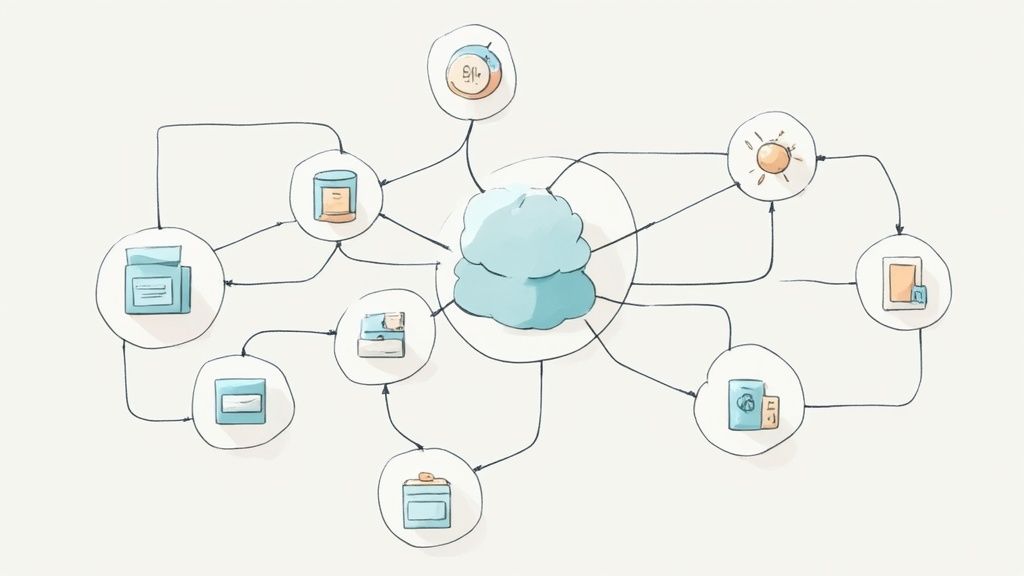
When you're building a distributed system, a few core principles guide every decision. These aren't just abstract concepts; they are the bedrock qualities that determine if a system can actually stand up to the messy, unpredictable real world. Getting them right is what separates a service that thrives under pressure from one that just crumbles.
The big three are scalability, availability, and performance. Think of them as the legs of a stool—if one is shaky, the whole thing becomes unstable. Each one tackles a different, crucial part of delivering a reliable and smooth experience to the user.
Let's dig into what these principles actually mean in practice, beyond the textbook definitions.
Mastering Scalability
Scalability is all about a system's ability to handle more work without breaking a sweat. Imagine a streaming service dropping a new blockbuster movie. Suddenly, millions of people log on at once. A scalable system simply expands to meet that demand gracefully.
There are two main ways engineers make this happen:
- Horizontal Scaling (Scaling Out): This is about adding more machines to the system. It’s like a busy supermarket opening more checkout lanes. Instead of forcing one cashier to work faster, you spread the load across many. This is the go-to approach for modern systems because you can just keep adding more machines as you grow.
- Vertical Scaling (Scaling Up): This means beefing up a single machine with more CPU, RAM, or storage. Think of it as giving that lone cashier a faster scanner and a bigger bagging area. It's often simpler to manage at first, but you eventually hit a physical limit, and the costs skyrocket.
The choice between them is a classic engineering trade-off. Horizontal scaling adds network complexity, while vertical scaling can create a single, catastrophic point of failure. For this reason, almost all massive services—from e-commerce sites to social media—lean heavily on horizontal scaling to serve their global user base.
The goal of scalability isn't just to handle more users. It’s about doing so without your costs spiraling or performance tanking. It's about growing efficiently.
Designing for High Availability
Availability is the measure of how often a system is actually up and running. It's usually talked about in "nines"—for instance, 99.999% availability (or "five nines") means the system is down for less than six minutes over an entire year. For something like an online payment gateway or an airline booking system, every second of downtime costs real money and erodes trust.
You achieve high availability through redundancy and fault tolerance. You start with the assumption that things will break. By building in backup components and keeping multiple copies of data (replication), the system can instantly switch over to a healthy part when another one fails. Most of the time, the user never even notices the hiccup.
This mindset is central to distributed systems: you have to build for failure, not just for success.
The economic engine behind this is massive. The market for Distributed Control Systems (DCS), valued at USD 21.97 billion, is projected to hit USD 33.31 billion by 2032. This isn't just a niche tech trend; it shows a broad industry shift towards decentralized systems for better reliability and control, especially with the rise of IIoT and 5G. For a closer look, you can find more insights on the DCS market growth.
Optimizing System Performance
Performance is all about speed—how fast a system responds to a user's request. We measure this with two key metrics: latency and throughput.
- Latency: This is the delay for a single request. When you click a button, it's the time you spend waiting for something to happen.
- Throughput: This is the total number of requests the system can handle over a period, like requests per second.
A highway is a great analogy. Latency is the time it takes one car to drive from the on-ramp to its exit. Throughput is the total number of cars that can pass a single point on that highway in an hour. You can have low latency but also low throughput (one fast car on an empty road), or you can have high throughput with terrible latency (a traffic jam where tons of cars are on the road, but they're all crawling).
A well-designed distributed system aims for the best of both worlds: minimizing latency while maximizing throughput to create a snappy, responsive experience for everyone.
Navigating the Famous CAP Theorem
Once you start digging into distributed systems, you'll inevitably hit a wall—or rather, a theorem. It's called the CAP Theorem, and it’s less of a guideline and more like the law of gravity for this field. It’s a hard constraint that forces every architect and engineer to make tough decisions about what their system will—and won’t—be able to do.
First put forward by computer scientist Eric Brewer, the theorem is elegantly simple: a distributed system can only provide two of the following three guarantees at the same time:
- Consistency (C): Every time you ask for data, you get the most recent version, or you get an error. No stale data, ever. Everyone sees the same thing at the same time.
- Availability (A): The system always responds to a request. It might not have the absolute latest data, but it won't just throw up an error message. It’s always online.
- Partition Tolerance (P): The system keeps working even if parts of it can't communicate with each other—say, a network cable gets cut between data centers. The network is "partitioned," but the show goes on.
Here’s the catch: in any real-world distributed system, network failures are a fact of life. They will happen. That makes Partition Tolerance (P) non-negotiable. If your system can't handle a network partition, it's not a distributed system; it's a ticking time bomb.
This reality forces a crucial choice: when the network inevitably fails, do you want your system to prioritize Consistency or Availability? You can't have both.
The Big Trade-Off: Consistency vs. Availability
Let's make this tangible. Imagine an airline's booking system. When you snag the very last seat on a flight to Hawaii, that system must guarantee no one else can book it a millisecond later. That requires iron-clad Consistency. If a network partition happens, the system might have to stop taking bookings altogether (sacrificing Availability) to prevent a disastrous double-booking. For a bank or an airline, consistency is king.
Now, think about your social media feed. You "like" a photo, and maybe your friend across the country doesn't see that like for a few seconds. Who cares? The system’s top priority is to keep the feed scrolling, showing you something rather than a loading spinner. It chooses Availability over perfect, up-to-the-nanosecond consistency. The system tolerates the partition, stays available, and everything eventually syncs up.
The core lesson of the CAP Theorem is that you cannot have a system that is perfectly consistent, always available, and resilient to all network failures. You are forced to choose what to sacrifice.
This infographic breaks down several common system architectures, all of which have to wrestle with these foundational trade-offs.
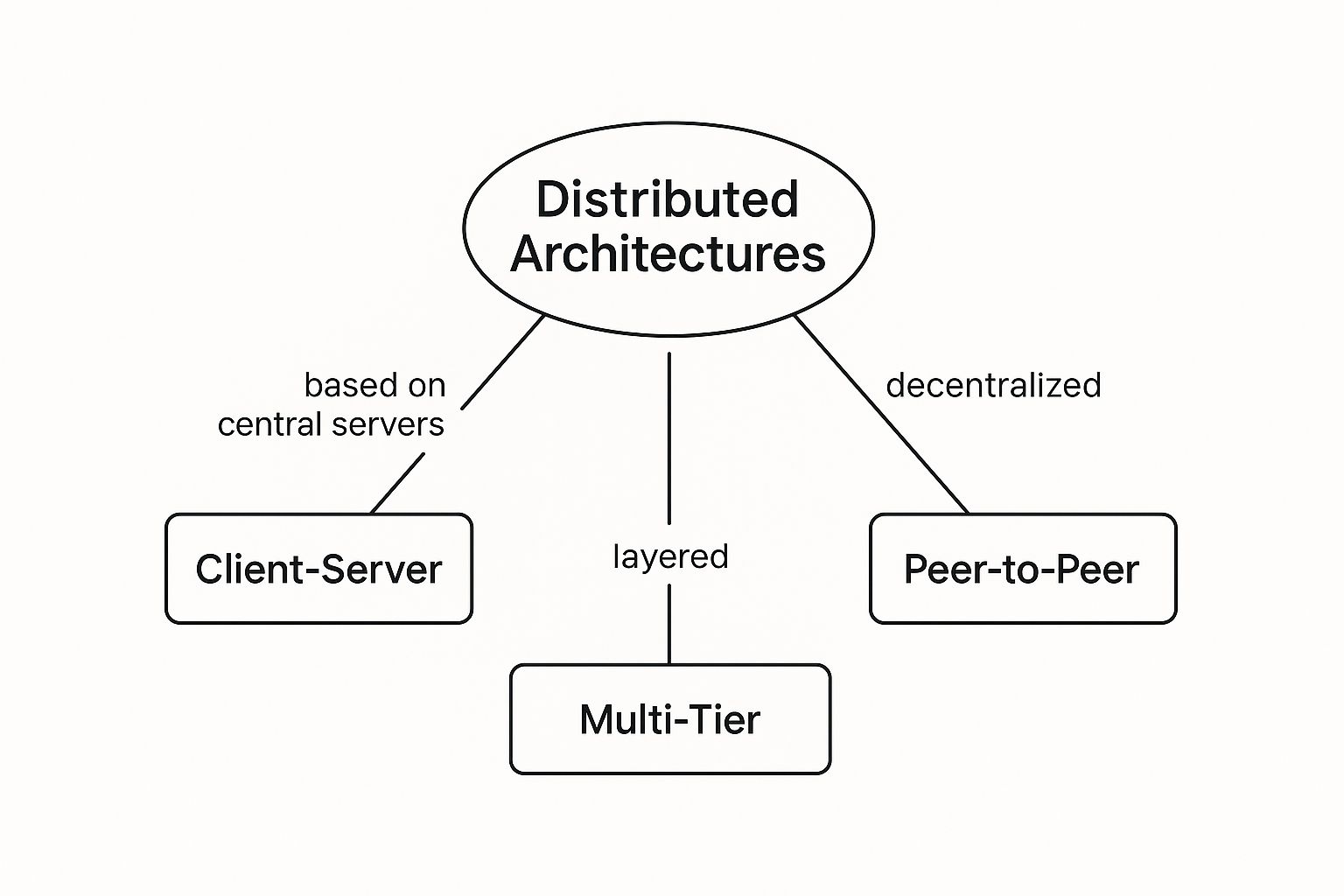
Whether it’s a simple client-server setup or a complex peer-to-peer network, each of these patterns makes a different bet on how to handle the CAP Theorem.
Choosing Your Consistency Model
Because perfect consistency is often at odds with high availability, engineers work with various "consistency models." These are essentially rules that define how strictly and quickly data updates need to spread across a system. The model you pick is driven entirely by what your application truly needs.
The table below breaks down the most common models, outlining the trade-offs you're making with each one.
Comparing Consistency Models in Distributed Systems
| Consistency Model | Description | Pros | Cons | Best-Fit Use Case |
|---|---|---|---|---|
| Strong Consistency | All nodes see the same data at the same time. A read is guaranteed to return the most recent write. | Data is always reliable and predictable. | Can introduce high latency; system may become unavailable during network partitions. | Financial systems, bank transactions, and inventory management. |
| Eventual Consistency | If no new updates are made, all replicas will eventually converge to the same value. | High availability and low latency. The system remains responsive. | Data can be stale for a period; complex to reason about application logic. | Social media feeds, DNS, and e-commerce product catalogs. |
| Causal Consistency | Writes that are causally related must be seen by all nodes in the same order. Unrelated writes can be seen in different orders. | A good balance between strong and eventual models. Preserves logical flow. | More complex to implement than eventual consistency. | Collaborative editing tools and comment threads where order matters. |
Making this choice is one of the most defining aspects of distributed system design. It's a strategic decision that directly shapes the user experience, system performance, and overall reliability. There's no single "best" model—only the one that best fits the problem you're trying to solve.
Building Systems That Refuse to Fail
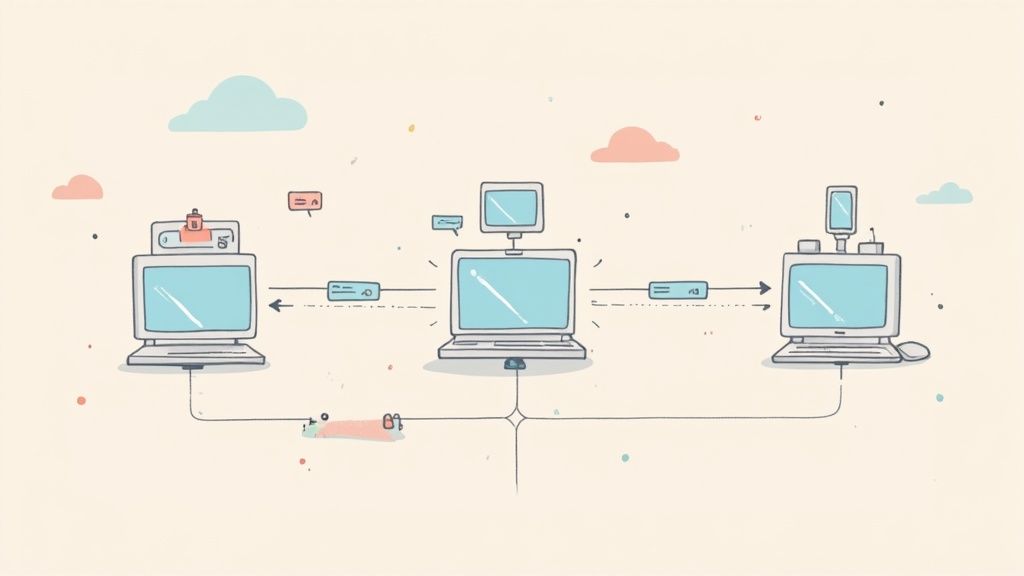
When you're working with distributed systems, you have to accept one hard truth: things will break. It’s not a question of if, but when. Servers crash, networks get congested, and hard drives give out. So, the goal isn't to build a system that never fails, but one that keeps running smoothly even when parts of it do. This is the core idea behind fault tolerance—designing for resilience right from the start.
A great analogy is a modern airliner. It’s engineered with the assumption that an engine could fail mid-flight. That’s why it has multiple engines and backup systems. If one goes down, the plane can still fly safely to its destination. We apply that same philosophy to distributed systems to ensure a single hiccup doesn't cascade into a full-blown outage.
Redundancy and Replication: The Core Strategies
Two of the most fundamental tools in our fault-tolerance toolbox are redundancy and replication. They sound similar, but they play slightly different roles. Redundancy is all about having backup components on standby, ready to jump in the moment a primary one fails.
Replication, on the other hand, is about data. It involves maintaining multiple, active copies of your data on different machines, sometimes in entirely different data centers. If the server holding your main data set goes offline, another node with an up-to-date replica can take over instantly. This is what prevents a single hardware failure from wiping out your data or taking your service offline.
Together, these strategies are designed to eliminate any single point of failure—a part of the system so critical that its failure would bring everything to a halt. By creating a safety net for every essential component, you build a system that just keeps going.
Building a fault-tolerant system means designing for failure. It's about gracefully handling the unexpected so that from the user's perspective, nothing ever went wrong.
Keeping Core Services Alive Through Graceful Degradation
Sometimes, you can't prevent a partial failure. When a system is under heavy load or some of its components are unavailable, it can use a smart strategy called graceful degradation. Instead of crashing entirely, the system intentionally dials back non-essential features to protect its core functions.
Think about an e-commerce site during a major traffic spike. The site might temporarily disable personalized recommendations or the ability to write new reviews. The experience isn't perfect, but the most important parts—letting customers find products and actually buy them—stay up and running. It's about prioritizing the critical path.
Here’s what graceful degradation often looks like:
- Read-Only Mode: A social media app might stop you from posting but will still let you scroll through your feed.
- Reduced Quality: A video streaming service might automatically drop the resolution from 4K to standard definition to cope with network issues.
- Fallback Data: An app might serve you slightly stale, cached data instead of live information until the connection to the main database is restored.
These are smart trade-offs that keep the lights on when it really counts.
Automated Healing and Monitoring
Modern cloud environments have taken fault tolerance to a new level with automated monitoring and self-healing. These systems are constantly on the lookout for trouble—a server that's not responding, a database query taking too long, you name it.
When an issue is flagged, automated workflows kick in immediately, often without a human ever getting involved. Traffic can be rerouted away from a faulty server, a crashed application can be restarted, or a completely new, healthy instance can be spun up to replace a failing one. This kind of automation means systems can recover from common problems in seconds, long before an on-call engineer even gets an alert.
How Different System Components Communicate
For a distributed system to actually work, its individual parts—the nodes—have to talk to each other. This constant chatter is what lets a bunch of separate computers act like a single, cohesive unit. But how they talk is a fundamental design choice, one that dramatically shapes the system's responsiveness, resilience, and overall complexity.
The two main ways they communicate are synchronous and asynchronous. Getting a feel for this difference is crucial to understanding modern system architecture.
Let's use a simple analogy: a phone call versus a text message. A phone call is synchronous. You dial, the other person picks up, and you're locked into a real-time conversation. You can't really do anything else until the call ends; you're blocked, waiting for an immediate response.
A text message, on the other hand, is asynchronous. You send it and then immediately put your phone away. You don't sit there staring at the screen waiting for a reply—you trust the network to deliver it and the other person to read it when they can.
Synchronous Communication: The Direct Approach
In a synchronous model, when one service (the client) makes a request to another (the server), it just stops and waits. It's a very direct, straightforward way to communicate. The client gets an immediate answer: the request either worked or it failed.
This pattern is common in simple request-response scenarios, like your web browser asking a server for a webpage. The big problem, though, is that it creates a serious risk in complex systems: tight coupling.
If the server is slow, down, or just overwhelmed, the client is stuck waiting. Now imagine hundreds of clients all waiting on that one slow service. The problem cascades, creating system-wide bottlenecks and failures. This tight dependency makes the whole system fragile.
Asynchronous Communication: Building for Resilience
To get around these problems, modern distributed systems lean heavily on asynchronous communication. In this model, services don't talk directly. Instead, they communicate through an intermediary, usually a message queue or an event bus.
One service publishes a message (or an "event") to the queue, and other services can subscribe to that queue to process messages whenever they're ready.
Asynchronous messaging decouples services from each other. The sender doesn't need to know who the receiver is, or even if the receiver is online at that moment. This creates a far more flexible and fault-tolerant system.
This "fire-and-forget" approach makes the entire system more robust. If a receiving service crashes, the messages just sit safely in the queue until it comes back online.
An Example From a Food Delivery App
Let's look at how this plays out in a food delivery app. The moment you tap "Place Order," a chain reaction kicks off.
- Order Placement: Your phone sends an
OrderPlacedevent to a message queue. The app can then immediately confirm the order on your screen, so the experience feels snappy. It isn't stuck waiting for everything else to happen behind the scenes. - Payment Processing: A completely separate payment service is listening to the queue. It sees the
OrderPlacedevent, processes your credit card, and then publishes its ownPaymentSuccessfulevent. - Restaurant Notification: The restaurant's system picks up the
PaymentSuccessfulevent and prints the order in the kitchen. - Driver Dispatch: At the same time, a dispatch service also sees the
PaymentSuccessfulevent and starts looking for a nearby driver.
Every step is an independent, asynchronous action. If the driver dispatch system is a little sluggish, it doesn't hold up your payment or stop the restaurant from getting your order. This kind of decoupling is the key to understanding distributed systems that can scale and handle the unpredictability of the real world.
Where You See Distributed Systems Every Day

It’s easy to think of distributed systems as a purely academic concept, but the truth is, they're the invisible engine behind your daily digital life. This isn't just theory—it’s the plumbing that makes the modern internet work. Every time you stream a movie, search for a restaurant, or save a file to the cloud, you're interacting with a massive, globally distributed system.
These systems are humming along in the background, delivering the speed and reliability we’ve come to expect. Once you connect the dots between the concepts and their real-world uses, you'll see why understanding distributed systems is crucial for anyone building or using technology today.
Powering the Cloud and Beyond
The most obvious examples are the cloud giants like Amazon Web Services (AWS) and Google Cloud. These platforms aren't just a bunch of servers in a warehouse; they are colossal distributed systems in their own right. When you deploy an application on the cloud, you’re plugging into a network engineered for unbelievable scale and resilience, spreading your code across countless machines in data centers worldwide.
Then there's the Content Delivery Network (CDN), a perfect illustration of a distributed system designed for speed. Imagine a popular website hosted in New York. Without a CDN, a user in Tokyo has to pull every image and line of code from halfway across the world, which means a slow, frustrating experience.
A CDN solves this by creating a distributed network of caches. It intelligently stores copies of the website's content on servers located much closer to the user in Tokyo. The result? Drastically reduced latency and a web that feels snappy and responsive, no matter where you are.
The Rise of the Distributed Cloud
But things are evolving. A newer idea, the distributed cloud, is pushing computing power even closer to where the action is—the "edge" of the network. Instead of sending all data back to a central cloud, edge computing handles tasks locally, right where the data is being created by IoT sensors, smart cameras, or self-driving cars.
This approach is essential for applications that can't afford any delay, where real-time responses are non-negotiable. The market reflects this shift; the global distributed cloud market is expected to jump from USD 4.92 billion to an incredible USD 19.36 billion by 2032. That explosive growth shows just how much demand there is for low-latency processing in everything from manufacturing to finance.
The real-world goal of distributed systems is simple: bring the computation and data closer to the user to deliver a faster, more reliable experience.
These principles are also pushing into new territory, especially in the Web3 world. Many blockchain technologies are, at their core, distributed systems built for security and decentralization. To see the variety, you can look into specific examples like a definition of Hyperledger Fabric, which is a type of permissioned distributed ledger. The concepts we've covered are also the foundation of decentralized finance (DeFi), NFTs, and DAOs, which all depend on a network of independent nodes working together.
You can explore a ton of relevant Web3 statistics in our detailed article to get a sense of the momentum. From massive cloud platforms to the next generation of the web, distributed systems are truly reshaping how we interact with technology.
Frequently Asked Questions
As you get deeper into distributed systems, you'll find that some questions come up time and time again. Let's tackle a few of the most common ones to help clear things up.
What's The Main Difference Between Distributed Systems and Microservices?
It's easy to mix these two up because they're so closely related, but they operate at different levels. Think of a distributed system as the entire city, while microservices are the individual, specialized buildings within it.
- Distributed System: This is the big-picture concept. It's any system where multiple, independent computers work together to appear as a single, coherent unit to the user. This could be a cloud platform, a peer-to-peer network, or a massive database.
- Microservices: This is a specific architectural style for building software. You take a large, monolithic application and break it down into a collection of small, focused, and independently deployable services. Each service does one thing well and communicates with others over a network.
So, a microservices architecture is simply one way to build a distributed system. It’s a popular implementation choice focused on making applications more modular and easier to manage.
Is Blockchain a Type of Distributed System?
Yes, without a doubt. A blockchain is a very specific, and fascinating, type of distributed system. At its heart, it’s a distributed ledger—basically a database that’s copied and spread across countless computers in a network.
What really sets it apart is the hardcore focus on decentralization and cryptographic security. A typical distributed database is managed by one company. A blockchain, on the other hand, is usually managed collectively by its participants, with no single person or entity in charge. This is the magic that unlocks features like immutability and trust.
The key takeaway is that all blockchains are distributed systems, but not all distributed systems are blockchains. The latter is a much broader field encompassing many different architectures and use cases.
Why Is System Complexity Considered a Major Challenge?
The single biggest headache in understanding distributed systems is wrestling with their inherent complexity. When you go from one computer to a whole network of them, the number of things that can go wrong multiplies exponentially.
Suddenly, you aren't just debugging your code. You're fighting network lag, nodes that partially fail, messages arriving out of order, and keeping data consistent everywhere at once. A bug might only surface under a bizarre set of timing conditions across three different machines, making it a nightmare to reproduce and fix. This complexity demands meticulous design, powerful monitoring tools, and a whole new mindset about how to handle failure. As distributed computing and AI intersect, things get even more complex; you can explore some fascinating AI statistics and trends in our guide.
What Does It Mean for a System to Lack a Global Clock?
On your laptop, every component marches to the beat of one central clock. This makes it simple to know the exact sequence of events. In a distributed system, each machine has its own internal clock, and it's physically impossible to keep them all perfectly in sync.
This is what we mean by the "lack of a global clock"—there's no single, universal source of truth for time. This creates some surprisingly tricky problems. If two events happen on two different nodes, how can you be 100% sure which one came first? You can't. This is precisely why engineers came up with clever solutions like logical clocks and vector clocks, which help establish a causal order of events—something that is absolutely critical for keeping data consistent.
Ready to find your place in the future of the web? At Find Web3, we connect talented professionals with the most exciting opportunities in blockchain, DeFi, and the metaverse. Explore thousands of jobs from leading Web3 companies and take the next step in your career today. Start your search on Find Web3.