
Customer support in the Web3 era isn't just about solving problems; it's about building trust in a trustless environment. Unlike traditional tech, Web3 support teams navigate unique and high-stakes challenges like irreversible blockchain transactions, private key security, and the intricacies of decentralized governance. A simple password reset won't cut it when a user's digital assets are on the line or they're confused about a smart contract interaction. This complexity demands a specialized approach, moving beyond generic advice to adopt battle-tested customer support best practices tailored for the blockchain. The old playbook simply doesn't apply.
This guide breaks down 10 crucial strategies that are non-negotiable for any project building in the decentralized future. From implementing proactive outreach to mastering first contact resolution, these actionable insights will help you build a support system that not only retains users but turns them into passionate advocates for your platform. We will explore how to deliver personalized experiences, optimize response times with empathy, and leverage data to constantly improve. For businesses looking to fully embrace this new era of customer support and integrate cutting-edge AI, understanding how to apply these principles is key. The strategic use of generative AI with major platforms is becoming essential, as detailed in this guide on leveraging GenAI in customer service with Salesforce and Zendesk.
For professionals aiming to build a career in this space-from developers to support specialists-mastering these skills is what separates a good candidate from a great one. Let's dive into the specific, actionable best practices that define elite Web3 customer support.
1. Omnichannel Customer Support
Omnichannel customer support is a holistic strategy that integrates all communication channels into a single, unified customer experience. Unlike a multichannel approach where channels operate in silos, an omnichannel system ensures that context and conversation history travel with the customer, whether they move from a live chat on your dApp to a support ticket via email, or from a social media DM to a Discord channel. This is one of the most crucial customer support best practices for building user trust in the often complex Web3 space.
How It Works and Why It's Essential in Web3
Imagine a user trying to unstake their tokens encounters a bug. They start a live chat, get an initial suggestion, but then have to leave. Later, they send an email referencing the issue. In an omnichannel setup, the support agent handling the email instantly sees the entire chat history, understanding the problem without forcing the user to repeat themselves. This seamless continuity is vital for resolving technical, high-stakes issues common in Web3, such as transaction failures or wallet connection problems.
The core benefit is a frictionless user journey. By centralizing user data and interaction history from platforms like Telegram, Discord, email, and in-app chat into a single CRM, support teams gain a complete 360-degree view of the user. This leads to faster, more accurate resolutions and a significantly better user experience.
The following infographic illustrates the fundamental process flow for establishing a true omnichannel support system.
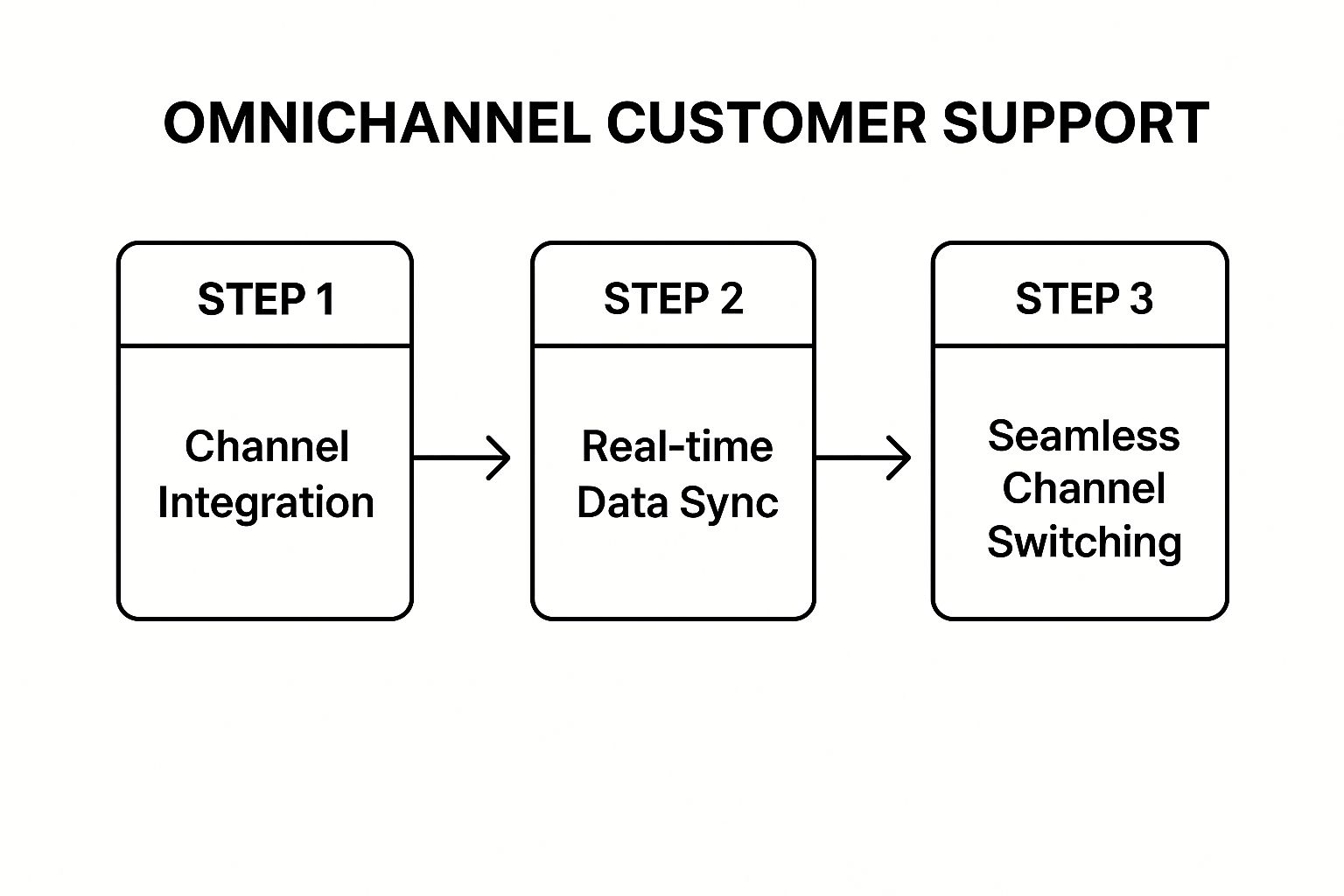
This visualization highlights that true omnichannel support is achieved only when integrated channels are powered by synchronized data, enabling a truly seamless user journey.
2. Proactive Customer Outreach
Proactive customer outreach is the strategy of anticipating user needs and addressing potential issues before they escalate into support tickets. Instead of waiting for users to report a problem, support teams actively monitor for warning signs and communicate preventative solutions. This approach flips the traditional reactive support model on its head, demonstrating a commitment to user success and solidifying it as one of the most effective customer support best practices for navigating the volatile Web3 landscape.
How It Works and Why It's Essential in Web3
Consider a scenario where a new liquidity pool on a DeFi platform has a known, intermittent smart contract bug affecting a small subset of users. A proactive team would identify wallets that have interacted with this contract and send a targeted, personalized message via Discord or email, acknowledging the potential issue and providing clear instructions for a workaround. This prevents widespread panic and a flood of repetitive support requests.
The core benefit is building immense user trust. By centralizing user activity data and setting up automated triggers, support teams can identify at-risk segments, such as users with repeatedly failing transactions or low wallet balances for upcoming gas fees. Reaching out first with helpful information, like a guide to adjusting gas limits or a warning about network congestion, transforms a potentially frustrating experience into a positive, supportive one. This is crucial for retaining users in an ecosystem where alternatives are just a click away.
This proactive stance not only reduces support ticket volume but also empowers users, enhances project reputation, and directly contributes to a more stable and user-friendly environment.
3. First Contact Resolution (FCR)
First Contact Resolution (FCR) is a critical metric and philosophy centered on resolving a customer's issue entirely within their first interaction. This means no follow-up emails, no ticket transfers, and no repeat calls. Achieving a high FCR rate is a hallmark of efficient and effective support, making it one of the most impactful customer support best practices for Web3 projects looking to build user confidence and reduce operational drag.
How It Works and Why It's Essential in Web3
In the high-stakes Web3 environment, users are often dealing with time-sensitive and stressful issues like a failed transaction, a lost NFT, or a wallet access problem. Forcing them to wait for multiple replies adds immense anxiety. An FCR-focused strategy empowers support agents with the knowledge, tools, and authority to solve problems on the spot. This could mean giving an agent the ability to manually verify a transaction on-chain or providing them with a comprehensive, step-by-step guide for resolving a common smart contract interaction error.
This approach requires significant upfront investment in agent training and internal resources. For instance, creating detailed knowledge bases with decision trees for complex issues allows agents to quickly diagnose and solve problems without escalation. Companies like Zappos and USAA have mastered this by giving their agents the autonomy to make decisions, a model that directly translates to Web3. Empowering an agent to issue a small gas fee refund for a failed transaction can turn a frustrated user into a loyal advocate instantly.
To implement an effective FCR strategy, teams should:
- Invest in Comprehensive Training: Equip agents with deep product knowledge and blockchain fundamentals.
- Build a Robust Knowledge Base: Create and maintain detailed, easily searchable guides for common and complex issues.
- Grant Appropriate Authority: Empower agents to make decisions, such as processing small refunds or escalating directly to engineers for critical bugs.
- Analyze Repeat Contacts: Regularly review why users are contacting support more than once to identify knowledge gaps or process inefficiencies.
4. Personalized Customer Experience
A personalized customer experience involves tailoring support interactions based on a user's specific history, behavior, and known preferences. Instead of providing generic, one-size-fits-all answers, this approach leverages user data to offer solutions and communications that feel uniquely relevant. In Web3, where users manage valuable digital assets and navigate complex protocols, this level of personalization is a powerful tool for building trust and is one of the most impactful customer support best practices.
How It Works and Why It's Essential in Web3
Consider a user who frequently interacts with your dApp's liquidity pools. When they contact support with a transaction issue, a personalized approach means the agent already sees their history. Instead of asking basic questions, the agent can say, "I see you were trying to add liquidity to the ETH/USDC pool and the transaction failed. Let's look at the gas fees from that specific attempt." This contextual awareness immediately demonstrates competence and respect for the user's time.
The core benefit is making users feel seen and understood, not just like another ticket number. By using a CRM that tracks on-chain activity, past support tickets, and in-app behavior, your team can proactively address potential issues or guide users based on their specific goals. This is crucial for resolving high-stakes financial issues common in Web3, as it fosters a sense of security and loyalty. Companies like Amazon and Netflix have mastered this by using viewing and purchase history to tailor not just recommendations but also support, a model Web3 projects can adapt to their unique ecosystems.
5. Self-Service Support Options
Self-service support options empower users with the tools and resources to resolve their issues independently, without needing direct agent interaction. This strategy involves creating comprehensive knowledge bases, detailed FAQs, video tutorials, and automated troubleshooting guides. For Web3 projects, where users often face similar technical hurdles like wallet connections or understanding gas fees, a robust self-service portal is one of the most effective customer support best practices for scaling support and enhancing user autonomy.
How It Works and Why It's Essential in Web3
Imagine a new user wants to bridge assets to a different network for the first time. Instead of waiting for a support agent, they can access a step-by-step video tutorial or an interactive guide within your dApp's help center. This immediate access to information resolves their query instantly and educates them on the process, building confidence and reducing friction. This is especially critical in a 24/7 global ecosystem like crypto, where users expect instant answers at any time of day.
The core benefit is efficiency and scalability. By proactively addressing common questions, you free up your support agents to focus on complex, high-priority cases that require human intervention. An effective self-service strategy, modeled after pioneers like Microsoft with its extensive documentation or Apple with its intuitive support tools, reduces ticket volume, lowers support costs, and fosters a more knowledgeable and self-sufficient user community.
The following video provides a deeper look into the strategic value of building and maintaining a powerful self-service knowledge base.
This approach not only resolves issues faster but also serves as a persistent educational resource that adds long-term value to your entire user base.
6. Continuous Agent Training and Development
Continuous agent training and development is an ongoing commitment to enhancing the skills, product knowledge, and service capabilities of your support team. Rather than a one-time onboarding session, this approach involves regular training, coaching, and professional growth opportunities. This strategy is one of the most impactful customer support best practices because it directly equips agents to handle the rapidly evolving technical and security landscape of Web3.
How It Works and Why It's Essential in Web3
Consider an agent who was trained when your protocol launched. Six months later, you’ve introduced liquid staking, a new governance model, and integrated with three new wallets. Without continuous training, that agent is unprepared to handle user queries about these new features, leading to incorrect answers, escalations, and frustrated users. Ongoing development ensures the team’s expertise grows in lockstep with your product.
The core benefit is maintaining a high-quality, knowledgeable support frontline that can build user confidence. In an industry where one wrong piece of advice can lead to lost funds, having expertly trained agents is non-negotiable. This model, famously championed by service-oriented leaders like Zappos and Ritz-Carlton, shifts support from a reactive cost center to a proactive, value-adding function that enhances user retention and trust.
Actionable steps for implementation include:
- Implement Microlearning: Create short, frequent training modules on new features, security updates, or common support scenarios.
- Use Real Scenarios: Role-play complex user issues, such as a failed transaction or a suspected phishing attempt, to build practical problem-solving skills.
- Establish Peer Mentoring: Pair new agents with experienced ones to accelerate knowledge transfer and foster a collaborative team culture.
- Track Training Effectiveness: Monitor metrics like first-contact resolution rates and customer satisfaction scores for agents post-training to measure impact.
7. Customer Feedback Collection and Action
Customer feedback collection and action is the systematic process of gathering, analyzing, and acting on user insights to improve products, services, and support experiences. This practice goes beyond simply asking for opinions; it involves creating a closed-loop system where feedback directly informs development and strategy, and those changes are communicated back to the community. Implementing this is one of the most impactful customer support best practices for fostering user loyalty and building a community-driven project in Web3.
How It Works and Why It's Essential in Web3
Consider a user who finds the process of bridging assets on a new DEX confusing. They leave feedback via a post-support survey. A reactive team might just note the comment, but a proactive one aggregates this feedback with similar comments from Discord and Twitter. This data then justifies a UI/UX update to simplify the bridging interface. Crucially, the team announces this update in their community channels, specifically crediting user feedback for the change.
This proactive approach is vital in the fast-evolving Web3 landscape where user trust is paramount. By actively seeking and implementing feedback, projects demonstrate that they value their community's input, transforming users from passive participants into active stakeholders. This cycle of feedback, action, and communication builds a powerful sense of ownership and can turn a good product into a great one. Centralizing feedback from surveys, social media, and direct support interactions into an actionable roadmap ensures continuous, user-centric improvement.
This practice is essential for:
- Identifying Pain Points: Uncover hidden issues in your dApp, documentation, or support processes before they escalate.
- Prioritizing Development: Use quantitative and qualitative feedback to guide your product roadmap, ensuring you build features users actually want.
- Boosting Community Engagement: Show your community their voice matters, strengthening their connection to the project.
- Reducing Support Volume: Proactively fixing common issues based on feedback reduces the number of repetitive support tickets over time.
8. Response Time Optimization
Response time optimization is the strategic process of minimizing the delay between a user's initial support request and the first meaningful response from your team. It goes beyond mere speed, focusing on setting clear expectations, implementing efficient workflows, and using technology to manage user inquiries effectively. This is a fundamental customer support best practice that directly impacts user satisfaction and trust, especially in the fast-paced Web3 environment where financial assets are often at stake.
How It Works and Why It's Essential in Web3
Consider a user who finds their crypto withdrawal is stuck pending. The anxiety and frustration escalate with every minute that passes without a response. Optimizing response times means having systems in place to immediately acknowledge their ticket, route it to an agent specializing in transaction issues, and provide an initial reply that confirms receipt and sets a clear timeline for investigation. This immediate engagement can de-escalate a potentially damaging situation and reinforce confidence in your platform.
The core benefit is managing user expectations and reducing anxiety. By using automated acknowledgments, intelligent routing based on issue type (e.g., smart contract error vs. UI bug), and continuous monitoring of key metrics like First Response Time (FRT), teams can ensure no user feels ignored. A critical aspect of customer satisfaction is addressing various strategies to reduce customer service response times to ensure timely and efficient support. This proactive approach prevents small issues from becoming major points of friction.
Implementing this practice involves a combination of technology and process:
- Set and Communicate Expectations: Clearly state your average response times on your support channels.
- Automate Acknowledgments: Every ticket, email, or message should receive an instant automated reply confirming it has been received.
- Use Intelligent Routing: Automatically assign tickets to the right agent or department based on keywords or user selection.
- Prioritize Urgently: Develop a triage system to flag and fast-track critical issues like potential security vulnerabilities or fund-related problems.
9. Empathy-Driven Communication
Empathy-driven communication is a customer service approach that prioritizes understanding and acknowledging a user's emotions, frustrations, and perspective. Instead of just solving the technical problem, it involves training agents to actively listen, validate feelings, and demonstrate genuine care for the user's situation. This human-centric method is one of the most impactful customer support best practices for de-escalating stressful situations and building lasting loyalty, especially in Web3 where users often face financial and technical anxiety.

How It Works and Why It's Essential in Web3
Consider a user who has just lost access to a wallet containing valuable NFTs due to a phishing scam. A purely technical response might focus on irreversible blockchain transactions and security protocols. An empathetic response, however, starts by acknowledging their distress: "I understand how incredibly stressful and upsetting this must be. Let's walk through the security steps we can take right now to protect your other assets." This validation immediately changes the dynamic from confrontational to collaborative.
The core benefit is transforming a negative interaction into a trust-building opportunity. In the high-stakes Web3 environment, where a single mistake can feel catastrophic, empathy is not a soft skill; it's a critical tool for user retention. By training support teams to recognize and address the emotional state of the user, projects can reduce churn, improve their public reputation, and demonstrate a commitment to user well-being that goes beyond the code.
This approach, popularized by companies like Chewy who famously send personalized condolences to pet owners, proves that emotional connection drives business success. For Web3 projects, this means training agents in active listening, developing empathy-focused conversation guides, and encouraging them to respond with genuine human understanding rather than just robotic scripts.
10. Data-Driven Performance Analytics
Data-driven performance analytics is the systematic process of collecting, analyzing, and applying customer support data to continuously improve service quality, agent performance, and overall user satisfaction. Rather than relying on intuition, this approach uses concrete metrics to identify trends, pinpoint inefficiencies, and make informed strategic decisions. Adopting this methodology is one of the most impactful customer support best practices for scaling operations and proactively addressing user needs in the fast-evolving Web3 landscape.
How It Works and Why It's Essential in Web3
Imagine your support team is experiencing a surge in tickets related to a new staking feature. A data-driven approach allows you to quantify this trend instantly. By analyzing metrics like ticket volume by category, first-response time, and resolution rates, you can identify the root cause, whether it's a UI bug, unclear documentation, or a smart contract issue. This insight enables you to escalate the problem to the development team with clear evidence, preventing a minor issue from becoming a major crisis.
In Web3, where issues can have direct financial consequences for users, this proactive capability is non-negotiable. Analytics platforms and CRM tools can be configured to track key performance indicators (KPIs) such as Customer Satisfaction (CSAT) scores, Net Promoter Score (NPS), and average handling time. Teams can then use this data to optimize everything from agent training modules to self-service resources. For instance, consistently low CSAT scores on tickets related to wallet connections might indicate a need for a detailed tutorial or a more robust FAQ section. This strategic use of data transforms support from a reactive cost center into a proactive, value-driving function that builds user trust and retention.
Customer Support Best Practices Comparison
| Item | Implementation Complexity 🔄 | Resource Requirements ⚡ | Expected Outcomes 📊 | Ideal Use Cases 💡 | Key Advantages ⭐ |
|---|---|---|---|---|---|
| Omnichannel Customer Support | High – complex integration and training | High – CRM and multi-channel systems | Seamless channel switching; higher resolution rates | Businesses with multiple customer touchpoints | Improved satisfaction; reduced customer effort |
| Proactive Customer Outreach | Moderate to High – advanced analytics | Medium to High – monitoring tools | Reduced escalated complaints; better retention | Companies aiming to prevent issues before they arise | Prevents issues; creates positive brand perception |
| First Contact Resolution (FCR) | High – extensive training & empowerment | High – skilled agents and knowledge bases | Higher satisfaction; reduced operational costs | Support centers focusing on immediate problem solving | Improved loyalty; lower customer effort |
| Personalized Customer Experience | High – complex data infrastructure | High – data integration & analysis | Tailored interactions; increased conversion | Customer-centric companies seeking deeper engagement | Stronger emotional connection; upselling |
| Self-Service Support Options | Medium – content creation & platform setup | Medium – content & chatbot systems | 24/7 availability; reduced support costs | Businesses with high volume of straightforward inquiries | Scalable support; faster resolutions |
| Continuous Agent Training and Development | High – ongoing programs and coaching | High – time & cost investment | Better service quality; reduced turnover | Organizations prioritizing agent skill growth | Improved agent confidence; higher FCR rates |
| Customer Feedback Collection and Action | Medium – multi-channel systems | Medium – analytics and response teams | Data-driven improvements; higher loyalty | Companies focused on closing the feedback loop | Direct insight; early issue detection |
| Response Time Optimization | Medium – routing and automation setup | Medium to High – staffing & tech | Faster responses; improved satisfaction | Support teams under pressure to respond quickly | Reduced escalations; competitive differentiation |
| Empathy-Driven Communication | High – intensive training and coaching | Medium to High – training resources | Strong emotional connections; better conflict resolution | Situations requiring sensitive handling and emotional care | Higher loyalty; meaningful resolutions |
| Data-Driven Performance Analytics | High – advanced analytics infrastructure | High – analytics tools and experts | Objective decisions; continuous improvement | Organizations leveraging metrics for strategic support insights | Early problem ID; optimized resource use |
Building Your A-Team for the Decentralized Frontier
Navigating the complex and rapidly evolving landscape of Web3 requires more than just innovative technology; it demands a fundamentally different approach to user engagement. Throughout this guide, we've explored ten essential customer support best practices designed to build trust, foster loyalty, and ensure user safety in a decentralized world. From implementing a seamless omnichannel presence to leveraging data for performance analytics, each practice serves as a critical pillar in constructing a resilient and user-centric support framework.
The journey from a reactive, problem-fixing function to a proactive, value-adding partnership is the ultimate goal. The principles we've discussed are not isolated tactics but interconnected components of a holistic strategy. A robust self-service knowledge base empowers users, which in turn frees up your agents to focus on complex issues requiring deep empathy and technical skill. Similarly, optimizing for First Contact Resolution (FCR) becomes far more achievable when your team receives continuous, specialized training on the latest blockchain protocols and security threats.
From Theory to Actionable Strategy
Mastering these concepts is about shifting your organizational mindset. It's about viewing support not as a cost center, but as your most valuable engine for user education, retention, and brand advocacy. The most successful Web3 projects will be those that prioritize the human element, recognizing that behind every wallet address and transaction hash is a person seeking guidance and security.
Your immediate next steps should be to audit your current support operations against the best practices outlined here.
- Identify Gaps: Where does your current process fall short? Are you truly omnichannel, or just present on multiple channels? Is your feedback loop active, with user insights directly influencing product development?
- Prioritize Initiatives: You don't need to implement everything at once. Start with the areas that will have the most significant impact on your user experience. For many, this means strengthening self-service options and investing in advanced agent training.
- Empower Your Team: The core of these customer support best practices is a well-equipped, knowledgeable, and empathetic team. An investment in your support professionals is a direct investment in your community's trust and your project's long-term viability.
The Future of Support is Decentralized and Human-Centric
Ultimately, the power of Web3 lies in its ability to empower individuals. Your customer support strategy must reflect this core ethos. It's a unique blend of technical expertise, security-first thinking, and profound empathy. The professionals who can master this combination are not just support agents; they are community builders, educators, and guardians of the user experience.
As the ecosystem matures, the demand for these specialized skills will only intensify. For companies, building a team capable of delivering this level of service is non-negotiable for success. For professionals, developing these competencies is the key to a thriving and impactful career on the decentralized frontier. By committing to these principles, you are not just resolving tickets; you are building a safer, more accessible, and more trustworthy Web3 for everyone.
Ready to build your Web3 support dream team or find your place within one? The Find Web3 job board connects pioneering companies with top-tier talent specializing in the decentralized space. Explore opportunities and find the professionals you need to implement these customer support best practices at Find Web3.