
The Web3 Revolution: Understanding What You're Investing In

Before investing, it's crucial to understand the core principles of Web3. This knowledge is the foundation of smart investment decisions. We'll explore the key changes driving Web3's shift from centralized platforms to decentralized, user-owned networks.
Decentralization and Ownership: The Core of Web3
This shift focuses on decentralization and digital ownership. Unlike Web2, where large corporations control data and platforms, Web3 distributes control among its users. This eliminates reliance on intermediaries like Facebook or Google, giving users direct ownership and control over their digital assets and data. It’s similar to owning a physical asset, but in the digital world.
Imagine owning digital art. In Web2, this art might reside on a platform like Instagram, subject to its rules. In Web3, this artwork exists as a Non-Fungible Token (NFT) on a blockchain, giving you verifiable ownership that's tradable independently of any platform. This ownership model extends beyond art, encompassing in-game items, digital identities, and even fractional ownership of real-world assets.
Trustless Systems and Transparency
Web3 incorporates trustless systems powered by blockchain technology. These systems operate based on pre-defined rules encoded in smart contracts, eliminating intermediaries and increasing transparency. Every transaction is recorded publicly and immutably on the blockchain, creating auditable and verifiable records.
This builds trust within the system, like a transparent public ledger. It impacts financial transactions, supply chain management, and even voting systems. For further insights into Web3 statistics, you can explore this helpful resource: How to master Web3 statistics.
The Rise of Web3 Investment
Growing interest in Web3 is evident in the substantial investments flowing into the sector. The Web3 investment landscape has seen dramatic growth, with venture capital actively seeking opportunities.
In Q1 2025 alone, venture capital investment in crypto and blockchain startups reached $4.9 billion. This represents a 40% increase quarter-over-quarter across 446 deals—a 7% increase in deals compared to the previous quarter. This growth highlights rising investor confidence and the maturation of Web3 technologies, especially in later-stage ventures. A detailed report offers more information: Web3 Investment Report – Mar 2025. This burgeoning investment activity signifies that Web3 is not just a technological trend, but a rapidly evolving economic force. Understanding these fundamental shifts is vital for any potential Web3 investor.
Navigating the Web3 Investment Landscape
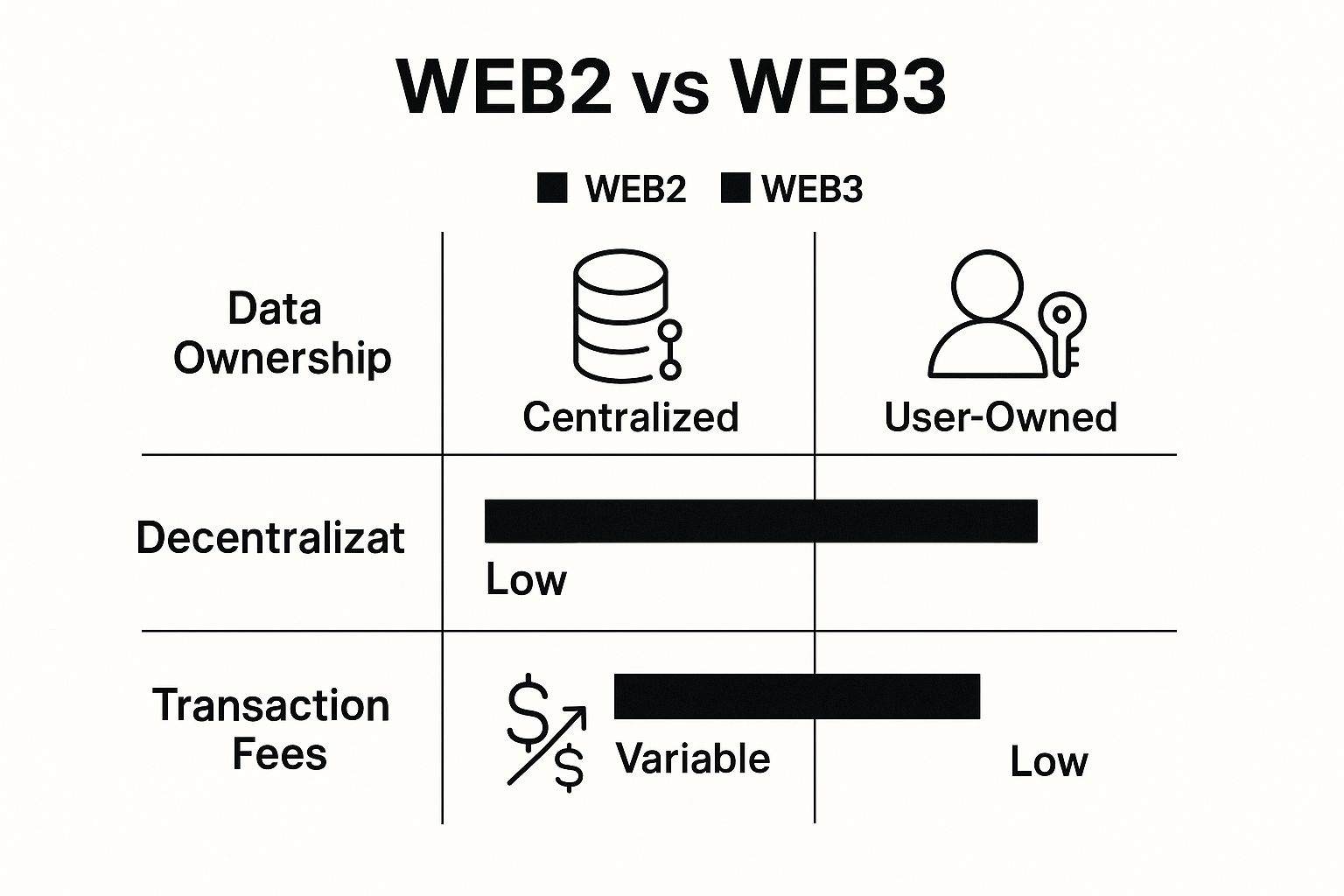
The infographic above highlights the core differences between Web2 and Web3 in terms of data ownership, decentralization, and transaction fees. Web3 prioritizes user-owned data and a high degree of decentralization, often resulting in lower transaction costs. These key distinctions create exciting investment possibilities not available in the traditional Web2 space. Want a more detailed understanding of Web3 terms? Explore our helpful guide on Web3 vocabulary.
Understanding the Diverse Investment Opportunities
The Web3 ecosystem offers a variety of investment options, each with its own potential upsides and downsides. These range from established cryptocurrencies like Bitcoin and Ethereum to more intricate Decentralized Finance (DeFi) protocols. The landscape also includes dynamic NFT marketplaces and immersive metaverse platforms. A solid grasp of these categories is essential for making well-informed investment choices. Many existing businesses are also looking to make a name for themselves in Web3. For example, building a Web3 fitness brand around the existing Just Do It model would be one intriguing way to go, as outlined in this piece: Web3 fitness brand.
Focusing on Infrastructure and Application Layers
Some investors concentrate on infrastructure plays, focusing on the core technologies underpinning Web3. This could involve investments in blockchain networks themselves, the related supporting technologies, or companies creating vital development tools. Other investors are more attracted to the application layer. They look for opportunities within the platforms and services built using the existing infrastructure. A useful analogy is investing in the pickaxes during a gold rush (infrastructure) versus investing in the companies that use those pickaxes to find gold (applications).
Identifying Genuine Innovation vs. Speculation
A central challenge for Web3 investors is distinguishing real innovation from speculative hype. Studying current developments provides crucial insights. For example, AI-powered Web3 projects have seen significant growth, attracting $1.8 billion in funding throughout 2024 and 2025. This represents roughly 26% of the total capital raised in the Web3 sector. Delve deeper into these trends with this insightful analysis on AI and Web3 funding trends. The combination of AI and decentralized technologies is driving progress in areas like decentralized autonomous organizations (DAOs), more advanced smart contracts, and personalized blockchain services. However, thorough research into each project is crucial to accurately assess its potential.
Developing a Web3 Investment Thesis
By appreciating the interconnectedness of the Web3 ecosystem, investors can create a comprehensive framework for analyzing different sectors. This includes pinpointing the sectors showing the most promise, aligned with individual investment goals. This might involve specializing in a particular Web3 niche, such as DeFi or gaming, or diversifying across several categories to strike a balance between risk and potential reward.
To help illustrate the different investment options available in Web3, let's look at a comparison table:
The following table provides a breakdown of various Web3 investment categories, comparing their risk levels, potential returns, liquidity, and required technical knowledge.
Web3 Investment Categories Comparison
| Investment Category | Risk Level | Potential Returns | Liquidity | Technical Knowledge Required |
|---|---|---|---|---|
| Cryptocurrencies (e.g., Bitcoin, Ethereum) | Medium to High | High | High | Low to Medium |
| DeFi Protocols | High | High | Medium | Medium to High |
| NFTs | High | Variable (potentially very high) | Low to Medium | Low to Medium |
| Metaverse Platforms | High | High | Low to Medium | Low to Medium |
| Infrastructure Projects | Medium | Medium to High | Low to Medium | Medium to High |
This table summarizes the key differences between popular Web3 investment avenues. Notice the higher risk associated with DeFi, NFTs, and the Metaverse, contrasted with the relatively lower risk (but also potentially lower returns) of infrastructure projects. Liquidity also varies significantly, with cryptocurrencies generally offering higher liquidity compared to other categories. The level of technical knowledge required also differs, highlighting the importance of understanding the technical complexities before investing.
Your First Web3 Investment: A Step-by-Step Blueprint
Ready to dive into the world of Web3? This guide offers a practical approach to making your first investment. We'll cover everything from setting up a secure wallet to understanding how seasoned Web3 investors analyze potential projects.
Setting Up Your Web3 Wallet
Your Web3 journey starts with a crypto wallet. This digital vault is where you'll store your digital assets, acting much like a bank account for the decentralized web. There are two primary types: hardware wallets and software wallets.
Hardware wallets are physical devices offering enhanced security, ideal for long-term storage of significant investments. Popular options include Ledger and Trezor.
Software wallets, on the other hand, are apps or browser extensions, offering greater convenience for daily transactions. While more practical for frequent use, they are generally considered less secure than hardware wallets. MetaMask and Trust Wallet are widely-used examples.
Choosing the right wallet is a crucial first step. Consider your security needs and how often you plan to transact. Once your wallet is set up, prioritize protecting your private key. This key is like the password to your vault; keep it offline and never share it.
Conducting Fundamental Analysis
Before investing in any Web3 project, thorough research is paramount. This means looking beyond the hype and evaluating the project's core components. Experienced investors focus on several key areas:
- Team Credentials: Research the team's experience and track record. Who are they, and what have they accomplished?
- Code Quality: Has the project's code undergone audits by reputable security firms? This helps ensure its resilience against vulnerabilities.
- Community Strength: A vibrant and engaged community can indicate a project's long-term potential. Consider joining relevant online communities, such as those for entrepreneurs, to stay informed. For example, you can explore communities like Saylo.
- Tokenomics: Understand how the project's tokens are distributed and used. Sustainable tokenomics are crucial for long-term value.
Acquiring Your First Web3 Asset
Once you've identified a promising project, the next step is acquiring your chosen asset. You can do this through centralized exchanges (CEXs) or decentralized exchanges (DEXs).
Centralized exchanges like Coinbase and Binance offer user-friendly interfaces and a wider range of assets. However, they require you to entrust your funds to the exchange.
Decentralized exchanges, such as Uniswap and SushiSwap, offer more control over your assets but can be more complex to navigate.
When using an exchange, consider the fees and security practices. It's wise to start with a small investment to familiarize yourself with the process.
Secure Storage: Protecting Your Investment
After purchasing your asset, transfer it to your secure wallet. This safeguards your investment from potential exchange hacks or vulnerabilities. Remember to keep your private key offline and protected.
Learning from Experienced Investors
New Web3 investors can benefit greatly from the wisdom of those who have already weathered the market's fluctuations. Common pitfalls to avoid include emotional investing, chasing hype without due diligence, and over-investing.
Developing a disciplined strategy based on sound research and risk management principles is crucial. By following this blueprint, you'll be well-prepared to research, acquire, and securely manage your first Web3 investments.
Building Your Defensive Framework for Web3 Investing

Protecting your investments is just as crucial as maximizing gains. This holds especially true in the exciting world of Web3 investing, which presents both unique challenges and remarkable opportunities. This section explores key defensive strategies for navigating the sometimes volatile Web3 market.
Position Sizing and Diversification
Position sizing, or the percentage of your portfolio allocated to a specific asset, is fundamental to risk management. The volatile nature of Web3 makes it vital to avoid overexposure to any single investment. For higher-risk assets, consider limiting individual positions to a small percentage of your overall portfolio—perhaps 5% or less.
Diversification is equally important. This involves spreading your investments across different asset classes to mitigate the impact of any single asset's decline. However, true diversification in Web3 requires more than simply holding various tokens.
Many Web3 assets are highly correlated and tend to move together. Effective diversification involves considering factors beyond asset class, including underlying technology, project stage, and the team's expertise.
Security Best Practices
Security is paramount in the decentralized world of Web3. Protecting your assets starts with carefully selecting a secure wallet and diligently managing your private key. Your private key is like the key to your digital vault – losing it means losing access to your funds.
Hardware wallets offer the highest level of security, storing your private keys offline and away from online threats. Always be vigilant against phishing scams and malicious links. Double-check website URLs and avoid clicking on anything suspicious.
Due Diligence and Audit Report Analysis
Thorough research is non-negotiable for any Web3 investment. This includes evaluating the project's team, its technology, and the surrounding community. A frequently overlooked aspect of due diligence is analyzing audit reports.
Smart contracts, the backbone of many Web3 projects, automate transactions and agreements. However, vulnerabilities in their code can be exploited. Reputable projects often commission independent security audits from firms like CertiK or ConsenSys Diligence to identify and mitigate these risks.
Learning to interpret these audit reports is a valuable skill. Pay attention to the severity and number of identified vulnerabilities.
Learning From Case Studies
The Web3 space is still relatively young, offering valuable lessons from both successes and failures. Examining case studies of projects that experienced significant hacks or exploits can offer critical insights. Understanding the factors that led to past failures, like the collapse of certain DeFi protocols, can inform your investment decisions.
Conversely, studying successful and resilient projects reveals best practices for security and risk management. These real-world examples demonstrate how robust defensive frameworks can protect investments and even facilitate remarkable recoveries after setbacks. By implementing these defensive strategies, you’ll be better prepared to navigate the risks inherent in Web3 while capitalizing on its significant potential. This foundation will allow you to pursue growth opportunities with greater confidence, knowing you have strategies in place to protect your investments.
Beyond Buying and Holding: Advanced Web3 Strategies
Building upon the basics of Web3 investing, this section explores more sophisticated strategies suitable for seasoned investors looking to amplify returns and deepen their involvement. These strategies offer higher potential gains, but also carry elevated risks and often demand a stronger technical grasp.
Yield-Generating Opportunities: Staking, Liquidity Provision, and Governance
Beyond simply acquiring and holding assets, investors can actively engage in the Web3 ecosystem through yield-generating activities. Staking involves locking up your cryptocurrency to support the operations of a blockchain network, earning rewards in the process. It’s analogous to earning interest on a traditional savings account.
Liquidity provision, on the other hand, entails contributing to decentralized exchanges (DEXs), facilitating trades and earning fees. However, this comes with the risk of impermanent loss, where the value of your assets can fluctuate depending on market dynamics.
Finally, governance participation empowers token holders to vote on proposals and shape the direction of a project, granting investors direct influence over the future of their investment. For more insights on DeFi statistics, check out this helpful resource: How to master DeFi statistics.
Evaluating Protocol Incentives and Risk-Adjusted Returns
Savvy investors diligently assess the incentives offered by various protocols. This requires understanding the reward structure, the inherent risks, and the potential opportunity cost of committing capital to one project over another.
Prevailing market conditions significantly impact these calculations. For instance, during periods of heightened volatility, the potential staking rewards might outweigh the risks. Conversely, during calmer periods, investors might prioritize liquidity.
Strategic NFT Investing: Beyond Speculative Collecting
NFTs present investment avenues beyond simply collecting digital art. Metaverse land development enables investors to acquire and develop virtual land within metaverse platforms, potentially establishing virtual businesses or generating rental income.
Royalty-generating NFTs provide a stream of income each time the NFT is resold, offering consistent returns. These strategies necessitate a deeper understanding of the particular NFT market and its underlying platform.
Balancing Passive and Active Strategies Across Market Cycles
Successful Web3 portfolios often combine passive and active strategies. Holding established cryptocurrencies like Bitcoin or Ethereum provides a relatively stable foundation, while engaging in activities like staking or NFT investing offers higher growth potential.
The optimal balance between these strategies should shift in response to market conditions. In a bear market, a more passive approach focused on holding established assets might be prudent. Conversely, a bull market could present compelling opportunities for more active participation in higher-risk, higher-reward strategies.
External forces, such as mergers and acquisitions, also influence market dynamics. The year 2025 is projected to be a pivotal year for Web3 startups in terms of mergers and acquisitions, propelled by increased regulatory clarity and burgeoning interest from traditional industries. Learn more about this trend: 2025 Web3 Startup Acquisition Trend.
This development highlights the growing recognition of Web3's potential to transform digital interactions, financial services, and identity management. By understanding these advanced strategies and adapting to market conditions, investors can maximize their opportunities within the dynamic Web3 landscape.
To help illustrate the potential returns and risks associated with different Web3 investment strategies, the following table provides a comparative overview:
Web3 Investment Strategies Performance Metrics
Statistical data on various Web3 investment strategies showing historical performance and risk metrics
| Strategy | Avg. Annual Return | Risk Rating | Liquidity | Min. Investment | Technical Complexity |
|---|---|---|---|---|---|
| Buying & Holding Blue-Chip Crypto | 10-15% | Medium | High | $100 | Low |
| Staking | 5-12% | Low-Medium | Medium | Varies | Low-Medium |
| Liquidity Provision | 8-20% | Medium-High | Medium | Varies | Medium-High |
| NFT Flipping | 20-50% | High | Medium-Low | Varies | Medium |
| Metaverse Land Development | 15-30% | High | Low | High | Medium-High |
| Governance Participation | 2-7% | Low | Medium | Varies | Low-Medium |
Note: The figures presented are illustrative and may not reflect actual market performance. Investment decisions should be based on thorough research and risk assessment.
This table summarizes the potential returns and risks across several Web3 investment strategies, ranging from the relatively stable approach of buying and holding blue-chip cryptocurrencies to the more complex and higher-risk strategies like liquidity provision and metaverse land development. Remember to carefully consider your individual risk tolerance and investment goals when choosing a Web3 strategy.
Navigating the Regulatory Landscape as a Web3 Investor
Web3 investing presents exciting opportunities, but understanding the legal complexities is essential. This section offers practical guidance from tax and legal experts in the digital asset space. Our goal is to help you transform regulatory challenges into strategic advantages.
Tax Implications of Web3 Investments
Participating in Web3 activities like cryptocurrency trading, NFT sales, staking rewards, and DeFi income often triggers significant tax implications. These implications vary based on your location and the specific investment. Careful tracking and accurate reporting of all your Web3 transactions are key to successful navigation of these obligations.
For example, selling cryptocurrency for a profit is typically a taxable event, similar to selling stocks. Likewise, staking rewards and income earned through DeFi protocols are usually treated as taxable income. A strong grasp of these tax rules is crucial to avoid penalties.
Legal Considerations for Web3 Investors
Tax implications aside, a range of legal issues can impact Web3 investors. The regulatory framework surrounding Web3 is still evolving, with different jurisdictions taking different approaches. It's essential to stay informed about these regulatory shifts and their potential impact on your investments.
For example, some jurisdictions are implementing specific regulations for stablecoins. Others are exploring legal frameworks for DAOs. These evolving regulations can significantly impact the value and practical usability of your Web3 assets.
Tools and Systems for Compliance
Managing the complexities of Web3 compliance can be demanding. Thankfully, numerous tools and systems are available to streamline the process. These range from specialized cryptocurrency tax software to portfolio tracking platforms that automate transaction recording.
Leveraging these tools can reduce the administrative burden of tax reporting and ensure accurate record-keeping. This is particularly beneficial for investors engaging in frequent Web3 transactions.
Emerging Regulatory Trends and Their Impact
The Web3 regulatory environment is dynamic. Staying aware of emerging trends is key to adapting your investment strategy effectively. For instance, increasing regulation of cryptocurrency exchanges could impact the liquidity of certain assets.
New regulations targeting NFTs could also affect the value of digital collectibles or the development of metaverse platforms. By anticipating these changes, investors can position themselves strategically and minimize potential disruptions to their portfolios.
Minimizing Tax Burdens While Maintaining Compliance
Savvy investors seek to minimize their tax liabilities while remaining compliant with all regulations. This requires a proactive approach to tax planning and a clear understanding of applicable deductions and exemptions. Consulting with a tax advisor specializing in digital assets can provide valuable guidance.
Strategic tax planning helps investors optimize returns and avoid overpaying taxes. This is particularly important for those generating substantial income from their Web3 activities.
Real Investor Experiences: Navigating Regulatory Challenges
Learning from other investors' experiences can provide invaluable insights. Many seasoned Web3 investors have successfully navigated complex regulatory situations. Examining their strategies, such as forming legal entities to manage their Web3 holdings, can offer practical and actionable advice. These real-world examples illuminate the intricacies of Web3 regulation and help you stay compliant while optimizing your investments.
Are you ready to discover the perfect Web3 career opportunity? Explore thousands of jobs in the crypto, NFT, DeFi, DAO, metaverse, and blockchain sectors at Find Web3. Start your Web3 career journey today!