
Understanding What Makes Virtual Worlds Actually Work

Stepping into a well-designed metaverse experience should feel effortless. It's like entering a room where you instantly know where everything is and how to interact with it. A poorly designed one, however, feels like stumbling through a dark, unfamiliar maze. This is why metaverse UX design is so critical.
The Psychology of Immersion
Think about the difference between watching a film and playing a videogame. One washes over you, the other invites you in. The metaverse is much more like a game. Good metaverse UX design relies on actively engaging the user. It needs to create a genuine sense of presence, that feeling of actually being in the virtual space.
Beyond Flashy Graphics: The Importance of Intuition
It's more than just pretty pictures. Imagine a breathtakingly realistic virtual museum where you can’t figure out how to open a door or read a description. Frustrating, right? Effective metaverse UX design prioritizes intuitive interaction. It's about making virtual environments easy and natural to use, regardless of a user’s technical skills.
This is backed up by recent trends. By 2025, while 54% of metaverse users identified high-quality graphics as important, 44% prioritized smooth user experiences and 47% valued social features. This shows people crave more than visual appeal. They want smooth interactions and meaningful connections. For a deeper dive into these trends, check out Insight Trends World.
Spatial Computing: A New Design Paradigm
Metaverse UX design lives in the world of spatial computing, where users interact with a digital environment in three dimensions. This radically changes the design game. Traditional web design, focused on flat screens, can fall apart in virtual spaces. A cluttered 2D menu that works on a website, for example, can become overwhelming in VR when projected onto a user’s entire field of vision.
Managing Cognitive Load in 3D
Imagine trying to read detailed text while navigating a complex virtual environment. It's mentally exhausting. Metaverse UX design needs to carefully manage cognitive load. This means presenting information in a way that’s easy to process in 3D. Think spatial audio cues, intuitive hand gestures, and minimalist visual interfaces.
Designing for Diverse Hardware
The metaverse isn't just for VR headsets. People might access it through AR glasses, phones, or even desktops. Metaverse UX design has to work across this diverse range of hardware, providing a consistent and enjoyable experience, no matter the platform. Interested in designing for the metaverse? Metaverse Jobs can help you explore career opportunities. This adds a layer of complexity, forcing designers to consider screen size, input methods, and processing power. Creating a successful metaverse experience isn't just about building visually impressive virtual worlds – it’s about building worlds that truly work for their inhabitants.
The Core Principles That Separate Great From Awful
Think of metaverse UX design like architecture meets psychology. You're not just constructing digital spaces; you're crafting immersive experiences so real, users forget they're in a virtual environment. By analyzing successful virtual worlds like VRChat and Horizon Worlds, we can uncover the fundamental principles that make these experiences truly engaging.
Presence: Beyond Visual Fidelity
Presence in the metaverse isn't simply about stunning graphics. It's about cultivating a powerful sense of “being there” through meticulously designed interactions. Imagine reaching out to touch a virtual object and feeling a subtle haptic vibration. This small detail significantly enhances the feeling of reality. Similarly, spatial audio, where sounds shift and change based on your position and orientation, adds another layer of immersion. These elements work in concert to convince your brain that the virtual world is tangible.
Spatial Affordances: Design That Makes Sense
Spatial affordances describe how an object's design intuitively communicates its function in 3D space. A virtual doorknob, for example, should look and operate just like a real one. Users should instinctively know how to interact with it without needing a tutorial. This intuitive design is critical for a comfortable metaverse experience. Imagine how jarring it would be if a virtual door opened with a button press instead of a natural turning motion. It would shatter the illusion of reality.
To illustrate how we gather insights into user experience within the metaverse, let's take a look at the following table:
Traditional vs. Metaverse UX Design Principles
A comparison of how core UX principles translate from 2D to 3D immersive environments
| Design Principle | Traditional UX | Metaverse UX | Key Differences |
|---|---|---|---|
| User Research | Surveys, A/B testing, user interviews | VR usability testing, behavioral analytics in virtual environments, physiological data analysis | Shift from observing screen interactions to analyzing user behavior and responses within a 3D space. |
| Information Architecture | Linear navigation flows, menu structures | 3D spatial organization, environmental cues, wayfinding | Transition from hierarchical structures to spatial relationships and exploration. |
| Interaction Design | Mouse clicks, keyboard inputs, touchscreens | Hand tracking, gesture recognition, voice commands, haptic feedback | Move towards natural, embodied interactions that mimic real-world actions. |
| Visual Design | 2D graphics, UI elements | 3D models, environments, avatars, immersive visuals | Focus on creating a sense of presence and spatial awareness through realistic or stylized 3D graphics. |
| Usability Testing | Observing user interactions with a screen | Analyzing user behavior and comfort within a simulated VR environment | Shift from observing screen-based interactions to assessing physical comfort and natural movement in 3D space. |
This table highlights the key shifts in thinking required when designing for the metaverse. While traditional UX focuses on screen-based interactions, metaverse UX must account for the user’s physical presence and interaction within a 3D environment.
The following infographic further visualizes different metaverse UX research methods and their outcomes:
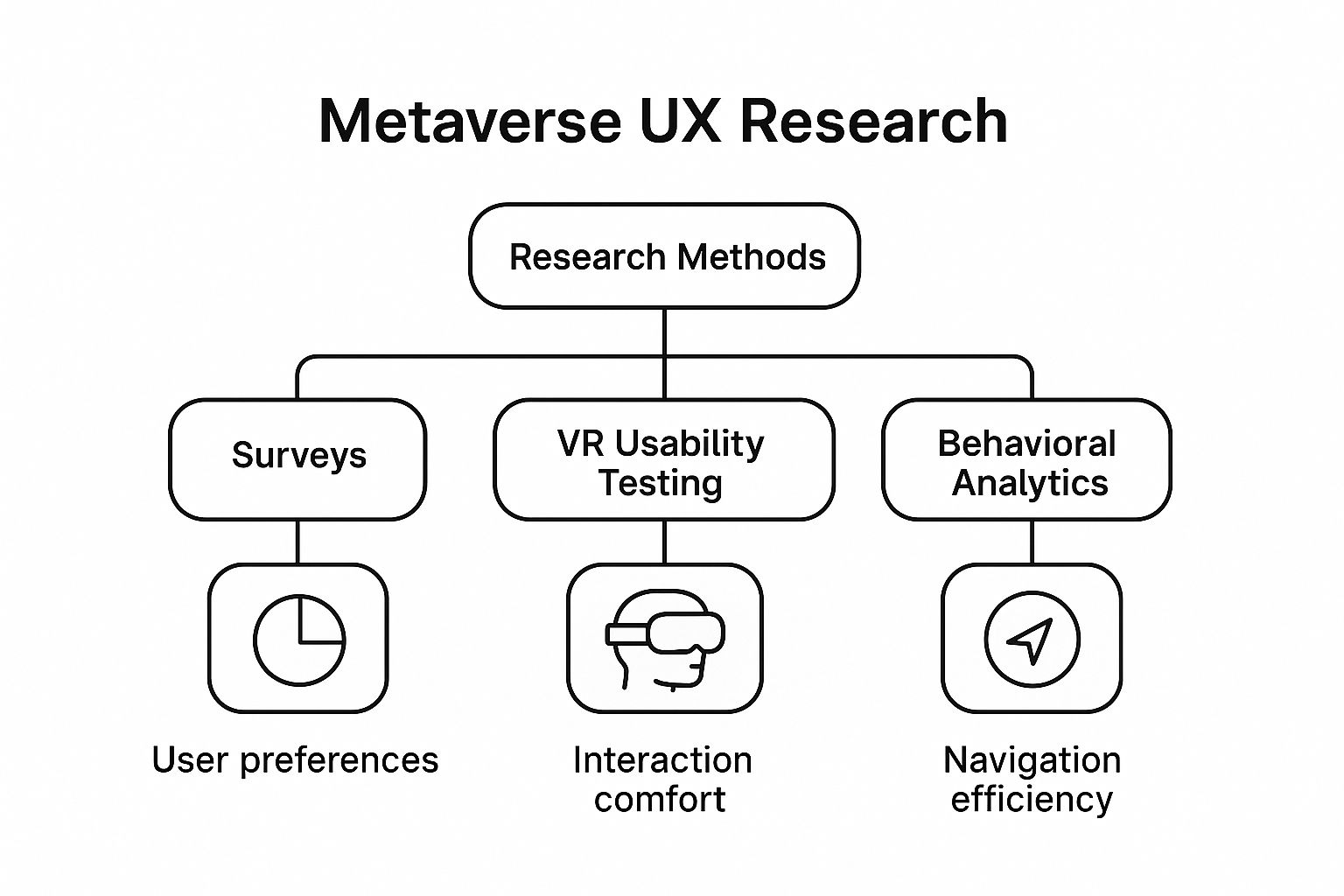
As shown in the infographic, methods like surveys can reveal user preferences and expectations, while VR usability testing offers crucial insights into interaction comfort and navigation efficiency. Behavioral analytics provide a granular understanding of how users explore and interact within the metaverse. Combining these research approaches provides a rich tapestry of data that informs design decisions.
Interface Integration: Part of the World, Not On Top of It
Interfaces in the metaverse shouldn't feel like clunky additions. They should be woven into the virtual environment itself. Imagine checking your virtual watch by simply glancing at your wrist, rather than pulling up a 2D menu. This is an example of a diegetic interface, where interface elements exist naturally within the world. This approach strengthens immersion by blurring the lines between the interface and the experience. Consider how platforms like Horizon Worlds use hand-tracking for object manipulation. This allows for more intuitive interactions that feel less like a game and more like a natural extension of reality. This seamless integration is key to creating truly engaging and immersive metaverse experiences.
Designing Virtual Spaces Where People Actually Connect

Many designers building social metaverse experiences get sidetracked by the shiny new tech. They focus on the bells and whistles instead of the heart of the matter: human connection. Truly connecting people in virtual spaces isn't about having the most realistic avatar or crystal-clear voice chat. It's about understanding how people interact in the real world and translating those social dynamics into the digital realm.
The Power of Proximity and Shared Experiences
Imagine you're at a party. You naturally gravitate towards people standing nearby. Conversations often start because you're both experiencing the same thing – the music, the food, the awkward small talk. This same principle applies to the metaverse. Platforms like Rec Room and AltspaceVR understand this, using proximity and shared activities to bring people together. Think about joining a virtual pottery class or playing charades in a virtual living room. These shared experiences, just like in real life, build a sense of community and connection.
Avatar Customization: More Than Just Aesthetics
Avatar customization is much deeper than just picking a cool outfit. It's about self-expression. Consider your own clothing choices in the real world. Your clothes reflect your personality and how you want to present yourself to others. Avatars function in the same way – they become extensions of ourselves in virtual spaces. By offering rich customization options, we empower users to express their unique identities, making them feel more connected to the virtual world and the people within it.
Designing for Authentic Interaction
Good metaverse UX design facilitates authentic interaction through thoughtfully designed conversation spaces. Picture a virtual campfire, a cozy coffee shop, or a quiet park bench. These virtual settings encourage spontaneous conversations, mirroring how we socialize in the real world. The placement of virtual objects, the ambient sounds, even the virtual lighting can contribute to a comfortable and inviting atmosphere. These details might seem small, but they have a big impact on how people interact within the space.
Balancing Privacy and Openness: A Delicate Act
Social metaverse platforms face a delicate balancing act between privacy and openness. People want to connect with others, but they also need to feel safe and in control of their interactions. Think about how social media platforms use privacy settings and friend lists to give users control over their online presence. Similar principles should apply to metaverse UX design. Giving users agency over who they interact with and how their avatar is presented builds trust and promotes genuine engagement. Designing spaces where people truly connect involves understanding human psychology and reflecting our natural ways of interacting in virtual environments. By focusing on these core elements, metaverse designers can create immersive experiences that are authentic, engaging, and genuinely social.
Mastering Movement And Wayfinding In Three Dimensions
Getting lost in a virtual world is a surefire way to frustrate users. Effective metaverse UX design prioritizes wayfinding, weaving it into the immersive experience itself. Think of it like urban planning, but for a city where users can teleport, fly, or even walk through walls. It's a whole new ball game.
Spatial Memory in Virtual Worlds
Our brains build spatial memory differently in virtual reality. In the real world, we rely on consistent physical cues like buildings, trees, and the horizon. These cues are often missing or easily manipulated in the metaverse. This can quickly disorient users. Imagine trying to navigate a virtual city with no clear horizon or consistent landmarks – you'd be spinning in circles in no time.
Rethinking Traditional Navigation
Tried-and-true 2D navigation patterns often fall flat in 3D spaces. A simple dropdown menu, perfectly functional on a website, becomes cumbersome in VR. A linear click-through process? Meaningless in a world where users can move in any direction. Metaverse UX design requires us to shift from linear thinking to spatial thinking.
The screenshot below shows a minimalist mobile browser design, focusing on core functionality over excessive features. This principle is essential for metaverse wayfinding. In a 3D environment, visual clutter disorients users.
Just as this browser streamlines navigation in a limited mobile space, metaverse interfaces need to present wayfinding information clearly and concisely within the 3D world itself. Overly complex or visually distracting navigation will hinder exploration and interaction.
Practical Approaches to Wayfinding
The best metaverse designers use distinct landmarks, clear visual cues, and a strong spatial hierarchy. Picture a towering clock tower in a virtual city – instantly recognizable. Color-coded pathways? Intuitive directional cues. Distinct districts within the environment establish a spatial hierarchy, helping users grasp the overall layout.
Movement Mechanics: Teleportation and Flight
Teleportation needs to feel smooth, not jarring. Showing users a preview of their destination before they teleport can reduce disorientation. For flight, limiting speed and providing clear visual feedback like motion blur helps prevent nausea and improves user control. These details are crucial for a comfortable and truly immersive experience.
Designing Expansive Yet Manageable Environments
Vast metaverse environments can easily overwhelm users. One solution is to divide large areas into smaller, interconnected zones. Think of a sprawling virtual world broken down into distinct neighborhoods, each with its own character and points of interest. This not only improves performance but also makes navigation less daunting. By understanding how spatial memory works in virtual reality and using smart design strategies, we can create immersive worlds that are both expansive and easy to navigate. This results in a more enjoyable and engaging user experience, encouraging exploration and discovery.
Building Interfaces That Live In Virtual Space

Let's face it, those clunky floating menus and 2D panels just don't cut it in immersive 3D worlds. For a truly engaging metaverse experience, interfaces need to feel like they belong there, like a natural extension of the virtual environment itself. This means rethinking our approach to interaction design from the ground up – from how users pick things up to how we present information. The goal is a seamless blend between metaverse UX design and the world it inhabits.
Spatial UI: Designing for 3D Interaction
Imagine reaching out and grabbing a virtual object as easily as you would in real life, or tweaking a setting by simply turning a virtual dial. This kind of intuitive interaction is the heart of spatial UI design, which focuses on natural hand movements and gestures. Many leading metaverse applications use hand-tracking interfaces to achieve this, creating a more engaging and intuitive experience.
However, designing for hand tracking isn't without its hurdles. Imperfect tracking and gesture recognition mean we need to be extra careful to make sure interactions are reliable and frustration-free.
Voice Commands That Understand Context
Voice control is another powerful tool for metaverse interaction. But simply adding voice commands isn't enough. We need context-aware voice recognition. This means the system needs to understand not just what you're saying, but where you are and what you're looking at in the virtual world.
For example, saying "open this" while looking at a virtual door should, well, open the door! It shouldn’t open a random menu or bring up a help screen.
Balancing Information Density and Spatial Awareness
Displaying information in 3D requires a delicate balancing act. Too much information can overwhelm users and shatter their immersion. Too little, and they’ll feel lost and unsure of what to do. Good metaverse UX design prioritizes spatial awareness.
Think strategically placed holographic displays that appear only when needed, or subtle audio cues that guide users without interrupting their experience. It's about giving users the information they need, when and where they need it, without cluttering their view.
Feedback Systems in Three Dimensions
Feedback is crucial in the metaverse, just like it is in the real world. But we can go beyond simple visual feedback. Imagine pressing a virtual button and feeling a slight haptic vibration in your hand controller. This tactile feedback adds a layer of realism and confirms your action.
Metaverse UX design needs to explore this multi-sensory feedback. Haptic feedback, spatial audio, and even subtle environmental changes can all communicate with users in a more immersive and intuitive way. Interested in diving deeper into design? Check out these Design Jobs.
Let's take a look at some best practices summarized in the table below:
Metaverse Interface Design Best Practices
Essential guidelines for creating effective interfaces in immersive 3D environments
| Interface Element | Traditional Approach | Metaverse Solution | User Benefit |
|---|---|---|---|
| Object Manipulation | Mouse clicks, keyboard controls | Direct hand interaction, gesture recognition | More intuitive and natural interaction |
| Navigation | 2D menus, point-and-click | Teleportation, embodied movement, hand-directed navigation | Increased sense of presence and agency |
| Information Display | Static screens, pop-up windows | Diegetic displays integrated into the environment, spatial audio cues | Reduced cognitive load, enhanced immersion |
| System Feedback | Visual notifications | Haptic feedback, spatialized audio cues | More engaging and informative feedback |
| Platform Compatibility | Designed for specific devices | Adaptive interfaces that adjust to different devices | Wider accessibility and consistent experience |
This table highlights how metaverse interfaces move beyond traditional screen-based interactions to offer more natural and immersive experiences.
Adapting Across Platforms
The metaverse isn’t limited to VR headsets. Users might be accessing it through AR glasses, mobile devices, or even traditional screens. Metaverse UX design needs to be adaptive, transitioning seamlessly between these different platforms while maintaining a consistent user experience.
This means considering factors like screen size, input methods (hand tracking, controllers, touch screens), and processing power. This adaptability is key for reaching a wider audience, ensuring everyone can participate regardless of their device.
Addressing these unique design challenges is what separates truly immersive metaverse experiences from clunky, frustrating ones. By focusing on intuitive interaction, context-aware controls, and seamless integration, we can build virtual worlds that feel natural, engaging, and truly transport users.
Creating Trust In Spaces Where Anything Feels Possible
Trust is fundamental to any successful metaverse experience. Think about it: when users can't physically verify their surroundings, feeling confident becomes absolutely crucial for them to engage with the virtual world. This means metaverse UX design needs to go beyond just the practical aspects of interaction. It also needs to address the very real psychological concerns users have when they're in these virtual spaces. This requires a shift in thinking, putting user safety and transparency at the forefront.
Transparency Without Overwhelm
Imagine walking into a virtual store. You naturally want to know that your data is safe, but being hit with walls of privacy disclaimers completely ruins the immersive experience. The trick is to design for transparency without overwhelming users with information. Think easily understood icons that communicate data usage at a glance, or interactive tutorials that explain privacy settings in an engaging way. Consider established social media practices when building these interfaces. For example, this resource on best practices for crossposting might spark some ideas.
Effective Reporting and Moderation
Just like any online community, the metaverse requires strong systems for dealing with disruptive individuals. Reporting tools need to be easy to find and use, even when a user is in the middle of a virtual experience. Imagine a simple hand gesture that flags inappropriate behavior, immediately notifying moderators.
Furthermore, moderation systems must respect and maintain the existing community culture. This means finding a balance between enforcing the rules and allowing the community to grow organically. Think clearly defined community guidelines that are developed collaboratively with the users, creating a sense of shared responsibility.
Onboarding for Confidence, Not Anxiety
First impressions are everything. A confusing or overwhelming onboarding process can make users anxious about interacting in the virtual world. Instead, onboarding should build their confidence. Imagine a guided tour of the virtual environment, highlighting key features and introducing social norms in a fun, interactive format. This can help users feel more at ease and encourage them to explore. Think personalized avatars and customizable environments that give users a sense of control right from the start.
Building Trust Through Community
Trust isn’t built solely by the platform creators; it grows within the community itself. Encourage positive interactions by using in-world rewards and recognition systems. Showcasing user-generated content and highlighting community achievements can strengthen social bonds and create a sense of shared purpose. Think community events, collaborative projects, and opportunities for users to contribute to the virtual world's development. This active participation organically builds trust, fostering a sense of belonging and encouraging long-term engagement. By focusing on these strategies, metaverse UX designers can create virtual environments where users feel not only safe and secure, but also empowered and inspired to connect with others.
Testing and Improving Your Virtual World
Testing user experience in the metaverse presents some interesting challenges. Imagine trying to evaluate a theme park while blindfolded. Traditional usability testing methods just don’t cut it when you're dealing with immersive experiences. How can you truly understand a user’s sense of presence, their comfort in navigating a 3D space, or their ease of interaction with virtual objects? It takes a fresh approach and some new tools.
Adapting Usability Testing for Virtual Environments
Traditional usability testing mainly focuses on observing user interactions with a 2D screen. In the metaverse, we need to analyze behavior and comfort within a simulated 3D world. This means adapting our current techniques. Think about watching users as they navigate a virtual store. Take note of where they get lost or have difficulty interacting with virtual products. It's also important to consider physiological data, like heart rate and eye tracking. This data can tell us a lot about user stress and focus, offering crucial insights into the emotional impact of the experience.
Innovative Methods for Immersive Experiences
Spatial behavior tracking is a powerful tool for understanding user behavior in virtual environments. It’s like having a heatmap for the virtual world, showing you where users spend their time, what attracts their attention, and how they move through the space. This can uncover hidden pain points, such as confusing navigation or underutilized areas within the environment. You can find more information on metaverse statistics at metaverse stats. Presence measurement takes us beyond simple observation. Using questionnaires and physiological data, we can assess how deeply immersed users feel in the virtual world. This helps us identify design elements that either enhance or diminish that sense of presence.
Testing Across Devices: The Compatibility Challenge
The metaverse isn't just accessible through VR headsets. Users might be experiencing it through AR glasses, mobile phones, or even their desktops. Designing for the metaverse means testing across all these different types of hardware. This brings up a crucial question: how can we ensure a consistently enjoyable experience across platforms with varying levels of immersion? One approach is to create tiered experiences, adjusting the complexity and visual fidelity based on the user’s device. A user on a mobile phone might have a simplified version compared to a user immersed in VR.
Measuring Success Beyond Clicks and Time-on-Page
Typical web metrics like clicks and time-on-page don’t give us the full picture in the metaverse. We need metrics that reflect the immersive nature of these experiences. For example, social interaction metrics could track the frequency and quality of user interactions within a virtual space. Emotional engagement metrics, gathered through physiological data or sentiment analysis, could provide insights into user enjoyment and satisfaction. Speaking of growth, the metaverse market is expected to reach $507.8 billion by 2030, growing at an annual rate of 37.43%. This underscores the importance of effective metaverse UX design. You can learn more here. A solid user-generated content strategy can also build trust within these virtual spaces.
Iterating Quickly in Resource-Intensive Environments
3D development requires significant resources, which can make rapid iteration difficult. Successful metaverse teams overcome this by utilizing lightweight prototyping tools to test core mechanics and interactions early on. They also prioritize modular design, making it easier to implement updates and changes without having to rebuild the entire virtual environment. This iterative approach allows for quick feedback and adaptation based on user testing – essential for thriving in this dynamic and evolving space.
Looking for a career in Web3? Check out the job opportunities at Find Web3.