
Cryptography is the bedrock of secure communication and data protection. Moving beyond theory and into practical application is essential for anyone serious about a career in blockchain, cybersecurity, or software engineering. This article cuts directly to the chase, providing a curated list of impactful projects on cryptography designed to build tangible skills and a standout portfolio. You won't find abstract theory here; instead, you'll get a strategic breakdown of projects that demonstrate a deep understanding of cryptographic principles.
We will explore a range of ideas, from implementing foundational algorithms like RSA and AES to building complex systems like a blockchain simulation or a secure chat application. Each project idea includes a clear objective, a recommended technology stack, and specific learning outcomes you can expect to achieve. This guide is structured to help you select and execute projects that align with your career goals, whether you're a student aiming for an internship or a developer targeting a specialized role in Web3. By completing these projects, you will not only grasp the "how" but also the critical "why" behind modern data security, making you a more effective and sought-after professional. This list is your blueprint for turning cryptographic concepts into demonstrable expertise.
1. RSA Encryption Implementation
Implementing the RSA (Rivest-Shamir-Adleman) algorithm is a cornerstone project for anyone serious about understanding public-key cryptography. It’s a foundational asymmetric encryption system where two different keys are used: a public key for encrypting data and a private key for decrypting it. The security of RSA relies on the computational difficulty of factoring the product of two large prime numbers, making it a powerful tool for secure data transmission. This project involves building the key generation, encryption, and decryption functions from the ground up.

This hands-on experience demystifies how asymmetric encryption works, a concept central to blockchain technology, secure communication, and digital identities. For aspiring Web3 developers, mastering this is non-negotiable, as it underpins how wallets and transactions are secured.
Strategic Breakdown
Implementing RSA from scratch is one of the most effective projects on cryptography for learning core principles. The process requires a deep dive into number theory, including prime number generation, modular arithmetic, and Euler's totient function.
- Objective: Build a working RSA cryptosystem capable of generating key pairs, encrypting a message with the public key, and decrypting it with the corresponding private key.
- Tech Stack: Python is an excellent choice due to its
mathlibrary and support for large integers. A language like C++ can also be used for performance-critical applications. - Learning Outcomes: Gain a profound understanding of public-key infrastructure (PKI), the mathematics behind modern encryption, and the practical challenges of secure key management.
Actionable Takeaways
To ensure your implementation is robust and educational, focus on these critical tactics:
- Use Secure Prime Generation: Employ a probabilistic primality test, like the Miller-Rabin test, to find large prime numbers. Avoid small or predictable primes, as they make the system vulnerable to factorization attacks.
- Implement Proper Padding: Raw RSA is susceptible to several attacks. Integrate a secure padding scheme like Optimal Asymmetric Encryption Padding (OAEP) to add randomness and prevent cryptographic exploits.
- Choose Appropriate Key Sizes: For educational purposes, smaller key sizes (e.g., 512-bit) are acceptable for faster computation. However, understand that real-world applications demand key sizes of 2048 bits or larger for adequate security.
2. AES Symmetric Encryption System
Building an Advanced Encryption Standard (AES) system is a phenomenal project for understanding symmetric-key cryptography, where the same key is used for both encryption and decryption. As the global standard adopted by the U.S. government, AES is ubiquitous in securing everything from sensitive government documents to everyday internet traffic. This project requires a deep dive into the algorithm’s core components, including key expansion, S-box substitution, and the distinct modes of operation.

This hands-on implementation provides a crucial look into the high-performance encryption that secures countless systems, such as wireless networks (WPA2/WPA3) and full-disk encryption like BitLocker. For developers in Web3, understanding AES is essential for grasping how data-at-rest is protected in wallets and nodes, complementing the asymmetric cryptography used for transactions.
Strategic Breakdown
Implementing AES is one of the most practical projects on cryptography because it exposes you to the real-world standard for bulk data encryption. The process involves meticulous byte-level manipulations, matrix operations, and an appreciation for how each round of encryption adds layers of security.
- Objective: Construct a complete AES encryption and decryption engine, supporting a specific key size (e.g., 128-bit) and implementing a secure mode of operation like Galois/Counter Mode (GCM).
- Tech Stack: C++ or Rust are excellent choices for their performance and low-level memory control, which is vital for cryptographic implementations. Python can be used for a more accessible, prototype-level build.
- Learning Outcomes: Develop a strong grasp of symmetric ciphers, block cipher modes of operation, and the critical importance of authenticated encryption to ensure both confidentiality and data integrity.
Actionable Takeaways
To create a secure and insightful AES implementation, concentrate on these fundamental tactics:
- Use an Authenticated Encryption Mode: Implement AES with a mode like GCM or CCM. These modes combine encryption with an authentication tag, protecting against attacks that modify ciphertext in transit.
- Implement Constant-Time Operations: Ensure your code executes in constant time to prevent timing attacks, where an attacker analyzes computational duration to infer information about the secret key. This is especially critical for substitution and mixing operations.
- Manage Initialization Vectors (IVs) Correctly: Use a unique, unpredictable IV for each encryption operation. Reusing an IV with the same key can completely compromise the security of the cipher, particularly in modes like GCM.
3. Blockchain and Cryptocurrency Simulation
Building a simplified blockchain from scratch is a capstone project that combines multiple cryptographic concepts into a single, functional system. This project involves creating a distributed ledger where transactions are grouped into blocks, cryptographically linked together using hash functions, and secured by a consensus mechanism. You'll implement core features like creating transactions, signing them with private keys, mining new blocks, and verifying the integrity of the entire chain.
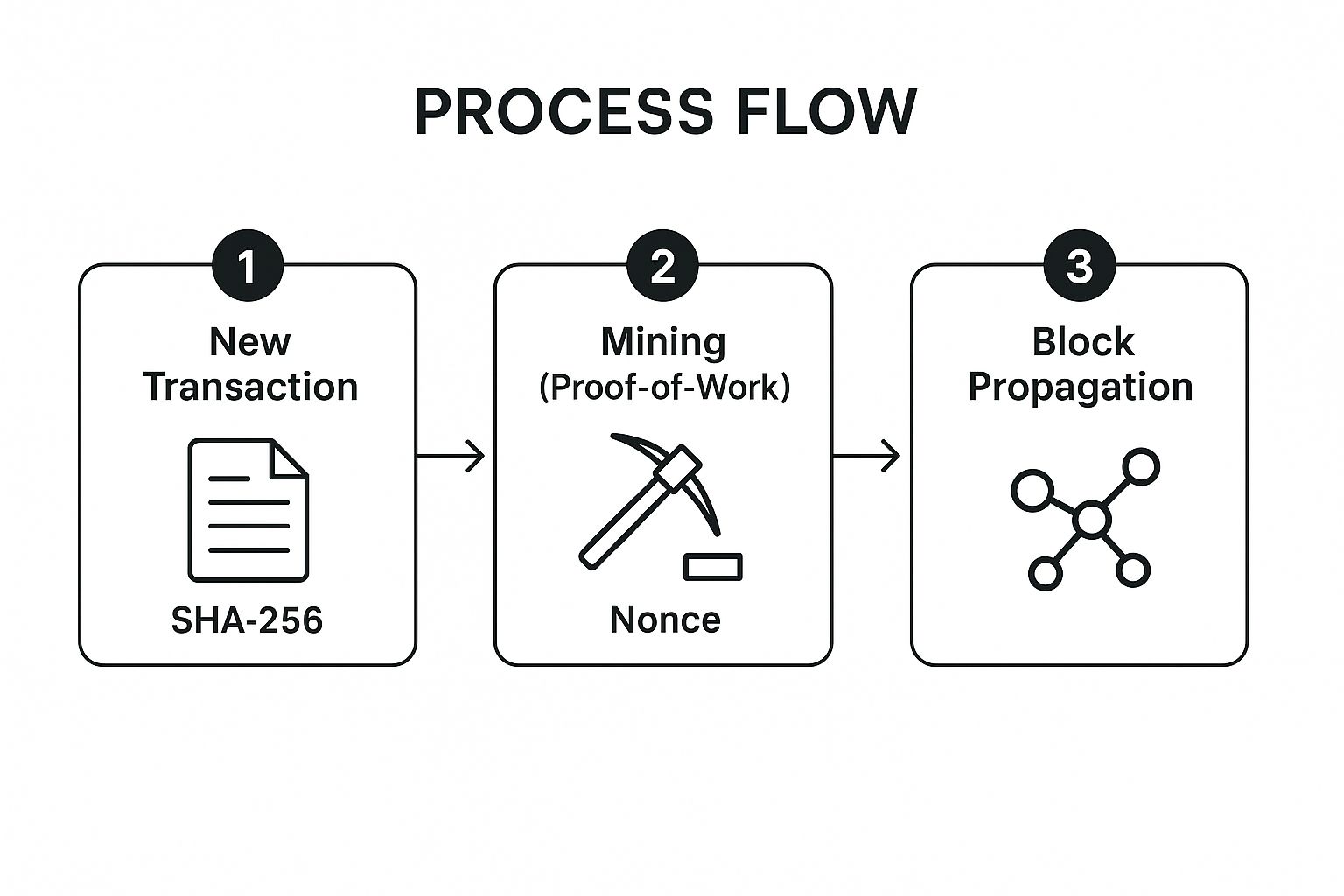
This hands-on simulation reveals how decentralized systems like Bitcoin and Ethereum achieve trust and security without a central authority. For developers entering the Web3 space, understanding this architecture at a fundamental level is crucial for building decentralized applications (dApps) and contributing to blockchain protocols.
Strategic Breakdown
Creating a blockchain simulation is one of the most comprehensive projects on cryptography because it forces you to integrate disparate primitives into a cohesive whole. The project requires a solid grasp of hash functions (like SHA-256), public-key cryptography for digital signatures, and the logic behind consensus algorithms like Proof-of-Work.
- Objective: Construct a functional, albeit simplified, blockchain that can create and validate transactions, mine new blocks through a consensus mechanism, and maintain an immutable ledger across a simulated network.
- Tech Stack: Python or Go are excellent choices. Python offers simplicity and readability for implementing the core logic, while Go’s concurrency features are ideal for simulating a peer-to-peer network.
- Learning Outcomes: Gain a practical understanding of how cryptographic tools secure a distributed system, the mechanics of consensus algorithms, and the principles of immutability and decentralization that define blockchain technology.
Actionable Takeaways
To make your blockchain simulation a powerful learning tool, concentrate on these tactical elements:
- Focus on Cryptographic Correctness: Prioritize the correct implementation of hash links between blocks and valid digital signatures for transactions. The security of the entire chain depends on these cryptographic foundations.
- Implement a Simple Consensus Algorithm: Start with a basic Proof-of-Work (PoW) algorithm. This involves finding a "nonce" that, when hashed with the block's data, produces a hash with a certain number of leading zeros. This demonstrates the concept of computational difficulty in mining.
- Ensure Proper Transaction Validation: Before adding a transaction to a block, your code must verify the sender's signature and ensure they have sufficient funds. This prevents fraudulent transactions and double-spending within your simulated ecosystem.
4. Secure Chat Application
Building a secure chat application is an ambitious yet incredibly rewarding project that delves into the practical application of modern cryptographic protocols. This endeavor involves creating an end-to-end encrypted messaging system, where messages are secured in a way that only the communicating users can read them. The project requires implementing sophisticated mechanisms like the Signal Protocol, which combines symmetric and asymmetric encryption to achieve forward secrecy and post-compromise security.

This project provides a comprehensive look at how cryptographic primitives are layered to build a secure communication channel, similar to what powers Signal and WhatsApp. For anyone interested in network security or privacy-preserving technologies, this is a capstone project that demonstrates mastery over complex cryptographic systems.
Strategic Breakdown
Creating a secure messaging app is one of the most practical projects on cryptography, as it forces you to solve real-world security challenges. The implementation goes beyond simple encryption and decryption, touching on key exchange, session management, and secure message transport. For implementing secure communication, a clear understanding of concepts like what is end-to-end encryption is indispensable.
- Objective: Develop a functional chat application with end-to-end encryption, ensuring message confidentiality, integrity, and authenticity using a protocol like Signal.
- Tech Stack: A backend language like Go or Node.js is suitable for server logic, while Python is excellent for prototyping the cryptographic engine. A networking library like
socketsor a framework like gRPC will be necessary. - Learning Outcomes: Gain expertise in advanced cryptographic concepts such as the Diffie-Hellman key exchange, forward secrecy, and the double ratchet algorithm. Learn to manage cryptographic keys and sessions securely.
Actionable Takeaways
To build a secure and functional chat application, focus on these critical implementation details:
- Implement the Signal Protocol (or a Simplified Version): Instead of reinventing the wheel, study and implement the Signal Protocol. It provides a battle-tested blueprint for secure key exchange (using the X3DH handshake) and session management (using a double ratchet).
- Focus on Key Verification: A secure channel is useless if users are talking to an impostor. Implement a key verification mechanism, such as comparing safety numbers or scanning QR codes, to prevent man-in-the-middle (MITM) attacks.
- Handle Offline Messaging Securely: Design a system to store encrypted messages on the server for offline users. Ensure these messages remain secure until the recipient comes online and can decrypt them with their private keys, without compromising the server.
5. Digital Signature and PKI System
Building a Public Key Infrastructure (PKI) with a digital signature system is an advanced project that bridges theoretical cryptography with real-world trust and identity management. This project involves creating a system to issue, manage, distribute, and revoke digital certificates, which bind public keys to identities. The digital signature component uses asymmetric cryptography to verify the authenticity and integrity of a message, ensuring it came from a specific sender and has not been altered.
This project is crucial for anyone looking to understand the trust models that secure the modern internet, from SSL/TLS certificates that enable HTTPS to the code signing certificates that verify software legitimacy. For Web3 developers, this knowledge is directly applicable to managing digital identities, authenticating nodes, and building secure, decentralized communication networks.
Strategic Breakdown
Creating a functional PKI is one of the most comprehensive projects on cryptography you can undertake, as it forces you to manage the entire lifecycle of cryptographic trust. It requires a solid grasp of asymmetric algorithms, hashing functions, and the protocols that govern certificate validation.
- Objective: Develop a miniature Certificate Authority (CA) that can generate a root certificate, issue end-entity certificates (e.g., for users or servers), and create a mechanism to sign data and verify those signatures against the issued certificates.
- Tech Stack: Go or Java are excellent choices due to their strong standard libraries for handling X.509 certificates and cryptographic operations. OpenSSL's command-line tools can also be used for prototyping and validation.
- Learning Outcomes: Gain an in-depth understanding of trust chains, certificate revocation lists (CRLs), Online Certificate Status Protocol (OCSP), and the practical challenges of maintaining a secure PKI.
Actionable Takeaways
To make your PKI implementation both secure and instructive, concentrate on these essential tactics:
- Implement a Clear Certificate Hierarchy: Start by creating a self-signed root CA certificate. Use this root CA to sign an intermediate CA, and then use the intermediate CA to issue certificates to end-entities. This tiered structure mirrors real-world PKI and improves security by keeping the root key offline.
- Handle Certificate Validation Correctly: Your verification logic must check the entire certificate chain, starting from the end-entity certificate and validating each signature up to a trusted root. This process must also include checks for expiration dates, key usage constraints, and revocation status.
- Incorporate a Revocation Mechanism: A PKI is incomplete without a way to revoke compromised certificates. Implement a simple Certificate Revocation List (CRL) that the CA publishes periodically. Your verification function should be designed to check this list before trusting any certificate.
6. Password Manager with Strong Encryption
Building a secure password manager is an advanced project that synthesizes multiple cryptographic concepts into a practical, high-stakes application. This project involves creating a system that securely stores user credentials using strong encryption, ensuring that even if the database is compromised, the sensitive data remains protected. The core principle is a zero-knowledge architecture, where the service provider can never access the user's unencrypted data. This is achieved by encrypting the data locally on the user's device before it's ever sent to a server.
This project directly addresses real-world security needs and is an excellent demonstration of applied cryptography. For developers interested in security engineering or Web3, where key management is paramount, building a password manager showcases the ability to handle sensitive user data responsibly. It demonstrates a deep understanding of cryptographic primitives and secure system design, making it one of the most impactful projects on cryptography.
Strategic Breakdown
Creating a secure password manager is a comprehensive challenge that tests your knowledge of symmetric encryption, key derivation, and secure architecture. The goal is to build a system where the master password is the single key to unlocking the user's encrypted vault, and this key never leaves the client's device.
- Objective: Develop a zero-knowledge password manager that encrypts a user's password vault locally using a key derived from their master password, and securely synchronizes the encrypted vault with a remote server.
- Tech Stack: Use a language with robust crypto libraries like JavaScript (with Web Crypto API), Python (with
cryptographylibrary), or Rust. A backend can be built with Node.js or a simple Python framework. - Learning Outcomes: Master authenticated encryption (e.g., AES-GCM), secure key derivation functions (KDFs) like Argon2 or PBKDF2, and the principles of zero-knowledge system design.
Actionable Takeaways
To build a password manager that is genuinely secure and not just a toy project, focus on these critical tactics:
- Use a Strong Key Derivation Function (KDF): Never use a master password directly as an encryption key. Instead, use a memory-hard KDF like Argon2 to derive the encryption key. This makes brute-force attacks against a stolen database computationally expensive and slow.
- Implement Authenticated Encryption: Use an authenticated encryption mode like AES-256-GCM. This not only encrypts the data but also provides integrity and authenticity checks, preventing tampering with the encrypted vault (e.g., a "bit-flipping" attack).
- Never Store the Master Password: The entire security model relies on the master password never being stored or transmitted. All encryption and decryption operations must happen on the client-side, ensuring only the user can ever access their unencrypted data.
7. Homomorphic Encryption Calculator
Building a homomorphic encryption calculator is a cutting-edge project that explores one of the most powerful concepts in modern cryptography. Homomorphic encryption allows computations to be performed directly on encrypted data without needing to decrypt it first. This "holy grail" of cryptography enables privacy-preserving analysis, secure cloud computing, and confidential data processing, as a third party can process sensitive information without ever having access to the underlying raw data.
This project provides a unique window into the future of secure computation. For developers interested in privacy-tech, secure multi-party computation, and confidential DeFi, understanding these principles is a massive differentiator. It showcases an ability to work with highly advanced and complex cryptographic primitives.
Strategic Breakdown
Implementing a homomorphic encryption scheme is one of the most advanced projects on cryptography you can undertake, requiring a solid grasp of lattice-based cryptography and advanced algebra. The goal is to see how operations like addition or multiplication can be performed on ciphertexts.
- Objective: Develop a simple calculator that can perform arithmetic operations (e.g., addition and multiplication) on encrypted numbers, then decrypt the result to verify its correctness.
- Tech Stack: C++ is often preferred for performance, with libraries like Microsoft SEAL or HElib. Python can also be used for prototyping, leveraging wrappers or simpler implementations.
- Learning Outcomes: Gain deep insights into privacy-preserving technologies, the challenges of noise management in homomorphic schemes, and the performance trade-offs inherent in computing on encrypted data.
Actionable Takeaways
To make this complex project manageable and educational, concentrate on these key tactics:
- Start with a Partially Homomorphic Scheme: Instead of tackling a fully homomorphic encryption (FHE) scheme immediately, begin with a simpler one like Paillier, which supports addition. This builds a foundational understanding of the core concepts without the complexity of bootstrapping.
- Focus on Noise Management: A critical challenge in many homomorphic schemes is "noise," which grows with each computation. Understand how this noise accumulates and why it eventually makes the ciphertext undecipherable. This will clarify the need for techniques like bootstrapping in FHE.
- Use Existing Libraries for Complex Schemes: For implementing FHE, leverage robust, open-source libraries like Microsoft SEAL or Zama's Concrete. Building an FHE scheme from scratch is a massive undertaking; using these libraries allows you to focus on the application and logic rather than the low-level cryptographic implementation.
7 Cryptography Projects Comparison
| Project Title | Implementation Complexity 🔄 | Resource Requirements ⚡ | Expected Outcomes 📊 | Ideal Use Cases 💡 | Key Advantages ⭐ |
|---|---|---|---|---|---|
| RSA Encryption Implementation | Intermediate – involves key generation, modular arithmetic | High CPU due to large prime computations | Secure asymmetric encryption and digital signatures | Secure communications, certificates, SSH keys | Strong mathematical basis, industry standard, supports signatures |
| AES Symmetric Encryption System | Intermediate – detailed algorithm with multiple modes | Moderate CPU, hardware acceleration available | Fast symmetric encryption/decryption | File encryption, VPN, disk encryption, wireless security | Fast and memory efficient, government approved standard |
| Blockchain and Cryptocurrency Simulation | Advanced – integrates cryptography with networking and consensus | High CPU for mining, networking needed | Distributed ledger with secure transactions | Cryptocurrency, educational demos, private blockchains | Combines multiple crypto concepts, relevant to modern tech |
| Secure Chat Application | Advanced – combines multiple protocols and key management | Moderate to high depending on encryption level | End-to-end encrypted messaging platform | Secure messaging apps like Signal, WhatsApp | Combines symmetric/asymmetric encryption, forward secrecy |
| Digital Signature and PKI System | Advanced – complex trust models and certificate management | Moderate CPU and storage for certificates | Trust infrastructure for authentication | Internet security, SSL/TLS certificates, code signing | Foundation of internet security, scalable trust model |
| Password Manager with Strong Encryption | Intermediate – key derivation and encryption focus | Moderate CPU and secure storage | Secure password storage and management | Personal password security apps | Addresses common security problem, practical application |
| Homomorphic Encryption Calculator | Expert – advanced math, noise management, circuit evaluation | Very high CPU, large ciphertext overhead | Privacy-preserving computation on encrypted data | Cloud security, privacy-sensitive computation | Cutting-edge cryptography, privacy-preserving, future tech |
Final Thoughts
Our journey through these diverse projects on cryptography has illuminated a clear path from foundational theory to practical, real-world application. We've seen how a simple RSA implementation can demystify the core principles of asymmetric encryption, and how building an AES tool provides tangible experience with the speed and efficiency of symmetric ciphers. Each project is more than just a coding exercise; it's a strategic stepping stone into the heart of modern digital security.
The true value of undertaking these projects lies in the hands-on experience they provide. You don't just learn about public key infrastructure; by building a digital signature system, you internalize the entire certificate lifecycle. You don't just read about blockchain; you simulate one, gaining a profound appreciation for its consensus mechanisms and immutable ledger. This transition from passive learning to active building is what separates a knowledgeable enthusiast from a skilled practitioner.
Key Takeaways and Strategic Next Steps
The projects outlined, from a secure password manager to a homomorphic encryption calculator, serve as a comprehensive curriculum. They are designed to build upon one another, equipping you with a versatile skill set that is in high demand across the Web3, cybersecurity, and fintech industries.
Here are the most critical takeaways to guide your next moves:
- Start with the Fundamentals: Don't skip the basics. Mastering RSA and AES implementation (Projects 1 and 2) provides the essential cryptographic vocabulary needed for more complex applications like secure chat or blockchain simulations.
- Bridge Theory and Application: The most impactful projects, such as the Secure Chat Application (Project 4) and the PKI System (Project 5), force you to solve real-world problems. This is where you learn about key exchange protocols, certificate validation, and user authentication in a practical context.
- Document and Showcase Your Work: A GitHub repository is your portfolio. For each project, create a detailed
README.mdfile that explains the cryptographic concepts, the architecture of your solution, and the challenges you overcame. This demonstrates not only your coding ability but also your deep understanding of the underlying principles.
Strategic Insight: The ability to articulate why you chose a specific cryptographic algorithm or protocol for a project is as important as the implementation itself. This demonstrates senior-level thinking and an understanding of trade-offs between security, performance, and complexity.
The Broader Impact of Your Cryptographic Skills
Mastering cryptography through hands-on projects opens doors to some of the most innovative and lucrative fields in technology. You become a candidate for roles in blockchain development, where securing digital assets is paramount. You can contribute to cybersecurity firms building next-generation defense systems or work on privacy-preserving technologies in AI and data science. The skills you build are not just theoretical; they are the bedrock of trust in our increasingly digital world.
By tackling these projects on cryptography, you are actively preparing yourself for a future where secure data transmission, verifiable digital identity, and decentralized systems are the norm. Each line of code you write is a step toward becoming a creator and guardian of that future. The journey is challenging, but the rewards, both in knowledge and career opportunities, are immense.
Ready to leverage your new skills and find your place in the decentralized future? The Find Web3 job board connects talented developers, engineers, and professionals with leading companies in the blockchain and crypto space. Explore curated opportunities where your expertise in cryptography is exactly what they're looking for. Visit Find Web3 to discover your next career-defining role.