
Securing a smart contract isn’t just about writing good code. It’s a comprehensive discipline that demands a defense-in-depth strategy, covering everything from the initial design all the way through post-deployment monitoring. With smart contracts, you don’t get a second chance. They are immutable and often control millions—or even billions—in assets, so a single mistake can lead to catastrophic, irreversible losses.
The key is to treat security as a core part of the entire development lifecycle, not a final checkbox.
The High Stakes of Smart Contract Security
Smart contracts are the engine of Web3, powering decentralized applications and managing a massive amount of value. But their greatest strength—immutability—is also their biggest risk. Once a contract is live on the blockchain, its code is set in stone. Any security hole you missed becomes a permanent, public target for anyone to exploit. It's not like patching a bug on a website; it's more like realizing you launched a satellite with a critical flaw after it's already in orbit.
The numbers are genuinely terrifying. In the first quarter of 2025 alone, hackers made off with over $1.6 billion from just 197 security incidents targeting smart contracts. Ethereum, being the heart of DeFi, was hit the hardest, accounting for nearly $1.54 billion of those losses. What’s even more concerning is how little of that stolen money is ever recovered—the rate has crashed to a grim 0.38%. Once it's gone, it's almost certainly gone for good.
Security in this space isn't just about preventing bugs. It's about protecting against systemic financial collapse within an ecosystem. A single exploit can wipe out user funds, destroy a project's reputation, and erode trust in decentralized technology itself.
This sobering reality forces us to think differently. Securing a smart contract is a fundamental requirement, not an optional extra. The threats are diverse, ranging from classic coding errors to sophisticated economic exploits, oracle manipulation, and even simple operational security failures like a compromised private key.
Common Threats and Their Defenses
To build resilient contracts, you first need to know what you're up against. While attackers are always innovating, many of the most devastating hacks exploit a handful of well-known vulnerability patterns. Getting to know these is your first line of defense.
Below is a quick overview of some of the most common vulnerabilities you'll encounter and the best practices for defending against them. Think of this as your "most wanted" list.
Common Smart Contract Vulnerabilities and Key Defenses
| Vulnerability Type | Description | Primary Defense Mechanism |
|---|---|---|
| Reentrancy | An attacker's contract repeatedly calls back into the victim's contract before the first invocation is finished, draining funds. | Use the Checks-Effects-Interactions pattern; employ reentrancy guards. |
| Access Control Flaws | Functions with privileged access (e.g., withdraw, changeOwner) are improperly protected, allowing unauthorized calls. | Implement Role-Based Access Control (RBAC) and the principle of least privilege. |
| Integer Over/Underflow | An arithmetic operation creates a number that's too large or small for its data type, causing it to wrap around to an unexpected value. | Use modern Solidity versions (0.8.0+) which have built-in checks; use secure math libraries. |
| Oracle Manipulation | An attacker manipulates external price feeds that a DeFi protocol relies on to trigger unfair liquidations or arbitrage. | Use decentralized oracle networks (e.g., Chainlink) and implement sanity checks on incoming data. |
Knowing these specific threats is a great start, but true security requires a more holistic approach. You need to understand the entire ecosystem your contract operates in. For more real-world analysis of DeFi risks and security, the yieldseeker Blog is a great resource that often dives into the practical side of these challenges.
Ultimately, the goal is to design a system that is inherently resilient from the ground up, not one that just gets patched up after a problem is found.
Building Security in Before You Write Any Code

The most important security work you'll ever do on a smart contract happens before a single line of Solidity is written. That might sound counterintuitive, but it's true. Real security is baked in at the architectural level, not sprinkled on top as an afterthought.
By focusing on battle-tested design patterns from the very beginning, you can design away entire categories of vulnerabilities. It’s the difference between building a fortress and trying to patch up a wooden shack after it's already built. This proactive mindset is everything.
This approach mirrors how any secure system is built, on-chain or off. The core idea is to start with a solid foundation, which is why implementing a robust cybersecurity framework is a critical concept even outside of Web3. For us, that means designing contract logic that is inherently hostile to attackers.
Neutralize Reentrancy with Checks-Effects-Interactions
If there's one pattern you need to burn into your memory, it's Checks-Effects-Interactions (CEI). This is your number one defense against reentrancy attacks, the very vulnerability behind some of the most devastating DeFi hacks.
The flow is straightforward but incredibly powerful:
- Checks: First, you validate everything. Use
require()to check permissions, inputs, and the contract’s current state. If anything is off, the transaction fails right there. No exceptions. - Effects: Next, you update your contract's internal state. This is where you do the math—updating balances, changing ownership, toggling flags. Settle your internal books first.
- Interactions: Only after all checks have passed and all state changes are complete do you interact with the outside world. This is the last step, where you might send ETH or call another contract's function.
By changing your contract’s state before making that external call, you shut the door on a malicious contract trying to call back into your function to exploit an old, outdated state.
This isn't just a best practice; it's a fundamental shift in how you should think. Assume every external contract you call is hostile. CEI forces you to code defensively against that reality.
Planning for the Worst with an Emergency Stop
Let's be realistic: no matter how much you test, a bug can always slip through. An emergency stop, often called a "circuit breaker," is your panic button. It’s a vital fail-safe that lets you pause critical functions when things go wrong.
Typically, this is just a simple boolean flag, maybe isPaused, controlled by a secure admin address or a multisig wallet. When flipped, key functions like withdraw() are modified to revert all transactions. It won't fix the bug, but it stops the bleeding. This gives you the breathing room to investigate the exploit, warn your users, and figure out a recovery plan without losing more funds.
You can easily implement this from day one using a Pausable module from a trusted library like OpenZeppelin. It’s a simple addition that provides a massive layer of risk management.
Designing for the Future with Upgradeability
The fact that blockchains are immutable is both a feature and a bug. To handle this, many mature projects rely on upgradeable contracts built with a proxy pattern. This clever design separates your contract's logic from its data, allowing you to deploy new logic without losing the original contract's address or state.
Here’s the high-level view:
- Proxy Contract: This is the stable address users interact with. It holds all the user data and contract state.
- Implementation Contract: This contract contains all the business logic that’s currently active.
- The Upgrade: When you need to fix a bug or add a feature, you deploy a new implementation contract. Then, you just instruct the proxy to point to this new logic address.
Be warned, however—upgradeability isn't a silver bullet. It introduces its own attack vectors, like storage layout collisions and complex initialization risks. You have to know what you're doing.
If you're new to these concepts, our Web3 Dictionary can help demystify terms like "proxy" and "immutability" that are so critical here. While it demands careful planning, adopting an upgradeability pattern gives you the flexibility you need for the long-term health and security of your project.
Implementing Robust Access Control and Data Feeds
Let’s be blunt: defining who can do what inside your smart contract isn't just a nice-to-have feature. It's the absolute bedrock of its security. Getting access control wrong is a direct path to disaster, and it's still one of the most common mistakes I see developers make.
The classic onlyOwner modifier is where many people start, but honestly, it’s often too blunt an instrument for real-world applications. A serious protocol rarely has a single "owner." You'll likely have admins who can pause the contract, minters who can create tokens, and maybe a separate treasury role to manage funds. Giving one super-powered account the keys to everything creates a massive single point of failure.
Moving to Granular Role-Based Access Control
A much more sophisticated and secure way forward is Role-Based Access Control (RBAC). This pattern is all about creating specific roles and assigning them only the permissions they absolutely need. It's a direct application of the principle of least privilege—nothing more, nothing less.
This is exactly where you lean on battle-tested libraries. Trying to roll your own security primitives is a classic rookie mistake that often introduces more vulnerabilities than it solves.
The screenshot above is from the OpenZeppelin Contracts library, a go-to resource for a reason. Their pre-audited and community-vetted AccessControl contract makes implementing RBAC incredibly straightforward. It gives you the tools to create, grant, and revoke specific roles on the fly, which immediately strengthens your contract's security posture.
By splitting up privileges, you dramatically shrink your attack surface. Think about it: if a minter key gets compromised, the attacker can only mint new tokens. They can't drain the treasury or upgrade the entire contract. That kind of containment is crucial for managing risk.
The Emerging Threat of Oracle Manipulation
While locking down internal permissions is critical, many smart contracts are completely dependent on external information—especially price data. This reliance on data feeds, known as oracles, opens up another major attack vector. If an attacker can feed your contract bad price data, they can exploit its logic for a massive payday.
This isn't just a theory. In fact, price oracle manipulation has been officially recognized as one of the top smart contract vulnerabilities. While flawed access control still holds the number one spot on the OWASP SC Top 10, price oracle manipulation was newly added for 2025, highlighting just how prevalent this threat has become in DeFi. These exploits often use flash loans to temporarily skew the spot price on a single decentralized exchange, triggering unfair liquidations or draining protocol funds. You can dive deeper into these risks by reading a breakdown of top smart contract vulnerabilities.
Hardening Your Oracle Integrations
Securing your data feeds demands a defense-in-depth approach. You simply cannot afford to blindly trust a single source of information.
Here are some practical strategies I always recommend for locking down oracle integrations:
- Use Decentralized Oracle Networks: Don't even think about using a single, centralized price feed. It's a recipe for disaster. Instead, you should be integrating with a decentralized network like Chainlink. These networks pull data from many independent sources, which makes them far more resistant to manipulation.
- Implement Time-Weighted Average Prices (TWAPs): Flash loan attacks work because they create huge, but very brief, price swings. A TWAP neutralizes this by calculating an asset's average price over a longer period. A sudden, manipulated price spike barely moves the needle on a longer-term average.
- Build in Sanity Checks: Before your contract ever acts on a price, it needs to ask: "Does this number even make sense?" This means coding in
require()statements that set reasonable upper and lower bounds. For instance, if an oracle suddenly reports ETH is worth $10, a simple sanity check would catch the anomaly and revert the transaction, stopping an exploit in its tracks.
When you combine robust internal controls with hardened, redundant data feeds, you build a contract that can withstand attacks from both inside and out. In today's environment, getting these two areas right is completely non-negotiable.
9. Your Practical Toolkit for Testing and Auditing
Let's get one thing straight: writing secure code is a marathon, not a sprint. I don’t care how many years you’ve been in the game; nobody ships flawless code on the first try. This is exactly why a methodical testing and verification strategy isn't just a "nice-to-have"—it's your most powerful ally in hardening smart contracts.
Think of it as a layered process. It starts on your local machine with some automated checks and ends with a pair of fresh, expert eyes going over every line of your code. By combining automated tools, rigorous manual testing, and professional oversight, you build a formidable defense against exploits.
Start with Automated Security Scanners
Before you even think about a manual review, let the robots do the heavy lifting. Automated scanners are your first line of defense. They act like a linter on steroids, flagging common vulnerabilities and well-known anti-patterns right inside your IDE or CI/CD pipeline.
These tools are fantastic for catching the low-hanging fruit, which frees up your mental energy to focus on the truly complex business logic flaws that only a human can spot.
For any serious developer, you'll want to get familiar with three main types of analysis:
- Static Analysis: Tools like Slither are essential. They read your source code without actually running it, building a map of your contract's logic. From there, they check for known bug patterns like reentrancy, unlocked pragmas, or potential integer overflows. It's your first, fundamental check.
- Dynamic Analysis (Fuzzing): This is where you really put your code through its paces. A fuzzer like Echidna will bombard your contract with a massive number of random or semi-random inputs, trying to break it. You define the rules—the invariants—and the fuzzer relentlessly searches for any transaction sequence that could violate them.
- Symbolic Execution: This is a more advanced technique used by tools like Manticore. It explores every single possible execution path in your code by treating inputs as symbolic variables. This allows it to mathematically prove whether certain unwanted states, like an attacker draining all the funds, are actually reachable.
The image below gives you a sense of how some of these popular tools stack up.
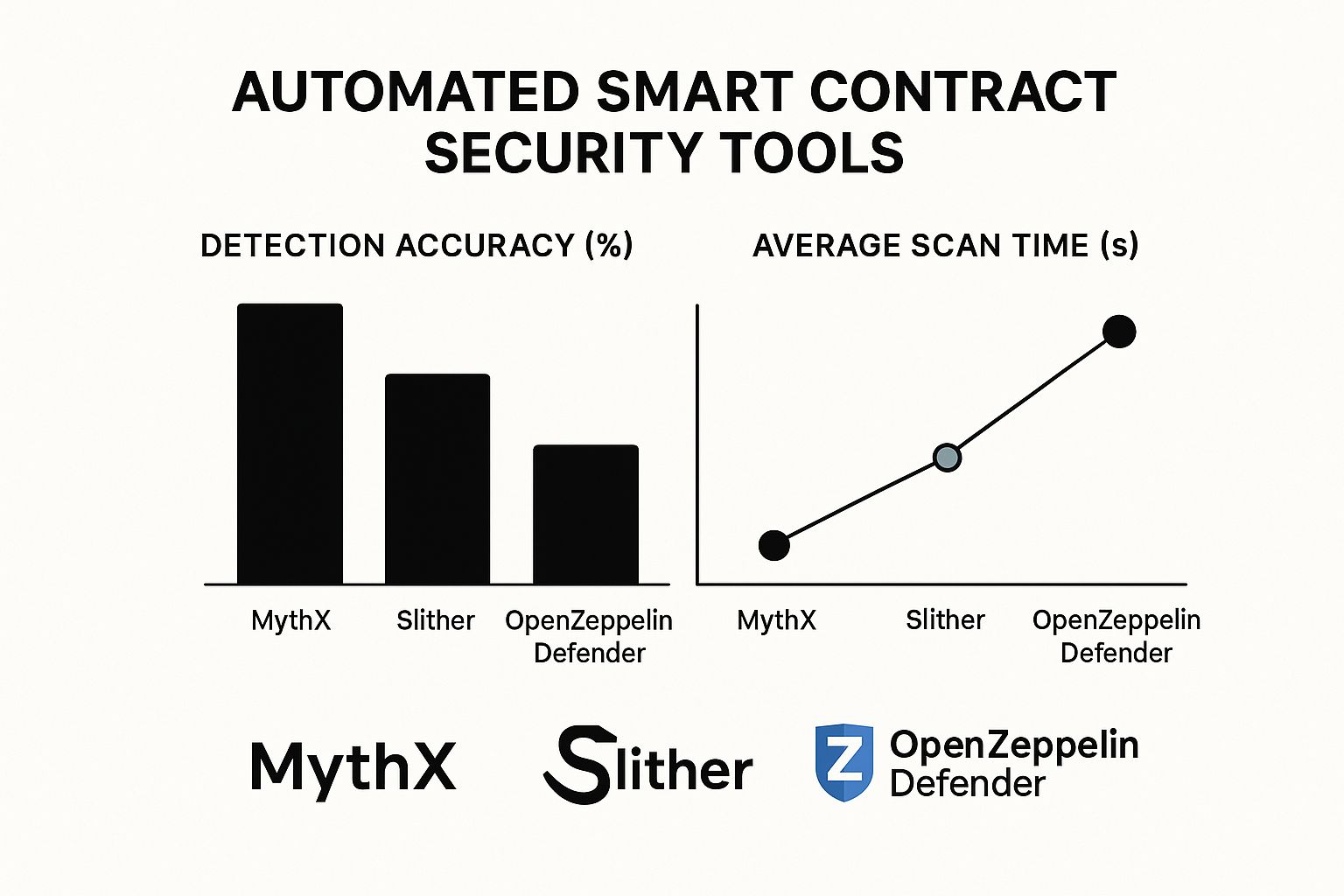
As you can see, there’s often a trade-off. Some tools are lightning-fast but might miss things, while others are more thorough but take longer to run. This is why a multi-tool approach is always the best bet.
Smart Contract Security Tool Comparison
To help you choose, here's a quick breakdown of some of the go-to tools in the industry. Each has its own strengths, and the best security teams I've worked with use a combination of them to cover all their bases.
| Tool Name | Analysis Type | Best For | Key Feature |
|---|---|---|---|
| Slither | Static | Finding common vulnerabilities early. | Fast, CI/CD integration, rich set of detectors. |
| Echidna | Dynamic (Fuzzing) | Property-based testing and finding logic bugs. | Tests user-defined invariants, not just known patterns. |
| Manticore | Symbolic | Deep analysis and proving exploitability. | Explores all code paths to find subtle bugs. |
| Mythril | Symbolic | Automated vulnerability detection. | Classic tool, good for quick checks on deployed bytecode. |
Ultimately, the goal is to build a safety net. No single tool is a silver bullet, but together they can catch a surprising number of issues before they ever become a real problem.
Don't Skip Unit and Integration Testing
While scanners are great for finding known patterns, they can't validate your project's unique business logic. That's your job. Modern development frameworks like Foundry or Hardhat come with powerful testing suites, and these should be the absolute bedrock of your workflow.
You'll need to write two main kinds of tests:
- Unit Tests: These are small, focused, and fast. They check individual functions in total isolation. Does your
deposit()function actually update a user's balance correctly? DoescalculateFee()return the expected amount for a given input? - Integration Tests: This is where you test how different parts of your system interact. Can a user successfully deposit tokens into Contract A, stake them in Contract B, and then withdraw the resulting rewards from Contract A? Integration tests are critical for uncovering emergent bugs that only appear when components start talking to each other.
Key Takeaway: A strong test suite isn’t just for security; it’s a living document of how your contract is supposed to behave. Don't just chase 100% test coverage. Instead, aim for thoughtful coverage that specifically targets edge cases, complex interactions, and your system's most critical invariants.
Preparing for a Professional Audit
An independent, professional security audit is the final and most crucial step before you even think about deploying. This is where you bring in third-party experts to scrutinize your entire codebase, documentation, and overall architecture for vulnerabilities.
While an audit is not a magical guarantee of security, it provides an invaluable external perspective from specialists who've seen hundreds of protocols and know exactly what to look for.
To get the most value from an audit, you need to come prepared.
- Clean and Documented Code: Make your auditors' lives easier. Ensure your code is well-commented and follows a consistent style. More importantly, provide clear, comprehensive documentation that explains the system's architecture and intended behavior. Auditors aren't mind readers.
- A Complete Test Suite: Handing over a robust test suite shows auditors you’ve done your homework. It helps them quickly understand your contract’s logic and allows them to focus their limited time on more complex and novel attack vectors.
- Choose the Right Firm: Not all audit firms are created equal. Look for firms with a proven, public track record of auditing protocols similar to yours. Check their published reports to see how they communicate their findings. Initiatives like the Soroban Security Audit Bank are also helping raise the bar by connecting projects with vetted, high-quality experts.
The auditing process should be a collaboration. The best security engineers are in high demand, and if you're looking to become one, you'll find that deep expertise in testing and verification is non-negotiable. You can explore a variety of blockchain engineering jobs where these skills are front and center.
Always treat audit findings not as criticism, but as a gift—they are actionable insights to harden your code and make your project safer for everyone.
Securing Your Deployments and Operations
Even a perfectly coded and audited smart contract can be compromised by a surprisingly simple mistake: weak operational security (OpSec). Securing your contracts isn't just about what happens in your IDE. It's about every single process that touches your project, especially how you deploy it and manage it day-to-day.
A flawless contract controlled by a vulnerable key is like building an impenetrable vault but leaving the key under the doormat. It’s where many projects, even experienced ones, find themselves in serious trouble. You have to expand your focus beyond the code and look at the entire infrastructure supporting your dApp.
The Real Threat? Your Private Keys
The security conversation is shifting. While we’ll always have to worry about code-level exploits, the industry is waking up to a massive and growing vulnerability: operational risk. Recent analysis shows a troubling trend where operational failures—especially compromised private keys—are now a dominant cause of major security breaches.
In fact, operational risks have quickly overtaken traditional code vulnerabilities as the leading source of losses in DeFi. Attackers are increasingly targeting the deployer accounts themselves, which lets them maliciously update otherwise secure contracts. This shines a light on a critical gap that goes beyond code audits, demanding a much stronger focus on the off-chain processes we use to manage privileged accounts. You can dive deeper into this research in Halborn's analysis of operational risks.
A Battle-Tested Playbook for Key Management
Protecting the private keys that hold administrative power over your contracts is non-negotiable. A single compromised key can give an attacker the ability to drain funds, upgrade the contract to a malicious version, or permanently freeze all operations.
Your primary goal here is to eliminate any single point of failure. I’ve seen this work in practice, and here's a hierarchy of tools you should be using:
- Hardware Wallets: At the absolute minimum, any address with privileged access must be controlled by a hardware wallet like a Ledger or Trezor. Storing keys in a browser extension or a
.envfile on a server is just asking for a bad day. - Multi-Signature (Multisig) Wallets: This is the industry standard for a reason. A multisig wallet is itself a smart contract that requires multiple, independent keyholders (e.g., 3 out of 5) to approve a transaction. This makes it exponentially harder for an attacker to gain control. Think of it as requiring multiple managers to turn their keys at the same time to open the bank vault.
- Multi-Party Computation (MPC): For institutional-grade security, MPC is a powerful alternative. It works by splitting a single private key into encrypted "shards" that are distributed among multiple parties and devices. A transaction can only be signed when a threshold of these parties uses their shards to collectively compute a signature—without ever putting the full key back together in one place.
My Personal Tip: Never, ever use the same address for deploying contracts and for your personal use. Keep them strictly separate. The deployer address should be used sparingly, stored with the highest level of security, and ideally managed by a multisig setup from day one.
Secure Deployment Scripts and Why Source Code Verification Matters
The deployment process itself can be a minefield. Hardcoding private keys into your scripts is a cardinal sin, as they can easily get committed to a public repository like GitHub by accident. Instead, always use environment variables that are securely managed and never, ever version controlled.
Once your contract is on-chain, you have one more crucial task: verify its source code. Uploading your contract's source to a block explorer like Etherscan allows anyone to confirm that the deployed bytecode perfectly matches the human-readable Solidity code you wrote.
This simple act provides immense value:
- It Builds User Trust: You’re proving you have nothing to hide.
- It Enables Community Auditing: White-hat hackers can more easily review your code for flaws they might spot.
- It Simplifies Integration: Other developers can see exactly how your contract works, making it easier for them to build on top of it.
Thinking about how a decentralized payment gateway can provide enhanced transaction security offers a useful parallel here. Both approaches are about creating trustless, verifiable systems where users don't have to take your word for it.
Finally, remember that security is a process, not a destination. After you deploy, you need a plan for monitoring on-chain activity and responding to incidents. Staying on top of the latest DeFi statistics and trends can help you anticipate emerging threats and understand the real-world impact of security failures. This holistic view ensures your defenses extend far beyond the initial deployment.
Answering Your Smart Contract Security Questions

When you're building a dApp, you're bound to run into some tough questions about security. It's easy to get bogged down. Let's cut through the noise and tackle some of the most common—and critical—questions I see from developers and founders all the time.
My goal here is to give you direct, no-nonsense answers so you can build with more confidence and start thinking about security from day one.
Is a Professional Audit Enough to Guarantee Security?
This is probably the most important question to get right, and the short answer is no. A professional audit is an absolutely essential, non-negotiable step in the process, but it is not a magic bullet. It doesn't guarantee your project is invincible.
Audits are incredible for sniffing out code-level vulnerabilities, tricky logic flaws, and areas where you might have strayed from best practices. But what an audit certificate can't do is protect you from threats outside the code itself. Think about a compromised private key used to deploy or manage the contract. In fact, recent data from 2025 shows that these kinds of operational failures are now a leading cause of major security breaches—a risk that audits alone simply can't cover.
Think of it this way: An audit is like having a master architect inspect the blueprints and construction of a bank vault. It ensures the vault itself is sound. But that inspection won't stop a thief who gets their hands on the keys you left lying on a desk.
Real security is a combination of things. It starts with a high-quality audit and extends to strong operational security (OpSec), like using multi-signature wallets for privileged roles, and having continuous on-chain monitoring in place.
What Is the Single Most Important Practice for a New Developer?
If you're just getting started with Solidity, the most critical practice you can master is the Checks-Effects-Interactions (CEI) pattern. It's a simple but incredibly powerful pattern that serves as your main line of defense against reentrancy attacks—one of the most devastating and historically common exploits in DeFi.
The logic is straightforward and easy to remember:
- Checks: First, perform all your
require()statements. Validate every input and check all state conditions before doing anything else. - Effects: Next, update your internal state variables. This means changing balances, updating ownership, or whatever else your function needs to do internally.
- Interactions: Finally, after all checks have passed and all state has been updated, you can interact with external contracts (like sending ETH or calling another function).
By burning this pattern into your brain, you ensure your contract's state is fully settled before any external call happens. This completely shuts down the risk of a malicious contract calling back into your function to take advantage of an outdated state. Mastering CEI is fundamental to developing a security-first instinct.
What Can I Do for a Contract Already Deployed?
Securing a live, immutable contract is tough, but you're not out of options. What you can do really hinges on how the contract was designed from the start.
If your contract is upgradeable (meaning it uses a proxy pattern), you have a clear path. You can deploy a new, patched implementation contract and just point the proxy to the new address. This is by far the cleanest and most effective solution.
But if your contract is not upgradeable, you have to shift your mindset from prevention to mitigation and monitoring. Here’s what you should do:
- Verify Source Code: If you haven't already, get the contract's source code verified on a block explorer like Etherscan. This creates transparency and is a huge trust signal for your users.
- Set Up Monitoring: Use tools like Forta to actively monitor on-chain activity. This can give you real-time alerts about suspicious transactions involving your contract.
- Create a Wrapper: If the contract holds user funds, consider deploying a "wrapper" contract. Users could interact with the wrapper, which adds an extra layer of security checks before calling the original, vulnerable contract.
- Establish a Response Plan: Have an incident response plan locked and loaded. Know how you'll communicate with your users. In a worst-case scenario, the only responsible move might be to publicly disclose the vulnerability and guide users on how to migrate their funds to a new, secure contract.
Ready to find your next role in the exciting world of Web3? Find Web3 is the premier job board for the blockchain industry, connecting top talent with innovative companies. Explore thousands of opportunities in engineering, marketing, design, and more. Visit https://findweb3.com to start your search today.