
Breaking Into the Smart Contract Development World
The world of smart contract development is booming. It offers exciting opportunities for skilled individuals. These developers are at the forefront of innovation, transforming industries like Decentralized Finance (DeFi) and digital identity systems. Opportunities abound in areas such as healthcare tokenization, transparent supply chains, and enterprise blockchain solutions.
This dynamic field offers various specializations. These include DeFi protocol architects and NFT marketplace engineers. This allows you to tailor your career path to your interests and strengths. How do you break into this exciting field?
One key factor influencing the smart contract developer roadmap is the growth of the blockchain market. This growth creates a high demand for skilled developers, pushing innovation and creating new specializations. For example, the blockchain market was valued at $28.93 billion in 2024.
It's projected to reach $49.18 billion in 2025. That's a remarkable 70% increase. This rapid expansion is fueled by growing demand for blockchain solutions across various sectors. These include finance, healthcare, and supply chain management. This growth highlights the significant career potential. Find more detailed statistics here.
Understanding the Different Paths to Success
Smart contract development offers multiple entry points and career paths. Some developers specialize in building decentralized applications (dApps) for specific industries. Others focus on core blockchain infrastructure. Your path can be as unique as your skills and interests.
- DeFi Specialist: Focuses on building decentralized exchanges, lending protocols, and other financial instruments.
- NFT Developer: Creates and manages non-fungible tokens (NFTs) for digital art, gaming, and other applications.
- Blockchain Infrastructure Engineer: Develops and maintains the underlying blockchain networks that power dApps.
- Security Auditor: Specializes in identifying and mitigating vulnerabilities in smart contracts.
Essential Skills for Smart Contract Developers
Specific skills depend on your chosen specialization. However, several core competencies are essential for all smart contract developers. Mastering these foundational skills will prepare you for a successful career.
- Programming Languages: Solidity, Rust, and Vyper are crucial languages for writing smart contracts.
- Blockchain Fundamentals: A strong understanding of blockchain technology, including consensus mechanisms and cryptography, is essential.
- Security Best Practices: Smart contracts handle valuable assets. Security expertise is paramount.
- Problem-Solving Skills: The ability to analyze complex problems and create innovative solutions is highly valued.
These skills, combined with a passion for innovation and continuous learning, are essential for success. Technical proficiency and adaptability will help you thrive in this rapidly changing field. Mastering these core aspects will prepare you for a rewarding career. You'll also be able to contribute to the evolution of the blockchain ecosystem.
Mastering the Technical Arsenal That Actually Matters
A successful smart contract developer doesn't just write code; they build secure, efficient, and scalable solutions built to last. This requires a deep understanding of the technical landscape and the ability to adapt to its constant evolution. This section breaks down the essential technical skills you need to thrive in this exciting field.
Foundational Programming Languages and Blockchain Concepts
A robust understanding of key programming languages is paramount. Solidity remains the dominant language for smart contract development on Ethereum and many other EVM-compatible blockchains. However, Rust is gaining traction due to its focus on safety and performance, particularly within Substrate-based chains like Polkadot. Vyper, a Pythonic language designed for security and auditability, offers an alternative to Solidity. Choosing the right language depends on the specific project and blockchain environment.
Beyond programming languages, a solid grasp of blockchain fundamentals is essential. This includes understanding various consensus mechanisms, such as Proof-of-Work (PoW) and Proof-of-Stake (PoS), and their implications for security and scalability. The infographic below visualizes the current usage distribution of different consensus mechanisms.
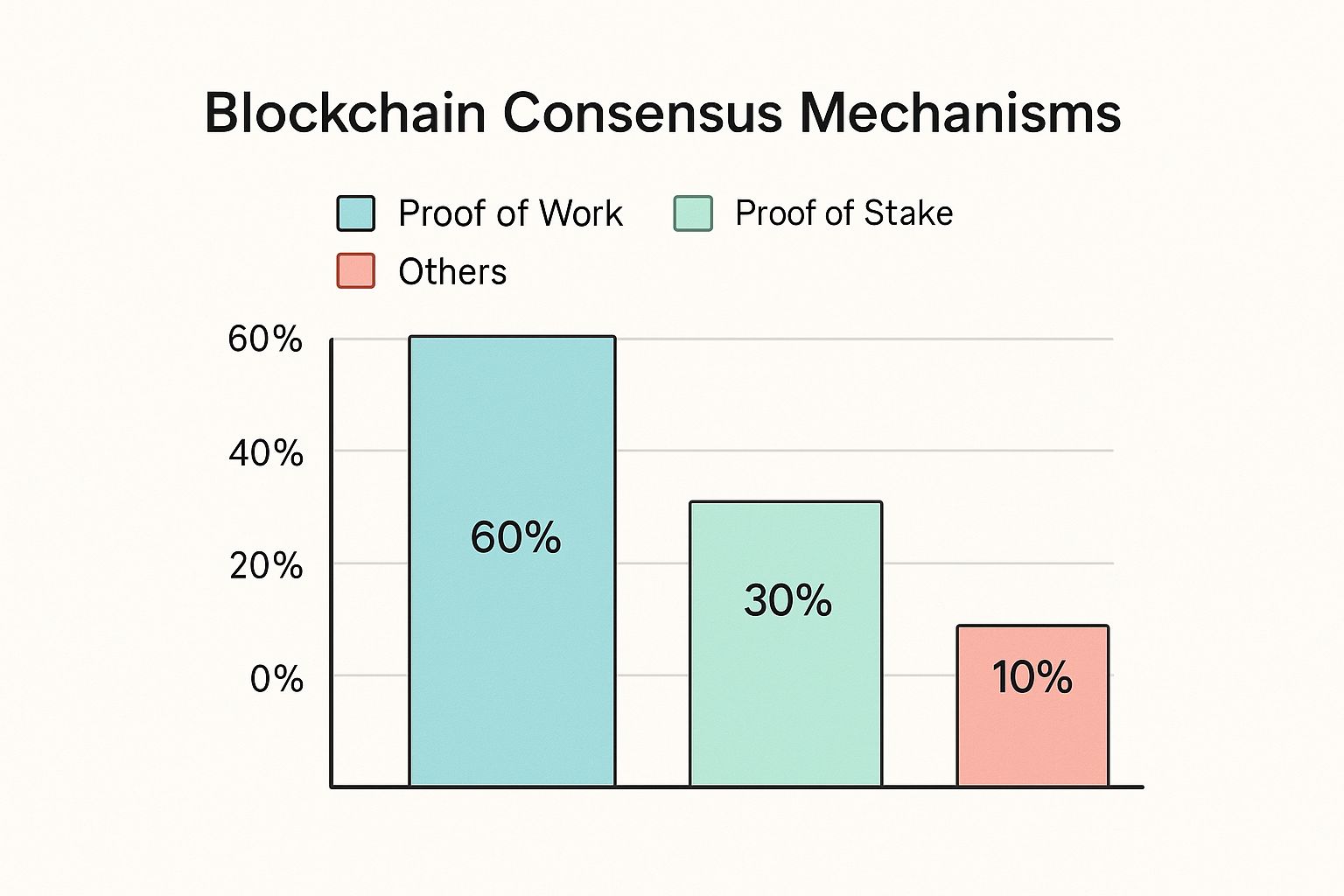
As illustrated, PoW still holds a significant share, but PoS is steadily growing, showcasing the shift towards more energy-efficient models. This knowledge helps developers make informed decisions about platform selection and optimization strategies.
Navigating Multi-Chain Development and Optimization Techniques
The blockchain ecosystem is becoming increasingly multi-chain. This means developers need to be comfortable working across different platforms like Ethereum, Polygon, and Avalanche. Each platform has its own nuances and considerations, including transaction costs, development tools, and community support.
Optimizing smart contracts for gas efficiency is also crucial. Gas refers to the computational effort required to execute a smart contract. Minimizing gas costs is essential for building cost-effective decentralized applications (dApps). This involves understanding how different operations consume gas and employing techniques to reduce unnecessary computations.
Critical Thinking Skills for Long-Term Success
Technical skills are foundational, but truly exceptional smart contract developers also possess strong critical thinking abilities. A security-first mindset is paramount. Smart contracts often handle significant value, making them attractive targets for hackers. Developers must understand common vulnerabilities and implement robust security practices throughout the development lifecycle.
Designing upgradeable contracts is another valuable skill. As blockchain technology evolves, contracts need to adapt to changing requirements. Building in upgrade mechanisms allows for bug fixes, feature enhancements, and overall improvement without complete redeployment.
To understand the skills employers are seeking, you can check out this guide on finding engineering jobs in the Web3 space.
The following table, "Smart Contract Developer Skill Progression," provides a comprehensive breakdown of skills needed at different career levels.
| Skill Category | Beginner Level | Intermediate Level | Advanced Level |
|---|---|---|---|
| Programming Languages | Solidity basics | Solidity, Vyper, or Rust proficiency | Mastery of multiple languages, including niche options |
| Blockchain Fundamentals | Understanding of core concepts (e.g., blocks, transactions) | Deep understanding of consensus mechanisms, security models | In-depth knowledge of various blockchain architectures and their trade-offs |
| Security Practices | Basic vulnerability awareness | Implementing standard security measures | Proactive threat modeling and advanced security auditing |
| Gas Optimization | Basic gas cost understanding | Employing gas optimization techniques | Developing highly gas-efficient contracts |
| Multi-Chain Development | Familiarity with one platform (e.g., Ethereum) | Experience with multiple platforms (e.g., Polygon, Avalanche) | Building cross-chain applications and bridges |
| Contract Upgradability | Basic understanding of upgrade patterns | Implementing upgradeable contracts | Designing complex upgrade mechanisms |
| Problem-Solving | Basic debugging and troubleshooting | Solving complex technical challenges | Architecting sophisticated solutions to intricate problems |
This table highlights the increasing complexity and depth of knowledge required as a smart contract developer progresses in their career. From foundational programming skills to advanced security practices and cross-chain development, continuous learning is essential for success.
Finally, developing a strong problem-solving approach is invaluable. The ability to analyze complex challenges, break them down into manageable components, and devise creative solutions sets great developers apart. This involves understanding the business logic behind a project, identifying potential bottlenecks, and crafting elegant code that meets project goals effectively. This holistic approach, combining technical expertise with strategic thinking, empowers smart contract developers to build innovative solutions that drive the future of blockchain technology.
Your Practical Learning Path From Zero to Hired
Starting your journey as a smart contract developer might seem daunting, but a structured approach can simplify the process. This practical roadmap, based on successful career transitions, guides you from beginner to job-ready developer.

Phase 1: Building A Solid Foundation
This initial phase focuses on essential blockchain and cryptocurrency fundamentals. It's crucial to grasp these core concepts before diving into smart contract development. Think of it like learning the rules of a game before playing.
Blockchain Basics: Understand the underlying technology behind blockchain, including distributed ledgers, cryptography, and consensus mechanisms. This forms the base upon which everything else is built.
Cryptocurrency Fundamentals: Learn about different cryptocurrencies, their use cases, and the economics of tokenomics. This knowledge helps you understand the context in which smart contracts operate.
Setting Up Your Development Environment: Familiarize yourself with essential tools like Remix IDE and Truffle Suite for writing, testing, and deploying smart contracts. This provides a practical workspace for your coding projects.
This foundational knowledge equips you with the necessary background to begin writing your first smart contracts, smoothly transitioning into the next phase: hands-on development.
Phase 2: Hands-On Smart Contract Development
This phase involves practical coding experience and understanding real-world applications. This is where you start putting your newfound knowledge into action.
Introduction to Solidity: Begin with Solidity, the most popular language for smart contracts. Practice writing basic contracts and gradually increase their complexity.
Deploying to Testnets: Learn to deploy your contracts to test networks like Rinkeby or Goerli. This simulates a real-world environment, allowing valuable testing before deploying on the mainnet.
Building Simple dApps: Start creating small, manageable decentralized applications (dApps). Focus on specific functionalities, like token creation or simple voting systems. These projects provide practical development experience.
These hands-on experiences will build your confidence and prepare you for more complex projects in the final phase.
Phase 3: Advanced Concepts and Portfolio Building
This final phase focuses on advanced concepts and building a portfolio to impress potential employers.
Security Best Practices: Understand common vulnerabilities in smart contracts and learn to implement critical security measures. This is essential for building secure and reliable dApps.
Gas Optimization: Learn techniques for writing efficient contracts that minimize gas costs. Efficient contracts are crucial for cost-effectiveness in a real-world blockchain environment.
Advanced Solidity Concepts: Explore more advanced Solidity topics like inheritance, libraries, and interfaces. This expands your development toolkit, enabling you to create sophisticated and robust dApps.
Building Complex dApps: Tackle more challenging decentralized application projects. This demonstrates your problem-solving skills and your ability to build real-world solutions.
Portfolio Development: Showcase your completed projects on platforms like GitHub to demonstrate your practical coding skills to potential employers. A strong portfolio is key to getting hired.
By following this smart contract developer roadmap, you’ll gain the skills and experience necessary to succeed in this dynamic field. This approach provides not only technical knowledge but also the adaptability needed to thrive in the constantly changing blockchain environment.
Real Career Opportunities and What They Actually Pay
The smart contract development field offers exciting career prospects with substantial financial rewards. However, understanding the career landscape is vital for making informed decisions. This includes researching salary expectations, exploring various career paths, and identifying the skills that command top compensation.
Salary Expectations Across Experience Levels and Markets
Smart contract developer salaries fluctuate based on several factors, including experience, location, and the type of company. Entry-level developers can anticipate earning between $80,000 and $120,000 annually. With experience, this range typically increases to between $120,000 and $180,000 per year. The growing demand for smart contracts significantly influences these figures. The market is projected to expand from $2.63 billion in 2024 to $3.21 billion in 2025, a notable 22% increase. Explore this topic further.
Geographic location also impacts earnings. Tech hubs like Silicon Valley and New York City frequently offer higher salaries. Company size and funding also play a role, with well-funded startups and large established enterprises often presenting more competitive compensation packages.
Diverse Career Paths in the Blockchain Ecosystem
The blockchain ecosystem provides diverse career paths for smart contract developers. Specialization in DeFi protocols presents an opportunity to build decentralized exchanges and lending platforms. Becoming an NFT platform engineer allows you to shape the infrastructure for digital asset ownership and marketplaces.
Blockchain infrastructure companies also require skilled developers to build and maintain their networks. Furthermore, traditional businesses are increasingly adopting blockchain technology, creating a demand for smart contract developers within established industries.
Freelancing, Security Auditing, and Emerging Opportunities
Traditional employment isn't the only option. The freelance market for smart contract developers is thriving, offering flexibility and potentially high hourly rates. Security auditing is another lucrative area of specialization, driven by the growing need to protect smart contracts from vulnerabilities.
Emerging fields like cross-chain development and layer-2 solutions offer further opportunities. These areas represent the cutting edge of blockchain innovation, promising high growth potential and the chance to work on groundbreaking projects.
Positioning Yourself for Success
Securing the highest-paying positions requires a strong foundation in core skills. These include proficiency in programming languages like Solidity and Rust, as well as a solid grasp of blockchain fundamentals. A deep understanding of security best practices and gas optimization is also vital.
Building a portfolio of real-world projects, contributing to open-source initiatives, and actively engaging with the blockchain community enhances your visibility and credibility. This proactive approach not only develops your technical expertise but also positions you as a valuable candidate for potential employers. Consider exploring Web3 job opportunities.
Strong communication and collaboration skills are essential for success in any development role. The ability to clearly explain technical concepts and work effectively within a team significantly impacts your career trajectory, especially in the dynamic world of blockchain development.
Thriving as a Remote Blockchain Developer
Smart contract development offers a distinct advantage: remote work flexibility. This opens doors to global projects and diverse collaborations, opportunities rarely found in traditional tech roles. The move towards remote work has reshaped the blockchain development world.
In fact, 64% of smart contract developer positions are now remote, reflecting a broader industry trend toward flexible work. This shift not only allows developers to work from anywhere but also cultivates a more diverse and globally accessible talent pool. Find more detailed statistics here.
Embracing the Global Nature of Blockchain
Remote work in blockchain aligns perfectly with the technology's decentralized nature. It mirrors the distributed, global structure of blockchain networks, making cross-time zone and cross-cultural collaboration not just possible, but essential.
A developer in Europe, for example, can seamlessly contribute to a project led by a team in Asia, leveraging the asynchronous nature of remote work. This global collaboration fosters innovation through diverse perspectives and expertise.
Essential Tools and Practices for Remote Collaboration
Successful remote smart contract developers rely on effective tools and practices. Here are some key examples:
Communication Platforms: Tools like Slack, Discord, and Telegram enable real-time communication and project updates.
Project Management Software: Platforms like Jira, Asana, and Trello organize tasks, track progress, and maintain project alignment.
Version Control Systems: Git and GitHub are crucial for collaborative coding, enabling multiple developers to contribute seamlessly.
Virtual Meeting Tools: Zoom and Google Meet facilitate face-to-face interactions, strengthening team connections and enabling effective problem-solving.
These tools, coupled with clear communication and established workflows, empower remote teams to operate efficiently and achieve their goals.
Navigating the Challenges of Remote Work
While remote work offers flexibility, it also presents challenges:
Communication Barriers: Working across time zones requires careful planning and asynchronous communication.
Maintaining Work-Life Balance: The lines between work and personal life can blur, requiring deliberate effort to maintain separation.
Building Team Cohesion: Creating a sense of community in a virtual environment demands proactive team-building.
These challenges can be addressed with proactive strategies, clear expectations, and a focus on strong team relationships.
Maximizing the Benefits of Remote Work
The advantages of remote work for smart contract developers are substantial:
Access to Global Opportunities: Remote work unlocks international projects and higher-paying roles, irrespective of location. This allows developers to pursue projects they are passionate about.
Improved Work-Life Balance: Remote work’s flexibility enables a better balance between professional and personal life, allowing for personalized work schedules.
Increased Productivity: Many remote developers report higher productivity due to fewer distractions and a customized work environment.
Reduced Costs: Eliminating commutes and other work-related expenses can lead to significant savings.
By embracing the opportunities and addressing the challenges, smart contract developers can thrive remotely, maximizing their earning potential and maintaining a fulfilling work-life balance. This flexibility also benefits the blockchain industry by fostering a more inclusive talent pool.
Building a Portfolio That Gets You Hired
In the competitive world of smart contract development, a strong portfolio is essential for landing your dream job. It's more than just a collection of projects; it's a showcase of your abilities and how you approach real-world problems. Focus on building projects that demonstrate practical application and a deep understanding of the technology.
Project Selection: From Simple to Sophisticated
Start with foundational projects to build a solid base. Creating an ERC-20 token contract is a great starting point, demonstrating your grasp of token standards and the basics of Solidity. As you progress, gradually increase the complexity.
Consider projects like a decentralized voting system or a simplified NFT marketplace. This phased approach allows you to progressively develop your skills and showcase increasing proficiency. This measured approach allows for continuous learning and skill development.
Taking on Advanced Challenges
As your experience grows, explore more complex projects. Building a decentralized exchange (DEX) or a lending protocol demonstrates your ability to handle intricate logic and crucial security considerations. For example, a DEX project requires understanding automated market makers (AMMs) and implementing robust security measures to mitigate potential exploits.
Professional Documentation and Deployment
Clear, concise, and well-commented code is critical, even for impressive projects. Well-documented code demonstrates professionalism and makes your logic easy to understand. Complement this with detailed README files that explain the project's purpose, provide context, and guide users on interacting with your decentralized application (dApp).
Don't just tell potential employers about your projects—let them experience them. Deploy your projects to a public testnet or mainnet, enabling direct interaction and showcasing the functionality firsthand. This interactive element significantly strengthens your portfolio.
To help you choose appropriate projects, the following table provides some ideas categorized by complexity level:
Portfolio Project Ideas by Complexity Level
Recommended projects to build and showcase at different skill levels, with estimated time commitments and key learning outcomes
| Project Type | Complexity | Time Investment | Key Skills Demonstrated |
|---|---|---|---|
| ERC-20 Token | Beginner | 1-2 weeks | Solidity basics, token standards |
| Decentralized Voting System | Intermediate | 2-4 weeks | Data structures, user interaction |
| Simple NFT Marketplace | Intermediate | 4-6 weeks | NFT minting, marketplace logic |
| Decentralized Exchange (DEX) | Advanced | 8-12 weeks | AMMs, security best practices |
| Lending Protocol | Advanced | 12+ weeks | Financial modeling, risk management |
This table offers a structured approach to project selection, helping you align your skills with suitable challenges. It also provides realistic time estimates, allowing for effective planning.
Contributing to Open Source and Engaging with the Community
Contributing to open-source blockchain projects provides invaluable learning opportunities. It's a chance to collaborate with seasoned developers, gain practical experience, and demonstrate your commitment to the smart contract developer community. Consider participating in bug bounties or contributing code enhancements to established projects. These contributions showcase your skills and passion.
Active participation in hackathons and online communities further enhances your portfolio. Hackathons offer an intense learning experience and the opportunity to develop innovative projects under pressure. Engaging with online communities lets you network with fellow developers and stay current with industry trends.
Preparing for Interviews and Negotiating Compensation
Your portfolio is the starting point. Thorough preparation for technical interviews is crucial. Review core concepts, practice coding challenges, and be prepared to discuss your projects in depth, including design decisions and challenges overcome. This preparation showcases not only your technical skills but also your communication abilities.
Research typical compensation for smart contract developer roles in your target market. Confidently negotiate a fair salary based on your skills and experience. Resources like Find Web3 offer valuable insights into salary ranges and current job market trends.
By following these strategies, you can create a compelling portfolio that highlights your skills and passion for blockchain development. This will position you for success in the dynamic world of Web3. Remember, continuous learning and adaptation are essential in this ever-evolving field.
Staying Ahead in the Fast-Moving Blockchain Space
The blockchain industry is constantly evolving. This makes continuous learning essential for smart contract developers. To remain competitive, adapting to new protocols, tools, and best practices is crucial. However, doing so without feeling overwhelmed requires a strategic approach to professional development.
Identifying Key Trends and Filtering Out the Hype
The blockchain space is brimming with new developments. It's important to remember, however, that not every trend warrants attention. Distinguishing between significant progress and passing fads is essential for focused and efficient learning. For instance, a new consensus mechanism might generate significant buzz, but its long-term viability and adoption rate are key considerations before investing time in learning it.
Focusing on established technologies like Solidity while also monitoring promising developments like Rust and Vyper offers a balanced approach. This strategic filtering prevents wasted effort and allows concentration on truly impactful advancements.
Building a Strong Network Within the Blockchain Community
Connecting with fellow developers and industry leaders is invaluable. This creates opportunities for learning, collaboration, and career growth. Platforms like Discord and Telegram offer excellent avenues for engagement. Attending industry conferences and participating in online forums can also broaden your network.
Networking not only exposes you to diverse ideas and perspectives but can also lead to job opportunities and partnerships. Building relationships with seasoned professionals can provide mentorship and valuable guidance as you navigate your career path. For a deeper understanding of the current Web3 landscape, explore these Web3 Statistics.
Positioning Yourself for Senior Roles and Specialized Positions
As you gain experience, consider specializing in high-demand areas such as protocol architecture or security consulting. These roles frequently offer higher salaries and opportunities to contribute meaningfully to critical aspects of blockchain development. Cultivating expertise in specific niches like DeFi or NFTs can further enhance your career prospects.
Senior roles often involve leading development teams and mentoring junior developers. This requires strong leadership and communication skills in addition to technical proficiency. Investing in developing these soft skills alongside your technical expertise is vital for long-term career advancement.
Understanding the Business and Regulatory Landscape
Effective smart contract developers possess a comprehensive understanding of the broader context of their work. This includes the business implications of blockchain projects and the ever-evolving regulatory landscape. For example, grasping the legal implications of token issuance or the compliance requirements for DeFi protocols becomes increasingly crucial as the industry matures.
This broader perspective allows for strategic contributions to projects. It facilitates informed decision-making regarding development choices and ensures alignment with overall business objectives. This holistic approach adds substantial value to your work.
Continuous Learning and Adaptation
The blockchain industry's rapid pace of change necessitates continuous learning. Staying abreast of emerging technologies and best practices is essential. This might involve pursuing online courses, attending workshops, or actively engaging with the developer community. A commitment to ongoing learning ensures your skills remain relevant and sought-after.
Furthermore, adapting to new tools and frameworks is crucial. Blockchain technologies are in constant flux, so flexibility and a willingness to learn new skills are paramount. This adaptability, combined with a solid foundation in core blockchain concepts, will position you for sustained success in this dynamic industry.
Ready to advance your Web3 career? Find Web3 (https://findweb3.com) connects talented individuals with leading companies hiring for blockchain roles. Explore numerous job listings, filter by your chosen specialization, and discover the perfect fit in the exciting world of Web3.