
At its heart, a web3 smart contract is a piece of self-executing code that lives on a blockchain. It’s built to automatically carry out the terms of an agreement between two or more parties.
A great analogy is a digital vending machine. You put in a specific coin (a cryptocurrency), select your item, and the machine automatically dispenses it. There's no need for a cashier or a third-party operator—the transaction is handled entirely by the code.
What Is a Web3 Smart Contract Anyway

Think of a smart contract as a simple program stored on a decentralized network. Unlike a traditional paper contract that needs lawyers or banks to ensure everyone holds up their end of the deal, this digital version runs precisely as it was written. Once it's live, there’s no room for downtime, fraud, or interference from outsiders.
The rules are locked in.
This incredible reliability is possible because these contracts are built on a blockchain. To really get a handle on smart contracts, you first need a solid understanding of the blockchain and its relation to cryptocurrency. The blockchain serves as a global, transparent database where the contract's code and all its transactions are permanently recorded and confirmed by a massive network of computers.
The Three Pillars of Smart Contracts
The real power of a Web3 smart contract lies in three key characteristics that make it so different from a regular agreement. These principles work in tandem to create a system where trust is built right into the code.
- Self-Executing: The code is designed to spring into action automatically when certain conditions are met. Imagine a crowdfunding campaign: a smart contract could be set up to release funds to the project creators once the goal is hit or refund them to backers if it falls short. No manual intervention needed.
- Immutable: Once a smart contract is deployed on the blockchain, its code is set in stone. It can't be altered or tampered with. This creates a permanent, unchangeable record of the agreement that everyone can rely on.
- Decentralized: Instead of living on a single company's server, the contract is copied and spread across thousands of computers in the blockchain network. This structure removes any single point of failure and makes it impossible for any one person or organization to control or shut it down.
A smart contract is a computer protocol intended to digitally facilitate, verify, or enforce the negotiation or performance of a contract. Smart contracts allow the performance of credible transactions without third parties.
This technology is the bedrock for building decentralized applications (dApps) and its adoption is skyrocketing. The smart contracts market was recently valued at around $2.02 billion and is projected to climb to $3.69 billion very soon. With a stunning forecasted annual growth rate of 82.21%, the market could reach an incredible $815.86 billion within the next decade.
If you're looking to get familiar with more of the terminology in this space, our Web3 Dictionary provides clear definitions.
How a Smart Contract Works, from Code to Execution
A Web3 smart contract doesn't just spring into existence on the blockchain. It follows a specific journey, starting as a simple idea and ending up as an unstoppable, automated program. Understanding this lifecycle is key to seeing how a few lines of code become such a powerful tool.
It all begins with a developer writing the contract's logic in a language like Solidity or Vyper. This code is essentially a digital rulebook, defining the "if this, then that" conditions for an agreement. For instance, a developer might program a rule like, "IF a user deposits 1 Ether, THEN the contract must send them 1 NFT in return."
From Code to Bytecode
After the code is written, it’s still just human-readable text. To work on the blockchain, it needs to be translated into a language that machines—specifically, the blockchain's network nodes—can understand. This translation step is called compilation.
A compiler takes the high-level Solidity code and churns out bytecode, which is a set of low-level instructions. This is the version of the contract that actually gets deployed onto the blockchain, ensuring every node can interpret and run it identically.
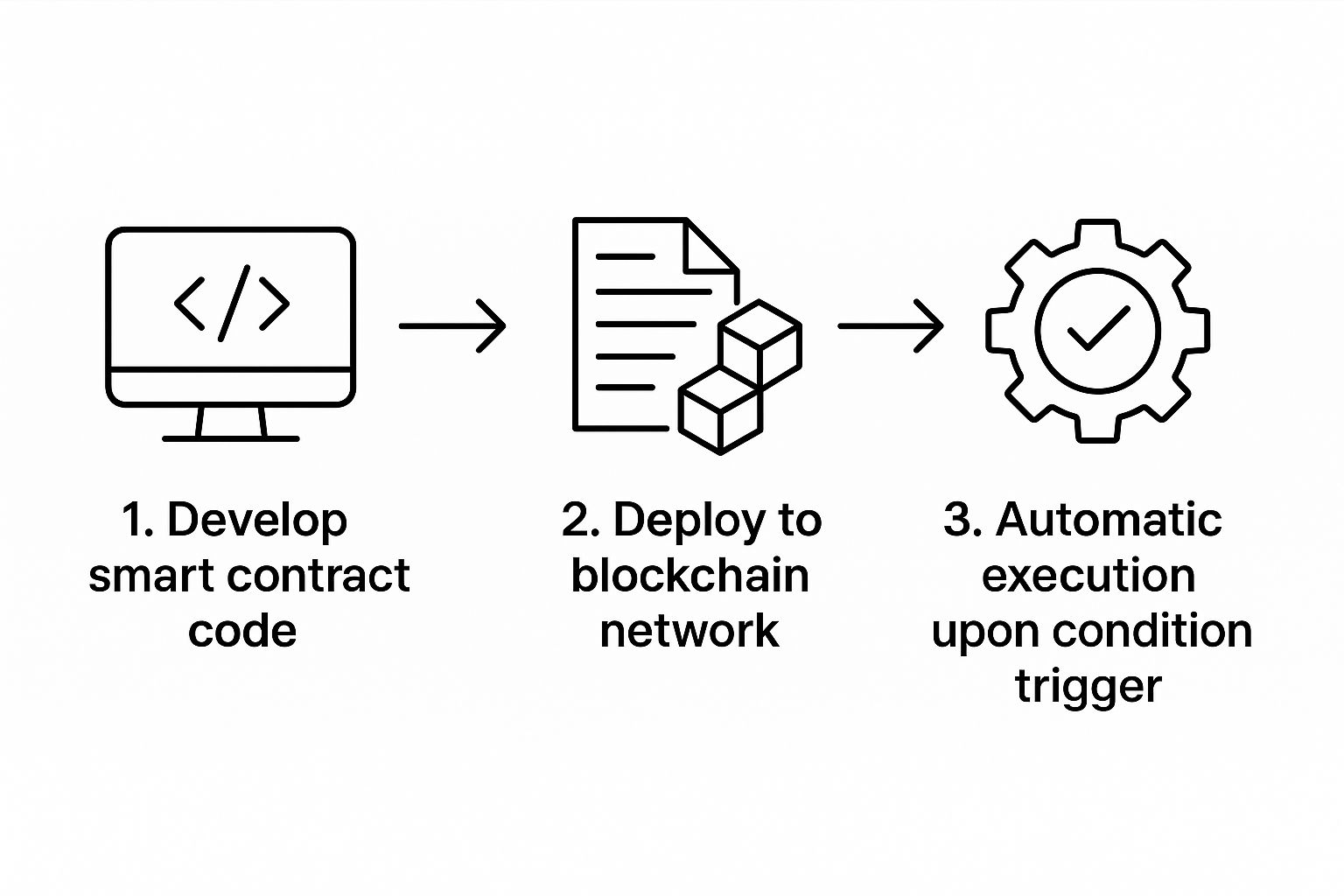
This process—from writing code to deploying it as an immutable program that executes automatically—forms the core lifecycle of every smart contract.
Deployment and the Ethereum Virtual Machine
With the bytecode ready, it's time for deployment. The developer packages the bytecode into a special transaction and sends it to the blockchain. This action permanently publishes the smart contract on the network, assigning it a unique address—just like a house gets a street address.
This is where the Ethereum Virtual Machine (EVM) steps in. You can think of the EVM as a single, global computer that runs on every node participating in the Ethereum network. It’s the runtime environment for all smart contracts, and its job is to make sure the code runs the exact same way for everyone, which is crucial for maintaining the network's consensus.
The EVM is what truly makes Ethereum a "world computer." It executes all the contract code and updates the state of the blockchain after every transaction, ensuring every interaction is predictable and secure.
Of course, this process isn’t free. Deploying a contract and interacting with it costs a transaction fee called gas. This fee compensates the network validators for the computing power they use to execute your code and keep the network secure. The cost boils down to two things:
- Contract Complexity: More lines of code and more complex operations mean more work for the validators, which costs more gas.
- Network Congestion: When the network is busy, it's like rush-hour traffic. The demand for space goes up, and so do gas prices.
Triggering Automatic Execution
Once deployed, the smart contract lives on the blockchain, basically dormant but always listening. It springs into action only when someone sends a transaction to its address that meets one of the conditions written in its code.
Let’s say you interact with a DeFi lending protocol. When you send cryptocurrency to the contract’s address to take out a loan, your transaction triggers a specific function. The EVM immediately executes the contract's logic: it checks if you provided enough collateral, calculates the loan terms, and automatically sends the borrowed funds to your wallet.
Every single step happens exactly as it was programmed. There's no middleman, no waiting for approval, and no chance of someone changing the rules. The contract just does what it was built to do—the very essence of automated, trustless execution. For a deeper dive into the mechanics, learning about validating smart contract state on EVM chains is a great next step.
Real-World Use Cases Are Already Here

A web3 smart contract isn't just a fascinating piece of code; it's a practical tool that’s already solving real problems across a bunch of different industries. These self-executing agreements are moving out of whitepapers and into the wild, bringing new levels of efficiency and transparency wherever they go.
By cutting out the middleman, smart contracts are changing the rules of the game. From finance to gaming, they are the engines driving a new generation of decentralized apps (dApps) that are completely rethinking how things get done.
Rebuilding Finance with DeFi
The most dramatic example of smart contracts in action is Decentralized Finance (DeFi). The goal here is simple but huge: build an open-source financial system that anyone can access, without needing traditional banks or brokerage firms to sign off on things.
Smart contracts are the backbone of this movement. They handle complex financial transactions automatically, powering services that directly compete with the old guard of banking.
- Automated Lending and Borrowing: Think of platforms like Aave or Compound. They use smart contracts to create pools of money where you can lend out your crypto to earn interest or borrow against your holdings. The contract handles everything—setting interest rates and even liquidating collateral if a loan goes bad. No loan officers, no paperwork.
- Decentralized Exchanges (DEXs): With a DEX like Uniswap, you can trade crypto directly from your own wallet. The smart contract acts as an "automated market maker," matching buyers and sellers instantly without a central company holding everyone's funds.
- Stablecoins: Smart contracts are crucial for stablecoins like DAI, which are designed to hold their value against a currency like the U.S. dollar. The contracts automatically manage the collateral backing the coin to keep its price stable.
The explosive growth in DeFi shows just how powerful this tech is. If you want to see the numbers behind this growth, you can check out the latest DeFi statistics in our detailed overview.
Bringing True Transparency to Supply Chains
Smart contracts are also cleaning up the notoriously messy world of global supply chains. For years, tracking a product from farm to shelf has been a nightmare of separate ledgers, missing data, and a lack of trust.
A web3 smart contract solves this by creating a single, permanent record on a blockchain. As a product moves along its journey, each handover is recorded as a transaction. This creates a bulletproof audit trail that anyone can check.
A coffee company can finally prove its beans are ethically sourced. A luxury brand can guarantee a handbag is authentic, putting a serious dent in the counterfeit market. It’s all right there on the chain.
Redefining Ownership in Gaming and Digital Collectibles
The gaming world is also getting a major upgrade thanks to smart contracts, mostly through Non-Fungible Tokens (NFTs). An NFT is simply a unique digital item—like a piece of art, a character skin, or a special sword—whose ownership is secured by a smart contract.
This idea unlocks a ton of cool possibilities:
- Real Player Ownership: When you earn a rare item in a Web3 game, it’s an NFT in your crypto wallet. You actually own it, not the game company. You can sell it, trade it, or even take it with you.
- A Connected Metaverse: In the future, that sword you won in one game might be usable in a completely different one, creating a much more connected digital world.
- Digital Real Estate: Virtual worlds like Decentraland use smart contracts to manage ownership of virtual land. People are buying, selling, and building entire businesses on digital property they truly own.
This move toward player-owned economies is a big reason why the entire Web3 market is expected to grow so fast. Some analysts predict the market could hit $229.15 billion by 2034, growing at an astonishing 44.9% per year. In fact, by 2030, blockchain tokenization—the core idea behind NFTs—is projected to make up around 10% of global GDP.
By automatically enforcing rules and creating verifiable digital scarcity, smart contracts aren't just making old processes faster—they are making entirely new kinds of digital value and interaction possible.
When you boil it all down, these examples show that the web3 smart contract is a core building block for a more open, fair, and user-focused internet.
Your Toolkit for Smart Contract Development
Jumping into web3 smart contract development might feel like a huge leap, but it’s more approachable than you think. You don't need to be a blockchain guru overnight. It's really about assembling a specialized toolkit, where each piece has a specific job in bringing your digital agreement to life.
The whole process boils down to picking the right environment, writing the actual code, and then testing it relentlessly before it ever goes live. Let's walk through the key components you'll need to get started, taking you from a simple idea to a fully functional smart contract on the blockchain.
Choosing Your Blockchain and Language
Your very first decision is a big one: where will your smart contract live? This choice sets the stage for everything that follows, from the programming language you'll use to the tools you'll need and the community you'll be building for.
- Ethereum: This is the OG of smart contract platforms and still the most popular choice by far. It has a massive, active developer community and more documentation than you could ever read. If you build here, you'll be using Solidity, a language designed specifically for the Ethereum Virtual Machine (EVM).
- Solana: If speed and low transaction fees are your top priorities, Solana is a fantastic option. Developers here typically use Rust, a powerful and memory-safe language that offers very different performance benefits compared to Solidity.
- Other Platforms: You'll also find bustling ecosystems on networks like Polygon, Avalanche, and BNB Chain. The good news is that many of these are EVM-compatible, meaning the Solidity skills you learn for Ethereum are directly transferable.
For most people starting out, picking Solidity on an EVM-compatible chain is the smoothest path forward. The sheer volume of tutorials and community support makes it much easier to get unstuck.
Essential Development Frameworks and IDEs
With a language and platform picked out, you need the right software to actually write, compile, and manage your code. You wouldn't build a house with only a hammer, and you definitely can't build a secure smart contract without a solid development environment.
Your Integrated Development Environment (IDE) is basically your super-powered code editor. A fantastic starting point is Remix, a browser-based IDE that requires zero setup. You can write, compile, and deploy contracts right from your web browser, which is perfect for learning the ropes.
When you're ready for more serious projects, you'll graduate to local frameworks like Hardhat or Truffle. These are complete development toolkits that run on your computer, giving you powerful features for compiling code, running automated tests, and deploying to different blockchain networks.
Think of a framework like Hardhat as a complete workshop for your web3 smart contract. It not only has the tools to build your contract but also includes a built-in testing ground to make sure it's secure and works exactly as intended before you deploy it to the public.
To give you a better idea of how these tools fit together, here’s a look at some of the most common options you'll encounter.
Popular Smart Contract Development Tools
The Web3 development stack is made up of several specialized tools that handle different parts of the creation and deployment process. Choosing the right combination can make your workflow much more efficient.
| Tool Category | Popular Options | Primary Function |
|---|---|---|
| Development Frameworks | Hardhat, Truffle, Foundry | Manages the entire lifecycle: compiling, testing, and deploying contracts. |
| Code Editors / IDEs | VS Code (with Solidity extensions), Remix IDE | Provides the environment for writing, editing, and debugging your code. |
| Local Blockchains | Hardhat Network, Ganache | Simulates a live blockchain on your computer for fast, free testing. |
| Testing Libraries | Chai, Mocha, Waffle | Helps you write and run automated tests to find bugs in your contract logic. |
This table isn't exhaustive, but it covers the core components of most professional development setups. As you gain experience, you'll find the combination that works best for you.
The Write, Compile, Test, Deploy Workflow
At its heart, the smart contract development lifecycle is a straightforward, four-step loop. Getting this process right is the key to building secure and reliable applications.
- Write: First, you draft the logic of your smart contract in a language like Solidity. You're defining the rules, functions, and data structures that will make your agreement work.
- Compile: Next, you use a compiler to translate your human-readable Solidity code into bytecode. This is the low-level, machine-readable format that the Ethereum Virtual Machine (EVM) actually understands and executes.
- Test: This is arguably the most important step. Before your contract goes anywhere near a live network—where mistakes can be permanent and expensive—you have to test it thoroughly. Frameworks like Hardhat let you spin up a local blockchain on your machine to run simulations and automated tests to hunt down any potential bugs or security holes.
- Deploy: Finally, when you're confident the code is solid, you deploy it to a public blockchain like Ethereum. This action publishes your contract, making it live, unchangeable, and ready to be used by anyone in the world.
Avoiding Costly Mistakes with Smart Contract Security

When your code is law and it's directly managing digital assets, security isn't just a nice-to-have feature—it's everything. In the world of Web3 smart contracts, a single bug can lead to catastrophic losses, wiping out value in minutes. The real kicker? These contracts are immutable. You can't just push a patch for a bug after deployment. Mistakes are permanent and often incredibly expensive.
This high-stakes environment means you absolutely must have a security-first mindset from the moment you write the first line of code. The first step is understanding the common threats out there, and there's no better cautionary tale than the infamous reentrancy attack.
The Anatomy of a Reentrancy Attack
Let's use a simple analogy. Imagine a smart contract that acts like an ATM. The normal, safe process for a withdrawal would be:
- Check if the user has enough funds.
- Update the user's balance in the system.
- Dispense the cash.
A reentrancy attack flips this logic. The vulnerable code checks the balance, dispenses the cash, and then tries to update the balance. The attacker exploits this tiny window of opportunity.
They create a malicious contract that calls the ATM's withdraw function. As soon as the ATM dispenses the funds, the attacker's contract is programmed to immediately call the withdraw function again, before the ATM has a chance to record the first transaction. This loop can continue, draining the contract until it's empty.
This isn't just a theoretical problem. This exact vulnerability was behind the notorious 2016 DAO hack, where attackers siphoned away $60 million worth of Ether. It was a painful, public lesson for the entire Ethereum community on the critical need for secure coding.
This is precisely why the "move fast and break things" startup mantra is a recipe for disaster in Web3. A "measure twice, cut once" philosophy is the only way to operate. Fortunately, a robust set of best practices has emerged from these hard-learned lessons.
Building a Strong Defensive Strategy
Protecting your Web3 smart contract is all about layering your defenses and committing to a rigorous development process. There's no single magic bullet; it's about building a culture of security from start to finish.
Here are the cornerstones of modern smart contract security:
- Use Battle-Tested Libraries: Don't reinvent the wheel, especially when it comes to fundamental security components. Lean on standard, community-vetted libraries like OpenZeppelin for things like token standards (ERC-20, ERC-721) and access controls. These libraries have been audited and stress-tested by experts, which dramatically reduces your attack surface.
- Adopt a Rigorous Testing Process: Your testing needs to be relentless. This means writing comprehensive unit tests for every function, running integration tests to see how contracts behave together, and even using advanced techniques like fuzzing to hammer your contract with random data to uncover weird edge cases. High test coverage is your first line of defense.
- Follow Secure Development Patterns: Simple, disciplined coding patterns can shut down major exploits. To prevent reentrancy, for instance, developers now use the "Checks-Effects-Interactions" pattern. This means your code should always perform internal checks first (like verifying balances), then update its own state (the effects), and only then interact with external contracts.
The Final and Most Critical Step: Audits
Even with the best internal practices, you need a fresh set of expert eyes on your code. A professional security audit from a reputable firm is the final, non-negotiable step before deploying any contract that handles real value.
Auditors are specialists trained to spot subtle vulnerabilities that automated tools and even seasoned developers can miss. An audit gives your team and your future users confidence that the code is sound. As the Web3 space matures, this is becoming a standard expectation for any serious project. This push for security, combined with an evolving regulatory landscape, has already fostered a 25% growth in trust and innovation. You can discover more about the impact of these applications and how they're changing the game.
By combining secure coding patterns, exhaustive testing, and professional third-party audits, you can build truly reliable applications that earn and keep users' trust.
The Future of Smart Contracts and Decentralized Tech
We're really just at the beginning of the journey for the web3 smart contract. We’ve only scratched the surface of what this core technology can do. The future isn't about small tweaks; it's about massive leaps forward in how smart contracts scale, think, and connect with the real world. These changes will cement them as the true backbone of the internet's next chapter.
As decentralized systems get bigger, the demands on them multiply. The next wave of innovation is all about making smart contracts faster, cheaper, and more powerful than anything we've seen before.
Smarter, Faster, and More Connected
The evolution of smart contracts isn't happening in a vacuum. It's being pushed forward by a few key trends that are set to blow the doors off their current capabilities. These aren't just ideas on a whiteboard; they're actively being built and deployed right now, setting the stage for far more sophisticated decentralized applications.
Here are the key developments to watch:
- Layer 2 Scaling Solutions: Think of technologies like rollups and state channels as express lanes for blockchains. They move the heavy lifting off the main chain, which slashes transaction fees and dramatically boosts speed. This is what will make smart contracts practical for everyday things that need to happen fast.
- Artificial Intelligence Integration: The mashup of AI and blockchain is giving rise to "AI agents." These are essentially autonomous programs that live on-chain. They can crunch data, make their own decisions, and carry out complex actions without a human pulling the strings, opening the door to things like fully automated companies and markets.
- Real-World Asset (RWA) Tokenization: Smart contracts are finally closing the gap between the digital and physical worlds. By turning assets like real estate, art, or private equity into digital tokens, smart contracts can automate everything from proving ownership to transferring value in markets that were previously stuck in the slow lane.
The future of smart contracts is all about them becoming more than just lines of code. They're growing into independent economic players that can react to both on-chain data and real-world events, weaving a programmable, automated layer into our global economy.
These breakthroughs are shifting smart contracts from a niche developer tool into a must-have for building a more decentralized and efficient world. The market's explosive growth reflects this rapid pace of change, and you can dig into some fascinating numbers in our detailed breakdown of Web3 statistics and trends.
At the end of the day, the web3 smart contract is on track to become a fundamental piece of our digital lives. By enabling automation without needing to trust a middleman, proving ownership beyond a shadow of a doubt, and allowing different systems to talk to each other effortlessly, this technology is doing more than changing how we send money—it's laying the foundation for a more open, transparent, and user-focused internet. The road ahead is exciting, and now you have the map to navigate it.
Frequently Asked Questions About Smart Contracts
Even after getting the basics down, it's natural to have a few more questions about how a web3 smart contract actually works in the real world. Let's tackle some of the most common ones to help solidify your understanding.
Think of it as filling in the gaps.
What Is the Difference Between a dApp and a Smart Contract?
It’s helpful to think of the relationship like an app on your phone and the backend server it connects to.
A smart contract is the engine room. It's the raw code living on the blockchain that executes specific rules—things like swapping one token for another or creating a new NFT. It’s the pure, unadorned logic.
A dApp (Decentralized Application), on the other hand, is the complete user-facing experience. It’s the website you visit or the interface you click on. When you interact with a dApp, it’s calling on one or more smart contracts in the background to get the job done. Simply put, the dApp is the "app," and the smart contract is the "brain" that powers it.
How Much Does It Cost to Deploy a Smart Contract?
There’s no single answer here—the cost to deploy a smart contract can swing dramatically. It all comes down to the "gas fees" you have to pay, which are influenced by two key things:
- Contract Complexity: A simple contract with just a few lines of code is much cheaper to deploy than a massive, complex one with lots of functions and variables. More code means more work for the network, which translates to a higher gas bill.
- Network Congestion: Gas prices are a live market, constantly changing based on how busy the blockchain is. During peak hours, when everyone is trying to make transactions, the network gets jammed up. Gas fees can rocket from just a few dollars to hundreds in a matter of minutes.
Are Web3 Smart Contracts Legally Binding?
This is where technology is outpacing the law. While a smart contract is brilliant at automating and enforcing the terms of an agreement digitally, its status as a legally binding contract in the traditional sense isn't a settled matter.
The legal recognition of smart contracts varies wildly from place to place. Some jurisdictions are beginning to build legal frameworks that accept them, but many others haven't caught up yet. It’s a complex and rapidly evolving corner of the legal world.
For now, it's safer to see smart contracts as incredibly powerful tools for digital enforcement, not as a blanket replacement for every traditional legal agreement.
Can a Smart Contract Be Changed After Deployment?
Fundamentally, no. One of the core principles of a web3 smart contract is immutability—once it’s on the blockchain, the code is set in stone and cannot be changed. This is a feature, not a bug, as it guarantees that the rules can't be secretly altered by anyone.
But what about bugs or the need for new features? Developers have figured out some clever ways to handle this. By using patterns like "proxy contracts," they can essentially point the original contract to a new, updated version containing the new logic. So while you can introduce upgrades, the original code itself is still there on the blockchain, untouched and permanent.
Ready to build your career in this exciting field? Find Web3 is the premier job board for roles in crypto, DeFi, and the metaverse. Explore over 10,000 opportunities from top companies and find your place in the future of the internet. Start your search today on Find Web3.