
So, you want to turn your art into an NFT. It's a fascinating process that takes your creative vision and transforms it into a unique, verifiable digital asset that you can sell directly to collectors. It’s all about proving ownership and opening up new doors for your work.
From Digital Canvas to Blockchain Asset
Turning a simple digital file into a non-fungible token (NFT) is less about the tech and more about what it represents: true ownership of your creation. This path allows you to bypass the traditional gatekeepers of the art world, like galleries and agents. Instead, you can connect directly with a global audience on marketplaces like OpenSea, Foundation, and Rarible. This is a game-changer for artists.
The market has definitely grown up since the wild, speculative days. After a necessary cooldown in 2022 when things got a bit oversaturated, we're now seeing much more stable and genuine growth. In fact, the global NFT art market was valued at $3.3 billion in 2024 and is expected to hit nearly $46 billion by 2033. This isn't just hype; it's driven by serious collectors who care about the art itself and its verifiable history. You can dig into the numbers yourself in this Market Data Forecast report.
The Core Process for Creators
When you boil it down, the process is surprisingly straightforward, even if you’re just starting out. If you're still getting your feet wet with the creative side of things, this guide on digital art for beginners is a great place to start before diving into the blockchain.
Once your art is ready, here’s what the journey looks like:
- Finalize Your Artwork: This could be a static image, a looping animation, a video, or even a piece of music. Get it polished and ready to go.
- Set Up Your Tools: You’ll need a non-custodial crypto wallet (MetaMask is the most common) to hold your crypto and interact with NFT platforms.
- Choose Your Platform: You'll need to pick a blockchain (like Ethereum or Solana) and an NFT marketplace that fits your style and budget.
- Mint Your Art: This is the technical step where you "tokenize" your art, officially recording it on the blockchain as a unique asset.
- List and Sell: Finally, you'll set your price, write a compelling story for your piece, and put it up for sale.
This guide is designed to cut through the noise. We're focusing on the practical steps you need to build a real, sustainable creative career in the Web3 world. Let’s get you set up to tackle each stage with confidence.
Getting Your Art Tools and Crypto Wallet Ready
Alright, before your art can make its debut on the blockchain, you need to get two key things in order: your creative setup and your crypto wallet. Think of it as preparing your studio and your bank account for the Web3 world. The software you pick will define your workflow, while your wallet will be your passport to every transaction.
Picking Your Digital Canvas
This is where the magic happens. The software you use is your digital canvas, and what you choose really comes down to your personal style and budget. Many pros stick with the tried-and-true industry leaders.
- Adobe Photoshop: It’s been the heavyweight champion of digital art forever for a reason. It's fantastic for highly detailed illustrations, complex photo composites, and anything requiring precise control over layers.
- Procreate: If you're an iPad artist, you probably already know and love Procreate. Its intuitive feel and incredible brush library make it a favorite for digital painting and sketching, especially when you're on the move.
But you absolutely don't need to break the bank to make great art. There are some killer free options out there. I often recommend GIMP (GNU Image Manipulation Program) to new artists; it's a powerful, open-source program that does a lot of what Photoshop can, making it a perfect starting point without the subscription fee.
Your Gateway to Web3: The Non-Custodial Wallet
Once your creative tools are sorted, it's time for the most critical piece of the puzzle: your crypto wallet. This is so much more than just a place to hold coins—it's your digital identity, your signature, and your key to the entire decentralized web.
You’ll want a non-custodial wallet like MetaMask. The "non-custodial" part is key; it means you and only you have control over your private keys and your assets.
When you first set up the wallet, you'll be given a seed phrase, which is usually a list of 12 or 24 random words. This is the single most important piece of information you will receive. It's the master key that can restore your wallet and all its contents if you ever lose your phone or your computer crashes.
Critical Security Tip: I cannot stress this enough—write down your seed phrase on paper and hide it somewhere safe. Actually, write it down twice and store it in two different secure, offline locations. Never, ever take a screenshot of it or save it in a digital file. If you lose that phrase, your assets are gone for good.
With your wallet created, you need to add some crypto to it to pay for transaction fees, commonly called "gas fees." If you're minting on a blockchain like Ethereum, you'll need its native currency, Ether (ETH). You can usually buy crypto right inside the MetaMask app with a debit card, or you can transfer it over from an exchange like Coinbase or Binance.
Having a little bit of crypto ready to go means you won't hit a roadblock when it's time to mint. Getting this foundation right is essential, whether you're just starting out or looking into more serious NFT job roles that demand this kind of practical knowledge.
Alright, with your artwork finalized, it's time to make one of the most important decisions in your NFT journey: where to actually mint and sell it. This isn't just a minor detail; your choice of blockchain and marketplace will directly affect your costs, your potential audience, and even the community you become a part of.
Think of it this way: the blockchain is like the country where your art will reside, with its own economy and rules. The marketplace is the specific gallery or storefront where collectors will discover your work. Getting this combination right is a massive part of a successful launch.
Before we get into the nitty-gritty of platforms, here’s a look at the general creative workflow. This is how an idea travels from a rough concept to a finished piece ready for the blockchain.
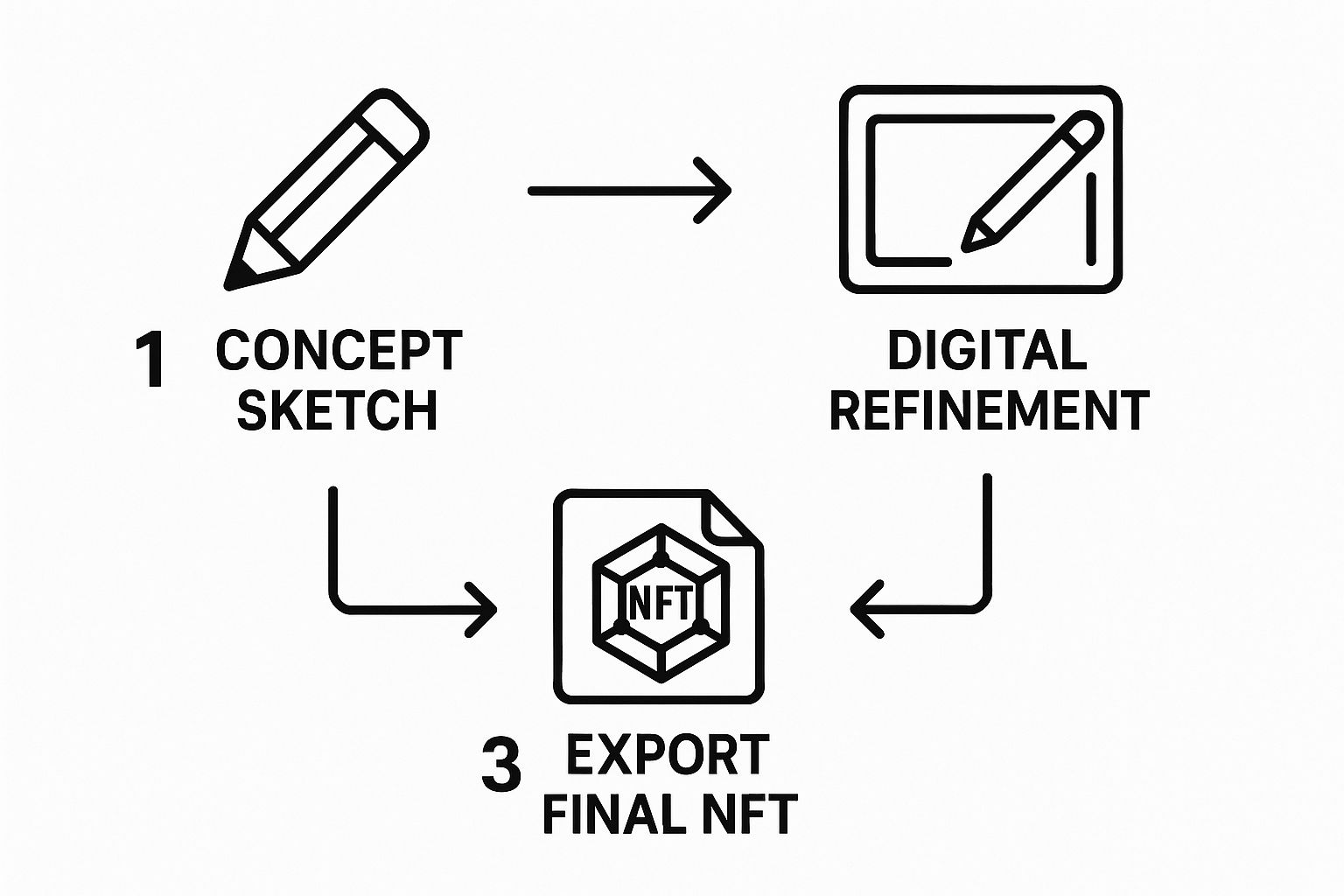
As you can see, minting is that final, exciting step that turns your digital file into a permanent, verifiable asset on the blockchain, just before you list it for sale.
Breaking Down the Big Blockchains
The blockchain you mint on is the technical foundation of your NFT. It dictates things like transaction costs (known as gas fees), how fast your NFT is created, and the vibe of the community. Each one has its own personality and clear trade-offs.
Ethereum: The OG. Ethereum is the original home of NFTs and still boasts the largest community and the highest-value art sales. The prestige is real, but it comes at a steep price. Gas fees can be unpredictable and expensive, sometimes jumping from $30 to over $100 just to mint a single piece during busy periods.
Solana: The speed demon. Known for its incredibly fast transactions and dirt-cheap fees—we're talking pennies per transaction. The Solana ecosystem is exploding with energy and growth. It’s a fantastic, low-risk choice for artists who want to experiment or drop larger collections without breaking the bank.
Polygon: The best of both worlds. As a "Layer 2" solution, Polygon runs alongside Ethereum, giving you access to its massive network and security but with much lower gas fees and quicker transactions. It’s a brilliant middle-ground for creators who want the credibility of the Ethereum world without the painful costs.
Your choice of blockchain is a strategic one. Ethereum offers prestige at a high cost, while Solana and Polygon provide affordable, high-speed alternatives perfect for emerging artists and experimental projects.
NFT Marketplace And Blockchain Comparison For Artists
Once you’ve picked a blockchain, you need to find a marketplace. These platforms are the storefronts where collectors browse and buy, and where the vast majority of Web3 commerce takes place, a fact backed by a mountain of Web3 statistics. This table breaks down some of the top players to help you see where you might fit in.
| Platform | Primary Blockchain | Typical Gas Fees | Key Feature For Artists |
|---|---|---|---|
| OpenSea | Ethereum, Polygon, Solana | Varies (High on ETH) | Its sheer size makes it great for beginners and big collections. |
| Rarible | Ethereum, Polygon, Tezos | Varies (High on ETH) | Excellent multi-chain support and a strong, community-focused feel. |
| Foundation | Ethereum | High | Feels like a curated, high-end gallery; best for established artists. |
| Magic Eden | Solana | Extremely Low | The go-to marketplace for the fast-growing Solana ecosystem. |
Ultimately, there isn't one "best" platform for everyone. A massive marketplace like OpenSea is a fantastic starting point because of its huge user base and flexibility. However, if you're a fine artist with an established following, a more curated, prestigious platform like Foundation could be the perfect showcase.
Your goal is to find the place where the community, the costs, and the overall culture align perfectly with your art and your ambitions.
From Upload to Listing: How to Mint Your Art
This is where the magic happens. Minting is the technical process of turning your digital file into a permanent, verifiable asset on the blockchain. It’s how your art officially becomes an NFT. I’ll walk you through how this works on a popular marketplace like OpenSea, taking your creation from a local file to a listed collectible.
It all starts with a simple upload. Most platforms are pretty flexible and accept common file types like JPG, PNG, GIF, MP4, and even GLB files for 3D models. Once your artwork is uploaded, you’ll land on a form where you get to define your NFT’s identity. This is your chance to tell its story.
Giving Your Art Its Soul with Metadata
Metadata is everything that gives your art context and makes it discoverable. Think of it as the soul of your NFT. Don't just breeze through this part; a well-crafted description can genuinely make or break a collector's decision to buy.
You’ll be asked to fill out a few key fields:
- Title: Go for something memorable that captures the feeling of the piece.
- Description: This is your direct line to a buyer. Tell them the story behind the art. What inspired you? What techniques did you use? Be authentic and let your personality shine through.
- Properties: These are basically searchable tags that help collectors filter and find your work. If you made a character, properties could be things like "Background: Blue" or "Accessory: Sunglasses." This is absolutely critical for generative PFP collections.
Your artwork is the main event, but the metadata is like the little plaque next to a piece in a gallery—it explains why it matters. For instance, the artist Sarah Zucker is famous for her glitch art. She often describes her unique process of running digital visuals through old VHS players and analog gear. That kind of detail adds immense value for collectors who truly appreciate the craft.
Your NFT’s description is your one shot to connect with a potential collector. Use it to share the story, the meaning, and the process. A generic title like "My new digital painting" will just get lost in the noise.
Editions and Royalties: Your Financial Blueprint
Next, you have to make two big financial decisions: how many copies to create and what royalty you’ll take on future sales. These choices define your art's scarcity and your ability to earn from it long-term.
You can go one of two ways:
- Single Edition (1/1): This means only one will ever exist. A true one-of-a-kind piece. These are generally seen as more prestigious and valuable, perfect for a standout masterpiece.
- Multiple Editions: You could also mint a limited run of, say, 10 or 100 identical NFTs. This makes your work more accessible to a wider audience at a lower price, which can be a great way to build an initial collector base.
Then you get to one of the most powerful features for artists in the NFT space: creator royalties. You can set a percentage, usually between 5-10%, that you will automatically earn every single time your art is resold on the secondary market. This is a game-changer, creating a potential income stream that grows as your reputation does.
Getting these details right is your entry ticket into a massive and expanding ecosystem. Projections show the total NFT market could be worth $61.01 billion in 2025. Digital art is a huge piece of that pie, accounting for roughly 21% of all transactions. You can explore more about these key market figures to see just how big the opportunity is.
Once you’ve filled everything in, you’ll hit that "Create" button. Your crypto wallet will pop up, asking you to sign and confirm the transaction (and pay a gas fee, if the network requires it). After a few moments of anticipation, your art will be officially minted on the blockchain, ready for you to list it for sale.
Marketing Your Art and Building a Community
Getting your art created and minted is a massive milestone, but it's really just the beginning. The next step is what separates the artists who thrive from those who fade away: connecting with collectors and building a genuine community around your work. Let’s be clear, the old "mint it and they will come" approach is dead.
Genuine connection is your single most valuable asset. The NFT space has matured significantly since its explosive growth from 2020 to 2022. As of 2025, the global NFT art market is valued at a staggering $5.32 billion and is on track to reach $8.5 billion by 2033. This isn't just a bubble; it's a fundamental shift toward digital ownership, where collectors are looking for authenticity and a real relationship with the artist.
Find Your Voice in the Web3 World
Your first move? Go where the conversations are happening. In the NFT world, that means immersing yourself in platforms like X (formerly Twitter) and Discord. Think of these less as broadcast channels and more as the community's town square.
Start by following other artists, well-known collectors, and the builders who are pushing the space forward. But don't just lurk—engage. When you see something you like, comment with more than just "gm" or "WAGMI." Ask thoughtful questions. Share your perspective on market trends. Celebrate someone else's big sale. The goal is to become a trusted, familiar face, not just another artist dropping links.
A fantastic way to build rapport is by joining, or even hosting, Twitter Spaces. It's a chance for people to hear the passion in your voice. You can talk about your artistic process, discuss what inspires you, or even collaborate with another creator for a joint chat. This is how you let potential collectors connect with the human behind the pixels.
Key Takeaway: Community doesn't pop up overnight. It's the byproduct of consistent, authentic engagement. Give value before you ask for a sale by sharing what you know and supporting others. The relationships you build are what will ultimately drive your success.
Since selling NFT art is essentially a new form of digital commerce, it pays to understand proven ecommerce social media marketing strategies to boost your sales and brand presence.
Weave a Narrative Around Your Art
Every piece of art has a story. You need to be its storyteller. People aren't just buying a JPEG; they're investing in the vision, the narrative, and the artist's journey. Use your platforms to share the why behind your creations.
- Pull Back the Curtain: Share behind-the-scenes content. This could be anything from early concept sketches and speedpaint videos to a shot of your messy desk. It builds anticipation and shows the real work involved.
- Share Your Inspiration: What sparked this piece? Was it a childhood memory, a bizarre dream, a reaction to a news event? Sharing these details adds layers of emotional depth and meaning.
- Communicate Your Vision: If you're building a collection, explain the big idea. What's the thread that ties all the pieces together? A strong, cohesive vision makes a collection feel complete and far more compelling to collectors.
This storytelling is what transforms a one-time buyer into a dedicated collector who feels invested in your career. To get a better handle on what's resonating in the market, it's worth checking out these insightful NFT stats that reveal what collectors are actively seeking.
Got Questions About Making NFTs? We’ve Got Answers.
Even with a step-by-step guide, stepping into the NFT world for the first time can feel like learning a new language. You’re bound to have questions. Let's tackle some of the most common ones I hear from artists, clearing up the confusion so you can move forward with confidence.
What’s the Real Cost to Create NFT Art?
There’s no single price tag on creating an NFT. Your costs can swing from practically zero to hundreds of dollars, and the biggest factor is something called a "gas fee."
Think of gas fees as the toll you pay to use a blockchain network. On a popular and busy network like Ethereum, these fees can get pricey, sometimes spiking from $10 to over $100 just to mint a single piece of art. It all depends on how congested the network is at that moment.
Fortunately, you have cheaper options. Many artists are now using blockchains like Polygon or Solana, where gas fees are often less than a dollar. This makes them a fantastic starting point if you're on a budget or planning to release a larger collection without a massive upfront investment.
There's also a clever technique called lazy minting. Some marketplaces let you list your art without officially creating the NFT on the blockchain right away. The minting only happens when someone actually buys your work, and the buyer covers the gas fee. It's a great, risk-free way to get started.
What Kind of Art Actually Sells as an NFT?
I get this one a lot. The truth is, there’s no secret formula. The NFT space is incredibly diverse. We've seen everything from mind-bending 3D animations and generative code-based art to digital paintings, quirky pixel art, and even stunning fine art photography find massive success.
Instead of chasing what's hot this week, the artists who truly connect with collectors tend to nail two things:
- A compelling story: Art that comes with a strong narrative or a unique concept gives collectors something to connect with beyond just the visuals.
- A recognizable style: When you develop a distinct aesthetic that’s all your own, your work becomes instantly identifiable in a sea of digital art.
Don't try to predict the market. The best move you can make is to create art that is genuinely you. Collectors are looking for authenticity, and the real value often lies in the story and unique vision you bring to the table.
Do I Need to Know How to Code to Make NFTs?
Not at all. This is a huge misconception. While some of the most complex, high-profile NFT projects involve custom-coded smart contracts, the vast majority of artists create and sell their work without writing a single line of code.
Today's NFT marketplaces are built for creators, not developers.
Platforms like OpenSea, Rarible, and Foundation have made the process incredibly intuitive. If you can upload a photo to Instagram, you can mint an NFT. You simply upload your art file, fill out a form with details like the title and description, and click a button. The platform takes care of all the complicated blockchain stuff behind the scenes.
How Do Royalties Work, and Are They a Big Deal?
Royalties are, hands down, one of the most powerful features for artists in the NFT space. In simple terms, a royalty is a percentage of the sale price you automatically receive every single time your art is resold to a new collector.
When you first mint your NFT, you get to set this royalty percentage yourself—it's usually between 5% and 10%. This term gets permanently baked into the NFT's smart contract, and marketplaces automatically enforce it on all future sales.
This creates a sustainable revenue stream that was almost impossible to achieve in the traditional art world. As your reputation grows and your art becomes more valuable, you continue to share in that success. It's a game-changer.
Ready to turn your passion for Web3 into a career? Find Web3 is the top destination for discovering jobs in the crypto, blockchain, and NFT space. Explore thousands of listings from leading companies to find your next opportunity. Start your search on Find Web3 today!