
A smart contract programmer is a special kind of developer who builds self-executing contracts that live on a blockchain. Think of them as the architects behind the automated, trustless agreements that make everything from decentralized finance (DeFi) to digital art (NFTs) possible. Their work is absolutely critical for building the secure, transparent apps that are the foundation of Web3.
What Does a Smart Contract Programmer Actually Do?

Imagine a high-stakes lawyer crossed with a bank vault engineer, but for the digital world. That's a smart contract programmer. Instead of drafting dense legal documents, they write code that lays out the exact rules of an agreement.
Once this code is pushed to a blockchain, it runs on its own. It just sits there, waiting for certain conditions to be met, and then executes automatically—no banks, lawyers, or other middlemen needed.
The Vending Machine Analogy
The easiest way to wrap your head around this is the classic vending machine analogy. A vending machine is basically a very simple, real-world smart contract.
- The Rule: You insert a specific amount of money.
- The Action: You select a specific item.
- The Outcome: The machine automatically gives you that item.
A smart contract programmer builds a far more sophisticated version of this. Instead of dropping a bag of chips, their code could be managing millions of dollars in a crypto lending protocol, transferring ownership of a one-of-a-kind digital painting, or even handling the voting mechanics for a decentralized autonomous organization (DAO).
The core principle is the same, though: rules are hard-coded, conditions trigger an action, and the outcome happens automatically and permanently.
To give you a clearer picture, here's a quick breakdown of what a smart contract programmer focuses on.
Smart Contract Programmer At a Glance
| Core Responsibility | Primary Technologies | Key Industries |
|---|---|---|
| Writing, testing, and deploying immutable, self-executing code on a blockchain. | Solidity, Rust, Hardhat, Truffle, Foundry | DeFi, NFTs, Gaming, Supply Chain, DAOs |
This table captures the essence of the role—it's a blend of high-level logic and deep technical execution across some of the most innovative sectors out there.
Core Responsibilities and Focus
The day-to-day work of a smart contract programmer is all about building trust with code. Because these contracts often control huge sums of money or valuable assets, there is absolutely no room for error. Security and precision are everything.
A single bug or oversight in a smart contract can lead to catastrophic, irreversible financial losses. This simple fact defines the entire job. It demands a level of meticulousness that goes far beyond what’s typical in traditional software development. The code isn't just instructions; it's the law.
Their main tasks really boil down to a few key activities:
- Designing Logic: They start by mapping out the complete flow of the digital agreement—the rules, the triggers, and what happens as a result.
- Writing Code: Next, they translate that logic into a specialized programming language, most commonly Solidity or Rust.
- Testing Rigorously: This is a huge part of the job. They have to simulate every possible scenario, attack vector, and edge case to find and patch vulnerabilities before the contract goes live.
- Optimizing for Efficiency: Every operation on a blockchain costs a small fee (known as "gas"). A good programmer writes clean, efficient code to keep these costs as low as possible for users.
- Deploying and Maintaining: Finally, they launch the contract onto a live blockchain. Depending on the project, they might also be involved in managing future upgrades or interacting with the deployed contract.
Ultimately, a smart contract programmer is creating the very building blocks of the decentralized web. They’re the ones building a world where trust is guaranteed not by a handshake or a corporate entity, but by transparent, unchangeable code.
The Essential Skills for a Smart Contract Programmer
If you want to become a solid smart contract programmer, you'll need more than just coding chops. It's a role that demands a unique mix of deep technical know-how, a security-first mindset, and an almost obsessive attention to detail. After all, when you're dealing with assets locked on an immutable blockchain, the stakes are incredibly high.
Your journey starts with mastering the right programming languages. For most projects out there today, especially anything built on Ethereum, Solidity is the undisputed leader. It was literally built for creating smart contracts and is the engine behind the vast majority of DeFi protocols and NFT projects. You'll also see other languages popping up, like Rust, which is big in the Solana and Polkadot ecosystems, and Vyper, a Python-like language that really doubles down on security and simplicity.
Core Technical Competencies
Beyond just speaking the language, a smart contract programmer needs a powerful toolkit. Most of the work involves using Solidity on the Ethereum blockchain to write, test, and deploy these self-executing contracts. These are the building blocks for huge sectors like DeFi, NFTs, and Decentralized Autonomous Organizations (DAOs).
To do this effectively, developers need to master tools like Hardhat, Truffle, and Remix. And it doesn't stop there—a deep understanding of how to optimize for Ethereum's gas fees and implement security patterns to prevent nasty vulnerabilities is crucial. To get a better sense of how these skills are valued, you can explore the wider Web3 dictionary.
Here are a few technical areas you absolutely have to nail down:
- Development Frameworks: Tools like Hardhat and Truffle are essential. Think of them as your workshop—they give you the environment to compile, test, and deploy contracts, making the whole development process way faster and more organized.
- Security Best Practices: This is everything. You have to understand common attack vectors like reentrancy attacks, integer overflows, and front-running. Knowing how to stop them before they happen is what separates the pros from the amateurs.
- Gas Optimization: Every single operation on a blockchain costs "gas." Writing tight, efficient code that keeps these transaction fees low is a make-or-break skill. It directly affects whether people can afford to use the application you're building.
This image really drives home the core pillars of expertise needed for this role.
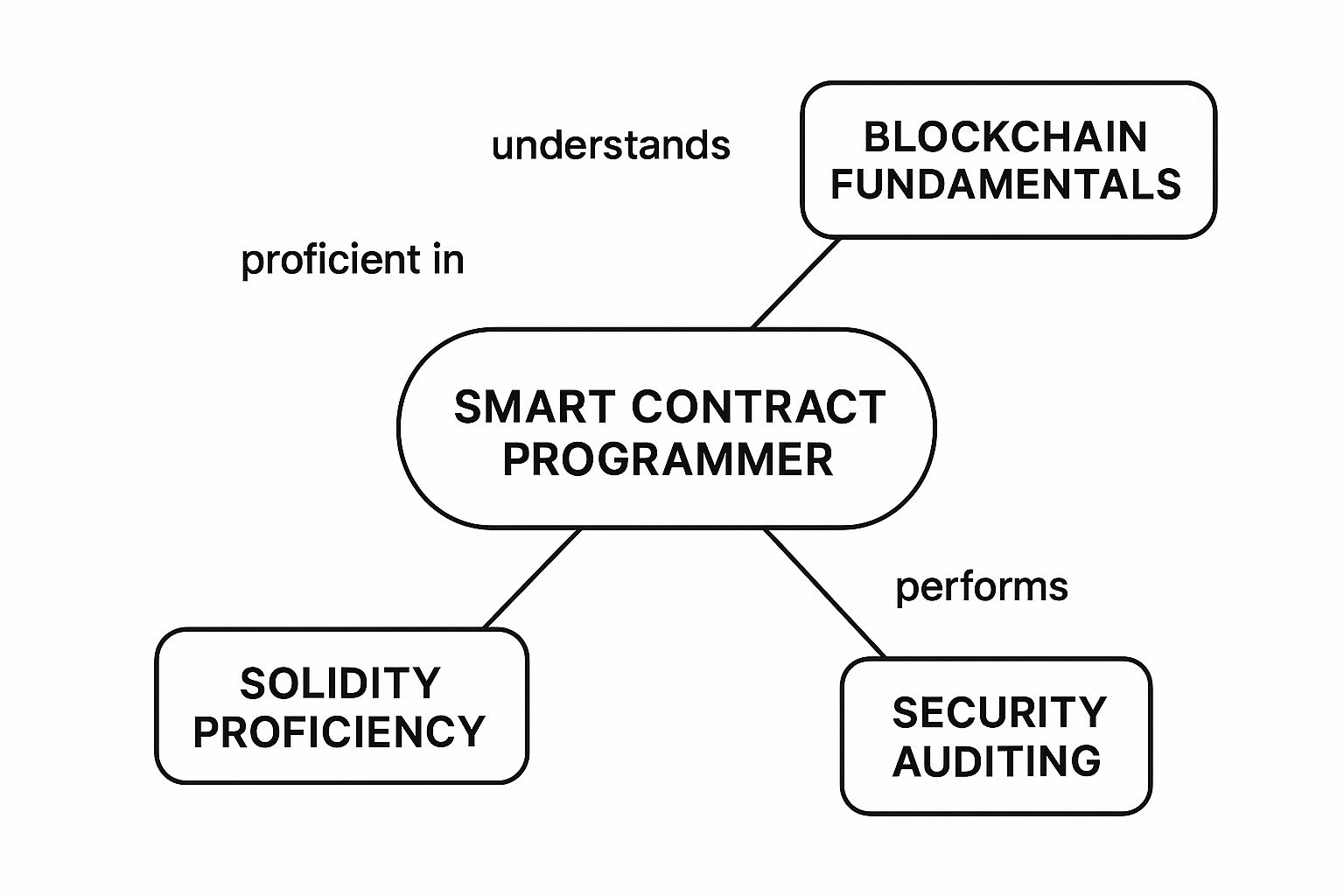
As you can see, it's the combination of language skills, foundational blockchain knowledge, and security auditing that creates a complete and effective smart contract developer.
Essential Non-Technical Abilities
While the technical skills get you in the door, it’s the non-technical abilities that will make you great. Because of the "code is law" nature of the blockchain, mistakes are permanent and can be disastrously expensive.
Because smart contracts are irreversible once deployed, the most valuable skill a developer can possess is an obsessive attention to detail. You must think like an attacker, anticipating every potential exploit and edge case before writing a single line of production code.
This way of thinking bleeds into a few other critical abilities:
- Problem-Solving: You're constantly going to run into weird, novel problems that don't have a textbook solution. The ability to think on your feet and come up with secure, efficient logic is absolutely vital.
- Meticulous Testing: A smart contract programmer has to be relentless when it comes to testing. Since these applications are decentralized and interact with other components, understanding contract testing is also a huge advantage for ensuring everything works together seamlessly.
It's this blend of technical mastery and analytical rigor that truly defines an expert in the field.
Breaking Down the Smart Contract Programmer Salary

Let's talk money. The intense demand for skilled smart contract programmers means the pay is seriously impressive. When you're responsible for code that secures millions—or even billions—of dollars in digital assets, companies don't hesitate to pay a premium for proven talent.
These high salaries aren't arbitrary. They're a direct reflection of the value these developers create. A single, well-written contract can be the engine for a wildly successful DeFi protocol or an entire NFT marketplace. On the flip side, one tiny bug can lead to a catastrophic, headline-making exploit. That makes a top-tier developer a non-negotiable investment.
Salary Benchmarks Across Experience Levels
As you'd expect, compensation for a smart contract programmer climbs steeply with experience and a track record of success. As the blockchain industry has grown, so have the paychecks.
Right now, we're seeing average annual salaries land somewhere between $120,000 to $180,000 globally. For senior specialists with deep expertise, that number can easily soar past $250,000. If you're just starting out, you can expect to land in the $80,000 to $120,000 range, especially in hot markets like North America and Western Europe. For a closer look, you can always review more detailed salary statistics to see how these trends are playing out.
This creates a pretty clear and rewarding career path:
- Entry-Level (0-2 years): You’re focused on getting the fundamentals down cold—mastering a language like Solidity, learning the principles of good security, and chipping in on smaller projects.
- Mid-Career (2-5 years): By now, you're taking the lead on designing and shipping more complex contracts. You’re also likely mentoring junior devs and taking on more responsibility for keeping the protocol secure.
- Senior/Lead (5+ years): At this level, you’re the architect. You're designing entire decentralized systems, often specializing in a niche like advanced security audits or gas optimization, and commanding the highest salaries.
Factors That Influence Your Earning Potential
Your base salary is just the starting point. A few other key factors can have a huge impact on your total compensation. Location is a big one. Major tech and crypto hubs like San Francisco, New York, and Zug (Switzerland's "Crypto Valley") naturally offer higher pay to offset the higher cost of living.
In the Web3 space, compensation often goes far beyond a traditional paycheck. Project tokens and equity can represent a substantial part of the offer, giving developers a direct stake in the success of the protocols they build.
Beyond where you live, what you know can dramatically boost your earnings. If you have deep expertise in a high-value area, you'll always be in demand.
- DeFi Protocol Security: If you can audit and secure complex financial contracts, you'll be one of the highest-paid people in the room.
- Layer-2 Scaling Solutions: Programmers who really know how to build on scaling platforms like Polygon or Arbitrum are becoming incredibly valuable as the ecosystem expands.
- NFT Innovations: A solid grasp of standards beyond the basic ERC-721 makes you a go-to developer for cutting-edge gaming and digital collectible projects.
Forging a Career Path: From Novice Coder to Smart Contract Expert
Becoming a top-tier smart contract programmer is a marathon, not a sprint. The journey starts with a solid grounding in traditional software development and builds toward highly specialized blockchain expertise. It's a clear path, but one that demands real dedication and a genuine hunger to keep learning.
Your first move shouldn't be to jump straight into Solidity. Instead, get your hands dirty with a battle-tested language like JavaScript or Python. This foundational knowledge makes the logic, syntax, and development patterns of blockchain programming feel much more familiar when you make the switch.
Once you’re comfortable, it’s time to dive headfirst into the world of Web3. The real goal here is to get from theory to practice as fast as humanly possible.
From Foundations to Your First Contracts
This first phase is all about absorbing information and immediately putting it to use. Don't just read about smart contracts—build them. Start with simple, well-documented tutorials, like creating a basic token or a simple voting dApp.
Think of it as your apprenticeship. Every little project you build cements core concepts and gives you a feel for the unique quirks and challenges of blockchain development.
- Nail the Basics: Get a firm grip on the Ethereum Virtual Machine (EVM), how transactions are processed, and the fundamentals of Solidity.
- Build Your Own Stuff: Create something that solves a simple problem you find interesting. This hands-on experience is infinitely more valuable than any certificate.
- Learn the Tools: Get comfortable with development frameworks like Hardhat or Foundry to compile, test, and deploy your code in a local environment.
Leveling Up to Intermediate Milestones
Once you've got the basics down, it’s time to prove your skills on a bigger stage. This is where you shift from being a learner to being a contributor. Your main objective is to build a portfolio that shows you can write clean, secure, and efficient code that actually works in the wild.
Getting involved in the wider developer community is absolutely crucial for growth. It’s how you get exposed to new ideas, better practices, and maybe even your future co-founder.
The best way to stand out is to show, not tell. A strong GitHub profile with meaningful open-source contributions or a few impressive hackathon projects often says more to a hiring manager than a traditional resume ever could.
To take your skills to the next level, focus on these steps:
- Contribute to Open-Source: Find a Web3 project on GitHub that interests you and start by fixing small bugs or improving documentation.
- Join Hackathons: These events are amazing learning experiences. They force you to build something real, fast, and under pressure.
- Build a Real Portfolio: Deploy a couple of your own smart contracts to a testnet and build a simple front-end so people can interact with them. This proves you understand the full decentralized application lifecycle.
When you feel ready to take that next step, you can find a huge range of roles on dedicated platforms. A quick look at current blockchain jobs will give you a great feel for what skills companies are looking for right now.
Achieving Expert Status
The final leg of this journey is all about deep specialization. Expert-level developers almost always find a high-value niche where their skills are in incredibly high demand.
This could mean becoming a security auditor who hunts for vulnerabilities in DeFi protocols, a specialist in Layer-2 scaling solutions, or an architect for complex DAO governance systems. At this stage, you're not just building apps anymore—you’re solving some of the hardest and most important problems in the decentralized world.
How to Find and Land Your First Web3 Job
Breaking into the Web3 world as a smart contract programmer isn't like applying for a job at a big tech company. The old ways of just polishing a resume and hitting "apply" often don't cut it here. This space moves differently—it's all about what you can prove you can do and how involved you are in the community.
So, where do you start? Forget the giant, generic job sites. Your best bet is to focus on niche boards where projects are specifically looking for your skills. You can find a ton of curated engineering opportunities in Web3 on dedicated platforms.
Even more importantly, get active where the developers are. Dive into the Discords, Telegram groups, and GitHub repos of projects you admire. Many teams end up hiring their most passionate and helpful community members directly. It's the ultimate "show, don't tell."
Crafting a Standout Portfolio
In Web3, your portfolio is your resume, your cover letter, and your first-round interview all rolled into one. When a hiring manager is considering you, the first thing they'll do is check out your GitHub. It's the ground truth of your abilities.
A killer portfolio needs to have a few key things:
- Deployed Contracts: Get something on a testnet. Seriously. Having at least one or two projects live on a network like Sepolia shows you know how to take an idea from code to a functioning application.
- Clean and Documented Code: Make your code a pleasure to read. Good comments, clean logic, and standard best practices scream professionalism and show you care about the details.
- Rigorous Tests: This is non-negotiable. Every project should have a solid test suite. It tells employers that you take security and reliability seriously, which is the most important trait for anyone writing smart contracts.
Your portfolio doesn't need to be some groundbreakingly complex DeFi protocol. In fact, a simple, secure, and well-tested contract for something like a voting dApp is often far more impressive than an ambitious project full of bugs. It’s all about demonstrating competence.
Nailing the Interview Process
Get ready for a technical deep dive. Smart contract interviews are tough and designed to test your real-world knowledge of blockchain fundamentals, common security holes, and code efficiency. Expect to be thrown problems about gas optimization or asked to spot the vulnerability in a snippet of code.
To give yourself a real edge, it's critical to tailor your resume to each job posting. This small step shows you've done your homework and aren't just spamming applications. When that preparation meets a strong portfolio, you become a candidate they can't ignore.
All this hard work pays off. The demand for skilled developers is pushing salaries up. In the U.S., the average salary for a blockchain developer is around $146,250 per year, and even entry-level roles can start near $121,000. With the explosion in areas like DeFi and NFTs, having sharp, provable skills is your ticket to a top-tier job.
Got Questions? Let's Get Them Answered
Diving into the world of Web3 and smart contracts can feel like learning a whole new language—because, well, it is. It's only natural to have a few questions. Here are some straight answers to the things people usually ask when they're just starting out.
Just How Hard Is It to Become a Smart Contract Programmer?
I won't sugarcoat it: becoming a smart contract programmer is tough. It’s not about just learning to code; it’s about learning to code with extreme precision. Think of it this way—once you deploy a smart contract, it’s out there forever. Mistakes can be incredibly costly and often can't be fixed.
You don't necessarily need a formal degree in computer science, but you absolutely need a solid grasp of a language like JavaScript or Python before you even think about touching Solidity. The real challenge isn't just picking up a new programming language; it's wrapping your head around entirely new concepts like the Ethereum Virtual Machine (EVM) and how to write code that doesn't waste money on gas fees.
The hardest part isn't learning Solidity's syntax. It's learning to think like a hacker. You have to constantly ask, "How could someone break this?" and plan for every single attack vector and weird edge case. That kind of security-first mindset only comes with practice and experience.
What Does the Long-Term Career Path Look Like?
The long-term outlook for a good smart contract programmer is fantastic. Seriously. We're seeing more and more industries, from finance to supply chain to gaming, start to build on the blockchain. That means the demand for developers who can write secure, efficient smart contracts is only going to go up.
If you really want to future-proof your career, you can specialize in a few key areas that are booming right now:
- DeFi Protocol Development: You could be building the financial systems of tomorrow.
- Security Auditing: This is huge. You'd be the one finding vulnerabilities before the bad guys do, saving projects millions.
- Layer-2 Scaling: Everyone wants faster and cheaper transactions, and you could be the one building the solutions to make that happen.
This isn't just another programming job. You’re literally building the foundational pieces of the next version of the internet.
Ready to find your place in the future of the web? At Find Web3, we connect top talent with the best opportunities in the blockchain industry. Explore thousands of jobs from leading Web3 companies and kickstart your career today. Visit us at https://findweb3.com to get started.