
When you hear "social media marketing," you probably think of traditional sales funnels and ad campaigns. In the crypto world, you need to throw that playbook out the window. Crypto social media marketing is all about building a genuine, engaged community on platforms where the Web3 crowd actually lives—think X (formerly Twitter), Discord, and Reddit.
This isn't about pushing a product with slick ads. It’s about fostering authenticity, transparency, and a sense of shared ownership. You're not just selling; you're educating, connecting, and building trust in a market that's naturally skeptical.
Why Your Marketing Playbook Fails in Web3
Trying to jam a standard marketing funnel onto a Web3 project is a recipe for disaster. Why? Because the audience is completely different. These aren't your average consumers. They're tech-savvy early adopters who can sniff out a corporate sales pitch from a mile away. They don't want to be "marketed to"; they want to be part of a movement.
I've seen so many well-funded projects crash and burn because they treated their community like a simple email list. They'd blast out hype-filled announcements and generic "buy now" messages, only to be met with crickets or, even worse, public backlash. That whole approach just fundamentally misunderstands what Web3 is all about.
The Community Is the Product
In crypto, trust isn't a nice-to-have—it's everything. The core ideas of decentralization and community ownership need to be baked into your marketing from the very beginning. Your community members aren't just customers; they're your potential investors, your loudest evangelists, and sometimes even your future collaborators.
The real goal of crypto social media isn't just to rack up followers. It's to build an ecosystem of true believers who feel like they have a real stake in the project. When they win, you win.
This is a massive shift from the Web2 world, where the relationship between a company and its users is almost always transactional. Getting this right is the first crucial step. It means you have to be fluent in the culture, from the technical jargon to the meme-heavy humor. If you're still getting up to speed, our detailed Web3 dictionary is a great place to start.
Why Authenticity Trumps Ad Spend
Let's be real: the crypto space is incredibly crowded. As the market grows, global spending on blockchain and crypto marketing is expected to blow past $3.5 billion by 2025. You simply can't outspend everyone.
With over 40% of blockchain companies dedicating more than 30% of their entire budget to marketing, according to some crypto marketing trends, your most powerful weapon isn't your ad budget. It's your authenticity.
Your audience is looking for projects that deliver on:
- Radical Transparency: Are you open about your challenges? Do you share developer updates and honest roadmaps?
- Genuine Engagement: Are the founders and core team actually in the trenches, talking to people? Or are they just broadcasting from an ivory tower?
- Educational Value: Do you help people understand what you're building? Empowering your community with knowledge is key.
Without these foundational pieces, even the most expensive and polished campaign will feel hollow. Your social media needs to be a true reflection of your project's values, building a rock-solid foundation of trust that will see you through the highs and lows of any market cycle.
How to Build a Die-Hard Crypto Community
In Web3, your community isn't just a support channel or a marketing list—it's the very engine of your project. I’ve seen time and again that successful crypto social media marketing is less about running flashy campaigns and more about patient, deliberate cultivation. If you want to build a die-hard community, you need an authentic strategy from day one.
The real goal is to turn passive observers into a loyal army of advocates. These are the people who will have your back during a market downturn, give you brutally honest product feedback, and ultimately become your most powerful growth engine.

Platforms like Discord are the modern-day town square for Web3. This is where the real, unfiltered conversations happen and where your project's culture is truly forged.
Choosing Your Community's Home Base
Your first big decision is where this community will live. This choice will fundamentally shape its culture and the kinds of conversations you'll have. My advice? Don't try to be everywhere at once. Pick a primary home and build out from there.
- Discord: This is the default for most crypto and NFT projects, and for good reason. Its killer feature is the channel structure, letting you neatly segment conversations for everything from technical support and developer chat to memes and official announcements. You can get a sense of its scale by looking at the latest https://findweb3.com/posts/discord-stats.
- Telegram: If you need speed and simplicity, Telegram is fantastic for rapid-fire announcements and big, free-flowing group chats. The downside is that its single-channel format can get chaotic fast, making moderation a real headache.
- Farcaster or Lens: Building on a decentralized social platform like these is a power move. It signals a deep commitment to Web3 principles and attracts a highly dedicated, technically savvy audience, though you’re dealing with a smaller user base for now.
Think about your project's needs. If you're building a complex DeFi protocol that requires separate channels for governance, bug reports, and user support, Discord is the obvious choice. For a memecoin built on hype and virality, Telegram might be a better fit.
Structuring for Genuine Conversation
A poorly structured server is a dead server. The whole point is to create dedicated spaces that encourage specific types of interaction, so your main channels don't just become a wall of "wen moon" spam.
Start with a clean, intuitive layout. Nothing scares off a new member faster than being overwhelmed by dozens of empty channels.
Start With These Essential Channels:
- Welcome & Rules: The first stop for every new arrival.
- Announcements: A read-only channel for all official updates.
- General Chat: The main social hub where everyone hangs out.
- Support & Questions: A dedicated space for users to get help.
- Memes & Off-Topic: Gotta have a place for fun and bonding.
A well-organized community hub isn't just about being tidy; it's a strategic tool. By creating designated spaces, you guide conversations, cut through the noise, and make it easy for members to find exactly what they're looking for.
As your community grows, you can start adding more specialized channels—think separate spaces for developers, governance proposals, regional groups, or even specific product features. For a great overview, it's worth checking out these proven strategies for building an online community that apply no matter which platform you choose.
Sparking and Sustaining Engagement
An active community doesn't just happen on its own. It needs a constant spark. Your job is to light that initial fire and then empower others to keep it going.
A great way to start is by running founder AMAs (Ask Me Anything). Nothing builds trust faster than direct access to the core team. Be transparent, answer the tough questions, and show the people behind the project. These sessions forge a real connection and prove you actually value what your community thinks.
Another powerful tactic I love is creating insider roles. Reward your most active, helpful, and loyal members with a special role in Discord. This simple act of recognition—calling them "OGs" or "Ambassadors"—gives them a sense of status and ownership. These people often become your best moderators and evangelists, voluntarily helping new members and setting a positive tone.
Finally, you need to recruit community mods who are true believers. Don't just hire a random person to police the chat. Find passionate members who are already contributing and empower them. A great mod isn't a security guard; they're a growth catalyst, fostering a welcoming environment where real dialogue can flourish. This is how you turn a simple chatroom into a self-sustaining ecosystem.
Pick Your Platforms Wisely: Where Does Your Project Belong?
One of the most common traps I see Web3 projects fall into is trying to be everywhere at once. They spread themselves thin across a dozen platforms, and the result is always the same: a weak presence everywhere and a strong presence nowhere.
In crypto, your focus is everything. You need to be deliberate, choosing the battlegrounds where your target audience—be it degen traders, NFT collectors, or hardcore developers—is already living and breathing. The right platform depends entirely on your project's goals. Are you launching a new dApp and need to get users in the door? Or are you building a developer-centric Layer 2 where fostering a technical community is the top priority? The answer changes your entire social strategy.
This gives you a visual on how a smart crypto marketing calendar might look, balancing content across the platforms that matter most.
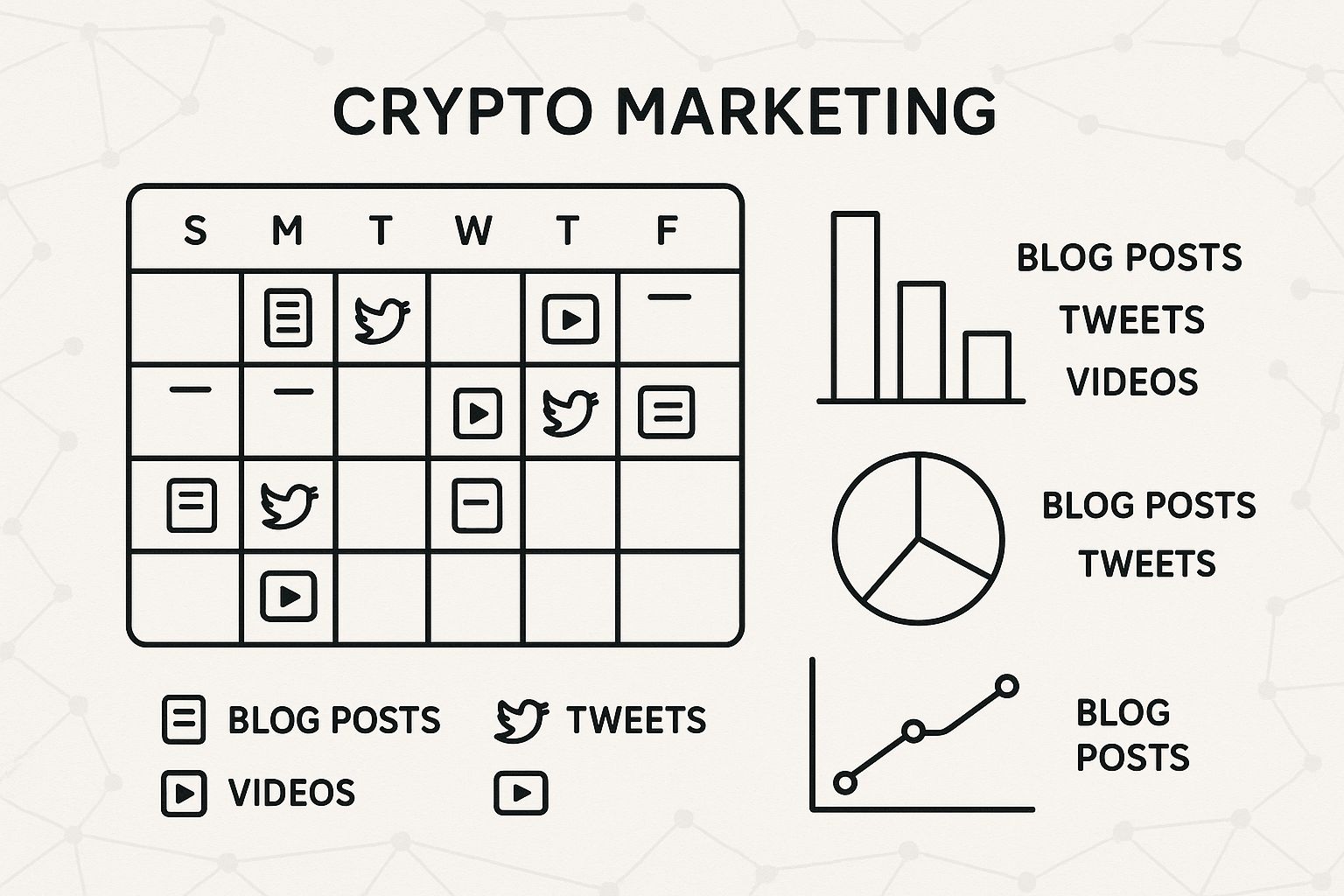
As you can see, a winning strategy isn't about posting the same thing everywhere. It’s about a mix of high-frequency updates on a platform like X, which is then backed up by deeper, more thoughtful content on your blog or YouTube.
To help you decide where to plant your flag, I’ve broken down the key players.
Here’s a quick rundown of how the top platforms stack up for Web3 projects. Each has a distinct role to play, and understanding these nuances is the first step toward building a community that lasts.
Crypto Social Media Platform Strategy Comparison
| Platform | Primary Use Case | Best For | Key Strategic Advantage |
|---|---|---|---|
| X (Twitter) | Real-time news, narrative building, and rapid engagement | Announcing partnerships, sharing alpha, and establishing thought leadership | Unmatched speed and reach for breaking news and shaping market perception. It's the crypto world's public square. |
| Discord | Deep community building and direct user engagement | Nurturing super-fans, providing support, and organizing focused discussions (e.g., dev talk, governance) | Creates a dedicated, organized "home" for your community, fostering a strong sense of belonging and loyalty. |
| Niche community engagement and building trust | Projects targeting specific subcultures (e.g., DeFi, Ethereum) that value technical depth and authenticity | Access to highly passionate, skeptical, and knowledgeable niche audiences. Earning trust here pays huge dividends. |
Choosing the right mix from this list—instead of trying to conquer all of them—is what separates successful projects from the ones that shout into the void.
X (Twitter): The Crypto Town Square
If the crypto world has a central nervous system, it’s X (the platform we all still call Twitter). This is where narratives are born and die in a single day, alpha gets dropped, and project reputations are made or broken in real time. For any serious Web3 project, being active and skilled on X isn't a "nice-to-have." It’s a core survival mechanism.
X is the undisputed king for:
- Rapid-Fire News: This is your go-to for announcing partnerships, protocol upgrades, or critical security updates.
- Thought Leadership: Founders and core team members can build a massive personal following and lend credibility to the project through insightful threads and market commentary.
- Meme Warfare: Don't underestimate this. Memes are how crypto culture communicates, and this is the primary battleground for winning hearts and minds.
The pace here is absolutely relentless. Your content needs to be sharp, concise, and plugged into the culture. The audience can sniff out inauthentic corporate jargon from a mile away. The best accounts seamlessly blend high-value updates with native humor and genuine engagement. For a deeper dive, check out these comprehensive X statistics to really grasp the platform's power.
Discord: The Community Citadel
While X is your broadcast tower, Discord is your community's home base. This is where you transform casual followers into a loyal army of advocates. It's the place for deep, sustained engagement where you can build a true sense of shared ownership.
Discord is less of a megaphone and more of a living ecosystem. It lets you create a structured, multi-channel hub where your community can self-organize, connect, and contribute.
Inside your Discord, you can host AMAs with the founders, spin up dedicated channels for developers to collaborate, offer hands-on user support, and set up roles and rewards for your most active members. It's the perfect setup for projects that need detailed discussion and feedback, like complex DeFi protocols or DAOs.
Reddit: The Passionate Niche Hub
Reddit is probably the most underrated and misunderstood channel in crypto marketing. It's not one single platform; it's a massive collection of hyper-specific, passionate communities called "subreddits." People don't come here just for news—they come for deep dives, brutally honest reviews, and peer-to-peer discussions.
The key to Reddit is that you can't just show up and start shilling your project. You'll get torn apart. Success comes from becoming a trusted, value-adding member of a relevant community, like r/ethereum or r/DeFi.
Here’s how you win on Reddit:
- Answer Questions: Genuinely help people in threads related to your project's niche without plugging your own stuff.
- Share Educational Content: Post useful tutorials, data-driven infographics, or in-depth guides that don't have a hard sales pitch.
- Host Transparent AMAs: Open the floor and let the community ask the tough questions. Candid, honest answers build incredible trust.
If you contribute authentically over time, you build a reputation that drives more organic interest than any ad campaign ever could.
Why Platforms Like Instagram Just Don't Work
Knowing where not to spend your time is just as important. The crypto audience has overwhelmingly voted with its attention, and some platforms just don't make the cut.
A clear example is Instagram, which receives a tiny 0.20% of crypto influencer marketing budgets. That’s not an accident. Crypto marketing thrives on platforms built for text-based discussion, community governance, and deep analysis. Think X for news, Discord for community, and YouTube for long-form education.
Platforms like Instagram and Facebook are built around visual, lifestyle-centric content. This model just doesn't resonate with a Web3 audience that prioritizes technical substance, data, and direct communication. While an NFT project with a heavy visual art component might find some niche use for Instagram, for the vast majority of crypto projects, it's a massive waste of resources with almost zero return. Stick to the platforms where the Web3 community actually lives.
Creating Content That Web3 Users Actually Want
Let's be clear: in crypto, generic "value-add" content is just noise. The Web3 audience is one of the most discerning and skeptical groups you'll ever encounter online. They can smell a sales pitch a mile away and are here for the real signal, not marketing fluff. Your entire content strategy has to be built on a foundation of substance, transparency, and a genuine understanding of what this community actually wants to see.
Forget about repurposing corporate blog posts or bland press releases. Your audience wants to see the gears turning. They’re dying to understand the why behind your project, not just the what. This means you have to get good at translating dense, technical documents—like your whitepaper and roadmap—into formats that are actually digestible and engaging on social media.
From Whitepaper to X Thread
The most successful projects I’ve seen treat their content creation as an act of translation. They take incredibly complex ideas and make them accessible without dumbing them down or sounding patronizing. A great way to start is by breaking down your project's core components into a few distinct content pillars.
Think of these pillars as the backbone of your content calendar. They ensure you’re consistently hitting the topics your community cares about most.
- Technical Deep Dives: Take one specific mechanism of your protocol and break it down. Explain how your consensus algorithm works or the thinking behind your tokenomics. Use simple analogies. Make it make sense.
- Ecosystem Explainers: Don't just talk about yourself. Create content that helps your audience become smarter, more informed participants in the broader Web3 space.
- Founder Insights & Vision: People don't connect with logos; they connect with people. Share the story behind the project, the long-term vision, and the core principles that guide your team.
- Community-Generated Content: This is huge. Run meme contests, shout out community-built tools, and showcase stories from your actual users. This fosters a powerful sense of ownership and belonging.
When you organize your efforts around these themes, you stop posting random, disconnected updates and start building a real library of content. This is how you establish your project as an authoritative, must-follow voice and attract people who are genuinely invested in what you're building.
The Power of Radical Transparency
One of the most potent—and underutilized—content strategies in crypto is radical transparency. In an industry where trust is everything and scams are lurking around every corner, being brutally honest about your journey is a superpower. This goes way beyond posting your standard project updates.
Radical transparency isn't just about sharing your wins. It's about publicizing your developer logs, openly discussing roadblocks, and admitting when you've messed up. This builds a level of trust that no marketing budget can ever buy.
For instance, instead of just vaguely announcing a launch delay, write a detailed post explaining the exact technical hurdle your team hit and the concrete steps you're taking to solve it. This approach respects your audience's intelligence and treats them like partners in the building process, not just passive consumers. It turns what could be a PR disaster into a massive opportunity to build unshakable trust.
Actionable Content Formats That Actually Work
The format of your content matters just as much as the message itself. A wall of text dropped in a Discord announcement will be completely ignored. But if you repurpose that same information correctly, it can capture widespread attention and spark conversation.
You need to translate dense info into these high-impact formats:
- Compelling X (Twitter) Threads: This is non-negotiable. Break down a major update or a complex concept into a 10-15 tweet thread. You need a strong hook, simple language, emojis for visual breaks, and custom graphics or diagrams to illustrate your key points.
- Shareable Infographics: Visualize your token distribution, roadmap milestones, or the map of your ecosystem. A clean, data-rich infographic is incredibly shareable and helps people grasp complex information at a glance.
- Insightful Blog Posts: Use your blog for the real deep dives. Your social posts can act as the hook, but your blog is where you explore the nuances of your tech or share your perspective on the market. Then, promote the hell out of those posts with summary threads on X.
- "Builder" AMAs and Live Streams: Host sessions on X Spaces or Discord that go beyond basic Q&As. Bring on your lead developer to do a live coding session or have a product manager walk through a new feature. Show, don't just tell.
Adopting this multi-format approach ensures your core messages actually land with different parts of your audience, wherever they hang out. It proves you’re serious about education and communication, turning your social channels into an essential resource for anyone interested in your corner of Web3.
Working With Influencers Without Getting Burned
Let's be honest: crypto influencer marketing can feel like a minefield. For every genuine advocate who can bring real credibility to your project, you'll find a dozen paid shills happy to hype anything for a quick check. If you want to succeed here, you have to stop thinking about finding the biggest megaphone and start focusing on building authentic partnerships that your community will actually respect.
Your audience can spot a fake, paid-for post from a mile away. When a big-name influencer suddenly starts tweeting vague praise about a project they’ve never mentioned before, the community’s first reaction is almost always skepticism, not excitement. This is exactly why a purely transactional approach almost always backfires—it destroys the very trust you’re trying to build.

Vetting Influencers Beyond Follower Counts
First things first: you have to look past the vanity metrics. A massive follower count means absolutely nothing if that audience is just bots, giveaway hunters, or people who never engage. You need to dig much deeper to find the real thought leaders and filter out the mercenaries.
Start by looking at the quality of their engagement. Are the replies to their posts actual questions and thoughtful discussions? Or is it just a wall of "Great project!" and fire emojis? Real influence sparks real conversation.
Then, dive into their content history.
- Niche Alignment: Do they consistently cover your specific corner of Web3? Whether that’s DeFi, NFTs, or Layer 2 scaling solutions, they need to live and breathe the same space you do.
- Educational Value: Is their content genuinely useful and informative, or is it just a constant stream of price predictions and hype?
- Project Loyalty: Do they jump from one "hot" project to the next every week? Or do they stick with and support the ecosystems they truly believe in over the long haul?
An influencer who has been teaching their audience about zero-knowledge proofs for a year is a far, far better partner for a ZK-based project than a generalist who has five times the followers. It’s not even close.
Structuring Partnerships for Authenticity
Once you've found someone who looks like a great fit, how you structure the partnership is everything. You need to move beyond simple paid posts and think about more integrated collaborations. This is what fosters real alignment and produces content that feels credible.
The best influencer collaborations don't feel like ads. They feel like genuine endorsements from a trusted expert who is actively involved in the project's success. That's the gold standard you should be aiming for.
Instead of just paying for a tweet, consider these more authentic models:
- Co-Hosted Educational Events: Invite them to co-host a live AMA on X Spaces or a technical deep-dive on YouTube. This frames them as an expert and lets their audience see them engaging directly with your team.
- Ambassador Programs: Create a formal program for a small, hand-picked group of influencers. Give them early access to updates, a direct line to your core team, and a real voice in providing feedback. This turns them into long-term advocates who are genuinely invested in your journey.
- Content Collaborations: Work with them to create something of real value, like a detailed tutorial, an in-depth project review, or a comprehensive thread that breaks down a core feature of your protocol.
As you build these relationships, it helps to understand the business side of things. Knowing how AI influencers monetize their presence, for example, can give you context for negotiating fair deals and spotting who’s genuinely in it for the tech.
Non-Negotiable Transparency Practices
In an industry that’s supposed to be built on trustlessness, transparency in your marketing is simply non-negotiable. Your community deserves to know when content is sponsored. Failing to disclose a paid partnership isn’t just unethical—it can cause a massive backlash that permanently tanks your project's reputation.
Make it mandatory that any influencer you work with uses clear, obvious disclosures like #ad or #sponsored. It’s a simple step that protects your project, shows respect for your community, and builds credibility for the long run. It signals that you have nothing to hide and that you’re confident in your project’s value beyond any paid promotion.
Influencer marketing is a huge part of crypto promotion, and the money involved is serious. Influencers with 100,000 followers can make around $1,000 for a single Instagram post. Those with 2 million followers can command between $7,500 and $15,000. And for the top-tier creators with 10 million or more followers? They can earn anywhere from $50,000 to $100,000 per post. These numbers highlight exactly why disclosure is so critical—the financial incentives are massive, and transparency is the only thing that maintains audience trust.
Your Top Crypto Marketing Questions, Answered
Working in crypto social media means facing a constant barrage of tough questions. The ground is always shifting, and what got results last cycle might fall completely flat today. I've been in the trenches with countless projects, and I see the same challenges pop up again and again. Here are my straight-up answers to the most common ones.
How Do I Actually Measure ROI on Community Building?
If you’re trying to draw a straight line from a Discord conversation to a token purchase, you’re thinking about this all wrong. That’s a Web2 hangover. In crypto, the real ROI of community isn't measured in direct sales—it's measured in the strength and activity of your ecosystem.
You need to shift your KPIs. Think less about vanity metrics and more about genuine health signals.
Here’s what I track:
- Discord Engagement: Are people actually talking? Look at your daily active users (DAUs) and, more importantly, the message-to-member ratio. A high ratio tells you people are having real conversations, not just lurking in the shadows.
- On-Chain Actions: This is where the rubber meets the road. How many community members are actually voting on governance proposals? How many are hammering your testnet or connecting their wallets to your dApp? These aren't just clicks; they're signs of a deeply committed user base.
- Support Deflection: This one is huge. When your community members start answering each other’s questions in your support channels, that's a massive win. You're not just saving on operational costs; you're building a culture where people genuinely want to help each other succeed.
The real return on a strong community is an organic marketing flywheel. You can't buy the kind of trust that comes from genuine word-of-mouth, user-generated tutorials, and peer-to-peer support. It’s an asset no ad budget can ever replicate.
What Are the Biggest Legal Landmines I Need to Sidestep?
The legal landscape in crypto marketing is treacherous, and pleading ignorance won’t save you. Two massive risks can sink your project if you're not careful: securities laws and deceptive advertising.
First, and I can't stress this enough, never, ever make price predictions. Don't even hint at it. Any language that sounds like you’re promising profits on an investment can get your token flagged as an unregistered security by regulators like the SEC. That is a red line. Do not cross it.
Second, transparency with influencers is non-negotiable. Every single partner promoting your project must clearly disclose their relationship. Make sure they use obvious tags like #ad or #sponsored right up front. Hiding these partnerships is the fastest way to get regulators knocking on your door and vaporize any trust you’ve built. Honestly, with regulations changing all the time, you absolutely need a lawyer who specializes in crypto to review your marketing materials.
Are Paid Social Media Ads Even Worth It for Crypto Projects?
This is a real head-scratcher for a lot of teams. While paid ads are the bread and butter of traditional marketing, they’re a minefield in the crypto world. Frankly, their effectiveness is often questionable.
You'll find that major platforms like Meta and Google have incredibly restrictive policies. They're notorious for rejecting or shutting down crypto-related ad accounts with little to no warning. It's a constant, frustrating battle that just isn't worth the energy for most projects.
X (what we all still call Twitter) is a bit more open, but the results can be a mixed bag and the costs can spiral quickly. Before you pour your budget into a campaign that could vanish overnight, think about where that money could work harder for you.
Consider shifting those funds toward strategies with a much more reliable and sustainable ROI in Web3:
- Community Grants: Pay developers and creators to build cool things within your ecosystem.
- Killer Content: Go deep on high-quality educational articles, video tutorials, and technical deep dives.
- Real Partnerships: Work with genuine influencers and communities who actually believe in what you're building.
These approaches build a strong, defensible foundation for growth that volatile ad campaigns just can't match.
Ready to build your Web3 dream team? Find Web3 is the top destination for sourcing specialized talent in crypto, DeFi, and NFTs. Post a job today and connect with thousands of qualified professionals. Explore your next hire at https://findweb3.com.