
What Exactly Are Blockchain Development Platforms?
Think about building a house. You wouldn't start by manufacturing your own bricks, forging your own nails, or milling your own lumber. That would be incredibly inefficient. Instead, you'd go to a hardware store that provides all the foundational materials and tools you need.
That's precisely the role blockchain development platforms play in the world of Web3. They are the essential toolkits that save developers from the monumental task of building an entire blockchain from scratch for every new idea.
By providing the core infrastructure, these platforms let builders focus their energy where it counts: on crafting the unique features and user experience of their decentralized applications (DApps).
The Core Components for Building on a Blockchain
At their heart, these platforms are a bundle of crucial tools that make building on a blockchain practical. It's a bit like a digital workshop, stocked with everything a developer needs to get the job done.
- Software Development Kits (SDKs): These are pre-packaged sets of code libraries and tools that make it much easier to interact with a specific blockchain.
- Application Programming Interfaces (APIs): Think of APIs as the messengers that allow an application to talk to the blockchain—requesting data or submitting transactions.
- Smart Contract Languages: These are the specialized programming languages, like Solidity for Ethereum, used to write the self-executing code that powers DApps.
- Testing Environments: Often called "testnets," these are critical sandboxes where developers can deploy and debug their code without putting any real funds or assets at risk.
This integrated approach is what has enabled so much innovation in the Web3 space. As more businesses and industries explore what blockchain can do for them, the demand for these foundational tools is exploding.
The numbers speak for themselves. The global blockchain market was valued at USD 26.91 billion in 2024 and is forecast to climb to an incredible USD 1,879.30 billion by 2034. That's a compound annual growth rate (CAGR) of 52.90%, highlighting the massive confidence and investment pouring into this space. You can dive deeper into these figures with this comprehensive market analysis from Precedence Research.
Picking the right blockchain development platform is one of the most consequential decisions a project can make. It directly impacts your application's performance, security, transaction costs, and ultimately, its ability to grow. This guide is designed to cut through the noise, helping you understand the key players and what makes each one tick, so you can choose the perfect foundation to build your vision.
Making Sense of Core Blockchain Concepts
Before you can really get your hands dirty with blockchain development platforms, it’s crucial to get a feel for the concepts that make them tick. These aren't just buzzwords; they're the core components that power everything from cryptocurrencies to the decentralized apps you hear so much about.
Think of them less like dense, technical jargon and more like the basic rules for a whole new way of interacting online. Once these ideas click, the world of blockchain development starts to make a lot more sense, and you can see the real potential for building more transparent and independent systems.
Let's break down the three most important pieces of the puzzle.
Smart Contracts: The Digital Vending Machines
The real magic behind most blockchain platforms is the smart contract. The name might sound intimidating, but the idea behind it is surprisingly straightforward. Picture a vending machine: you put in the right amount of money (the condition), and the machine automatically gives you your snack (the outcome). No cashier, no negotiation, no waiting for approval.
A smart contract works the exact same way. It’s a bit of code that sits on the blockchain and automatically carries out the terms of an agreement once certain conditions are met. This self-executing nature cuts out the middleman, which means less friction and a much lower chance of human error. For a developer, smart contracts are the programmable building blocks for just about everything.
DApps: Apps Without a Boss
So, what do you build with these smart contracts? Decentralized Applications, or DApps. On the surface, they look and feel just like the apps on your phone, but there’s a massive difference under the hood. DApps run on a peer-to-peer network, meaning no single company is in charge.
Take a typical ride-sharing app. A central company dictates the prices, skims a big cut from every fare, and owns all the user data. A DApp version, on the other hand, would connect riders and drivers directly.
The rules—like fares and payment terms—are all laid out in a smart contract that everyone can see. Payments go straight from the rider to the driver, without a corporate giant taking a hefty commission. This shift creates a fairer and more open system for everyone involved.
You can apply this model to almost any industry, from finance to social media, completely changing how we use online services and who controls our data. Understanding how DApps work is key, as this technology drives the crypto market and the top benefits of cryptocurrency.
Consensus Mechanisms: How Everyone Agrees on the Truth
This all leads to a big question: if there's no central authority, how does a decentralized network agree on what’s true? That’s the job of consensus mechanisms. Think of them as the official rulebooks that blockchains follow to confirm transactions and keep the shared ledger honest.
Imagine a large team collaborating on a critical document. To avoid a chaotic mess and make sure everyone works from the correct version, they follow a strict set of rules for approving changes. A consensus mechanism does exactly that for a blockchain. The two you'll hear about most are:
- Proof of Work (PoW): This requires network participants (called "miners") to solve difficult math puzzles to add new transactions. It's incredibly secure but uses a lot of energy.
- Proof of Stake (PoS): Here, participants validate transactions based on how much cryptocurrency they're willing to "stake," or lock up, as collateral. It’s a far more energy-efficient and scalable approach.
Getting a solid grasp on these foundational ideas is your first real step toward building with blockchain development platforms. To keep learning the lingo, our extensive Web3 dictionary is a fantastic resource to have in your back pocket.
Choosing Your Blockchain Architecture

Before you even start looking at specific blockchain development platforms, you have to make a foundational choice about the kind of network you’re building. This is the bedrock of your entire project. Not all blockchains are created equal; their core architecture determines who can participate, how data is verified, and how private everything is.
Picking the wrong architecture is a bit like building a glass-walled conference room for a top-secret meeting. It just doesn't fit the purpose. The decision really comes down to a balancing act between transparency, security, and control. Your project's specific needs will almost certainly point you toward one of three models: public, private, or a hybrid of the two.
Public Blockchains: The Digital Town Square
When most people think of blockchain, they're picturing a public one. Giants like Bitcoin and Ethereum have made this model famous. The best analogy is a global, digital town square—it’s completely permissionless, which means anyone on the planet can join in, read the entire history of transactions, and propose new ones.
This radical openness is what makes it so powerful for certain applications. It's the perfect fit for projects that need to be transparent and resistant to censorship.
- Cryptocurrencies: Digital money requires an open network that no single bank or government can shut down.
- NFTs: Proving you own a digital asset is pointless unless that proof is on a public ledger for anyone to see and verify.
- Decentralized Finance (DeFi): DeFi applications aim to build financial tools open to everyone, and that’s only possible on a public chain.
The trade-off? Performance. With a global network of participants all needing to agree, transaction speeds can be slower and the costs higher.
Private Blockchains: The Corporate Intranet
At the other end of the spectrum, you have private blockchains. If a public chain is the town square, a private chain is like a company's secure internal network. Access is strictly permissioned. A central administrator holds the keys, deciding who can join the network and what permissions they have.
This controlled environment is exactly what many businesses need. Think of a consortium of banks wanting to settle trades instantly or a retailer tracking its supply chain. They get the security and immutability of a blockchain without broadcasting sensitive business data to the world. As of 2024, it's no surprise that sectors like finance and healthcare, where data control is essential, heavily lean on private models. You can learn more about these market divisions in the blockchain industry.
Because far fewer people are involved in validating transactions, private blockchains are also much faster and cheaper to run.
The key sacrifice here is decentralization. A private blockchain, by its very design, gives up the "trustless" nature of public networks. Instead, all participants place their trust in the central administrator who controls the system.
Hybrid Blockchains: The Best of Both Worlds?
So, what if you need a little of Column A and a little of Column B? That’s where hybrid blockchains come in. They aim to offer a middle path by blending features from both public and private systems. This is like a corporate network that gives specific customers or partners limited, controlled access.
A hybrid setup lets an organization keep its day-to-day operations on a fast, private chain while using a public blockchain for specific moments of verification. For instance, a hospital could manage sensitive patient records on a private chain for confidentiality but post cryptographic proof of those records onto a public chain. This proves the records exist and haven't been tampered with, all without revealing the actual health data.
This approach delivers incredible flexibility, giving you customized privacy where you need it without completely giving up the public trust that a blockchain can offer. Getting this architectural choice right is your first major step toward finding the perfect blockchain development platform.
Comparing the Leading Blockchain Platforms
Choosing a blockchain platform for your project is a lot like picking a vehicle for a road trip. Are you after the rugged, all-terrain power of a 4×4, the eco-friendly efficiency of a hybrid, or the sheer velocity of a sports car? Each one will get you to your destination, but the experience will be completely different. The top blockchain platforms are much the same—each is engineered with a specific purpose in mind.
This comparison will break down the industry’s heavy hitters. We'll get into their unique strengths, the specific problems they aim to solve, and the trade-offs they make along the way. This should give you a much clearer idea of which one could be the right foundation for your decentralized project. Let's dive in.
Top Blockchain Development Platforms Comparison
To kick things off, let's look at the key players side-by-side. This table offers a quick snapshot of their core technical differences, from how they reach consensus to the languages they speak.
| Platform | Consensus Mechanism | Smart Contract Language | Transactions Per Second (TPS) | Ideal Use Case |
|---|---|---|---|---|
| Ethereum | Proof-of-Stake (PoS) | Solidity, Vyper | ~15-30 | DeFi, NFTs, General DApps |
| Solana | Proof-of-History (PoH) + PoS | Rust, C, C++ | Up to 65,000 | High-frequency trading, Gaming, Micropayments |
| Cardano | Ouroboros (PoS) | Plutus, Marlowe | ~250 | High-stakes applications, Identity, Secure Systems |
| Hyperledger Fabric | Pluggable (e.g., Raft) | Go, Java, JavaScript | >3,500 | Enterprise, Supply Chain, Private Networks |
As you can see, these platforms are built for very different jobs. The trade-offs between speed, security, and decentralization become pretty clear when you see the numbers lined up like this.
Ethereum: The Trailblazer
Ethereum is the undisputed pioneer of the smart contract world. When it launched in 2015, its introduction of programmable logic on a blockchain was a game-changer, paving the way for everything from DeFi to NFTs. Its greatest strength is its massive, deeply established ecosystem.
Think of Ethereum as the first major city in a new world. It has the most roads, the most businesses, and the most people who know their way around. This long history has cultivated a huge community of developers, tons of documentation, and a set of battle-hardened tools that make it a very approachable place to start building.
Of course, that popularity has its price. Because of its Proof-of-Work origins, the main network has notoriously struggled with high transaction fees (known as "gas") and sluggish speeds during busy periods, typically handling around 15-30 transactions per second (TPS). While the recent move to Proof-of-Stake is a massive step toward fixing these scaling issues, it's still a work in progress.
Solana: The High-Speed Challenger
If Ethereum is the established, sprawling city, Solana is the sleek, futuristic metropolis built for pure speed. Its entire design philosophy revolves around performance, directly tackling the throughput bottlenecks that have held back other public blockchains.
Solana gets its incredible speed from a unique consensus mechanism called Proof-of-History (PoH), which works alongside Proof-of-Stake. This powerful combination allows the network to process an almost unbelievable number of transactions—theoretically hitting 65,000 TPS—with fees that are next to nothing. This makes it a go-to for apps that need things to happen instantly.
- High-Frequency Trading: Perfect for DeFi platforms where executing trades in a millisecond matters.
- Blockchain Gaming: Ideal for in-game actions and asset swaps that can't be slowed down by network lag.
- Micropayment Systems: Great for applications where even a tiny transaction fee would be a deal-breaker.
This obsession with speed has, at times, led to questions about network stability and decentralization, but you simply can't argue with its raw power.
This infographic really puts the performance differences into perspective.
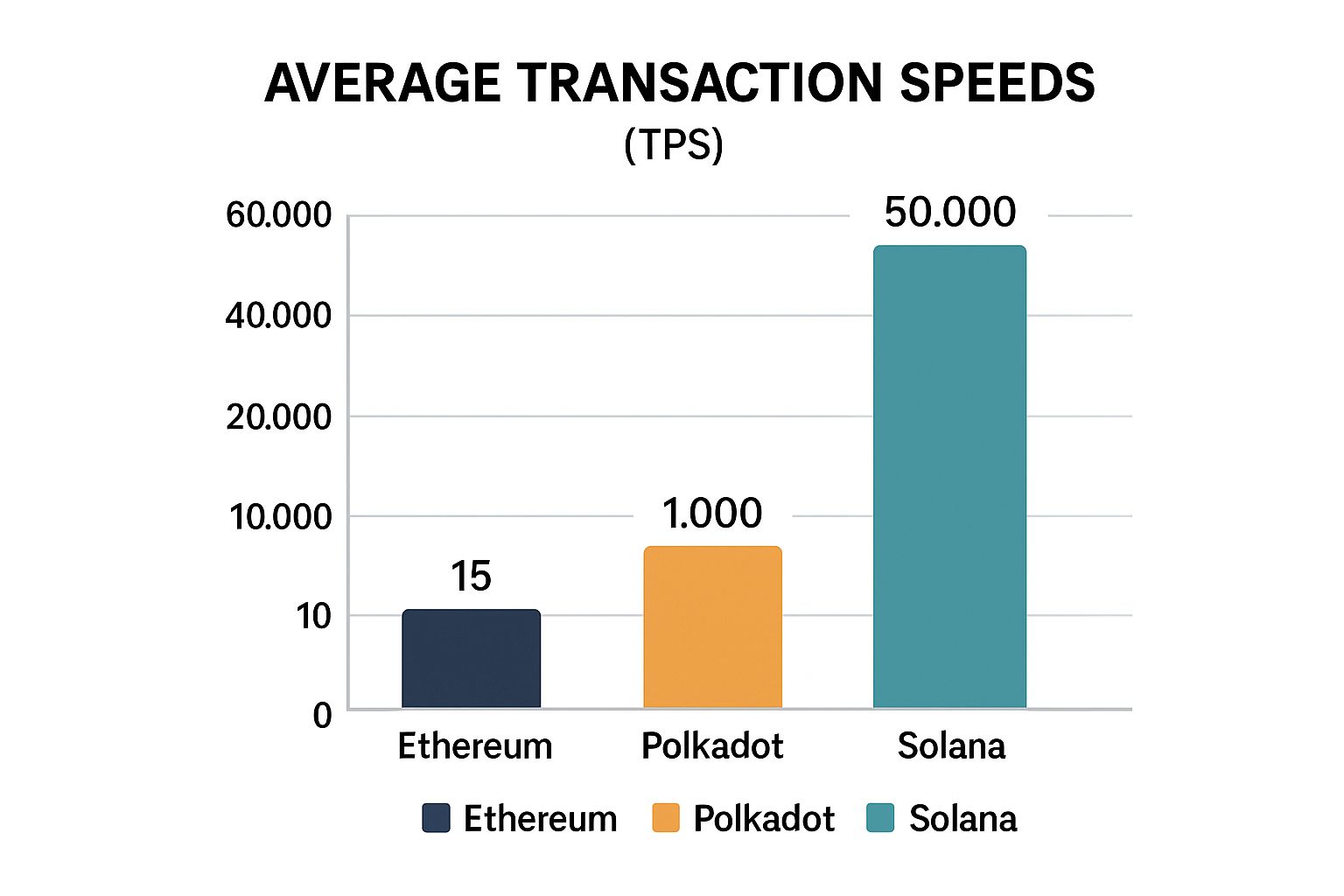
It’s clear from this chart that platforms like Solana are playing a completely different ballgame when it comes to performance scale.
Cardano: The Methodical Academic
Cardano takes a completely different path, one that prioritizes academic rigor and peer-reviewed research above all else. If other platforms are building the car while driving it down the highway, Cardano is the team that spends years perfecting the engine blueprints before a single bolt is turned.
Its development is famously methodical, broken into carefully planned phases where every update is supported by scientific papers. The goal is to build an incredibly strong foundation based on security and long-term sustainability. The platform runs on a unique Proof-of-Stake protocol called Ouroboros, which was engineered from scratch to be provably secure and energy-efficient.
This "research-first" philosophy means development moves more slowly than its rivals, but the trade-off is a more resilient and predictable platform. It’s a natural fit for organizations building high-stakes applications where absolute correctness is a must.
The demand for developers who understand these specialized, high-assurance systems is growing fast. If you're looking to get into the field, checking out current job openings in the blockchain sector is a great way to see what skills are most valuable right now.
Hyperledger Fabric: The Enterprise Solution
While the others are open, public networks anyone can join, Hyperledger Fabric is in a category all its own. Managed by the Linux Foundation, it's an open-source framework for building private, permissioned blockchain development platforms aimed squarely at business and enterprise use.
Don't think of it as a single blockchain, but rather as a toolkit for building your own custom solution. Companies can create private networks where every participant is known and has been granted access. Its key features are all business-focused:
- Modular Architecture: You can swap components like consensus and identity services in and out to fit your needs.
- Private Transactions: Data can be kept confidential, shared only with the specific parties who need to see it—a must-have for business.
- No Cryptocurrency Needed: It doesn't rely on a native token to run, which means no exposure to crypto price swings.
This makes Hyperledger Fabric the top choice for complex use cases like supply chain management, international trade finance, and healthcare records, where privacy, control, and permissioning are non-negotiable.
A Practical Framework for Platform Selection
Alright, now that we've covered the major players, let's translate that knowledge into a real-world decision. Picking from the long list of blockchain development platforms can feel like a guessing game, but a structured approach makes all the difference. The key is to stop getting lost in the technical jargon and start by looking at your project's DNA.
Think of it like building a house. You wouldn't start ordering lumber and windows before you have a blueprint. The same logic applies here. The platform you choose has to be the right foundation for your project's goals, security needs, and future growth. This framework breaks that big decision down into four essential pillars.
Evaluate Performance and Scalability
First things first: how big is this thing going to get? Seriously. Are you building a niche DApp for a tight-knit community, or are you shooting for the moon with millions of potential users? This one question changes everything.
Platforms like Solana were designed for the fast lane. With its Proof-of-History consensus, it's built for applications that need transactions to happen in the blink of an eye with low fees, like a high-frequency trading bot or a massive online game.
On the other hand, if your app doesn't need to process thousands of transactions per second, the battle-tested reliability and enormous ecosystem of a platform like Ethereum might be the smarter choice. Getting this right from the start determines whether your users have a smooth experience or hit a frustrating performance wall down the road.
Assess Security and Privacy Needs
Next up, let's talk about data. How sensitive is it? Are you creating a public NFT marketplace where total transparency is a selling point? Or are you architecting a private supply chain solution for a corporation where confidentiality is everything? The answer will point you in a clear direction.
This is where a platform like Hyperledger Fabric shines. It's purpose-built for creating private, permissioned networks. Think of it as a members-only club where you control exactly who gets in and what they can see—perfect for businesses dealing with trade secrets or sensitive records. If your main goal is maximum decentralization and an open, censorship-resistant environment, then a public blockchain is your only real option.
Choosing the right security model is non-negotiable. A pharmaceutical supply chain tracker handling sensitive medical data would prioritize Hyperledger Fabric's privacy features, while a decentralized social media platform would choose a public chain for its open and censorship-resistant nature.
Consider the Developer Ecosystem
A platform isn't just technology; it's the people and tools that surround it. A strong developer ecosystem is the support system that will make or break your project. This means great documentation, active forums where you can get help, tons of code libraries, and—crucially—developers who know how to build on it.
When it comes to a thriving community, Ethereum is in a league of its own. It has years of collective knowledge baked in and a massive pool of experienced developers. A healthy ecosystem means you can build faster, solve problems more easily, and find qualified people to help you. Before you commit, do some recon. The demand for specialized talent is intense. A quick look at current Web3 engineering job openings can give you a real sense of which platforms have a deep talent pool.
Analyze Interoperability Requirements
Finally, think about whether your DApp needs to play well with others. Will it exist in its own little world, or will it need to talk to other blockchains? The future of Web3 is looking more and more like a network of connected chains, not a collection of digital islands.
Interoperability—the ability for different blockchains to share data and assets—is becoming a massive advantage. If your application needs to, say, read data from one chain to trigger an action on another, you should be looking at platforms that are part of a cross-chain ecosystem like Cosmos or Polkadot, or have well-supported bridges to other networks. Planning for this now ensures your project won't get left behind as the blockchain world gets more connected. This practical approach will empower you to select the platform that truly fits.
What's Next for Blockchain Development?
The world of blockchain development platforms doesn't sit still for a moment. It's constantly moving, with brilliant people finding new ways to solve old problems like speed, scale, and cross-chain communication. If you're building in this space, keeping an eye on these developments isn't just a good idea—it's essential for creating anything with lasting value.
These aren't just small updates. We're seeing major shifts in how decentralized applications are built and what they can do. The goal is a future where these systems are faster, smarter, and more connected than we could have imagined just a few years ago. Let's look at the trends that are really pushing things forward.
Layer 2 Scaling Solutions Are Taking Off
One of the biggest game-changers right now is the boom in Layer 2 scaling solutions. Picture a popular blockchain like Ethereum as a single, congested city street. At peak times, it's a traffic jam. Getting anywhere is slow and expensive (think high gas fees). Layer 2s, like Arbitrum and Optimism, are like express highways built over that street.
They work by taking huge batches of transactions, processing them quickly and cheaply "off-street," and then just posting a summary of the final results back to the main Layer 1 network. This simple but powerful idea massively boosts how many transactions can be handled without compromising the security of the main chain.
This is huge. By moving most of the heavy lifting off-chain, Layer 2s make it possible for blockchain development platforms to host apps with millions of users—something that was just a pipe dream on congested mainnets. We're talking high-frequency trading, massive online games, and complex financial tools.
Blockchains Are Finally Talking to Each Other
For years, blockchains were like walled gardens. They were powerful on the inside, but they couldn't communicate or share anything with their neighbors. That siloed era is ending, thanks to a huge push for interoperability.
The magic behind this is a technology called cross-chain bridges. These act as translators, letting different blockchain ecosystems talk to each other and move assets between them. Someone could, for instance, take their tokens from the Solana network and use them in a DeFi app on Ethereum without ever touching a centralized exchange.
This kind of connection creates a much more cohesive and user-friendly Web3. Some of the key players making this happen include:
- Cosmos: Building an "Internet of Blockchains" where independent chains can easily connect.
- Polkadot: Allows specialized blockchains ("parachains") to plug into a shared security and communication network.
- LayerZero: A protocol that lets smart contracts on one chain send messages directly to contracts on another.
The Fusion of AI and IoT with Blockchain
Looking further ahead, one of the most exciting trends is how blockchain is starting to merge with Artificial Intelligence (AI) and the Internet of Things (IoT). When you put these three together, you get the foundation for some truly autonomous systems.
Here’s how it works: Blockchain gives you a secure and unchangeable record of data. IoT devices provide a constant stream of that data from the real world. And AI delivers the intelligence to make sense of it all and act on it.
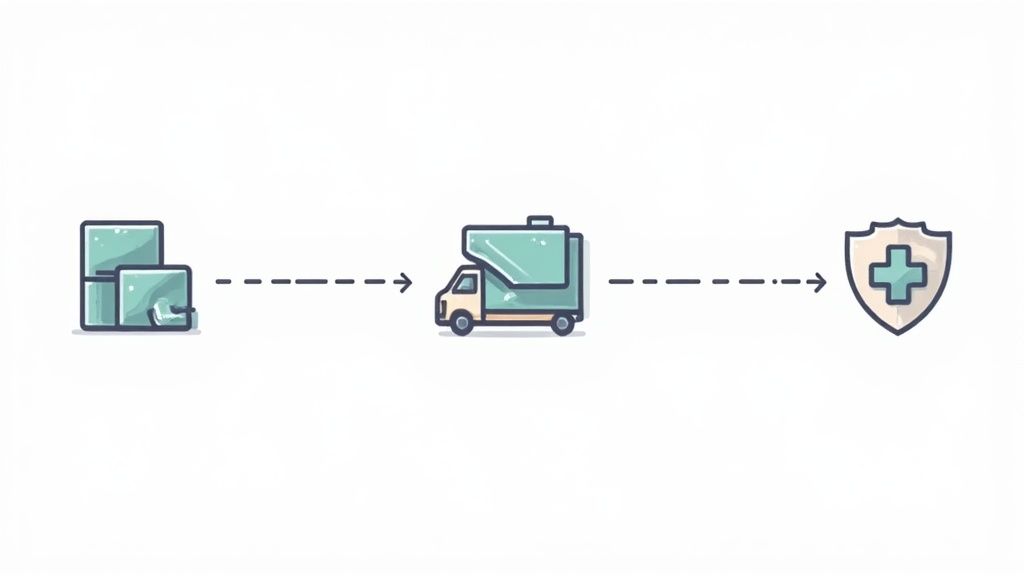
Think about a smart supply chain. An IoT sensor on a shipping container logs its location and temperature to a blockchain. An AI constantly monitors that data. If the package arrives safely, the AI can trigger a smart contract to release payment. If the temperature goes out of spec, it can automatically file an insurance claim. This blend of technologies is setting the stage for a future built on trustless, automated systems, with blockchain serving as the fundamental layer of truth.
A Few Common Questions About Blockchain Platforms
Even after getting a handle on the major platforms, you're bound to have some practical questions. Let's tackle a few of the most common ones that come up when people are ready to move from theory to actually building something.
What's the Toughest Part of Blockchain Development?
Honestly, it’s the mental shift. The biggest hurdle for most developers is wrapping their head around the core ideas of decentralization, consensus algorithms, and cryptography. It's a completely different way of thinking compared to standard software development. You're not just building an app; you're engineering a secure, trustless system from the ground up.
Beyond that, writing truly secure smart contracts is incredibly demanding. Once a contract is on the blockchain, it’s usually there for good—mistakes and all. A tiny bug can become a massive, costly exploit. This reality forces you to be obsessed with security and testing from day one, which can be a tough adjustment.
Can I Build a Blockchain App Without Knowing How to Code?
Yes, you absolutely can. We're seeing a surge in no-code and low-code blockchain development platforms designed for this exact purpose. These tools provide visual editors, drag-and-drop components, and ready-to-go templates that let you create DApps, tokens, and smart contracts without writing a line of code.
Of course, you'll trade some custom functionality for convenience, but they are a fantastic way to get started. They're perfect for entrepreneurs or creators who want to quickly build a prototype or launch a straightforward project without needing a dedicated development team.
This trend is a huge deal for the industry, as it’s inviting a whole new wave of creative people into the Web3 world.
What's the Ballpark Cost to Build a DApp?
This is the classic "it depends" question. The cost can swing wildly, from a few thousand dollars for a simple proof-of-concept to well over $100,000 for a complex, feature-rich platform.
The final bill comes down to a few big variables:
- Complexity: A simple token is one thing; a full-blown decentralized finance (DeFi) protocol is another beast entirely.
- Platform Choice: Gas fees—the cost of deploying and interacting with your app—can be significant, especially on popular networks like Ethereum during busy periods.
- Team: The size and experience level of your development team is always a major factor in the budget.
- Security Audits: If your DApp handles money, you can't skip this. A thorough, professional security audit is non-negotiable and adds a significant cost.
Think of it this way: a simple prototype is on the low end, but a high-stakes financial application needing multiple audits and top-tier security will naturally be on the much higher end.
Ready to build your career in this exciting field? Find Web3 is the top destination for discovering your next role in the blockchain industry. Explore thousands of jobs from leading companies and find your perfect fit today.