
Demystifying Blockchain Security Audits That Actually Work

In the blockchain space, security is critical. A single vulnerability can have devastating consequences, impacting funds, reputation, and user trust. This is why a robust blockchain security audit is essential for any project. But what constitutes a truly effective audit?
Beyond the Basics: What a Real Audit Looks Like
A true blockchain security audit goes beyond a simple code review. It's a comprehensive analysis of the project's security, from the underlying architecture and smart contracts to consensus mechanisms and operational processes. A thorough audit will examine the code for vulnerabilities, assess the network's resilience to attacks, and evaluate the overall security design.
This multifaceted approach is crucial because blockchain systems are complex. Interconnected components create numerous potential points of failure. A vulnerability in one area can impact the entire system. A fragmented approach to security isn't sufficient.
Blockchain security audits involve examining a blockchain’s architecture, smart contracts, and consensus mechanisms. This process is essential for preserving the integrity of digital assets and ensuring compliance with industry standards. Regular audits allow developers to identify and address vulnerabilities proactively. This protects sensitive data and enhances the credibility of blockchain projects.
For instance, a thorough audit can help prevent issues like data handling errors or smart contract vulnerabilities. Regular audits are also vital for maintaining user trust and promoting secure trading, as demonstrated by platforms like MEXC that prioritize security and transparency. Learn more about MEXC’s security practices here. Effective audits also address the human element, evaluating security practices and procedures to minimize insider threats and operational errors.
Key Components of an Effective Audit
Several key components contribute to a genuinely effective blockchain security audit:
Static Analysis: This involves reviewing the code without executing it, searching for potential vulnerabilities like logic errors or insecure coding practices.
Dynamic Testing: This complements static analysis by running the code in a simulated environment to find vulnerabilities that may only appear during execution.
Formal Verification: This advanced technique uses mathematical models to verify the code's correctness, offering greater assurance than traditional testing.
Governance Review: This critical step evaluates the project's decision-making processes, identifying potential weaknesses exploitable by malicious actors.
Why These Components Matter
Each component plays a crucial role in uncovering different vulnerabilities. Static analysis might find coding errors, while dynamic testing could reveal issues with component interaction. Formal verification provides high confidence in the code’s logic, and a governance review can expose vulnerabilities in the project’s organizational structure.
By combining these techniques, a comprehensive blockchain security audit provides a complete picture of a project's security posture, ensuring its resilience and success. This holistic approach is vital for identifying and mitigating a wide range of potential threats, protecting both the project and its users.
Why Modern Blockchain Security Audits Are Non-Negotiable
The blockchain technology landscape is constantly changing, and with it, the security threats it faces. Simply put, yesterday's security measures aren't enough to protect against tomorrow's more sophisticated attacks. Looking at recent high-profile exploits reveals a troubling trend: vulnerabilities that could have been avoided with proper blockchain security audits. These exploits, often resulting in the loss of millions in a matter of seconds, highlight the crucial need for strong security measures.
The Evolving Threat Landscape
The landscape of threats to blockchain technology is dynamic. New attack vectors are constantly appearing, challenging even the most experienced security professionals. Reentrancy attacks, where malicious contracts repeatedly withdraw funds before the initial transaction completes, remain a significant issue. Also, flash loan attacks, which exploit the instant, uncollateralized loans available in DeFi, can manipulate market prices and drain liquidity pools.
These evolving threats call for proactive security measures, not reactive ones. Blockchain security audits offer the foresight needed to identify and fix vulnerabilities before they are exploited. This proactive approach is increasingly important as the blockchain ecosystem grows. In 2025, operational risks within DeFi have become a leading threat, further emphasizing the need for solid security. This shift underscores the importance of regular audits to find and address vulnerabilities. Learn more about these risks. Interested in a career in blockchain security? Explore opportunities here.
The Regulatory Shift: From Suggestion to Mandate
Regulatory bodies are increasingly acknowledging the vital role of blockchain security. Recommendations are quickly becoming requirements, putting projects without proper security protocols at considerable risk. This shift highlights the importance of not only conducting audits but also showing a commitment to ongoing security best practices.
Building Trust Through Transparency
Beyond regulatory compliance, blockchain security audits build trust. A clear commitment to security reassures users and stakeholders that their assets and data are protected. This transparency is essential for building confidence in a technology still being adopted by the mainstream. The importance of security is further highlighted by the fact that 15.1% of organizations plan to increase their information security spending in 2025. Regular audits strengthen the security of blockchain applications and build trust by demonstrating adherence to industry best practices and standards.
Practical Countermeasures: Staying Ahead of the Curve
Staying ahead of attackers requires a proactive security strategy. This means incorporating security audits into every phase of development, not just as an afterthought. This proactive approach reduces the risk of expensive and damaging exploits. It also allows projects to adapt quickly to the ever-changing threat environment. By implementing strong security measures, projects can build resilience, protect their users, and secure their long-term position in the market.
The Anatomy of Battle-Tested Security Audits
Not all blockchain security audits are created equal. Some offer a surface-level review, while others provide a truly in-depth assessment, uncovering critical vulnerabilities that could compromise your entire project. Understanding the difference between these approaches is vital for ensuring robust security.
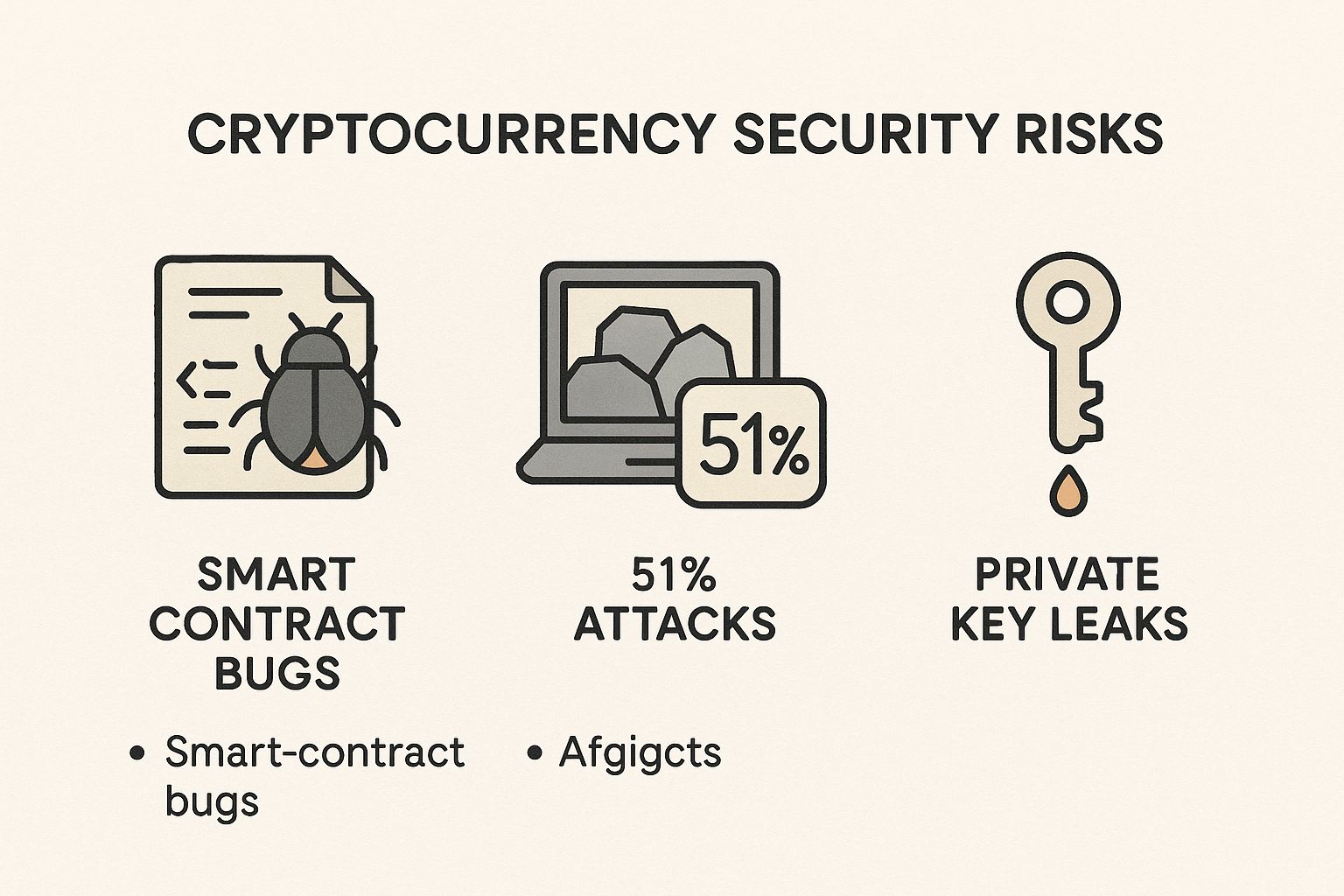
Threats like smart contract bugs, 51% attacks, and private key leaks underscore the necessity of a comprehensive security strategy. Protecting your blockchain project requires a multi-layered approach that addresses potential weaknesses across the entire system, from code to governance.
Multi-Layered Approaches for Robust Protection
A robust security audit employs a combination of methods. Let's explore how these layers work together to provide comprehensive protection.
- Static Analysis: This method examines the codebase for inherent vulnerabilities without actually executing the code. Think of it like proofreading a document before printing it.
- Dynamic Testing: This involves running the code in a simulated environment to observe its behavior under different conditions. This is akin to test-driving a car before buying it.
- Formal Verification: This advanced technique uses mathematical proofs to rigorously validate the code's logic, ensuring its correctness with a high degree of certainty.
By combining these approaches, auditors can identify a broader range of vulnerabilities than any single method could achieve alone.
A project might use static analysis to identify potential coding errors, then use dynamic testing to see how those errors might be exploited in a real-world scenario.
Formal Verification: Mathematically Proven Security
Formal verification is a particularly powerful technique. Unlike traditional testing that looks for specific instances of failure, formal verification uses mathematical models to prove the code’s underlying logic is sound. This method offers a much higher level of assurance, especially for complex smart contracts where unexpected interactions can lead to vulnerabilities.
While complex, formal verification offers a significantly greater level of confidence in the code’s security. It helps mitigate the risk of unforeseen exploits, which is crucial given the potential financial and reputational damage a vulnerability can cause.
The Crucial Role of Governance Evaluation
Beyond code analysis, a comprehensive audit also examines the project’s governance mechanisms. This often-overlooked area can be a significant attack surface. Weaknesses in governance can be exploited to gain control of the system or manipulate its operation.
For example, a flawed voting mechanism in a Decentralized Autonomous Organization (DAO) could allow a malicious actor to seize control, potentially leading to theft or other harmful actions. A thorough security audit identifies and addresses these vulnerabilities.
Learning from Real-World Exploits
A practical, real-world perspective is essential for understanding the true impact of security vulnerabilities. By analyzing past exploits, audits can identify patterns and weaknesses that might otherwise be missed. A good audit doesn't just point out theoretical risks – it shows you how those risks have played out in real-world scenarios and what could have been done to prevent them.
A prime example is a reentrancy attack, where a malicious contract repeatedly withdraws funds from a vulnerable smart contract. A thorough security audit identifies this type of vulnerability and recommends appropriate mitigation strategies.
Before we delve deeper, let's examine some key components of a robust blockchain security audit in more detail. The following table outlines these components, their purpose, common vulnerabilities they address, and the associated risk levels.
Blockchain Security Audit Components That Matter
| Audit Component | Primary Purpose | Common Vulnerabilities Found | Risk Level |
|---|---|---|---|
| Smart Contract Audit | Verify the logic and security of smart contracts | Reentrancy attacks, integer overflow/underflow, logic errors | High |
| Consensus Mechanism Review | Evaluate the robustness and security of the consensus algorithm | 51% attacks, Sybil attacks, double-spending | Critical |
| Cryptography Assessment | Analyze the strength and implementation of cryptographic primitives | Weak key generation, insecure randomness, cryptographic backdoors | High |
| Governance Model Analysis | Assess the security and resilience of the governance structure | Centralization risks, voting manipulation, administrator key compromise | Medium |
| Platform Security Review | Examine the underlying blockchain platform for vulnerabilities | Denial-of-service attacks, network exploits, data breaches | High |
This table highlights the various aspects of a blockchain project that require careful scrutiny during a security audit. The risk levels indicate the potential impact of vulnerabilities found in each component.
Choosing the right security audit approach and partner is a critical decision for any blockchain project. It's an investment in the long-term health and success of your endeavor.
Navigating the New Security Standards Landscape
The blockchain world is maturing. With this evolution comes a heightened focus on security. New standards are emerging, reshaping the security landscape and raising expectations for projects. These changes are steering the industry away from its less structured beginnings and toward a future characterized by greater regulation and security.
Emerging Frameworks: NIST, ISO, and Industry Consortiums
Key organizations are developing frameworks that define best practices for blockchain security. These include the National Institute of Standards and Technology (NIST) and the International Organization for Standardization (ISO). Industry consortiums also play a vital role, fostering collaboration and driving improvements in security standards. This joint effort aims to establish a more unified and robust security approach across the entire blockchain industry.
These frameworks provide essential guidance, establishing a common language and a clear set of security expectations. For instance, NIST is developing standards for blockchain identity management. Meanwhile, ISO is creating guidelines for blockchain interoperability. When navigating security standards, utilizing existing resources can be invaluable. One helpful tool is the AWS Security Audit Checklist.
From Theory to Practice: Real-World Implementation
These emerging standards are more than just theoretical concepts. Projects are actively implementing them and observing tangible improvements. They’re recognizing that a strong commitment to security is not merely a compliance requirement, but a significant competitive advantage.
This proactive approach to security fosters trust with both investors and users, demonstrating a clear dedication to protecting their assets and data. This focus is especially critical in the blockchain field, where security breaches can have devastating consequences. The introduction of new blockchain security standards in 2025 aims to create safer ecosystems. These standards are intended to boost trust in digital assets and blockchain networks, ultimately making these technologies more secure and reliable. Learn more about these evolving standards here.
Which Certifications Matter?
Not all certifications carry equal weight. Some certifications resonate strongly with investors, while others offer a false sense of security. Understanding this distinction is critical for projects aiming to attract funding and build credibility.
For more insights, you might be interested in checking out our guide on the latest Web3 news. Investors are becoming increasingly discerning, looking beyond superficial certifications and seeking concrete evidence of genuine compliance. They want assurance that a project's commitment to security extends beyond simply meeting regulatory requirements.
Demonstrating Genuine Compliance: Building Legitimate Trust
True compliance involves more than just meeting minimum requirements. It requires integrating security into the core of a project. This means incorporating security best practices from the very beginning of the development process, not just as an afterthought. This proactive and comprehensive approach cultivates legitimate trust and positions projects for lasting success in the increasingly regulated blockchain landscape. This shift towards proactive security measures emphasizes the growing maturity of the industry and the increasing importance of investor and user confidence.
Selecting Security Partners Who Actually Deliver Results

Choosing the right partner for your blockchain security audit is crucial. Selecting the wrong firm can be an expensive mistake, creating a false sense of security while leaving your project vulnerable. This section discusses how to identify top-tier security firms and avoid those offering superficial services.
Evaluating Expertise Beyond Marketing Hype
Look beyond polished marketing and focus on concrete evidence of expertise. This includes the depth of their technical understanding, experience specifically with blockchain technology, and a proven history of finding vulnerabilities. A firm's reputation within the blockchain community is a strong indicator of their skill and ethical practices. For instance, have they published insightful research or spoken at respected security conferences? Do they contribute to open-source security tools? These activities demonstrate a genuine commitment to blockchain security.
Consider the firm's team. Do they possess certified experts in critical areas like cryptography, smart contract development, and blockchain architecture? This breadth of knowledge is essential for comprehensive audits.
Before we delve into potential warning signs, let's take a look at a comparison of some top security audit firms:
To help you in your search, we've compiled a table comparing leading blockchain security audit providers. This table highlights their specializations, methodologies, and other key factors to consider.
Top-Tier Blockchain Security Audit Firms Compared
| Audit Firm | Specialization | Methodology | Average Audit Duration | Price Range | Notable Clients |
|---|---|---|---|---|---|
| Trail of Bits | Smart contracts, DeFi, Infrastructure | Formal verification, manual review | 2-4 weeks | $50,000 – $250,000+ | MakerDAO, Uniswap |
| ConsenSys Diligence | DeFi, NFTs, Infrastructure | Manual review, automated analysis | 1-3 weeks | $25,000 – $150,000+ | Aave, OpenSea |
| CertiK | Smart contracts, DeFi, Infrastructure | Formal verification, manual review | 2-6 weeks | $30,000 – $200,000+ | Binance, The Sandbox |
| OpenZeppelin | Smart contracts, DeFi | Manual review, automated analysis | 1-4 weeks | $20,000 – $100,000+ | Compound, Yearn.finance |
| Quantstamp | Smart contracts, DeFi | Automated analysis, manual review | 1-2 weeks | $15,000 – $75,000+ | eToro, Polkadot |
This table provides a starting point for your research. Remember to delve deeper into each firm's offerings and client testimonials to find the best fit for your project.
Red Flags and Crucial Questions
Certain red flags should raise concerns. Be wary of firms offering unrealistically low prices or exceptionally fast turnaround times. Thorough audits require time and resources. Rushing the process can result in missed vulnerabilities.
A high price, however, doesn't inherently guarantee quality. Ask specific questions about their methodology, the tools they use, and their reporting process. A reputable firm will be open about their approach and readily answer your questions. What particular vulnerabilities do they target? How do they ensure their findings are accurate and useful?
Don't hesitate to ask for references or case studies showcasing their successes. A reputable firm will gladly share examples of past work, demonstrating their skills and experience.
Building Long-Term Security Partnerships
A single audit offers a limited perspective. The blockchain landscape is ever-changing, with new threats constantly emerging. This demands constant vigilance. Rather than relying on one-time audits, successful blockchain projects establish long-term relationships with security firms. These partnerships facilitate continuous security assessments, vulnerability remediation, and proactive adaptation to new threats.
This proactive approach enables projects to stay ahead, integrating security into their core rather than treating it as an afterthought. This is fundamental for mitigating risk and building trust within the blockchain ecosystem. It's also significantly more cost-effective in the long run than dealing with the aftermath of a major security breach.
Turning Audit Findings Into Actionable Security Improvements
A blockchain security audit report is only as valuable as the actions taken in response to its findings. Transforming technical discoveries into tangible security enhancements is crucial for protecting your assets. This goes beyond simply patching vulnerabilities; it requires a comprehensive strategy to elevate your overall security posture.
Prioritizing Vulnerabilities: Beyond Severity Scores
Many audit reports assign severity scores to vulnerabilities. However, relying solely on these scores for prioritization can be misleading. A high-severity vulnerability with a low probability of exploitation might be less critical than a medium-severity vulnerability that can be easily exploited. Effective prioritization considers both the likelihood of exploitation and the potential impact.
For example, a vulnerability enabling an attacker to drain funds from a smart contract carries a higher impact than one exposing non-sensitive data, even if the latter has a higher severity score. A practical approach involves evaluating the potential damage each vulnerability could cause to your project and the ease with which it could be exploited.
From Weakness to Strength: Case Studies in Remediation
Studying successful remediation efforts offers valuable lessons. Leading projects often convert identified weaknesses into security strengths. This might involve redesigning smart contracts to eliminate vulnerabilities, implementing multi-signature wallets to safeguard funds, or strengthening access controls to prevent unauthorized modifications. For additional insights on Web3 statistics and trends, see: How Web3 is evolving in 2025.
These proactive measures demonstrate a commitment to security and build trust among users and investors. By effectively addressing vulnerabilities, projects enhance their security reputation and mitigate the risk of future exploits.
Validation: Ensuring True Fixes
Verifying that vulnerabilities are genuinely fixed is paramount. A simple patch might address the immediate problem but leave underlying weaknesses exposed. Effective validation processes involve retesting the remediated code using the original audit methods. This confirms complete vulnerability elimination, ensuring the fix isn't merely superficial.
This rigorous approach guarantees a comprehensive fix that doesn't introduce new vulnerabilities. It also provides evidence of a project's dedication to thorough security practices, crucial for establishing and maintaining trust.
Transparent Communication: Building Confidence
Communicating security improvements effectively is essential for building trust. Transparency fosters confidence, while secrecy breeds suspicion. Openly sharing improvements with stakeholders, including users and investors, demonstrates a commitment to security. This transparency cultivates trust and strengthens the project's reputation.
However, this communication requires careful consideration. Avoid technical jargon and emphasize the positive impact of the improvements. Explain how the changes mitigate risk and bolster security without causing undue alarm. Clear, concise, and accessible communication is key to building trust and showcasing a project’s dedication to security.
Future-Proofing Your Blockchain Security Strategy
Tomorrow's threats demand proactive defenses today. The blockchain security landscape is constantly evolving, requiring projects to adapt and strengthen their security strategies. This means moving beyond static, one-time audits and embracing a dynamic, future-focused approach.
The Rise of AI-Powered Analysis and Automated Verification
Blockchain security audits are being reshaped by new technologies. AI-powered analysis tools, such as those offered by Splunk, can sift through large datasets, identifying patterns and anomalies that indicate potential vulnerabilities. This allows auditors to focus on the most critical areas, increasing efficiency and the likelihood of uncovering complex exploits.
Automated continuous verification tools provide real-time security monitoring, catching vulnerabilities as they emerge. This proactive approach minimizes the potential damage caused by exploits.
These advancements represent a significant step forward in blockchain security, enabling projects to identify and address vulnerabilities more quickly and effectively.
Decentralized Security: Strength in Numbers
Decentralized security validation mechanisms offer a promising new approach. Imagine a network of independent security experts continuously reviewing a blockchain’s code and infrastructure.
This distributed approach enhances transparency and makes it much harder for malicious actors to compromise the system. It also reduces reliance on centralized authorities.
This model distributes the responsibility of security across a network, mitigating the risks associated with single points of failure and improving overall system resilience.
Preparing for Post-Quantum Threats
Forward-thinking projects are already considering the potential impact of quantum computing on cryptography. Quantum computers, while still developing, pose a threat to current cryptographic algorithms.
These projects are exploring and implementing post-quantum cryptography to protect against future attacks. This proactive approach demonstrates a commitment to long-term security, safeguarding the future of their projects.
Cross-Chain Vulnerabilities: A Growing Concern
As the blockchain ecosystem becomes more interconnected, cross-chain vulnerabilities are a rising concern. These vulnerabilities arise from the interactions between different blockchains, creating new attack vectors.
Recognizing this, proactive projects are developing specific strategies to mitigate these risks, ensuring the security of their interactions across multiple chains. This proactive approach is crucial for maintaining the integrity and security of the overall blockchain ecosystem. After addressing audit findings, consider your product's long-term visibility, perhaps through strategies like cybersecurity SEO.
Reimagining Governance for Enhanced Security
Governance structures, especially in Decentralized Autonomous Organizations (DAOs), are being re-evaluated and strengthened. A robust security framework needs to be adaptable, capable of responding to new threats without compromising the principles of decentralization. Finding this balance between security and decentralization is a key challenge for DAO governance.
New models are emerging that incorporate advanced security measures while preserving the core values of community ownership and decision-making. This includes integrating formal verification into the governance process, ensuring proposed changes are thoroughly vetted for security implications before implementation.
Are you ready to take your Web3 career to the next level? Find Web3 offers a comprehensive platform for exploring exciting opportunities in the blockchain and crypto space. Discover your next role at Find Web3.