
A career in cryptography is all about designing and analyzing the systems that keep our digital world safe. Think of it as the art and science of creating and cracking codes to ensure data stays private and communications remain secure. As our lives move more online, the people who can protect that information are more valuable than ever.
Why a Career in Cryptography Is More Relevant Than Ever

Cryptography is the invisible backbone of our digital trust. It’s what lets you bank online without worry, send a private message, or shop without your credit card details being broadcast. Choosing this career path puts you on the front lines of cybersecurity, tackling complex puzzles that protect everything from a single person's privacy to a nation's secrets.
This isn't just a stuffy academic field. Cryptographers are the practical architects building the secure systems we all depend on. They're found in a huge range of industries, each with its own unique puzzles to solve.
The Forces Driving the Demand for Cryptographers
The need for talented cryptographers is exploding, and it’s not a temporary spike. It's a fundamental shift tied to our increasingly digital society. The career outlook is incredibly strong, and to give you a clearer picture, I've put together a quick snapshot of the key numbers.
This table provides a high-level overview of what you can expect when pursuing a career in this field.
Cryptography Career Snapshot
| Metric | Statistic |
|---|---|
| Projected Job Growth | 8% by 2034 in related roles |
| Reported Cybercrime Losses (2023) | Over $12.5 billion |
| Number of Cybercrime Complaints (2023) | 880,418 reported to the FBI |
| Primary Education | Bachelor's in CS, Math, or Cybersecurity |
These numbers paint a clear picture: as digital threats rise, so does the demand for experts who can stop them.
The demand isn't just coming from one place, either. Several key industries are hungry for cryptographic talent:
- Financial Services: Banks and fintech firms are constantly battling sophisticated fraud. They need top-notch encryption to safeguard transactions and sensitive customer data.
- Big Tech: From cloud infrastructure to the operating system on your phone, major tech companies rely on cryptographers to build security into their core products.
- Government and Defense: National security is a huge area. Agencies hire cryptographers to protect state secrets, build secure communication lines for military and intelligence operations, and analyze foreign threats.
- Emerging Tech: The rise of Web3, blockchain, and the Internet of Things (IoT) has opened up a massive new frontier. Securing decentralized networks and billions of smart devices is a huge challenge that falls squarely on the shoulders of cryptographers.
More Than Just a Job—A Lasting Career
A career in cryptography offers more than just a paycheck; it provides real stability and a ton of intellectual stimulation. The work is never boring. It’s a constant cat-and-mouse game between those building the locks and those trying to pick them, meaning you're always learning and adapting to new threats.
A career in cryptography is less about finding a job and more about embracing a mindset of continuous problem-solving. You are tasked with staying one step ahead of adversaries, making it one of the most intellectually stimulating paths in technology today.
The financial rewards are also a major draw. Because these skills are so specialized and critical, cryptographers command impressive salaries. As companies and governments continue to pour money into cybersecurity, that financial security isn't going anywhere. This is especially true in the booming Web3 space, a trend you can see reflected in recent Web3 statistics.
This guide will give you the roadmap to break into this exciting and rewarding field.
Building Your Foundational Cryptography Skills

A career in cryptography is built on a very specific set of skills. While a knack for puzzles is a good starting point, it won't land you a job. Employers are looking for people who have put in the work to build a serious academic and practical foundation in the field.
The educational barrier to entry is still quite high, and for good reason—this work is critical. A bachelor's degree is usually the bare minimum, with nearly 60% of all cybersecurity jobs requiring one.
Choosing Your Academic Path
You won't find many "cryptography" bachelor's degrees out there. Instead, you need to choose a major that gives you the right building blocks. From my experience, hiring managers almost always pull from three main pools:
- Computer Science: This is the most direct route. It gives you a solid grounding in algorithms, data structures, and the principles of secure software development.
- Mathematics: A math degree, particularly one focused on pure or applied mathematics, is incredibly valuable. This is where you'll develop the theoretical muscle to really understand why complex encryption schemes work.
- Computer Engineering: This path offers a unique perspective by blending hardware and software. You'll learn how cryptographic principles get implemented right down to the silicon.
No matter which major you pick, some courses are non-negotiable. Your transcript absolutely must include discrete mathematics, number theory, linear algebra, and advanced algorithm analysis. These subjects are the mathematical bedrock of everything a cryptographer does.
Mastering the Right Programming Languages
Theory is one thing, but cryptography is an applied field. You have to be able to build, test, and implement cryptographic systems, and that means you need to be a skilled programmer.
Two languages are the bread and butter of this industry:
- Python: It’s prized for its clean syntax and massive library ecosystem (think PyCryptodome). Python is perfect for quickly prototyping new ideas, scripting security tests, and running cryptanalysis.
- C++: When raw performance matters, C++ is king. It gives you the low-level memory control needed to implement high-speed encryption algorithms and defend against tricky side-channel attacks.
A great way to show your versatility is to build a portfolio with projects in both languages. For example, you could implement a classic cipher like AES in C++ to make it fast, then write a Python script to hammer it with statistical tests.
You'll also find many cryptographic ideas popping up in decentralized systems. Getting comfortable with the lingo in this space is a smart move. Our Web3 dictionary can help you get up to speed quickly.
When to Pursue an Advanced Degree
So, is a bachelor's degree enough? It depends on your goals.
For many hands-on roles, like a Cryptography Engineer, a bachelor's and a strong portfolio of projects will get your foot in the door. But if you dream of doing cutting-edge research or inventing new cryptographic primitives, you’ll need to go further.
A Master's degree can open doors to specialized roles, focusing on hot topics like post-quantum cryptography or zero-knowledge proofs. It makes you a much more compelling candidate for teams working on the next generation of security.
A PhD is pretty much a requirement for top-tier research positions at places like Google, government agencies, or in academia. It proves you can not only apply existing crypto but also contribute new knowledge to the field. If you want to see what that world looks like, check out a conference like the RSA Conference to see high-level research in action.
Turning Theory Into Real-World Experience
Book smarts will get your foot in the door, but it’s practical experience that lands you the job in cryptography. Hiring managers need to see you can do more than solve problems on paper. They’re looking for proof that you can build, break, and secure systems in the real world. This is where you transform your academic knowledge into a tangible portfolio that commands attention.
The most straightforward way to get this experience is through internships and co-op programs. Think of these less as summer jobs and more as auditions for your future career. Securing a spot at a tech company, a cybersecurity consultancy, or a government agency offers an invaluable look into the daily challenges and workflows of a professional cryptographer.
Gain an Edge with Hands-On Projects
If an internship isn't on the table right away, personal projects are your best bet. A well-documented project on your GitHub profile often speaks louder than any bullet point on a resume. It’s direct evidence of your skills, your passion, and your ability to see a complex task through from start to finish.
Move beyond generic coding exercises and focus on projects with real cryptographic weight:
- Build a Classic Cipher from Scratch: Don't just import a library. Try implementing an algorithm like AES or DES in a language like C++ or Python. This forces you to get your hands dirty with the inner workings of substitution-permutation networks, key scheduling, and block modes.
- Develop a Secure Messaging App: Put together a simple client-server application that uses end-to-end encryption. A project like this demonstrates that you can manage keys, implement secure protocols, and think about the entire security lifecycle.
- Contribute to Open-Source Crypto Libraries: Find a project like OpenSSL or a smaller, more modern library and jump in. Even fixing minor bugs or improving documentation shows initiative and proves you can navigate a large, complex codebase.
These projects do more than just fill out your portfolio; they cement your understanding in a way that classroom learning simply can't.
Sharpen Your Skills in the Arena
A huge part of cryptography isn’t just about building things—it’s about breaking them. This is where competitive hacking, especially Capture the Flag (CTF) events, becomes your training ground. CTFs are competitions where teams solve a series of cybersecurity puzzles, many of which are steeped in cryptanalysis.
Participating in CTFs is an intense workout for your analytical mind. You’ll be pushed to spot weak encryption, exploit flawed implementations, and reverse-engineer custom protocols, all under the pressure of a ticking clock. Documenting your solutions to tough CTF challenges on a personal blog is a brilliant way to showcase your problem-solving process to potential employers.
By actively participating in CTF competitions, you're not just solving puzzles; you're demonstrating a proactive and adversarial mindset. This is a highly sought-after trait for any role in a career in cryptography, proving you can think like an attacker to build stronger defenses.
Find Your Niche by Exploring Specializations
Cryptography is a massive field. As you build experience, you’ll naturally find yourself drawn to certain areas. Understanding the different specializations is crucial for steering your learning and, ultimately, your career. When you align your projects and skills with a specific niche, you become a much more compelling candidate for those specialized roles.
The career and salary potential in this field is significant, underscoring why finding the right focus area matters.
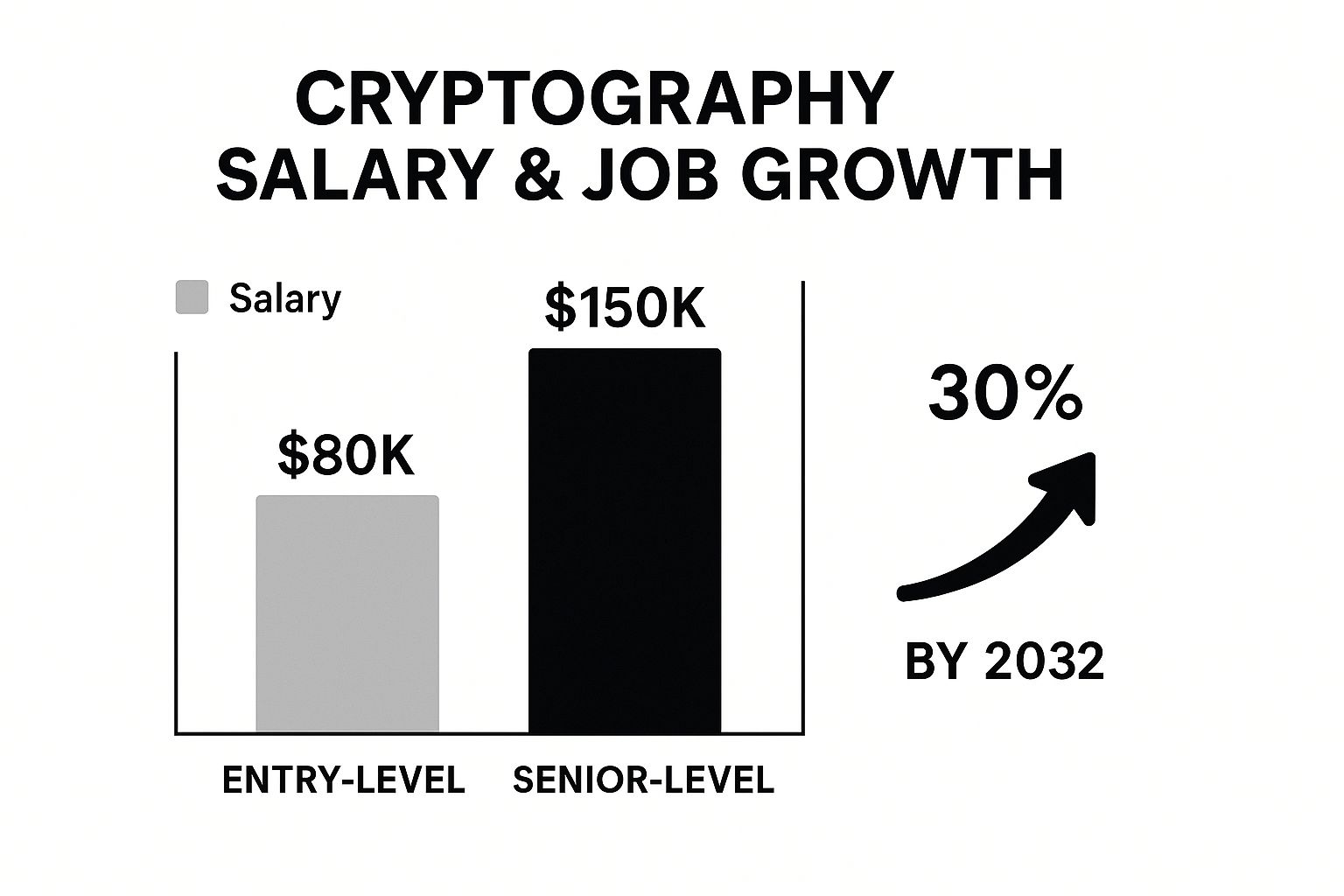
The data speaks for itself—advancing within a specialization can nearly double your earning potential, with job growth projected at an incredible 30% by 2032.
To help you get a feel for the landscape, it’s worth looking at the most common specializations within cryptography. Each has a unique focus and demands a distinct set of skills.
Comparing Cryptography Specializations
This table breaks down some of the core areas you might consider focusing on.
| Specialization | Primary Focus | Key Skills | Typical Application |
|---|---|---|---|
| Symmetric-Key Cryptography | Designing and analyzing algorithms where the same key is used for encryption and decryption (e.g., AES). | Deep knowledge of block ciphers, stream ciphers, and cryptanalysis techniques like linear and differential attacks. | Securing data at rest (disk encryption) and high-speed data streams. |
| Asymmetric-Key Cryptography | Working with key pairs (public and private) for tasks like digital signatures and key exchange (e.g., RSA, ECC). | Strong foundation in number theory, algebraic geometry, and complexity theory. | Secure web browsing (TLS/SSL), digital identity verification, and cryptocurrency transactions. |
| Post-Quantum Cryptography (PQC) | Developing new cryptographic systems that are resistant to attacks from future quantum computers. | Advanced mathematics, including lattice-based, code-based, and hash-based cryptography. | Long-term data protection for government, finance, and critical infrastructure. |
| Cryptographic Protocol Design | Creating secure communication protocols that combine various cryptographic primitives to achieve a security goal. | Formal verification, security modeling, and a strong grasp of network security principles. | Designing secure voting systems, authentication mechanisms, and privacy-preserving technologies. |
Picking one of these paths and intentionally gearing your projects toward it will give you a serious leg up when you start your job search.
Landing Your First Cryptography Job

Okay, you’ve put in the work. You've built a solid foundation and have a portfolio of projects to show for it. Now comes the exciting part: turning that hard-earned knowledge into a career.
This is where theory hits the real world. The key is to be deliberate. You need to target the right employers and tailor your approach to show them exactly why you’re the person they need. The cryptography job market is surprisingly diverse, with opportunities at massive tech corporations, secretive government agencies, and nimble startups building the future of the web. Each environment offers a totally different culture and set of challenges.
Where to Look for Cryptography Roles
The demand for cryptographers isn't confined to a single industry. You'll find big tech companies constantly hiring to secure their sprawling infrastructure and protect user data. Government bodies, especially in defense and intelligence, are always on the lookout for talent to work on national security challenges.
But a lot of the most fascinating work today is happening in the Web3 space. Companies building blockchain protocols, decentralized finance (DeFi) platforms, and next-gen digital wallets are desperate for cryptographic expertise. These are the roles where you get to work on problems that haven't been solved yet.
A great way to get a feel for the market is to keep an eye on specialized job boards. Sites that aggregate crypto job listings give you a real-time view of which companies are hiring and the specific skills they're looking for.
Differentiating Between Key Job Titles
As you start your search, you'll see a few common job titles pop up again and again. While they're all related, they represent distinct day-to-day realities.
Cryptography Engineer: This is a builder's role. You'll be the one implementing cryptographic libraries, developing secure protocols, and weaving encryption into software and hardware. Expect to get your hands dirty with languages like C++, Rust, or Python.
Cryptanalyst: This is a breaker's role. Your job is to think like an attacker. You’ll spend your time stress-testing systems, algorithms, and protocols to find weaknesses before the bad guys do. This requires a sharp, adversarial mindset and a deep theoretical grasp of how things can break.
Security Researcher (Cryptography Focus): This position often blends the builder and breaker roles. You might be inventing novel cryptographic schemes one day and discovering new classes of attacks the next. These jobs are common at big tech companies and academic-style research labs, and often require a Master's or PhD.
Knowing the difference is crucial. It helps you focus your resume and prep for the interviews that truly align with your skills and interests.
Crafting a Resume That Gets Noticed
Your resume is your foot in the door, so it has to do more than just list your coursework. In a highly technical field like cryptography, your projects are your credibility.
Don't just list what you built; explain the why and the how. Instead of saying, "Built a secure messaging app," try something with more substance: "Designed and implemented an end-to-end encrypted chat application using the Signal Protocol, demonstrating proficiency in key exchange, forward secrecy, and authenticated encryption." See the difference? One is a statement; the other is proof of skill.
Your GitHub profile is your second resume. Keep it clean, well-documented, and filled with projects that showcase your passion for cryptography. A hiring manager will almost certainly look at it.
Nailing the Technical Interview
Cryptography interviews are famously tough. They are designed to push you and rigorously test both your foundational knowledge and your ability to think on your feet. It's usually a multi-stage process that can include anything from whiteboard problems to take-home assignments.
You should be ready for:
- Mathematical Puzzles: Questions that dig into number theory, abstract algebra, and probability.
- Algorithmic Challenges: Classic coding problems, but often with a security-focused twist.
- System Design Questions: High-level prompts like "design a secure password manager" or "outline a secure voting protocol" to test your architectural thinking.
There's no substitute for preparation. Grind through common coding challenges, brush up on your math fundamentals, and practice explaining complex cryptographic concepts out loud as if you were talking to a colleague.
Once you feel confident in your skills, the final piece is your interview performance. Walking in prepared can make all the difference, so it’s worth reviewing some crucial job interview preparation tips to calm your nerves and put your best foot forward.
What's Next? The Future of Cryptography and Your Career Path
Diving into a career in cryptography means you're signing up for a field that never sits still. The principles you master today are just the starting point. To build a career with real longevity and impact, you have to keep one eye on the present and the other firmly on the horizon.
The cryptographic landscape is on the verge of some massive shifts. These aren't just fascinating theories for academics anymore; they're the technologies that will define security for the next decade and beyond. Getting a handle on them now is key to staying relevant.
Preparing for the Quantum Leap
Without a doubt, one of the biggest challenges looming is the threat from quantum computers. For years they were the stuff of science fiction, but they're becoming powerful enough to shatter the public-key cryptography we depend on every single day, like RSA and ECC.
This has kicked off a frantic race to develop post-quantum cryptography (PQC).
PQC is all about creating new cryptographic algorithms that can stand up to attacks from both the computers we have today and the quantum machines of tomorrow. As you can imagine, specialists in PQC are in white-hot demand as governments and major companies scramble to future-proof their systems. If you have a deep love for mathematics, this is a niche where you can truly make a name for yourself.
Beyond PQC, a few other advanced concepts are finally moving from the research lab into the real world, opening up some exciting career avenues.
- Homomorphic Encryption: This is a wild one. It lets you perform calculations on encrypted data without ever decrypting it. Think about a cloud service analyzing sensitive health records for disease patterns but never actually seeing the raw patient information. It’s a complete game-changer for data privacy.
- Zero-Knowledge Proofs (ZKPs): These allow you to prove something is true without revealing any of the underlying information. It's the digital equivalent of proving you know a secret password without ever typing the password itself. ZKPs are quickly becoming essential for blockchain privacy and new forms of secure authentication.
Mastering these areas isn't just about padding your resume. It's about putting yourself at the bleeding edge of security, ready to solve tomorrow's problems before they become today's headlines.
The Blockchain and DeFi Revolution
It's hard to overstate how much blockchain technology and decentralized finance (DeFi) have supercharged the demand for cryptographers. These systems are built, from the ground up, on pure cryptographic principles—from the hash functions that chain the blocks together to the digital signatures that make transactions happen.
This demand is reshaping the job market. The need for blockchain and cryptography skills is exploding, and the U.S. Bureau of Labor Statistics expects a massive 22% jump in demand for blockchain developers by 2025. That's a role that is, at its core, a cryptography job.
We're seeing this play out in real-time. Glassdoor reported a staggering 118% year-over-year surge in crypto-related job postings in 2023, driven by the boom in DeFi and NFTs. You can dig into the hiring trends and opportunities to get the full scope of how fast this space is moving.
Charting Your Career Trajectory
A career in cryptography isn't just one job; it's a journey. Knowing what the path looks like helps you set smart goals and make the right moves to keep climbing.
Your career will probably follow a path something like this:
Junior Cryptography Engineer/Analyst: When you're starting out, you'll be focused on implementation and analysis under the guidance of senior team members. You'll work with established crypto libraries, help out with security audits, and learn how to apply all that theory to actual, running code.
Senior Cryptography Engineer: After a few years in the trenches, you'll earn more autonomy. You'll be the one designing cryptographic protocols for new products, leading critical security projects, and mentoring the next crop of junior engineers. Your focus shifts from simply doing the work to making key architectural decisions.
Principal Cryptographer/Security Architect: At this stage, you're the go-to expert. You're setting the technical security vision for your entire organization, researching new threats before they materialize, and maybe even contributing to the industry standards everyone else follows.
Chief Information Security Officer (CISO) or Research Lead: At the top, the path can fork. You might move into an executive role like a CISO, where you're responsible for the entire security strategy of a company. Or, if you're a die-hard technologist, you could lead a dedicated research team, pushing the boundaries of what's even possible in cryptography.
To make this kind of climb, staying sharp is non-negotiable. It means a real commitment to continuous learning—attending conferences, earning advanced certifications, and being an active voice in the open-source community. Your career growth will be a direct reflection of how dedicated you are to staying on the edge of this incredible field.
Got Questions About a Career in Cryptography? We Have Answers.
It’s completely normal to have a ton of questions when you’re looking at a specialized field like cryptography. It’s not your typical career path, so wondering about the day-to-day, the educational requirements, and how to even get your foot in the door is part of the process.
Let’s tackle some of the most common questions I hear from aspiring cryptographers to help clear things up.
Do I Really Need a PhD?
This is probably the most frequent question I get, and the honest answer is: it depends entirely on what you want to do.
If your goal is to push the boundaries of the field—inventing new cryptographic algorithms or conducting foundational research at a university or a major corporate lab (think Microsoft Research or Google's security teams)—then yes, a PhD is pretty much non-negotiable. That's the path for becoming a true research scientist.
But for the vast majority of jobs out there? Absolutely not. Most companies are desperate for skilled practitioners who can apply, implement, and build secure systems. For a role like a Cryptography Engineer, a Bachelor’s or Master’s degree is often more than enough, especially when paired with a killer portfolio and sharp coding skills.
In my experience, a well-curated GitHub profile showing you can actually apply cryptographic concepts can be far more impressive to a hiring manager than a PhD on a resume. Practical skills often win.
What’s the Real Difference Between a Cryptographer and a Cryptanalyst?
It's a classic tale of builders versus breakers.
A cryptographer is the architect. They are on the defensive side, focused on designing and constructing secure cryptographic systems, protocols, and algorithms. Their entire job revolves around creating strong digital locks to protect data.
A cryptanalyst, however, is on offense. They are the ones who test those locks. Their job is to analyze systems and find vulnerabilities before the bad guys do. They spend their days hunting for mathematical weaknesses, subtle implementation errors, or even side-channel attacks. Both roles are critical; you can't have a secure ecosystem without this constant push and pull.
Just How Important Is Programming?
It's everything. Modern cryptography isn't just theory scribbled on a whiteboard; it's an applied science that lives and breathes in code. The theoretical foundations are all math, but you have to be able to translate those complex ideas into secure, efficient, and functional software.
You'll need to be comfortable in languages like Python, C++, or Rust for a few key reasons:
- Implementation: You'll be the one building the software that correctly uses cryptographic primitives.
- Integration: You'll need to weave established crypto libraries into much larger, complex applications.
- Analysis: You'll often write your own scripts and tools to stress-test systems for potential weaknesses.
Without solid programming chops, even the most brilliant cryptographic theory is stuck being just that—theory.
Can I Get Hired with No Formal Work Experience?
Yes, but you have to be strategic. If you don't have internships or previous jobs on your resume, your portfolio of personal projects needs to do the talking for you. This is your chance to prove your passion and demonstrate your skills in a tangible way.
A strong portfolio could showcase things like detailed write-ups from Capture the Flag (CTF) competitions, your own implementations of classic ciphers, or even contributions to an open-source security project. A GitHub profile that tells a story of curiosity and skill can absolutely open doors that a thin resume can't.
Ready to turn your skills into a career? At Find Web3, we connect talented professionals with top companies in the blockchain and crypto space. Explore thousands of roles in cryptography, engineering, and more. Start your job search today at https://findweb3.com.