
The rapid expansion of Web3, from decentralized finance (DeFi) to non-fungible tokens (NFTs), has created unprecedented demand for professionals who can secure its foundations. At the core of this digital revolution lies cryptography, the science of secure communication. As companies build the next generation of the internet, the need for experts who can design, implement, and audit cryptographic systems has skyrocketed. This has opened up a wealth of cryptography job opportunities for those with the right skills and expertise.
This guide provides a detailed roundup of the most promising cryptography-focused careers in the Web3 ecosystem. We will break down seven key roles, exploring their core responsibilities, the specific skills required to succeed, and typical salary expectations you can anticipate. Our goal is to offer a clear, actionable roadmap for navigating this specialized field.
You will gain practical insights into what it takes to become a:
- Cryptographic Engineer
- Cybersecurity Analyst
- Blockchain Developer
- And more…
This list is designed to help you identify the right path, whether you are an experienced engineer looking to specialize or a newcomer aspiring to enter the field. Let's explore the cryptographic landscape and find where your skills fit best.
1. Cryptographic Engineer: The Architect of Digital Trust
Among the most vital cryptography job opportunities, the role of a Cryptographic Engineer stands out as the master builder of digital security in Web3. These specialists are responsible for designing, implementing, and maintaining the core cryptographic systems that secure blockchain networks, decentralized applications (dApps), and digital wallets. Their work is a critical fusion of advanced mathematical theory and expert-level software engineering.
Cryptographic Engineers translate complex concepts like zero-knowledge proofs or elliptic curve cryptography into practical, high-performance code. This code is the bedrock of Web3's promise of security and decentralization, protecting user assets and ensuring the integrity of distributed ledgers.
Core Responsibilities and Impact
In the Web3 ecosystem, this role is at the forefront of innovation. Key responsibilities often include:
- Developing Novel Protocols: Designing and implementing cutting-edge cryptographic protocols, such as the ZK-Rollup technology used by scaling solutions like zkSync and StarkNet to enhance blockchain throughput.
- Implementing Core Primitives: Building the foundational cryptographic functions for new privacy-centric blockchains like Zcash or creating the multi-party computation (MPC) infrastructure for custodians like Fireblocks.
- Ensuring Future Security: Researching and developing post-quantum cryptography (PQC) to safeguard networks against the threat of future quantum computers.
The following infographic provides a high-level overview of the key metrics associated with this role, covering salary expectations, educational background, and job security.
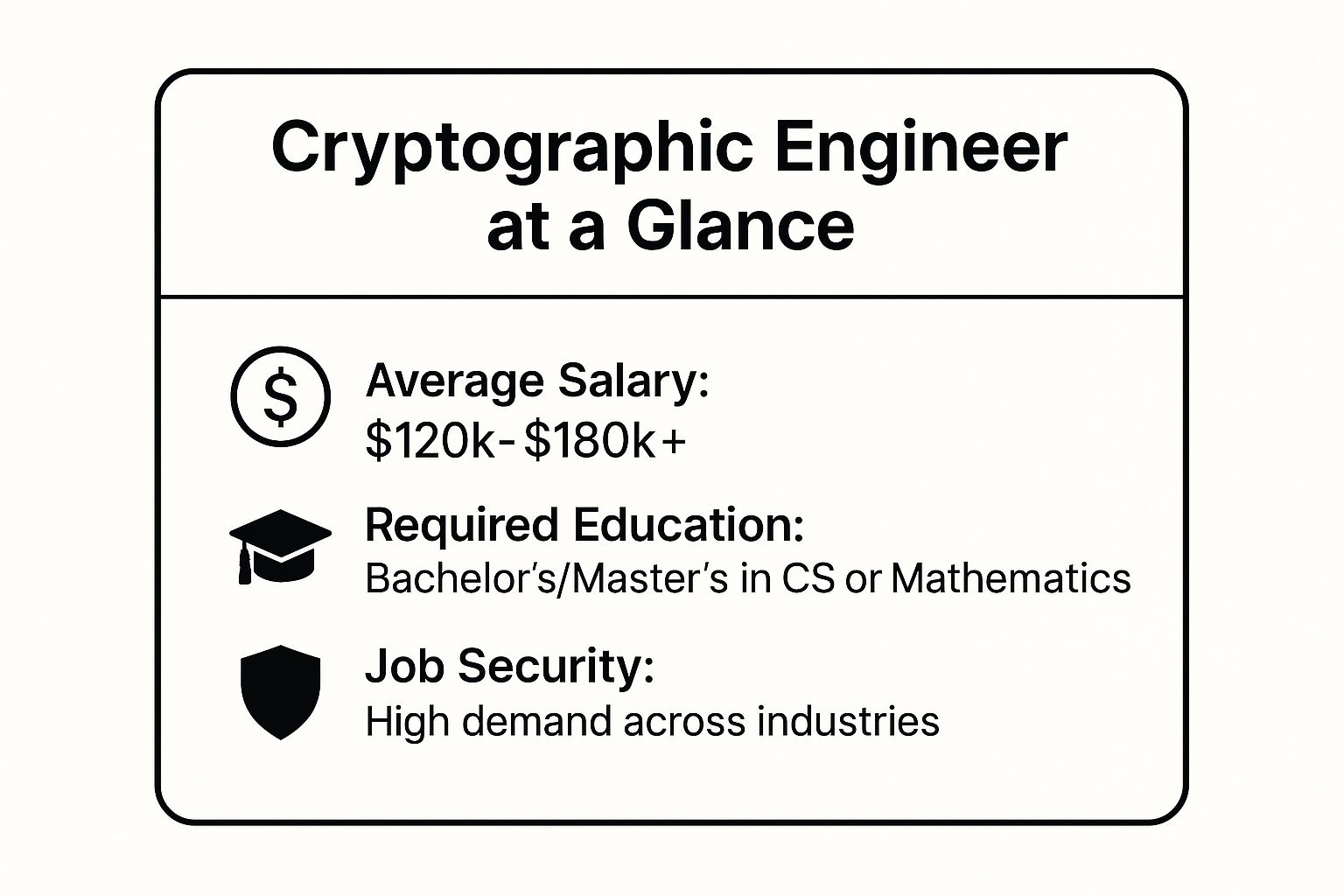
The data clearly indicates that this is a highly valued and secure career path, demanding specialized education but offering significant financial rewards.
How to Succeed as a Cryptographic Engineer
To excel in this demanding field, a strategic approach to skill development is essential.
Key Insight: The most successful Cryptographic Engineers blend deep academic knowledge with hands-on, open-source contributions. This combination demonstrates both theoretical understanding and practical application, a highly sought-after trait by top Web3 companies.
Here are five actionable tips to build your profile:
- Master Performance-Oriented Languages: Focus on Rust and C++, as they are the industry standard for writing secure, high-performance cryptographic code.
- Deepen Your Mathematical Foundation: Prioritize advanced studies in number theory, elliptic curves, and lattice-based cryptography, which are fundamental to modern Web3 protocols.
- Contribute to Open-Source Projects: Gain practical experience and build a public portfolio by contributing to foundational libraries like
arkworks,dalek, orOpenZeppelin. - Stay on the Cutting Edge: Regularly read academic papers from top-tier conferences such as CRYPTO and Eurocrypt to stay current with the latest breakthroughs.
- Build Your Network: Engage with established cryptographers and researchers on platforms like Twitter or at industry conferences to find mentorship and collaboration opportunities.
By focusing on these areas, aspiring engineers can position themselves for the most compelling cryptography job opportunities at leading firms like Polygon, Matter Labs, and ConsenSys.
2. Cybersecurity Analyst (Cryptography Focus): The Guardian of Encrypted Data
While Cryptographic Engineers build the locks, Cybersecurity Analysts with a cryptography focus are the guardians who ensure those locks are used correctly and remain unbroken. These specialists bridge the gap between theoretical cryptography and practical, day-to-day security operations. They monitor, analyze, and defend against threats targeting an organization's cryptographic infrastructure.
Cybersecurity Analysts are the front-line defenders responsible for implementing and auditing cryptographic controls. Their work ensures that sensitive data, from financial transactions to classified government information, remains confidential and secure against sophisticated adversaries. This role is crucial for maintaining operational integrity and regulatory compliance.
Core Responsibilities and Impact
In an era of constant cyber threats, this role is essential for risk management. Key responsibilities often include:
- Auditing Cryptographic Implementations: Assessing the strength and proper configuration of encryption protocols in use, for example, ensuring a financial institution's payment systems comply with PCI DSS cryptographic requirements.
- Managing Cryptographic Keys: Developing and enforcing robust policies for key generation, storage, rotation, and destruction, a critical function for cloud service providers like AWS or Azure securing customer data.
- Incident Response: Investigating and responding to security incidents involving potential cryptographic weaknesses or failures, such as a brute-force attack on an authentication system.
This specialized skill set makes these analysts indispensable for any organization serious about data protection. It's a high-stakes, high-impact career path among the available cryptography job opportunities.
How to Succeed as a Cybersecurity Analyst (Cryptography Focus)
To excel in this role, a blend of analytical prowess and deep technical knowledge is required.
Key Insight: The most effective Cybersecurity Analysts don't just understand cryptographic theory; they understand how it fails in the real world. They combine knowledge of protocols with an adversarial mindset to preemptively identify and mitigate vulnerabilities before they can be exploited.
Here are five actionable tips to build your profile:
- Obtain Industry Certifications: Pursue credentials like CISSP, CISM, or CompTIA Security+ to validate your foundational cybersecurity knowledge and management skills.
- Gain Hands-On SIEM Experience: Master security information and event management (SIEM) tools like Splunk, QRadar, or LogRhythm to learn how to detect anomalies in encrypted traffic and system logs.
- Develop Compliance Expertise: Deepen your knowledge of regulatory frameworks like HIPAA, GDPR, or NIST, as their cryptographic requirements dictate much of the day-to-day work.
- Practice with Penetration Testing Tools: Use tools like Wireshark, Nmap, and Metasploit in a lab environment to understand how attackers probe for cryptographic weaknesses in protocols like TLS/SSL.
- Build Industry-Specific Knowledge: Specialize in the unique cryptographic challenges of a high-demand sector like finance, healthcare, or government to become a more valuable and sought-after candidate.
By mastering these areas, aspiring analysts can secure top-tier cryptography job opportunities at leading cybersecurity firms like Palo Alto Networks, CrowdStrike, and Mandiant.
3. Blockchain Developer: The Builders of the Decentralized Web
While not pure cryptographers, Blockchain Developers are among the most prolific consumers and implementers of cryptographic principles, making this one of the most accessible cryptography job opportunities. They are the software engineers who build, maintain, and secure the decentralized applications (dApps) and systems that run on blockchain networks. Their role requires a deep, practical understanding of how cryptographic tools provide security and trust in a trustless environment.

Blockchain Developers utilize cryptographic hash functions, digital signatures, and Merkle trees to ensure data integrity and transaction validity. They write the smart contracts that automate complex financial agreements in DeFi and build the infrastructure for DAOs, all while ensuring the underlying code is secure from exploits.
Core Responsibilities and Impact
In the Web3 ecosystem, Blockchain Developers turn cryptographic theory into functional, user-facing products. Their responsibilities often include:
- Smart Contract Development: Writing, testing, and deploying secure smart contracts on platforms like Ethereum, often for DeFi protocols such as Uniswap or Aave.
- Protocol Implementation: Contributing to the core codebase of Layer 1 blockchains like Bitcoin or implementing scaling solutions for networks like Polygon.
- dApp Construction: Building the full-stack architecture for decentralized applications, from the on-chain logic to the user interface that interacts with it, as seen in projects developed by firms like ConsenSys.
- Oracle Integration: Developing systems that securely feed real-world data to blockchains, a core function of networks like Chainlink.
The following video provides an overview of the key concepts and technologies that a Blockchain Developer must master.
This role is pivotal for the growth of the entire Web3 space, as developers create the applications that drive user adoption and innovation.
How to Succeed as a Blockchain Developer
To excel in this rapidly evolving field, a hands-on, security-first mindset is paramount.
Key Insight: The most effective Blockchain Developers think like an adversary. They not only build functionality but also constantly probe for potential vulnerabilities, understanding that smart contract code is immutable and a single flaw can be catastrophic.
Here are five actionable tips to build your profile:
- Master Core Blockchain Languages: Become proficient in Solidity for Ethereum Virtual Machine (EVM) development and Rust for high-performance ecosystems like Solana and Polkadot.
- Understand Cryptographic Primitives: Focus on the practical application of hash functions, public-key cryptography, and digital signatures. You don't need to invent them, but you must know how to use them securely.
- Use Development Frameworks: Gain hands-on experience with industry-standard tools like Hardhat or Truffle for smart contract compilation, testing, and deployment.
- Contribute to Open-Source Projects: Build your credibility by contributing to DeFi protocols, infrastructure projects, or NFT standards on GitHub. This is the best way to showcase your skills.
- Stay Current with Security Best Practices: Follow security firms like Trail of Bits and OpenZeppelin, and study common exploits to learn how to write more resilient code.
By mastering these skills, aspiring developers can secure the most sought-after Blockchain Developer positions at innovative companies like Chainlink, Alchemy, and leading DeFi protocols.
4. Information Security Consultant: The Strategic Security Advisor
While engineers build the cryptographic systems, the Information Security Consultant acts as the strategic advisor, guiding organizations on how to best implement and manage them. These professionals bridge the gap between deep technical cryptography and high-level business objectives. They assess existing security postures, design robust encryption architectures, and ensure compliance with industry standards, making them indispensable for companies navigating the complex Web3 landscape.
Information Security Consultants combine technical expertise with exceptional communication skills. They translate intricate security vulnerabilities and cryptographic solutions into actionable business strategies for clients ranging from fledgling startups to enterprise-level organizations. Their work ensures that theoretical security measures are practically and effectively applied to protect sensitive data and digital assets.
Core Responsibilities and Impact
In the Web3 world, this role is crucial for instilling trust and mitigating risk. Key responsibilities often include:
- Security Architecture Design: Advising a new decentralized finance (DeFi) platform on the optimal cryptographic architecture to secure user funds and smart contracts, as seen with consulting services from firms like Deloitte or PwC.
- Cryptographic Audits and Assessments: Conducting comprehensive security assessments for blockchain projects before their mainnet launch, similar to the work done by specialized firms like Optiv and Rapid7.
- Policy and Compliance: Helping a crypto exchange develop and implement data protection policies that adhere to global regulations while leveraging advanced encryption techniques.
The demand for consultants who can navigate these complex intersections of technology, business, and regulation highlights why this is one of the most dynamic cryptography job opportunities available.
How to Succeed as an Information Security Consultant
To excel in this client-facing role, a blend of technical depth, business acumen, and a strong professional network is critical.
Key Insight: The most effective Information Security Consultants are not just technical experts; they are trusted storytellers who can articulate complex risks and solutions in a way that C-suite executives can understand and act upon.
Here are five actionable tips to build your profile:
- Build a Strong Project Portfolio: Document successful client engagements, detailing the challenges, your proposed cryptographic solutions, and the positive business outcomes.
- Obtain Advanced Certifications: Pursue globally recognized certifications like CISSP (Certified Information Systems Security Professional), CISA (Certified Information Systems Auditor), or SABSA (Sherwood Applied Business Security Architecture) to validate your expertise.
- Develop Niche Expertise: Specialize in a high-demand area within Web3, such as DeFi protocol security, NFT marketplace vulnerabilities, or enterprise blockchain implementation.
- Cultivate Communication and Presentation Skills: Practice translating complex technical topics into clear, compelling presentations and reports for non-technical stakeholders.
- Maintain a Strong Professional Network: Actively engage with peers and potential clients at industry conferences and on professional platforms to build relationships and generate leads.
By mastering these skills, aspiring consultants can secure high-impact roles at top advisory firms like Ernst & Young and Accenture or build a thriving independent practice.
5. Cryptographic Researcher: The Pioneer of Future Security
While engineers build today's digital defenses, Cryptographic Researchers invent the security of tomorrow. This role is at the absolute frontier of the field, operating within elite academic, corporate, or government research labs. These individuals are tasked with conceptualizing, developing, and analyzing novel cryptographic algorithms, protocols, and security models that will define the future of secure communication and computation.
Cryptographic Researchers are the visionaries who ask "what if?" They explore the theoretical limits of security and privacy, often years before their ideas become practical implementations. Their work, published in peer-reviewed papers and presented at premier conferences, lays the groundwork for the entire cryptography industry, influencing everything from blockchain protocols to national security standards.
Core Responsibilities and Impact
In both Web3 and traditional tech, this role is about pushing the boundaries of what is possible. Key responsibilities often include:
- Innovating New Algorithms: Designing entirely new cryptographic schemes. This includes the work done at institutions like Stanford's Applied Cryptography Group, which has produced foundational work on pairing-based and identity-based cryptography used in advanced blockchain systems.
- Breaking Existing Systems: Performing cryptanalysis to identify vulnerabilities in current standards, a critical function performed by teams at Microsoft Research and government bodies like the NSA.
- Developing Post-Quantum Cryptography (PQC): Creating and standardizing cryptographic systems, such as lattice-based or hash-based signatures, that can resist attacks from future quantum computers, a major focus for IBM and Google's research divisions.
How to Succeed as a Cryptographic Researcher
Excelling in this highly academic role requires immense dedication to theoretical exploration and a commitment to advancing the field.
Key Insight: The most influential Cryptographic Researchers are not just brilliant mathematicians; they are also excellent communicators who can articulate the importance of their abstract work to both academic peers and industry practitioners, bridging the gap between theory and application.
Here are five actionable tips to build your profile:
- Pursue a PhD: An advanced degree, typically a doctorate in mathematics or computer science with a cryptography focus, is almost always a prerequisite for these positions.
- Publish in Top-Tier Venues: Target prestigious conferences like CRYPTO, Eurocrypt, and Asiacrypt, and journals like the Journal of Cryptology, to build a strong academic reputation.
- Master Emerging Fields: Build deep expertise in cutting-edge areas like fully homomorphic encryption (FHE), secure multi-party computation (MPC), and post-quantum cryptography (PQC).
- Collaborate Extensively: Work with industry partners to see your research applied to real-world problems. For those focused on protecting digital assets, understanding essential data security best practices is crucial for this collaboration.
- Engage in the Community: Participate in cryptographic competitions and challenges organized by bodies like NIST and contribute to the discourse within the International Association for Cryptologic Research (IACR).
By following this path, aspiring academics can secure one of the most intellectually rewarding cryptography job opportunities and contribute to the fundamental science of trust.
6. Penetration Tester (Cryptography Specialist): The Ethical Hacker of Encryption
Where Cryptographic Engineers build the defenses, Penetration Testers with a cryptography specialization try to tear them down. This role is crucial among cryptography job opportunities, acting as the offensive force that validates the strength of security systems. These ethical hackers proactively search for and exploit vulnerabilities within cryptographic implementations, protocols, and key management systems before malicious actors can.
These specialists combine the mindset of an attacker with a profound knowledge of cryptographic theory and common implementation pitfalls. They don't just run automated scans; they dissect algorithms, challenge assumptions in protocol design, and think creatively to uncover subtle flaws that could lead to catastrophic breaches. Their work ensures that theoretical security translates into real-world resilience.

Core Responsibilities and Impact
In any industry handling sensitive data, from finance to Web3, this role is the ultimate stress test. Key responsibilities often include:
- Protocol Analysis: Evaluating the design and implementation of cryptographic protocols in cryptocurrency exchanges or DeFi platforms to identify logical flaws or weaknesses.
- Implementation Auditing: Reviewing source code and binary applications to find common cryptographic errors, such as weak random number generation, incorrect use of padding, or side-channel vulnerabilities.
- System Hardness Testing: Conducting targeted attacks against systems like hardware security modules (HSMs), IoT devices, or banking applications to test the resilience of their encryption and key protection mechanisms.
The work of these experts, popularized by figures like Kevin Mitnick and firms such as Offensive Security and Bishop Fox, is what provides organizations with tangible proof of their security posture.
How to Succeed as a Penetration Tester (Cryptography Specialist)
Excelling in this role requires a unique blend of offensive security skills and deep cryptographic insight.
Key Insight: The most effective cryptographic pentesters don't just find vulnerabilities; they understand the underlying mathematical weakness that makes an exploit possible. They bridge the gap between theoretical cryptanalysis and practical, hands-on hacking.
Here are five actionable tips to build your profile:
- Master Offensive Security Tools: Become proficient with staples like Burp Suite for web-based crypto attacks, Metasploit for exploit development, and custom Python or Go scripts for bespoke testing.
- Study Cryptographic Attacks: Go beyond theory and learn the mechanics of attacks like padding oracles, timing attacks, and differential fault analysis. Understand their preconditions and countermeasures.
- Pursue Hands-On Certifications: Earn certifications that validate practical skills, such as the OSCP (Offensive Security Certified Professional) or GPEN (GIAC Penetration Tester), to prove your capabilities.
- Practice on Vulnerable Platforms: Sharpen your skills on capture-the-flag (CTF) challenges from platforms like Hack The Box or CryptoHack, which feature dedicated cryptography puzzles.
- Develop Strong Reporting Skills: The ability to clearly document a vulnerability, explain its business impact, and provide actionable remediation advice is just as important as finding the flaw itself.
By honing these skills, aspiring testers can secure high-impact cryptography job opportunities at leading security firms and innovative tech companies.
7. Digital Forensics Analyst: The Digital Detective
In the landscape of cryptography job opportunities, the Digital Forensics Analyst represents the crucial intersection of cryptography, investigation, and law. These specialists are digital detectives who analyze cybercrimes and security breaches where encrypted data is a key factor. They work to recover, decrypt, and analyze cryptographic evidence to piece together the events of an incident and often provide expert testimony in legal cases.
The role requires a unique combination of deep technical knowledge and meticulous investigative procedure. A Digital Forensics Analyst must understand how encryption works not just in theory, but how it is implemented and potentially broken or bypassed in real-world systems. Their work is critical for holding malicious actors accountable and strengthening security postures after an attack.
Core Responsibilities and Impact
In an era of rampant cybercrime, this role is essential for justice and corporate security. Key responsibilities often include:
- Incident Response: Investigating security breaches within corporate environments to understand the attacker's methods, especially when they use encryption to hide their tracks or hold data for ransom.
- Law Enforcement Support: Working with agencies like the FBI's Cryptanalysis and Racketeering Records Unit to crack encrypted communications used by criminal organizations.
- Evidence Recovery: Utilizing specialized tools to recover and analyze encrypted data from hard drives, mobile devices, and network traffic for private forensics firms like Kroll or Stroz Friedberg.
This specialization is vital for translating complex digital evidence into understandable facts for legal proceedings and strategic security decisions.
How to Succeed as a Digital Forensics Analyst
To excel in this investigative field, a blend of technical prowess and procedural discipline is non-negotiable.
Key Insight: Top-tier Digital Forensics Analysts distinguish themselves not just by their technical ability to crack a cipher, but by their unwavering adherence to legal evidence handling procedures. The most brilliant decryption is worthless in court if the chain of custody is broken.
Here are five actionable tips to build your profile:
- Obtain Forensics Certifications: Pursue credentials like the Certified Computer Examiner (CCE) or GIAC certifications (GCFA, GCFE) to validate your skills and knowledge of industry-standard practices.
- Master Forensic Toolkits: Gain hands-on proficiency with essential software like EnCase, FTK (Forensic Toolkit), and Cellebrite, which are the workhorses of digital investigation.
- Understand Legal Frameworks: Study legal procedures, evidence handling protocols, and the rules of evidence. Knowing how to maintain a defensible chain of custody is paramount.
- Specialize in Encryption Types: Develop deep expertise in specific areas, such as ransomware decryption, mobile device encryption, or cryptocurrency transaction analysis.
- Develop Clear Communication Skills: Practice explaining complex technical concepts in simple, clear language. This is essential for writing reports and providing effective expert testimony in court.
By mastering these areas, aspiring analysts can secure high-impact cryptography job opportunities that bring digital criminals to justice.
7 Cryptography Job Roles Comparison
| Role | Implementation Complexity 🔄 | Resource Requirements ⚡ | Expected Outcomes 📊 | Ideal Use Cases 💡 | Key Advantages ⭐ |
|---|---|---|---|---|---|
| Cryptographic Engineer | High – advanced algorithms and protocol design | High – strong math and programming skills | Robust, secure cryptographic systems | Designing encryption algorithms, secure communication | Cutting-edge tech, high salary, strong job security |
| Cybersecurity Analyst (Cryptography Focus) | Moderate – assessment and monitoring processes | Moderate – certifications and SIEM tools | Improved security posture and compliance | Security operations, threat response, compliance audits | Growing field, diverse careers, good work-life balance |
| Blockchain Developer | High – complex distributed ledger and smart contracts | High – blockchain platforms and dev tools | Secure, decentralized applications and protocols | Smart contracts, DeFi, NFT marketplaces | Innovative projects, remote work, high compensation |
| Information Security Consultant | Medium – advisory and architecture design | Moderate – experience and certifications | Security strategies and compliance improvements | Consulting for businesses on cryptographic solutions | High earning potential, varied projects, independence |
| Cryptographic Researcher | Very High – novel algorithm creation and proofs | High – advanced degrees and research resources | New cryptographic methods and theoretical advances | Academic and government research | Intellectual freedom, academic prestige, long-term security |
| Penetration Tester (Cryptography Specialist) | High – offensive testing and vulnerability analysis | Moderate – certifications and specialized tools | Identification of cryptographic weaknesses | Ethical hacking of encryption and protocols | Exciting work, high demand, strong job security |
| Digital Forensics Analyst | Moderate – investigative cryptographic analysis | Moderate – forensic tools and legal knowledge | Cybercrime resolution and legal evidence | Encrypted data recovery and digital crime investigation | Meaningful impact, law enforcement collaboration |
Finding Your Place in the Cryptographic Revolution
The journey through the world of cryptography job opportunities reveals a landscape ripe with potential and purpose. We've explored a diverse array of roles, from the deep, theoretical work of a Cryptographic Researcher to the hands-on, defensive strategies of a Cybersecurity Analyst. Roles like the Blockchain Developer build the very foundations of Web3, while the Penetration Tester acts as an ethical adversary, hardening systems against real-world attacks.
This variety underscores a critical takeaway: securing the decentralized future is not a monolithic task. It requires a symphony of specialists. Whether you are drawn to constructing secure protocols, breaking them to find flaws, or investigating digital trails as a Digital Forensics Analyst, there is a vital niche for your skills. The common thread is a relentless pursuit of knowledge and a commitment to protecting digital assets and privacy in an increasingly interconnected world.
Charting Your Course: Actionable Next Steps
Transitioning from interest to employment requires a strategic approach. The demand for cryptographic expertise is surging, but so is the competition. To stand out, you must translate your theoretical understanding into practical, demonstrable skills.
Here are concrete steps to take now:
- Build a Specialized Portfolio: Don't just list your skills; prove them. If you're targeting a Cryptographic Engineer role, contribute to an open-source cryptography library on GitHub. Aspiring Penetration Testers can participate in bug bounty programs for blockchain platforms and document their findings.
- Engage with the Community: The Web3 and cybersecurity communities are incredibly active. Join Discords, follow key researchers on Twitter, and participate in CTF (Capture the Flag) competitions. This not only builds your network but also keeps you on the cutting edge of new vulnerabilities and techniques.
- Pursue Relevant Certifications: While not always mandatory, certifications like the Offensive Security Certified Professional (OSCP) or a GIAC (Global Information Assurance Certification) can validate your skills and help you pass initial HR screenings.
Key Insight: Your career path in cryptography is not just about what you know; it’s about what you can do. Practical application, continuous learning, and community involvement are the pillars that will support your professional growth and help you secure high-impact cryptography job opportunities.
The Broader Impact of Your Cryptographic Career
Choosing a career in cryptography is more than a strategic move for job security; it's an opportunity to be at the forefront of a technological paradigm shift. The principles you will work with and defend are the bedrock of digital trust, individual sovereignty, and a more transparent internet. To effectively find your place in this evolving field, it's crucial to stay informed about current IT hiring trends, which consistently highlight the growing demand for cybersecurity and blockchain specialists. By mastering these concepts, you become an essential guardian of the new digital economy, ensuring that the promise of Web3 can be realized safely and securely. The path is challenging, but the rewards, both professional and personal, are immense.
Ready to find your role in the cryptographic revolution? Start your search on Find Web3, the premier job board dedicated to the Web3 ecosystem. Explore curated listings for Cryptographic Engineers, Blockchain Developers, and more from the industry's most innovative companies at Find Web3.