

DeFi Yield Farming Guide to Maximize Crypto Earnings
Think of DeFi yield farming like this: you're putting your crypto to work instead of letting it gather dust in a digital wallet. It’s a bit like being a landlord for your digital assets—you lend them out to decentralized platforms and, in return, you collect rewards.
What Exactly Is DeFi Yield Farming?
At its heart, yield farming is all about strategically lending or staking your crypto assets within decentralized finance (DeFi) protocols to chase the highest possible returns. You’re essentially providing the liquidity that makes the DeFi world go 'round, allowing others to borrow or trade without needing a traditional bank.
This entire process is the engine of the DeFi ecosystem. It powers decentralized exchanges (DEXs) and lending platforms through automated code known as smart contracts. It's a true peer-to-peer system, and its growth has been nothing short of explosive. You can get a better sense of this expansion by checking out these updated DeFi statistics.
A New Form of Passive Income
Let's be honest, the interest you earn from a traditional savings account is usually pretty underwhelming. This is where yield farming really stands out. By 2025, it has cemented its place as one of the most compelling ways to generate passive income in the crypto space. While a bank might offer you less than 2% a year, it's not uncommon to see DeFi platforms offering Annual Percentage Yields (APYs) that range from a solid 5% to well over 100%, all depending on the specific platform and your strategy.
The core idea is to maximize your returns by strategically moving crypto assets between different lending protocols and liquidity pools. The best yield farmers are always on the hunt, chasing the platforms that offer the highest yields to optimize their earnings.
Yield Farming vs. Traditional Savings
To really understand the shift that yield farming represents, it helps to put it side-by-side with a good old-fashioned bank savings account. One offers the comfort of familiarity and stability, while the other opens the door to much greater potential returns, but brings along higher risk and a steeper learning curve.
Here's a quick breakdown of how they stack up.
DeFi Yield Farming vs Traditional Savings
| Feature | DeFi Yield Farming | Traditional Savings |
|---|---|---|
| Potential Returns | High (often 5% to 100%+ APY) | Low (typically <2% APY) |
| Control Over Funds | You maintain self-custody of your assets | Funds are held by the bank |
| Accessibility | Open to anyone with a crypto wallet and internet | Requires bank account, ID, and is location-based |
| Risk Level | High (Impermanent loss, smart contract risk, scams) | Very Low (FDIC insured up to a certain amount) |
| Transparency | Fully transparent via on-chain data | Opaque; operations are internal to the bank |
As you can see, the two couldn't be more different. DeFi offers unparalleled access and potential, but it's a world where you are your own bank—and that comes with a whole new set of responsibilities and risks. Traditional banking, on the other hand, is the slow and steady route, with built-in safety nets but minimal rewards.
Understanding the Mechanics of Yield Farming
Before you can chase those high returns, you need to pop the hood and understand what makes yield farming tick. It’s not magic; it’s a system of interlocking parts. Getting a handle on these core concepts is absolutely essential before you put any of your own money on the line.
At the heart of it all, you'll find liquidity pools. The best way to think about them is like a community pot of funds. Instead of one person trying to sell ETH to another, a liquidity pool contains a big pile of two different tokens, say ETH and USDC, ready for anyone to trade against.
These pools are the engine for decentralized exchanges (DEXs). Unlike the New York Stock Exchange, which matches individual buyers and sellers, a DEX lets traders swap tokens directly with the pool. This whole setup only works because people—yield farmers like you—are willing to fill that pot in the first place.
The Role of Liquidity Providers
So, who are these people filling the pools? They’re called Liquidity Providers (LPs), and when you deposit your tokens, that’s exactly what you become. You're providing the necessary liquidity that allows the exchange to function.
As a thank you for locking up your assets and enabling trades, the protocol gives you a cut of the action. This reward comes from the trading fees the pool generates. For example, if a pool charges a 0.3% fee on every single swap, that fee gets split among all the LPs based on how much they contributed. In exchange for your deposit, you'll get special LP tokens, which are basically your receipt proving you own a share of that pool.
This image gives you a great visual of the basic cycle: you deposit assets, they fuel the DeFi machine, and you earn rewards in return.
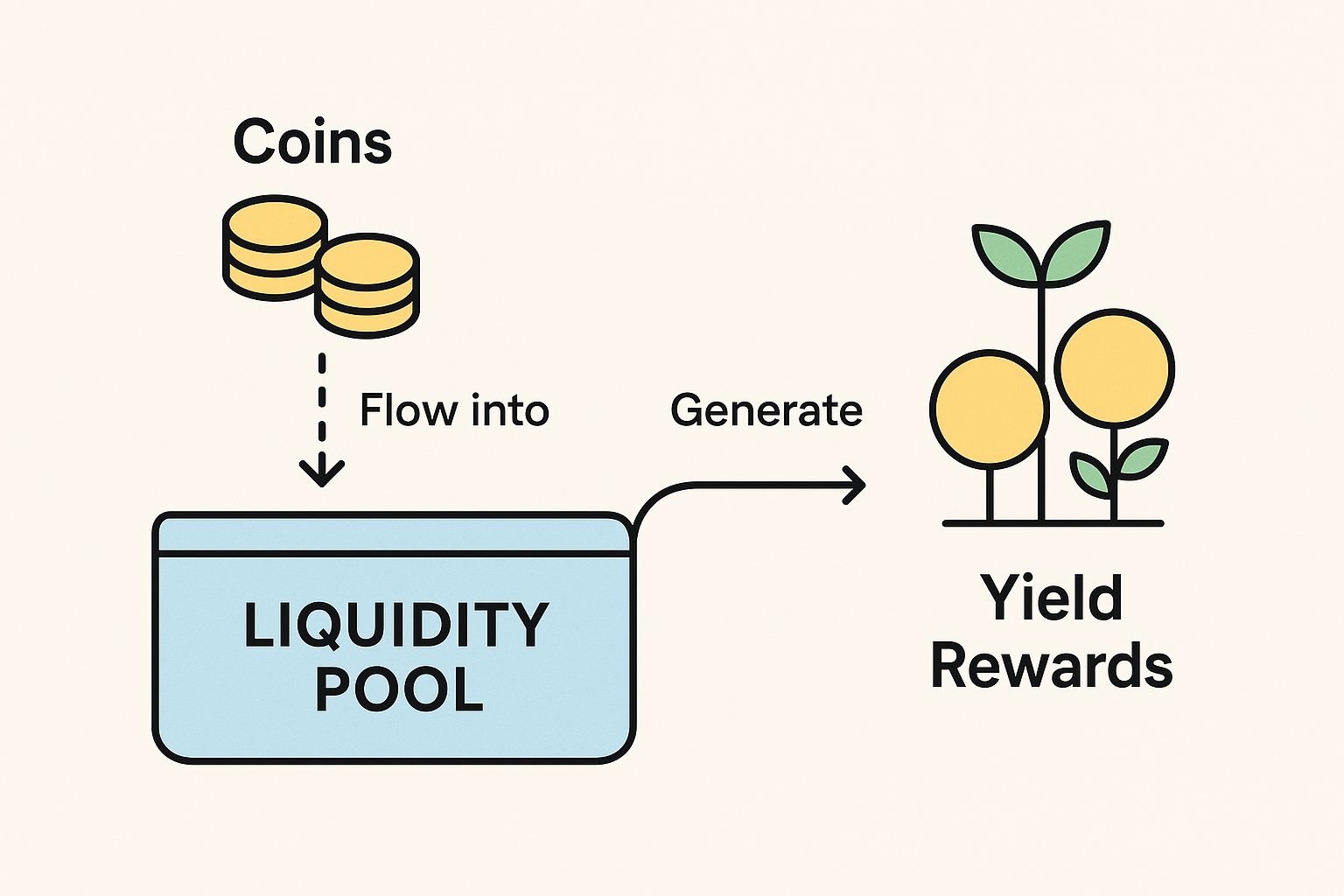
It’s a simple loop on the surface, but one that makes your crypto work for you instead of just sitting in a wallet.
Understanding APY vs. APR
As you start exploring different farms, you’ll see two terms everywhere: APR and APY. They look similar, but the difference between them can have a huge impact on your earnings.
- APR (Annual Percentage Rate): This is the straightforward, simple interest you’d earn over a year. It doesn’t account for any compounding.
- APY (Annual Percentage Yield): This is where things get interesting. APY includes the effect of compounding—that is, reinvesting your earnings to generate even more earnings.
For a yield farmer, APY is the number that really matters. It shows the true growth potential if you regularly compound your rewards. A farm showing a 50% APR could easily turn into a 65% APY or more just by reinvesting your profits.
The Seesaw Problem of Impermanent Loss
Now for the big one: impermanent loss. This is probably the most misunderstood risk in all of yield farming. It isn't a direct loss of your funds but an opportunity cost—the difference between the value of your assets in the pool versus what they’d be worth if you had just held them.
Picture a seesaw. To provide liquidity, you deposit two tokens of equal value, one on each side, keeping it perfectly balanced. But what happens if one token’s price shoots up while the other stays the same? The seesaw tilts. To keep things balanced (maintaining that 50/50 value split), the protocol automatically sells some of the high-performing token to buy more of the other.
When you decide to cash out, you might get back less of the token that skyrocketed and more of the one that didn't. If the total dollar value of your withdrawn assets is less than what you would have had by simply holding them, that's impermanent loss. The "loss" only becomes real—or permanent—the moment you withdraw. It's a risk that's baked into the system, directly tied to the price swings of the tokens you choose.
Your First Steps Into Yield Farming
Alright, you've got the theory down. Now, let's roll up our sleeves and get practical. This section is your launchpad, designed to walk you through your very first yield farming adventure, step by step. We'll start with the bare essentials, making sure you have a solid and secure foundation before you put any of your capital to work.
Before you can do anything in crypto, you need a secure digital wallet. This isn't just a place to stash your coins; it's your personal key to the entire decentralized web. Think of it as your passport and bank account rolled into one—it's what lets you interact with DeFi platforms and, most importantly, keeps you in control of your funds.
This defi yield farming guide is built for beginners, so we’ll break everything down into simple, manageable actions. By the time we're done, you'll feel confident enough to see a transaction through from start to finish.
Step 1: Set Up a Secure Crypto Wallet
First things first: you need a self-custody wallet. This type of wallet is crucial because it means _you_—and only you—hold the private keys to your crypto. One of the most popular and user-friendly options out there is MetaMask, which works great as a browser extension and a mobile app. Other solid choices include Trust Wallet and Rabby.
Here’s how to get set up with MetaMask:
- Download and Install: Head over to the official MetaMask website to download the extension for your browser (like Chrome, Firefox, or Brave). Always double-check that you're on the real site to avoid nasty phishing scams.
- Create a New Wallet: Follow the on-screen instructions. During this process, you’ll be given a 12-word secret recovery phrase.
- Secure Your Phrase: This is the most critical step. Write this phrase down on a piece of paper and store it somewhere safe and offline. Even better, make a couple of copies and store them in different secure locations. Never, ever store it digitally or share it with anyone. This phrase is the master key to your funds; lose it, and your money is gone for good.
With your wallet ready, you now have your gateway to the world of DeFi. The next step is getting some funds into it.
Step 2: Acquire the Necessary Crypto Assets
You can’t farm without seeds. In the world of DeFi, your "seeds" are the specific crypto tokens needed for the liquidity pool you want to join. Most pools require a pair of tokens—typically a major asset like Ethereum (ETH) paired with a stablecoin like USDC, or another token specific to the platform.
To get these assets, you'll likely need to use a centralized exchange (like Coinbase or Binance) to buy crypto with your local currency (USD, EUR, etc.). After buying the tokens, you'll withdraw them from the exchange directly to your new MetaMask wallet address. Be meticulous here—copy your wallet address perfectly and always send a small test amount first to make sure everything is working correctly.
A crucial part of this process is managing gas fees—the transaction costs on a blockchain network like Ethereum. These fees fluctuate based on network congestion, so it's wise to check gas tracker sites before making large transactions.
Step 3: Connect to a DeFi Platform and Choose a Pool
Wallet funded? Great. You’re ready to connect to a DeFi platform. This could be a decentralized exchange like Uniswap or a lending protocol like Aave. When you land on their website, look for a "Connect Wallet" button, which is usually in the top-right corner. Clicking it will trigger a prompt from your MetaMask wallet asking you to approve the connection.
Once you’re in, it's time to find a good liquidity pool. Here’s what you should be looking for:
- Asset Type: What’s your risk tolerance? Are you okay with the volatility of two different crypto assets, or would you prefer the lower risk of a stablecoin pair?
- APY (Annual Percentage Yield): A sky-high APY is tempting, but it almost always comes with higher risk. Look for a healthy balance between potential rewards and the project's reputation.
- TVL (Total Value Locked): A high TVL (say, over $10 million) is generally a good sign. It suggests the community trusts the platform and that the pool has deep liquidity.
Let's use a simple example. Imagine you deposit $1,000 worth of ETH into a lending pool on a platform like Aave. People can then borrow that ETH and pay interest on it. That interest is then passed on to you as a reward. If the pool offers a 10% APY, you could earn $100 over the year, separate from any change in ETH's price. You can dive deeper into how these profit models work by exploring more about yield farming opportunities in 2025.
Step 4: Stake Your LP Tokens and Start Earning
After you’ve deposited your two tokens into a liquidity pool, the platform will give you something in return: LP (Liquidity Provider) tokens. These tokens are basically a receipt that proves you own a share of that pool. But you’re not done yet. For most yield farms, there's one last step.
You need to take those LP tokens and stake them in the platform’s designated farm or staking contract. This final action is what switches on your rewards. Once your LP tokens are staked, you’ll start earning yield, which you can usually track on a dashboard right on the platform.
Congratulations—you are now officially a yield farmer
Exploring Different Yield Farming Strategies
Once you get the hang of the basics, the next real step is figuring out your game plan. It's important to understand that not all yield farming strategies are created equal. They vary wildly in both their risk and potential for reward, so your choice should really line up with your financial goals and how much risk you’re truly comfortable with.
Think of it like choosing a hiking trail. Some are flat, paved paths perfect for a casual stroll. Others are steep, rocky climbs that promise breathtaking views but come with some serious dangers. DeFi yield farming has a similar spectrum of paths, ranging from conservative and steady to highly speculative.
Let's break down the most common approaches to help you find the right fit. This isn't about finding the "best" strategy overall, but the best one for you.
Low-Risk Strategies for Capital Preservation
For anyone who cares more about protecting their capital than chasing moonshot returns, low-risk farming is the perfect place to start. This approach is all about minimizing volatility and impermanent loss, which are easily two of the biggest headaches for any farmer.
The most common low-risk strategy involves providing liquidity for stablecoin pairs. These are just pools made of two tokens pegged to a stable asset, like the US dollar (think USDC/DAI). Since both tokens are designed to hold a $1.00 value, the price drift that causes impermanent loss is kept to a minimum.
Platforms like Curve Finance are specialists in these stable-asset swaps, offering modest but generally reliable returns. You won't see the flashy triple-digit APYs here, but you'll gain valuable experience with much less stress.
Medium-Risk Strategies for Balanced Growth
If you're willing to stomach a bit more risk for better returns, medium-risk strategies offer a nice middle ground. This usually means providing liquidity for a well-established, blue-chip crypto asset paired with either a stablecoin or another major crypto.
Some common examples you'll see are pairs like:
- ETH/USDC: This combines the leading smart contract platform with a trusted stablecoin.
- WBTC/ETH: This pair brings together the two titans of the crypto world, Wrapped Bitcoin and Ethereum.
These assets are definitely still volatile, so impermanent loss becomes a very real factor you have to watch. However, their long track records and deep liquidity offer a degree of stability you just won't find with newer, more obscure tokens. The potential returns here are often much higher than stablecoin farming, directly reflecting that increased risk.
The key to medium-risk farming is to choose asset pairs you actually believe in for the long haul. If you're bullish on both tokens in the pair, the sting of impermanent loss can often be canceled out by the overall price appreciation of the assets themselves.
High-Risk, High-Reward Strategies
Welcome to the Wild West of yield farming. This is the most speculative corner of DeFi, really only for experienced users who know exactly what they’re getting into. High-risk strategies involve farming with brand new, highly volatile, or "exotic" tokens, often on newer platforms promising the world. The hook? Absolutely astronomical APYs, sometimes climbing into the thousands of percent.
But the dangers are just as extreme. These tokens can have insane price swings, leading to crippling impermanent loss. Worse, newer projects are far more vulnerable to smart contract bugs or outright "rug pulls," where the developers simply disappear with everyone's money. This kind of farming demands constant attention and a mindset where you're prepared to lose your entire investment.
Automated Farming with Yield Optimizers
Let's be honest, manually managing your farm can be a real grind. You have to constantly claim rewards and reinvest them to get the power of compounding working for you, and all that activity racks up gas fees. This is where yield optimizers (also called auto-compounders) come in to save the day.
Platforms like Yearn Finance or Beefy Finance essentially act as your personal robotic farmhands. They automatically:
- Collect your earned rewards.
- Sell those reward tokens on the market.
- Use the money to buy more of your original LP tokens.
- Add these new LP tokens right back into your staked position.
This whole process compounds your earnings way more efficiently than you could ever do by hand, which in turn boosts your overall APY. For those interested in more advanced methods, exploring specialized DeFi yield vaults and automated strategies can open up new ways to maximize your returns. Using an optimizer is a powerful move to put your farming on autopilot.
How to Choose the Right DeFi Platform
Picking the right platform is easily one of the most important decisions you'll make on your yield farming journey. The DeFi space is packed with options, and each one comes with its own set of strengths and weaknesses. If you want to protect your capital and hit your goals, making an informed choice is the very first step.
It’s tempting to just chase the highest APY, but that’s a rookie mistake. A truly solid platform is a balancing act—it needs to offer good returns, but also rock-solid security, plenty of liquidity, and a great reputation in the community. Let's dig into how to size up these platforms and look at some of the top players you'll come across.
Key Factors for Vetting Platforms
Before you even think about depositing a single token, you have to do your homework. Seriously. Think of it like being a detective investigating a new opportunity. A little bit of due diligence upfront can save you from a world of hurt later on.
Here's what you need to look at:
- Total Value Locked (TVL): This is just a fancy way of saying how much money is currently deposited in a platform. A higher TVL, especially something over $50 million, is a good sign. It generally means people trust the platform and there’s enough liquidity for trades to happen smoothly without wild price swings.
- Security Audits: The best platforms hire outside security firms to poke and prod their smart contracts, looking for any holes or weaknesses. Always look for recent, thorough audit reports from well-known firms. If there’s no audit? That’s a huge red flag.
- Community and Reputation: Take a look at the project's social media, like X (what used to be Twitter) and Discord. Is the development team active, transparent, and engaged? A vibrant community isn’t just good for morale; it can be an incredible resource for support and shared knowledge.
A Look at Top Contender Platforms
Right now, the DeFi landscape is full of competition. The more established protocols are usually offering yields somewhere in the 20%-30% range per year. You'll definitely see riskier projects promising eye-watering returns of 80% APY or more, but it’s always smarter to start with the market leaders.
Platforms like Uniswap, for example, are a cornerstone of DeFi. They function as decentralized exchanges with a massive selection of token pairs. The screenshot below shows its clean swapping interface, a basic tool you'll be using all the time.
This simple design makes getting started feel easy, but don't be fooled. Under the hood is a powerful automated market maker that keeps thousands of different liquidity pools running.
To give you a better idea of what's out there, I've put together a quick comparison of some of the most popular platforms and what they're really good for.
Comparison of Top Yield Farming Platforms
Here's a look at some of the leading DeFi platforms. Each one serves a different purpose, so your choice will really depend on the kind of strategy you want to run.
| Platform | Primary Function | Best For | Key Feature |
|---|---|---|---|
| Uniswap | Decentralized Exchange | A wide variety of token pairs and deep liquidity. | The largest and most well-known AMM. |
| Curve Finance | Decentralized Exchange | Farming with stablecoin pairs to minimize price risk. | Highly efficient swaps for like-pegged assets. |
| Aave | Lending Protocol | Lending single assets to earn interest with less complexity. | A robust system for borrowing and lending. |
| Beefy Finance | Yield Optimizer | Automating your farming to maximize compound interest. | Auto-compounding vaults across many chains. |
Ultimately, your platform choice directly shapes your strategy. If stability is your main goal, Curve is a fantastic fit. But if you want to automate your earnings and squeeze out every last bit of APY, a yield optimizer like Beefy is the way to go.
The best platform is simply the one that aligns with your personal risk tolerance and financial goals. As you get more comfortable, you'll probably end up using a mix of platforms to diversify your strategies anyway.
The skills you build evaluating these protocols are valuable and can be applied across the entire crypto space. They're even in-demand professionally. If you're curious about where this knowledge could take you, you can check out the latest DeFi jobs and see just how valued these skills are.
Understanding the Real Risks of Yield Farming
Let's be honest—the sky-high APYs are what get everyone excited about yield farming. But those incredible returns aren't magic; they come with a hefty dose of risk. DeFi is the wild west of finance, a fast-moving, permissionless space where you can lose your entire investment if you're not paying attention. A good yield farming guide wouldn't be complete without a frank discussion of what can, and often does, go wrong.
The point here isn't to scare you off. It’s to give you the lay of the land so you can make smart moves, protect your funds, and farm with a bit more confidence. Before you even think about depositing your first token, you absolutely need to understand these core risks.
The Constant Shadow of Impermanent Loss
We've mentioned impermanent loss (IL) before, but it's so critical that we need to dig into it with a real-world example. Just remember, this is the paper loss you experience when the price of your tokens in a liquidity pool diverges from what they'd be worth if you simply held them in your wallet.
Imagine you're providing liquidity to an ETH/DAI pool.
- You start by depositing 1 ETH (valued at $3,000) and 3,000 DAI (also $3,000). Your total initial stake is $6,000.
- Suddenly, the price of ETH moons, doubling to $6,000. To keep the pool balanced, arbitrage traders will rebalance your share.
- When you decide to pull your funds out, you might receive something like 0.707 ETH and 4,242 DAI. At current prices, your stake is now worth $8,484. Not bad!
- But hang on. What if you had just held your original assets? You’d have 1 ETH (now worth $6,000) and 3,000 DAI ($3,000), for a grand total of $9,000.
That difference, $516, is your impermanent loss. You still made a profit, but you would have made more by simply holding. This risk is most pronounced in pools where both assets are volatile and can swing wildly in price.
Smart Contract Flaws and Malicious Rug Pulls
At its core, DeFi is built on code, and code can have bugs. Smart contract risk is the ever-present danger that a hacker will find and exploit a vulnerability in a protocol’s code, potentially draining the platform of all its funds. Even protocols that have gone through security audits aren't bulletproof. Audits help reduce risk, but they never completely eliminate it.
Then there's the darker side: the "rug pull." This is an outright scam where devious founders launch a project, lure in investors with promises of massive returns, and then vanish—taking all the liquidity with them and leaving everyone else holding worthless tokens.
You can often spot the warning signs of a potential rug pull if you know what to look for:
- Anonymous Teams: Reputable projects have founders who aren't afraid to show their faces. Anonymity is a huge red flag.
- No Security Audit: If a project hasn't bothered with a third-party audit, you shouldn't bother with it either.
- Unlocked Liquidity: Serious projects often use services to lock their initial liquidity for a period of time, proving they can't just drain the pool and run.
Always, always do your own research. If an opportunity looks too good to be true, it almost certainly is. The golden rule of crypto applies tenfold here: never invest more than you are prepared to lose, especially when chasing yields on new and unproven farms.
Common Questions About Yield Farming
As you dive into the world of yield farming, you're bound to have some questions. The concepts can feel a bit abstract at first, and knowing the practical side of things is what separates successful farmers from those who get burned. Let's walk through some of the most frequent questions I hear from people just getting started.
How Much Money Do I Need to Start?
There's no magic number, but the real answer comes down to one thing: gas fees. These are the transaction costs you pay to use a blockchain network.
If you're farming on a network like Ethereum, these fees can get expensive, sometimes running dozens or even hundreds of dollars per transaction. Starting with less than $500 – $1,000 can be tough, because your gas costs could quickly wipe out any profits you make.
The good news? Newer networks and Layer 2 solutions are much cheaper. On platforms like Polygon, Arbitrum, or Solana, you can realistically start with $100 or even less, as the transaction fees are just a fraction of a dollar. A good rule of thumb is to start with an amount where your expected gains will easily cover your costs.
Is Yield Farming Actually Profitable?
Yes, it absolutely can be—but it's far from a sure thing. Profitability isn't about just picking the highest APY and hoping for the best. It's a game of strategy.
Your success will depend on:
- The strategies you use.
- The platforms you trust your funds with.
- The overall market conditions (a bull market is a lot more forgiving!).
- How actively you manage risk.
Always remember, those eye-popping 1,000% APYs are almost always attached to the highest risks, whether it's the danger of impermanent loss, a potential smart contract bug, or the volatility of a new token.
Profitable yield farming isn't a "set it and forget it" investment. It's an active process. You need to constantly be researching, spreading your capital across different farms, and knowing when to pull your funds out to protect your initial investment or lock in your gains.
How Are Yield Farming Earnings Taxed?
This is where things get tricky, as tax laws for DeFi are still being written and vary wildly depending on where you live. You should always treat this as a serious matter.
Generally, most jurisdictions view your earnings in two ways:
- Income: The rewards you receive from a farm are typically considered income, valued at the market price on the day you claim them.
- Capital Gains: When you later sell or trade those reward tokens, it can trigger a separate capital gains tax event on any appreciation in value.
Keeping meticulous records of every single transaction is non-negotiable. Seriously. And because the rules are so complex and location-specific, it's essential to speak with a qualified tax professional who understands cryptocurrency in your country.
If any of these terms feel a bit overwhelming, our comprehensive Web3 dictionary is a great resource for breaking down the jargon.