
Layer 2 scaling solutions are all about taking the pressure off a main blockchain (like Ethereum), which we call Layer 1. Think of them as a separate, high-speed processing layer built on top of the main chain. They handle transactions off-chain, bundle them up, and then report back to Layer 1, which keeps everything secure. This lets us have the best of both worlds: speed and security.
Why Blockchains Need a Superhighway
Picture a bustling city with just one main road. During rush hour, it's a nightmare. Traffic is gridlocked, getting anywhere takes forever, and tolls (the transaction fees) go through the roof because everyone is trying to use the same small road at once.
This is exactly what happens on popular blockchains like Ethereum. It's a classic case of the "blockchain trilemma"—that constant struggle to perfectly balance scalability, security, and decentralization. You can usually only get two out of three.
When the network gets busy, you get a serious blockchain traffic jam. This leads to two major headaches:
- Slow Transactions: Your transaction can feel like it's stuck in digital cement, sometimes for hours.
- High Fees: The "gas fees" needed to process your transaction can become ridiculously expensive, making small transfers or app interactions totally impractical.
This is where Layer 2 scaling solutions step in. They are the multi-lane superhighway built right alongside that congested main road. Instead of forcing every transaction down the same slow path, Layer 2s handle the heavy lifting on a much faster, parallel track.
The Core Purpose of Layer 2
At its heart, the goal is straightforward: move the bulk of the transaction work off the main chain to free up bandwidth. This lets Layer 1 focus on its most critical job: providing rock-solid security and finalizing transactions.
These solutions didn't just appear out of thin air; they were born out of necessity. As blockchains got more popular, the networks hit a wall. Transaction speeds ground to a halt, and fees exploded, which was a huge barrier for dApps trying to attract mainstream users.
By moving the actual work off-chain and just posting a summary or proof back to Layer 1, these technologies can take a network like Ethereum from handling fewer than 20 transactions per second (TPS) to processing thousands.
The big idea is to separate the doing from the recording. Layer 2s do the transactions fast and cheap, while Layer 1 records the final outcome, acting as the ultimate source of truth and security.
The smart contracts that anchor these systems to Layer 1 are incredibly important. They're often written in Solidity and demand careful design and clear, effective Solidity code documentation to ensure they are secure and easy to maintain. Getting a handle on these foundational concepts is key, and if you're ever stuck on a term, our Web3 dictionary is a great place to start.
A Look at Different Layer 2 Architectures
If Layer 2 solutions are the express lanes for blockchain traffic, then their architectures are the different types of roads that make up this network. Not all are built the same. Each design offers a unique blend of speed, security, and complexity, and understanding the trade-offs is key to grasping how the whole ecosystem works.
Each architecture tackles the scaling problem from a slightly different angle. Some are like a private toll road just for two people, while others act as a massive carpool, bundling thousands of individual trips into one efficient journey.
To make sense of it all, let's break down the main categories of Layer 2 solutions.
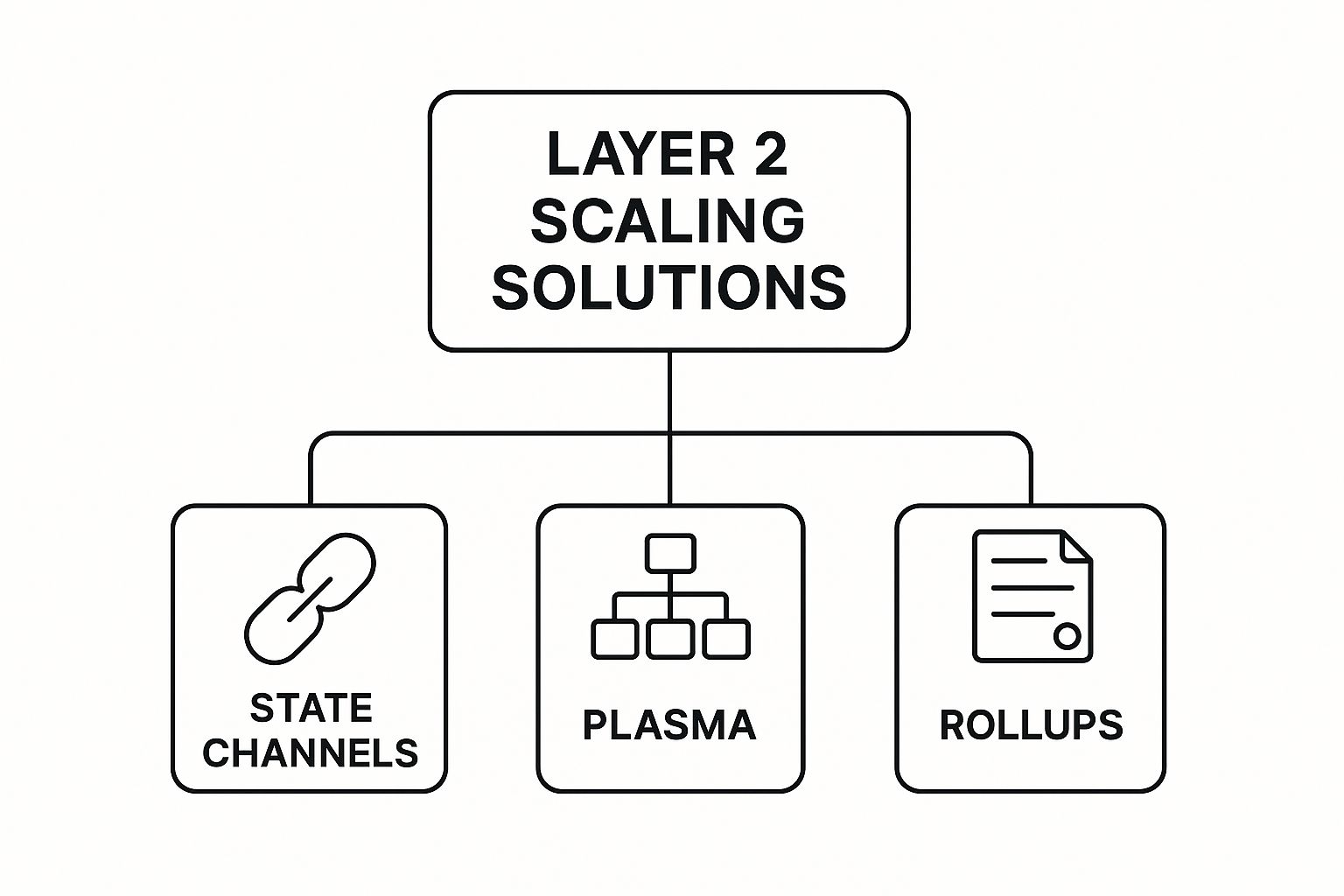
This diagram shows how the big idea of "Layer 2s" branches out into distinct technologies like Rollups, State Channels, and Sidechains—each with its own clever approach to scaling.
Rollups: The Carpooling Service
Right now, rollups are the most popular and widely used type of Layer 2. The best way to think of them is as a highly efficient carpooling service for blockchain transactions. Instead of every person driving their own car onto the main highway (Layer 1), a rollup bundles hundreds or even thousands of transactions into a single, compressed batch.
This single batch is then submitted to the main chain. By doing this, the cost of one Layer 1 transaction gets split among all the "passengers" in the rollup, which slashes fees for everyone. It also frees up a ton of space on the main road, easing congestion.
Crucially, rollups inherit their security directly from the underlying Layer 1 because the transaction data is still posted on-chain. This makes them a very secure and effective way to scale. They come in two main flavors, Optimistic and Zero-Knowledge, which we'll compare in more detail later.
State Channels: The Private Toll Lane
Imagine you and a business partner need to send dozens of small payments back and forth all day. Opening and closing a new transaction on the main blockchain for every single payment would be painfully slow and ridiculously expensive.
This is exactly the problem State Channels solve. They work like a private, pre-paid toll lane opened between two or more people.
Here’s the process:
- Open the Channel: The parties lock some funds in a smart contract on Layer 1. Think of this as paying the initial toll to get on the private lane.
- Transact Freely: Once the channel is open, they can conduct a limitless number of transactions between themselves. It's all instant, with zero fees, because it's happening entirely off-chain.
- Close the Channel: When they're done, they submit only the final state of their transactions back to the Layer 1 chain, which then updates their balances accordingly.
State channels are perfect for applications with a high volume of back-and-forth transactions between a fixed group, like micropayment systems or turn-based blockchain games.
This approach is incredibly fast and cheap for its niche. The catch? Participants have to be online to transact, and it isn't designed for the kind of general-purpose smart contract activity that rollups handle so well.
Sidechains: The Independent Road Network
If a Layer 1 blockchain is a country, then a sidechain is like a neighboring nation with its own rules, its own government, and its own security forces. It's an independent blockchain that runs parallel to a mainnet, connected by a two-way bridge that lets assets move between them.
Unlike rollups, sidechains don't post their transaction data back to the main chain. They're responsible for their own security, usually through a separate consensus mechanism like Proof-of-Stake (PoS). This separation gives them a huge amount of flexibility and scalability.
Because they handle their own consensus, sidechains can be fine-tuned for specific jobs, like gaming or enterprise applications, without being limited by the mainnet's rules. But that independence comes with a critical trade-off: sidechains do not inherit the security of the main chain. If a sidechain's security is compromised, the funds on that chain are at risk.
Plasma: The Tree with Many Branches
Plasma is another Layer 2 architecture that’s often explained using a "tree with many branches" analogy. It works by creating smaller "child" chains that are anchored to the main Layer 1 "root" chain. Each of these child chains can, in turn, sprout its own child chains, forming a hierarchical tree-like structure.
This design allows a massive number of transactions to be processed out on the branches, with only a tiny bit of data—the root hash of each branch's state—being periodically sent back to the mainnet. This offloads a huge amount of work from Layer 1.
Plasma's key security feature is the "Plasma Exit" mechanism, which gives users a way to safely withdraw their assets back to the main chain if a child chain starts acting up. While powerful in theory, Plasma has proven to be quite complex to implement for general-purpose smart contracts, which helps explain why rollups have gained so much more traction for things like DeFi.
When it comes to Layer 2 scaling solutions, rollups are the undisputed champions. But they aren't a monolithic technology. Instead, they branch into two distinct camps, each with a completely different way of thinking about how to prove that off-chain transactions are legitimate: Optimistic Rollups and Zero-Knowledge (ZK) Rollups.
Getting a grip on the core difference here is everything. One approach operates on a "trust-but-verify" model, while the other demands absolute mathematical certainty from the get-go. This single philosophical divide leads to a whole host of trade-offs that impact speed, cost, finality, and even developer experience.
This isn't just a technical debate; it fundamentally shapes how decentralized applications are designed and how we interact with them. Let's pull back the curtain on each one.
The Optimistic Approach: Innocent Until Proven Guilty
Optimistic Rollups work on a simple, almost elegant principle: they assume every transaction in a submitted batch is valid by default. You can think of it like an honor system. The rollup operator bundles up transactions and posts the data to Layer 1, "optimistically" asserting that everything is above board.
This "assume-it's-good" approach makes the whole process fast and pretty cheap upfront. But to keep everyone honest, there's a critical safety net: the challenge period.
After a batch goes on-chain, a time window—often around seven days—opens up. During this period, anyone watching the chain can dispute the batch by submitting a fraud proof. If the challenge proves the batch contained a bad transaction, the state is rolled back, and the dishonest operator gets their staked assets slashed. If no challenges arise, the batch is considered final.
The key takeaway: The "innocent until proven guilty" model prioritizes simplicity and lower computational costs. The trade-off? Users have to wait for the challenge period to close before they can safely withdraw their funds back to the mainnet.
The Zero-Knowledge Method: Mathematical Proof of Validity
ZK-Rollups take the exact opposite stance. They operate on a "trust no one" or "show me the proof" basis. Instead of just hoping transactions are valid, they use some seriously advanced cryptography to generate a direct mathematical proof that they are. This is called a validity proof, typically a zk-SNARK or zk-STARK.
This proof cryptographically guarantees that every single rule was followed for every transaction in the batch, all without revealing any of the private transaction data. That’s where the "zero-knowledge" part comes from.
When a ZK-Rollup submits its data to Layer 1, it attaches this tiny, powerful proof. The Layer 1 smart contract only needs to check this single proof to instantly validate the entire batch of hundreds, or even thousands, of transactions. It’s incredibly efficient.
The massive win here is immediate finality. As soon as the mainnet contract verifies the validity proof, those transactions are as final and secure as any other Layer 1 transaction. No long, anxious waiting periods for withdrawals.
Optimistic Rollups vs Zero-Knowledge Rollups: A Head-to-Head Comparison
To really see how these two stack up, it helps to put them side-by-side. The table below breaks down their core differences, showing the distinct advantages and trade-offs each one makes.
| Feature | Optimistic Rollups | Zero-Knowledge (ZK) Rollups |
|---|---|---|
| Verification Model | Assumes validity by default. Relies on fraud proofs and a challenge period to catch errors. | Proves validity upfront. Relies on mathematical validity proofs for verification. |
| Transaction Finality | Delayed. Finality is only achieved after the ~7-day challenge period expires. | Nearly instant. Finality is achieved as soon as the proof is verified on Layer 1. |
| Withdrawal Time | Long (days), tied directly to the length of the challenge period. | Fast (minutes), since there's no delay once the proof is submitted and verified. |
| Complexity | Lower technical complexity, making them generally easier and faster for developers to build on. | Higher computational and cryptographic complexity, especially in generating proofs. |
| Cost | Generally cheaper on-chain unless a fraud proof is needed. Off-chain computation is light. | Proof generation is computationally expensive, but this cost is spread across many transactions. |
These fundamental differences are not only shaping the technology but also creating specialized career paths within the blockchain industry. Since so many Layer 2s are built on Ethereum, a deep understanding of these systems is a valuable skill. If you're curious about the opportunities out there, you can Discover remote Ethereum jobs and see what kinds of roles are in demand.
Ultimately, choosing between them comes down to priorities. An application that needs massive throughput for complex DeFi operations and can handle a withdrawal delay might lean towards an Optimistic Rollup. On the other hand, a payment app or NFT marketplace where fast, guaranteed finality is essential for user trust would be a natural fit for a ZK-Rollup.
The Real-World Impact of Layer 2 Adoption
It’s one thing to talk about technology in theory, but the real measure of its worth is how it performs out in the wild. Layer 2 scaling solutions have officially moved beyond the whiteboard and are now a bustling ecosystem, fundamentally changing how millions of people use blockchains every day. They've become the critical plumbing for the next wave of decentralized apps.
The proof is in the numbers. Layer 2 networks aren't just propping up the mainnet anymore—in many cases, they're outperforming it. They're built to handle a massive number of transactions, they secure billions of dollars in assets, and they deliver the kind of speed and low costs that real-world applications need to attract a mainstream audience.
This shift isn't a fluke. It's a direct result of users seeking out faster, cheaper experiences without giving up the rock-solid security of the underlying blockchain.
Powering a New Breed of dApps
Perhaps the biggest win for Layer 2s has been the explosion of new apps that were simply unthinkable on a slow, congested Layer 1. On mainnet Ethereum, high fees made things like gaming, social media, and active DeFi trading a non-starter for most people.
Layer 2s completely flipped the script. By slashing the cost of entry, they unleashed a torrent of innovation in a few key areas:
- Decentralized Finance (DeFi): Protocols can now build sophisticated trading, lending, and yield-farming products with fees that are just a tiny fraction of mainnet costs. This makes DeFi accessible to a much broader crowd.
- NFTs and Gaming: Minting and trading NFTs is suddenly affordable. Blockchain games can now handle the fast, constant in-game actions and microtransactions needed to create a fun, engaging experience.
- Social and Consumer Apps: A new generation of decentralized social platforms and consumer apps is popping up, all built on the idea that users should be able to interact freely without worrying about a gas fee for every single post or click.
This boom has also fueled a hot job market for developers and other pros who get how these systems work. If you're looking to jump in, our guide to DeFi jobs is a great place to start exploring career paths in this fast-growing field.
A Look at the Leading Layer 2 Networks
To see just how dominant layer 2 scaling solutions have become, you only need to look at the top projects. Networks like Arbitrum, Optimism, and Base aren't just side projects; they are economic giants processing millions of transactions and holding immense value. The usage data makes it crystal clear: users and developers are moving their activity off the mainnet.
For example, the combined daily transaction volume on Layer 2 chains has rocketed past that of Ethereum itself. This isn't just a random spike; it's a powerful signal that users are voting with their feet (and their wallets) for the better experience L2s offer.
The total value locked (TVL) on Layer 2 networks is now in the tens of billions of dollars. This represents a massive migration of both capital and trust from Layer 1 to these scaling solutions.
The growth has been nothing short of explosive. By mid-2025, Layer 2 chains were collectively processing over 1.54 million transactions daily, easily outpacing Ethereum's own volume of around 1 million. Arbitrum is the current heavyweight, controlling over 51% of the Ethereum L2 market with more than $6 billion in TVL. Meanwhile, Base, Coinbase's Layer 2, has pulled in about $3.4 billion in TVL by creating a simple, user-friendly on-ramp for mainstream users. You can find more insights on these Layer 2 blockchain trends on Blockchain App Factory.
The Road Ahead for Layer 2 Scaling
While Layer 2 scaling solutions have been a game-changer for blockchain, their journey is really just getting started. The ecosystem we see today is powerful, but it’s still working through some growing pains. To really understand where we're headed, we need a clear-eyed look at the hurdles that developers and users are tackling right now.
One of the biggest headaches is fragmentation. We have dozens of Layer 2 networks, all running independently. This creates a bunch of disconnected islands, trapping assets and liquidity within their own little worlds. For users, this means moving funds between networks can be a clunky and slow process, breaking the seamless experience everyone wants.
Then there’s the issue of centralization risk. Many of today’s rollups depend on a single operator—a sequencer—to organize transactions and send them back to the main chain. It's fast, sure, but it also creates a single point of failure and opens the door to potential censorship. That goes against the very grain of what blockchain is all about.
The Next Wave of Scaling Innovations
But here's the good news: the future for Layer 2 is incredibly bright. A wave of groundbreaking developments is already in motion, designed to make these networks more decentralized, better connected, and even more affordable. These changes are set to cement Layer 2s as the main stage for blockchain action.
Keep an eye on these key advancements:
- Proto-Danksharding (EIP-4844): This is a massive upgrade for Ethereum that’s tailor-made for Layer 2s. It creates a new, cheaper way for rollups to post data, which is expected to slash user fees by 10x to 100x.
- Decentralized Sequencers: The race is on to replace single sequencers with decentralized networks. This move will get rid of that single point of failure, making the whole system more resilient and censorship-resistant.
- Improved Interoperability: New protocols are being built to act as seamless bridges between different L2s. The goal is to tear down the walls between those islands, letting assets and information move freely across the entire Layer 2 ecosystem.
The core idea behind these upgrades is to double down on what makes Layer 2s great—speed and low cost—while systematically addressing their current weaknesses, like centralization and fragmentation.
Pushing the Boundaries with Layer 3s
As if that weren't enough, a new idea is starting to take hold: Layer 3s, often called "app-chains." Think of these as hyper-specialized blockchains built on top of a Layer 2, dedicated to a single application. A complex game or a sophisticated DeFi protocol, for instance, could get its own Layer 3.
This gives an application ultimate control and peak performance since it doesn't have to share resources. It’s all part of a bigger vision for a "modular blockchain" stack, where each layer has a specific job. By building on these technologies, developers are paving the way for a more scalable, user-friendly, and connected Web3. A look at the latest DeFi statistics shows just how quickly this corner of the ecosystem is growing and why these scaling solutions are so critical.
Frequently Asked Questions About Layer 2
Once you start digging into Layer 2 scaling solutions, you’ll quickly find yourself with a handful of questions. It's a complex space, but understanding the core concepts is crucial as these technologies become a bigger part of the blockchain world. Let's break down some of the most common questions to clear things up.
Think of this as your go-to reference. We'll get into the important differences between the various L2 types and tackle the real-world concerns that users and developers run into every day.
Are Layer 2 Solutions as Secure as the Main Blockchain?
This is the big one, and the short answer is: it depends entirely on the type of Layer 2. Security isn't a blanket feature—it’s directly tied to how the solution connects back to the mainnet (Layer 1).
Solutions like Rollups, whether Optimistic or ZK, are specifically engineered to "borrow" their security from Layer 1. They do this by posting all their transaction data or special mathematical proofs back to the main blockchain. This design is a game-changer because it means that even if the Layer 2 network completely goes offline, you can still get your funds back by interacting directly with the smart contract on Layer 1.
Key Takeaway: Real Layer 2 solutions, like rollups, are considered very secure because they anchor their final truth to the mainnet. This is what makes them a true L2.
Sidechains, on the other hand, play by a different set of rules. They are essentially independent blockchains with their own set of validators and their own consensus rules. This means a sidechain is responsible for its own security and doesn't get the same guarantees from the mainnet.
What Is the Difference Between a Sidechain and a Layer 2?
It's incredibly common to get these two mixed up. While they both aim to help blockchains scale, the way they relate to the main chain—especially when it comes to security—is fundamentally different.
A true Layer 2, like a rollup, is a scaling technology that handles transactions off-chain but ultimately settles them, or proves their validity, back on the Layer 1 it’s built on. It’s fully dependent on the mainnet for its security.
A sidechain is a separate, parallel blockchain. It connects to the mainnet with a "bridge," but it has its own consensus, its own rules, and its own security model.
- Layer 2: Imagine an express lane built over a highway. It moves traffic much faster, but it's still part of the same highway system and protected by the same rules.
- Sidechain: This is more like a neighboring country. You can travel between the two using a border crossing (the bridge), but it has its own government, laws, and police force.
This isn't just a technical detail—it has huge implications. When you move assets to a sidechain, their security is only as strong as that sidechain's own network of validators.
Why Are There So Many Different Layer 2 Solutions?
The sheer number of layer 2 scaling solutions can be dizzying, but there's a good reason for it: there’s no single "best" way to scale a blockchain. Every approach makes different trade-offs between things like speed, security, cost, and developer complexity. This variety gives projects the freedom to choose the right tool for the job.
Take ZK-Rollups, for example. They offer incredibly fast transaction finality and top-tier security thanks to their complex math, but that complexity can make them harder to build on.
Then you have Optimistic Rollups. They are typically much easier for developers to work with and are more compatible with existing smart contracts. The trade-off? They have a built-in withdrawal delay to give the network time to challenge any fraudulent transactions.
This rich ecosystem allows for specialization.
- A high-frequency trading app might use a state channel for instant, zero-fee transactions between two parties.
- A major DeFi protocol might lean towards a ZK-Rollup to get that combination of high security and fast finality.
- A blockchain game developer might choose a sidechain to get total control over the game's environment, accepting the different security model as a fair trade-off.
Ultimately, this modular approach to scaling is what drives the industry forward. As the demands of decentralized apps get more complex, a specialized solution will likely be there to meet them.
Ready to find your place in the future of blockchain? At Find Web3, we connect talented professionals with the most exciting opportunities in the crypto space. Whether you're a developer, designer, or marketer, your next career move is waiting. Explore thousands of jobs at leading Web3 companies today on https://findweb3.com.