
Understanding What Makes Web3 UX Design Different
Web3 promises a decentralized internet, but building a positive user experience (UX) presents some unique challenges. Unlike Web2, where users interact with centralized platforms like Facebook or Twitter, Web3 introduces complexities like blockchain transactions, wallet connections, and cryptographic keys. These new elements require a fundamental rethinking of traditional UX principles.
For example, Web2 users are accustomed to instant feedback. Blockchain transactions, however, can take time, demanding innovative UX solutions to manage user expectations during these delays. Security also takes on a new dimension in Web3. Users manage their own assets, which increases the impact of errors and raises the stakes for building trust.
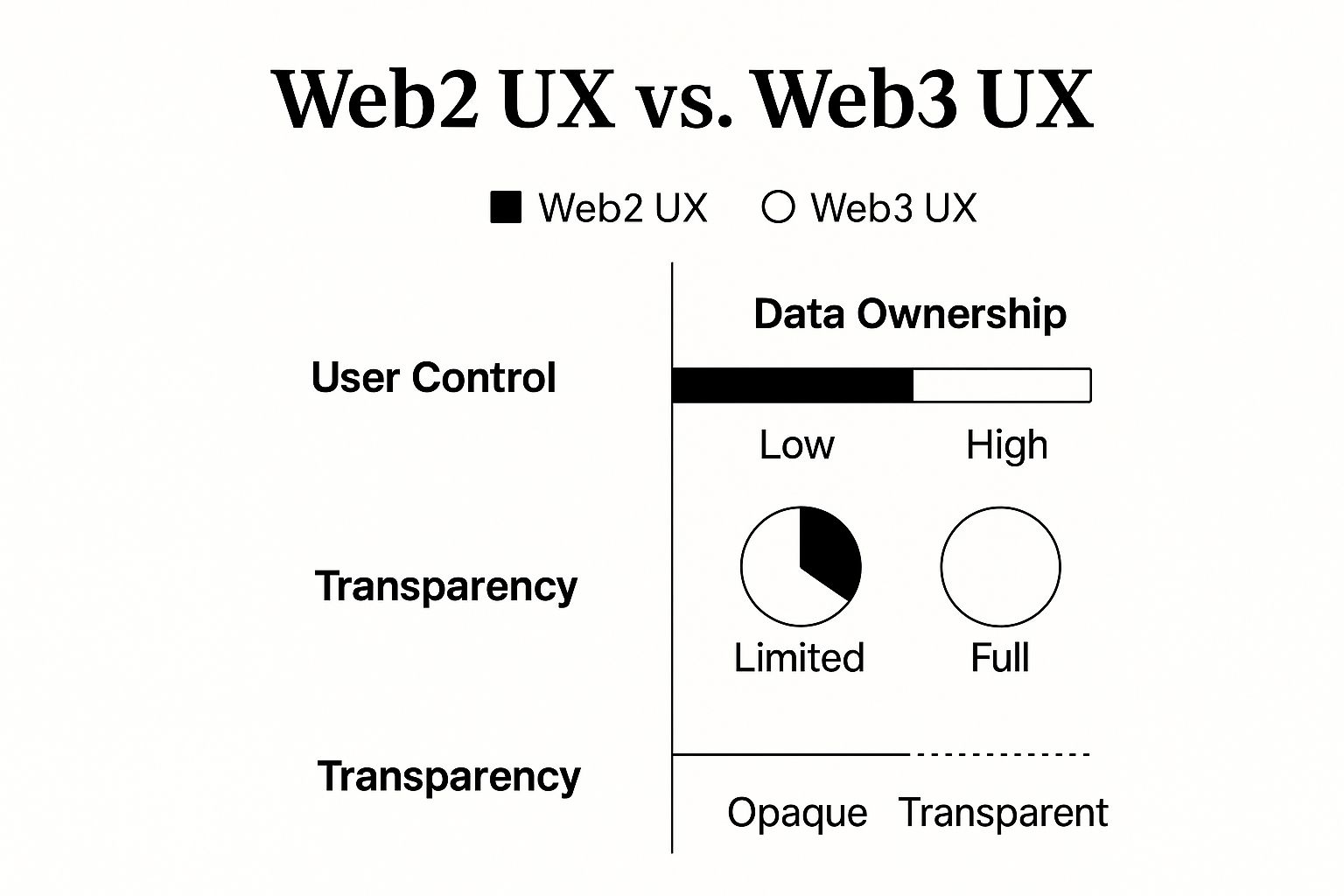
This infographic visually represents some core differences between Web2 and Web3 UX. Web3 empowers users with greater data ownership, control, and transparency. Designing interfaces that make these benefits accessible without sacrificing usability is crucial for mainstream adoption. Understanding the core concepts of personalization within this decentralized space is also essential. For a more in-depth look at personalization in Web3, you can read Getting Personal With Web 3.0.
Key Differences Between Web2 and Web3 UX Design
Several key aspects distinguish Web3 UX design from its Web2 counterpart. Let's explore some of the most important ones:
User Control and Ownership: Web3 emphasizes user ownership of data and assets. This requires UX designers to create interfaces that empower users to manage their digital identities and holdings securely and efficiently. Think of it like owning a house versus renting – ownership brings more control but also more responsibility.
Transparency and Trust: Blockchain’s inherent transparency offers the potential for building greater trust. However, making this transparency understandable to users is a design challenge. Web3 UX designers need to communicate transaction details, security measures, and platform governance clearly, without overwhelming users with technical jargon.
Decentralization and Security: Web3’s decentralized nature enhances security but also introduces new vulnerabilities. Users are responsible for managing their private keys, making security breaches potentially devastating. Web3 UX design must prioritize clear security communication and intuitive interfaces for managing cryptographic keys and transactions. For further reading on Web3 security and other statistics, check out Web3 Statistics.
The Importance of Community: Web3 thrives on community engagement. UX design should facilitate interaction and collaboration within decentralized communities. Features like integrated forums, decentralized governance mechanisms, and tokenized incentives can foster a sense of ownership and belonging.
To further illustrate the distinctions, let's look at a comparison table:
The following table provides a detailed comparison of Traditional Web and Web3 design approaches and their impact on users.
Traditional Web vs Web3 UX Design Comparison
| Aspect | Traditional Web | Web3 Design | Impact on Users |
|---|---|---|---|
| Data Ownership | Centralized platforms control user data | Users own and control their data | Increased user privacy and control |
| Security | Platform-controlled security measures | User-managed private keys and wallets | Greater security risks but also potential for enhanced user control |
| Transparency | Limited transparency into platform operations | Transparent blockchain transactions | Increased trust and accountability |
| User Interaction | Primarily interacting with centralized platforms | Direct peer-to-peer interaction | Fosters community engagement and ownership |
| Transaction Speed | Typically instant transactions | Transaction speeds can vary depending on network congestion | Users may experience delays in Web3 transactions |
This table highlights the core differences in user experience between traditional web and Web3 applications. The shift towards user ownership, transparency, and community engagement requires careful consideration in Web3 UX design.
The Web3 UX design landscape is evolving rapidly. By 2030, the Web3 market is projected to reach a valuation of $81.5 billion, highlighting the immense potential for growth and innovation in this space. As Web3 technologies become more mainstream, creating intuitive interfaces that cater to both technical and non-technical users is essential. This involves using engaging visuals to make complex decentralized applications more accessible. Simplifying complex processes and terminology is crucial for attracting a wider user base. Learn more about Web3 UX design here.
Design Principles That Actually Work In Web3

Web3, with its decentralized nature and blockchain technology, presents unique opportunities and challenges for UX designers. Building intuitive and user-friendly experiences in this space requires a fresh perspective on design. This section explores proven strategies for making Web3 applications truly user-friendly.
Transparency and User Education
Transparency is paramount in Web3 UX design. Users need to understand the underlying processes, particularly regarding transactions and security. However, clarity shouldn't come at the cost of simplicity. Progressive disclosure is a valuable technique, revealing information gradually as the user interacts with the application. Initially, focus on core actions, unveiling advanced functionalities and blockchain details later on.
Streamlined Wallet Integration
Connecting a digital wallet is often the first step for Web3 users, and it needs to be seamless. Supporting multiple wallets, providing clear instructions, and minimizing the steps required are crucial. Consider offering a QR code for mobile wallet scanning or implementing deep linking for a smoother experience.
Managing User Expectations
Blockchain transactions aren't instant. This can be confusing for users accustomed to Web2 speeds. Managing expectations around transaction times is essential. Real-time feedback, such as progress indicators or status updates, keeps users informed. Clear communication about potential delays builds trust and minimizes frustration.
Designing for Different Levels of Technical Literacy
The Web3 user base varies widely in their technical understanding. Effective Web3 UX design must cater to this diversity. Consider offering different modes of interaction. A simplified view can cater to beginners, hiding complex details, while an advanced mode provides greater control and transparency for experienced users.
Security Without Anxiety
Security is critical in Web3. However, overemphasis can create unnecessary anxiety. The aim is to build confidence, not fear. Use clear, reassuring language when explaining security measures. Visual cues, like lock icons and checkmarks, can subtly reinforce security. Integrating multi-factor authentication (MFA) with options like hardware wallets can further enhance security.
Handling Errors and Providing Support
Errors are inevitable. In Web3, where transactions are irreversible, error handling is even more crucial. Design clear, informative error messages that guide users towards solutions. Easy access to support channels, like FAQs, documentation, or community forums, builds trust and confidence.
The UX design industry, including Web3, is experiencing significant growth. India's UX design market, for example, is projected to reach ₹2,244 Crore ($2.9 billion) by 2025. Entry-level UX designers earn around $75,000 annually, while senior designers earn approximately $110,000. This growth highlights the rising importance of user experience. More detailed statistics can be found here. As Web3 evolves, effective UX design will be crucial for wider adoption and a more inclusive and accessible decentralized future. Investing in Web3 UX design isn't just about better products; it's about shaping the future of the internet.
Solving The Biggest Web3 UX Challenges
Web3 design presents unique obstacles not found in traditional web design. This section explores practical solutions for real-world Web3 applications, focusing on key pain points and how successful teams overcome them.
Navigating the Complexity of Gas Fees
Gas fees, the cost of conducting transactions on a blockchain, can be a major barrier for new Web3 users. Explaining these fees without causing "sticker shock" requires careful UX design. One effective strategy is contextual education. Instead of presenting gas fees in isolation, explain their purpose within the transaction flow. Think about using analogies to real-world transaction fees, like those charged by banks or payment processors.
Another helpful approach is offering gas fee estimations upfront. This allows users to understand the cost before committing to a transaction. Adding features that allow users to adjust gas prices based on their desired transaction speed provides a degree of control and transparency.
Designing for Unstable Network Conditions
Blockchain networks can experience periods of instability and congestion. Web3 applications must be designed to handle these fluctuations gracefully. A good solution is implementing clear loading states and progress indicators during transactions, keeping users informed of the process.
Offline functionality, where possible, can also mitigate the impact of network disruptions. For example, allow users to draft transactions or explore content even when offline, synchronizing data once the connection is restored.
Creating Intuitive Wallet Connection Flows
Connecting a digital wallet is often a user's first interaction with a Web3 application. This initial experience must be intuitive and accessible, even for newcomers. Simplified connection processes, with clear instructions and minimal steps, are crucial. Supporting a wide range of wallets caters to a broader audience.
Furthermore, offering alternative login methods, such as social logins or email/password combinations, can ease the transition for users unfamiliar with wallets. For more information on related topics, check out this resource: How to master DAO.
Mastering Transaction Delays and User Expectations
Blockchain transaction times can vary significantly. Managing user expectations during these delays is essential for a positive UX. Providing real-time transaction status updates, with estimated completion times, keeps users informed and reduces anxiety. Clearly explaining potential delays, framed within the context of the blockchain network, educates users about the underlying processes.
Consider also offering transaction speed options, allowing users to prioritize speed over cost, or vice versa.
Designing for Varying Technical Literacy Levels
The Web3 user base ranges from crypto veterans to complete beginners. Effective Web3 UX caters to this diversity. One approach is progressive disclosure, revealing complex features only when needed. Offering different interface modes, such as a simplified view for beginners and an advanced view for experts, provides tailored experiences.
Using contextual help and tooltips can explain technical terms and concepts without overwhelming novice users.
Building Fallback Experiences
Blockchain interactions can sometimes fail. Web3 applications must handle these failures gracefully. Clear and informative error messages, explaining the reason for the failure and suggesting solutions, guide users toward recovery. Fallback mechanisms, such as retry options or alternative transaction pathways, minimize disruption.
Finally, providing easy access to support channels, like FAQs or community forums, offers further assistance.
Building Trust Through Web3 Interface Design
Trust is fundamental in the Web3 space, where users manage their own assets and interact with decentralized systems. This section explores proven strategies for creating a Web3 UX design that fosters genuine user confidence.
Communicating Security Without Creating Anxiety
Security is paramount in Web3. However, overwhelming users with technical details can be counterproductive. Instead of inducing fear, aim for reassurance.
Clearly explain security measures in plain language, avoiding technical jargon. For example, use straightforward phrases like "protected by encryption" instead of complex cryptographic explanations.
Visual cues, such as lock icons or checkmarks, can subtly reinforce security without causing unnecessary anxiety.
Designing Reassuring Verification Flows
Verification processes are necessary, but they can often feel like a hurdle. Streamlining these flows is key to building trust and a positive user experience.
Minimize the number of steps required for verification. Provide clear instructions at each stage, and offer visual feedback to indicate progress.
Consider using micro-interactions, like subtle animations, to make the verification process more engaging. This reduces friction and builds user confidence.
Visual Hierarchy for Critical Security Information
Presenting security information effectively is crucial for user understanding. Employing visual hierarchy helps highlight key details at the right time.
Use contrasting colors, varying font weights, and different sizes to draw attention to essential security information, such as transaction confirmations or wallet connection requests. This ensures users clearly understand the implications of their actions within the Web3 environment.
The Psychology of Trust in Blockchain Environments
Understanding the psychology of trust is essential for effective Web3 UX design. Users need to feel in control of their experience.
Design interfaces that empower users to manage their digital identities and assets securely and with ease. This sense of control boosts their confidence in the system.
Transparency is another key factor. Clearly communicating transaction details and security measures builds trust by demonstrating openness and accountability.
Learning from High-Trust Web3 Applications
Analyzing successful Web3 applications reveals valuable insights into trust-building strategies. Observe how these platforms communicate security statuses, handle verification, and present critical information.
Identify common visual indicators that effectively build trust across different demographics. This analysis can inform your own design decisions.
Designing Clear Security States
Clearly communicating the security status of the system is essential. Use distinct visual cues to indicate different states, such as "connected," "disconnected," or "pending."
For instance, a green checkmark could signal a secure connection. A red exclamation point could indicate potential risks. This clear communication reduces uncertainty and builds user trust.
Making Cryptography Understandable
Cryptographic concepts can be intimidating. Instead of focusing on technical details, explain the benefits of cryptography in simple terms.
Use analogies to familiar concepts to make complex ideas accessible. For example, compare private keys to house keys and stress the importance of safeguarding them. This approach demystifies cryptography and builds trust.
Career Opportunities In Web3 UX Design
The Web3 design field offers a wealth of opportunities for UX designers. This dynamic environment blends technical complexity with user-centric design, creating a high demand for skilled professionals. Let's explore the current job market, salary expectations, and required skills for a successful Web3 UX design career.
Exploring Career Paths in Web3 UX Design
The Web3 space, from established crypto companies to emerging startups, provides diverse career paths. Established companies often seek seasoned designers to lead teams and guide product strategy. Startups, however, offer designers a chance to own entire products and significantly influence a company's trajectory. Interested in exploring available roles? Check out these Web3 design jobs.
Freelancing is also a popular option in the Decentralized Finance (DeFi) realm. This allows designers to choose projects aligned with their passions and work with a variety of clients. It also encourages specialization within the Web3 ecosystem.
Essential Skills for Web3 UX Designers
Traditional UX skills are fundamental, but some specific skills are highly sought after in Web3. Understanding blockchain technology is crucial. Designers should grasp concepts like smart contracts, wallets, and decentralized applications (dApps). This knowledge enables them to create interfaces that integrate seamlessly with blockchain functions.
Familiarity with Web3-specific design patterns is also vital. This includes designing for wallet connections, transaction flows, and gas fee interactions.
Building a Winning Portfolio for Web3
A strong portfolio is essential to demonstrate your Web3 expertise. Feature projects showcasing your understanding of blockchain technology and user-centric design principles within a decentralized environment. This could include dApp prototypes, wallet interface designs, or even conceptualizing new Web3 interactions.
Highlight how your designs address Web3 challenges, such as transaction delays or explaining gas fees clearly. Focusing on user experience within this complex technical space showcases valuable skills.
To give you an idea of salary expectations and market demand, let's take a look at the following table:
Web3 UX Designer Salary and Market Data
Comprehensive breakdown of salary ranges, market growth, and career opportunities in Web3 UX design
| Experience Level | Average Salary | Key Skills Required | Market Demand |
|---|---|---|---|
| Entry-Level | $70,000 – $90,000 | Figma, Prototyping, Blockchain Basics | High |
| Mid-Level | $90,000 – $120,000 | User Research, Solidity, dApp Design | Very High |
| Senior-Level | $120,000+ | Team Leadership, Product Strategy, Tokenomics | Extremely High |
This table provides a general overview. Actual salaries can vary based on location, company size, and specific skill sets. The market demand for Web3 UX designers is currently very strong across all experience levels.
The global UX services market is expanding rapidly. Valued at $2.59 billion in 2022, it's projected to reach $32.95 billion by 2030, with a CAGR of 37.8%. For Web3 UX designers, this represents significant opportunity. More detailed statistics on the UX market can be found here.
Furthermore, video content is predicted to constitute 82% of all web traffic by the end of 2025. This underscores the importance of multimedia integration in UX design, including Web3 applications. Designers with multimedia skills have a distinct advantage.
Transitioning from Traditional UX to Web3
Many traditional UX designers are looking to transition into Web3. Building a solid foundation in blockchain technology is a crucial first step. Engage with Web3 communities, explore online resources, and consider specialized courses to deepen your knowledge.
Networking within the Web3 design community can unlock new opportunities. Attend online and in-person events, connect with designers on social media, and participate in relevant conversations. Building relationships can lead to mentorship and valuable insights.
The Future of Web3 UX Design
The Web3 space is constantly evolving. Staying current with the latest trends, including new design patterns, emerging technologies, and evolving user expectations, is essential. Continuous learning and adaptability are key to success in this rapidly changing field.
Your Web3 UX Design Toolkit and Resources
Success in Web3 UX design depends heavily on having the right tools and a strong community. This section will introduce you to essential resources that active Web3 designers use every day, from specialized design systems to collaborative platforms ideal for distributed teams. Building your Web3 UX design toolkit is the first step toward creating compelling decentralized experiences.
Essential Design Systems and Prototyping Tools
Creating a smooth and intuitive user experience requires tools specifically designed for the Web3 environment. Design systems built for blockchain applications offer pre-built components and design patterns that can significantly streamline your workflow. They also ensure consistency across your decentralized application (dApp).
Several prototyping tools are now equipped to handle the complexities of Web3 interactions, such as wallet integrations and transaction flows. These tools allow you to test and refine your designs early in the process, ensuring a user-friendly experience before any actual development begins.
- Examples of Web3 Design Systems: The landscape of Web3 design systems is constantly changing, so it's important to research the most up-to-date options.
- Prototyping Tools with Web3 Integration: Figma, with its extensive library of community plugins, is a popular choice. Other tools are continually emerging to meet the specific demands of Web3 prototyping.
This means you can build interactive prototypes that realistically simulate blockchain interactions. This facilitates early user testing and helps identify any potential UX issues before the development phase.
Collaboration Platforms For Distributed Teams
Web3 projects often involve geographically dispersed teams working across various time zones. Effective collaboration is crucial for project success. Platforms that facilitate asynchronous communication, file sharing, and design feedback are incredibly valuable.
- Popular Collaboration Tools: Slack, Discord, and Notion are frequently used, along with project management tools like Asana and Trello.
Version control systems like GitHub are also essential for managing code and design assets in a collaborative environment. This ensures everyone is working with the most recent versions and contributes to a more streamlined development process.
Understanding Blockchain Technology and Web3 Design Patterns
A solid understanding of blockchain fundamentals is essential for effective Web3 UX design. Fortunately, there are numerous resources available to help you learn these concepts, even without a computer science background.
- Educational Platforms: Many online platforms and communities offer introductory courses and tutorials on blockchain technology.
Understanding the technology is important, but it's not enough on its own. Familiarity with Web3-specific design patterns is equally crucial. These patterns address the unique challenges inherent in designing for decentralized applications. Finding reliable resources for these design patterns can save you significant time and effort.
Connecting With the Web3 Design Community
The Web3 design community is a vibrant and active source of knowledge and support. Engaging with this community offers valuable insights and keeps you informed about the latest trends.
- Active Communities: Join online forums, attend Web3 design events (both virtual and in-person), and actively participate in relevant discussions.
This provides excellent opportunities to learn from experienced designers, share your own knowledge, and contribute to the growth and evolution of the Web3 UX design field. Building your Web3 UX design toolkit is an ongoing journey. As the Web3 ecosystem continues to evolve, so too will the available tools and resources. Staying up-to-date with these advancements is key to remaining competitive and creating exceptional user experiences in the decentralized world.
Getting Started With Web3 UX Design
Ready to explore the world of Web3 UX design? This journey involves a new way of thinking, embracing the decentralized nature of blockchain technology while keeping user needs front and center. This section provides a practical roadmap with actionable steps to build your Web3 design skills and launch your career in this evolving field.
Mastering the Fundamentals: Key Concepts and Skills
Beginning your Web3 UX design journey starts with a focus on core concepts. Understanding the basics of blockchain technology, such as how transactions work and the function of crypto wallets, is essential. Initially, don't get lost in the technical details; concentrate on the user's perspective. How do these concepts affect their experience?
Next, become familiar with Web3-specific design patterns. How do you design for wallet connections? How can you smoothly handle transaction delays? Resources like design systems created specifically for blockchain applications can be invaluable. These often offer pre-built components and design patterns that help improve your design process. To further enhance your knowledge, explore AI's expanding role in content creation through this guide on AI videos.
Building Your Web3 Portfolio: Showcasing Blockchain Thinking
Your portfolio is essential in the Web3 world. It should highlight your ability to apply design thinking to the unique challenges of decentralized applications (dApps). Start with small projects, perhaps designing the interface for a simple dApp or redesigning the user flow for a decentralized exchange (DEX).
Consider contributing to open-source Web3 projects. This offers valuable experience and shows your commitment to the community. Even conceptual projects exploring innovative Web3 interactions can be strong additions to your portfolio.
Practical Steps for Finding Your First Web3 UX Design Role
Securing your first Web3 UX design role requires a strategic approach. Networking within the Web3 community is critical. Attend online events, join relevant online forums, and connect with designers on social media platforms. Building connections can lead to mentorship and job opportunities.
Refine your resume and portfolio to emphasize your Web3 skills and experience. Showcasing your understanding of blockchain concepts and decentralized design principles can help you stand out. Explore different career paths, from established crypto companies to new startups. Consider freelance work in the DeFi (Decentralized Finance) space to gain practical experience.
Setting Realistic Expectations and Staying Motivated
The Web3 space is constantly changing. Set realistic goals for your skill development. Don’t expect to become a Web3 expert quickly. The learning process takes time, so patience and persistence are important.
Identify clear signs of progress, such as mastering new design tools or completing a successful project. Acknowledge small wins throughout the process. Maintaining motivation is vital for success.
Practical Next Steps: From Learning to Launching
Begin by exploring online resources and communities focused on Web3 UX design. Many platforms provide introductory courses and tutorials on blockchain technology. Choose a learning path that fits your style and pace.
Develop a basic understanding of smart contracts, wallets, and dApps. Experiment with different prototyping tools that handle Web3 interactions. Practice designing for wallet connections and transaction flows.
Engage with the Web3 design community. Join online forums, participate in conversations, and network with experienced designers. Building relationships within this community will be invaluable as you advance in your Web3 journey.
Ready to start your Web3 career? Find Web3 is a dedicated job board featuring thousands of jobs in the crypto, NFT, DeFi, DAO, metaverse, and blockchain industries. Explore Web3 design jobs now. Find the right opportunity for you.