
So, what exactly is a smart contract?
At its heart, a smart contract is just a piece of code designed to automatically carry out an agreement once certain conditions are met. Forget about needing a middleman.
The best way to think about it is like a high-tech vending machine. You put in your money (the condition), and the machine automatically gives you your snack (the outcome). There's no need for a cashier to make it happen. Smart contracts work the same way, but on a blockchain.
Getting to the Core of Smart Contracts
Instead of wading through dense legal paperwork and relying on someone to enforce it, a smart contract translates the terms of an agreement directly into a computer program. Once created, these digital contracts live on a blockchain—a secure, shared, and unchangeable record. This is key, because it means the rules can't be tampered with after they're set.
The logic is beautifully simple: "if this happens, then do that."
For example, a contract could be programmed with a simple rule: "if the tracking number shows the package was delivered, then release the payment to the seller." This straightforward structure eliminates guesswork and the need for anyone to step in and manually approve things. The blockchain itself is the impartial judge, checking if the conditions are satisfied and executing the contract exactly as written.
The Bedrock of Automated Agreements
This whole process—from the underlying technology to the final, automated result—is what makes smart contracts so powerful.
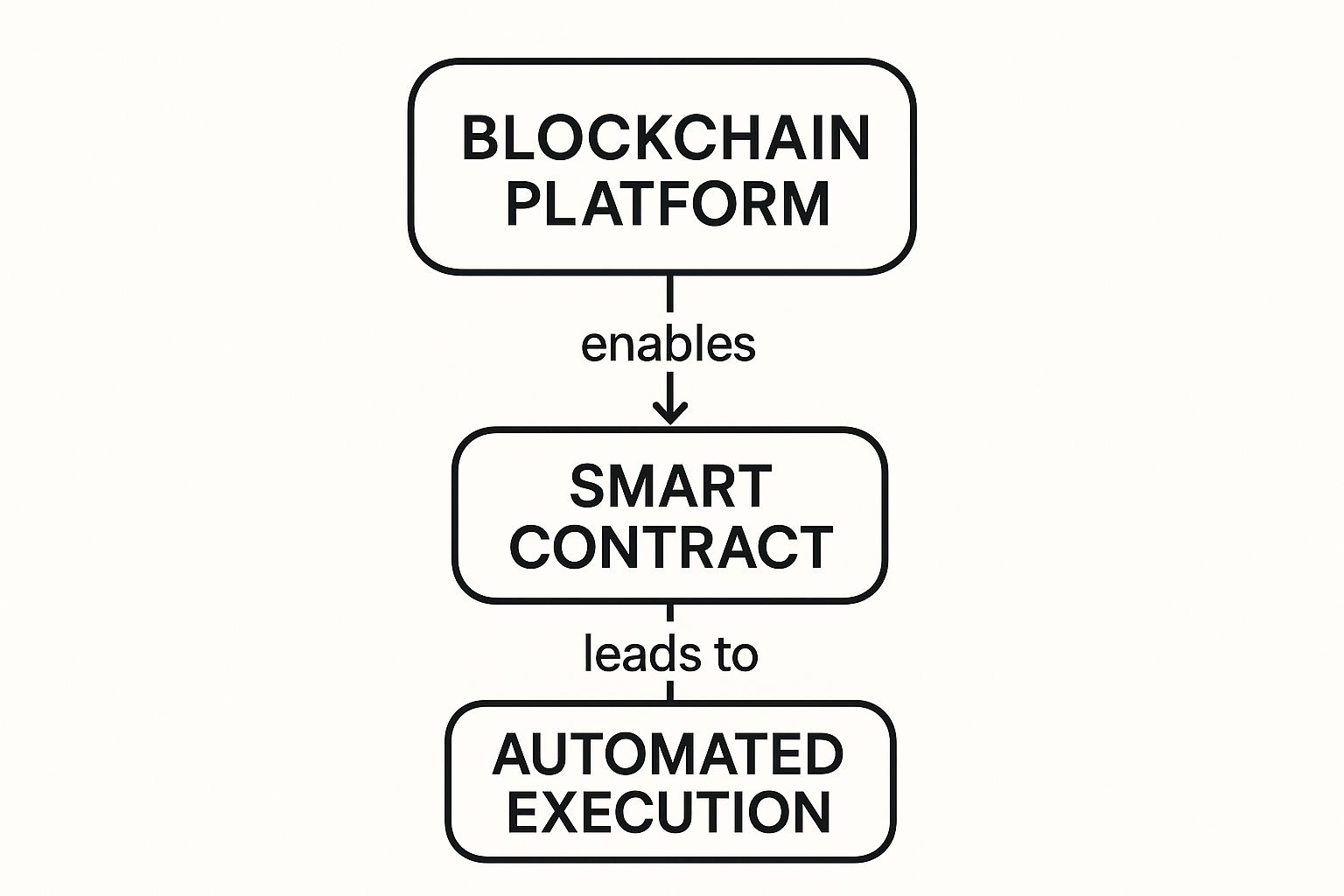
As you can see, the blockchain provides the secure and transparent environment where the smart contract runs. This foundation is what guarantees the agreement will execute automatically and reliably. If you're new to some of these terms, our complete Web3 dictionary is a great resource for getting up to speed.
Think of it this way: smart contracts aren't just code; they are agreements that enforce themselves. This self-executing feature is what cuts out the need for trusted third parties like banks or lawyers, completely changing the game for how we transact and exchange value.
Smart Contracts vs. Traditional Contracts at a Glance
To really appreciate what makes this technology so different, it helps to see it side-by-side with the old-school agreements we're all used to. While both are meant to define the rules of an interaction, how they're built, enforced, and managed couldn't be more different.
Here’s a quick breakdown of where they stand apart.
| Feature | Smart Contract | Traditional Contract |
|---|---|---|
| Enforcement | Automated and self-executing by code | Requires lawyers, courts, or arbitration |
| Speed | Near-instantaneous once conditions are met | Can take days, weeks, or months to finalize |
| Trust | Trust is placed in the immutable code | Trust is placed in intermediaries and legal systems |
| Cost | Low operational costs; no intermediaries | High costs due to legal fees and administrative overhead |
| Transparency | Publicly verifiable on the blockchain | Often private and accessible only to involved parties |
The table makes it clear: smart contracts offer a faster, more transparent, and often cheaper way to make and manage agreements. They replace the need for trust in people with the certainty of code.
How a Smart Contract Actually Works
To really get what a smart contract is, let's forget the dry definitions and look at a real-world example. Picture a freelance graphic designer, Alex, who just landed a logo project with a startup called Innovate Co. In the traditional world, this is a dance of uncertainty. Alex worries about getting paid on time, and Innovate Co. is hesitant to pay before seeing the final work.
A smart contract completely changes this dynamic.
Instead of relying on invoices, follow-up emails, and mutual trust, they decide to use a smart contract on a blockchain like Ethereum. Their agreement gets boiled down to simple, direct logic coded onto the network.
The core of their deal is a single, automated rule: "IF Alex submits the final logo files to the designated project folder, THEN the contract will automatically transfer 1 Ether (ETH) from Innovate Co.'s wallet to Alex's wallet." This isn't just a digital handshake; it's a binding instruction locked into a secure, decentralized system.
The Life Cycle of an Agreement
So, how does this freelance gig actually play out with a smart contract in the driver's seat? The whole process is transparent and follows a clear, logical path.
Creation and Funding: First, the terms Alex and Innovate Co. agreed on are coded into a smart contract. Innovate Co. then sends the 1 ETH payment directly into the contract. The funds are now held in a digital escrow, locked by the code. Both parties can see the money is there, but nobody can touch it—yet.
Execution of Terms: Alex gets to work, nails the design, and uploads the final logo files to the pre-agreed location (maybe a decentralized storage folder linked to the contract). This simple action is the trigger.
Automatic Verification: The smart contract is always "watching" for its conditions to be met. As soon as it detects the file upload, it verifies the "IF" part of its programming. There’s no accounts payable department to chase or manager who needs to sign off. It just happens.
Instant Settlement: The moment the condition is confirmed, the "THEN" clause executes instantly. That 1 ETH held in escrow is released and transferred directly into Alex’s digital wallet. The transaction is done, the deal is closed.
The beauty of this is that neither Alex nor Innovate Co. had to trust each other. They just had to trust the code.
The Blockchain as an Unbiased Enforcer
The real magic here isn't just the code, but the blockchain it runs on. Think of the blockchain as a global, tamper-proof notary that forces everyone to play by the rules. Every single step—from funding the contract to the final payout—is logged as a permanent transaction on a distributed public ledger.
This setup gives smart contracts two superpowers:
- Immutability: Once that contract is on the blockchain, its code is set in stone. It can't be changed. Innovate Co. can't suddenly decide to pay less, and Alex can't alter the delivery requirements. This creates a level playing field.
- Transparency: Both Alex and Innovate Co. can look at the contract and the status of the funds anytime they want. This shared visibility gets rid of the "he said, she said" arguments about whether conditions were met.
A smart contract isn't just an agreement; it's an automated and impartial executor of that agreement. The blockchain provides the trust, security, and availability needed for the contract to function reliably, turning a digital promise into a guaranteed action.
The entire system is locked down with cryptography, which makes cheating nearly impossible. A huge network of computers all work together to validate every transaction, so no single person or group can manipulate the outcome. For Alex, this means payment is a certainty once he delivers. For Innovate Co., it means they only pay when they get what they asked for.
By doing this, they’ve completely cut out the need for traditional middlemen like banks or expensive escrow services. They've eliminated delays, reduced administrative headaches, and built a foundation of trust based on secure code instead of hoping for the best. That, right there, is the fundamental power of how a smart contract works.
So, What's the Big Deal? The Real Payoffs of Smart Contracts

Okay, we’ve covered the "what." But the real question is, why should anyone care? The buzz around smart contracts isn't just tech hype; it’s about the very real problems they solve. They directly attack the traditional weak spots in agreements: trust, speed, and cost.
Think of them as a way to replace clunky, manual processes with sleek, automated efficiency. They strip away the ambiguity and friction, creating a much cleaner and more reliable way for people and businesses to work together.
Let’s dig into the core advantages that make them so compelling.
Blazing Speed and Efficiency
Traditional contracts are slow. They get bogged down in paperwork, endless email chains, and manual sign-offs from multiple people. A simple international property sale can drag on for weeks, caught in a mess of banking bureaucracy and legal back-and-forths.
Smart contracts, on the other hand, run at the speed of software. Since they execute themselves, agreements get settled almost the second the conditions are met.
- No More Paper-Pushing: Forget filing forms or chasing down documents. The code simply does its job the moment the blockchain confirms a condition has been met.
- Always On: A blockchain network doesn't have business hours. It never closes. This means smart contracts can process transactions and finalize agreements 24/7, anywhere on the globe.
What does this look like in practice? A process that used to take days, like transferring ownership of a digital asset, can now be over in minutes. That’s a huge leap in efficiency.
Serious Cost Savings
Every person in the middle of a traditional deal—lawyers, brokers, bankers, escrow agents—gets a piece of the pie. Those fees pile up, making even simple transactions more expensive than they need to be.
Smart contracts are built to cut out the middleman. By taking humans out of the verification and execution loop, you also eliminate their fees. The only real cost is the network's "gas fee" to run the transaction, which is usually a tiny fraction of what a lawyer or broker would charge.
By automating trust itself, smart contracts slash the overhead required to make and enforce an agreement. This makes all kinds of transactions cheaper and more accessible.
Imagine a musician getting paid for their music. Instead of a publisher taking a huge cut and processing royalties quarterly, a smart contract could instantly send a micropayment to the artist’s wallet every single time their song is streamed. It's direct, it's automatic, and it ensures the creator gets their fair share without delay.
Fort Knox-Level Security and Transparency
This is a big one. Smart contracts get their security from the blockchain they live on. Once a contract is deployed, its code is immutable—it can't be changed by anyone, not even the people who wrote it.
This permanency locks in the terms, preventing fraud and making sure everyone is held to the exact same rules they agreed to from the start. Better yet, every action related to that contract is logged on a public ledger, creating a crystal-clear audit trail that anyone can see.
This has a couple of powerful results:
- Hack-Resistant Logic: The cryptography securing the blockchain makes it incredibly difficult for anyone to tamper with the contract's rules.
- Guaranteed Action: The outcome is purely based on the code. There's no room for one party to back out, dispute the terms, or fail to deliver because of a "misunderstanding."
Hands-Off, Autonomous Execution
Ultimately, smart contracts provide something incredibly valuable: certainty. They are built on simple "if-then" logic and run automatically, without needing anyone to press a button.
This autonomy gets rid of the human element—the biases, the interpretations, and the mistakes that can mess up traditional deals. A smart contract will do exactly what it was programmed to do, every time.
This reliability is the bedrock of trust in the digital world, especially when you're dealing with strangers. You don't have to trust the person on the other side of the screen; you just have to trust the code. This fundamental shift is what makes smart contracts a cornerstone of a more decentralized internet.
Smart Contracts in Action Across Industries
The theory behind smart contracts is one thing, but seeing them solve real-world problems is where their power truly clicks. This isn't just some niche crypto tool; it's a versatile engine for automation that's already creating tangible value in a whole host of industries.
From the world of finance to the complexities of shipping, smart contracts are busy streamlining operations, slashing costs, and building trust where it used to be expensive or downright impossible. These aren't just ideas for the future—they are practical applications making businesses more efficient and transparent today. Let’s dive into some of the most compelling examples.
Reshaping the World of Finance
Decentralized Finance, better known as DeFi, is probably the most visible showcase for smart contracts right now. The entire DeFi ecosystem—from lending platforms to automated crypto exchanges—is built on this self-executing code.
Think about a DeFi lending protocol. Here, a smart contract completely replaces the traditional bank. Someone can lock up their digital assets as collateral inside a smart contract, which then automatically releases a loan. The contract handles everything that comes next, from interest payments to liquidating the collateral if its value falls too low, all without a single human needing to get involved.
This automated, code-based trust is exactly why the financial sector is paying such close attention. It strips away layers of bureaucracy and opens up financial services to anyone with an internet connection.
In fact, by 2025, smart contracts are expected to become mainstream in finance, with an estimated 85% of global financial institutions projected to adopt them in some capacity. This shift is driven by their ability to drastically speed up transaction settlements and cut contract enforcement costs by up to 35%. To put it in perspective, in 2023 alone, smart contracts powered over $300 billion in transactions worldwide, a figure that speaks volumes about their growing importance. You can dig into more data on smart contract adoption in finance to see the momentum for yourself.
Bringing Transparency to Supply Chains
Getting a product from a factory to your doorstep is often a messy, opaque process involving dozens of people and mountains of paperwork. This complexity is a breeding ground for delays, fraud, and disputes. Smart contracts cut through that chaos by creating a single, unchangeable record of a product's entire journey.
Let’s take a shipment of organic coffee beans. A smart contract can be set up to track its path from a farm in South America all the way to a café in Europe.
- Origin Verified: The moment the beans are harvested, a sensor logs the data to the blockchain, triggering the first "if" condition in the contract.
- Customs Cleared: When the shipment hits customs, an official's digital sign-off automatically updates the contract, releasing payment for the next leg of the journey.
- Delivery Confirmed: Finally, upon arrival at the café, a quick scan confirms delivery. This action triggers the final clause, automatically paying the farmer, the shipping company, and everyone else involved.
At every step, all parties have real-time visibility into where the shipment is and what's happening. It eliminates arguments over delivery times and guarantees the product is what it says it is, because that digital record can't be secretly changed.
Automating the Insurance Industry
Let’s be honest: the traditional insurance process can be painfully slow. Filing a claim usually means tedious paperwork, manual reviews, and a long wait for a payout. Smart contracts are turning this on its head by automating the entire claims process based on verifiable data.
A great example is flight delay insurance. A traveler buys a policy, which is just code in a smart contract. The rule is simple: "IF the flight is delayed by more than two hours, THEN automatically pay the claim."
To make this work, the smart contract connects to a trusted data source—what we call an "oracle"—that feeds it real-time flight information. The second that oracle reports a delay that meets the policy's condition, the contract executes and instantly sends the payout to the traveler’s digital wallet.
There are no forms to fill out, no adjusters to call, no waiting for a check in the mail. The process is clean and simple:
- Agreement Locked: The policy terms are coded and deployed.
- Trigger Event Occurs: The flight delay is confirmed by a trusted source.
- Instant Payout: The smart contract automatically sends the money.
This kind of automation isn't just a better experience for the customer; it also dramatically lowers administrative costs for insurance companies. From healthcare to real estate, these core principles of automation and trust are unlocking new efficiencies and proving that smart contracts are a foundational technology for the next wave of business innovation.
Choosing the Right Platform for Smart Contracts
Every smart contract needs a home—a blockchain platform that provides the secure, decentralized environment where it can run. But these platforms aren't one-size-fits-all. They each offer a unique blend of speed, cost, and developer-friendliness, and picking the right one is a huge decision.
The conversation nearly always begins with Ethereum. As the platform that first introduced smart contracts to the world, it boasts the largest and most mature ecosystem. It’s like the original operating system for decentralized apps—it has the most users, the most developers, and the most time-tested code.
Ethereum's native programming language, Solidity, was built from the ground up specifically for this purpose. Because of its long-standing dominance, you’ll find a massive community, endless tutorials, and robust tools, making it the go-to for many developers breaking into the space.
Ethereum: The Undisputed Leader
So, what makes Ethereum special? Its core strengths are its immense decentralization and security, upheld by a global network of validators. This makes it incredibly reliable and censorship-resistant. But that popularity has a downside: the network can get congested, leading to slower transactions and high "gas fees," which are the costs for executing code.
Even with those growing pains, Ethereum is still king. It's the engine behind the overwhelming majority of DeFi, NFTs, and other decentralized applications, making it the most vibrant and active smart contract environment out there.
The platform a smart contract is built on directly influences its performance, cost, and reach. Ethereum's massive user base and developer community provide a significant first-mover advantage, but newer platforms are competing fiercely on speed and scalability.
Exploring Other Major Platforms
While Ethereum paved the way, a whole new wave of blockchains has emerged to tackle its limitations, especially around speed and cost. These alternatives bring fresh ideas and different architectures to the table.
Take Solana, for example. It was built for one thing: raw speed. Capable of handling tens of thousands of transactions per second for a tiny fraction of Ethereum's cost, it's a perfect fit for applications that can't tolerate delays, like fast-paced blockchain games or high-frequency trading platforms.
Then there's Cardano, which takes a much more deliberate, academic approach. It prioritizes sustainability and something called formal verification—a method of mathematically proving that code will work exactly as intended. This intense focus on security makes it attractive for high-stakes financial applications where a single bug could be catastrophic.
Finally, you have Polkadot, which is all about interoperability. Its entire purpose is to let different, siloed blockchains talk to each other and exchange information securely. Think of it as a "blockchain of blockchains," designed to weave together an interconnected Web3 instead of forcing developers to choose one isolated network.
As these platforms grow, so does the need for skilled talent. Looking into career paths in blockchain development reveals just how specialized the industry has become, with companies seeking expertise on each of these unique networks.
Comparing Top Smart Contract Platforms
To really grasp the differences, a side-by-side comparison helps. The table below breaks down the core features of these leading platforms, showing the trade-offs each one makes.
| Platform | Primary Language | Key Advantage | Typical Transaction Speed |
|---|---|---|---|
| Ethereum | Solidity | Largest ecosystem and most decentralized | 15-30 Transactions Per Second (TPS) |
| Solana | Rust | Extremely high speed and low cost | 50,000+ TPS |
| Cardano | Plutus, Haskell | Emphasis on security and sustainability | ~250 TPS |
| Polkadot | Rust, Substrate | Cross-chain interoperability | ~1,000 TPS |
In the end, there's no single "best" platform—it all comes down to the project's specific goals. An NFT artist might want the massive audience on Ethereum, while a decentralized social media app would probably need the low-cost, high-speed environment that a platform like Solana provides.
Challenges and the Future of Automated Agreements
Smart contracts are a massive leap forward, but like any groundbreaking technology, they have their share of growing pains. It’s important to understand these hurdles—not as deal-breakers, but as the very problems that are driving the next wave of innovation in the space.
One of the biggest double-edged swords is code immutability. Once you deploy a smart contract to the blockchain, that's it. It’s locked in. This is fantastic for security, creating a tamper-proof agreement. But it also means a single bug or oversight is permanent. There’s no "undo" button, which makes meticulous pre-launch auditing an absolute necessity.
Then there’s the issue of scalability. Blockchains can get crowded. When a network like Ethereum is busy, transactions slow down and the fees (known as gas) can skyrocket. This makes smart contracts less practical for things that require tons of small, fast interactions, like a micropayment system for an online game.
Solving the Real-World Data Puzzle
A really interesting challenge is what we call the oracle problem. By design, blockchains are closed systems. They can't just pull in outside information like the current price of gold, the weather in Tokyo, or the final score of a football game. To get this off-chain data, they need a special service called an oracle.
This introduces a new layer of trust into a trustless system. What if the oracle provides bad data, either by mistake or on purpose? A smart contract acting on that wrong information could trigger a massive, incorrect payout. Building secure and reliable oracles is one of the most critical frontiers in the entire industry.
And finally, the legal framework is still playing catch-up. Are smart contracts legally binding in every country? How do you handle a dispute when the code is the ultimate authority? These are the complex legal questions being hashed out in courtrooms and regulatory bodies right now.
The Bright Future of Smart Agreements
Despite these hurdles, the momentum is undeniable. The global market for smart contracts is set to explode from USD 2.02 billion in 2024 to a staggering USD 815.86 billion by 2034. That’s a compound annual growth rate of over 82%, a testament to the immense value and potential everyone sees in this technology. You can explore the market's trajectory and key drivers for a deeper dive.
Better yet, smart people are actively building solutions to these very problems:
- Layer-2 Scaling: Technologies like rollups and sidechains act like express lanes for blockchains. They process transactions off the main chain, making them dramatically faster and cheaper, which directly tackles the scalability problem.
- AI Integration: Imagine a smart contract that isn't just rigid code but can use AI to analyze complex data and make more nuanced decisions. This fusion is poised to create far more dynamic and intelligent agreements.
- Smarter Languages: Developers are creating new programming languages designed specifically for smart contracts, with built-in safety features to prevent common and costly bugs.
This work is pushing the envelope every single day. The growth in areas like decentralized finance (DeFi) is a direct result of these improvements, and our guide on key DeFi statistics shows just how fast that sector is moving. The road ahead is long, but smart contracts are getting more powerful, secure, and intelligent by the day.
Common Questions About Smart Contracts
As you start to wrap your head around smart contracts, a few questions always pop up. It's only natural to wonder about their legal weight, how flexible they really are, and where the potential pitfalls lie. Getting these answers is crucial to understanding how they actually work in the wild.
Let's dive into some of the most frequent questions.
Are Smart Contracts Legally Binding?
This is a bit of a "it depends" situation. The legal world is still playing catch-up with the tech, so the answer varies wildly depending on where you are.
Some places have passed specific laws to recognize smart contracts as legit, while others are still figuring it out. Ultimately, a smart contract's legal muscle often comes down to whether it ticks the old-school boxes of a traditional contract—like having a clear offer, acceptance, and an exchange of value. As the technology becomes more common, we'll see more solid legal frameworks pop up around the world.
Can a Smart Contract Be Changed or Updated?
Here's one of the core principles of blockchain tech: once a smart contract is live, its code is set in stone. This immutability is a powerful security feature because it ensures no one can sneak in and change the rules after the fact.
But what if you find a bug or want to add a new feature? Developers have clever workarounds for this. They can use patterns, like "proxy contracts," that essentially point to a new, updated version of the contract's logic. This allows for upgrades without having to scrap the original contract and its address.
The single greatest risk is a bug in the code. Because smart contracts are permanent and often control valuable assets, a vulnerability could be exploited by hackers, leading to irreversible losses. This is why thorough code audits and rigorous testing by security experts are absolutely essential.
The growing trust in this technology is clear from the numbers. In 2024, North America commands a 35.05% market share, a trend that got a major push during the COVID-19 pandemic as industries like healthcare adopted smart contracts for secure data management.
Even more telling is the user growth for decentralized apps, which are built on smart contracts. The daily user base shot up by roughly 396% in a single year, reaching 2.4 million users. You can explore the smart contracts market growth in more detail to get the full picture.
Ready to find your place in the next wave of tech? At Find Web3, we connect talented professionals with top roles in blockchain, DeFi, and the metaverse. Explore thousands of job listings and launch your Web3 career today at https://findweb3.com.