
A Decentralized Autonomous Organization, or DAO, is a fascinating new way to organize people and resources. It’s an online-native organization collectively owned and managed by its members, without a traditional CEO or board of directors calling the shots.
Think of it as a group of people coming together for a common purpose, where the rules are written in code and all decisions are made by voting on a blockchain.
What Is a DAO in Simple Terms
Let's try an analogy. Imagine a co-op—like a community-owned grocery store—but built for the internet. Instead of a manager deciding what to stock, all the members vote on which products to carry, how to set prices, and how to spend the profits.
That's the basic idea of a DAO. There's no single boss. Instead, power is spread out among its members, who usually hold special governance tokens that act like voting shares. Every action, from financial transactions to changing the rules, is recorded on a public blockchain for anyone to see. This transparency is a core part of what makes DAOs work.
The Power of Code and Community
What makes a DAO tick? It really boils down to two key ingredients working together:
- Smart Contracts: These are the backbone of a DAO. They're essentially self-executing agreements with the rules coded directly into them. Think of them as the organization's constitution—a rulebook that automatically enforces decisions once the community votes. If you're new to some of these concepts, our Web3 dictionary is a great place to get up to speed.
- Community Governance: This is where the human element comes in. Members propose ideas—anything from funding a new project to changing a specific rule. The community then debates and votes on these proposals. If a proposal passes, the smart contract automatically carries it out.
This structure creates a level of transparency and collective ownership that’s nearly impossible in a typical company. It removes the need for many of the usual middlemen, which can lower costs and reduce the risk of someone interfering with the process.
A DAO is fundamentally an experiment in trustless coordination. It allows a group of strangers from around the globe to pool resources and work towards a common goal, with the assurance that the rules of engagement are fair and will be enforced as written.
The growth here isn't just a niche trend; it's significant. There are now over 13,000 active DAOs worldwide, and the number is growing by about 30% each year. As you can discover more insights about this DAO growth, you'll see them making their mark everywhere from finance to social clubs.
Traditional Company vs DAO At a Glance
To really grasp how different DAOs are, it helps to see them side-by-side with the corporate structures we're all familiar with.
The table below breaks down the core differences in how they're structured, how decisions are made, and how they operate.
| Feature | Traditional Company | Decentralized Autonomous Organization (DAO) |
|---|---|---|
| Structure | Hierarchical (CEO, board, managers) | Flat and decentralized (community of members) |
| Decision-Making | Top-down, made by executives or a board | Bottom-up, through community proposals and voting |
| Transparency | Opaque, operations are private | Fully transparent, all actions on a public blockchain |
| Rules | Legal contracts and internal corporate policies | Enforced by code (smart contracts) |
| Access | Permissioned, requires hiring or invitation | Permissionless, anyone can typically join |
| Trust | Relies on trusting people and the legal system | Relies on trusting the code |
This comparison shows a clear shift from a model based on hierarchy and private control to one rooted in community and open collaboration. It's a fundamental change in how we think about building and running an organization.
How a DAO Actually Works
So, how can an organization with members spread across the globe possibly function without a CEO or any traditional managers? The secret sauce is smart contracts. Think of these as self-executing programs living on a blockchain, forming the unbreakable constitution for the entire organization.
It's like a hyper-advanced vending machine. Every single rule—from what happens when you put money in, to when the machine orders its own refills—is hard-coded. DAOs apply this same principle to much bigger things. Every single action, whether it's spending money from the group treasury or even changing the rules themselves, is handled by this transparent, automated system.
The Proposal and Voting Process
At its heart, a DAO is all about its decision-making loop. It’s a genuinely democratic process that follows a few clear steps:
- Proposal Creation: First, a member needs to make a formal proposal. To do this, they usually have to hold a certain number of the DAO's governance tokens. The proposal could be anything—funding a new project, hiring a developer, or even changing the logo.
- Community Debate: This is where the real magic happens. Before any votes are cast, the proposal gets debated and picked apart by the community on platforms like Discord or dedicated forums. Members hash out the details, raise red flags, and work together to make the idea stronger.
- On-Chain Voting: Once a proposal is polished and ready, it's time for the official vote. Members use their governance tokens as ballots. The most common model is one token, one vote, though some DAOs are experimenting with new ways to ensure a few wealthy "whales" can't dominate every decision.
- Execution: If the vote passes and meets the required minimum participation (the quorum), the smart contract kicks in and automatically executes the decision. No one needs to sign off on it. If the vote was to pay a contributor, the treasury smart contract simply sends the funds to the right wallet. It just happens.
The best part? This entire process is completely public. Every proposal, every vote, and every transaction is permanently recorded on the blockchain for anyone to see. This radical transparency is what builds trust—everyone can verify for themselves that the rules are being followed to the letter.
Managing the Treasury
One of the most powerful aspects of a DAO is its collective treasury, which is also controlled by smart contracts. This isn't your typical corporate bank account managed by a CFO. It's a pool of funds locked on the blockchain that literally cannot be touched unless the community votes to approve it.
This approach has been incredibly successful. Collectively, the total value locked in DAO treasuries has soared past $40 billion, giving these new organizations the kind of financial firepower you'd normally only see with traditional venture capital firms. With this capital, they're funding everything from groundbreaking software to community-led art projects. You can explore more about these financial trends to get a sense of the scale.
The infographic below really puts the growth of DAOs into perspective, showing how they went from a niche concept to a major economic player.
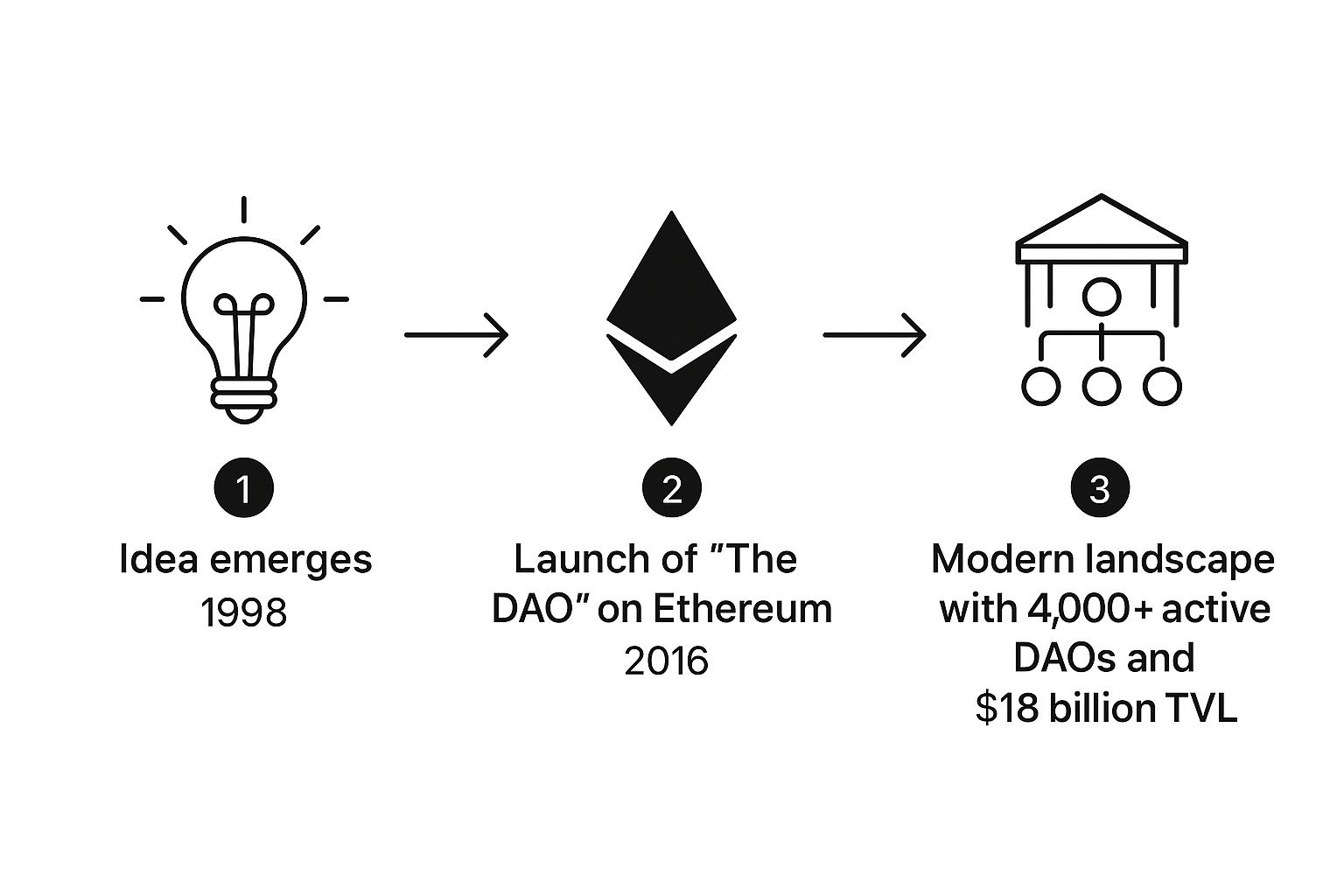
What you're seeing is a clear and dramatic acceleration. An idea that was just a theory a couple of decades ago has exploded into a multi-billion dollar ecosystem in just a handful of years.
The Evolution of Decentralized Organizations
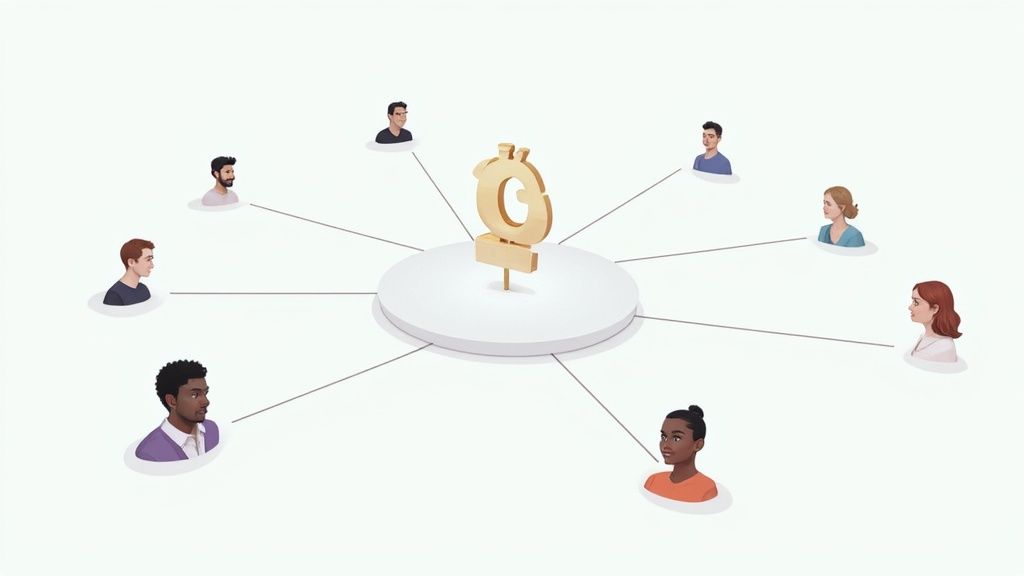
The idea of a Decentralized Autonomous Organization didn't just appear overnight. While its conceptual roots go back to early discussions on digital cooperation, the real story begins with a now-infamous, high-stakes experiment on the Ethereum blockchain known simply as "The DAO."
Launched back in 2016, "The DAO" was a bold attempt to build a community-run venture capital fund. It made waves by raising an incredible $150 million in Ether, capturing the attention of the entire crypto community. But the story took a dark turn when an attacker exploited a major flaw in its code, draining a third of the funds. This event became a tough but necessary lesson, hammering home the critical importance of ironclad security and thorough code audits.
While "The DAO" itself failed, it wasn't the end of the road. Far from it. It was actually the beginning, forcing developers to learn from the mistakes and build a stronger, more secure generation of DAOs.
From Simple Funding to Complex Governance
In the years after the 2016 hack, the principles behind DAOs were quietly refined. The first wave of DAOs were fairly simple, mostly focused on pooling funds to back different projects. As the technology matured, so did their ambition.
Today's DAOs are much more than just crypto crowdfunding tools. They’ve blossomed into complex digital organizations that govern massive projects across a whole range of industries.
- DeFi Protocols: Groups like MakerDAO and Uniswap use a DAO structure to govern financial systems worth billions. Members vote on everything from key risk parameters to software updates.
- Art and Collectibles: Collector DAOs like PleasrDAO bring members' funds together to buy culturally important digital art and NFTs, effectively acting as community-run digital museums.
- Social Clubs: DAOs such as Friends With Benefits (FWB) function as exclusive social clubs, using a DAO to manage membership and coordinate everything from online discussions to real-world events.
What started as a flawed experiment has now blossomed into a diverse ecosystem. The journey from "The DAO" to modern DAOs shows a clear progression from a single, ambitious idea to a versatile model for global collaboration.
The Future of DAO Innovation
This evolution is far from complete. DAO technology and governance models are constantly improving, influenced by developments in crypto policy and tech. For example, AI is beginning to help automate tasks like compliance and risk management, while new legal structures are giving DAOs more standing in the real world.
It's a space that is constantly adapting and getting better, as you can see how crypto policy trends are shaping DAOs and their potential for the future.
Real-World Examples of Successful DAOs
Theory is one thing, but seeing how DAOs work in the wild is where it really clicks. These aren't just fringe experiments anymore; they're influential organizations managing billions of dollars in assets, steering cultural movements, and fostering incredibly active communities. Let's look at a few that show just how versatile this model can be.
One of the cornerstones of the DAO world is MakerDAO, the organization behind the decentralized stablecoin, Dai. Think of it as a community-run bank. The global community of MKR token holders is in charge, voting on crucial risk parameters—like stability fees and which assets can be used as collateral—to keep the Dai stablecoin reliably pegged to the US dollar.
Governing Decentralized Finance
Another giant in the decentralized finance (DeFi) scene is Uniswap. As one of the top decentralized exchanges (DEXs), Uniswap lets anyone swap crypto tokens directly with other users, no traditional middleman needed. The Uniswap DAO, driven by its UNI governance token, gives its users the keys to the kingdom.
Members can propose and vote on just about anything, from adjusting fee structures to expanding onto new blockchains. It’s a genuinely democratic process. This image from the governance platform Snapshot shows exactly what that looks like in practice, with active proposals up for community debate.
This isn’t just abstract decision-making. These are tangible choices that directly shape one of the biggest applications in all of crypto. The best part? It's all out in the open. Anyone can see what proposals are being discussed, track the voting in real-time, and get a clear picture of where the platform is headed.
Beyond Finance: Art and Culture DAOs
The DAO framework is incredibly flexible, stretching far beyond the world of finance. Communities are getting creative and using this structure to pursue all sorts of collective goals, especially in art and culture.
Here are a couple of standout examples:
- PleasrDAO: This is basically a decentralized art collecting syndicate. Members pool their funds to acquire culturally important digital artifacts, like the original Doge meme NFT and Edward Snowden's "Stay Free" artwork. Their mission is to collect and share iconic pieces that define internet history.
- Friends With Benefits (FWB): FWB operates like an exclusive digital social club for creatives, thinkers, and artists. Holding the FWB token unlocks access to a private Discord server and unique real-world events. The community votes on everything, from who to partner with to where the next party should be held.
From managing a currency to buying priceless art, these successful DAOs prove that decentralized governance isn't just a futuristic idea—it's a practical and powerful tool for collaboration today. They show that a community, united by a shared mission and encoded rules, can achieve remarkable things without ever needing a traditional corporate hierarchy.
The Benefits and Risks of the DAO Model
The idea of a community-driven, decentralized organization is incredibly compelling, and it offers some real advantages over the top-down corporate structures we're all used to. But like any new model, it’s not perfect. It comes with its own unique set of challenges and trade-offs you need to understand before jumping in.
One of the biggest wins for DAOs is a level of transparency that's practically unthinkable in a traditional company. Every single vote, transaction, and rule change is etched onto a public blockchain. This creates a permanent, verifiable record that anyone can inspect at any time.
This radical openness also means DAOs are globally accessible. All you need is an internet connection and the right tokens to have a say, which completely shatters the old geographic barriers. You end up with these incredible international communities, and as a bonus, this model can slash overhead by getting rid of physical offices and a lot of the bloated management hierarchies found in legacy companies.
The Upside of Decentralization
Most of the benefits flow directly from a DAO’s core DNA: community ownership and automation powered by code.
- Radical Transparency: Every part of the operation, from how the treasury is managed to the results of a vote, is out in the open on the blockchain. This transparency builds a massive amount of trust among members.
- Enhanced Collaboration: By cutting out the centralized gatekeepers, DAOs make it possible for people all over the world to pool their funds and talent to chase a common goal.
- Lower Overhead: Smart contracts take over tons of administrative and financial chores, which means less need for expensive middlemen and layers of management.
A DAO's power lies in its ability to coordinate human activity at scale without relying on traditional trust mechanisms. It replaces faith in people with faith in transparent, verifiable code.
Navigating the Potential Downsides
For all their benefits, DAOs also come with some serious risks and operational headaches that every community has to grapple with. Often, the biggest challenges are just the flip side of the model’s greatest strengths.
One of the most common complaints is slow decision-making. Getting everyone to propose, debate, and vote on every meaningful action is democratic, but it can be painfully slow compared to a CEO making a quick, top-down call. For the latest on how DAOs are working to solve these problems, you can find helpful updates in Web3 news and analysis.
Another real issue is voter apathy. If not enough members show up to vote, a DAO can fail to meet the quorum needed to pass crucial proposals. The whole thing can grind to a halt.
But maybe the most critical risk of all is smart contract security. A DAO's entire rulebook is written in code. A single bug or vulnerability can be disastrous, as we learned the hard way with the infamous hack of "The DAO" back in 2016. On the blockchain, there's no "undo" button, which makes rigorous security audits absolutely non-negotiable.
Pros and Cons of Joining a DAO
To help you weigh the decision, here’s a quick summary of what you're signing up for when you join a DAO—the good and the bad.
| Benefits of DAOs | Risks and Challenges |
|---|---|
| Complete Transparency: All actions and funds are on a public ledger for anyone to see. | Slow Governance: Reaching consensus through community voting can take a lot of time. |
| Community Ownership: Members have a direct say in the organization's future. | Voter Apathy: Low participation can lead to gridlock and stalled progress. |
| Global Collaboration: Anyone can join and contribute, regardless of their location. | Security Vulnerabilities: Bugs in the smart contract code can lead to catastrophic loss. |
| Lower Operational Costs: Automation reduces the need for intermediaries and management. | "Whale" Dominance: Members with large token holdings can have outsized influence. |
Ultimately, while the risks are real, many DAOs are actively working on creative solutions to these problems. A final challenge is the influence of "whales"—people or groups holding a huge chunk of the governance tokens. Their voting power can potentially let them push decisions in their own favor, which goes against the whole decentralized spirit. Because of this, many DAOs are now experimenting with new voting systems to spread power more fairly.
How to Get Involved with a DAO
So, you're intrigued by the idea of DAOs and want to jump in. The good news is that moving from a curious observer to an active participant is more straightforward than you might imagine. The first step is simply finding a DAO that genuinely excites you—whether your passion lies in finance, gaming, art, or social causes.
Think of it like finding any other community. You start by exploring. DAO aggregators and community platforms are your best friends here; they act like directories, helping you discover organizations based on their mission and activity. Once you’ve pinpointed a few that resonate with you, it’s time to start engaging with their community.
Getting Set Up to Participate
Before you can start voting on proposals or shaping the future of a project, you'll need a couple of essential tools. Think of this as getting your basic gear for the Web3 world.
Set Up a Crypto Wallet: A self-custody wallet, like MetaMask or Rainbow, is your passport to the decentralized web. It’s where you’ll hold your tokens and securely connect to DAO platforms.
Acquire the Right Tokens: To have a say in most DAOs, you’ll need to hold their specific governance token. You can usually acquire these on a decentralized exchange (DEX) like Uniswap. The number of tokens you hold often correlates directly to your voting power.
Once your wallet is ready and funded with the necessary tokens, you’re officially ready to go.
Finding Your Role and Making an Impact
Joining a DAO is about more than just casting votes. There are countless ways to contribute, and you can decide how deep you want to go, from simply lurking in discussions to leading major initiatives.
It's a common myth that you need to be a developer or a crypto wizard to add value. The truth is, DAOs are desperate for all kinds of talent—marketers, writers, designers, and community managers are just as crucial.
A great way to start is by joining the DAO’s Discord server or community forum. Just listen in for a while. Get a feel for the culture, see what projects are being discussed, and understand the community's priorities. From there, you can start small by offering feedback on proposals or taking on a small task.
Many DAOs even offer paid bounties for specific contributions, giving you a clear path to get your hands dirty. As you become a trusted member, you might even find opportunities for full-time DAO jobs and career opportunities.
Got Questions About DAOs? Let's Clear Things Up.
So, you're getting curious about DAOs. It’s natural to have a few questions rolling around in your head before you jump in. Think of this as the final check-in before you decide to participate, making sure you understand what you're getting into.
Let's walk through some of the most common questions people ask.
Is It Safe to Join a DAO?
This is probably the first thing on everyone's mind, and the honest answer is: it depends. The beauty of a DAO is its transparency—all the rules and transactions are on a public blockchain for anyone to see. That offers a certain kind of security.
The real risk, however, is hidden in the code. A bug or a weak spot in the DAO's smart contract could be exploited by a bad actor, potentially draining the community's treasury. It’s a real risk that has happened before.
That's why due diligence isn't just a suggestion; it's essential. Before you put any serious time or money into a DAO, do your homework. Dig into its history, see if its code has been audited by a reputable firm, and get a feel for the community's vibe and reputation.
Do I Have to Be a Coder to Participate?
Absolutely not. This is one of the biggest myths out there. While developers are crucial for building the technical foundation, they're only one piece of a much larger puzzle.
Most of the work that keeps a DAO running and growing is completely non-technical. DAOs are desperate for people with all sorts of skills.
- Marketing & Communications: Someone has to get the word out and build the brand.
- Graphic Design: Creating visuals, logos, and a unique identity.
- Community Management: Making sure the Discord server or forum is a healthy, welcoming place.
- Writing & Content: Crafting articles, guides, and updates to keep everyone informed.
- Strategy & Operations: Helping steer the ship and make sure things run smoothly.
A DAO is all about people working together. Your unique background, whatever it is, is almost certainly something a growing community needs.
Are DAOs Actually Legal?
Now we’re getting into the complicated stuff. The legal status of DAOs is still a major gray area in most of the world, and the answer changes depending on where you live. They just don't fit into the old boxes of traditional corporate law.
But we're starting to see some progress. Places like Wyoming in the US and the Marshall Islands have passed laws creating a new legal wrapper for DAOs, giving them recognition as a type of limited liability company (LLC). This is a huge step.
For now, it’s best to treat the legal situation as fluid. It’s changing all the time, so it's a good idea to stay up-to-date on the rules and regulations in your specific country or state.