
At its core, Distributed Ledger Technology (DLT) is a fancy term for a very simple idea: a shared, synchronized database that exists across a network.
Imagine a group of people all have a copy of the same digital notebook. Whenever someone adds a new entry, everyone's notebook updates automatically. Critically, no one can go back and secretly erase or change what's already been written. This creates one, undisputed version of the truth, all without needing a single person or company in charge.
Unpacking the Core Idea of DLT

The real magic of DLT is that it tackles the age-old problem of trust. In the traditional world, we rely on intermediaries like banks or governments to verify transactions and keep records straight. DLT flips that model on its head by distributing the responsibility among everyone in the network.
Every participant, often called a "node," has their own identical copy of the ledger. Before any new transaction gets added, a majority of these nodes have to agree that it's valid. It’s this group consensus that makes the system so incredibly secure and transparent.
By cutting out the middleman, DLT can make processes faster and cheaper. It's a powerful concept, and the numbers show it. The global market for blockchain and DLT jumped from $1.1 billion in 2017 to an impressive $17.46 billion in 2023, with some analysts predicting it could hit $1.4 trillion by 2030.
The Three Pillars of DLT
So, what makes DLT tick? It really boils down to three foundational concepts. Getting these down is key to understanding how this technology actually works. If you come across other unfamiliar terms, our https://findweb3.com/posts/web3-dictionary can help clear things up.
- Decentralization: There's no single point of control. The ledger is copied and spread across many computers, so if one goes down, the network keeps running without a hitch.
- Transparency: Even if users are anonymous, the transactions themselves are generally open for everyone on the network to see. This keeps everything out in the open and builds accountability.
- Immutability: Once a record is added to the ledger, it’s locked in with powerful cryptography. It can't be altered or deleted, creating a permanent and unchangeable audit trail.
For anyone who wants to go a bit deeper, there are some great educational resources on DLT available that build on these fundamentals.
DLT Core Concepts at a Glance
To make these ideas even clearer, let's break them down in a simple table. This is a quick reference for the key principles that give DLT its strength.
| Concept | Simple Explanation | Key Benefit |
|---|---|---|
| Decentralization | No single person or server is in charge; the ledger is shared. | Resists censorship and single points of failure. |
| Transparency | Transactions are visible to all participants on the network. | Creates trust and accountability without a middleman. |
| Immutability | Once recorded, data cannot be changed or removed. | Guarantees a permanent, tamper-proof record of events. |
These three pillars—decentralization, transparency, and immutability—work in concert to create a secure and trustworthy system for recording just about anything of value.
How Distributed Ledger Technology Actually Works
Let's pull back the curtain and see what's happening under the hood. To really get a feel for distributed ledger technology, we need to move past the abstract idea and look at the mechanics.
Picture this: you’re ordering a coffee in a high-tech, super-secure café. Instead of just telling the barista, you announce your order—"one latte for Alex"—to everyone in the shop.
Every single customer and employee (who are the nodes in our network) hears you. They all look at their own copy of the day's order list to confirm your request is legitimate. This is the first step of any DLT transaction: a proposal is broadcast to every participant in the network for them to check out.
Reaching a Digital Agreement
After you announce your order, the café doesn't just trust you blindly. All the participants have to agree that your transaction is valid before it's officially added to the list. This group-voting process is what we call a consensus mechanism.
This is where DLT gets its security. There isn't one single person in charge; the whole group has to agree. Different ledgers have different ways of getting to this agreement. Some, like Bitcoin's Proof of Work, make nodes solve tricky math problems to prove their honesty. Others use a system where participants put some of their own assets on the line to vouch for a transaction.
This flow is actually pretty straightforward. A transaction gets proposed, verified by the group, and then permanently recorded.
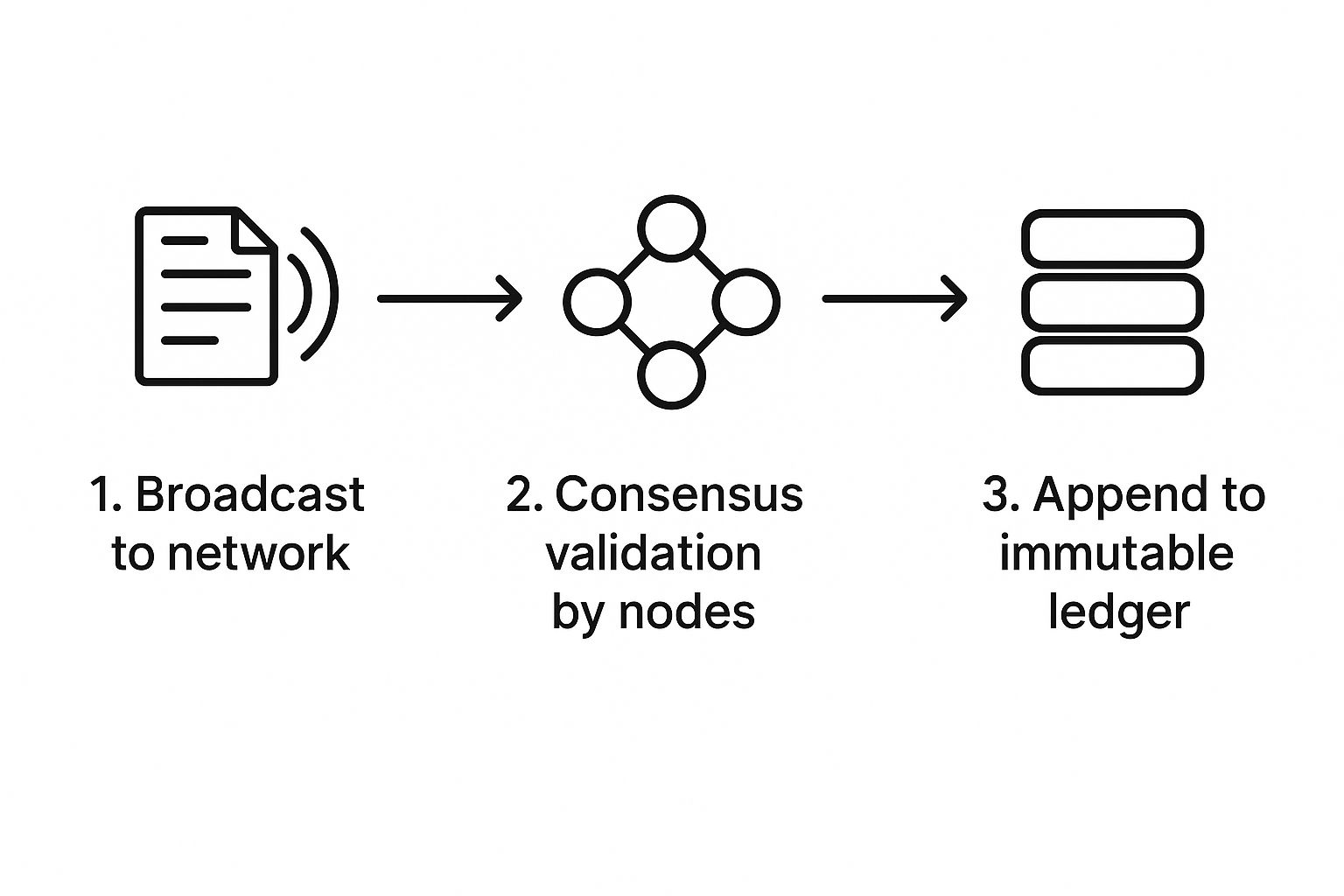
As you can see, it’s a collective effort. No single person or computer has the final say. It’s a multi-stage journey from the initial request to a permanent, locked-in record.
Sealing the Deal with Cryptography
Once everyone agrees the transaction is good to go, it gets bundled together with other recent transactions into a new "block" of data. This is where the magic of cryptography steps in. The block is stamped with a unique, unbreakable digital fingerprint known as a hash.
Here’s the clever part: this hash is created using the data inside the new block and the hash from the block that came just before it. This creates an unbreakable cryptographic chain, linking each block securely to the one before it.
Key Takeaway: Because of this chaining, trying to tamper with an old transaction is next to impossible. If you changed even a tiny detail in a past block, its hash would change completely. That would break the chain, and the entire network would immediately see the red flag.
This cryptographic linking makes the ledger immutable—a fancy word for unchangeable. Once a transaction is on the chain, it's there for good.
We've seen this play out in the real world. JPMorgan Chase, for example, used this exact process to issue the first live municipal bond in the U.S. on a blockchain. The bond issuance for Quincy, Massachusetts, was worth about $10 million and settled almost instantly. The process created a transparent, permanent record of ownership right from the start.
So, to wrap it all up, the final steps are:
- Adding the Block: The new, hashed-and-verified block gets tacked onto the end of the shared ledger.
- Network Update: Every node on the network updates its personal copy of the ledger to include this new block.
- Finalization: Your transaction is now a permanent, tamper-proof part of the record, visible to everyone involved.
This whole cycle—broadcasting, reaching consensus, and adding the block with cryptography—is the engine that makes DLT work. It creates a secure and trustworthy way to record information without needing a central boss to oversee everything.
The Different Flavors of DLT: Public, Private, and Consortium
Not all distributed ledgers are built the same. Just as you wouldn't use a hammer to turn a screw, the right type of DLT depends entirely on the job you need it to do. They come in a few different flavors, and the main difference really boils down to a single question: who's allowed in?
The answer to that question changes everything—from how secure the network is to how fast it can run. Let's break down the three main models you'll run into.
Public Ledgers: Open for Business
This is the type most people think of, thanks to big names like Bitcoin and Ethereum. A public DLT is completely open, or "permissionless." Absolutely anyone with an internet connection can download the software, join the network, see the entire transaction history, and help validate new entries.
It's a bit like a global public library. Everyone has a library card, can browse all the books, and can even volunteer to help re-shelf them. This radical openness is what gives public ledgers their legendary decentralization and makes them incredibly hard to censor. But there's a catch: getting millions of anonymous computers to agree on everything is slow and energy-intensive.
Private Ledgers: By Invitation Only
At the other end of the spectrum, you have private DLTs. These are "permissioned" networks managed by a single organization. Think of it like a company's secure internal database—only employees with the right credentials can get in and make changes.
A central administrator holds all the power here. They decide who gets to join, what data they can see, and who has the authority to validate transactions. Because the participants are known and trusted, private ledgers are incredibly fast and efficient. They're a perfect fit for a company wanting to track its own supply chain or manage internal assets, where privacy and speed are the most important factors.
Key Insight: The trade-off for all that speed and control is decentralization. With one entity in charge, you lose the censorship resistance and resilience that make public ledgers so robust.
Consortium Ledgers: The Best of Both Worlds
Sitting neatly between the two extremes is the consortium DLT. This hybrid model isn't open to the public, nor is it controlled by a single company. Instead, it’s governed by a pre-selected group of trusted organizations.
Imagine a group of major banks creating a shared network to settle international payments faster. No single bank controls the system; they govern it collectively. This "gated community" approach delivers a powerful combination of benefits:
- Shared Control: It avoids the "single point of failure" problem because governance is distributed among members.
- Kept Under Wraps: Sensitive business information stays private and is only shared among the trusted participants.
- Seriously Efficient: With a limited number of known validators, transactions fly through much faster than on a public network.
This collaborative structure has made consortiums, like those built on R3's Corda platform, a go-to choice for entire industries looking to work together without airing their dirty laundry on the public internet.
Public vs Private vs Consortium DLTs Compared
To make these distinctions even clearer, let's put the three types side-by-side. The table below breaks down their core features, highlighting how their differences make them suitable for very different tasks.
| Feature | Public DLT (e.g., Bitcoin) | Private DLT (e.g., Hyperledger Fabric) | Consortium DLT (e.g., R3 Corda) |
|---|---|---|---|
| Access | Permissionless (Anyone can join) | Permissioned (Access is restricted by one organization) | Permissioned (Access is restricted by a group of organizations) |
| Participants | Anonymous or pseudonymous | Known and identified | Known and identified |
| Centralization | Highly decentralized | Highly centralized (controlled by one entity) | Partially decentralized (controlled by a group) |
| Data Privacy | All transactions are public and transparent | High degree of privacy; data is only visible to authorized participants | High degree of privacy; data is visible only to relevant parties in a deal |
| Transaction Speed | Relatively slow (due to complex consensus) | Very fast | Fast |
| Immutability | Very high; practically impossible to alter | High, but the central entity could potentially make changes | High, but the governing consortium could theoretically agree to changes |
| Best For | Cryptocurrencies, public records, voting systems | Internal business processes, supply chain management, asset tracking | Inter-bank transfers, insurance claims, industry-wide collaborations |
As you can see, the choice isn't about which DLT is "better" in a vacuum, but which is the right tool for the specific problem you're trying to solve. Each model offers a unique balance of transparency, privacy, and performance.
Why Is Everyone Talking About DLT? The Core Benefits Explained
So, what’s all the fuss about distributed ledger technology? It’s not just hype. DLT offers a fundamentally different—and often better—way to handle information, directly tackling some of the oldest problems in business: trust, security, and efficiency.

The real magic is in its core design. By distributing the ledger across a network of computers, it gets rid of the single point of failure that plagues traditional databases. This simple change makes the entire system incredibly tough and resilient against attacks or system crashes.
Creating Trust with Transparency and an Unbreakable Record
In most systems today, we're forced to trust a central authority—a bank, a government, a big tech company. DLT flips that model on its head. Instead of blind faith, it provides verifiable proof. Every participant on the network sees the exact same ledger, creating a level of transparency that keeps everyone honest.
Even better, the ledger is immutable. Think of it like a digital stone tablet. Once a transaction is recorded and validated by the network, it’s cryptographically sealed. It cannot be changed or deleted, ever. This creates a permanent, tamper-proof audit trail, which is a game-changer for everything from financial accounting to tracking products down a supply chain.
Key Takeaway: By cutting out middlemen like banks and clearinghouses, DLT can slash costs and speed up settlement times. Processes that used to take days can now be wrapped up in minutes, which is a massive boost to efficiency.
A few years back, a study projected that DLT could cut banks' infrastructure costs for things like cross-border payments and trade finance by $15-20 billion annually by 2022. That’s the kind of tangible impact we’re talking about.
A Quick Rundown of DLT's Advantages
The benefits of DLT aren't isolated; they all reinforce one another to create a powerful, trustworthy system. Here are the main advantages:
- Rock-Solid Security: Because the data is spread out, a hacker would need to attack thousands of computers at the same time to do any damage. It’s an incredibly tough nut to crack.
- Total Transparency: With a shared ledger, everyone is on the same page. This builds mutual trust because all participants are working from a single source of truth.
- Serious Efficiency Gains: Automating agreements with smart contracts and removing intermediaries makes transactions faster and cheaper.
- Pinpoint Traceability: DLT gives you a clear, unchangeable history of an asset. You can easily trace its entire journey from its origin to where it is now.
These advantages explain why so many industries are exploring DLT. To really see the financial shift it represents, it’s helpful to understand the differences between cryptocurrency and fiat currency. This technology is also a huge driver behind the industry's growth, a trend you can see in the latest https://findweb3.com/posts/web3-statistics.
Real-World DLT Applications Across Industries
The theory behind distributed ledgers is interesting, but where does the rubber meet the road? The real story is how DLT is being put to work solving actual problems. All over the world, organizations are using this technology to build systems that are more transparent, secure, and efficient.
We're talking about everything from tracing a mango from a farm in India to a grocery store shelf in London, to settling multi-million dollar financial deals in minutes instead of days. These aren't just pie-in-the-sky ideas; they are active solutions already changing how major industries function. By creating a shared, unchangeable record, DLT tackles long-standing issues of trust and verification that have always complicated global systems.
A Clearer View for Supply Chain Management
Supply chain management is one of the clearest and most powerful examples of DLT in action. Think about a typical supply chain: it's a tangled web. The farmer, the shipping company, the warehouse, and the retailer all keep their own separate, siloed records. This fragmentation creates massive blind spots, making it a nightmare to trace a product's origin, verify its authenticity, or figure out where things went wrong.
DLT cuts through that complexity by creating a single, shared ledger that every single participant can view and contribute to. Every time a product changes hands or moves to the next stage, that event gets logged as a permanent block on the chain. The result is an unbreakable, end-to-end audit trail.
For a luxury brand, this could mean proving a handbag is genuine. A unique digital ID is assigned to the bag the moment it's made, and its journey is tracked at every single stop until it lands in the customer's hands. Suddenly, counterfeits become a non-issue. The same logic applies across the board:
- Food Safety: Tracking a crate of lettuce from the field to the supermarket, making it possible to pinpoint the source of a contamination in hours, not weeks.
- Pharmaceuticals: Guaranteeing that life-saving drugs are authentic and have been kept at the right temperature throughout their entire journey.
- Ethical Sourcing: Providing solid proof that raw materials like diamonds or cobalt were sourced responsibly and not from conflict zones.
Key Insight: DLT brings radical transparency to supply chains. Instead of just hoping everyone is honest, companies and consumers can rely on a verifiable, tamper-proof record of a product's entire life.
Remaking Finance and Healthcare
Finance and healthcare are two other arenas where DLT is making serious waves. The technology's knack for securing data and automating old, manual processes is proving to be a game-changer. Both sectors are jumping on board, with a detailed market analysis from Grandview Research showing just how fast adoption is growing.
In the financial world, DLT is untangling processes that have been notoriously slow and costly. Take cross-border payments. A simple international transfer can take days to zigzag through a network of intermediary banks. With a shared ledger, that same transaction can be settled almost instantly, slashing both costs and the risk that one party won't hold up their end of the deal.
Healthcare, on the other hand, is using DLT to finally give patients true ownership of their medical records. Imagine a secure system where your health history can be shared safely between your family doctor, a specialist, and a hospital—but only when you give explicit permission. This not only leads to better, more coordinated care but also protects some of the most sensitive data we have. As these applications become more mainstream, the demand for skilled professionals is exploding, opening up a wide range of blockchain jobs.
What's Next? The Challenges and Future of DLT
As promising as distributed ledger technology is, it's certainly not perfect. We're still in the early days, and like any groundbreaking tech, DLT is facing some serious growing pains. These aren't just minor bugs; they're fundamental hurdles that need to be cleared before DLT can truly go mainstream.
The good news is that thousands of brilliant minds are working on these problems right now. The big three challenges everyone is trying to crack are:
- Scalability: Let's be honest, many public DLTs are slow. Bitcoin, for example, processes just a handful of transactions per second. That’s a world away from the thousands that networks like Visa handle every moment. Closing that gap is a top priority.
- Interoperability: Right now, most distributed ledgers operate in their own little worlds. They're like walled gardens that can't easily share data or value. For a truly connected digital economy, these networks need to learn how to talk to each other seamlessly.
- Regulatory Uncertainty: Governments and regulators are still playing catch-up. This lack of clear, consistent rules makes big companies nervous about making massive investments. Everyone is waiting for the official playbook.
The Exciting Road Ahead
Even with these hurdles, the future for DLT looks incredibly bright. The pace of innovation is relentless, pushing the tech into new territory and hinting at a much smarter, more connected world. It's also going global in a big way. Asia is leading the charge with around 263 million users, and North America is projected to hit between 57 and 65 million users by 2025. You can dig deeper into these global blockchain statistics on tekrevol.com to see the full picture.
Key Insight: The real magic isn't just about making DLT faster. It's about blending its core strengths—security, transparency, and decentralization—with other powerful technologies to build things we couldn't before.
Looking at the horizon, a few key trends are starting to take shape. The combination of DLT with Artificial Intelligence (AI) and the Internet of Things (IoT) is a huge one. Imagine smart, autonomous systems that can manage supply chains or energy grids securely without human intervention.
Another massive shift is the tokenization of real-world assets. Think about it: everything from a skyscraper to a rare painting could be digitally represented and traded on a ledger. This could unlock trillions of dollars currently tied up in illiquid assets, making them accessible to a much wider pool of investors. The next chapter for DLT is just beginning.
Got Questions? We've Got Answers
Even after breaking down the basics, a few common questions always seem to surface when people are first getting their heads around distributed ledger technology. Let's tackle them head-on to clear up any lingering confusion.
Is Blockchain Just Another Name for DLT?
Not quite, but it’s easy to see why they get mixed up. The simplest way to think about it is that distributed ledger technology (DLT) is the parent category—the broad concept of a decentralized, shared database.
Blockchain is just one specific, and very famous, type of DLT. It's the one that organizes data into a chain of cryptographically linked blocks. So, all blockchains are DLTs, but not all DLTs are blockchains. There are other models out there, like Hashgraph or Tangle, that achieve the same goal without using a "chain" structure at all.
How Is DLT Different from a Regular Database?
The core difference boils down to a single word: control.
A traditional database is centralized. It lives on a server managed by one entity, like a bank or a tech company. This creates a single point of failure and gives that single entity total control over the data.
DLT flips that model on its head by being decentralized. Instead of one master copy, the ledger is replicated and distributed across a network of computers. No single person or group is in charge. To change anything, a majority of the network has to agree on it first, which makes the system incredibly transparent and tough to cheat.
Do You Need Cryptocurrency to Use DLT?
Nope, not at all. It's a common misconception because public ledgers like Bitcoin famously use crypto as an incentive to get people to validate transactions and secure the network.
But in the business world, many DLTs are private or consortium-based. In these "permissioned" systems, the participants already know and trust each other. That trust is built on legal agreements and business relationships, so there’s no need for a crypto token to keep everyone honest.
Ready to build your career in this fast-growing space? Find Web3 is the premier job board for roles in blockchain, crypto, DeFi, and more. Explore thousands of opportunities from top companies and find your next role at https://findweb3.com.