
So, what exactly is liquidity mining in the world of crypto? Think of it as a way to put your idle crypto assets to work. You lend your tokens to a decentralized exchange (DEX), and in return, the platform rewards you, usually with its own native tokens. It's a bit like earning interest in a savings account, but built for the decentralized web.

Breaking Down How Liquidity Mining Works
Let's use a simple analogy. Picture a small, local farmer's market. To attract more shoppers, the market needs a wide variety of fresh produce. But to get that produce, it needs farmers. So, the market organizer might offer a bonus to any farmer who brings their goods and keeps their stall well-stocked. This makes the market better for everyone—more choices for buyers, more business for sellers.
Liquidity mining follows the same logic. A DEX needs a deep supply of various crypto assets so users can trade instantly without causing massive price fluctuations. This supply is kept in something called a liquidity pool.
When you decide to participate, you act like one of those farmers. By depositing your assets into a liquidity pool, you become a liquidity provider. You're supplying the crucial "inventory" that allows the decentralized marketplace to run smoothly.
To truly get a handle on liquidity mining, it helps to understand the key players and what drives them. The whole system is a network of give-and-take between different groups.
Key Roles in a Liquidity Mining Ecosystem
The table below breaks down the main participants and what each one brings to the table—and what they get out of it.
| Participant | Role | Motivation/Reward |
|---|---|---|
| Liquidity Providers (LPs) | Deposit pairs of crypto assets (e.g., ETH/USDC) into a pool. | To earn rewards (trading fees, new tokens) on otherwise idle crypto. |
| Decentralized Exchanges (DEXs) | The platforms that host the liquidity pools and facilitate trades. | To attract liquidity, enabling smooth, low-slippage trading for users. |
| Traders | The end-users who swap one token for another on the DEX. | To access a liquid market where they can execute trades quickly and affordably. |
This elegant system creates a win-win scenario: LPs earn passive income, DEXs gain the liquidity they need to operate, and traders get a better user experience.
This model was a major catalyst during the Decentralized Finance (DeFi) boom of 2020 and 2021. In fact, by mid-2021, the total value locked in DeFi protocols skyrocketed into the tens of billions, largely fueled by the incentives offered through liquidity mining. If you want to dive deeper into some of the terms used here, our comprehensive Web3 dictionary is a great resource.
Your Step-by-Step Liquidity Mining Journey
Alright, we've covered the "what" and the "why." Now, let's get our hands dirty and walk through how you actually do this. Seeing the process from start to finish is the best way to move liquidity mining from a fuzzy concept to a concrete strategy.
Let's say you have some ETH and a stablecoin like USDC sitting in your wallet. Here’s how you’d put them to work.
Step 1: Pick Your Platform and Pool
First things first, you need to choose a home for your assets. This means selecting a decentralized exchange (DEX). You've probably heard of the big ones like Uniswap, SushiSwap, or PancakeSwap. Each has its own vibe—different fees, reward structures, and communities.
Once you’re on a DEX, you need to find the right liquidity pool. You’ll be looking for a pair that matches the crypto you hold, like an ETH/USDC pool. As you browse, you’ll see an important number called the Annual Percentage Rate (APR). This is a big-picture estimate of what you could earn over a year, combining both the trading fees and any bonus token rewards.
Step 2: Deposit Your Assets
Found your pool? Great. The next step is to deposit your tokens. Here’s the key rule: you must deposit an equal value of both assets in the pair. So, if you're adding $1,000 worth of ETH to the pool, you'll need to match it with $1,000 worth of USDC, for a total deposit of $2,000.
This 50/50 split is non-negotiable. It’s what keeps the Automated Market Maker (AMM)—the smart contract running the show—properly balanced. By adding your funds, you're deepening the pool and making it a more stable and efficient place for others to trade.
The whole process, from depositing to getting paid, looks a little something like this:
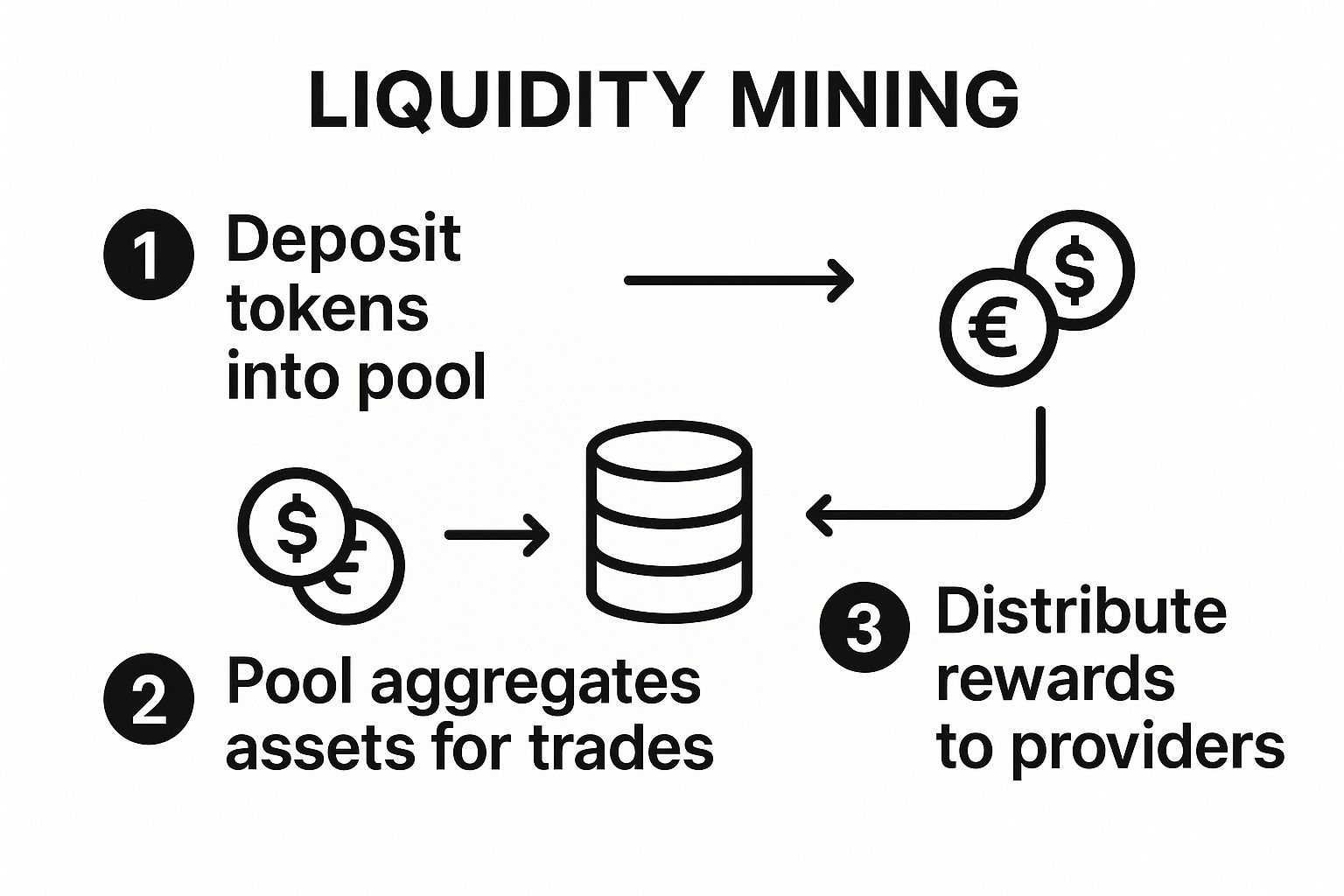
This graphic really breaks down the cycle: you add your assets to the pool, traders use that pool, and you get rewarded for making it all possible.
Step 3: Receive and Stake Your LP Tokens
After your deposit goes through on the blockchain, the protocol will automatically send you a special token in return. This is called a Liquidity Provider (LP) token.
Think of LP tokens as your claim ticket or receipt. They're digital proof of your specific share of the liquidity pool. The more you put in relative to everyone else, the more LP tokens you get.
But this isn't just a receipt to file away. It's the key that unlocks your rewards. For most liquidity mining programs, there's one final step: you need to "stake" these LP tokens. This usually happens in a separate "farm" or "staking" section on the DEX. By staking them, you're officially raising your hand and telling the protocol, "Hey, I'm here to provide liquidity," which makes you eligible for those extra reward tokens.
Once that's done, you're in business. You’ll start earning a cut of the trading fees from every transaction in your pool, plus the bonus tokens offered as the main liquidity mining incentive.
The Real Rewards of Being a Liquidity Provider
So, what’s the real incentive to jump in and become a liquidity provider? The payoff is a powerful, two-pronged income model that can put your idle crypto assets to work, generating passive income. This isn't just about earning a bit of interest; it's about plugging directly into the economic engine of a decentralized exchange.
Your earnings come from two main streams. The first is pretty simple: you get a small cut of the trading fees from every single swap that uses your pool. The more people trade, the more fee revenue you collect, all based on how big your share of the pool is.
The second, and often more lucrative, source of rewards gets to the heart of liquidity mining: bonus tokens. To attract capital and bootstrap their platforms, protocols give out their own native governance tokens (think UNI for Uniswap or CAKE for PancakeSwap) to users who stake their LP tokens. This is the "mining" part of the name.
The Two Pillars of Your Potential Earnings
Your total return is a combination of these two reward types, and they each play a different role in your overall profit.
Trading Fee Share: This is your direct payment for making trades possible. You can think of it as your base pay for providing the service of liquidity. It's a steady trickle of income as long as the pool sees trading activity.
Bonus Token Rewards: This is where the serious growth potential lies. These tokens don't just offer an immediate return; they also give you a stake in the platform's future success, which can be incredibly valuable.
This dual-reward system is exactly why liquidity mining has ballooned into a massive industry. Top-tier platforms like Uniswap V3 and Curve Finance have seen their Total Value Locked (TVL) soar past $5 billion each, fueled almost entirely by these incentives. Depending on the specific pool, the platform, and market conditions, these rewards can translate into Annual Percentage Rates (APRs) anywhere from a modest 5% to well over 100%.
Beyond Personal Gain: The Flywheel Effect
Things get really interesting when the price of the reward token itself starts to climb. Earning a token that then doubles or triples in value can create a powerful "flywheel effect," amplifying your returns far beyond what the initial APR suggested. This possibility of explosive growth is what attracts so many people to DeFi.
By providing liquidity, you are not just an investor; you are an active participant in a project's early growth. You help bootstrap its ecosystem, making the exchange more robust and useful for everyone involved.
Ultimately, being a liquidity provider means you're doing more than just chasing passive income. You're becoming a foundational piece of a new financial system, getting in on the ground floor of exciting projects, and sometimes even gaining a voice in how they evolve. For a bigger picture of the entire ecosystem, our article on key DeFi statistics offers great context on the market's incredible growth. This active role is precisely what makes liquidity mining such a compelling strategy for informed crypto users.
Navigating the Hidden Risks of Liquidity Mining
While the allure of high APRs in liquidity mining is strong, those rewards don't come without a catch. High returns almost always signal high risk, and ignoring the potential downsides is a fast track to losing your funds. Before you deposit a single dollar, you need to understand what can go wrong.
The most common risk, and often the most confusing for newcomers, is impermanent loss. This is a strange concept unique to providing liquidity; it doesn't happen when you simply hold tokens in your wallet.
Impermanent loss is the difference between the value of your assets while in a liquidity pool versus what they would be worth if you had just held onto them. The "loss" is only "realized" or made permanent when you withdraw your tokens from the pool.
How Impermanent Loss Works: A Practical Example
Let's break this down. Imagine you provide liquidity to a pool by depositing 1 ETH (valued at $3,000) and 3,000 USDC. Your total initial investment is $6,000. The pool needs to maintain a 50/50 value balance between the two assets.
Now, say the price of ETH skyrockets to $6,000. To maintain that 50/50 balance, the automated market maker (AMM) algorithm adjusts your share. Your position in the pool might now be something like 0.707 ETH and 4,242 USDC. The total value of your liquidity is now $8,484.
Looks like a win, right? But hold on. What if you had just held your original assets instead of providing liquidity? You'd have 1 ETH (now worth $6,000) and 3,000 USDC, for a total value of $9,000.
By providing liquidity, you missed out on $516 of potential gains. That's your impermanent loss. For your venture to be profitable, the trading fees and token rewards you earned must be greater than this $516 loss.
More Than Just Impermanent Loss: Other Dangers Lurking in the Pools
Impermanent loss gets all the attention, but it’s far from the only danger. The world of DeFi can feel like the Wild West at times, and you need to be on guard against other threats.
Here are a few more risks that can be just as damaging, if not more so:
Smart Contract Bugs: Liquidity pools run on code. If that code has a flaw or a vulnerability, a hacker can exploit it and drain the entire pool. In these situations, everyone who provided liquidity can lose everything. It’s a total loss.
Rug Pulls: This is an outright scam. Scammers will create a new token, set up a liquidity pool, and promote it heavily to attract investors. Once enough people have swapped their valuable assets (like ETH or USDC) for the new token, the creators pull all the valuable assets out of the pool and vanish. This leaves everyone else holding a worthless token.
Reward Token Volatility: A large chunk of your yield often comes from the platform’s native reward token. But what happens if that token’s price crashes? A 100% APR is completely meaningless if the token you're being paid in plummets to zero.
Understanding these risks is crucial. While the potential for high returns is real, so is the potential for significant losses. Before jumping in, it's wise to weigh the pros and cons carefully.
Liquidity Mining Risks vs. Potential Rewards
| Aspect | Potential Risk | Potential Reward |
|---|---|---|
| Asset Prices | Impermanent Loss: Price changes in your paired assets can reduce your total value compared to just holding them. | High Yields: Earn trading fees and governance tokens, often resulting in high APRs that can outperform holding. |
| Platform Security | Smart Contract Bugs & Exploits: A vulnerability in the protocol's code could lead to a complete loss of your deposited funds. | Access to New Projects: Participate in the growth of new and innovative DeFi protocols by providing early liquidity. |
| Project Integrity | Rug Pulls: Malicious developers can drain all liquidity from a pool, leaving your tokens worthless. | Governance Power: Earning governance tokens can give you a say in the future direction of the protocol. |
| Reward Value | Reward Token Volatility: The value of the tokens you earn can be highly volatile and could crash, eroding your profits. | Asset Appreciation: The tokens you earn as rewards could increase significantly in value over time. |
Ultimately, successful liquidity mining isn't just about chasing the highest APR. It’s about managing risk. By understanding these potential pitfalls, you can make more informed decisions and better protect your capital while navigating the exciting world of DeFi.
A Look at Popular Liquidity Mining Platforms
Alright, enough with the theory. Let’s get our hands dirty and see where the real action is. The Decentralized Finance (DeFi) world is packed with different platforms, and each one puts its own unique spin on liquidity mining. Knowing the major players is a must before you even think about jumping in.
These platforms are anything but identical. They live on different blockchains, charge different fees, and pay out rewards in their own distinct tokens. Let's walk through a few of the top contenders so you can get a feel for how these ecosystems actually work in practice.
Uniswap: The Ethereum Pioneer
When people talk about DEXs, Uniswap is often the first name that comes up. It's a true trailblazer on the Ethereum blockchain and pretty much wrote the playbook for the Automated Market Maker (AMM) model that so many others have followed.
Its native token, UNI, isn't just for rewards; it's a governance token. This means if you hold UNI, you get a vote on where the protocol goes next. Uniswap really shook things up with its V3 update, which introduced "concentrated liquidity." This lets savvy providers put their capital to work within specific price ranges, potentially earning way more in fees if they can correctly predict market movements. It's a powerful tool, but it also dials up the complexity and the risk of impermanent loss.
PancakeSwap: The BNB Chain Powerhouse
Built on the BNB Smart Chain (BSC), PancakeSwap shot to fame by offering a friendly, low-cost experience. With transaction fees that are often just a few cents, it opened the door for people who were put off by Ethereum's high gas prices.
Here, the native token is CAKE. Liquidity providers deposit their asset pairs into "Farms" and earn CAKE in return. PancakeSwap is famous for its massive selection of pools, which often include newer and more speculative tokens. It also offers a whole ecosystem of other features like lotteries and prediction markets, making it a fun and engaging place to start.
By looking at these platforms, you start to see that liquidity mining isn't a one-size-fits-all game. Your choice of platform dictates your potential returns, the risks you take on, and the very assets you can use.
SushiSwap: The Community-Driven Fork
SushiSwap made a huge splash by starting its life as a "fork" of Uniswap—essentially, it copied Uniswap's code and then added its own twist. It famously pulled off a "vampire attack," luring a staggering amount of liquidity away from Uniswap by offering its own SUSHI token as an extra reward for migrating.
That single event really showed just how fierce the competition is in DeFi. SushiSwap has since evolved into a multi-chain platform with a strong focus on community governance. Often, you can take your earned SUSHI rewards and stake them for even more yield, a strategy known as yield farming.
Choosing the right platform demands some homework. You need to look into its security audits, the strength of its community, and how its rewards are structured. This dynamic field is also creating entirely new career paths; you can find a surprising number of DeFi jobs focused on building and securing these new financial systems.
Got Questions About Liquidity Mining? Let's Clear Things Up.
Diving into the world of decentralized finance always brings up a few head-scratchers. When you first encounter terms like "liquidity mining" and "impermanent loss," it's natural to feel a bit confused. This section is all about answering those common questions in plain English, so you can connect the dots and feel more confident navigating the space.
We'll break down some key concepts, get to the bottom of how returns are actually calculated, and revisit that tricky idea of impermanent loss.
Is Liquidity Mining Just Another Name for Staking?
Not quite, but it's easy to see why people mix them up. Both involve locking up your crypto to earn rewards, but their fundamental purpose is completely different.
Think of staking as a security job. You're locking up a single token (like ETH on the Ethereum network) to help validate transactions and keep the blockchain secure. For that service, you earn staking rewards.
Liquidity mining, on the other hand, is more like being a market maker. You supply a pair of assets to a liquidity pool on a decentralized exchange (DEX) so other people can trade them. Your risk is also different—the idea of impermanent loss is a big deal in liquidity mining, but it doesn't even exist in standard staking.
How Are Liquidity Mining Returns Calculated?
When you see a big, juicy Annual Percentage Rate (APR) advertised for a liquidity pool, that number usually comes from two distinct sources. To really understand what you might earn, you have to look at both.
- Trading Fees: Every time someone uses your pool to swap tokens, they pay a small fee. You get a piece of that fee, proportional to your share of the pool. The more trading volume, the more you earn from fees.
- Bonus Reward Tokens: This is the "mining" part of the equation. To attract liquidity, platforms will often give you their own native tokens (like CAKE or SUSHI) as an extra incentive. This bonus is frequently the largest slice of the advertised APR.
It's crucial to remember that APR isn't a promise. It's a snapshot in time that can change in a heartbeat. If a bunch of new people jump into the pool, your share gets smaller, and your APR will likely drop. The price of the reward token itself can also swing wildly, directly impacting the real-world value of what you're earning.
Could You Explain Impermanent Loss Again?
Absolutely. This is probably the single biggest risk unique to liquidity mining, so it’s worth getting a firm grip on it.
Impermanent loss is the potential downside you face when the value of your deposited tokens changes compared to just holding them in your wallet. It kicks in when the prices of the two tokens in your pair drift apart.
Imagine you deposit ETH and USDC into a pool. Suddenly, the price of ETH skyrockets while USDC remains stable. To maintain its balance, the pool's algorithm sells some of your now-valuable ETH for more USDC. If you were to pull your funds out at that moment, you'd be left with less ETH and more USDC than you started with. The total value of that combination might be less than if you had simply held onto your original ETH and USDC.
The "loss" is only "impermanent" while your funds are still in the pool. It becomes very real and permanent the moment you withdraw.
Can I Actually Lose Money with Liquidity Mining?
Yes, you absolutely can. Let's be clear: liquidity mining is not a risk-free way to print money. It's entirely possible to end up with less than you started with.
Here are the main ways you can lose money:
- Significant Impermanent Loss: If the prices of your two assets diverge dramatically, your impermanent loss can easily wipe out any rewards you've earned from fees and bonus tokens.
- Reward Token Collapse: That amazing APR doesn't mean much if the reward token you're getting paid in crashes. If that token's value goes to zero, that part of your earnings is completely worthless.
- Catastrophic Events: In a worst-case scenario, you could lose everything. A hacker could exploit a bug in the smart contract and drain the entire pool, or malicious developers could perform a "rug pull" and disappear with all the funds.
This is why doing your own research is non-negotiable. Always investigate the platform, understand the specific risks of the pool you’re joining, and never, ever invest more than you can comfortably afford to lose.
Ready to turn your interest in DeFi into a career? Find Web3 is the premier job board for the blockchain industry, featuring over 10,900 roles in DeFi, NFTs, the metaverse, and more. Explore your next opportunity at findweb3.com.