
A remote front-end developer today is more than just a website builder. In the world of Web3, you're the architect crafting the user experience for the next phase of the internet. This job has leaped beyond static pages; it's now about creating the dynamic, intuitive gateways to decentralized applications (dApps) that make blockchain technology usable for everyone.
The New Frontier for Remote Front End Developers
The core job of a front-end developer has always been to turn design into a functional, interactive experience. What's changing is the backstage machinery. Instead of plugging into a single, centralized server owned by one company—the classic Web2 model—you're now building interfaces that talk to decentralized, community-run networks.
Think of it like this: in Web2, you might build a beautiful website for a major bank. In Web3, you’re creating the portal for a global, user-owned financial system. Your work is the essential bridge that connects everyday people to the power of the blockchain. Without clean, secure, and engaging front ends, Web3’s potential would remain a complex idea, out of reach for most. This pivotal position makes the remote front-end developer one of the most vital roles in the entire ecosystem.
The demand for these roles is climbing, and the remote work landscape is expanding right alongside it.
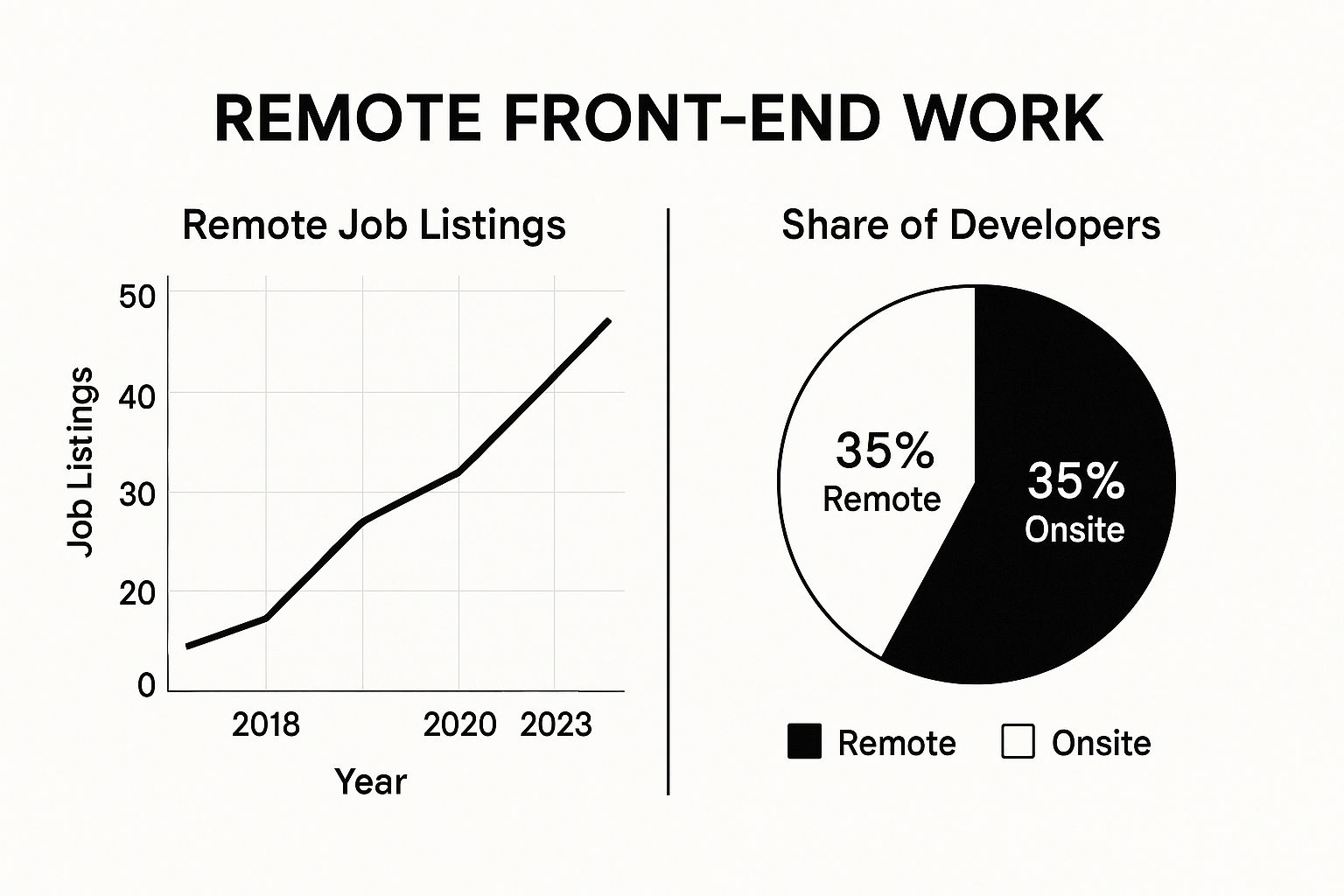
As the data shows, the upward trend in remote opportunities isn't slowing down, highlighting a career path that offers both stability and the freedom to work from anywhere.
Web2 vs Web3 Front End Development At a Glance
To really get a feel for this evolution, it helps to see the two worlds side-by-side. While both depend on solid front-end fundamentals, their architecture, data handling, and philosophy on user identity are worlds apart.
| Aspect | Traditional Web2 Front End | Web3 Front End |
|---|---|---|
| Architecture | Relies on a centralized client-server model. The app is hosted on a single company's servers. | Connects to a decentralized network (blockchain). Logic is handled by smart contracts, not a central backend. |
| User Authentication | Users log in with email/password or social accounts, trusting a company with their data. | Users connect with a cryptographic wallet like MetaMask, maintaining control over their identity and assets. |
| Data Interaction | Data is stored in private, centralized databases. Users get data from the company via an API. | Data is on a public, immutable blockchain. The front end reads from the chain or writes to it via transactions. |
This new paradigm doesn't just change the backend; it requires a more dynamic and adaptable front-end skillset. The role is broadening quickly, with developers who can blend traditional skills like JavaScript and React with knowledge of AI and machine learning being in high demand.
Newer, high-performance languages are also making their mark. Rust, for example, is gaining serious traction, with its adoption seeing a 47% year-over-year jump for enterprise-level projects that demand speed and security. You can find more insights on these remote developer hiring trends, which show a clear preference for developers who are fast learners over those who just check a list of technical boxes.
What a Web3 Front-End Developer Actually Does
So, what does a day in the life of a Web3 front-end developer really look like? Let’s push past the buzzwords. At its core, the job is incredibly hands-on, creative, and completely centered on the user. You're the one building the experience in a decentralized world, making mind-bendingly complex technology feel simple and intuitive.
Think of it this way: you’re designing the digital lobby for a new kind of internet bank. You don't build the super-secure vault deep underground (that's the blockchain protocol), but you design and build every single thing a customer sees and touches—from the front door to the teller window. Your work is what turns a powerful, complex system into something people can actually use.
Essentially, your main job is to construct the bridge between a person and the blockchain. You build the websites and apps that let people interact with smart contracts, check their digital assets, and vote on proposals, all without needing to be a cryptography expert.
Core Responsibilities and Impact
Your daily tasks are all about creating a smooth journey from the user's screen to the on-chain world. A remote front-end developer in this space isn't just making buttons look pretty; you’re building the critical functions that make Web3 possible.
Here’s a breakdown of what that often involves:
- Connecting UIs to the Blockchain: You’ll use JavaScript libraries like Ethers.js or Web3.js to pull information from the blockchain and present it clearly. This could be anything from displaying a user's token balance to listing NFTs for sale in a marketplace.
- Enabling Wallet Interactions: This is a huge one. You'll integrate crypto wallets like MetaMask directly into the interface, building the prompts that let users connect their wallet, sign messages, and approve transactions safely.
- Visualizing Smart Contract Data: It's your job to translate raw, technical data from the blockchain into something a human can understand. This might mean creating a real-time dashboard for a DeFi protocol or a sleek gallery to show off a user’s NFT art collection.
The ultimate goal is to build trust through usability. In a system that’s technically "trustless," the front end is where users decide if they feel safe enough to connect and transact. A clear, responsive, and secure interface isn’t a nice-to-have; it’s everything.
This role demands a special mix of sharp technical chops and deep user empathy. The good news is that finding the right fit is getting easier. More companies are posting specialized blockchain developer jobs on dedicated platforms, looking for people with exactly this skillset. Your work directly shapes how many people adopt a project and determines its ultimate success.
Building Your Web3 Front End Skillset
Thinking about moving into a Web3 role? It might seem like a huge jump, but the good news is your existing front-end skills are the perfect launchpad. Becoming a successful remote front end developer in this world isn't about starting from scratch. It’s about adding a new, specialized layer on top of the solid foundation you already have.
Here’s an analogy: imagine you're an architect who's an expert at building with traditional materials like wood and steel. Now, you're learning to work with a new "smart glass" that can display information and change its own transparency. You absolutely still need all your core architectural skills, but you're adding a powerful new capability to your toolkit. It's the exact same idea here.
Reinforcing Your Foundational Excellence
Before you even think about touching the blockchain, your command of traditional front-end tech needs to be rock-solid. These are the non-negotiables, the building blocks that every single dApp interface relies on.
- HTML & CSS Mastery: You still have to build things that people can actually use and look at. Creating structured, accessible, and visually appealing interfaces is as fundamental as ever.
- Modern JavaScript (ES6+): A deep understanding of async/await, promises, and other modern syntax is absolutely crucial. You’ll be dealing with the delays and responses that are just part of interacting with a blockchain.
- React or a Similar Framework: Building with a component-based framework like React, Vue, or Svelte is pretty much standard. dApps have complex, state-driven UIs, and these tools are built for the job. In fact, a staggering 79% of developers say React helps them build UIs faster, which is a massive plus in the fast-moving Web3 space.
Honestly, these skills are your bedrock. Without them, trying to connect to a decentralized backend is going to be a real struggle.
Adding the Web3 Specialization Layer
Okay, once your foundation is solid, it's time to add the tools that connect your app to the blockchain. This is where the role really starts to shift.
At its heart, a Web3 front end developer's job is to translate complex blockchain events into a simple, human-readable experience. You’re the interpreter standing between the user and the smart contract.
The main tools for this are a couple of specialized JavaScript libraries. You don't need to be a cryptography genius, but you do need to know how to use these "translators."
- Ethers.js or Web3.js: These are the big two for talking to the Ethereum blockchain. They let your front end read data from smart contracts, ask a user to sign a transaction with their wallet, and listen for things happening on-chain.
- State Management in dApps: Managing application state gets a lot trickier when your single source of truth is spread across a decentralized network. Figuring out how to handle on-chain data, track pending transactions, and manage wallet connection status is a unique and vital skill. If you're curious about the industry's growth, check out these Web3 statistics that paint a clear picture of its rapid expansion.
Looking beyond the immediate Web3 skills, broadening your expertise into hot areas like building generative AI-powered applications can make you an even more attractive candidate. By mastering this two-tiered skillset—foundational excellence plus a Web3 specialization—you make yourself a truly valuable asset in the decentralized economy.
Your Earning Potential in the Global Market
Let's talk about one of the most attractive parts of specializing in this field: the money. When you're a remote front-end developer with Web3 skills, you’re not just another coder. You're a specialist in a field where demand is high and the talent pool is still relatively small. That scarcity is your biggest advantage, driving up compensation as companies all over the world compete for experts who can connect their users to the blockchain.
This isn't just wishful thinking; the numbers back it up. In the United States, for example, the need for skilled remote developers has pushed salaries comfortably into six figures. According to recent data, the average pay for a remote front-end developer hovers around $110,412 a year. Even developers in the 25th percentile are pulling in about $104,000. If you're at the top of your game, you could be looking at $141,500 or more. You can dig into these salary trends for remote front-end developers on ZipRecruiter.com to see for yourself.
What this wide salary range shows is a clear runway for growth. You start strong, and as your experience and expertise deepen, your value in the market just keeps climbing.
What Shapes Your Salary
While those average figures are great, several things will determine where you actually land on that pay scale. Getting a handle on these factors is key to knowing your worth and negotiating your salary with confidence. At the end of the day, your paycheck reflects the specific value you bring to a project.
Here’s what really drives your salary:
- Experience Level: No surprise here. A senior dev with a portfolio of successful dApps is going to earn a lot more than someone just breaking into the space.
- Framework Proficiency: Knowing your way around React or Vue is the price of entry. But true experts who can optimize for performance and wrangle complex state management are far more valuable.
- Web3 Specialization: Your comfort level with Web3 libraries like Ethers.js or Web3.js is a huge deal. The more sophisticated the on-chain interactions you can handle, the more you can command.
- Demonstrable Portfolio: A killer portfolio with real-world Web3 projects—think a DeFi dashboard or an NFT minting site—is your best negotiation tool. It’s hard proof you can do the work.
Think of your salary not just as payment for your time, but as a direct investment by a company in your unique ability to make their decentralized project accessible and successful.
By focusing on building these skills and showing them off in your portfolio, you can aim for the higher end of that salary spectrum. Because the work is remote, you’re in a global talent market where top skills command top dollar, no matter where you live.
Finding Your Place in the Worldwide Job Market
One of the best parts about being a remote front end developer is that your job search isn't limited to your city or even your country. The opportunities are truly global. If you get a handle on worldwide job market trends, you can position yourself for a much wider array of roles and build a career that’s completely untethered from a specific location.
This global market has some fascinating differences in pay and demand, all shaped by local economies and how fast their tech scenes are growing. Take South America, for instance. A remote developer there can make an average of $117,086 a year, but that number can swing wildly depending on your experience and who you're working for.
When you're ready to start looking, specialized platforms with remote frontend developer job listings are your best friend. They cut through the noise and help you zero in on great opportunities no matter where they are.
Hotspots for Developer Demand
While you can find work anywhere, some regions are definitely heating up and becoming hubs for developer talent. Canada is a prime example. Its tech sector is booming, and web developer jobs account for a massive 54% of all new tech roles being created.
This isn't just a fleeting trend. Projections show that Canada is expected to have over 8,300 new job openings for web developers and programmers between 2024 and 2033.
That kind of sustained growth is a clear sign of a healthy, expanding market where skilled front-end developers are desperately needed. It shows how certain countries are turning into magnets for tech talent, which creates incredible opportunities for remote workers no matter where they live. You can dive deeper into these developer statistics and global trends to get a better feel for the landscape.
By keeping an eye on these global shifts—from salary benchmarks in South America to explosive job growth in North America—you can make much smarter career moves. It’s about more than just looking at local job boards; it's about tapping into a worldwide market that’s open for business 24/7 to find the absolute best role, pay, and career path for you.
How to Land Your First Remote Web3 Role

Alright, you’ve studied the theory. Now it’s time to get paid for it. Landing your first job as a remote front-end developer in Web3 isn't just about what you know—it's about what you can prove. You need a solid game plan to turn that knowledge into a real-world career.
The very first step? Build a portfolio that screams Web3. A collection of generic websites just won't fly here. You need projects that show you have hands-on experience connecting a user interface to a blockchain. When a hiring manager looks at your work, they should instantly see you know how to build bridges between people and decentralized protocols.
This means your portfolio needs to go way beyond standard static sites. It has to feature projects that prove you get the specific hurdles involved in dApp development.
Create a Portfolio That Speaks Web3
To get a recruiter’s attention, your portfolio needs to be filled with relevant, compelling examples. Think of it as your resume’s proof-of-work—it shows you’ve actually done the work.
Here are a couple of ideas to get you started:
- Build a Decentralized Voting App: Design and code an interface where users can connect their crypto wallets and cast votes on proposals. This is a classic for a reason: it immediately proves you can manage on-chain transactions and reflect state changes from a smart contract.
- Design an NFT Marketplace UI: Create a front-end that pulls and displays NFT data from a popular collection. This shows you're comfortable working with token standards like ERC-721 and can present blockchain data in a way that makes sense to everyday users.
Projects like these demonstrate that you’re more than just a talented web designer; you're someone who can build a true gateway to the decentralized world.
Prepare for the Web3 Technical Interview
Once your portfolio does its job and gets you noticed, the technical interview is your next big challenge. This is where you’ll need to prove your core front-end skills are rock-solid and that your Web3 knowledge isn't just surface-level.
Expect a mix of questions. They'll definitely probe your expertise with frameworks like React or Vue, but they’ll also dive deep into your understanding of libraries like Ethers.js or Wagmi.
Your ability to clearly explain how you'd manage wallet connection states or handle asynchronous calls to an RPC node is just as crucial as writing clean code. It tells the interviewer you’ve wrestled with the real-world user experience challenges of a decentralized app.
Since these roles are remote, almost every interview will be virtual. Making a great impression on video is key. A guide on how to prepare for a video interview and win the job can give you a serious edge.
Finally, get active in the community on platforms like Discord and Twitter, and when you’re ready to apply, focus your search. Instead of sifting through general job boards, head straight to curated platforms where you can find Web3 engineering jobs and connect directly with companies looking for your exact skills.
Frequently Asked Questions
Jumping into any new field brings up a ton of questions. If you're a remote front-end developer eyeing the Web3 space, you probably have a few yourself about where you'd fit in. Let's tackle some of the most common ones so you can step forward with confidence.
Do I Need to Be a Blockchain Expert or Learn Solidity?
This is a big one, and the short answer is no, you absolutely don't. Think of it this way: as a front-end developer, your job is to build the beautiful, intuitive car dashboard, not to engineer the engine itself.
While it helps to understand the basics of what a smart contract is and what it does, you won't be expected to write them. Your real power lies in using your existing skills—HTML, CSS, and modern JavaScript frameworks—to connect to those contracts using libraries like Ethers.js or viem. Your focus is on the user experience, not the on-chain logic.
How Can I Get Web3 Experience Without a Formal Job?
The best way to learn is by doing. In the Web3 world, your portfolio of projects often speaks louder than your resume.
Building personal projects is the single most effective way to prove your capabilities and create a portfolio that stands out. It demonstrates initiative, passion, and real-world problem-solving skills.
Here are a few ideas to get you started:
- Build a simple dApp: Create a basic interface that just reads data from a public smart contract, like displaying the latest block number on Ethereum.
- Design a gallery: Find an existing NFT collection on a marketplace like OpenSea and build a sleek, custom front-end to view the art.
- Contribute to open source: Hop on GitHub and find a Web3 project that needs front-end help. Even small contributions, like fixing a UI bug, are incredibly valuable.
This kind of hands-on work shows you can apply your skills in a real Web3 context, which is exactly what employers want to see.
What Is the Long-Term Career Path?
The road ahead for a Web3 front-end developer is wide open and exciting. You're not just stepping into a job; you're entering an ecosystem that's constantly growing.
From a senior front-end role, you could naturally progress to a lead developer, managing a team and guiding a project's technical direction. Or, you could choose to specialize in a booming niche like DeFi (Decentralized Finance) or Web3 gaming. Many developers also find their deep user-facing experience makes them a perfect fit for a transition into product management. The skills you build here are at the forefront of tech, setting you up for fantastic long-term opportunities.
Ready to find your place in the future of the internet? On Find Web3, you can browse thousands of roles from leading companies. Start your search for the perfect remote front-end developer job today.