
The demand for skilled community managers who can work from anywhere is absolutely booming. It's no surprise that remote community manager jobs are now some of the most sought-after positions in the tech world. In a digital-first economy, these roles are the bedrock for building loyalty and sparking real growth.
The New Digital Frontier for Community Managers
The global shift toward distributed teams has completely reshaped community management. What was once a niche role has become a strategic powerhouse. A remote community manager is so much more than a moderator—they’re the architect of a brand’s entire digital world.
Think of them as the mayor of a digital town. They're responsible for building, nurturing, and leading the online spaces where a brand's biggest fans hang out. This "town" could be a buzzing Discord server for a new Web3 project, a helpful forum for a SaaS product, or a super-engaged social media group for a gaming company.
At its core, their mission is to make people feel like they belong. They turn passive followers into an active, self-sustaining community. This takes a special blend of art and science. On one hand, you need to be an empathetic communicator who can smooth over conflicts and celebrate members. On the other, you have to be an analyst who can dig into the data, measure engagement, and steer the strategy.
The image below breaks down the key parts of the role—from day-to-day responsibilities to the skills you need to succeed.
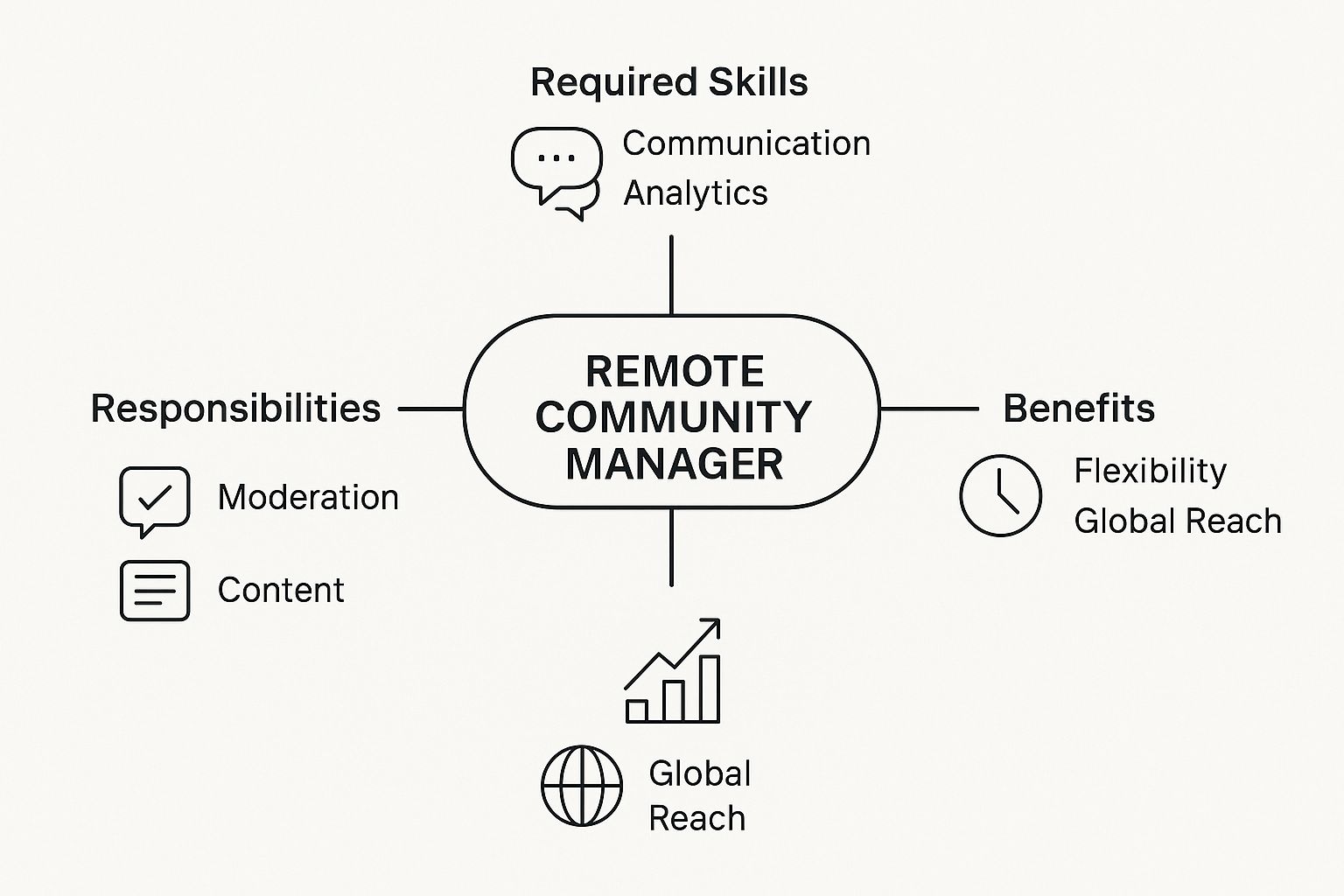
As you can see, it’s a dynamic mix of operational tasks, sharp analytical skills, and personal perks that make it a perfect fit for a remote setup.
The Rise of Remote-First Communities
The surge in demand for remote community manager jobs mirrors the bigger trend of remote work everywhere. According to FlexJobs’ Remote Work Economy Index, remote job postings jumped by 8% in the second quarter of 2025 alone, showing just how much opportunity is out there. This growth is especially strong in tech, gaming, and Web3, where communities are global and decentralized by nature.
For companies, hiring remote community managers opens up a worldwide talent pool. It means they can find someone who truly gets their brand’s culture, no matter where they live. For professionals, it offers incredible flexibility and the chance to work with some truly innovative projects. To stay ahead, it's essential to keep a constant stream of fresh social media content ideas to fuel engagement.
A great community manager doesn't just manage a group of people; they build an environment where relationships can flourish. They are the bridge between a company and its most passionate users, turning feedback into innovation and loyalty into growth.
The Web3 space, in particular, is a massive engine for these roles. To get a real sense of this momentum, it’s worth checking out some key Web3 statistics that show the industry's trajectory.
What Does a Remote Community Manager Actually Do All Day?
So, what’s the real story behind one of those community manager remote jobs? If you're picturing someone just scrolling through social media feeds, think again. The role is a fascinating blend of strategy, content creation, digital diplomacy, and hard data, all handled from a home office.

Think of a community manager as a digital town mayor or the host of a never-ending party. Their job is to make sure everyone feels welcome, the conversations are flowing, and the environment stays positive and productive. It's a hands-on job that changes by the hour.
To give you a clearer picture, let's break down the core responsibilities. The role is split between high-level strategic planning and the day-to-day operational tasks that bring that strategy to life.
Core Responsibilities of a Remote Community Manager
| Responsibility Area | Key Strategic Functions | Example Daily Tasks |
|---|---|---|
| Engagement & Content | Developing a content calendar and engagement strategy to align with business goals. | Posting daily discussion prompts, running contests, and sharing relevant articles. |
| Moderation & Safety | Creating and upholding community guidelines to ensure a safe and inclusive space. | Responding to flagged posts, mediating disputes, and removing spam or trolls. |
| Growth & Outreach | Planning initiatives to attract new members and build partnerships with other communities. | Welcoming new members, promoting the community on other platforms, and engaging influencers. |
| Feedback & Reporting | Establishing KPIs and a system for tracking community health and sentiment. | Analyzing engagement data, compiling weekly reports, and sharing member feedback with the product team. |
As you can see, it's a dynamic mix. The manager constantly switches between being a creative content producer, a vigilant moderator, and a sharp-eyed analyst.
Strategic Engagement and Content Curation
A huge part of the day is spent on proactive engagement. This isn't just random chatting; it's about executing a deliberate plan to spark conversations that matter to the brand and its members.
A morning might kick off with a new user-generated content (UGC) campaign. The manager could post a challenge asking people to share how they use a product, instantly turning customers into brand storytellers. They'll then spend the day highlighting the best entries and keeping the energy high.
They also act as the community's go-to resource, curating and sharing valuable content like industry news, expert tutorials, or insightful articles. This transforms the community from a simple brand channel into an indispensable hub for its members.
Nurturing a Safe and Inclusive Environment
Another massive piece of the puzzle is moderation. The community manager is the first line of defense against spam, trolls, and any behavior that makes the space feel toxic. They are always on watch, especially in fast-moving channels like Discord or Telegram, ready to enforce the rules.
This requires a deft touch—a mix of empathy and firmness. When a heated debate pops up, they jump in not to take sides, but to mediate. The goal is to steer the conversation back to a civil place, making sure the community remains a welcoming spot for everyone.
A thriving community is built on trust. A remote manager’s most important job is to ensure every member feels seen, heard, and respected. This psychological safety is the bedrock upon which all engagement is built.
Staying on top of these varied tasks requires serious organization. Mastering digital planning for peak productivity is a game-changer for anyone in a demanding remote role like this.
Performance Analysis and Reporting
Finally, the role is surprisingly analytical. A great community manager doesn't just guess if the community is doing well; they prove it with data. A portion of their day is always dedicated to tracking key performance indicators (KPIs) to measure what's working and what isn't.
They dive into analytics dashboards to answer critical questions:
- Engagement Rate: Are people actively joining conversations, or are they just lurking?
- Member Growth: Is the community growing with the right kind of members?
- Sentiment Analysis: Is the overall mood of the community positive, negative, or neutral?
- Retention: Are members sticking around for the long haul?
At the end of the month, they package these insights into a report for the wider team. This isn't just a bunch of numbers; it’s a story. It might show how a specific campaign led to a 15% increase in positive sentiment or how member feedback directly inspired a new product feature. This data-driven approach proves the community’s value and cements the manager’s role as a key strategic player.
What It Really Takes to Get Hired for a Remote Community Role
Landing a top-tier remote community manager job is about more than just being great at posting online. It’s a specific blend of technical savvy and genuine people skills. Companies aren't just looking for a moderator; they're hiring a leader who can build and nurture a vibrant digital home, all from a distance.
And the demand for these roles is only growing. Projections show that by 2025, a whopping 36.2 million workers in the U.S. will be remote, making up 22% of the entire workforce. That’s a staggering 87% jump from pre-pandemic days, and community management is a huge part of that shift.
The Essential Hard Skills for Remote Management
Hard skills are your bread and butter—the tangible, technical abilities you'll use every single day. For a remote community manager, these skills prove you can handle the toolkit of the trade without someone looking over your shoulder.
- Platform Mastery: You have to be fluent in the language of the community's home base. That means knowing your way around tools like Discord for fast-paced chats, Circle for more structured course communities, or even enterprise-level platforms like Khoros. Employers need to see you can confidently set up channels, manage user roles, and use bots to make life easier.
- Analytics and Reporting: Data is your compass. You need to be comfortable digging into Google Analytics, native dashboards (like Discord Server Insights), and other social media analytics tools. The real skill isn't just pulling numbers; it's about translating metrics like engagement rates and member growth into a clear story for your team.
- Social Media Suite Proficiency: The lines between community and social media often blur. Being handy with a platform like Sprout Social or Hootsuite is a huge plus. It shows you can schedule content, keep an eye on brand mentions, and juggle conversations across different channels without breaking a sweat.
Beyond the daily grind, companies want someone who can actively grow the community. Knowing proven strategies to boost social media engagement shows you're not just a caretaker—you're a builder.
The Critical Soft Skills That Set You Apart
If hard skills open the door, soft skills are what make you a keeper in a remote community role. These are the human-centric abilities that become even more crucial when every interaction is through a screen.
Sharp Written Communication
Your keyboard is your most important tool. Every announcement, welcome message, and tricky conversation happens in writing. You have to be a chameleon with your tone—able to post a fun, emoji-packed contest one minute and then write a clear, serious message about a guideline violation the next.
Digital Empathy and Conflict Resolution
Online, it's so easy for things to get lost in translation and for tempers to flare. A great remote community manager can read between the lines of a heated comment, understand the frustration behind the words, and respond with empathy. You’re a digital diplomat, tasked with de-escalating tension and keeping the peace. It’s a skill set that overlaps quite a bit with what’s needed in remote customer support roles.
A skilled remote community manager doesn’t just answer questions; they anticipate needs. They sense the community's mood through text-based cues and proactively address concerns before they become major issues. This intuition is invaluable.
Strategic Thinking and Proactivity
When you’re working remotely, you have to be a self-starter. No one is there to hand you a to-do list every morning. Employers want to see that you can think bigger picture, proposing new ideas for the community's health and then running with them. This could mean spotting a potential leader in the group and empowering them, or noticing a common question and creating a helpful guide to answer it.
The Differentiator: Web3 Knowledge
In the current job market, especially for community manager remote jobs in tech, a solid grasp of Web3 concepts is a massive advantage. You don’t need to code a smart contract, but knowing the lingo will set you miles apart from other candidates.
- Blockchain and Crypto Basics: Get a handle on what a blockchain is, the difference between a coin and a token, and the general idea behind major projects like Ethereum.
- NFT and DAO Concepts: Be ready to explain what an NFT represents and how DAOs (Decentralized Autonomous Organizations) work as community-run groups.
- Community-Centric Ethos: This is the most important part. Understand the Web3 culture of decentralization, ownership, and transparency. It’s a mindset, and showing you get it helps you connect authentically with a Web3-native audience.
Having this knowledge signals that you're not just looking for any job. It shows you're genuinely plugged into the future of the internet and can confidently navigate the unique conversations happening there.
Understanding Your Earning Potential
Let's talk money. One of the first questions people ask about community manager remote jobs is, "What can I actually make?" The good news is that the pay is often quite competitive, but it’s not a simple, single number. Your salary really depends on a mix of your experience, the industry you jump into, and the specifics of the compensation package.

Getting a handle on these factors is the key to negotiating a salary that truly reflects what you bring to the table. It means you can walk into any interview feeling confident and well-informed about your market value.
How Experience and Industry Shape Your Salary
Naturally, your level of experience is the biggest driver of your paycheck. An entry-level community coordinator is on a different pay scale than a senior community strategist who has a portfolio of building engaged audiences from the ground up. Companies will always pay a premium for seasoned leaders who can manage teams and steer high-level strategy.
The industry you're in also makes a huge difference. A community manager for a local non-profit will almost certainly see a different salary range than someone working for a big-name SaaS company. The most noticeable pay bumps, though, are usually found in highly specialized, fast-growing sectors.
Web3 and crypto projects, for instance, are known for offering higher salaries to attract the best talent. That's because the job often requires a solid grasp of the tech and the unique ability to manage communities that are literally invested in the project's success.
These roles demand a special blend of skills—part traditional community building, part deep knowledge of blockchain, tokens, and decentralized culture. That unique combination commands a higher price in the job market.
Let's look at some concrete numbers. While salaries can vary widely, here's a general idea of what you might expect in the US market, comparing general tech roles to the often higher-paying Web3 space.
Estimated Annual Salary Ranges for Remote Community Managers
| Experience Level | General Tech/SaaS Salary Range (USD) | Web3/Crypto Salary Range (USD) |
|---|---|---|
| Entry-Level | $55,000 – $75,000 | $65,000 – $90,000 |
| Mid-Level (2-4 years) | $75,000 – $100,000 | $90,000 – $130,000 |
| Senior-Level (5+ years) | $100,000 – $140,000+ | $130,000 – $180,000+ |
As you can see, specializing in Web3 can give your earning potential a significant boost at every stage of your career. These figures are estimates, of course, but they provide a solid baseline for what to expect.
Geographic Location in a Remote World
You'd think location wouldn't matter for a remote job, right? Well, it's not quite that simple. Many companies, especially those based in high-cost-of-living areas like San Francisco or New York, still adjust salaries based on geography, even for remote employees.
This is all part of a massive shift in how we work. By 2023, about 28% of all employees were working remotely worldwide—a huge leap from just 20% in 2020. With this rapid change, companies are still trying to nail down fair and consistent pay structures. You can dig deeper into these work dynamics and see more remote work statistics to understand the evolving landscape.
Beyond the Base Salary: Other Compensation Models
When you get a job offer, it's easy to focus only on the base salary. But don't stop there. Many companies, particularly startups and Web3 projects, get creative with their compensation to bring in and keep great people.
Always look for these other forms of payment:
- Equity or Stock Options: A classic in the tech startup world. This gives you a small piece of ownership in the company, which could become incredibly valuable if the company takes off.
- Token Allocations: This is huge in the Web3 space. You might receive a certain amount of the project's native token as part of your pay, directly tying your personal success to the health and growth of the community.
- Performance Bonuses: Many roles come with bonuses tied to hitting specific goals or Key Performance Indicators (KPIs), like growing the community by a certain percentage or boosting engagement rates.
These extras can dramatically increase your total earnings. When you're looking at a new opportunity, make sure you evaluate the entire package, not just the number on the paycheck. It’s the only way to get a true picture of your long-term financial potential.
Where to Find the Best Remote Opportunities
When you're hunting for a great community manager remote job, knowing where to look is half the battle. The best roles aren’t usually sitting on massive, generic job boards. They're tucked away in the corners of the internet where the most exciting companies are actively looking for talent.
Think of it less like casting a wide net and more like a targeted expedition. You have to go where the conversations are happening. This means blending classic job searching with smart, active networking—a two-pronged attack that will seriously boost your chances of landing a role you'll love.
Your strategy should be a mix: keep an eye on the big remote-work sites, but focus your energy on niche platforms and direct engagement within the communities you already admire. This way, you’ll catch both the publicly listed jobs and the hidden gems that surface through connections.
Niche and Specialized Job Boards
General job sites are fine, but the real gold is on specialized platforms. These boards are built for specific industries, so the listings are far more relevant, and you’re competing with people who are just as serious as you are.
For anyone looking to build a career in Web3, using a dedicated platform is a no-brainer. These sites cut right through the noise, putting you in front of the crypto, NFT, and DeFi projects that are actually hiring. They’re built by people in the industry, for people in the industry.
The best job platforms are more than just listings; they’re communities themselves. They offer resources, insights, and a direct line to the companies shaping the future.
Take a job board focused entirely on the decentralized web. Searching for community manager positions on Find Web3 gives you a direct pipeline to the teams building the next wave of online communities.
Here are a few top-tier resources to bookmark:
- Find Web3: This is your go-to for anything in crypto, blockchain, and the metaverse. It’s built from the ground up for the Web3 world.
- We Work Remotely: One of the biggest and most trusted remote-only job boards out there, with a ton of tech and community roles.
- Remotive: Another fantastic spot for remote work, complete with a job board, a great newsletter, and a community to connect with other remote professionals.
The Power of Active Networking
Some of the absolute best community manager remote jobs never get formally posted. They’re filled through referrals and word-of-mouth. This is where your people skills and genuine passion for building communities become your biggest advantage.
Don't let your job search be a passive scroll-fest. Turn it into an active campaign where you’re building relationships and showing off your expertise on the platforms where founders and hiring managers actually hang out.
Think of your social profiles as a living, breathing resume. They should tell a clear story about who you are, what you care about, and the value you can bring to a team.
Where to Build Your Network
To network effectively, you need to be in the right rooms. Focus your time and energy on the platforms where the real professional and community-focused discussions are happening.
- LinkedIn: This is non-negotiable. Polish your profile with keywords like "community manager" and "remote." Don't just lurk—share your thoughts on community building, comment on posts from industry leaders, and send personalized connection requests to recruiters.
- Twitter (X): Twitter is the real-time pulse of the tech and Web3 worlds. Follow the key people, jump into relevant conversations (without being spammy), and share your take on community trends. It’s an incredible tool for getting on the radar of companies you admire.
- Discord: If you’re aiming for a role in Web3 or gaming, being active on Discord is critical. Join the servers for projects that interest you, contribute to conversations, and help other members out. It’s the perfect way to demonstrate your community management skills in real-time, which can often lead directly to a job offer.
How to Craft an Unforgettable Application
In a crowded market for community manager remote jobs, a generic application is a one-way ticket to the "no" pile. To actually get noticed, you have to stop thinking of your application as just a summary of your past. Think of it as a compelling preview of the value you'll bring to the team. It’s all about showing, not just telling.
Honestly, your application is your very first community-building exercise. The hiring manager is your first audience member. Your job is to grab their attention, earn their trust, and convince them they’ve found the perfect person to lead their community.
Tailor Your Resume with Quantifiable Wins
Your resume is precious real estate—don’t waste it on fluffy descriptions of your duties. Instead, you need to turn every responsibility into a concrete, measurable achievement that proves your impact. Hiring managers are hunting for results, and numbers are the clearest language you can speak.
So, instead of saying you "managed a Discord server," put a number on it.
- Before: "Responsible for community engagement and moderation."
- After: "Grew Discord server membership from 5,000 to 15,000 in six months through targeted outreach and strategic AMA sessions."
See the difference? That simple shift proves you're not just a moderator; you're a growth driver who understands business goals. Go through every single bullet point on your resume and ask yourself, "How can I prove this with data?"
Write a Cover Letter That Tells a Story
Your cover letter is your chance to let your personality come through. This is where you connect with the person on the other side of the screen and show your genuine passion for their project. The worst thing you can do is just rehash your resume. Tell a story instead.
Kick it off by explaining why you’re drawn to their specific project. Mention something you genuinely admire about their mission, a recent campaign, or their product. This instantly shows you’ve done your homework and aren't just blasting out applications to anyone and everyone.
A great cover letter frames your experience as the solution to the company's needs. It connects the dots, showing how your past successes in community building are directly applicable to the challenges and opportunities they face today.
Wrap up with a confident call to action. Tell them you're excited to discuss your specific ideas for growing their community. It shows you're already thinking like a member of the team.
Build a Portfolio That Showcases Your Work
A portfolio is the ultimate proof. It’s where you put your money where your mouth is, giving a hiring manager a tangible look at your skills in action. Make it clean, easy to navigate, and packed with undeniable examples of your community-building chops.
Here’s what every strong portfolio needs:
- Project Case Studies: Pick 2-3 of your proudest community projects. For each one, clearly outline the initial challenge, the strategy you came up with, the steps you took, and the measurable results you delivered. Back it all up with screenshots, links, and even testimonials.
- Content Examples: Show off your writing and creative side. Include samples of engaging announcements, community guidelines you've drafted, or slick event promotions you’ve designed.
- Key Skills and Platforms: Create a simple list of the community management tools, analytics software, and social media platforms you've mastered.
This curated collection of your work makes your abilities real and undeniable. It helps a hiring manager stop guessing and start picturing you crushing it in the role.
Frequently Asked Questions
Stepping into a new remote career path always comes with a few questions. Let's tackle some of the most common ones about finding community manager remote jobs so you can move forward with confidence.
Do I Need a Degree for a Remote Community Manager Job?
Honestly, not usually. While a degree in something like communications or marketing can give you a nice foundation, it’s almost never a hard requirement. What hiring managers really care about is your hands-on experience, your ability to connect with people, and a genuine passion for building communities.
Your portfolio is your real power player here. If you can point to projects you’ve managed or communities you’ve grown—even if it was volunteer work—that speaks volumes more than a diploma. This is especially true in a space like Web3, where proven skills and adaptability are everything.
What Is the Typical Career Path?
The cool thing about being a community manager is that your career can go in a lot of different directions. There's a pretty clear leadership track if you want it: you could move from Community Manager to a Senior or Lead position, and eventually become a Head of Community or even a Director of Marketing.
But you can also branch out into really interesting specializations. Many community pros find their way into Developer Relations (DevRel), Community Operations, or Product Management. It makes perfect sense—your deep insight into what users actually want and need is incredibly valuable for shaping a product's future.
How Can I Get Experience With No Experience?
This is the classic chicken-and-egg problem, but there's a straightforward solution: just start doing the work. You can build a solid foundation of experience long before you have the official job title.
- Volunteer to moderate: Find a Discord server or subreddit for a hobby you love and offer to help out.
- Start your own thing: Create a small community from scratch. It could be for a local gaming group, a book club, or anything you're passionate about.
- Track your progress: Whatever you do, document it. Keep notes on your engagement tactics, how you grew the group, and how you managed tricky situations.
This kind of proactive, hands-on experience is exactly what catches a hiring manager's eye. It shows you have the drive and the raw skills to thrive in a remote setting.
What Are the Biggest Challenges of This Role?
The toughest parts of remote community management are often personal. Because online communities never truly sleep, the "always-on" culture can be a fast track to burnout if you're not careful.
Juggling time zones to serve a global audience is another common hurdle, as is carving out a real work-life balance when your office is always at home. To succeed, you’ll need a ton of self-discipline, great communication with your team, and the ability to set firm boundaries to protect your personal time.
Ready to find your perfect remote role in the world of Web3? At Find Web3, we connect top talent with the most exciting projects in crypto, blockchain, and the metaverse. Explore thousands of community manager remote jobs and start building the future today at https://findweb3.com.