
If you're a Python developer eyeing a remote career, you’ve picked the right time. The demand for remote Python roles is booming, largely because the language is the backbone of explosive fields like AI, data science, and web development. It's now the second most in-demand programming language, making it a golden ticket for a flexible work life.
Decoding the Remote Python Job Market
To really succeed, you have to look past the surface-level job postings and understand what's actually happening in the market. This isn't just a fleeting trend; it's a real change in how tech companies build their teams. Python's straightforward syntax and massive library ecosystem make it perfect for remote teams that need to work together on complex problems without getting bogged down.
The demand is coming from all corners of the industry. You’ve got a wide playing field:
- The Big Players: Think Google, Meta, and Amazon. They're constantly on the lookout for remote Python talent to power their cloud services, machine learning projects, and massive data pipelines.
- The Scrappy Startups: Ambitious startups in fintech, biotech, and SaaS absolutely depend on Python. They use frameworks like Django and FastAPI to build and scale their backends quickly.
- The Traditional Giants: Even old-school companies are getting in on the action. As they move more of their operations online, they're hiring Python developers to automate internal workflows, build custom tools, and make sense of their business data.
Where the Real Opportunities Are
The beauty of remote work is that you can be anywhere, but the hottest opportunities are definitely concentrated in a few key specializations. The python developer remote jobs with the best pay and perks almost always ask for more than just general Python knowledge. Hiring managers are laser-focused on finding people who can solve specific, high-value problems.
For instance, if your resume mentions experience with scikit-learn and TensorFlow, you’re immediately on the radar for a top-tier remote AI position. In the same way, a developer who's a master at building and scaling RESTful APIs with Flask is a huge asset for any company growing its online services.
Here's the bottom line: specialization is your superpower. Being a Python generalist is good, but having deep expertise in a high-demand area makes you a standout candidate in a crowded remote job market.
Understanding these dynamics is crucial. It lets you focus your energy and skills on what remote-first companies are actually looking for. It’s not just about knowing Python; it’s about knowing which flavor of Python makes you invaluable. This strategic thinking is the first real step to cutting through the noise and landing a role that fits both your career goals and your lifestyle.
Let's break down some of the most in-demand specializations you should be looking at.
Top Specializations for Remote Python Developers
The table below highlights the most lucrative and sought-after Python specializations for remote work right now. Think of it as a roadmap for focusing your skills where they'll have the biggest impact.
| Specialization | Key Skills & Libraries | Common Remote Projects |
|---|---|---|
| Data Science & Machine Learning | NumPy, Pandas, Scikit-learn, TensorFlow, PyTorch | Building predictive models, creating data visualization dashboards, developing recommendation engines. |
| Backend Web Development | Django, Flask, FastAPI, SQL, REST APIs | Creating and maintaining server-side logic, managing databases, building robust APIs for web and mobile apps. |
| DevOps & Automation | Ansible, Docker, Kubernetes, CI/CD, Boto3 | Automating infrastructure deployment, writing scripts for system administration, building CI/CD pipelines. |
| Data Engineering | Apache Spark, Airflow, Kafka, SQL/NoSQL databases | Designing and building data pipelines, managing ETL processes, ensuring data quality and accessibility. |
| Cybersecurity | Scapy, Nmap, Requests, BeautifulSoup | Developing security tools, performing penetration testing, analyzing network traffic, and automating security audits. |
By zeroing in on one of these areas, you're not just applying for a job; you're positioning yourself as an expert solution to a company's biggest challenges.
Building a Portfolio That Shouts 'Remote Ready'

Let's be honest: a portfolio full of tutorial projects isn't going to cut it. When you're going for python developer remote jobs, your portfolio is your single most important asset. It's the proof that you can work independently and deliver high-quality code without someone looking over your shoulder.
Your portfolio has to do more than just show off your coding chops. It needs to tell a story about how you solve problems, communicate your process, and manage projects—all skills that are non-negotiable in a remote setting.
Hiring managers for remote roles are looking for specific signals that you're built for this kind of work. They need to see that you can tackle the unique challenges that come with being on a distributed team.
Selecting Projects with Remote Intent
Instead of building another to-do list app, think bigger. Choose projects that directly mirror the kind of work you’d be doing in a real-world remote engineering job. You need to show you can build things that work in a distributed environment.
Focus on projects that showcase skills like:
- Robust API Development: Build a clean, well-documented RESTful or GraphQL API. This demonstrates you know how to create the connective tissue that holds modern applications together.
- Asynchronous Task Management: Get your hands dirty with something like Celery and RabbitMQ or Redis. This proves you understand how to build scalable, non-blocking systems that can handle real workloads.
- Cloud Deployments: Don't just run your code locally. Deploy it on a cloud platform like AWS, Google Cloud, or Heroku. Even better, document your CI/CD pipeline.
A project deployed on AWS with a public API and a detailed README is infinitely more valuable than a brilliant algorithm that only runs on your machine. It proves you can ship a complete solution.
The demand for Python developers in AI and machine learning is also exploding. Developers with these skills are commanding some of the highest salaries, averaging around $115,000 annually, thanks to powerful libraries like TensorFlow and PyTorch. Adding a project in this space is a surefire way to make your portfolio stand out. You can dive deeper into these salary trends in a great report over on PythonCentral.io.
Crafting a Compelling GitHub README
Think of your GitHub README as the one-page summary a busy hiring manager will actually read. It’s not just a code dump; it’s a critical communication tool.
For every project, your README should explain the why and the how, not just the what.
A killer README needs to cover:
- The Problem: What real-world problem were you trying to solve?
- The Solution: How did you tackle it? Give a quick overview of your tech stack and, more importantly, why you chose those tools.
- Setup and Installation: Write clear, step-by-step instructions. If someone can’t get your project running, they'll assume you’re a poor communicator.
- Challenges and Learnings: This is gold. Briefly talk about a technical hurdle you hit and how you got past it. It gives a real glimpse into your thought process.
This level of detail shows you’re a thoughtful developer who can communicate effectively—exactly what every remote team is looking for. And if you're looking for roles where this kind of thinking is valued, you can find some great opportunities for web3 developers on FindWeb3.com.
Finding High-Quality Remote Python Roles
Tossing your resume onto a massive, general job board can feel like shouting into the void. If you want to land legitimate, well-paying remote Python developer jobs, you need to get strategic and look where the best companies are actually hiring.
The real gems are usually found on niche platforms and deep within developer communities. These are the places that filter out the noise and connect you with companies that genuinely understand and embrace a remote-first culture. I'm talking about sites like We Work Remotely, Remotive, and Arc.dev. They're built for developers, so the quality of the listings is just leagues ahead of the big aggregators.
Looking Beyond the Obvious Job Boards
Here's a tip that many developers overlook: your job search shouldn't be confined to job sites. Some of the most exciting opportunities I've seen were never even posted publicly. They came from being an active, helpful member of the community.
You need to put yourself where the hiring managers are already looking.
- Dive into Specialized Slack Channels: Get active in communities dedicated to Python, Django, or data science. Recruiters and engineering managers often drop exclusive openings in these channels, hoping to find someone who's truly passionate about the tech.
- Contribute to GitHub Repositories: Nothing says "I can do the job" like a portfolio of real contributions. Working on open-source projects not only sharpens your skills but gets your name in front of companies that need proactive, collaborative developers.
- Get Smart with LinkedIn: Tweak your profile to be a magnet for the right roles. Pack it with keywords like "Python," "remote," "Django," or "machine learning." Then, go a step further—follow the remote-first companies you admire and connect with their engineering leads.
I see too many developers just passively wait for recruiters to message them. The real pros actively build a presence where it counts. Your next great gig might spark from a conversation in a Slack channel, not from filling out another application form.
If you're curious about the fast-growing Web3 world, there are entire platforms dedicated to it. You can find some really unique remote Python developer jobs in blockchain and DeFi. Check out the curated list of Web3 opportunities on FindWeb3.com to get a feel for what's out there.
Spotting Red Flags in Job Postings
As you get deeper into your search, you'll need a good B.S. detector. Learning to spot low-quality or scammy posts is crucial. Is the job description super vague? Is the salary wildly unrealistic? Can you find any real information about the company? These are all major red flags.
A legitimate remote role from a solid company will always have clear expectations, a defined culture, and transparent compensation.
For example, even in a major hub like New York City, top-tier companies are advertising senior remote Python roles with salaries between $170,000 and $234,000 annually. These jobs often list specific needs like AWS, Kubernetes, and machine learning skills right alongside Python. That’s the level of detail and compensation you should expect to see in a high-quality posting. You can explore the competitive market for remote Python jobs in NYC to see for yourself. Trustworthy listings will always reflect the market reality.
Mastering the Remote Interview Process
The remote interview is a different beast entirely. It's less about the raw code you can pump out and more about proving you can communicate, collaborate, and solve problems effectively from hundreds or even thousands of miles away. Companies aren't just looking for Python chops; they're trying to figure out if you'll be a proactive, independent, and clear-thinking member of their distributed team.
You have to show you're “remote-ready” from the moment the video call starts. This means getting the basics right. A stable internet connection, good lighting, a crisp microphone, and a clean, quiet background are table stakes. A blurry video feed or a chaotic background screams that you aren't taking the opportunity seriously. It’s a simple thing, but it makes a huge difference.
Navigating the Live Coding Challenge
This is where so many talented developers freeze up. It’s not a whiteboard session where you can gesture and interact in person. It’s just you, your screen, and the interviewer’s voice. Because of that, you absolutely must talk through what you’re doing.
Don't just dive in and start typing in silence. Here’s a better way to handle it:
- Restate and Clarify: Start by repeating the problem back to them in your own words. This confirms you're on the same page. Ask about edge cases or constraints—it shows you’re thinking ahead.
- Talk Through Your Plan: Before writing a single line of code, give them the 10,000-foot view of your approach. Something like, "Okay, my first thought is to use a hash map to track character counts, then loop through that to find the first non-repeating one. Should be an O(n) solution."
- Narrate as You Go: This is the most important part. As you type, explain your choices. "I'm using a
defaultdicthere to avoid a key error," or "I'll wrap this logic in a helper function to keep the main function clean." This gives them a live view of your problem-solving mind.
The point of a live coding challenge isn't just getting the right answer. It's about revealing how you think. A candidate who clearly communicates their logic but ends up with a minor bug is often far more impressive than someone who silently produces a perfect solution out of thin air.
This kind of open communication is a direct signal that you can collaborate effectively in a remote setting. It's especially crucial in complex fields like blockchain, where explaining intricate ideas is part of the job. If that’s your area of interest, you can see what kinds of NFT jobs are available on FindWeb3.com to get a feel for the required skills.
Answering Remote-Specific Questions
Get ready for questions that have nothing to do with Python. Hiring managers need to be sure you have the self-discipline and communication skills to succeed without someone looking over your shoulder.
They'll ask things like:
- "How do you structure your day to stay productive at home?"
- "What's your preferred way to communicate with a remote team—sync or async?"
- "Tell me about a time you had a disagreement with a colleague in another time zone. How did you resolve it?"
Your best bet here is to use the STAR method (Situation, Task, Action, Result) and pull from real-life examples. Talk about the tools you rely on, whether it's Slack, Jira, or a simple to-do list app. Mention your habits for giving clear progress updates or proactively asking for code reviews. You're not just answering a question; you're proving you already have the mindset of a successful python developer remote job holder.
To get a better sense of how this all fits together, the chart below illustrates the early stages of a successful job search.
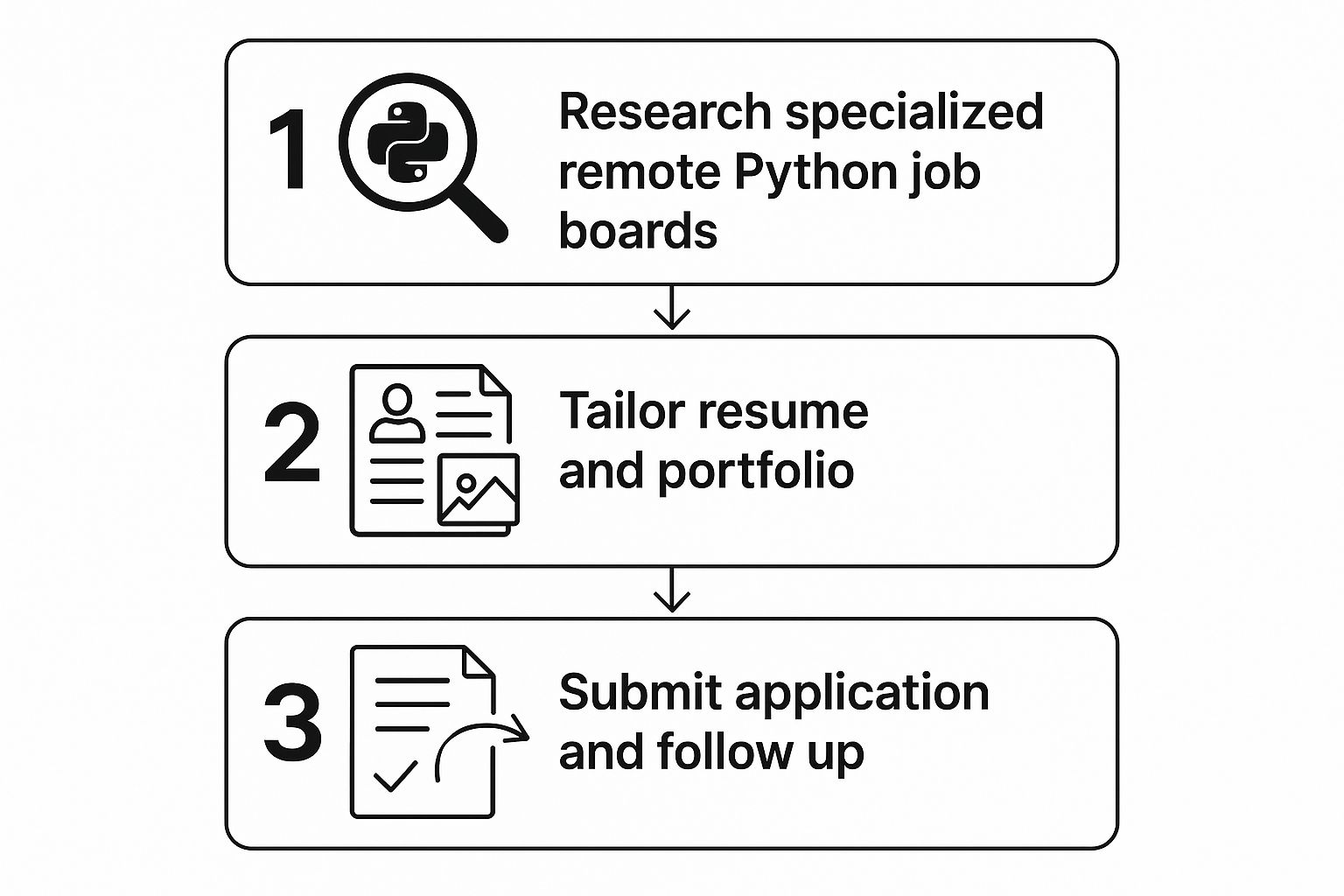
As you can see, a focused, well-prepared strategy is always going to beat a scattergun approach of applying everywhere.
Negotiating Your Remote Salary and Perks
Getting that job offer is a fantastic moment, but don't pop the champagne just yet. The next conversation is one of the most important: negotiating your compensation. This is your chance to make sure you're paid based on your market value, not just your local cost of living.
Remember, companies often see significant savings with a remote workforce—less office space, fewer utilities, and so on. It’s only fair that your salary reflects the immense value you bring to the table, regardless of where your desk is.
Know Your Worth with Data
Before you even dream of throwing out a number, you have to do your homework. Seriously, solid research is your best friend in any negotiation. You need to walk into that conversation armed with hard data that backs up the salary you’re asking for.
Start by digging into national and even global salary data for remote Python developer jobs. Don't let your local city’s salary averages hold you back. Your skills in machine learning, backend wizardry with Django, or cloud architecture are worth just as much to a company in San Francisco as they are from a home office in Omaha.
For example, looking at data from mid-2025, the average hourly rate for remote Python developers in the U.S. is floating around $58.62. That number can swing wildly depending on your experience and specialties, with some top developers pulling in over $86 an hour. Knowing that the typical market rate is somewhere between $48 and $67 an hour gives you a powerful, evidence-based range to work with. You can dive deeper into specific salary breakdowns for remote Python roles at ZipRecruiter to build an even stronger case.
So, when the inevitable "What are your salary expectations?" question comes up, resist the urge to give a single number. Instead, offer a well-researched range. It shows you've done your homework and are flexible, but it also anchors the conversation at a level you're comfortable with.
Here’s how that might sound:
"Based on my research for remote Python roles that require my level of expertise in cloud deployment and API design, I’m targeting a range between $135,000 and $150,000. Of course, I'm happy to discuss the total compensation package to find a number that works for both of us."
This simple shift frames the talk around your skills and market data, turning it from a haggle into a professional business discussion.
Negotiating Beyond the Base Salary
A great offer is about more than just the annual salary. Especially in remote work, the right perks can make a huge difference in your day-to-day happiness and financial well-being. If a company can't quite hit the top of your salary range, see what else they can bring to the table.
Here are a few high-impact perks worth fighting for:
- Home Office Stipend: A lump sum to get you set up with a proper ergonomic chair, a good desk, and quality monitors. Your back will thank you.
- Monthly Tech/Utilities Allowance: A recurring payment to help cover the internet and electricity bills you're now footing for work.
- Professional Development Budget: Dedicated funds for certifications, online courses, or industry conferences to keep you at the top of your game.
- Truly Flexible Hours: The freedom to structure your workday around your life, not a rigid 9-to-5 clock.
Don't dismiss the value of these benefits. A generous home office stipend or a solid professional development budget can easily be worth several thousand dollars a year. Think about the entire package, not just the base number, to build a role that truly sets you up for success.
Common Questions About Remote Python Jobs

As you start seriously looking for a remote Python role, you’re bound to have some questions. It's only natural. Let's walk through some of the most common things developers ask and get you some straight answers so you can move forward with confidence.
What Are the Most Essential Non-Technical Skills?
Your Python skills get you in the door, but your soft skills are what make you a great remote hire. When a hiring manager can't just walk over to your desk, they need to know you can operate effectively on your own.
Here's what they're really looking for:
- Asynchronous Communication: This is the big one. Most of your collaboration will be text-based. Can you write a clear, concise bug report or project update without needing a follow-up call? That's the gold standard.
- Proactive Self-Discipline: Remote work is all about ownership. Without a boss looking over your shoulder, you have to be the one to manage your time, hit your deadlines, and stay focused. It’s a trust exercise, and you need to prove you’re up to it.
- Independent Problem-Solving: Every developer gets stuck. Remote teams need people who will first try to get un-stuck on their own—through research, debugging, and experimentation—before immediately pinging a senior for help.
When you can show you have these skills, you're not just a coder. You're a reliable professional who can be trusted to deliver from anywhere.
Do I Need a Computer Science Degree?
Honestly? Probably not. While a CS degree is never a negative, the tech industry has shifted its focus, especially for python developer remote jobs. It's less about your diploma and more about what you can build.
Most companies today care more about your practical abilities. A killer portfolio packed with interesting projects, a clean and active GitHub profile, and maybe a few relevant certifications can easily outweigh a traditional degree. If you can demonstrate that you can solve their specific problems, many hiring managers won't even ask where you went to school.
In the remote world, your GitHub is your resume. A well-documented project that solves a real-world problem is far more powerful than a degree you earned five years ago.
How Can I Stand Out Without Remote Experience?
This is the classic "can't get a job without experience, can't get experience without a job" dilemma. But you can absolutely get around it. The key is to reframe your existing experience to highlight remote-friendly skills.
You don't need a job title with "Remote" in it. Instead, focus on projects and roles where you:
- Worked with a high degree of autonomy and managed your own schedule.
- Collaborated with a team using modern tools like Git, Jira, or Slack.
- Communicated progress and blockers primarily through written updates.
In your cover letter and during interviews, tell these stories. Talk about your self-motivation and your knack for clear communication. You're shifting the conversation from a lack of a specific job title to a wealth of relevant, remote-ready skills.
Are Remote Python Jobs More Competitive?
In a word, yes. When a job is open to anyone, anywhere, the applicant pool naturally gets a lot bigger. You're not just competing with local talent anymore; you're up against developers from across the country or even the world.
But don't let that discourage you. It just means you have to be more strategic. Specialization is your best friend here. A generalist Python developer faces a ton of competition, but a developer with deep expertise in a niche like data engineering with Airflow, backend development with FastAPI, or machine learning applications will always be in high demand.
Once you land the job, setting up your space for success is the next step. Learning how to organize your home office for productivity is a skill in itself and pays dividends in the long run.