
Cryptography is more than just abstract mathematics; it's the bedrock of modern digital security and the engine of Web3 innovation. For developers, engineers, and aspiring tech professionals, translating theoretical knowledge into practical skills is essential for career growth. Understanding how cryptographic principles are applied in real-world systems is the difference between a foundational understanding and true expertise. This is particularly true when pursuing specialized roles where a strong portfolio is non-negotiable.
This article provides a direct path to building that expertise. We will dissect seven significant projects in cryptography, moving beyond simple descriptions to offer a strategic analysis of their implementation, impact, and the replicable methods you can apply to your own work. The goal is to provide a clear, actionable roadmap for mastering the core concepts that power today's most secure and decentralized systems.
Whether you're building a portfolio to land your first role, aiming to deepen your existing skill set, or simply exploring the field, these examples offer tangible starting points. We'll explore the strategic choices behind iconic systems like the Signal Protocol and the foundational security of TLS/SSL, providing the insights needed to transform theory into tangible, career-defining skills.
1. Signal Protocol
The Signal Protocol stands as a monumental achievement in secure messaging, providing robust, asynchronous end-to-end encryption. Developed by Open Whisper Systems, it serves as the cryptographic backbone for widely used applications like Signal, WhatsApp, and Google Messages. It is one of the most impactful projects in cryptography because it solved the complex challenge of providing strong security guarantees for real-world, asynchronous communication.
The protocol's genius lies in its combination of several cryptographic primitives. It uses the Extended Triple Diffie-Hellman (X3DH) protocol for initial key agreement, establishing a shared secret key between users, even if one is offline. Following this, the Double Ratchet Algorithm takes over for ongoing message encryption.
How It Works: The Core Mechanisms
The Double Ratchet is the engine of the protocol, generating new, temporary encryption keys for every message. This continuous key rotation provides two critical security properties:
- Perfect Forward Secrecy: If a long-term key is compromised, past messages remain secure because their unique session keys have been discarded.
- Post-Compromise Security: If a session key is compromised, the protocol can self-heal, re-establishing security for future messages once the attacker is no longer active.
This dynamic key management ensures that a single point of failure does not unravel the security of an entire conversation. The following infographic illustrates the high-level process flow of the Signal Protocol's key agreement and message exchange.
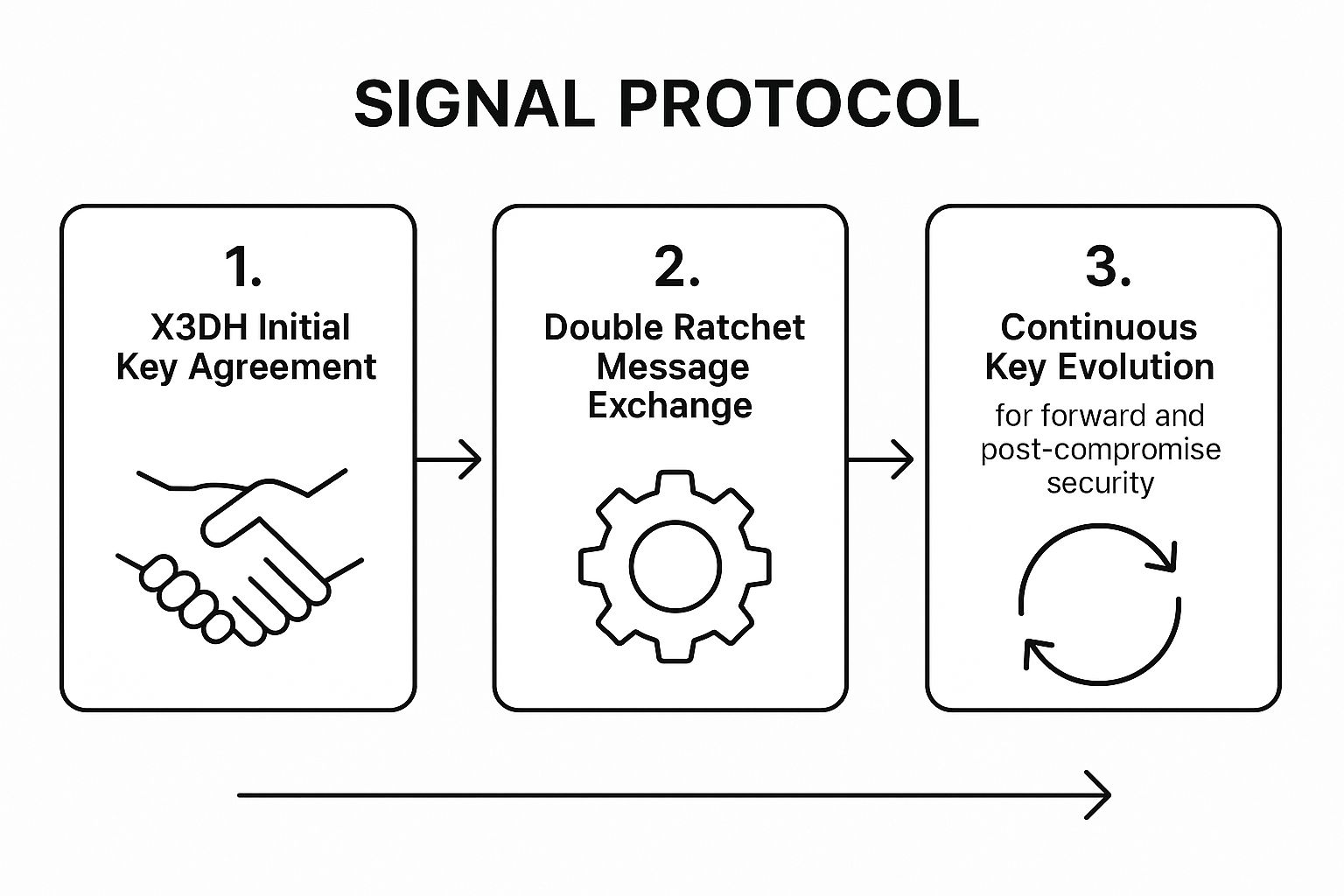
This visualization highlights how the protocol moves from a secure initial setup to a self-healing, continuously evolving encryption system for ongoing communication.
Implementation Tips and Takeaways
For developers looking to integrate this protocol, the primary recommendation is to use the official, well-vetted libsignal libraries rather than attempting a custom implementation. Cryptographic protocols are notoriously difficult to implement correctly, and even minor errors can lead to catastrophic vulnerabilities.
Strategic Insight: The Signal Protocol's success is a lesson in practical security design. It prioritizes resilience against key compromise, acknowledging that perfect, long-term key security is an unrealistic assumption in the real world.
Key considerations include implementing robust key verification (e.g., safety numbers), securely storing user identity keys, and gracefully handling the complexities of out-of-order message delivery in an asynchronous environment.
2. TLS/SSL Implementation Projects
Transport Layer Security (TLS), and its predecessor SSL, are the fundamental protocols that secure communications across the internet. An implementation of TLS/SSL is one of the most foundational projects in cryptography, as it underpins the security of everything from web browsing to API communications. These projects involve building the software that handles the entire security handshake, including certificate validation, key exchange, and bulk data encryption.
The protocol's core function is to establish a secure, authenticated, and encrypted channel between two parties over an insecure network. It uses a combination of symmetric and asymmetric cryptography. Asymmetric cryptography is used during the initial "handshake" to securely exchange a shared secret, while faster symmetric cryptography is used to encrypt the actual data transmitted afterward. Well-known implementations include OpenSSL, Google's BoringSSL, and the memory-safe rustls.
How It Works: The Core Mechanisms
The TLS handshake is a multi-step process that negotiates the security parameters for a communication session. Key stages of this process include:
- Cipher Suite Negotiation: The client and server agree on a set of cryptographic algorithms (cipher suite) to use for key exchange, authentication, and encryption.
- Authentication: The server proves its identity to the client by presenting a digital certificate, which is validated against a trusted Certificate Authority (CA).
- Key Exchange: The client and server use an asymmetric key exchange algorithm, like Diffie-Hellman, to securely generate a shared session key without an eavesdropper being able to intercept it. This key is then used for symmetric encryption of all subsequent traffic.
This sequence ensures that even if an attacker can monitor the entire network exchange, they cannot decrypt the transmitted data or impersonate the server.
Implementation Tips and Takeaways
For developers working with TLS, the most important rule is to rely on established, well-maintained libraries rather than building from scratch. The protocol is incredibly complex, and small mistakes can create severe vulnerabilities. For those diving into building robust applications, understanding API Security Best Practices is crucial, especially when configuring TLS for secure endpoints.
Strategic Insight: The strength of TLS comes from its modularity and forward-thinking design. Its ability to negotiate different cipher suites allows it to evolve, phasing out weak algorithms and adopting stronger ones as cryptographic research advances.
Key best practices include disabling outdated protocols like SSLv3 and early TLS versions, implementing HTTP Strict Transport Security (HSTS) to enforce encrypted connections, and using strong, modern cipher suites. Regularly updating your TLS library is non-negotiable to protect against newly discovered vulnerabilities.
3. Blockchain Cryptography Systems
Blockchain technology represents a paradigm shift in secure, decentralized data management, and at its core lies a symphony of cryptographic primitives. These systems use hash functions, digital signatures, and Merkle trees to ensure data integrity, prevent tampering, and enable consensus without a central authority. This makes it one of the most transformative projects in cryptography, as it provides a practical framework for creating trust in a trustless environment, powering everything from cryptocurrencies like Bitcoin to enterprise supply chain solutions.
The security of a blockchain is built on a chain of cryptographically linked blocks. Each block contains a hash of the previous one, creating an immutable, time-stamped ledger. Digital signatures, based on public-key cryptography, are used to authenticate transactions, ensuring that only the rightful owner of an asset can spend it.
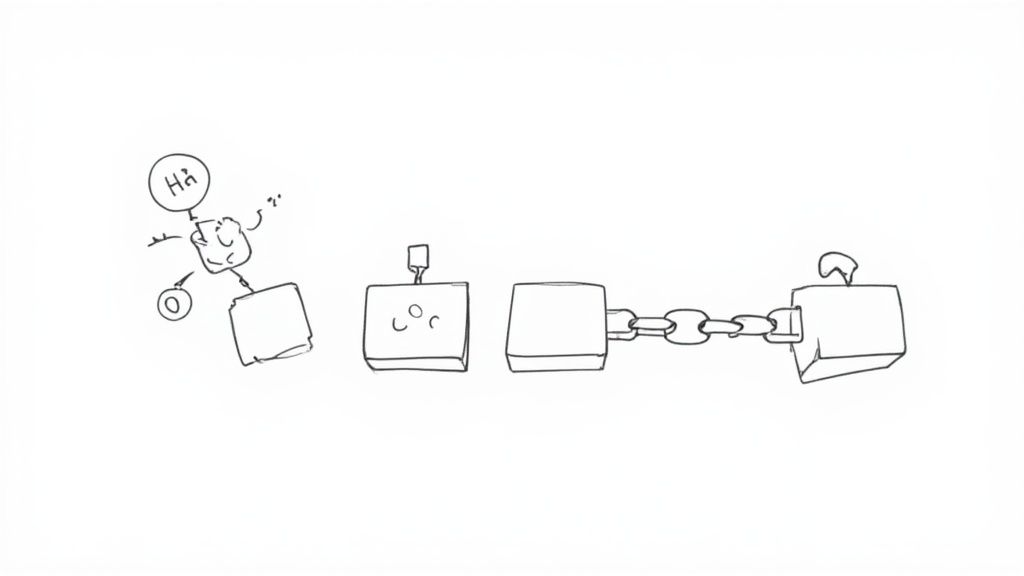
This structure ensures that modifying any historical data would require re-calculating all subsequent blocks, an computationally infeasible task on a sufficiently large network. This foundational security is what makes systems like Ethereum and Hyperledger Fabric viable for high-stakes applications. For a deeper dive into the terminology, you can learn more about Web3 concepts in this comprehensive Web3 dictionary.
How It Works: The Core Mechanisms
Blockchain's cryptographic security relies on three fundamental components working in concert to create a secure and verifiable ledger:
- Cryptographic Hashes: Functions like SHA-256 create a unique, fixed-size fingerprint of data. They are used to link blocks together and to create Merkle trees, which efficiently verify data integrity within a block.
- Public-Key Cryptography: This enables digital signatures using algorithms like ECDSA. Users have a private key to sign transactions and a public key to receive assets, proving ownership without revealing the secret key.
These mechanisms combine to create a system where transactions are both secure and transparently verifiable by anyone on the network.
Implementation Tips and Takeaways
For developers building on or creating a blockchain, the focus must be on the correct application of these cryptographic tools. A single flaw in key management or signature verification can compromise the entire system.
Strategic Insight: The genius of blockchain is not in inventing new cryptography, but in orchestrating existing, proven primitives in a novel way to solve the problem of decentralized consensus and immutability.
Key considerations include using hardware wallets for secure key storage, implementing thoroughly vetted cryptographic libraries, and leveraging testnets for rigorous security audits before deploying to a mainnet. For smart contract development, gas optimization and robust access controls are critical to prevent exploits and financial loss.
4. Zero-Knowledge Proof Systems
Zero-Knowledge Proof (ZKP) systems are a revolutionary cryptographic method allowing one party (the prover) to prove to another (the verifier) that they know a piece of information, without revealing the information itself. This "proof of knowledge without disclosure" has profound implications for privacy and scalability in digital systems. ZKPs are one of the most transformative projects in cryptography because they enable trustless verification, powering privacy-preserving cryptocurrencies like Zcash and scalable blockchain solutions like Polygon Hermez.
The magic of ZKPs lies in their ability to verify the integrity of a computation without re-executing it or seeing the inputs. By transforming a computational statement into a mathematical proof, a prover can demonstrate that a certain outcome is correct. This is achieved through sophisticated schemes like zk-SNARKs (Zero-Knowledge Succinct Non-Interactive Argument of Knowledge) and zk-STARKs (Zero-Knowledge Scalable Transparent Argument of Knowledge), each offering different trade-offs in proof size, proving time, and setup requirements.
How It Works: The Core Mechanisms
At their core, ZKP systems rely on three fundamental properties to ensure their integrity and usefulness:
- Completeness: If the prover's statement is true and both parties follow the protocol, the verifier will always be convinced of the proof's validity.
- Soundness: If the prover's statement is false, it is computationally impossible for them to trick the verifier into accepting the proof as valid.
- Zero-Knowledge: The verifier learns nothing more than the fact that the statement is true. The underlying secret information remains completely private.
This combination enables powerful applications, from anonymous transactions to verifiable off-chain computation, where trust is established through mathematics rather than intermediaries. The video below provides a conceptual overview of how these proofs function.
This conceptual framework is the foundation for building systems that can verify actions without compromising sensitive data.
Implementation Tips and Takeaways
For developers venturing into ZKPs, it is crucial to use established libraries like circom or libsnark. Creating a ZKP system from scratch is an immensely complex task where small errors can undermine all security guarantees. The focus should be on designing efficient "circuits," which are the logical representations of the computation being proven.
Strategic Insight: The power of Zero-Knowledge Proofs is their ability to decouple verification from data access. This fundamentally changes the trust model of digital interactions, enabling scalable and private systems where integrity can be mathematically guaranteed.
When implementing, developers must optimize circuit design for performance, as proof generation can be resource-intensive. It's also critical to understand the trade-offs between different ZKP schemes (e.g., SNARKs vs. STARKs) regarding setup ceremonies, proof size, and verifier costs to select the right tool for the job.
5. Post-Quantum Cryptography Projects
Post-Quantum Cryptography (PQC) represents a forward-thinking shift in digital security, designed to protect information systems from attacks by future quantum computers. These initiatives focus on developing and standardizing new cryptographic algorithms that are resistant to threats posed by Shor's and Grover's algorithms. As one of the most critical ongoing projects in cryptography, PQC ensures long-term data confidentiality and integrity in a world where quantum computing becomes a reality.
The core challenge is to replace public-key cryptography systems like RSA and ECC, which would be rendered insecure. PQC explores mathematically complex problems believed to be hard for both classical and quantum computers, including lattice-based, code-based, and multivariate cryptography. Major standardization efforts, led by institutions like NIST, are central to this global transition.

This proactive migration is essential for protecting everything from government secrets and financial transactions to the underlying infrastructure of the internet.
How It Works: The Core Mechanisms
Unlike classical algorithms, PQC schemes are built on different mathematical foundations. The primary candidates selected by NIST's PQC standardization process, such as CRYSTALS-Kyber for key establishment and CRYSTALS-Dilithium for digital signatures, rely on the difficulty of problems in structured lattices. These new primitives provide two key security properties:
- Quantum Resistance: The underlying mathematical problems are conjectured to be intractable for quantum computers, preventing them from breaking the encryption or forging signatures.
- Crypto-Agility: The transition encourages designing systems that can easily swap out cryptographic algorithms, allowing for future upgrades as the security landscape evolves.
Leading this effort, the Open Quantum Safe (OQS) project provides open-source implementations of PQC algorithms, enabling developers to experiment and integrate them into existing protocols like TLS and SSH.
Implementation Tips and Takeaways
For developers and organizations planning for the quantum era, the immediate focus should be on preparation and strategic integration. A primary recommendation is to start by identifying and inventorying all uses of public-key cryptography within your systems. Exploring opportunities for PQC is a valuable skill, and you can learn more about career paths in this emerging field.
Strategic Insight: The most effective PQC transition strategy is a hybrid approach. Combining a classical algorithm with a post-quantum one ensures that security relies on the hardness of at least one of the two, mitigating risks from both known and future threats.
Key considerations include performance testing, as PQC algorithms often have larger key and signature sizes that can impact system performance. Begin with non-production environments to evaluate this impact and stay current with the final standards published by NIST to ensure long-term compliance and security.
6. Secure Multi-Party Computation (SMPC)
Secure Multi-Party Computation (SMPC) represents a groundbreaking cryptographic frontier, allowing multiple, non-trusting parties to jointly compute a function over their private inputs without revealing those inputs to one another. Protocols like those used in Facebook's CrypTen or the SCALE-MAMBA platform enable collaborative data analysis, such as training a machine learning model, where the underlying data remains completely confidential. This makes SMPC one of the most transformative projects in cryptography for privacy-preserving data science and decentralized finance.
SMPC’s power comes from sophisticated techniques like secret sharing, where each party's input is split into multiple shares distributed among participants, and garbled circuits, which obscure the logic of the computation itself. No single party ever holds enough information to reconstruct another's private data, yet the collective can arrive at the correct, final output of the desired function.
How It Works: The Core Mechanisms
The specific protocol often depends on the security model, which can range from "semi-honest" (assuming parties follow the protocol but might try to learn from the data they see) to "malicious" (assuming parties may actively try to sabotage the computation). The core idea involves two main phases:
- Offline/Preprocessing Phase: Parties perform input-independent computations to generate cryptographic material like shared random numbers or garbled circuits. This heavy lifting is done in advance to speed up the next phase.
- Online Phase: Once the private inputs are available, the parties use the preprocessed material to quickly and securely compute the function. This phase requires minimal, low-latency communication.
This two-phase structure makes complex, real-time computations feasible by shifting the most intensive cryptographic work to a time before the actual inputs are known.
Implementation Tips and Takeaways
Developers building with SMPC should start with established frameworks like MP-SPDZ or CrypTen, as building these protocols from scratch is exceptionally complex. The choice of protocol is critical and depends entirely on the specific application's requirements.
Strategic Insight: SMPC's value lies in unlocking collaborative data insights that would otherwise be impossible due to privacy regulations or commercial sensitivity. It shifts the paradigm from data sharing to secure, collaborative computation.
When implementing a solution, carefully consider the security model that fits your threat landscape. A semi-honest model is more efficient but offers weaker guarantees than a malicious one. Additionally, optimizing the network communication layer is crucial, as SMPC protocols are often communication-bound. You can explore how these privacy-preserving techniques are influencing new financial systems by reading more about DeFi statistics and trends.
7. Cryptographic Key Management Systems
A Cryptographic Key Management System (KMS) is a foundational technology for securing data at scale. It provides a centralized and secure framework for the entire lifecycle of cryptographic keys, from generation and storage to rotation and eventual destruction. Platforms like AWS KMS, Azure Key Vault, and HashiCorp Vault have made this one of the most critical projects in cryptography for modern cloud infrastructure, solving the immense challenge of managing millions of keys securely.
The core purpose of a KMS is to abstract away the complexity of key management from developers and applications. Instead of embedding keys in code or configuration files, applications request cryptographic operations from the KMS, ensuring the raw key material never leaves its secure boundary. This approach drastically reduces the attack surface and simplifies compliance with security standards.
How It Works: The Core Mechanisms
A KMS is built around a secure, often hardware-based, root of trust. Hardware Security Modules (HSMs) are commonly used to protect the master keys that encrypt all other keys within the system. The system's operation revolves around several key lifecycle functions:
- Key Generation & Storage: Creates strong, random cryptographic keys and stores them in a highly available and durable environment, often encrypted by a master key.
- Access Control: Enforces granular policies defining who and what (e.g., users, roles, applications) can use specific keys for specific operations like encryption or decryption.
- Auditing: Provides detailed logs of every key action, creating an immutable trail for security analysis, compliance reporting, and incident response.
This centralized control model ensures that key usage is consistently managed and monitored across an entire organization, preventing fragmented and insecure key handling practices.
Implementation Tips and Takeaways
When deploying a KMS, focus on robust policy enforcement and operational resilience. Start by implementing the principle of least privilege, granting only the minimum necessary permissions for any user or service to access a key. To ensure the integrity and confidentiality of your systems, it's vital to implement essential data security best practices in conjunction with robust cryptographic solutions.
Strategic Insight: A KMS transforms cryptographic keys from a distributed liability into a centralized, manageable asset. Its real value is not just in storing keys, but in providing a policy enforcement engine that governs their use.
Key considerations for a successful implementation include planning for high availability and disaster recovery to prevent service disruption, establishing clear key rotation schedules, and integrating the KMS with monitoring systems to detect and alert on anomalous activity. A well-defined key escrow and recovery procedure is also essential for business continuity.
7 Cryptography Projects Comparison Matrix
| Technology | 🔄 Implementation Complexity | ⚡ Resource Requirements | 📊 Expected Outcomes | 💡 Ideal Use Cases | ⭐ Key Advantages |
|---|---|---|---|---|---|
| Signal Protocol | High | Moderate (cryptographic expertise, secure key storage) | End-to-end encrypted messaging with forward & post-compromise security | Secure messaging apps (e.g., Signal, WhatsApp) | Proven security, asynchronous messaging, efficient on mobile |
| TLS/SSL Implementation Projects | High | Moderate to High (certificate management, PKI infrastructure) | Secure network communications with wide compatibility and updates | Securing web and network traffic | Industry standard, hardware acceleration, extensive support |
| Blockchain Cryptography Systems | Very High | High (compute for consensus, key management) | Immutable, decentralized ledgers with secure transactions | Decentralized systems, cryptocurrencies | Decentralized trust, transparency, programmable contracts |
| Zero-Knowledge Proof Systems | Very High | Very High (computationally intensive proof generation) | Privacy-preserving verification without data exposure | Privacy-enhancing protocols, scaling blockchains | Strong privacy, efficient verification, mathematical guarantees |
| Post-Quantum Cryptography | Very High | High (larger keys/signatures, computational overhead) | Quantum-resistant cryptography for future-proof security | Quantum-safe encryption, hybrid cryptosystems | Quantum resistance, NIST standards, future-proofing |
| Secure Multi-Party Computation | Very High | Very High (communication & computation overhead) | Collaborative computation with data privacy | Privacy-preserving joint analytics, sensitive data processing | Strong privacy, no trust required, supports complex workflows |
| Cryptographic Key Management | High | Moderate to High (HSMs, scalable infrastructure) | Centralized secure key lifecycle management | Enterprise key management and compliance | Centralization, compliance, automated rotation, scalability |
Building Your Future in Web3 and Cryptography
The journey through these foundational projects in cryptography reveals a clear and powerful narrative: the future of digital interaction is being built on principles of security, privacy, and verifiable trust. From the end-to-end encryption exemplified by the Signal Protocol to the decentralized ledger systems powered by blockchain, each project serves as a critical building block for the emerging Web3 landscape. These are not merely academic exercises; they are the architectural blueprints for the next generation of the internet.
Understanding the mechanics behind TLS/SSL is essential for securing today's web, while diving into Post-Quantum Cryptography prepares you for tomorrow's security challenges. Similarly, projects involving Zero-Knowledge Proofs (ZKPs) and Secure Multi-Party Computation (SMPC) are at the forefront of privacy-preserving technology, a cornerstone of user-centric Web3 applications. The common thread is a shift from centralized, opaque systems to decentralized, transparent, and user-controlled environments.
From Theory to Tangible Skill
The most critical takeaway from this exploration is the imperative to move from theoretical knowledge to practical application. Reading about cryptographic primitives is valuable, but implementing them is transformative. Building even a simplified version of a key management system or contributing to an open-source ZKP library provides you with an undeniable advantage in the job market.
Strategic Insight: A portfolio showcasing functional cryptography projects is more compelling to a Web3 recruiter than any certification. It demonstrates not just what you know, but what you can build, secure, and deploy. This hands-on experience proves you can translate complex concepts into real-world solutions.
Actionable Next Steps for Aspiring Builders
To bridge the gap between learning and earning, focus on a structured approach. Your goal should be to create a portfolio that tells a story of your evolving expertise in cryptography.
- Start with a Foundational Project: Begin with a more accessible project, like implementing a simple TLS/SSL handshake or building a basic cryptographic hash function. This builds confidence and solidifies your understanding of core principles.
- Specialize in a High-Demand Area: Choose a domain that excites you, such as ZKPs for privacy or post-quantum algorithms for future-proofing. Deep diving into one of these areas makes you a specialist, a highly sought-after role in the Web3 space.
- Contribute to Open Source: Find an established cryptography project on a platform like GitHub. Even small contributions, like improving documentation or fixing minor bugs, demonstrate your collaborative skills and your commitment to the ecosystem.
- Document and Share Your Work: Create a blog post, a detailed README file, or a short video explaining your project. This not only reinforces your own learning but also builds your personal brand as a knowledgeable developer in the field.
By undertaking these projects in cryptography, you are not just learning to code; you are learning the language of digital trust. This expertise is indispensable for anyone looking to build a career in Web3, from engineers and product managers to security auditors and protocol designers. The skills you cultivate by tackling these challenges are precisely what innovative companies are searching for as they build a more secure and decentralized digital world.
Ready to apply your new skills and turn your project portfolio into a career? Explore cutting-edge roles at top Web3 companies on Find Web3. Visit Find Web3 to connect with innovative teams that are actively hiring talent with expertise in cryptography and decentralized systems.