
Proof of Work (PoW) is the original secret sauce that makes blockchains like Bitcoin secure. At its core, it’s a system designed to prevent anyone from gaming the network. It does this by making participants, known as miners, prove they’ve done some serious computational heavy lifting.
This work involves spending real-world resources—namely, electricity and powerful computer hardware. By making it expensive and difficult to add new information to the blockchain, PoW ensures that cheaters can’t just rewrite the history of transactions without paying a massive price.
Breaking Down How Proof of Work Actually Works
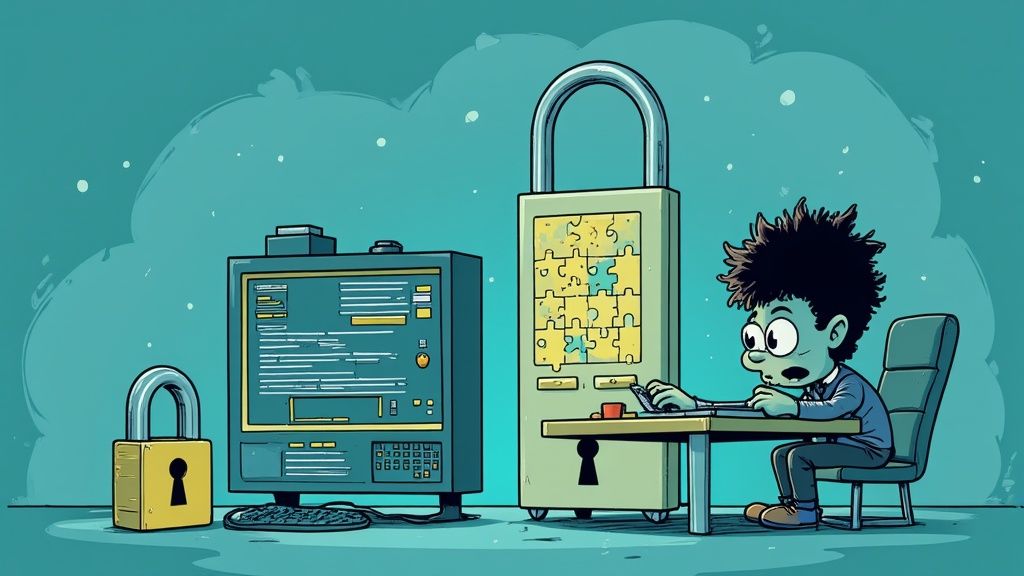
Think of Proof of Work as a massive, global competition. Miners are all racing against each other to solve a complex mathematical puzzle. The first one to crack it gets the right to validate the latest batch of transactions (a "block") and add it to the blockchain.
This isn't your typical algebra problem. The "puzzle" involves a process called hashing. Miners take the data from a block of transactions, add a random number called a nonce, and run it through a cryptographic hashing function. Their goal is to generate a hash—a long string of numbers and letters—that starts with a specific number of zeroes.
There's no shortcut to finding this magic number. It’s pure, brute-force guesswork. Miners have to run trillions of calculations every second, constantly changing the nonce until they stumble upon a hash that meets the network's difficulty target. This intense, energy-guzzling effort is the "work."
Once a lucky miner finds the solution, they broadcast it to everyone else on the network. Here’s the clever part: while finding the answer is incredibly hard, verifying it is a piece of cake. Anyone can take the winning miner's data and nonce, run it through the hash function once, and instantly confirm it’s correct.
It’s a bit like solving a giant Sudoku puzzle. It might take you hours of brainpower to finish, but anyone can check your completed grid for accuracy in just a minute. This elegant "hard to solve, easy to verify" design is what makes a PoW blockchain so secure without needing a bank or central authority to oversee things.
Core Components of Proof of Work at a Glance
To put it all together, it helps to see the key players and processes in one place. This table lays out the fundamental elements that make the entire system tick.
| Component | Role in the System | Analogy |
|---|---|---|
| Miners | Network participants who use powerful computers to solve the cryptographic puzzle. | Competitors in a global race to find a winning lottery ticket. |
| Hashing | The process of converting input data into a unique, fixed-size string of characters. | Creating a unique digital fingerprint for a block of transactions. |
| Block Rewards | The incentive (new cryptocurrency and transaction fees) given to the winning miner. | The prize money and trophy awarded for winning the race. |
This setup creates a powerful economic incentive for miners to play by the rules and contribute their computing power to keep the network honest and functional.
The beauty of Proof of Work is that it converts real-world resources—electricity and computing power—into digital trust. This tangible cost is what gives the network its robust security and makes tampering with the ledger almost impossible.
To really get a feel for this process in action, it’s worth digging into how Bitcoin mining, a core example of Proof of Work, functions to see how these concepts are applied. Many of these terms are foundational in the decentralized world; for a deeper dive into the lingo, our https://findweb3.com/posts/web3-dictionary can help.
The Surprising Origins of Proof of Work
You might think Proof of Work (PoW) started with Bitcoin, but its roots go back way further—and they have nothing to do with digital money. The core idea was actually born in the 1990s as a clever solution to a problem we all still know and hate: spam.
Back then, as the internet was just taking off, junk email was already becoming a massive headache. Researchers quickly pinpointed the real issue: sending spam was practically free. A single person could blast out millions of emails with almost no effort or cost, overwhelming inboxes across the globe. The challenge was to make that process expensive for the spammers without affecting regular folks just trying to send a message.
A New Cost for Digital Messages
In 1992, computer scientists Cynthia Dwork and Moni Naor floated a brilliant idea. What if sending an email required a tiny bit of computational work? They imagined a system where your computer would have to solve a small puzzle before it could send a message. For one email, this would be trivial—taking just a split second.
But for a spammer trying to send millions of them? That tiny bit of work would add up fast, becoming an enormous computational and financial roadblock. Each email would need its own unique "proof of work," making mass spam campaigns impossible to pull off. This was the seed that would eventually grow to secure trillions of dollars in value.
"The main idea is to require a user to compute a moderately hard, but not intractable, function in order to gain access to the resource, thus preventing frivolous use."
That original concept perfectly sums up the goal: make using a resource computationally expensive enough to discourage abuse. It's the same principle that underpins what is proof of work in crypto today.
From Spam Filter to Digital Gold
The idea really took shape in 1997 when cryptographer Adam Back created Hashcash. Back put the theory into practice, proposing the use of a cryptographic hash function as the "puzzle." An email header would carry a special "Hashcash stamp," which was proof that the sender's computer had burned some CPU cycles to create it.
This is where the story pivots. Satoshi Nakamoto, the mysterious creator of Bitcoin, explicitly referenced Adam Back's Hashcash in the Bitcoin whitepaper. Nakamoto saw that this anti-spam tool could solve a much bigger problem: how to build a secure, decentralized currency without a bank or government in charge. Instead of protecting email inboxes, the "work" would now protect an entire digital ledger.
The graphic below shows just how far this concept has come, from a simple email filter to the engine driving global cryptocurrencies.
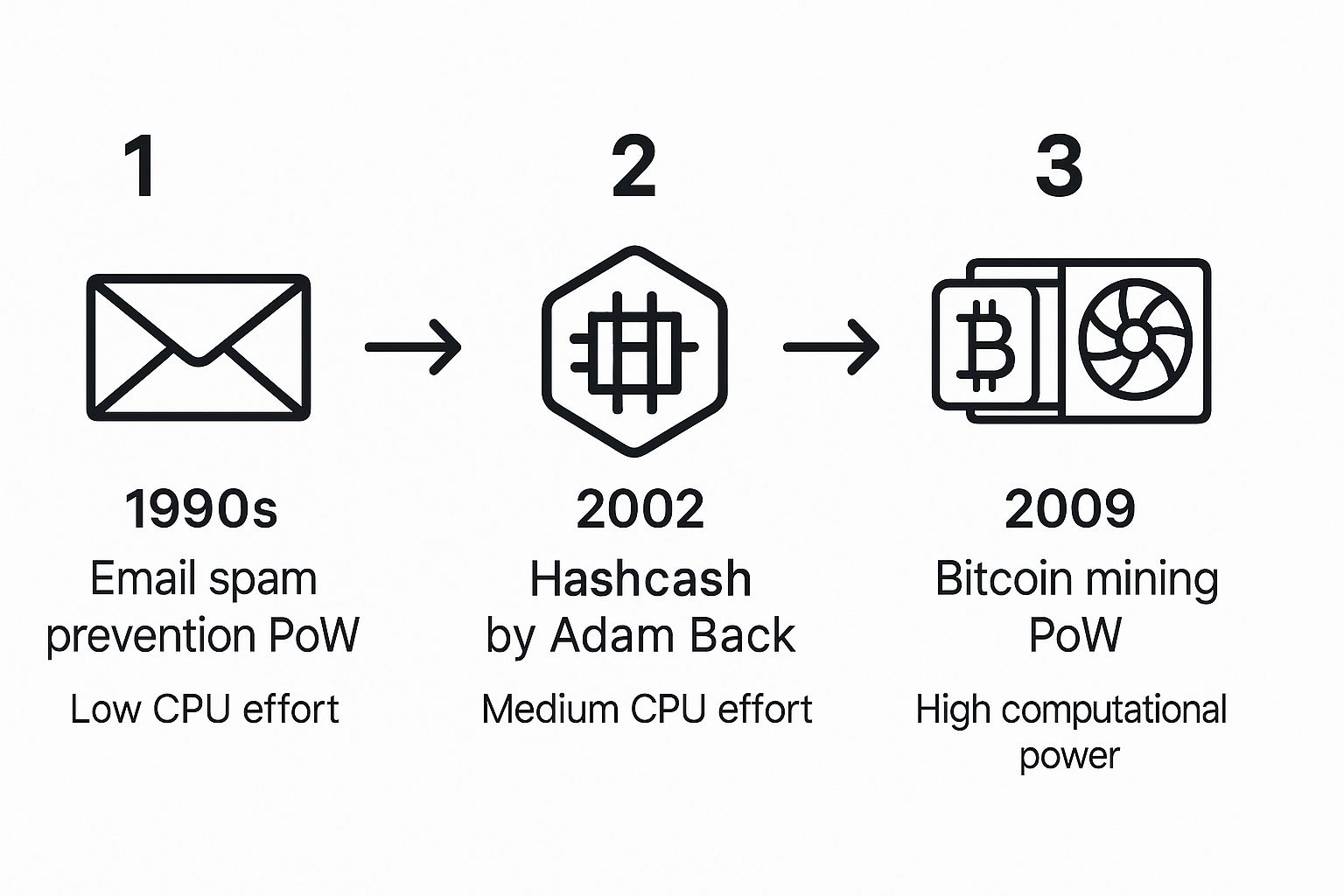
This journey shows how PoW was scaled up massively. The computational challenge went from a minor hurdle for spammers to a globally distributed, resource-intensive competition. What started as a clever trick to clean up our inboxes became the very foundation for a new kind of digital trust.
How Proof of Work Secures the Blockchain

The real genius of Proof of Work is how it secures a blockchain by making it incredibly expensive and difficult to cheat. We're not talking about passwords or firewalls here. The security model is built on raw economic incentives and massive computational power.
Imagine the blockchain is a long, transparent ledger book. To add a new page of transactions (a block), miners have to compete to solve an incredibly hard puzzle. This "puzzle" is essentially a brute-force guessing game, where miners try to find a specific number called a nonce.
When the nonce is combined with the block's data, it produces a unique digital fingerprint, or hash, that meets a very specific target—like starting with a certain number of zeros. This race to find the right nonce is the "work" in Proof of Work, and it consumes a staggering amount of energy and processing power.
The first miner to find the solution gets to add their block to the chain and broadcasts their "proof" to everyone. The rest of the network can then check this proof almost instantly. It’s this "hard to solve, easy to verify" principle that lies at the heart of what is proof of work.
Creating an Unbreakable Chain
Once a new block is verified and added, it’s locked in. But here's the crucial part: each new block contains the digital fingerprint (the hash) of the block that came before it. This creates a cryptographic chain, linking every block to the one before it, all the way back to the very first one.
This chaining effect is what makes the ledger immutable, or tamper-proof. Let's say a bad actor wanted to alter an old transaction to reverse a payment. They can't just change that one block.
- The Ripple Effect: The moment they change any data in a past block, its hash changes completely.
- The Broken Link: This new, altered hash no longer matches the one stored in the next block, visibly breaking the chain for everyone to see.
- The Impossible Race: To cover their tracks, the attacker would have to re-solve the puzzle not just for the block they altered, but for every single block that came after it. They'd have to do this faster than the entire global network of honest miners, who are busy adding new blocks to the real chain.
On a large network like Bitcoin, this would require an almost unimaginable amount of computing power, making it practically impossible to pull off.
The 51 Percent Attack Explained
So, what’s the biggest theoretical threat? You've probably heard of the 51% attack. This is a scenario where a single entity or a coordinated group manages to control more than half of the network's total mining power, or hash rate.
If they achieved this, they could theoretically cause some serious chaos:
- They could block new transactions from being confirmed.
- They might be able to halt payments between users.
- Most importantly, they could reverse their own recent transactions, allowing them to "double-spend" their coins.
But even with that much power, they still couldn't create new coins from scratch or steal funds from other people's wallets. More to the point, launching such an attack on a major blockchain is incredibly difficult. The cost to buy and power enough hardware to control 51% of Bitcoin's network would easily run into the billions of dollars, making it an economically foolish endeavor.
While Proof of Work is a powerful security layer, it's always wise to remember that it's part of a larger ecosystem of fundamental data security practices that apply to any digital system.
The security of Proof of Work lies in its economic design. It makes it far more profitable for miners to contribute honestly to the network and earn block rewards than to spend a fortune trying to attack it for a limited gain.
Ultimately, the integrity of the blockchain is a direct result of the collective "work" all the miners are doing. Every calculation and every watt of energy spent reinforces the entire ledger, making it one of the most resilient and transparent record-keeping systems ever built. The sheer cost and competition ensure the chain of blocks remains an honest and unaltered history of every transaction.
The Economic Engine Behind Proof of Work
The incredible amount of computing power that locks down a Proof of Work blockchain isn't donated out of the goodness of anyone's heart. Miners pour millions into specialized hardware and rack up huge electricity bills for one simple reason: it's a profitable business. The whole system runs on a clever economic engine designed to make honest work pay and cheating a surefire way to lose money.
This economic setup is built on two core incentives that keep miners plugging away, 24/7. To really get why Proof of Work is so tough to break, you have to understand what’s in it for them.
The Two Pillars of Miner Revenue
At its heart, mining is a race for rewards, and these rewards come from two different places. This two-pronged income stream makes sure that even as the network gets older, there’s always a good reason to keep contributing hashing power.
The first and biggest prize is the block reward. When a miner cracks the puzzle and adds a new block to the chain, the network's code lets them create a set amount of brand-new cryptocurrency. For Bitcoin, this is literally how new BTC are born and enter the world. It’s the jackpot for winning the computational lottery.
The second source of cash is transaction fees. Every single transaction packed into a block has a small fee attached, paid by the person sending the funds. The winning miner gets to scoop up all the fees from the transactions in the block they found. While these fees are usually much smaller than the block reward, they become more and more important as the network gets bigger and block rewards shrink over time.
Put them together, and you have a solid financial backbone for network security.
Built-in Scarcity and The Halving
One of the most ingenious economic rules baked into many PoW cryptocurrencies, including Bitcoin, is an event called the halving. This is a pre-scheduled update that automatically slashes the block reward in half roughly every four years. Its job is to control the supply of new coins and create digital scarcity, kind of like how there’s only so much gold you can pull out of the ground.
This event has a huge impact on miner profits and the network’s entire economy. After the April 2024 halving, for example, the Bitcoin block reward is now 3.125 BTC. Miners supplement this with transaction fees, which can swing wildly depending on how busy the network is and Bitcoin's market price.
The halving is a powerful economic tool. By making new coins harder to earn over time, it creates a predictable, anti-inflationary monetary system that can have a major influence on the asset's long-term value.
This scarcity model puts the pressure on miners to get smarter and more efficient, constantly hunting for cheaper power and better hardware to protect their profit margins. It's a high-stakes game of survival of the fittest.
Balancing the Books: Costs vs. Rewards
Mining isn't all about collecting rewards; it comes with some serious operational costs. The main expenses that eat into profits are:
- Hardware: Miners rely on specialized machines called ASICs (Application-Specific Integrated Circuits), and a single unit can set you back thousands of dollars.
- Electricity: Keeping these powerful computers running around the clock is an energy hog, making power the biggest ongoing cost by far.
- Infrastructure: This covers everything else—cooling systems to stop the machines from melting, the physical space for the "farm," and ongoing maintenance.
The tug-of-war between these costs and potential rewards creates a fragile economic equilibrium. If the crypto's price crashes or the network difficulty skyrockets, mining can quickly become a money-losing venture for the less efficient players. This forces them to power down, which in turn causes the network's difficulty to automatically adjust downwards, making it easier for the remaining miners to find blocks.
This self-correcting loop ensures the network stays secure and running, no matter what the market is doing. The economic incentives are finely tuned to push miners to act in the network's best interest, because their own long-term profits are directly tied to the health of the blockchain they're securing. These complex dynamics often ripple out into the wider market, a topic we explore further in our guide to Web3 statistics.
Proof of Work in the Real World
Theory is one thing, but Proof of Work really comes to life when you see it securing massive, real-world networks. These aren't just academic experiments; they're global financial systems that depend on the raw computational muscle of PoW to run without any central authority.
When someone asks, "what is proof of work?", the simplest and most powerful answer is Bitcoin. It's the original and the ultimate case study. The network is protected by an astronomical amount of computing power—its hash rate—contributed by millions of miners across the globe.
This collective effort has made Bitcoin the most resilient and secure decentralized network ever built.
Bitcoin: The Original PoW Blockchain
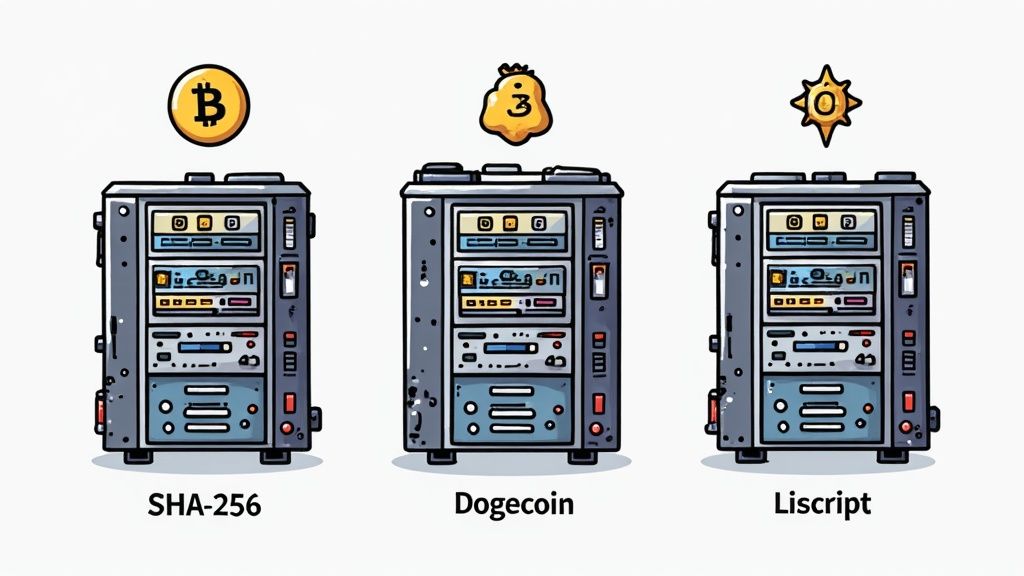
Bitcoin relies on the SHA-256 hashing algorithm, a cryptographic workhorse that has been a security standard for decades. The sheer size of its mining network makes a hostile takeover, like a 51% attack, almost a fantasy. The cost to acquire the necessary hardware and electricity would run into the billions, making any such attempt economically absurd.
It's this ironclad security that has allowed Bitcoin to operate without a single second of downtime for over a decade, processing hundreds of thousands of transactions every day. Its track record has cemented PoW's reputation as the most battle-tested method for creating truly censorship-resistant digital money. The demand for experts who can build and maintain these systems is huge, a trend reflected in the ever-growing blockchain job market.
Exploring Other Major PoW Coins
Bitcoin may be the king, but it’s not the only PoW chain out there. Plenty of other well-known cryptocurrencies have adopted the Proof of Work model, often tweaking the formula to achieve different goals. Litecoin and Dogecoin are two of the most famous examples.
A key difference is that these projects intentionally chose different hashing algorithms. This was a smart move, as it helped foster a more diverse mining ecosystem and prevented the specialized hardware built for Bitcoin (known as ASICs) from completely dominating every other PoW network.
- Litecoin (LTC): Often dubbed the "silver to Bitcoin's gold," Litecoin uses an algorithm called Scrypt. It was designed to be more memory-intensive, which at first made it easier for everyday people to mine using standard CPUs and GPUs.
- Dogecoin (DOGE): What began as a meme has evolved into a crypto giant. Dogecoin also runs on Scrypt and shares a lot of its DNA with Litecoin. The main distinctions are its much faster block times and a more inflationary supply schedule, which encourages spending and tipping.
The total market capitalization of all PoW coins is an estimated $2.45 trillion. This staggering number shows just how much trust and value the market places in this security model. It's a clear signal that investors still prioritize the proven, hardcore decentralization that only Proof of Work can offer. You can explore the data further to see the full breakdown of PoW cryptocurrencies on CoinGecko.
To see how these design choices play out, it helps to compare these PoW giants side-by-side.
Comparison of Major Proof of Work Cryptocurrencies
The table below breaks down how different design choices impact each blockchain's real-world operation.
| Cryptocurrency | Hashing Algorithm | Average Block Time | Primary Use Case |
|---|---|---|---|
| Bitcoin (BTC) | SHA-256 | ~10 minutes | Digital Gold, Store of Value |
| Litecoin (LTC) | Scrypt | ~2.5 minutes | Faster Digital Payments |
| Dogecoin (DOGE) | Scrypt | ~1 minute | Tipping, Microtransactions |
As you can see, while they all share the same PoW foundation, small tweaks to the algorithm and block time can lead to very different use cases, from a global store of value to a system for quick, small-scale payments.
You can’t really talk about Proof of Work without bringing up its main rival: Proof of Stake (PoS). While PoW relies on raw computing muscle to keep a network secure, PoS uses a totally different model based on economic collateral. This sets up a classic trade-off: battle-tested security versus modern efficiency.
Think of a Proof of Work system as a constant competition. Miners are all spending energy to be the first to solve a complex puzzle. The winner gets to add the next block to the chain and collects a reward for their effort. It's a permissionless free-for-all; anyone with the right hardware can jump in, which is a key driver of its decentralized nature.
Proof of Stake completely scraps that race. Instead, network participants, known as validators, lock up a certain amount of their own cryptocurrency as a security deposit, or "stake." The network then chooses a validator to create the next block, and the more you stake, the higher your odds of being selected.
The Security and Decentralization Debate
The real power of PoW is its undeniable connection to the physical world. The money spent on electricity and specialized hardware creates a very real, very expensive barrier to entry for attackers. To take over a major PoW network, you’d need to control more than half of its total computing power—a monumentally expensive task. This is the security model that has kept Bitcoin safe and sound for well over a decade.
PoS, on the other hand, builds its security on economic game theory. If a validator tries to push through a fraudulent transaction, they get penalized by having their staked coins taken away in a process called "slashing." Critics worry this can lead to centralization, creating a "the rich get richer" dynamic where the biggest stakers gain more and more control. Supporters counter that it actually lowers the barrier to entry—you just need the currency, not a warehouse full of computers.
Proof of Work ties security to the laws of physics and the cost of energy, making attacks objectively expensive. Proof of Stake ties security to economics, making it financially disastrous for validators to cheat.
Energy Consumption: The Elephant in the Room
The most glaring difference, and the main reason PoS was even invented, is energy use. Proof of Work is intentionally energy-hungry. The Bitcoin network, for instance, uses around 169.7 TWh of electricity per year, which is on par with the consumption of the entire country of Poland. This massive energy bill has ignited a fierce debate about its environmental footprint. You can explore a deeper dive into the statistical differences between these consensus models from CoinLaw.io.
This is where PoS shines. By getting rid of the energy-burning competition among miners, PoS networks run on a tiny fraction of the power. When Ethereum switched from PoW to PoS in 2022, its energy consumption dropped by an estimated 99.95%. This incredible efficiency is why almost every new blockchain project today chooses to build on a Proof of Stake foundation.
In the end, it’s not about which one is "better." It's about which trade-offs a project is willing to make. PoW offers a level of security that has been proven in the wild for years, anchored by real-world costs. PoS paves the way for a more energy-efficient and scalable future.
PoW FAQs: Your Questions Answered
We've covered a lot of ground, but a few questions about Proof of Work always pop up. Let's tackle some of the most common ones to clear up any lingering confusion.
Why Is Proof of Work So Energy Intensive?
It’s a fair question, and the answer is simple: it's a feature, not a bug. PoW's entire security model is built on making it outrageously expensive to cheat. That economic cost is paid in real-world resources—electricity and powerful computer hardware.
Think about it: millions of miners are all racing at the same time, running endless trial-and-error calculations to solve a complex puzzle. This brute-force computational effort is the "work," and it directly burns a massive amount of energy. This isn't wasted energy; it's the very thing that makes the blockchain's history so tough to rewrite.
You can think of all that energy consumption as the network's security budget made physical. The higher the energy cost, the more expensive it is for an attacker to take over, making the entire network safer for everyone.
Can Proof of Work Be Hacked or Attacked?
Theoretically, no system is untouchable. But in practice, successfully attacking a major Proof of Work blockchain like Bitcoin is next to impossible. The most well-known threat is the 51% attack, where one person or group would need to seize control of more than half of the network's total mining power.
Pulling this off on the Bitcoin network would require an unbelievable amount of hardware and electricity. The cost to acquire and run everything would easily soar into the billions of dollars. It's an economically absurd plan with very little financial upside, which is a powerful deterrent. The bigger and more spread out the mining network gets, the harder it becomes to launch such an attack.
Is Proof of Work Still Relevant Today?
Absolutely. While newer systems like Proof of Stake (PoS) have turned heads with their incredible energy efficiency, Proof of Work is still the heavyweight champion of security and decentralization. Its long track record of fending off attacks makes it the go-to choice for blockchains where maximum, uncompromising security is the top priority.
Many experts argue that PoW's dependence on physical resources (electricity and hardware) is actually what keeps it from becoming too centralized. In some PoS systems, there's a risk that the wealthiest participants can accumulate more and more influence over time. Ultimately, they're just two different approaches with different trade-offs. PoW remains highly relevant for its battle-tested, unparalleled method of securing a decentralized network.
Ready to dive into the world of decentralized technology? Find Web3 is your ultimate resource for discovering career opportunities in the blockchain space. Explore thousands of jobs in engineering, design, and marketing to start building the future of the internet. Begin your search at https://findweb3.com.