
Navigating the Blockchain Developer Landscape
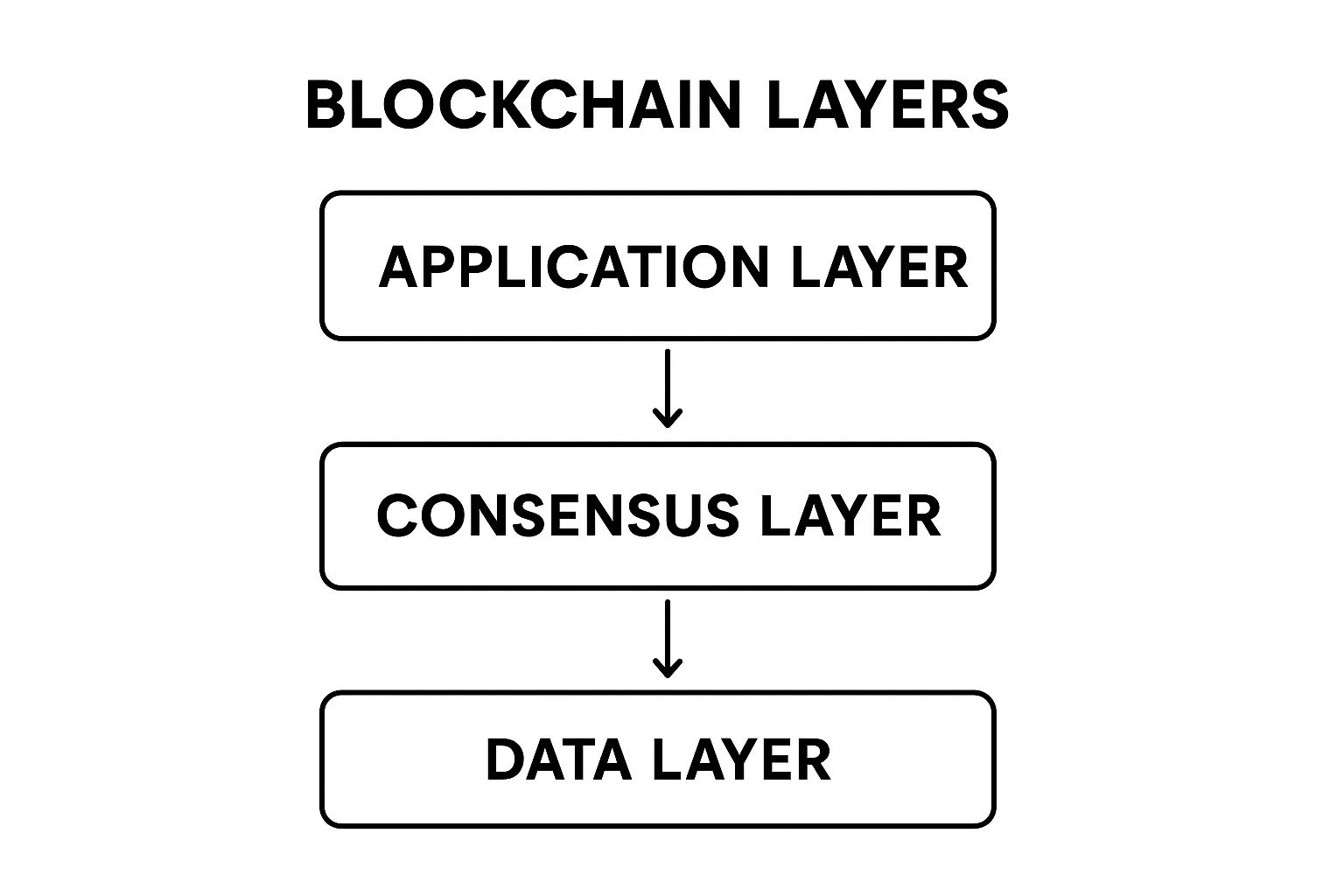
The infographic above illustrates the core layers of blockchain technology: the Application Layer, the Consensus Layer, and the Data Layer. These layers form the foundation of any blockchain system. A strong understanding of these layers is essential for aspiring blockchain developers.
Each layer presents unique functionalities and challenges. These directly influence the skillset needed for developers working within each specific domain. This layered structure emphasizes how interconnected blockchain development truly is.
For example, a blockchain software developer building a decentralized application (dApp) on the Application Layer must understand how it interacts with the underlying Consensus Layer (responsible for transaction validation) and the Data Layer (where data is stored). Therefore, a successful blockchain developer roadmap requires knowledge across all three.
Core Blockchain Developers vs. Blockchain Software Developers
Both roles contribute to the blockchain ecosystem, but their focus and responsibilities are quite distinct. Core blockchain developers are the architects of the blockchain itself. They design and implement consensus mechanisms, optimize network performance, and maintain the overall security and integrity of the blockchain protocol.
This role demands a deep understanding of cryptography, distributed systems, and network architecture. Blockchain software developers, on the other hand, build applications on top of existing blockchain platforms. They use the blockchain's functionality to create dApps, smart contracts, and other decentralized solutions.
Their skillset typically includes proficiency in programming languages like Solidity, JavaScript, and Python, plus experience with Web3 development tools. Reviewing existing product roadmaps, such as this Roadmap, can be insightful.
Charting Your Course in a Growing Market
The demand for blockchain developers is intrinsically linked to the growth of the blockchain technology market. This market has seen exponential growth, reflecting the rising demand for blockchain solutions across various sectors. By 2024, the global blockchain technology market was valued at USD 18.3 billion.
Projections forecast a remarkable CAGR of 53.6% between 2025 and 2034. This growth is driven by factors like the rise of cryptocurrencies, initial coin offerings (ICOs), and increased enterprise adoption of blockchain technology. Learn more about blockchain market growth. Additional insights can be found here: How to master….
This rapid expansion highlights the importance of a well-defined blockchain developer roadmap. Choosing the right path within this ecosystem can significantly influence both career trajectory and earning potential. Effectively navigating this field requires a clear grasp of market dynamics, emerging trends, and the specific skills employers are seeking.
To help clarify the different roles within this landscape, the following table provides a breakdown of common blockchain developer positions:
Types of Blockchain Developer Roles
This table outlines the main categories of blockchain development roles, their primary responsibilities, and the typical skills required for each position.
| Role | Primary Responsibilities | Required Skills | Typical Salary Range |
|---|---|---|---|
| Core Blockchain Developer | Designing and implementing blockchain protocols, consensus mechanisms, and security features | Cryptography, distributed systems, network architecture, C++, Go, Rust | $120,000 – $250,000+ |
| Blockchain Software Developer | Developing dApps, smart contracts, and other decentralized applications on existing blockchain platforms | Solidity, JavaScript, Python, Web3 development tools | $100,000 – $200,000+ |
| Blockchain Architect | Designing the overall architecture of blockchain solutions, integrating different components, and ensuring scalability and security | Blockchain architecture, system design, cloud computing, security best practices | $150,000 – $300,000+ |
| Smart Contract Developer | Writing and deploying smart contracts on blockchain platforms, ensuring their security and efficiency | Solidity, Vyper, Remix, Truffle | $90,000 – $180,000+ |
This table provides a general overview, and actual salaries and responsibilities can vary based on experience, location, and company. The key takeaway is that specialized skills are required across different blockchain development roles, each contributing to the overall growth and evolution of the technology.
Building Your Foundation: The Skills That Actually Matter
So, you're ready to start your journey as a blockchain developer? Excellent! This rapidly growing field offers incredible opportunities. But before getting into complex concepts, let’s establish the core skills that truly matter. It’s not about chasing the latest trendy tools, but building a solid foundation for long-term success.
Essential Programming Languages: Your Blockchain Toolkit
First, mastering certain programming languages is paramount. JavaScript is often a crucial starting point because it’s widely used in web development, a skill surprisingly relevant for building user-friendly decentralized applications (dApps). As you progress, Solidity, the language of Ethereum smart contracts, becomes indispensable. Python, known for its versatility and extensive libraries, is also highly valuable for scripting and data analysis within the blockchain space.
Computer Science Fundamentals: Beyond the Code
While specific languages are vital tools, understanding underlying computer science principles is equally crucial. A solid grasp of data structures and algorithms allows you to write efficient and optimized code. Familiarity with basic cryptography is also important for understanding blockchain’s security aspects. Finally, understanding how distributed systems work is key to grasping the very essence of blockchain technology.
From Traditional Programming to Blockchain Development: Bridging the Gap
Many successful blockchain developers began in traditional software development roles. The transition isn’t about abandoning existing skills, but adapting them to blockchain’s unique challenges. For example, experience with web development is invaluable for building the front-end interfaces of dApps. This means existing knowledge can be a stepping stone, not a hurdle.
This market has seen impressive growth. By 2025, the blockchain market is expected to reach $49.18 billion, growing from $28.93 billion in 2024 at a CAGR of 70.0%. This rapid growth is fueled by the rise of Decentralized Finance (DeFi), Non-Fungible Tokens (NFTs), and increased scalability. Find more detailed statistics here. This explosive growth highlights the need for a robust blockchain developer roadmap.

Practical Learning Pathways: Strategies for Success
Numerous resources are available for learning blockchain development, from online courses to community forums. However, the key is practical application. Building your own projects, contributing to open-source initiatives, and engaging with the blockchain community are invaluable ways to solidify your understanding and build a strong portfolio.
Avoiding Common Pitfalls: Staying on Track
One common mistake is trying to learn everything at once. Focus on a specific area, like smart contract development or dApp development, and gain proficiency before moving on. Don’t underestimate soft skills like communication and collaboration, as blockchain development is often a team effort.
Navigating the blockchain development landscape requires understanding what skills truly matter. Focusing on these foundational elements will provide a solid base for a successful and rewarding career in this dynamic field. This focused approach will allow you to confidently tackle the challenges and opportunities that await.
Demystifying Blockchain and Cryptography Fundamentals
Beyond programming languages, successful blockchain developers need a solid understanding of blockchain and cryptography principles. These fundamentals are essential for building secure and efficient decentralized applications. Let's explore the core concepts that drive blockchain's potential.
Understanding Distributed Ledgers
At the heart of blockchain technology is the distributed ledger, a database copied across numerous computers. This decentralized design removes the need for central control, boosting both transparency and security. Imagine a shared document accessible to everyone, where each modification is permanently recorded and visible. This shared, unchangeable record is the essence of a distributed ledger.
This decentralization is key for any blockchain developer. For instance, if someone tries to change a transaction on one copy of the ledger, the other copies will automatically reject the change. This maintains data integrity. This inherent security is what sets blockchain apart from traditional, centralized databases.
Consensus Mechanisms: Ensuring Agreement
Maintaining consistency across a distributed ledger requires a consensus mechanism. This is a set of rules determining how new transactions are verified and added to the blockchain. Think of it as a voting system, where participants agree on the order of transactions. Different blockchain platforms utilize various consensus mechanisms, each with its own advantages and disadvantages.
Proof-of-Work (PoW), used by Bitcoin, is a common mechanism. PoW requires participants to solve complex mathematical problems to validate transactions, demanding substantial computing power. Proof-of-Stake (PoS), used by newer blockchains like Ethereum 2.0, requires participants to "stake" their cryptocurrency to validate transactions, offering a more energy-efficient approach.
Cryptography: Securing the Chain
Cryptography is the backbone of blockchain security, ensuring data integrity and confidentiality. A crucial cryptographic tool is the hash function. This mathematical algorithm transforms any input data into a fixed-size output, called a "hash." It's computationally impractical to reverse-engineer the input data from the hash, ensuring data integrity.
Public-key cryptography uses a pair of keys – a public key for encryption and a private key for decryption. This enables secure communication and transaction verification. Digital signatures, created using private keys, offer a definitive way to verify the authenticity of transactions, much like a handwritten signature verifies a document. The global impact of blockchain is predicted to add USD 1.76 trillion to global GDP by 2030, and the market is expected to reach USD 12,895 billion by 2033, growing at a CAGR of 68%. Learn more here. This significant growth highlights the importance of a well-defined roadmap for aspiring blockchain developers.
These fundamental concepts are essential for any aspiring blockchain developer. Understanding how distributed ledgers, consensus mechanisms, and cryptography interact is crucial for designing, building, and securing successful blockchain applications. A strong grasp of these principles sets the stage for a thriving career in this evolving field.
Mastering Smart Contracts That Actually Work
Moving beyond simple examples, let's explore how seasoned blockchain developers create robust smart contracts capable of managing substantial assets. By examining proven contracts, we'll uncover the architectural patterns successful projects use to build secure and efficient systems. This exploration is crucial for anyone following a blockchain developer roadmap.
Building Secure and Efficient Smart Contracts
Think of a smart contract like a vending machine. You provide specific input (like payment), and the machine automatically dispenses the product. Similarly, smart contracts execute predefined actions when conditions are met, automating transactions and agreements.
However, unlike vending machines, smart contracts often handle significant value, requiring a higher level of security. This is where understanding architecture patterns becomes critical. A common pattern is the proxy pattern, which allows contract upgrades without impacting existing users. This pattern separates the contract's logic from its data storage, enhancing flexibility and adaptability.
Development Environments and Testing: Ensuring Code Quality
Like any software development, building smart contracts requires the right tools. Truffle (https://trufflesuite.com/) and Hardhat (https://hardhat.org/) are popular development environments that streamline writing, testing, and deploying smart contracts. These tools offer built-in testing frameworks that facilitate rigorous automated security analysis.
Testing is crucial in smart contract development because bugs can be expensive. The DAO hack of 2016, resulting in millions of dollars lost, highlighted the importance of thorough testing and secure coding practices.
Choosing the Right Blockchain Platform: A Critical Decision
Not all blockchain platforms are the same. Ethereum (https://ethereum.org/en/), with its large developer community and established ecosystem, is a popular choice for many decentralized applications (dApps). However, platforms like Binance Smart Chain (https://www.bnbchain.org/en), Solana (https://solana.com/), and others offer faster transaction speeds and lower fees. Each platform excels in specific areas, making careful consideration essential.
Choosing a platform requires careful consideration. Ethereum is favored for its robustness, while Binance Smart Chain’s efficiency is attractive for high-volume transactions. Solana's high throughput appeals to dApps needing fast processing. The right choice aligns platform capabilities with your project's needs within the blockchain developer roadmap.
Real-World Vulnerabilities and Best Practices
Smart contract vulnerabilities can be costly. The reentrancy attack, for example, lets attackers repeatedly withdraw funds before a contract can update its balance. Experienced developers use rigorous testing and security audits to identify and mitigate these risks.
Understanding these vulnerabilities and their countermeasures is crucial. Think of a reentrancy attack like repeatedly withdrawing money from an ATM before the bank registers the first withdrawal. The solution involves carefully ordering contract operations to prevent such manipulation. This highlights the importance of security within the blockchain developer roadmap. Mastering smart contract development goes beyond writing functional code; it's about building secure, reliable, and efficient systems that handle real-world value and complexity. This meticulous approach is essential for success.
Building dApps Users Actually Want to Use
Creating decentralized applications (dApps) that people genuinely want to use is a crucial part of the blockchain developer roadmap. Many dApps fall short because they prioritize functionality over a smooth and engaging user experience. This section explores the strategies behind successful dApps, focusing on practical ways to design user-friendly interfaces and seamless integrations.
Connecting Frontends and Backends With Web3 Libraries
Building a bridge between intuitive frontends and the complex world of blockchain backends requires specialized tools. Web3 libraries, such as Ethers.js and Web3.js, offer the essential functions for interacting with the blockchain. These libraries translate your frontend code, allowing it to communicate effectively with the blockchain.
For instance, using Ethers.js allows you to retrieve data from smart contracts and display it in a user-friendly way on your dApp's frontend. This gives users access to blockchain data without the need to grapple with complex technical details. Web3 libraries also simplify implementing key features like wallet integration.
Seamless Wallet Integration: A Key to User Adoption
Connecting a digital wallet is often the first interaction users have with a dApp. A clunky or confusing integration process can be a major barrier to entry. Successful dApps make sure this connection is smooth and intuitive.
Supporting major wallets like MetaMask, Trust Wallet, and WalletConnect is essential. Clear instructions and prompts simplify the process, letting users quickly connect their wallets and begin using the dApp. This ease of use greatly influences user adoption and engagement.
State Management and Latency: Addressing Blockchain’s Challenges
Blockchain transactions naturally involve latency, a delay between initiating an action and seeing its confirmation on the blockchain. Effective state management during this period is vital for keeping users informed and engaged. Imagine sending a payment and being left in the dark about its progress – this can be a source of frustration.
Well-designed dApps use clear loading indicators and give timely status updates, keeping users informed throughout the transaction process. This transparency manages expectations and reduces user frustration. This responsiveness is essential for a positive user experience.
Designing User-Centric Interfaces: Borrowing From Web2 Best Practices
Designing effective dApp interfaces requires a deep understanding of the blockchain's challenges and potential. While the underlying technology is complex, the interface needs to be simple and intuitive. Consider the success of Web2 applications like Instagram and TikTok: their popularity comes from their ease of use.
dApps can learn from these examples. Focusing on clear navigation, visually appealing designs, and responsive layouts that work across devices will attract a wider audience and encourage mainstream adoption.
Examples in Action: Learning From Successful dApps
Analyzing successful dApps reveals valuable lessons. In the DeFi space, platforms like Aave and Compound provide intuitive interfaces for managing crypto assets. In the NFT world, marketplaces such as OpenSea offer user-friendly ways to browse and trade digital collectibles.
These dApps effectively combine sophisticated blockchain functionality with user-centric design. Aspiring blockchain developers can learn from these successful examples, incorporating user-focused strategies to build dApps that are both functional and enjoyable. You can explore DeFi jobs and blockchain jobs on our job board. This practical experience is invaluable for any blockchain developer roadmap.
To further illustrate the tools and frameworks essential for building these user-friendly dApps, the following table offers a detailed overview:
Popular Blockchain Development Frameworks & Tools
This table provides an overview of essential blockchain development tools and frameworks across different blockchain platforms.
| Framework/Tool | Primary Use | Blockchain Platform | Learning Curve | Community Support |
|---|---|---|---|---|
| Hardhat | Development environment, testing, debugging | Ethereum | Moderate | Strong |
| Truffle | Development environment, testing, deployment | Ethereum | Moderate | Strong |
| Brownie (Python-based) | Development, testing, deployment | Ethereum | Moderate | Growing |
| Embark | Decentralized application development framework | Ethereum, IPFS | Moderate | Active |
| OpenZeppelin | Smart contract security audits, libraries | Ethereum | Moderate to Advanced | Strong |
| Web3.js | JavaScript library for interacting with Ethereum | Ethereum | Moderate | Strong |
| Ethers.js | JavaScript library for interacting with Ethereum | Ethereum | Moderate | Strong |
| Solana Tool Suite | Command-line tools for developing on Solana | Solana | Moderate | Growing |
| Anchor | Framework for writing Solana programs | Solana | Moderate to Advanced | Active |
This table summarizes some of the most popular frameworks and tools currently utilized in blockchain development, showcasing the range of options available to developers. Choosing the right tools is paramount for building successful, user-friendly dApps.
Advanced Techniques Used by Elite Blockchain Developers
Elite blockchain developers build upon a strong foundation of skills to push the boundaries of this technology. They constantly explore advanced techniques to tackle complex issues, driving improvements in scalability, security, and user experience. This continuous evolution is essential for the future direction of blockchain development.
Layer 2 Scaling Solutions: Overcoming Bottlenecks
Scalability remains a significant challenge for blockchain technology. As networks expand, transaction speeds decrease and fees increase, leading to frustrating bottlenecks. Elite developers address this issue by implementing Layer 2 scaling solutions. These solutions function as an overlay on the main blockchain, processing transactions off-chain and only recording the final results on the primary chain.
Think of Layer 2 as an express lane on a highway, bypassing traffic congestion. By moving transactions off the main blockchain, Layer 2 solutions like state channels and rollups dramatically boost throughput and reduce costs. This optimization is a key factor in achieving widespread blockchain adoption.
Cross-Chain Interoperability: Connecting the Ecosystem
Another crucial challenge lies in the limited interoperability between different blockchains. This often results in isolated blockchains, hindering their full potential. Elite developers are actively developing cross-chain interoperability solutions. These solutions allow different blockchains to communicate and exchange value seamlessly.
This is analogous to transferring assets between countries without the complexities of exchange rates. Cross-chain interoperability brings this same level of fluidity to the blockchain ecosystem, enabling different blockchains to connect and collaborate effectively.
When developing decentralized applications (dApps), understanding onchain domains is vital for user identities. For a deeper dive into this topic, take a look at this article: Onchain Domains 101.
Oracle Implementations: Bringing Real-World Data to the Blockchain
Smart contracts, while powerful tools, are inherently limited by their inability to access external data. Oracles serve as bridges, bringing real-world data onto the blockchain. This opens up a vast array of possibilities, from supply chain management to prediction markets.
For example, a smart contract managing insurance payouts can use an oracle to retrieve weather data. This allows the contract to automatically trigger payouts based on specific weather conditions. This connection to real-world information significantly expands the versatility of smart contracts.
Zero-Knowledge Proofs and Sustainable Tokenomics
Elite developers utilize zero-knowledge proofs (ZKPs) to bolster privacy. ZKPs enable one party to prove knowledge of something without revealing the actual information. Imagine proving you know a secret password without disclosing the password itself. This technique is essential for applications that prioritize privacy.
Furthermore, designing sustainable tokenomics is crucial. Successful blockchain projects rely on token economies that encourage participation and remain resilient against market fluctuations. This requires a deep understanding of economics, game theory, and blockchain technology itself.
Governance and Smart Contract Upgradeability
Effective governance is paramount for decentralized projects. Elite developers explore various governance models, from on-chain voting to decentralized autonomous organizations (DAOs). The goal is to create systems that empower community participation and streamline decision-making.
Finally, smart contracts require upgrade mechanisms to address bugs and adapt to evolving needs. Elite developers implement upgrade strategies that balance security with flexibility. This ensures that contracts can evolve without compromising their integrity. To explore how these advanced techniques are applied in the rapidly evolving decentralized finance sector, check out our guide on DeFi jobs. These advanced techniques are indispensable for any aspiring blockchain developer striving to advance the field. They represent the leading edge of innovation within the constantly evolving blockchain developer roadmap.
Launching Your Blockchain Career That Actually Pays
Landing a lucrative blockchain career takes more than just technical skills. It requires a strategic approach to presenting your abilities, networking effectively, and understanding the market. This section explores how to turn your blockchain developer roadmap into a rewarding career.
Building a Portfolio That Gets Noticed
A strong portfolio is essential for showcasing your skills. Simply listing projects isn't enough; you need to highlight their impact. Did your smart contract handle a high volume of transactions? Did your dApp attract a large user base? Quantify your achievements whenever possible. For example, stating that your smart contract processed 10,000 transactions per day with zero security incidents is much more impactful than just saying you “developed a smart contract.”
Include a variety of projects to showcase your versatility. This might include dApps for different industries, smart contracts with varying complexity, or contributions to open-source projects. A broad skill set makes you a more attractive candidate.
Open-Source Contributions That Stand Out
Contributing to open-source projects is a great way to gain experience and demonstrate your commitment to the blockchain community. However, focus on projects aligned with your interests and career goals. Contributing to a popular DeFi protocol is more valuable for aspiring DeFi developers than contributing to a gaming project.
Actively engage with project maintainers and community members. Ask questions, offer suggestions, and participate in discussions. This shows your passion and willingness to collaborate.
Networking Authentically in the Blockchain Community
Networking is crucial, especially in the fast-paced blockchain world. Attend online and offline events, join relevant online communities, and engage with developers on platforms like Twitter and LinkedIn. Focus on building genuine relationships, not just collecting contacts. Offer help, share your knowledge, and actively participate in the community.
Identifying High-Demand Specializations
Some blockchain specializations are in high demand. DeFi protocol development, NFT platform engineering, and Web3 game development are a few examples. Understanding market trends and identifying high-growth areas can significantly impact your earning potential. Consider exploring: Blockchain jobs.
Realistic Job-Hunting Strategies for Blockchain Roles
Job hunting for blockchain roles often differs from traditional software development jobs. Many blockchain projects are run by decentralized autonomous organizations (DAOs), which have unique hiring processes. Be prepared to engage with the community, demonstrate your skills through contributions, and show your passion for the project.
Negotiating Competitive Compensation and Continuous Learning
Once you receive an offer, negotiate your compensation. Research industry benchmarks and know your worth. Continuous learning is essential in the evolving blockchain space. Stay updated on the latest trends, explore new technologies, and continuously expand your skills to remain competitive.
Launch your blockchain career on Find Web3 – the premier job board for the Web3 ecosystem. Discover thousands of opportunities across DeFi, NFTs, DAOs, and more. Start your search today!