
Setting Up Your Development Environment the Right Way
Setting up a development environment for smart contracts can be a real headache. We've all been there, wrestling with obscure error messages at some ungodly hour. But take it from me (and a bunch of other devs I've chatted with), it doesn't have to be this painful. There are definitely ways to make this process smoother.
Before diving into the code, you absolutely need a solid testing strategy. Think of it as building a safety net for your smart contracts. A well-defined test environment will save you from headaches down the road. A great resource for this is the Test Environment Strategy. Bookmark it!
Picking Your IDE
Now, about your Integrated Development Environment (IDE). While some devs love their stripped-down text editors, a proper IDE like Remix or VS Code with the Solidity extension will supercharge your workflow. Think code completion, debugging tools, and built-in testing – a world away from endless console.log debugging sessions. Believe me, your future self will thank you.

This screenshot from the Hardhat website shows how it handles compiling, deploying, and testing smart contracts. Managing a local blockchain for development can get messy, but Hardhat simplifies a lot of that, letting you focus on the important stuff: your code.
Frameworks: Hardhat vs. Truffle
Next up, development frameworks. Hardhat and Truffle are the big names here. Both handle compiling, deploying, and testing, but they have different vibes. Hardhat, with its JavaScript focus, is often easier to pick up if you're coming from a web dev background. Truffle has been around longer and has a larger ecosystem, which can be a plus for bigger, more complex projects.
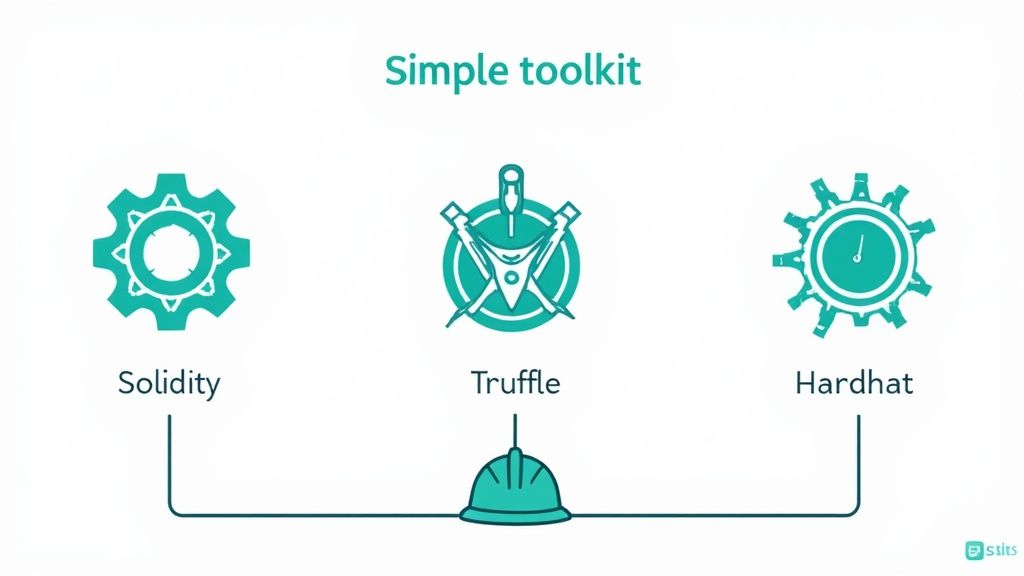
Choosing Your Toolkit
The right tools often depend on which blockchain you're building for. If you're working with Ethereum, the current market leader, you might gravitate towards a specific set of tools. It’s like picking the right wrench for the job.
This infographic highlights Ethereum's market dominance – a whopping 60% share, followed by Binance Smart Chain at 20%. The rest of the market is split among various other platforms. Ethereum’s popularity has a big impact on tool development, with many designed specifically for it.
Environment Management: Keeping Your Secrets Safe
Finally, don't overlook environment management. Something like dotenv to manage environment variables (especially your private keys!) is critical for security. Seriously, your private keys are like your crypto wallet password – protect them at all costs.
To help you choose the right tools, check out this comparison table:
Smart Contract Development Tools Comparison
A detailed comparison of popular development frameworks, IDEs, and testing tools with their strengths and use cases.
| Tool | Best For | Learning Curve | Key Features |
|---|---|---|---|
| Hardhat | Javascript Developers | Easy | Local Ethereum Network, Task Runner, Plugins |
| Truffle | Larger Projects, Javascript | Medium | Migrations, Console, Extensive Ecosystem |
| Remix | Beginners, Quick Prototyping | Easy | Browser-Based, Built-in Debugger |
| VS Code | Experienced Devs, Customizable | Medium | Solidity Extension, Powerful Debugging Features |
This table summarizes the key differences between some of the most popular development tools. Each has its own strengths, so choose based on your project and experience level.
With these essentials in place, your development environment will become a powerful ally in your smart contract journey. No more late-night battles – just smooth sailing and productive coding.
Choosing Your Programming Language Without Regrets
So, you're thinking about diving into the world of smart contracts? Awesome! But before you get lost in lines of code, there’s a big decision waiting for you: which programming language will be your coding sidekick? This choice really can make or break your project, so let's explore the options together.
Solidity: The King of the Hill
For a lot of developers, Solidity is the automatic choice for smart contracts. It's the native language of Ethereum, the biggest smart contract platform out there. This means you're tapping into a huge community, tons of helpful resources, and a high probability that someone, somewhere has already wrestled with – and solved – the same coding puzzle you're facing on Stack Overflow. Plus, Solidity's syntax is similar to JavaScript, which is great news for web developers making the jump to blockchain.
But like anything, Solidity has its quirks. It's a relatively new language, so it's had some growing pains and security hiccups over the years. This makes thorough testing absolutely crucial. Check out the official Solidity documentation to get a feel for it:
See how well-structured the Solidity documentation is? Clear guides, plenty of examples, even a built-in compiler. This kind of support is gold when you're learning. But remember, even with great docs, careful coding and lots of testing are still your best friends.
Beyond Solidity: Rust and Vyper
While Solidity’s currently on top, other languages are making a name for themselves. Rust, known for its focus on memory safety and speed, is becoming a popular choice for smart contracts. Its strict compiler is like having a super-powered code reviewer, catching errors before they cause trouble on the blockchain. Then there’s Vyper, a Python-like language, offering a simpler syntax and aiming for improved security and easier audits.
Picking a less-common language has trade-offs, though. You might get perks like better security or performance, but you’ll probably find a smaller community, fewer ready-made libraries, and maybe a steeper learning curve. It's a bit like venturing off the beaten path – more adventurous, but you need to be more self-reliant. If you're curious about blockchain jobs, browsing roles on Find Web3 can give you a sense of what languages are in demand.
The Job Market and the Bigger Picture
Your language choice can affect your job prospects, too. Solidity developers are hot right now, thanks to Ethereum’s market dominance. Smart contracts are booming across different industries; the market is expected to hit $12.77 billion by 2032, with a CAGR of 24.7% between 2024 and 2032. This crazy growth is driven by the need for secure, automated, and transparent processes in business. For more on smart contract trends, check out this article: Top 6 Smart Contract Programming Languages. But keep in mind, the blockchain world is always evolving, so other languages might rise in importance. Staying tuned to industry trends and being open to learning new languages is key for staying ahead in this fast-paced field. Picking your programming language is like choosing the foundation for a house – it affects everything that comes after, so think about your project’s needs, community support, and your long-term career goals before you decide.
Writing Smart Contracts That Actually Solve Problems
So, you've written your "hello world" smart contract. Now what? Moving into real-world smart contract development requires a change in perspective. Instead of simply tinkering with code, you're now building solutions to actual business problems. That’s a pretty big jump! Let’s explore how experienced developers approach this.
Thinking Like a Smart Contract Architect
Building practical smart contracts always starts with deeply understanding the problem at hand. What are you trying to achieve? A decentralized marketplace? A secure voting system? Maybe a supply chain tracker? Every use case has its own quirks and challenges. You’ll need to consider these from the start as you think through the contract’s logic and how it interacts with the outside world.
Imagine creating a decentralized escrow service, for instance. You’d need to carefully consider how funds are deposited, held securely, and then released. What happens if there’s a disagreement? How do you prevent someone from gaming the system? Questions like these form the foundation of your design process.
Mastering State Management
One of the most crucial parts of smart contract programming is state management. This refers to how your contract stores and updates information. If you don’t get this right, you’ll end up with bugs, security holes, or even worse, a completely broken contract.
From my experience, using enums or structs to define different states is a great way to stay organized. Think of it like keeping your closet tidy. Everything has its place, making it easy to find what you need and preventing a chaotic mess. This makes the code easier to read, understand, and audit later on.
Event Handling: Making Your Contract Talk
Smart contracts aren’t islands. They need to interact with the outside world. That’s where event handling becomes important. Events let your contract send out notifications when specific actions happen, enabling external applications and users to monitor what’s going on.
Let’s say a user deposits funds into our escrow contract. The contract can emit a Deposit event with the details – who deposited the funds and how much. This lets external systems track deposits and update their own records. It's like having a little news reporter built into your contract!
The Anatomy of Well-Structured Code
Well-structured smart contract code is like a well-designed building – easy to navigate, understand, and maintain. A few key principles always guide my work:
- Modularity: I break down complex logic into smaller, reusable functions. This makes testing and debugging so much easier.
- Clear Naming Conventions: Descriptive names for variables and functions are a must. Trust me, you'll thank yourself later when you're revisiting your code.
- Comments and Documentation: Explaining what your code does is critical, not just for others, but also for your future self!
This screenshot shows the Remix IDE, a fantastic tool for developing and debugging Solidity smart contracts. Look at the clean layout, syntax highlighting, and built-in debugging features. Remix can be a real lifesaver.
Common Pitfalls and Debugging Strategies
Even the best developers make mistakes. A frequent oversight is gas costs. Every operation on the blockchain costs gas, which translates to real money. Writing efficient code is crucial for keeping transaction fees down and making sure your contract is practical to use. Security is another critical area. Smart contracts are tempting targets for hackers, so robust security is essential.
Debugging smart contracts can be tricky. Tools like Remix and debuggers built into your IDE are indispensable. They let you step through the code, examine variables, and pinpoint exactly where things are going wrong. Mastering these tools will save you countless headaches.
Libraries vs. Rolling Your Own Solutions
Should you use existing libraries or build your own solutions? There's no single answer. Libraries offer pre-built functions, which saves time. However, using someone else's code introduces potential security risks. Always carefully audit any library before you include it in your project. If you decide to build your own, keep it simple and clear. Overly complicated code is a breeding ground for bugs and makes auditing much more difficult.
Smart Contract Security Best Practices
Essential security patterns and common vulnerabilities to avoid when programming smart contracts are outlined in the table below. It's worth spending time studying these to prevent potentially disastrous exploits.
| Security Pattern | Purpose | Implementation | Risk Level |
|---|---|---|---|
| Input Validation | Prevent invalid data from entering the contract | Require checks on all inputs | High |
| Access Control | Restrict functions to authorized users | Use modifiers like onlyOwner | High |
| Reentrancy Guard | Prevent malicious re-entrant calls | Implement checks-effects-interactions pattern | High |
| Integer Overflow/Underflow | Prevent unexpected behavior due to integer limits | Use SafeMath library | Medium |
| Gas Limit Management | Prevent denial-of-service attacks | Carefully estimate gas usage | Medium |
| Error Handling | Gracefully handle unexpected errors | Use require, assert, and revert statements | Medium |
This table summarizes some of the most important security considerations in smart contract development. Addressing these proactively will significantly strengthen your contracts.
By mastering these core principles, you can create robust, secure, and efficient smart contracts that solve real-world problems. It’s a tough but rewarding journey, and the skills you develop will be invaluable as the blockchain space continues to evolve.
Testing Strategies That Catch Expensive Bugs Early
This screenshot shows the Hardhat development environment. It's a popular choice for smart contract development, and you can see why. The clear structure really emphasizes the importance of testing right within the framework. Hardhat gives you a solid foundation for writing, compiling, and, yes, testing your Solidity code.
When it comes to smart contracts, testing isn't just a best practice, it's mission-critical. We're talking about code that handles real money. A tiny bug can have disastrous consequences. I've heard some real horror stories from fellow developers – glitches that drained funds or locked up entire systems. Let's dive into the testing strategies that can save you from those headaches.
Unit Testing: The Foundation of Confidence
Unit tests are the bedrock of any reliable smart contract. These tests zero in on small, isolated parts of your code—individual functions or even specific lines of logic. It’s like checking each part of an engine before putting the whole thing together. For smart contracts, this means meticulously testing each function to ensure it behaves exactly as expected with various inputs and edge cases. Frameworks like Mocha and Chai give your tests structure and efficiency. I'm a big fan of Chai's assertion style – it keeps tests readable and easier to debug.
Unit tests are vital, but they don't catch everything. What happens when your contract interacts with other contracts or outside systems?
Integration Testing: Making Sure the Pieces Fit
That’s where integration tests come into play. Think of them as a dress rehearsal. They ensure all the different parts of your system work together smoothly. In the smart contract world, this could involve testing how your contract interacts with a DeFi protocol or an oracle feeding in external data.
So you've got your tests. But are they enough?
Test Coverage: Aiming for Comprehensive Protection
Test coverage helps you answer that question. This metric tells you what percentage of your code your tests actually exercise. Higher coverage means you’ve vetted more of your code, leaving fewer places for bugs to hide. Don’t get obsessed with 100% coverage though. Sometimes, getting those last few percentage points just isn't worth the effort. Focus on the critical parts of your contract's logic.
Advanced Testing Techniques: Going Beyond the Basics
Want to take your testing to the next level? Check out these advanced techniques:
- Property-based testing: This automatically generates tons of test cases, often uncovering edge cases you'd never think of.
- Formal verification: This uses mathematical proofs to verify the correctness of your code, giving you the highest level of certainty.
Testing Complex Interactions and Network Conditions
Smart contracts live in a messy world. You need to test how your contract handles different network conditions. Simulating network congestion, high gas prices, or even deliberate attacks can reveal hidden weaknesses.
Imagine a decentralized exchange with multiple interacting contracts. You’d want to test what happens if one of those underlying contracts fails. Does your contract handle the failure gracefully? Or does it trigger a system-wide meltdown?
Learning from Real-World Failures
One of the smartest things you can do is learn from other people’s mistakes. Reading post-mortems of smart contract hacks and exploits can be incredibly valuable. You’ll start to recognize common vulnerabilities and get new ideas for improving your testing. By the way, if you're interested in this kind of work, there are a lot of Web3 engineering jobs out there.
A comprehensive testing strategy is a safety net for your project and your users. It gives you the confidence to deploy your code, knowing you've done everything possible to prevent those costly, and often embarrassing, bugs.
Deploying to Mainnet Like a Professional
Deploying a smart contract to mainnet can feel a bit like stepping into the boxing ring for the final round. You’ve trained hard, practiced your moves, and now it’s time for the real deal. It's natural to feel a little apprehensive, but with the right prep work, you can approach deployment with confidence.
Preparing for Launch
Before you even think about hitting that deploy button, take a deep breath and review everything one last time. Seriously, I can’t stress this enough. Go over your testing strategy again. Did you really cover all the crucial edge cases? Did you simulate different network conditions, like high traffic or network congestion? And have you thought about how your contract will interact with other contracts already out there in the wild west of mainnet?
A fresh perspective can be invaluable, so consider grabbing a colleague for a code review and a second look at your test cases. Trust me, it’s much better to catch issues now than after deployment.
For smoother deployments, look into DevOps automation tools. These tools can automate a lot of the repetitive and error-prone tasks involved in deploying, letting you focus on the more important aspects.
Gas Optimization and Deployment Scripts
Gas costs are a real thing on mainnet. Those small testnet fees can become surprisingly hefty when you deploy to the live network. Optimize your contract's gas usage before you deploy. Gas reporters can be super helpful for pinpointing areas where you can save some gas.
Deployment scripts are also your best friend. They automate the whole deployment process, ensuring it's consistent every time and reducing the risk of human error. I learned this the hard way early in my career. I mistyped an address during a manual deployment once, and it cost me a lot of time and a few gray hairs.
Verification and Monitoring
Once your contract is deployed, verify it on a block explorer like Etherscan. This makes your code publicly visible, which builds trust and transparency within the community.
This screenshot shows what a verified contract looks like on Etherscan. You can see all the important details clearly laid out: contract address, source code, even the ABI. This kind of transparency is essential for building trust. Users can see exactly what your contract does, which gives them confidence.
This transparency is becoming even more important as the smart contract market grows. It’s projected to reach $7.45 billion by 2029, with a 23.4% CAGR. You can read more about that growth here.
Set up monitoring systems to keep an eye on your contract’s performance and to alert you if anything unexpected happens. Early warnings can save you a lot of trouble down the line. I once deployed a contract with a subtle bug that I completely missed during testing. My monitoring system picked up on unusual transaction patterns within hours, and I was able to fix the problem before it became a major issue.
Contract Upgrades and Data Migration
Think about contract upgrades from the very beginning. The blockchain space evolves rapidly, and you'll almost certainly need to update your contract eventually. Designing your contract with upgradeability in mind, using patterns like proxy contracts, can save you a ton of headaches later on.
Data migration can be tricky during upgrades. I’ve seen projects really struggle with this, leading to lost user data or inconsistencies. Careful planning and extensive testing are essential for smooth data migration.
Post-Deployment Checklist
Deploying to mainnet isn't the finish line; it's more like a checkpoint. Here’s a quick post-deployment checklist:
- Verify Contract Functionality: Double-check that everything works as expected on mainnet.
- Monitor Gas Usage: Keep track of gas costs to make sure your contract stays efficient.
- Security Audits: Consider getting a professional security audit to find any vulnerabilities you might have missed.
- Community Engagement: Keep your community updated on any changes and address any questions or concerns they might have.
Deploying to mainnet is a big step, but by approaching it strategically and systematically, you can significantly increase your chances of success. Remember, your smart contract is a living, breathing piece of software that requires ongoing care and attention.
Maintaining and Evolving Your Smart Contract System
Deploying a smart contract isn't the end of the road. It's more like launching a satellite – constant monitoring, adjustments, and upgrades are essential. Let's dive into the less glamorous, but equally important, world of smart contract maintenance and evolution.
Monitoring and Optimization
Keeping a close eye on your contract's performance, gas usage, and any unexpected quirks is crucial once it's live. Set up alerts for unusual activity like spikes in gas usage or failed transactions – anything that deviates from the norm. I learned this the hard way. Once, a subtle bug in one of my contracts was triggered by a specific combination of user inputs. Luckily, my monitoring system flagged unusual gas spikes, alerting me before things spiralled out of control.
Gas optimization is a continuous process. Real-world usage data can reveal optimization opportunities you might have missed initially. Tools like gas profilers can help you identify and refine the gas-guzzling parts of your code.
Upgrades and Governance
Smart contracts rarely stay static. New features, bug fixes, and adapting to blockchain changes are all part of the journey. Planning for upgrades from the outset is essential. Proxy contracts or upgradeable contracts allow you to modify your contract's logic without starting from scratch. This minimizes disruption and keeps your system flexible.
But even with these patterns, upgrades carry inherent risks. Thorough testing and meticulous planning are non-negotiable for successful upgrades.
Security Updates and Community Feedback
This screenshot highlights OpenZeppelin, a fantastic resource for smart contract developers. They offer pre-built, audited contracts and libraries that can seriously boost the security of your projects – reducing the risk of reinventing the wheel and potentially introducing vulnerabilities.
Security is paramount in the smart contract space. Regular internal and external code audits are a must. Staying up-to-date on the latest security best practices and vulnerabilities is critical. Check out this article on securing REST APIs, Securing Jira Server’s REST API with Personal Access Tokens, for some helpful security insights. Respond quickly to any reported vulnerabilities and patch your contracts promptly.
Engage with your community! Encourage feedback, bug reports, and feature requests. A responsive and transparent development team builds trust and helps create a system that truly meets user needs. Speaking of communities, if you're interested in the NFT space, check out the NFT jobs board on Find Web3.
Maintaining a smart contract system is an ongoing commitment. It's a continuous cycle of monitoring, optimization, upgrading, and adapting to the evolving needs of your users and the blockchain ecosystem.
Your Next Steps in Smart Contract Development
So, you've reached this point. You've got your environment all set up, chosen your language, written your contracts, tested them thoroughly, and even deployed to mainnet. Kudos! But your journey as a smart contract developer isn’t over yet. It's like nurturing a garden – you've planted the seeds, now you need to help them grow.
Level Up Your Skills
Smart contract development is constantly evolving. Staying up-to-date is key to long-term success. Don't hesitate to delve deeper into the language you've chosen. Explore more advanced concepts like gas optimization, formal verification, and secure coding patterns. Resources like the Solidity documentation and platforms like Cyfrin, with its great articles on blockchain security and development, are incredibly helpful.
I personally found that focusing on gas optimization early on really saved me money and headaches down the road. It's easy to overlook, but it makes a big difference.
Find Your Tribe
Connect with other developers by joining online communities and attending meetups (both virtual and in-person). Sharing knowledge, discussing challenges, and learning from others' experiences is invaluable. It’s like having a built-in support system to guide you through those inevitable coding hurdles. Find Web3 is a fantastic resource for community connections.
I remember hitting a wall with a particularly tricky integration problem. Posting about it in a developer forum led to not just a solution, but a valuable connection with a fellow developer.
Build a Portfolio That Speaks Volumes
Hands-on projects are the best way to showcase your skills. Start small with personal projects to gain practical experience. Contributing to open-source projects is another great way to learn from more experienced developers and get feedback on your code. As you grow more confident, consider tackling bigger projects or even freelancing to expand your portfolio.
One of my first projects was building a simple decentralized voting app. It wasn't flashy, but it taught me a ton about interacting with different smart contracts.
Networking: It’s Not Just About Handshakes
Networking in the blockchain world is about forging genuine relationships. Participate in online discussions, share your insights, and contribute to the community. Attend conferences and workshops—they're amazing opportunities to meet potential collaborators and employers. Remember, relationships are a long-term investment.
I landed my first blockchain job through a connection I made at a local blockchain hackathon. It was all about showing genuine interest in the work they were doing.
Realistic Timelines and Honest Assessments
Mastering smart contract development takes time and dedication. Don't get discouraged if you're not an expert overnight. Set achievable goals, focus on continuous learning, and celebrate your progress. Be honest about your strengths and weaknesses. Identify areas for improvement and actively look for resources and mentors to guide you.
Early on, I struggled with understanding certain security concepts. Finding a mentor who could break down these concepts in a way that made sense was a game-changer.
Whether you're looking for a blockchain developer role, building your own DeFi protocol, or integrating smart contracts into current business processes, your next steps involve constant learning, community engagement, and practical experience. It's a challenging but incredibly rewarding path.
Ready for the next step in your Web3 journey? Check out the thousands of blockchain and crypto jobs on Find Web3.