
If you've ever wondered what gives a cryptocurrency its value, you've come to the right place. The answer lies in its tokenomics. This isn't just a buzzword; it's the economic engine of any digital asset, a portmanteau of "token" and "economics."
Think of it as the rulebook for a digital economy. This rulebook dictates everything from how many tokens will ever exist to who gets them and why. It’s the monetary policy for a project, all written in code.
What Is Tokenomics and Why It Matters

Let's use an analogy. A country's central bank manages its currency. It decides how much money to print, influences interest rates to guide economic behavior, and fights to keep inflation in check. Tokenomics does the exact same job for a crypto project, but it’s all out in the open and automated on the blockchain.
This economic design is the heart and soul of a crypto project. A project might have the most brilliant technology imaginable, but with weak tokenomics, it's like building a mansion on a sinkhole. Sooner or later, economic reality will cause it to collapse.
The Foundation of Digital Value
Getting a grip on tokenomics is what allows you to see past the marketing noise and evaluate a project's true potential. It's about understanding the core economic levers: how many tokens exist, how they're released over time, who got them first, and what you can actually do with them.
A well-designed tokenomics model makes sure everyone is pulling in the same direction. It aligns the incentives of the developers, investors, and users so that what's good for the individual is also good for the entire network.
This alignment is the secret sauce that separates projects built for the long haul from those that are just a flash in the pan. It's why employers in the Web3 space, especially those hiring for https://findweb3.com/jobs/defi, prize candidates who can dissect and understand these economic models.
More Than Just Fundraising
Back in the early days of crypto, tokens were often little more than a way to raise money in an ICO. That's changed completely. Today, a token's design is a powerful tool used to encourage specific actions, secure the network, and build a vibrant, self-sufficient economy.
For many projects, tokens are also a way to secure non-dilutive funding for startups, allowing them to raise capital without giving away equity.
At its core, understanding tokenomics is about answering three simple but powerful questions about any token:
- Why does it exist? This gets at its purpose and utility.
- Why should it be valuable? This forces you to look at its supply and demand.
- Why should I trust it? This is all about its distribution and incentive model.
When you can answer these, you're no longer just guessing. You're analyzing. You're equipped to spot real innovation and sidestep the hype. This guide will show you how.
Deconstructing a Token's Economic Blueprint

To really get a feel for a crypto project, you have to pop the hood and look at its economic engine. This blueprint, what we call tokenomics, is made up of a few key parts that all work together to define a token's value, its job, and where it's headed long-term.
Think of each component as a chapter in the project's story. Let's break down the essentials that anyone—whether you're an investor or just a curious user—should be looking at. These are the building blocks that give a digital asset real structure and purpose.
The Critical Role of Token Supply
First up, and arguably the most fundamental piece, is token supply. This is all about scarcity, which is a massive driver of value. It’s a lot like gold mining; the less gold there is in the world, and the tougher it is to find more, the more valuable each ounce becomes.
When you look at supply, you'll usually see it broken down into three key numbers:
- Circulating Supply: This is the number of tokens actually floating around in public hands, being traded on exchanges. It’s the "liquid" part of the supply.
- Total Supply: This bucket includes every token that has ever been created, minus any that have been verifiably "burned" or destroyed. It also counts tokens that are locked up or reserved and not on the open market yet.
- Maximum Supply: This is the absolute, hard-coded limit on how many tokens can ever exist. Bitcoin's famous 21 million cap is a perfect example of creating digital scarcity.
Knowing the difference here is huge. A project might have a small circulating supply that makes it look rare, but if there's a massive total supply waiting in the wings, it could seriously dilute the value for everyone else later on.
How Tokens Get Into People's Hands
Next, we have token distribution. This simply explains how the tokens are handed out in the beginning. Honestly, this is one of the most telling parts of a project’s tokenomics—it shows you how fair the project aims to be and whether it's truly focused on building a community.
Distribution can happen in a few different ways, each with its own pros and cons:
- Initial Coin Offerings (ICOs): One of the old-school methods where projects sell tokens directly to the public to raise money.
- Airdrops: Free tokens sent to specific wallets, often as a way to kickstart a community or reward early believers.
- Fair Launches: These try to level the playing field by releasing tokens on the open market with no pre-sales or team allocations, giving everyone the same shot.
A project's distribution plan is a window into its soul. If the founding team holds a huge, unlocked stash of tokens, that can be a major red flag. On the other hand, a wide, fair distribution to the community is a great sign of decentralization and long-term health.
What's the Point? The Token's Utility
So, what can you actually do with the token? This is the question of token utility. A token without a real job in its ecosystem is often just a speculative asset with no staying power. Real utility weaves the token into the very fabric of the platform.
A token's job can be many things:
- Governance: Holders get to vote on proposals that steer the project's future.
- Platform Access: You might need the token to use certain features or services.
- Native Currency: It can be the main way to pay for things within its own ecosystem.
This function is what gives a token real, intrinsic demand. The way tokens are designed and distributed is the core of tokenomics, which you can read more about by exploring the fundamental concepts of tokenomics. It's all about how these assets guide user behavior toward a common goal.
Giving People a Reason to Participate
Finally, a solid tokenomics model needs strong incentive mechanisms. These are the rewards and rules designed to encourage people to act in ways that help the whole network. Without good incentives, a project will struggle to attract the users, validators, and liquidity it needs to thrive.
The most common incentive you'll see is staking. Users can lock up their tokens to help secure the network, and in return, they earn more tokens as a reward. This not only keeps the blockchain safe but also helps reduce the circulating supply, since those staked tokens are temporarily out of play. These mechanisms are the glue holding the digital economy together.
Understanding Token Supply and Demand
The value of anything—whether it's a first-edition comic book or a barrel of oil—comes down to the timeless dance between supply and demand. Crypto is no different. This fundamental principle is the very engine of a token's economy, and understanding it is how you learn to spot a sustainable project versus one built on shaky ground.
When you get right down to it, the analysis asks a simple question: will there be more or fewer tokens over time, and what makes people want to hold them? A project's answer to this question places its economic model into one of two main camps. This is where tokenomics stops being theoretical and starts having very real financial consequences.
Inflationary Models: Fueling Growth
First up, we have inflationary models. In this setup, the total number of tokens is designed to increase over time. New tokens are regularly minted and released into the wild, most often as rewards for people who help keep the network running.
It’s a lot like a company issuing new stock to raise capital for expansion. Staking rewards are a perfect example. When users lock up their tokens (a process called staking), they help secure the network and validate transactions. The protocol thanks them for their service by creating new tokens and paying them out as a reward. This inflation is a powerful incentive that encourages the participation needed to keep the ecosystem healthy and secure.
But there's a catch. An inflationary model that isn't carefully managed can be a double-edged sword. If new tokens are printed too aggressively without a real increase in demand, the value of every single token gets watered down, leaving existing holders in a tough spot. The trick is to strike a delicate balance between new supply and genuine network growth.
Deflationary Models: Creating Scarcity
On the other side of the coin are deflationary models. Here, the total supply of tokens is programmed to shrink over time. This is done through a mechanism called a token burn, where tokens are sent to a dead-end "burner" address, permanently taking them out of circulation.
Think of it as a public company buying back its own shares to make the remaining ones scarcer and, hopefully, more valuable. That's exactly what a token burn accomplishes in the digital world. It introduces scarcity, a potent driver of value. A famous real-world example is Ethereum's EIP-1559 update, which began burning a portion of every transaction fee, putting constant downward pressure on the total supply of ETH.
A token burn is a clear, programmatic commitment to making an asset scarcer. When demand remains steady or grows while supply shrinks, basic economics suggests the price should increase over time.
Preventing Price Dumps with Vesting and Lock-Ups
Even with a brilliant supply model, a project's future can be torpedoed by its earliest backers. If the team, advisors, and big-money investors get a huge chunk of tokens and can sell them all on day one, they could easily crash the price, wiping out the community members who came in later.
This is where two essential safeguards come into play:
- Vesting Schedules: This is simply a release schedule for insider tokens. Instead of getting a massive bag of tokens all at once, their allocation unlocks gradually over a set timeframe, often 2-4 years. This forces them to have skin in the game and care about the project's long-term health.
- Lock-up Periods: Think of this as an initial waiting period before the vesting schedule even kicks in. A project might implement a one-year lock-up, meaning no team or investor can sell a single token for the first full year. This proves they're committed to building real value before cashing out.
Together, vesting and lock-ups are non-negotiable parts of any respectable tokenomics model. They shield the community from catastrophic sell-offs and show that the founding team is dedicated to the long haul, not just a quick flip. By paying close attention to these supply dynamics, you can start to tell the difference between a sustainable digital economy and a ticking time bomb.
Your Framework for Evaluating Tokenomics
Alright, now that we’ve covered the core concepts, it's time to put that knowledge to work. Knowing the theory is one thing, but applying it is how you separate promising projects from those just riding a wave of social media hype.
This isn't about finding some secret formula. It's about developing a consistent process—a mental checklist—that lets you ask the right questions every single time. Building this skill gives you the confidence to look past the flashy marketing and see the project for what it really is: a tiny digital economy with its own set of rules.
Start With the Project's Blueprint
Every serious crypto project has a whitepaper. Think of this as the project's constitution and business plan rolled into one. It’s your single most important document and the first place you should go to understand the project's goals, its tech, and, most critically, its tokenomics.
If you can't find a whitepaper, or if the one you find is just a mess of vague promises and marketing buzzwords, that’s a massive red flag. Transparency isn't just a nice-to-have in this world; it's the bedrock of trust. If you come across unfamiliar terms, our Web3 dictionary is a great resource to keep handy.
Key Questions for Your Checklist
As you dig into a project's documentation, you’re essentially on a fact-finding mission. Your goal is to build a complete picture of its economic engine.
Here are the essential questions that should form the backbone of your analysis:
What Does the Token Actually Do?
- What problem does this token solve inside its ecosystem?
- Is there a real reason for anyone to buy, hold, or use it besides just hoping the price goes up?
- Does the token's purpose feel natural and necessary, or does it feel tacked on just to have a token?
How Is the Supply Designed?
- What are the numbers for circulating supply, total supply, and maximum supply?
- Is the supply designed to be inflationary (new tokens are created) or deflationary (tokens are removed)?
- If it's inflationary, are the rewards for creating new tokens sustainable? Are they tied to real value creation or just printing money out of thin air?
Who Owns the Tokens?
- How were the tokens first created and distributed? Was it a "fair launch" where everyone had a chance, or an ICO that gave huge chunks to private investors?
- What percentage of the supply is held by the team, advisors, and early investors?
- Crucially, are these insiders subject to strict vesting schedules and lock-up periods? If not, they could dump their tokens on the market at any time—a serious risk for everyone else.
"Tokenomics is a core element for investors looking at the cryptocurrency space, as it defines the financial structure and operational rules of tokens within their ecosystems. A complete understanding of tokenomics lets investors judge a token's long-term viability instead of just its speculative hype." — TokenMetrics on investment strategy
Where to Find the Real Answers
The whitepaper is your starting point, but you can't just take the team's word for it. You have to verify their claims. This step is about cross-referencing what they say with what’s actually happening.
On-Chain Explorers: This is where the truth lives. Tools like Etherscan (for Ethereum) or Solscan (for Solana) are your best friends. They let you look directly at the blockchain to verify total supply, see who the largest holders are (the "whales"), and watch how tokens are moving in real-time.
Official Documentation: Look beyond the whitepaper. Good projects have extensive developer docs, detailed blog posts, and forum discussions that provide much more context on the token's mechanics.
Community Channels: Official Discord and Telegram groups can be noisy, but they are also a place to ask the team tough questions directly. How they respond—or don't respond—can tell you a lot.
By using this framework, you stop being a passive spectator and become an active analyst. You'll quickly learn to spot the red flags—like shady token allocations, a useless token, or runaway inflation—and, more importantly, identify the projects with sound economics built to last.
Tokenomics in Action: Real-World Case Studies
Theory is great, but seeing tokenomics play out in the wild is where the lightbulb really goes on. To truly get a handle on how these economic designs work, let's look at the two titans of crypto: Bitcoin and Ethereum. Each took a fundamentally different path, and comparing them shows just how much those initial design choices shape a token's entire economic life.
By putting Bitcoin and Ethereum side-by-side, we can move from abstract ideas to concrete examples. You'll see how the principles we've discussed translate into real-world value, network security, and long-term evolution.
Bitcoin: The Original Deflationary Model
Bitcoin (BTC) is the poster child for a deflationary asset. Its tokenomics are famously straightforward, rigid, and predictable—a simplicity that has become one of its greatest assets. The entire economic model is built on one core principle: absolute, verifiable scarcity.
At the heart of this model is its hard-coded maximum supply of 21 million coins. That’s it. There will never be more, a rule baked into the network's code that is virtually impossible to change. This immediately establishes Bitcoin as a finite digital resource, much like a digital version of gold.
This scarcity is powerfully reinforced by a mechanism known as the halving.
- Roughly every four years (specifically, every 210,000 blocks), the reward paid to miners for validating transactions gets cut in half.
- This event methodically slows down the rate at which new Bitcoin is created and enters the market.
- The latest halving in April 2024 dropped the block reward from 6.25 BTC to just 3.125 BTC.
This predictable squeeze on new supply—what economists call a supply shock—is central to Bitcoin's identity. As the creation of new coins dwindles, the existing supply becomes rarer and rarer, especially if demand holds steady or grows. Bitcoin's tokenomics are laser-focused on one job: being a secure and predictable store of value. Its simplicity isn't a bug; it's the defining feature.
The image below gives a great visual of how a fixed supply model like Bitcoin stacks up against a more flexible, potentially inflationary one.
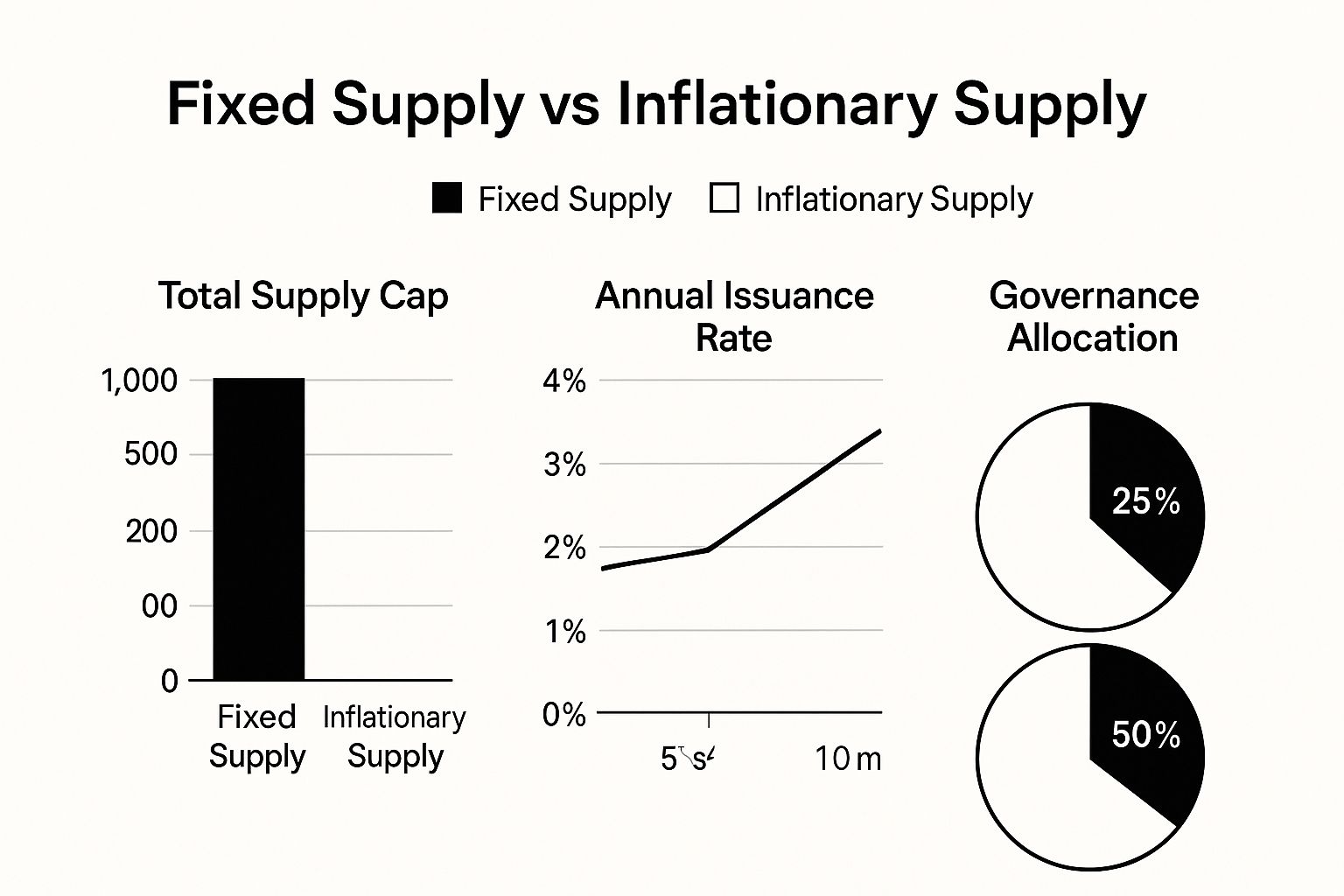
As you can see, fixed supply models give you a predictable, capped total, while inflationary models can have a much more variable rate of issuance over time.
Ethereum: The Dynamic Economic Engine
In stark contrast to Bitcoin's unchangeable rules, Ethereum (ETH) has a much more dynamic and adaptive economic model. If Bitcoin is digital gold, Ethereum is designed to be a decentralized world computer. Its tokenomics are built to support that vision, focusing on utility and network activity.
Unlike Bitcoin, Ethereum has no fixed maximum supply. Instead, its supply is determined by a constant push-and-pull between two forces:
- Issuance: New ETH is created as a reward for validators who stake their own ETH to help secure the network. This adds to the supply, creating inflationary pressure.
- Burning: A portion of every transaction fee is permanently destroyed, or "burned," thanks to a game-changing 2021 update called EIP-1559. This removes ETH from the supply, creating deflationary pressure.
The balance between ETH being issued to stakers and ETH being burned from transaction fees is what dictates whether the supply is growing or shrinking at any given moment. When the network is buzzing with activity, it’s possible for more ETH to be burned than is created. This phenomenon has led the community to dub it "ultrasound money."
This design cleverly links the token's scarcity directly to its usefulness. The more people use the Ethereum network, the more fees they pay, and the more ETH gets burned. It's a feedback loop where demand for the platform reinforces the value of the asset. This complex model is always evolving, driven by a massive community of developers and economists. This focus on utility has also opened up thousands of career paths, with many opportunities available on platforms listing crypto jobs.
Bitcoin vs. Ethereum Tokenomics Comparison
To really nail down the differences, a side-by-side table is the best way to see how these two tokenomic philosophies diverge.
| Feature | Bitcoin (BTC) | Ethereum (ETH) |
|---|---|---|
| Max Supply | Fixed at 21 million | No fixed maximum supply |
| New Issuance | From mining rewards (halves every 4 years) | From staking rewards (variable) |
| Scarcity Driver | The hard cap and predictable halvings | Transaction fee burning (EIP-1559) |
| Primary Goal | To be a secure, decentralized store of value | To power a decentralized computational platform |
| Flexibility | Extremely rigid and difficult to change | Highly flexible and subject to community upgrades |
Ultimately, what these two crypto giants prove is that there's no single "right" way to design tokenomics. Bitcoin’s rigid scarcity and Ethereum’s dynamic, utility-driven model both present compelling—though very different—value propositions. Understanding these real-world examples is the key to critically analyzing the economic design of any other project you come across.
Common Questions About Tokenomics
As you get your feet wet in the world of crypto, you'll find that some questions pop up again and again. You might grasp the basics—supply, distribution, utility—but seeing how they play out in the real world can be a messy business.
Let's tackle some of the most common sticking points head-on. Getting these concepts down will help you analyze projects with a much sharper eye and spot red flags others might miss.
Can a Project Just Change Its Tokenomics?
This is a huge one, and the honest answer is, "it depends." Technically, yes, a project’s economic rules can be changed. But whether that’s even possible, or a good idea, boils down to a single, critical concept: governance.
Take a highly decentralized project like Bitcoin. Trying to change its core tokenomics—like the famous 21 million supply cap—is practically impossible. It would require getting a massive majority of thousands of independent miners and node operators across the globe to agree. That difficulty is actually a core feature, giving Bitcoin its predictable, store-of-value reputation.
However, many newer projects, especially in the DeFi space, are built differently, with more flexible governance.
- On-Chain Governance: In these systems, the token holders themselves can propose and vote on changes directly on the blockchain. If a proposal to tweak staking rewards or adjust a token burn mechanism gets enough votes, the smart contracts can update automatically.
- Team Control: In more centralized projects, the founding team might keep the power to make changes through special admin keys or multisignature wallets. This is pretty common in a project's early days, but it becomes a much bigger risk as the project grows.
A change in tokenomics isn't inherently bad. Sometimes it's a necessary adjustment to new market conditions. The real question is who gets to make that change and how open the process is. An unexpected, top-down change can signal instability, whereas a community-approved one can be a sign of a healthy, evolving project.
Is Good Tokenomics a Guarantee of Success?
Absolutely not. While solid tokenomics is vital for a project's long-term health, it's just one piece of a much bigger puzzle.
Think of it like having a perfectly engineered race car engine. That engine is completely useless if it's dropped into a car with no wheels, a broken steering wheel, and a rusted-out frame.
Excellent tokenomics can't save a project that’s fundamentally broken in other areas. A project’s success depends on many things working together:
- Product-Market Fit: Is the project actually solving a real problem that people will use?
- Technology and Security: Is the code solid, secure, and built to scale? A history of hacks or bugs will kill trust, no matter how good the token model is.
- Team and Community: Is the team experienced and transparent? Is the community active, engaged, and genuinely supportive?
- Market Conditions: Sometimes, broad market trends and shifting narratives can sink even the most well-designed projects.
A project with a brilliant deflationary model will still fail if its platform is a pain to use or if nobody actually wants what it’s offering. Strong tokenomics creates the potential for sustainable value, but it's the product, team, and community that have to follow through. And while understanding a project is key, it's just as important to protect what you hold. Exploring different cryptocurrency security solutions is always a smart move.
What Is the Difference Between Tokenomics and Token Metrics?
This is a subtle but important distinction that trips a lot of people up. The terms are often thrown around interchangeably, but they refer to different levels of analysis. Nailing this difference will make you a much sharper crypto analyst.
Here’s a simple way to think about it: tokenomics is the why, while token metrics are the what.
Tokenomics is the big-picture, strategic blueprint. It’s the economic theory and philosophy behind the token—the "-omics" part of the word. It answers questions about the rules and incentives that govern the entire system.
- Why does this token have a burn mechanism?
- How are stakers rewarded for securing the network?
- What is the long-term vision for making the asset scarce?
Token Metrics, on the other hand, are the specific, hard numbers that result from that tokenomics model. They are the raw stats you look at to size up a project at any given moment.
| Aspect | Tokenomics (The "Why") | Token Metrics (The "What") |
|---|---|---|
| Supply | The strategy is to make the asset deflationary over the long run. | The current circulating supply is 150 million. |
| Distribution | The plan is to distribute tokens fairly to build a decentralized community. | The team holds 12% of the supply, vesting over 3 years. |
| Value | The model is designed to share platform fees with long-term holders. | The 24-hour trading volume is $4.2 million. |
In short, tokenomics is the rulebook for the game. Token metrics are the current score. You need to understand the rules (tokenomics) to make any sense of the score (token metrics).
Ready to turn your Web3 knowledge into a career? Find Web3 is the premier job board for the blockchain industry, connecting top talent with innovative companies. Explore thousands of roles in engineering, marketing, and more. Start your search today at https://findweb3.com.