
Think of yourself as a digital locksmith, but instead of tumblers and pins, you're working with complex math to create unbreakable locks. These aren't just for a treasure chest; they protect everything from your bank account details to sensitive government secrets. This is the reality of a career in cryptography, a field that has quietly become one of the most essential and rewarding pillars of our modern world.

Why Is a Career in Cryptography So Valuable?
In a world running on data, cryptography is the very foundation of digital trust. Every time you tap your card to pay, send a "private" message on an app, or access your medical records online, you're counting on the invisible work of a cryptographer. They are the master architects of digital privacy, designing the sophisticated mathematical frameworks that keep prying eyes away from sensitive information.
This non-stop demand for data protection has led to a major talent crunch. In fact, the U.S. Bureau of Labor Statistics forecasts an impressive 11% jump in jobs for information security professionals—which includes cryptographers—by 2033. That's way faster than the average for most jobs, and it paints a clear picture: we desperately need experts who can build and maintain our digital fortresses. If you're curious about the specifics, you can explore the detailed career outlook for cryptographers and see the numbers for yourself.
The Bedrock of Digital Trust
At its core, a career in cryptography is about solving some of the world's most high-stakes puzzles. People in this field don't just use off-the-shelf security tools; they invent entirely new ones. It’s a constant cat-and-mouse game where you have to stay one step ahead of hackers, anticipate future threats, and even develop "quantum-resistant" algorithms to fend off attacks from technologies that don't even exist yet.
One of the biggest drivers for modern cryptography is the “harvest now, decrypt later” threat. This is where attackers steal huge volumes of encrypted data today, betting they’ll have the technology to crack it years from now. This urgency makes the work of cryptographers more critical than ever.
This forward-thinking approach is what makes the field so challenging—and so incredibly exciting. It’s not a job where you can get comfortable. It's a continuous cycle of strategy, innovation, and outsmarting the opposition.
A Snapshot of the Opportunity
To really grasp the value of a career in this space, it helps to look at the hard numbers. This brief table summarizes the key data points you should know if you're considering this path.
Cryptography Career Snapshot
| Metric | Statistic | Key Takeaway |
|---|---|---|
| Projected Job Growth | 11% by 2033 | The field is expanding much faster than the average occupation. |
| Typical Education | Bachelor's in CS/Math | A solid technical degree is the most common starting point. |
| Average Salary Range | $100,000 – $170,000+ | High-level expertise commands a significant salary. |
| Key Industries | Tech, Finance, Government | Cryptographers are in demand across many high-stakes sectors. |
As you can see, the data speaks for itself. With robust job growth, excellent earning potential, and opportunities in critical industries, cryptography offers a secure and impactful career path for those with the right skills and mindset.
So, what does a cryptographer actually do all day? It's a role that sounds pretty abstract, but the reality is much more hands-on than just scribbling complex math on a whiteboard. Think of them as the master architects and quality inspectors for our digital world's security.
Their days are a mix of deep, creative thinking and rigorous, methodical testing. It's less about a single, repetitive task and more about a constant cycle of building, breaking, and rebuilding security systems to stay ahead of an ever-changing threat landscape.
Let's use an analogy. Imagine you're hired to build a cutting-edge bank vault. You wouldn't just focus on making a thick door. Your job would be to design the entire security system—the locks, the alarms, the surveillance, and all the procedures—from the ground up. That's a cryptographer in a nutshell.
Designing Digital Fortresses
A huge chunk of a cryptographer's time is dedicated to designing and developing new cryptographic systems. This is where the innovation happens. For instance, when a company is about to launch a new mobile banking app, a cryptographer is the one who designs the encryption protocols that shield everything from your login credentials to your transaction history as it zips between your phone and the bank's servers.
This process involves more than just picking a strong algorithm off a shelf. They have to decide on appropriate key lengths, map out the entire data flow, and create a system that's not only ironclad but also fast and efficient enough not to slow things down for the user. They are literally creating digital locks that are, for all practical purposes, impossible to pick.
A cryptographer’s challenge is to build systems that are secure against the attacks we see today and those we can only imagine. This means looking over the horizon at things like quantum computing and how it could one day shatter our current encryption standards.
Probing for Weaknesses
Once a system is built, the work isn't over. In fact, it’s just beginning. The second core function of a cryptographer is cryptanalysis—the art and science of trying to break codes. They don't just build the locks; they also have to be master lockpickers, relentlessly trying to find weaknesses in their own creations and in existing systems.
This "ethical hacking" is what separates good security from great security. It’s all about finding a flaw before a real attacker does. Some of their daily work might include:
- Scrutinizing algorithms to hunt for subtle mathematical weaknesses.
- Creating theoretical attacks to see how a security protocol holds up under pressure.
- Performing detailed code reviews to make sure the cryptographic theory was implemented perfectly, without any accidental backdoors.
This adversarial mindset is absolutely critical. By learning to think like the enemy, a cryptographer can build defenses that are truly resilient, protecting everything from classified government secrets to the simple act of buying a coffee online.
What It Takes to Build a Career in Cryptography

Breaking into cryptography isn’t just about being good at math; it’s about knowing how to use that math to build—and break—incredibly complex security systems. It’s a field that demands a special mix of deep technical know-how and razor-sharp analytical thinking. You really need to build a solid foundation across a few key areas to get started.
Your journey almost always begins with a strong handle on programming. Languages like Python and C++ are the absolute workhorses of the industry. Python is fantastic for quickly building prototypes or writing scripts to analyze code for weaknesses, while C++ is critical for high-performance systems where every millisecond counts.
Of course, the math behind it all is equally important. Having a solid grasp of number theory, linear algebra, and probability isn't just for passing exams. This is the very language you'll use to design, understand, and critique the cryptographic protocols that keep our data safe.
Core Technical Skills
To really make an impact, you need to master a specific set of technical skills. Think of these as the essential tools in a digital locksmith's kit. Without them, you can't create secure locks or spot the tiny flaws that could lead to a massive breach.
Here are the hard skills you can't live without:
- Encryption Standards: You need to be intimately familiar with symmetric and asymmetric algorithms. We're talking about the classics like AES and RSA, as well as modern standards like Elliptic Curve Cryptography (ECC).
- Security Protocols: It’s vital to understand how protocols like TLS/SSL and IPsec actually work to protect data as it moves across networks.
- Algorithm Analysis: You must be able to dissect algorithms to find potential weaknesses and evaluate how they perform under pressure.
Applying these principles is where the rubber meets the road. For instance, understanding modern security challenges and learning about mobile authentication best practices shows how these abstract concepts become real-world solutions that protect millions of users.
Educational Pathways and Certifications
There isn't just one road into cryptography; the industry needs people from all sorts of backgrounds. The explosive growth of web services has created a massive demand for professionals who can secure all that communication.
While there are multiple routes, about half of all cryptographers have at least a bachelor’s degree in computer science, applied mathematics, or engineering. Many senior roles will even require a master's or Ph.D.
A formal degree is the most common starting point, but demonstrable skill is what truly opens doors. A strong portfolio of personal projects or contributions to open-source security libraries can often say more than a diploma, especially for hands-on engineering roles.
Certifications are another fantastic way to prove you know your stuff. Credentials like the Certified Information Systems Security Professional (CISSP) or CompTIA Security+ are well-respected and give you immediate credibility. Many aspiring pros also find success in intensive cybersecurity bootcamps that offer a direct, hands-on learning experience.
Once you start building these skills, you'll be ready to explore the wide world of cryptography engineering jobs and find a role that fits your expertise.
Exploring Top Cryptography Jobs and Salaries
When people hear "cryptographer," they often picture one specific job. But that's like saying everyone in medicine is just a "doctor." In reality, the field of cryptography is a rich landscape of highly specialized roles, each with its own unique focus, challenges, and rewards.
Figuring out these different paths is the first step to finding where you belong. Do you get a thrill from building secure systems from the ground up? Or are you more of a detective, fascinated by the puzzle of finding hidden flaws? Your answer will point you toward very different, but equally vital, career paths.
The Builders and the Breakers
Let's start with two of the most foundational roles: the Cryptography Engineer and the Cryptanalyst. Think of them as two sides of the same coin.
A Cryptography Engineer is, at their core, a builder. They are the ones who design, develop, and implement the encryption algorithms and security protocols that keep our digital world safe. Their main goal is to construct the digital vaults that protect sensitive data.
On the other hand, a Cryptanalyst is a professional codebreaker. They stand on the opposite side, meticulously analyzing cryptographic systems to hunt for weaknesses and vulnerabilities. This isn't malicious; it's a form of "ethical hacking" that is absolutely essential for stress-testing security and ensuring the vaults our engineers build are truly secure.
Cryptography isn't a single job—it's an ecosystem of interconnected roles. The builders (Engineers) create the locks, the breakers (Cryptanalysts) test their strength, and the strategists (Architects) decide where the locks are needed most.
The potential in this field is undeniable, with strong salaries and significant demand for skilled professionals.
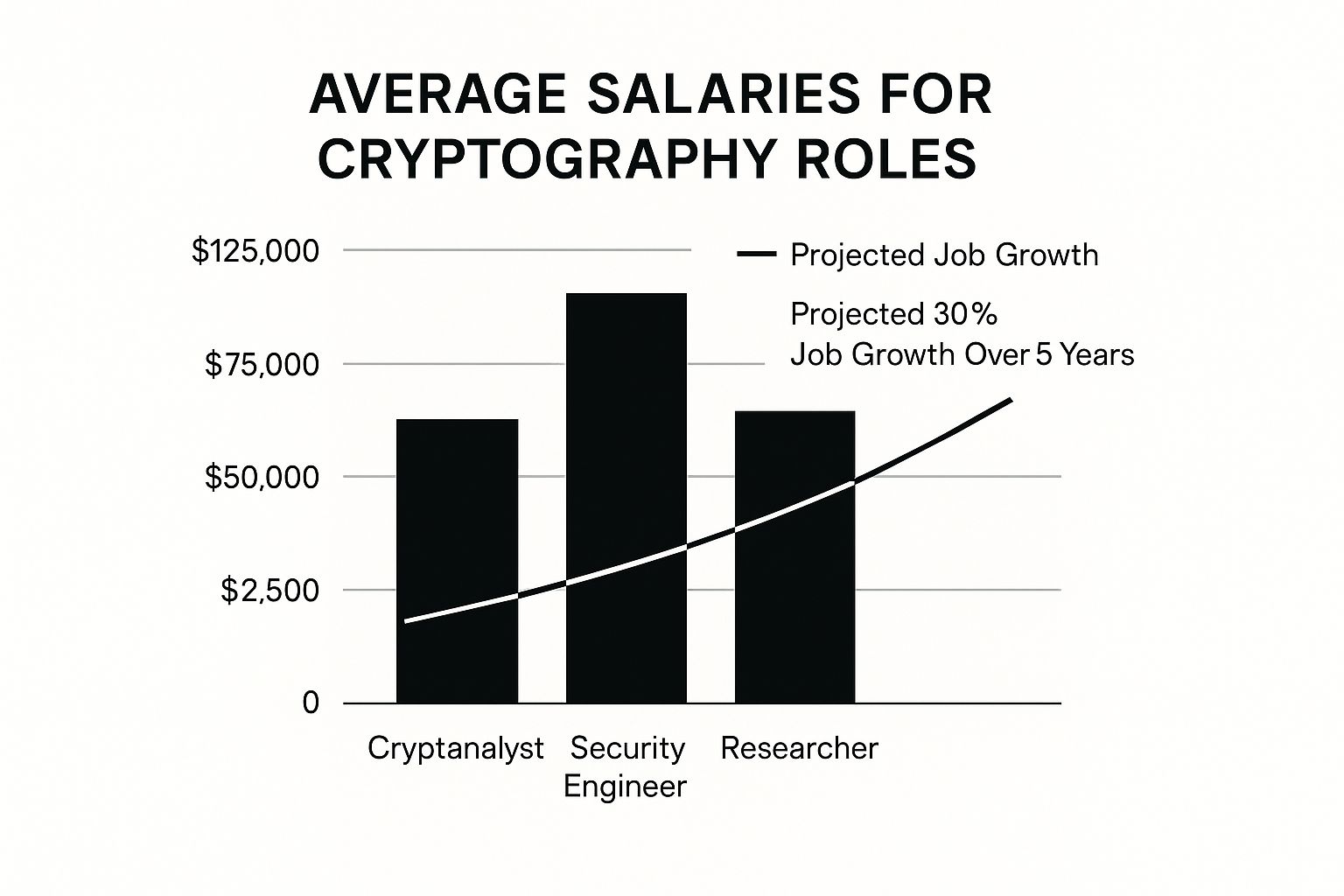
The numbers speak for themselves. Beyond the competitive salaries, the projected 30% job growth signals a powerful, sustained need for these specialized skills across industries.
Architects and Innovators
Looking beyond the core builder and breaker roles, the field gets even more interesting. A Security Architect, for instance, operates at a 30,000-foot view. They are responsible for designing an organization's entire security blueprint, deciding which cryptographic tools and protocols are needed to protect the company's most critical assets.
Then you have roles born from new technologies, like the Blockchain Developer. These specialists apply cryptographic principles—like digital signatures and hash functions—every single day to build and secure decentralized applications. Their work is what guarantees the integrity and security of blockchain networks.
Comparison of Top Cryptography Career Paths
To give you a clearer picture of how these roles stack up, this table compares some of the most sought-after positions in the field.
| Job Role | Primary Responsibilities | Average Salary Range (USA) | Key Skills |
|---|---|---|---|
| Cryptography Engineer | Designing and implementing secure encryption systems and protocols. | $115,000 – $180,000+ | Strong programming (C++, Python), advanced math, protocol design |
| Security Architect | Creating the overall security strategy and infrastructure for an organization. | $130,000 – $200,000+ | Network security, risk assessment, systems design, cloud security |
| Cryptanalyst | Analyzing and attempting to break cryptographic systems to find flaws. | $95,000 – $150,000 | Advanced mathematics, reverse engineering, statistical analysis |
| Blockchain Developer | Building and securing decentralized applications using crypto principles. | $120,000 – $190,000 | Solidity, Rust, Go, smart contracts, distributed systems |
From tech and finance to government and beyond, it's clear that a career in cryptography offers a diverse range of opportunities. If you're ready to find your niche in this fascinating field, you can explore a wide variety of current openings for crypto jobs to see what's out there.
How Blockchain and Web3 Are Creating New Opportunities
Cryptography is going through a seismic shift, and it’s all thanks to the explosion of blockchain technology and the decentralized internet, or Web3. This isn't just another trend. We're witnessing the birth of a new digital frontier where cryptographic skills aren't just useful—they are the very foundation of an entirely new economy.
So, what is a blockchain? At its heart, it's a shared, unchangeable digital ledger. Think of it like a chain where every transaction, or "block," is cryptographically locked to the one before it. This simple but powerful idea creates an incredibly secure and transparent record, powering everything from Bitcoin to revolutionary financial systems.
This new ecosystem is hungry for cryptography talent. The skills that have long been part of the field are now the launching pad for some of the most exciting and future-focused careers in cryptography, especially since these systems now secure trillions of dollars in digital assets.
The New Digital Gold Rush
The demand for people who can build and secure these new systems is skyrocketing. Careers in cryptography are evolving almost as fast as blockchain and decentralized finance (DeFi) themselves. The U.S. Bureau of Labor Statistics, for instance, projects that the need for blockchain developers—a role built on cryptography—will jump by 22% by 2025.
On top of that, the World Economic Forum predicts that over 10% of global GDP could be stored on blockchain platforms by 2025. This only underscores the urgent need for true experts. You can discover more insights about these crypto hiring trends and see the numbers for yourself.
This intense demand has created jobs that we couldn't have imagined a decade ago. These roles aren't for generalists; they require a deep, practical understanding of how to apply cryptographic principles to protect decentralized networks.
Here are just a few of the roles that have emerged:
- Smart Contract Auditor: These are the digital detectives of Web3. They meticulously pick apart the code of smart contracts—which are just self-executing agreements on the blockchain—to find security holes before hackers do.
- DeFi Security Researcher: This is a highly specialized role focused on the intricate world of decentralized finance. They hunt for vulnerabilities in lending protocols, exchanges, and other financial tools built on the blockchain.
- Zero-Knowledge Proof (ZKP) Engineer: ZKPs are a fascinating corner of cryptography that let you prove something is true without revealing the secret information behind it. ZKP engineers are building the next generation of privacy technology from the ground up.
The core challenge in Web3 is building trust in a "trustless" environment. Cryptography is the only tool that can achieve this, making skilled professionals the architects of this new digital world.
If you’re just getting your feet wet in this space, it’s a good idea to first understand the fundamentals of blockchain and its relation to cryptocurrency.
For those who already have a solid background in cryptography, this is a golden opportunity to work on genuinely groundbreaking problems with a massive real-world impact. If you're ready to make the leap, you can find a wealth of opportunities on blockchain job boards that connect talent with the companies pioneering this space.
How to Launch Your Career in Cryptography

Making the jump from learning cryptography to actually landing a job in the field takes a smart, focused plan. It’s not just about listing skills on a resume. You need to show that you can apply what you know in the real world and that you’re genuinely passionate about it. Let’s walk through the essential steps to kickstart one of the most rewarding careers in cryptography.
First things first: you need a portfolio that speaks for itself. Theoretical knowledge is great, but a portfolio full of tangible work is what will make you stand out. This is your chance to prove you can use complex cryptographic concepts to solve actual security challenges.
A fantastic place to start is by contributing to open-source cryptography libraries. Getting involved with projects like the Open Quantum Safe (OQS) project lets you collaborate with seasoned pros and work on code that matters. Even small contributions signal initiative and a deep-seated interest in the field.
Build Your Network and Your Brand
Once your portfolio is taking shape, it's time to start connecting with people. The cybersecurity community can feel tight-knit, but it's also welcoming to newcomers who show genuine enthusiasm. Networking isn't just a transactional thing; it’s about building relationships and becoming a recognized name.
Attending major industry conferences is one of the best ways to do this. Events like Black Hat and DEF CON are goldmines for meeting peers, getting the inside scoop on emerging threats, and talking directly with potential employers. These are the places where the industry's sharpest minds come together.
Your resume gets you through the door, but your network gets you the invitation. Building relationships with professionals in the field can provide mentorship and lead to job opportunities that are never publicly advertised.
After you've sharpened your skills and built a portfolio, the next step is the job hunt itself. Learning how to effectively use LinkedIn for job searching is key to connecting with recruiters and uncovering relevant cryptography roles.
Ace the Technical Interview
The final boss battle is often the technical interview. It's designed to see how you think on your feet and solve problems under a bit of pressure. To nail it, you have to be ready for a thorough test of your skills.
Here’s a practical game plan to get you ready:
- Craft a Compelling Resume: Even if you're coming from a non-traditional background, tailor your resume to highlight your projects and hands-on skills. Feature any open-source contributions, personal projects involving encryption, or relevant coursework.
- Practice Common Problems: Get your hands dirty. Work through challenges on platforms like CryptoHack or participate in Capture The Flag (CTF) events. This is how you build the muscle memory needed for analyzing and implementing algorithms.
- Explain Your Thinking: This is huge. During the interview, walk them through your thought process out loud. Interviewers care just as much about how you tackle a problem as they do about whether you get the perfect answer.
By building a solid portfolio, networking with intention, and preparing diligently for your interviews, you'll be in a great position to launch your career in this exciting and critically important field.
Frequently Asked Questions About Cryptography Careers
Thinking about a career in cryptography often sparks a lot of questions. It's a fascinating and rewarding field, but it definitely has its own unique path and set of expectations. Let's clear up some of the most common uncertainties aspiring cryptographers face.
We’ve gathered the questions we hear most often to give you a real-world picture of what it takes to build a career in this critical industry.
Do I Really Need a PhD to Be a Cryptographer?
Not always. It's a common misconception that a PhD is a universal ticket into the field, but the reality is much more nuanced.
If your dream is to push the boundaries of cryptographic theory in a pure research lab or an academic setting, then yes, a PhD is pretty much standard. However, for the vast majority of industry roles—like Cryptography Engineer or Security Architect—practical, hands-on experience and a killer project portfolio often speak much louder than an advanced degree. Companies are looking for people who can build and implement secure systems, and a bachelor's or master's degree combined with proven skills will get you in the door.
What Programming Languages Should I Focus On?
If you're going to master any, make it Python and C++. These two are the undisputed workhorses of the cryptography world.
- Python: Its simplicity and massive collection of libraries make it perfect for rapid prototyping. You can quickly script an analysis, test a new algorithm idea, or even perform cryptanalysis without getting bogged down in complex code.
- C++: When it's time to build something for a real-world, production system, performance is king. C++ gives you the speed and low-level memory control needed to implement robust, efficient cryptographic protocols that can handle heavy loads.
Think of it this way: Python is your sketchbook for brilliant ideas, and C++ is your workshop for forging those ideas into high-performance, industrial-strength tools. Being fluent in both gives you a massive professional edge.
Can I Break into Cryptography Without a Computer Science Degree?
Absolutely. Some of the sharpest minds in cryptography come from backgrounds in mathematics, physics, or engineering. The intense analytical and abstract problem-solving skills you develop in these fields are the perfect bedrock for understanding complex cryptographic concepts.
The trick is to bridge the gap. You’ll need to intentionally build up your practical skills. Focus on learning programming, algorithms, data structures, and the fundamentals of network security. The best way to prove you have what it takes is to build things. Create a portfolio of personal projects, contribute to open-source security software, and earn a few key certifications. This shows employers you have not just the theoretical foundation, but also the passion and practical ability to do the job.
Ready to turn your skills into a career? Find Web3 is the premier job board for roles in blockchain, DeFi, and Web3 security. Explore thousands of listings from top companies and find your next opportunity.