
Crypto marketing is more than just a job; it’s a career path forging its way at the crossroads of finance, tech, and digital communication. This isn't your typical marketing gig. It’s about building passionate communities and telling powerful stories for Web3 projects, moving way beyond old-school advertising. If you've got a genuine interest in what's next, this is your chance to help build a new digital economy from the ground up.
The Unstoppable Rise of Crypto Marketing Jobs

What we're seeing right now feels a lot like the early days of the internet. Remember when "internet marketing" was a weird, niche experiment? Now, it's the backbone of modern business. Crypto marketing is on that exact same path, shifting from a fringe idea to a core function for any serious project in the space. The boom in Web3, Decentralized Finance (DeFi), and NFTs has thrown open a new digital frontier, and every single project needs skilled marketers to help them chart a course.
Think of crypto marketers as the guides and community architects of this new world. They aren't just pushing a product; they're building a movement. Their job is to break down complex tech for everyday people, build trust in an environment that’s naturally skeptical, and create buzzing ecosystems on platforms like Discord and Telegram. This is where marketing stops being about ads and starts being about authentic connection.
A New Breed of Marketing Pioneer
Because of this, the demand for professionals who can connect complex blockchain concepts with a mainstream audience has just exploded. The crypto world has its own unique culture, its own language, and its own unwritten rules. You can't just apply a standard marketing playbook here. Success demands a mix of timeless marketing fundamentals with a real, boots-on-the-ground understanding of what makes Web3 communities tick.
The real job of a crypto marketer is to build an educated, engaged, and loyal community that genuinely believes in a project's long-term vision. It's about inspiring participation, not just driving transactions.
This shift has created a massive opportunity. As the industry has grown, so has the need for marketing talent. A 2023 report showed that crypto-related job postings jumped by a staggering 118% year-over-year. And it’s not slowing down. The global DeFi market alone was valued at around $13 billion in 2023 and is projected to grow at a 42.7% compound annual growth rate through 2028. All that growth requires dedicated marketing teams to bring in new users. You can dig deeper into crypto hiring trends and opportunities to see just how big this wave is.
Navigating the Challenges and Rewards
Let's be real—a career in this space isn't a walk in the park. The market is notoriously volatile, the tech changes by the week, and the strategies that killed it last month might be useless tomorrow. But if you’re someone who loves to learn and adapt on the fly, the rewards are huge.
A career in crypto marketing puts you right in the action:
- A Front-Row Seat to Innovation: You'll be working on projects that could fundamentally change how we think about money, art, and online communities.
- High-Impact Work: In the fast-moving startup world of crypto, your marketing efforts can directly impact a project's trajectory and token value. You see the results of your work, fast.
- Global and Remote-First Culture: The decentralized ethos of crypto applies to how we work, too. Many crypto marketing jobs are fully remote, letting you collaborate with brilliant people from all over the world.
This guide is designed to be your roadmap for navigating this exciting—and sometimes chaotic—career path.
Understanding the Core Crypto Marketing Roles
Forget everything you know about traditional corporate marketing structures. In crypto, job titles are less about rigid hierarchies and more about the mission you're on. These roles aren't about just selling a product; they're about building a vibrant, self-sustaining digital nation around a project. To make a real impact here, you have to understand who the key players are and what part they play in the journey.
Think of it like putting together a crew for an expedition into uncharted territory. You need more than just someone who can read a map. You need a scout, a diplomat, a storyteller, and an engineer—each with a distinct, critical function.
This diagram breaks down the essential skill pillars that hold up these dynamic roles.
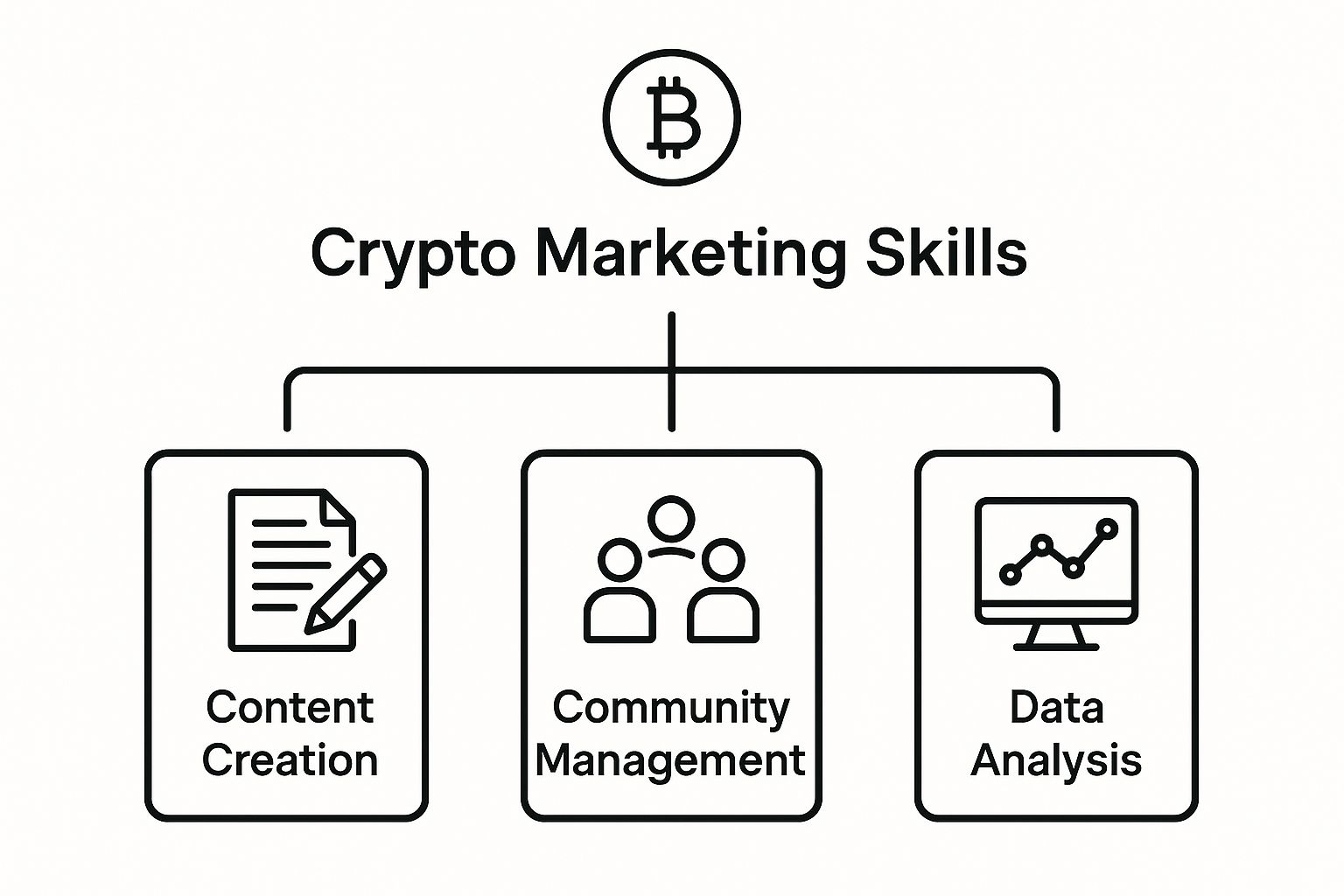
As you can see, everything branches out from strategic thinking. It’s a clear visual of how content, community, and data have to work together to create real momentum.
To give you a clearer picture, here's a quick breakdown of the most common roles you'll encounter, what they're tasked with, and where they spend their time.
Key Crypto Marketing Roles and Responsibilities
| Job Role | Primary Mission | Key Platforms & Tools |
|---|---|---|
| Community Architect | To build, nurture, and protect a vibrant and engaged community. | Discord, Telegram, Zealy, Galxe |
| Protocol Evangelist | To translate complex tech into compelling stories and educational content. | X (Twitter), Mirror, Medium, GitBook |
| Growth Hacker | To drive user acquisition and ecosystem expansion through data-driven experiments. | Dune Analytics, Nansen, Quest Platforms, On-chain data tools |
| Brand Guardian | To shape and maintain a consistent and powerful brand identity across all channels. | Figma, Notion, Project Management Software |
These four roles form the bedrock of almost any crypto marketing team. Let's dive a little deeper into what each one actually does.
The Community Architect
At the very heart of any successful crypto project, you'll find the Community Architect, often called a Community Manager. This person is part digital mayor, part diplomat, and part moderator, all rolled into one. Their core mission is to build, grow, and protect the project's community, which almost always lives on platforms like Discord and Telegram.
They're the first point of contact for new members, the one organizing AMAs (Ask Me Anything sessions), and the moderator keeping conversations on track. A great Community Architect can make a massive, sprawling server feel like a welcoming neighborhood, turning passive followers into die-hard advocates.
The Protocol Evangelist
Next up is the Protocol Evangelist, or what some might call a Content Strategist. These are the storytellers and the educators. Their job is to take the really dense, technical stuff—like zero-knowledge proofs or Layer-2 scaling—and spin it into a compelling narrative that a normal person can actually get excited about.
Their toolkit is all about communication:
- Engaging Blog Posts: Breaking down complex protocol updates into easy-to-read articles.
- Informative Twitter (X) Threads: Crafting viral, educational content that grabs attention and holds it.
- Clear Documentation: Writing the guides that help developers and users actually use the tech.
Without a good evangelist, even the most brilliant technology will just sit there, gathering dust. They make the complex accessible.
In Web3, your community is your most powerful marketing channel. The goal isn't just to acquire users but to cultivate a loyal base of contributors and advocates who will amplify your message authentically.
This deep focus on community and education is what really sets crypto marketing apart. These roles are foundational for building the trust you need to last.
The Growth Hacker
The Growth Hacker, or Performance Marketer, is the data-obsessed strategist laser-focused on user acquisition. If the Community Architect builds the city, the Growth Hacker builds all the roads leading to it. They live and breathe metrics, experiments, and finding scalable ways to bring new people into the ecosystem.
A day in their life might involve:
- Designing and running airdrop campaigns to reward early adopters and generate buzz.
- Managing partnerships with key influencers and other Web3 projects.
- Digging into on-chain data to understand user behavior and spot the next big growth opportunity.
This role is a mash-up of raw creativity and serious analytical skills. They are constantly testing new channels, from running quests on platforms like Galxe to coordinating promotions with crypto media.
The Brand Guardian
Finally, there’s the Brand Guardian, or the Marketing Manager, who zooms out to see the big picture. This person ensures the project’s story, messaging, and look-and-feel are rock-solid and consistent everywhere. They are the conductor of the orchestra, making sure the community, content, and growth teams are all playing from the same sheet of music.
The Brand Guardian develops the high-level marketing strategy, manages the budget, and serves as the crucial link between the marketers and the core dev team. They make sure every tweet, blog post, and Discord announcement fits the project's long-term vision.
A great way to see how these roles come to life is by exploring the latest crypto marketing jobs on specialized job boards. You’ll get a real-time view of how projects are defining these critical positions for themselves.
Building Your Essential Crypto Marketing Skill Set

If you're looking to land one of the more exciting crypto marketing jobs out there, your classic marketing playbook won't be enough. The real pros in this space are a hybrid—they blend timeless strategic thinking with a hands-on, practical grasp of the Web3 world.
It's less about having a decade of traditional experience and more about having an insatiable curiosity and the agility to learn on the fly.
This skill set really boils down to two key areas. First, you need the technical know-how to speak the language of crypto. Second, you need the strategic chops to build and lead a genuine community. Nail both, and you're not just getting a job; you're setting yourself up to make a real impact.
Mastering the Technical Know-How
Let's be clear: you don't need to be a developer. But you absolutely must understand the technology you're marketing. This foundation isn't just a nice-to-have; it's the bedrock of trust you'll need to connect with a very sharp, technically-minded audience.
Think of it like this: would you buy a car from a salesperson who has only ever read the brochure? Or one who has actually driven it, popped the hood, and can tell you exactly how the engine works?
Your technical toolkit should include:
- Blockchain Fundamentals: You need a solid grip on what a blockchain is, why decentralization matters, and the key differences between major players like Ethereum and Solana. This is your baseline.
- Web3-Specific SEO: This isn't your standard keyword game. You'll be optimizing for hyper-specific terms like "Layer 2 scaling solutions" or "zero-knowledge proofs" and learning to navigate Google's E-E-A-T guidelines in a field where trust is paramount.
- On-Chain Analytics: Getting comfortable with tools like Dune Analytics or Nansen is a massive leg up. Knowing how to read on-chain data helps you see what users are actually doing, measure your campaigns' real-world impact, and spot growth opportunities invisible to everyone else.
This technical literacy is your credibility. It proves you’re not just a tourist in crypto but an active participant who gets what makes the tech special.
Developing Your Strategic Skills
While tech knowledge gets you in the door, strategic skills are what will propel your career forward. These are the abilities that turn a simple marketing campaign into a full-blown movement. This is where your adaptability and intellectual curiosity really come into play.
The most valuable skill in crypto marketing isn't knowing everything today; it's the relentless drive to learn what will be important tomorrow.
Here are the strategic pillars you need to focus on:
- Community Architecture: In Web3, your community isn't just a side effect of good marketing—it is the marketing. You have to learn how to build and nurture vibrant, self-running communities on platforms like Discord and Telegram. This means everything from moderating chats to designing quests that get people excited and involved.
- Narrative Weaving: The best crypto marketers are master storytellers. They can take a dense technical idea and spin it into a compelling story that makes people believe in the project and want to be a part of it. This skill is crucial, whether you're writing a viral X (formerly Twitter) thread or a deep-dive blog post.
- Adaptive Strategy: The crypto market moves at an unbelievable speed. A strategy that was genius last month could be totally useless today. Your ability to pivot, test new ideas without being afraid to fail, and learn from data in real-time is your most critical asset. This is where fundamental marketing knowledge helps, like understanding Influencer Marketing Best Practices to better manage collaborations in a fast-changing environment.
Ultimately, your success in finding and thriving in crypto marketing jobs comes down to your commitment to never stop learning. Get in there. Join DAOs, follow the key thinkers on social media, and always be asking questions. That hands-on approach will build your skills faster than any course ever could.
Mastering Modern Web3 Marketing Strategies
Marketing in Web3 isn't just different; it's a completely new game. The old model of blasting ads at people doesn't work here. In fact, the community actively pushes back against it. If you want to land one of the many crypto marketing jobs out there, you have to throw out the old playbook and learn a new one grounded in authenticity, real engagement, and creating actual value.
Here’s a good way to think about it: traditional marketing is like shouting at a crowd with a megaphone, hoping someone pays attention. Web3 marketing is more like hosting an awesome party. You create an incredible vibe, invite cool people, and give them a reason to stick around, connect, and even bring their friends. The goal isn't just to get customers; it's to build a movement. This shift in mindset is the secret sauce behind every successful project in this space.
The Community-First Playbook
Given how decentralized and user-owned Web3 is, the single most important marketing strategy is building online communities. It’s where trust is earned, and it’s the breeding ground for a project's most die-hard fans. Everything else you do in marketing is built on this foundation.
This community-first approach isn't about selling; it's about educating and rewarding people for participating. These are the go-to tactics you'll see every day.
- Airdrops and Incentivized Campaigns: Airdrops are essentially free token giveaways to early users or community members. It's an incredibly effective way to get your token into a lot of hands, kickstart your network, and reward the people who believed in you from day one.
- AMA (Ask Me Anything) Sessions: These live Q&A sessions are a staple, usually happening on X (formerly Twitter) Spaces, Discord, or Telegram. They create a direct, unfiltered line between the founding team and the community, which is absolutely critical for building trust and transparency.
- Influencer Collaborations: Getting a shout-out from a respected voice in crypto can be huge for reaching new people. But this isn't like your typical Instagram ad. The focus is on genuine educational content and authentic endorsements, not just a paid post.
These strategies work because they pull people in. They give everyone a chance to get involved and feel like they’re part of the project's story right from the start.
Navigating the Core Communication Channels
Your entire marketing plan will sink or swim based on how well you get the culture of each platform. You can't just copy and paste the same message everywhere. Every channel has its own vibe and unwritten rules.
X (Twitter) is the de facto town square for all things crypto. It's where big news breaks, where heated debates unfold in real-time, and where a single educational thread can go viral and reach millions. It’s fast, punchy, and rewards people who can deliver a ton of value in very few words.
Discord is your project’s home base. This is where your most dedicated fans hang out. It's the spot for deep-dive conversations, exclusive news, governance discussions, and getting direct help. A well-run Discord server can turn a bunch of followers into a powerful, self-organizing ecosystem.
Telegram is perfect for rapid-fire announcements and managing huge, often international, communities. It's a bit more chaotic than Discord, but it's fantastic for sending out quick updates and keeping a constant line of communication open with a global audience.
Getting the nuances of these platforms right is non-negotiable for anyone serious about a crypto marketing career. The ability to "speak the language" of each one will make or break your project's success. You can check out some current Web3 statistics to see just how users are spread across these channels.
The crypto marketing ecosystem is characterized by highly data-driven and innovative strategies that propel engagement and return on investment (ROI). Influencer marketing remains a dominant tool, with many top blockchain brands collaborating with social media personalities to improve reach and credibility. Platforms like TikTok, Twitter, and Discord are central to crypto marketing campaigns, providing avenues for immersive, educational content and real-time community interaction. The integration of AI and augmented reality (AR) technologies enhances personalization and user experience, driving deeper connections with target audiences. Discover more insights about crypto marketing statistics on amraandelma.com.
Finding and Landing Your First Crypto Marketing Job

Alright, you know the roles and you've got a sense of the skills needed. But how do you actually get your foot in the door? Landing one of the many crypto marketing jobs isn't about just polishing up your resume and spamming the "apply" button on LinkedIn. It’s a whole different ballgame.
Think of it less as applying for a job and more like joining a movement. In Web3, proving you're an active, engaged member of the community often carries more weight than a perfectly formatted CV. It’s about showing, not just telling.
Where to Find Genuine Web3 Opportunities
First things first: forget about scrolling through those massive, generic job platforms. The real gems are found on specialized boards that live and breathe the Web3 ecosystem. These sites cut through the noise, putting you in direct contact with innovative projects that need marketing talent right now.
If you want to get a feel for what's out there, a great starting point is to https://findweb3.com/jobs/crypto and see what’s currently available.
Beyond the dedicated job boards, some of the most powerful ways to find a role are a bit unconventional but incredibly effective.
- Become a Twitter (X) Native: This is non-negotiable. Follow key project leads, jump into conversations (the meaningful ones!), and share your own insights. So many jobs are filled simply through connections made in public discussions.
- Join a DAO: Seriously, contributing to a Decentralized Autonomous Organization is like a Web3 internship on steroids. You'll get hands-on experience, build a real portfolio of work, and rub shoulders with influential people in the space.
- Be Active in Discord: Don't just lurk in the shadows. Ask smart questions, help onboard new members, and actually participate in community calls. The project teams are always watching for standout contributors.
This proactive approach completely changes the dynamic. You go from being another faceless applicant to a known, respected member of the community.
The most powerful resume in Web3 is a verifiable track record of genuine participation and value creation. Your contributions on-chain and within communities speak louder than any bullet point on a document.
Tailoring Your Application for a Crypto Audience
When you finally find a role you want to go for, your application needs to speak the language of the industry. Ditch the corporate jargon and focus on what actually matters in this space.
Your resume should clearly highlight:
- Community Involvement: List the DAOs you're active in or the Discord communities you help moderate.
- On-Chain Activity: Mention any relevant on-chain history, like being an early user of a protocol or participating in governance votes. It's public proof of your engagement.
- Passion Projects: Include links to your blog, a popular Twitter thread you wrote, or any piece of content that demonstrates you truly understand the market.
This kind of detail signals to recruiters that you're not just looking for any job—you're looking for a career in Web3 because you're genuinely all-in on the technology.
As you map out your career, it's also smart to look at general marketing career opportunities to see what skills are transferable. Having that wider perspective can make your application even more compelling.
The Bitcoin job market, for instance, is showing remarkable strength and maturity. A recent report counted 141 Bitcoin-related job postings in just one month, which is a 4% increase from the previous year. What's more, 52% of these roles were at Bitcoin-only companies, signaling a trend toward specialization.
Growing a Long-Term Career in Web3 Marketing
Landing your first crypto marketing job is a huge win, but the real challenge is building a career that lasts. This space moves at a breakneck pace. What's working today could be a relic tomorrow.
To really thrive here, you have to embrace constant learning and stay curious. Think of your career less like a ladder and more like an ever-changing map you're drawing yourself. The projects, tech, and marketing channels that are hot right now will inevitably shift. Your ability to adapt and genuinely want to learn what's next is your single greatest asset for the long haul.
Build Your Personal Brand—The Right Way
In an industry literally built on digital identity and trust, your personal brand is everything. This isn't about chasing influencer status; it's about consistently adding real value to the conversation where it's happening.
Platforms like X (formerly Twitter) and Farcaster are the de facto town squares for Web3. Being an active, thoughtful voice there is non-negotiable.
Here’s what that actually looks like:
- Share What You're Learning: Be open about your process. Document the challenges, the wins, and your unique take on industry trends. People connect with the journey.
- Engage Meaningfully: Don't just shout into the void. Ask smart questions, leave insightful replies, and amplify the great work of others.
- Show, Don't Just Tell: Use these platforms to share case studies of your marketing successes or even just a well-thought-out analysis of another project's campaign.
This public activity becomes your living resume. It demonstrates your passion and expertise far better than a static PDF ever could.
Network Like You Mean It
Networking in Web3 is so much more than just collecting contacts at a conference, though those in-person events are still fantastic for building real rapport. It’s about becoming a trusted, known member of the community.
A long-term career in Web3 marketing puts you on the front lines of what's next. You aren't just pushing products; you're helping shape the culture and user experience of the future internet.
Get active in the places where people are building. Join niche Telegram groups, jump into governance discussions for a DAO you believe in, and show up for virtual summits. When you go to events, make it your mission to build genuine relationships, not just to hand out your contact info.
The strongest professional bonds are almost always formed when you're working on something together. Find opportunities to contribute, and you'll find your career grows right along with your network.
Got Questions About Crypto Marketing Jobs? Let's Get Them Answered.
Jumping into crypto marketing can feel like you've landed in a foreign country where everyone's speaking a different language. It's totally normal to have a ton of questions about what it actually takes to build a career in this space.
So, let's clear the air. This section tackles the most common questions I hear from people trying to break in. Think of it as a straight-to-the-point guide to help you figure out your next move.
Do I Need to Be a Coder?
This is easily the question I get asked most often. The answer is a huge sigh of relief: no, you don't need to be a developer.
Of course, you absolutely need to understand the basics of blockchain. You have to get what a smart contract is, what decentralization means, and why it all matters. But your job isn't to write the code.
Your real superpower is translating the geeky stuff into a story people actually care about. Companies are desperate for marketers who can build a community from scratch, create a compelling narrative, and run smart digital campaigns. A deep curiosity and a willingness to learn the tech will take you much further than a computer science degree.
The best crypto marketers are translators. They stand between the super-technical dev team and the everyday user, making the complex feel simple and exciting.
What’s the Pay Like?
Let's talk money. Salaries in crypto marketing are seriously competitive, but they can be all over the map depending on your specific role, how many years you've been in the game, and how much funding the project has. One of the unique things here is that your compensation is often a mix of a cash salary and project tokens.
Here’s a rough idea of what you can expect:
- Entry-Level Roles: If you're starting out as a Community Moderator or a junior content person, you’re likely looking at a range of $50,000 to $70,000.
- Mid-Level Roles: Once you have some solid experience as a Marketing Manager, Content Strategist, or Growth Hacker, that number can jump to $120,000 to $180,000, sometimes even more.
- Senior Leadership: At the top end, a Head of Marketing or CMO at a big, well-funded project can pull in over $200,000 a year, plus a hefty bag of tokens.
Those token incentives are the real game-changer. If the project takes off, the value of your tokens can blow your salary out of the water. It’s a powerful way to tie your own success directly to the project's growth.
Are Most Gigs Remote?
Yep. The vast majority of crypto marketing jobs are fully remote. The whole industry was built on a global, decentralized idea, and the work culture reflects that. For anyone looking for more flexibility and a life outside a cubicle, this is a massive perk.
This setup lets companies hire the best person for the job, no matter where they live, which leads to some incredibly diverse and interesting teams. While some of the bigger, more corporate-style companies might have an office, remote-first is the norm, not the exception.
How Do I Get My Foot in the Door with No Experience?
This is where you have to get creative and scrappy. When you don't have direct crypto experience, you need to prove you're passionate and willing to do the work. Honestly, that hustle often impresses hiring managers more than a traditional marketing resume.
Start by just getting involved:
- Join the conversation: Hop into the project's Discord and Telegram channels. Don't just lurk—be a helpful, active member.
- Get loud on social: Spend time on X (formerly Twitter) and Farcaster. Follow the right people, ask good questions, and share what you're learning.
- Create your own stuff: Start a small blog or an X account dedicated to your crypto journey. Write about projects you find interesting or break down marketing campaigns you admire.
- Contribute to a DAO: This might be the single best thing you can do. It gives you real experience, helps you network, and builds a portfolio of work that's literally recorded on the blockchain.
Ready to find your place in the future of the internet? At Find Web3, we connect talented professionals like you with thousands of the best opportunities in the Web3 ecosystem. Explore the latest crypto marketing jobs and start building your career today by visiting https://findweb3.com.