
Understanding The Blockchain Job Market That's Changing Everything

The blockchain developer landscape is dynamic and constantly evolving. What was once considered advanced quickly becomes standard practice. To stay competitive, your blockchain developer resume needs to reflect these rapid changes. This means understanding not only the necessary technical skills but also the broader market trends shaping the industry.
This evolution is clear in the shift from experimental startups to large-scale enterprise adoption of blockchain technology. Established financial institutions are increasingly embracing DeFi (Decentralized Finance), while gaming studios are actively building immersive Web3 experiences. This creates diverse niche opportunities for blockchain developers.
Understanding these specialized areas is essential for tailoring your resume effectively. The rise of remote work also impacts job market growth. This trend opens up global opportunities, allowing you to target companies and projects worldwide.
However, certain blockchain ecosystems and specializations command higher salaries. Researching specific platforms and their associated demand is crucial for strategic positioning. Understanding the market enables you to showcase the most in-demand skills, increasing your chances of landing your ideal role. The blockchain developer job market is experiencing significant growth, with demand projected to increase by 22% by 2025. Find more detailed statistics here.
Key Sectors Driving Blockchain Hiring
Identifying high-growth sectors within the blockchain industry is critical for a successful job search. Consider these key areas:
- DeFi: This sector continues to attract significant investment and talent, creating opportunities for developers specializing in smart contracts, decentralized exchanges, and stablecoins.
- Web3 Gaming: Integrating blockchain into gaming opens doors for developers experienced in NFTs, tokenomics, and metaverse development.
- Enterprise Blockchain: Large organizations are increasingly adopting blockchain solutions for supply chain management, data security, and identity verification, creating demand for developers with enterprise-level experience.
- NFT Marketplaces: The continuing evolution of digital ownership and collectibles creates high demand for developers proficient in smart contracts and token standards related to NFTs.
By focusing your blockchain developer resume on these key sectors, you effectively demonstrate your relevance to potential employers. Understanding which skills are standard requirements versus differentiating factors helps you stand out. Aligning your skills with actual market demand is more effective than relying on outdated advice.
Technical Skills That Actually Get You Hired
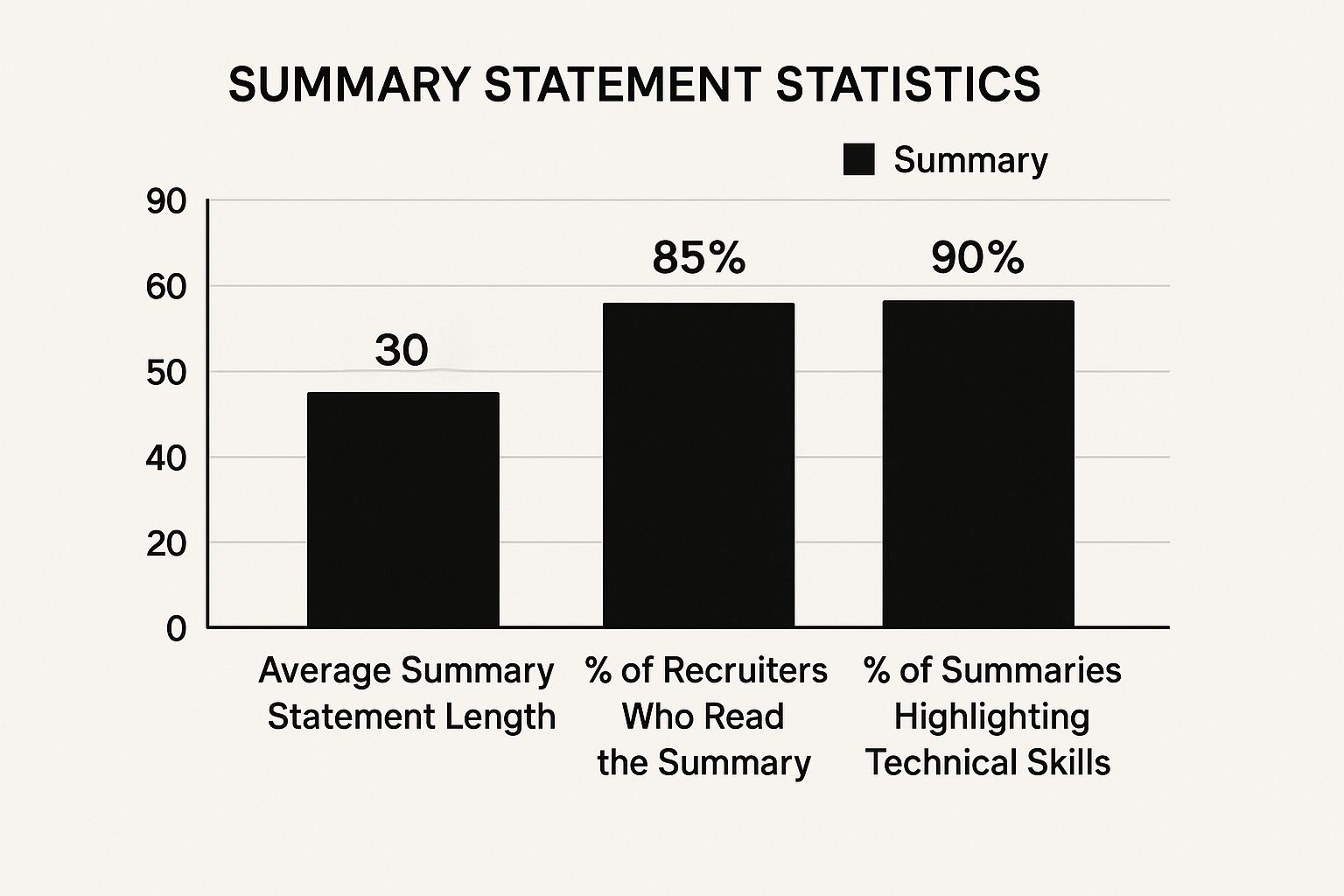
The infographic above highlights some key data about resume summaries: the average length, how often they're reviewed, and how many emphasize technical skills. A concise summary is essential. 85% of recruiters read them, and 90% of effective summaries showcase technical proficiencies. Your blockchain developer resume must make a strong first impression with a brief, impactful summary.
Essential Programming Languages
Foundational programming languages are important, but specialized blockchain development skills are critical. This includes proficiency in languages like Solidity for Ethereum smart contracts, Rust for building secure and performant blockchains, and JavaScript for front-end development and interacting with Web3 libraries.
A deep understanding of Solidity is crucial for developing decentralized applications (dApps) and interacting with the Ethereum Virtual Machine (EVM).
Expertise in Rust is increasingly sought after for building new blockchain protocols and contributing to projects focused on scalability and security.
Blockchain Platforms and Frameworks
Mastery of specific blockchain platforms is vital. Ethereum, Hyperledger Fabric, Corda, and EOS are prominent examples. Simply listing them isn't enough.
Demonstrate a deeper understanding. For example, if you have Ethereum experience, highlight your knowledge of related tools like Truffle and Hardhat for development and testing. This showcases practical application.
When exploring the blockchain job market, review current listings on sites like Remote Health Jobs. Also, check out resources like Find Web3 for engineering jobs.
Smart Contract Development and Security
Smart contract development is fundamental to blockchain development. Your resume should highlight your proficiency in writing, deploying, and auditing smart contracts.
Demonstrate a strong understanding of security best practices to mitigate vulnerabilities and exploits. Experience with formal verification tools and security analysis techniques is a strong asset.
To help illustrate the required skills and their market demand, the following table provides a comparison across different blockchain platforms:
Core Blockchain Development Skills by Platform
A comparison of essential technical skills required for different blockchain platforms and their market demand
| Platform | Primary Language | Key Skills | Market Demand |
|---|---|---|---|
| Ethereum | Solidity | Smart Contract Development, EVM knowledge, Web3.js | High |
| Hyperledger Fabric | Go, JavaScript | Chaincode development, Fabric SDK, distributed ledger technology | Medium |
| Corda | Kotlin | Smart Contract Development, JVM knowledge, distributed ledger technology | Medium |
| EOS | C++ | Smart Contract Development, EOSIO SDK, blockchain architecture | Medium |
This table demonstrates the importance of specializing in a particular platform while also possessing strong fundamental skills in smart contract development and distributed ledger technology. Ethereum currently enjoys the highest market demand due to its mature ecosystem and widespread adoption.
DeFi, NFTs, and Emerging Technologies
The blockchain landscape is dynamic, with continuous innovation. While core skills are essential, highlighting knowledge of trending areas like DeFi (Decentralized Finance), NFTs (Non-Fungible Tokens), and DAOs (Decentralized Autonomous Organizations) enhances your resume. It demonstrates adaptability and a commitment to staying current within this rapidly evolving industry.
Building A Resume Structure That Gets Past ATS Systems

Your impressive blockchain projects won't get you far if your resume can't get past the Applicant Tracking Systems (ATS). These systems act as gatekeepers, scanning resumes for specific keywords and formatting before a human recruiter ever lays eyes on them. This section focuses on crafting a blockchain developer resume structure optimized for both ATS and the discerning eyes of hiring managers.
Formatting For ATS Compatibility
ATS software often struggles with complex formatting. Keep your resume clean and simple. Use a standard font like Times New Roman or Arial. Avoid excessive design elements or unusual formatting. This helps ensure the system can accurately parse the information and extract the relevant details.
Use clear section headings such as "Professional Summary," "Work Experience," and "Skills." This helps the ATS categorize your information correctly. It also improves readability for the hiring manager once your resume makes it through the initial screening process.
Structuring Your Blockchain Developer Resume
The order of information on your resume matters. Begin with a compelling Professional Summary that immediately highlights your blockchain expertise and career goals. This concise overview acts as your elevator pitch, grabbing the reader's attention and clearly stating your objective. Consider exploring sites like Find Web3 Crypto Jobs to research open positions and understand current market demands.
Follow your summary with your Work Experience, presented in reverse chronological order (most recent first). Focus on quantifiable achievements. Use action verbs to describe your contributions. For example, instead of writing "Responsible for smart contract development," use stronger language like "Developed and deployed smart contracts that reduced gas fees by 15%."
Keyword Integration Best Practices
ATS systems rely on relevant keywords to match candidates with open positions. Incorporate terms like "blockchain developer," "Solidity," "smart contracts," "DeFi," and "Web3" into your resume naturally. Include other relevant technologies you are proficient in. However, avoid keyword stuffing, which can be a red flag for ATS and human reviewers.
Focus on organically weaving these keywords into your Professional Summary, Work Experience descriptions, and Skills section. Context is key. Simply listing keywords won't impress hiring managers. Show, don't just tell. Demonstrate how you've utilized those skills to produce tangible results.
Tailoring Your Resume for Specific Roles
One size does not fit all. Customize your resume for each position you apply for. Carefully analyze the job description for specific requirements and keywords. Tailor your resume to reflect those needs. This demonstrates your genuine interest in the specific role and increases your chances of getting noticed.
This targeted approach also shows that you've taken the time to understand the company and its specific requirements, which is always appreciated. Consider your target audience as well. A technical reviewer will appreciate in-depth technical details. A non-technical recruiter may need a more accessible overview of your achievements. Effectively balancing these different perspectives requires adapting your presentation for each stage of the hiring process.
Project Presentations That Demonstrate Real Impact
Your project portfolio often determines whether you land an interview for a blockchain developer role. This section explains how to choose and present projects that effectively showcase your technical skills and your grasp of the blockchain ecosystem. It's not just about what you built, but the impact it made.
Selecting the Right Projects
Choosing the right projects for your blockchain developer resume is crucial. Focus on projects that highlight sought-after skills, such as smart contracts, DeFi integration, and blockchain security. A diverse portfolio is also beneficial, demonstrating your adaptability across various blockchain platforms and technologies.
- Smart Contract Projects: Include complex smart contracts you’ve developed, detailing the logic and functionality implemented.
- DeFi Integrations: Showcase your experience integrating with decentralized exchanges, lending protocols, and other DeFi primitives.
- Security Implementations: Highlight projects involving security measures, such as audits, vulnerability assessments, and secure key management.
Quantifying Your Impact
When it comes to a technical resume, numbers carry significant weight. Quantify your contributions whenever possible. This adds credibility to your claims and provides potential employers with tangible achievements.
- Gas Optimization: If you optimized smart contracts for gas efficiency, state the percentage reduction. For example, “Reduced gas costs by 20% through optimized Solidity code.”
- Transaction Volume: For high-throughput projects, specify the transaction volume handled. An example would be, “Developed a system capable of handling 10,000 transactions per second.”
- Security Vulnerabilities: If you identified and resolved security vulnerabilities, mention the number addressed and their potential impact.
Presenting Open-Source and Personal Projects
Open-source contributions and personal projects showcase your dedication to continuous learning and innovation. Even small contributions to impactful projects can leave a lasting impression.
- Open-Source Contributions: Include a link to your GitHub profile and highlight contributions to relevant repositories. Quantify your impact, such as the number of issues resolved or lines of code contributed.
- Hackathon Achievements: Mention any hackathons you’ve participated in, especially if your project received recognition or you placed well.
- Personal Projects: Personal projects are a great way to explore new technologies and demonstrate your passion. Even if they aren’t production-ready, they showcase your initiative. Your online presence matters. For tips on improving your online profile, consider a Twitter bio template.
Structuring Your Project Descriptions
Describe your projects concisely and systematically, emphasizing your role and contributions. A good structure includes:
- Project Title: A clear and descriptive title that instantly conveys the project's purpose.
- Technologies Used: A brief list of the technologies and platforms utilized.
- Your Role: A clear definition of your responsibilities within the project.
- Key Contributions: Focus on your specific contributions and their resulting impact. Use quantifiable metrics wherever possible.
- Project Outcome: A brief overview of the project's overall outcome and any lessons learned. This demonstrates your ability to reflect on your work and identify areas for improvement. This attention to detail is valuable in the competitive blockchain developer market.
By carefully selecting and presenting your projects, you create a compelling portfolio that showcases your skills and experience, transforming your blockchain developer resume into a powerful tool for landing your dream job.
Salary Insights And Remote Work Opportunities

Understanding compensation trends is crucial for making informed career decisions. Effectively positioning your blockchain developer resume also depends on this knowledge. This involves researching salary ranges and understanding the factors that influence pay. It also includes recognizing how remote work opportunities can broaden your job prospects.
Blockchain Developer Salary Expectations
Several factors significantly influence your expected salary as a blockchain developer. Your experience level plays a major role. Entry-level positions typically have lower salaries than senior roles requiring extensive expertise. Location also matters. Cost of living and local market demand impact compensation packages. Finally, your specialized blockchain ecosystem or niche can also affect your earning potential. For example, expertise in high-demand areas like DeFi or NFTs often commands higher salaries.
Compensation for blockchain developers varies based on experience and location. In the U.S., entry-level blockchain developers can expect to start around $121,000 annually. Experienced developers can earn up to $187,500. Top-end salaries can even exceed $250,000. This is particularly true for those with specialized skills in emerging sectors like gaming and NFT platforms. Discover more insights about blockchain developer salaries.
The Impact of Remote Work
The global nature of the blockchain industry has significantly increased remote work opportunities. This benefits both companies and developers. Companies can access a wider talent pool. Developers gain greater flexibility. This shift also means your location is less of a limiting factor in your job search. You might be interested in: Blockchain jobs on Find Web3. By May 2025, remote blockchain developer jobs accounted for over 101% compared to non-remote positions. This trend toward remote work allows companies to access global talent, creating more opportunities regardless of where you live.
Positioning Yourself for Success
Accurately representing your experience level and highlighting relevant skills on your resume are key. These steps will help you target the desired salary tier.
- Emphasize Specialized Skills: Focus on sought-after skills such as DeFi, NFTs, or expertise on specific blockchain platforms.
- Highlight Remote Work Adaptability: Showcase your ability to work independently and productively in a remote setting.
- Quantify Achievements: Use metrics to demonstrate the impact of your work in previous roles.
Researching company compensation practices is essential. Present your qualifications effectively and understand the dynamics of remote work. By doing so, you can maximize the impact of your blockchain developer resume. You'll be well-positioned to target the compensation you deserve.
Avoiding Resume Mistakes That Kill Your Chances
Even seasoned blockchain developers sometimes make critical resume mistakes that can cost them opportunities. Understanding these common pitfalls can significantly improve your chances of landing that dream blockchain developer role. This section identifies those mistakes and provides solutions for crafting a resume that truly stands out.
Overly Technical Language
Showcasing technical skills is essential for a blockchain developer resume. However, overwhelming recruiters with jargon can be counterproductive. Recruiters often conduct the initial screening and might not possess the deep technical knowledge to grasp highly specialized terminology. This can lead to your resume being discarded before it even reaches a technical reviewer.
The Problem: Using excessive technical language without context can alienate non-technical recruiters.
The Solution: Strive for a balance between technical depth and clear explanations. Imagine explaining a complex concept to someone unfamiliar with blockchain. Provide sufficient detail to demonstrate expertise without losing the reader.
Lack of Context For Projects
Listing blockchain projects without explaining their purpose and impact diminishes their value on your resume. Simply stating "Developed smart contract" doesn't convey the complexity or significance of the project.
The Problem: Listing technologies without demonstrating their practical application and achievements.
The Solution: Write concise but impactful descriptions for each project. Highlight the challenges you faced, your specific contributions, and the positive outcomes. Whenever possible, quantify your impact with metrics, such as gas optimization percentages or transaction volumes handled.
Keyword Optimization Gone Wrong
Keyword optimization is crucial for getting past Applicant Tracking Systems (ATS). However, stuffing keywords into your resume can make it sound unnatural and raise red flags. A balanced approach is necessary for optimal impact.
The Problem: Overusing keywords makes your resume sound robotic and insincere.
The Solution: Naturally incorporate relevant keywords such as "blockchain developer," "Solidity," "smart contracts," and any specific blockchain platforms you’re proficient with. Context is paramount. Demonstrate your skills through clear project descriptions and measurable achievements.
Common Presentation Errors
Several presentation errors can diminish your resume's effectiveness. Let's explore a few:
- Listing technologies without demonstrating impact: Simply listing technologies provides minimal value. Quantify your achievements using relevant metrics to showcase the real-world impact of your work.
- Appearing too narrowly focused: If you specialize in a particular blockchain niche, ensure you demonstrate adaptability. Highlight transferable skills and your willingness to embrace new technologies.
- Poor timing of application submissions: Research a company's hiring cycles to maximize your visibility. Applying too early or too late can result in your resume getting lost in the shuffle.
To help illustrate best practices, review the following table:
Blockchain Resume Mistakes vs. Best Practices
A side-by-side comparison of common resume mistakes and the recommended best practices for blockchain developers.
| Common Mistake | Why It Hurts | Best Practice | Impact |
|---|---|---|---|
| Overly Technical Language | Alienates non-technical recruiters | Balance technical details with clear explanations | Improves readability and understanding |
| Lack of Project Context | Fails to showcase the impact of your work | Provide concise project descriptions with quantifiable achievements | Demonstrates value and contribution |
| Keyword Stuffing | Appears unnatural and insincere | Naturally incorporate relevant keywords within context | Improves ATS compatibility while maintaining authenticity |
| Listing Technologies Without Impact | Doesn't provide meaningful insights into your skills | Quantify achievements with metrics | Highlights the real-world impact of your skills |
| Narrow Focus | Limits perceived potential | Showcase adaptability and willingness to learn | Expands opportunities and demonstrates growth potential |
| Poor Application Timing | Reduces visibility | Research company hiring cycles | Increases chances of consideration |
By understanding and avoiding these common mistakes, you can greatly improve your blockchain developer resume. Consider your target audience – while technical reviewers appreciate in-depth details, recruiters require a clear, concise overview of your experience. A balanced approach optimizes your chances of securing an interview. For targeted job searching within the blockchain industry, explore platforms like Find Web3.
Customizing Your Resume For Maximum Interview Success
Not all blockchain developer roles are created equal. Your resume needs to reflect the specific requirements of each opportunity. This section offers practical strategies for customizing your application, whether you're targeting Decentralized Finance (DeFi) protocols, enterprise blockchain solutions, or Web3 gaming platforms.
Researching Company Culture and Technical Needs
Before tailoring your resume, research the target company. Understanding their culture and technical needs is crucial. Explore their website, blog, and social media presence for insights into their values and priorities. Reviewing recent news articles and press releases can often reveal their current projects and technical focus.
Examine the job description closely. Identify the keywords and required skills. Understanding these details allows you to align your resume effectively. This targeted approach shows genuine interest and increases your chances of a positive first impression.
Adapting Your Resume Accordingly
Once you understand the company's needs, adapt your resume to match. For instance, if a company emphasizes DeFi, highlight your related experience. Tailor your Professional Summary to reflect their specific requirements. Adjust the skill order, prioritizing those most relevant to the role.
If the role requires experience with a specific blockchain platform like Hyperledger Fabric, make sure that skill is prominent. If they emphasize security, showcase your experience with security audits and best practices. This customization demonstrates attention to detail and commitment.
Checklists, Cover Letters, and Follow-Up
Use checklists to optimize your resume. Ensure all essential elements are present and well-presented. This methodical approach minimizes errors and maintains consistency.
Craft a compelling cover letter that complements your technical profile. This is your chance to elaborate on your skills and experience and showcase your personality and cultural fit.
Develop a follow-up strategy. A polite email after applying can reinforce your interest. However, avoid excessive follow-up.
Templates and Examples For Various Blockchain Companies
Adaptable templates can help structure your resume effectively. Real-world examples demonstrate successful customization techniques, providing inspiration and practical guidance. They can help you create a resume that stands out.
Review successful resume examples for different blockchain companies and roles. Analyze how they present information and tailor content. This helps you understand effective strategies and apply them to your own resume.
Ready to advance your blockchain development career? Find Web3 offers a centralized platform for exploring Web3 opportunities, from engineering and design to marketing and operations. Visit Find Web3 today to discover your next role in the exciting world of blockchain technology.