
Unlock Your Blockchain Career: The Ultimate Job Platform Guide
The demand for skilled blockchain engineers is booming. If you're seeking specialized blockchain engineer jobs or aiming to enter the Web3, DeFi, or NFT sectors, knowing where to look is essential. This guide cuts straight to the chase, revealing the top 8 platforms to discover your next opportunity. We'll help you navigate the job market efficiently, connecting you with leading companies and exciting projects. Find the right platform here to kickstart or advance your career in this innovative and rapidly expanding field.
1. AngelList (now Wellfound)
For individuals seeking high-impact blockchain engineer jobs, particularly within the dynamic startup ecosystem, AngelList (now rebranded as Wellfound) stands out as a pivotal platform. Originally launched as AngelList, a hub for startup fundraising and talent acquisition, it has evolved into Wellfound, sharpening its focus on connecting skilled professionals, especially engineers, with innovative tech companies, including a significant number in the blockchain and Web3 space. It's renowned for offering direct lines of communication to founders and key decision-makers, often bypassing traditional recruitment hurdles.
Wellfound operates as more than just a job board; it's a comprehensive ecosystem where startups share their mission, vision, team, and funding status, providing candidates with a holistic view of potential employers. For blockchain engineers, this means unparalleled access to roles at the bleeding edge of decentralized technology. The platform specializes in connecting technical talent with blockchain startups, from nascent projects seeking foundational team members to established crypto companies scaling their operations. A key characteristic of many roles found here is the offer of equity-based compensation, aligning the success of the engineer with that of the startup. This direct-to-founder approach and equity potential make it a unique avenue for those looking to make a significant mark in the rapidly evolving world of blockchain engineer jobs.
The platform's significance in the blockchain sphere is underscored by numerous success stories. For instance, early hires for crypto giants like Coinbase found their footing through AngelList. Similarly, the foundational teams of major NFT marketplaces like OpenSea leveraged the platform for recruitment. Developer acquisitions for prominent layer-2 scaling solutions such as Polygon (formerly Matic) also highlight AngelList/Wellfound's role in building robust blockchain development teams. These examples demonstrate its effectiveness in sourcing talent for companies that have gone on to define the crypto landscape. This track record solidifies its place as an essential resource for anyone serious about a career in blockchain development.
Why AngelList (Wellfound) Deserves its Place:
AngelList, now Wellfound, earned its spot by being a trailblazer in startup hiring, particularly for tech roles. Its early adoption and embrace by the Web3 community make it a go-to platform. It has consistently provided:
- Direct Communication: Engineers can often connect directly with founders, CTOs, and hiring managers, facilitating more meaningful conversations and faster hiring processes compared to going through layers of recruiters.
- Equity Compensation Transparency: Information about stock options and equity is often presented upfront, which is a crucial factor for many seeking blockchain engineer jobs in high-growth startups.
- Startup-Focused Blockchain Positions: The platform is heavily skewed towards startups, meaning the roles are often dynamic, offering broad responsibilities and the chance to work on greenfield projects in the blockchain domain.
- Company Culture and Mission Visibility: Startups on Wellfound typically provide detailed profiles, giving candidates insights into their culture, mission, and the problems they are solving, which is vital for assessing fit, especially in the purpose-driven blockchain space.
- Remote-First Opportunities: Reflecting the global and decentralized nature of blockchain technology, many companies on Wellfound offer remote or hybrid roles, catering to a worldwide talent pool.
To give you a clearer picture of what to expect when searching for blockchain engineer jobs on Wellfound, the following infographic summarizes key data points:
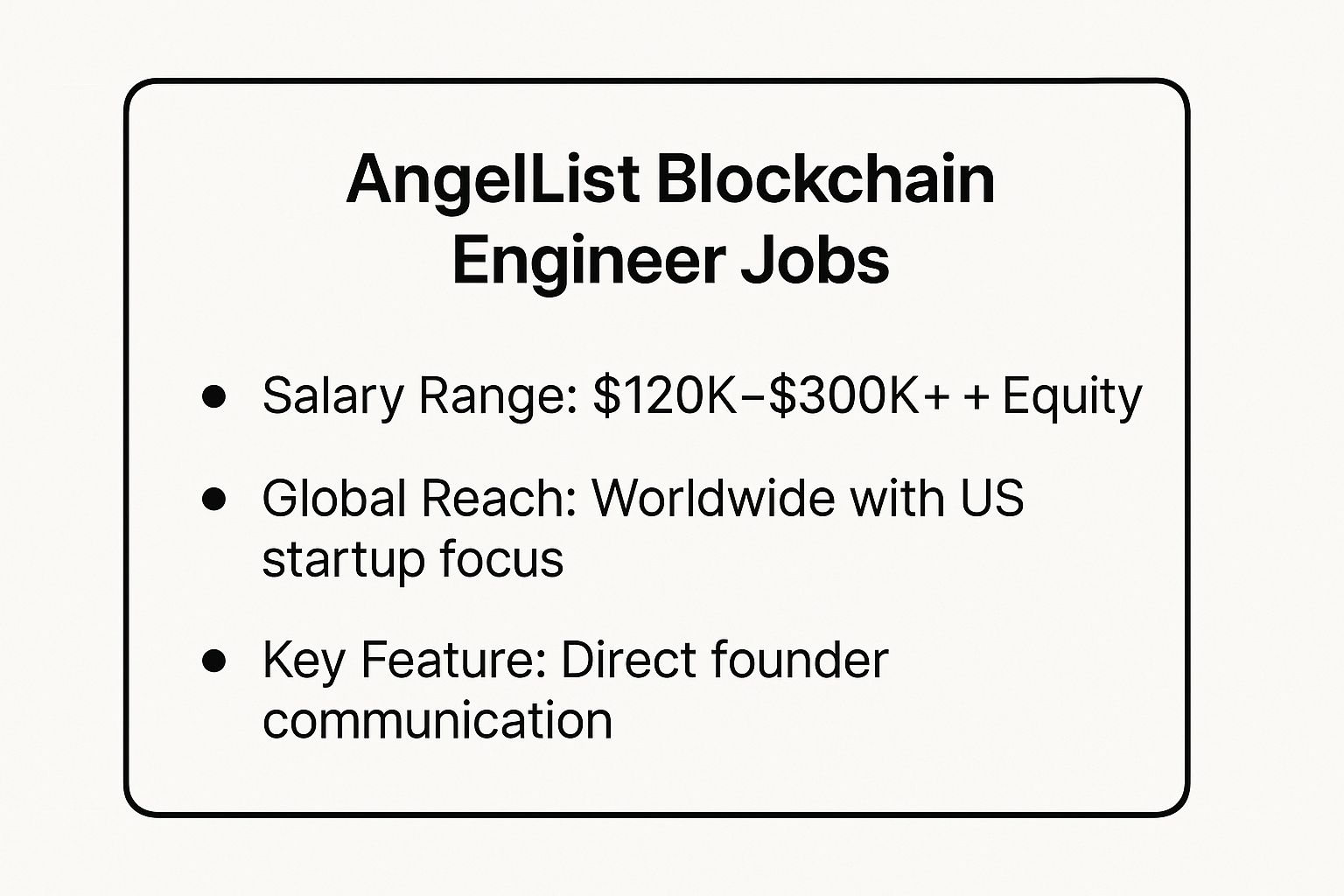
This summary highlights the competitive compensation packages, global reach with a strong US startup presence, and the distinctive advantage of direct communication with company leaders that Wellfound offers to blockchain professionals. These takeaways underscore why the platform is a prime destination for talent in the Web3 space.
Pros and Cons of Using Wellfound:
Pros:
- Access to Cutting-Edge Projects: Be at the forefront of blockchain innovation.
- Potential for Significant Equity Upside: High-risk, high-reward opportunities.
- Direct Founder Contact: Bypass intermediaries for more authentic interactions.
- Comprehensive Startup Profiles: Detailed information on company funding, team, and mission.
Cons:
- Higher Risk Positions: Startup volatility means less job security compared to established corporations.
- Requires Full-Stack Capabilities: Many roles demand a broad skill set beyond just blockchain expertise.
- Equity May Not Materialize: The value of equity is contingent on the startup's success.
- Intense Work Environment: Startups often expect long hours and high commitment.
Actionable Tips for Blockchain Engineers:
To maximize your chances on Wellfound when seeking blockchain engineer jobs:
- Showcase Versatility: Highlight both your specialized blockchain skills (smart contracts, specific protocols, consensus mechanisms) and your traditional development expertise (e.g., backend systems, APIs, frontend frameworks).
- Due Diligence is Key: Research the company's funding rounds, investors (often listed on Wellfound), and market position. This shows initiative and helps you assess stability.
- Prepare for Rigorous Technical Interviews: Expect in-depth technical challenges, live coding sessions, and architectural discussions, especially when interacting directly with CTOs or senior engineers.
- Network Actively: Use the platform to connect with founders, engineers, and other professionals in the blockchain space. Engage with company posts and participate in relevant discussions.
The platform's ethos was significantly shaped by its co-founders, Naval Ravikant and Babak Nivi, who championed a more transparent and accessible model for startup hiring and investment. Its early adoption by pioneering blockchain projects, including some associated with the early Ethereum ecosystem, further cemented its reputation within the Web3 community.
For more insights into how Wellfound facilitates connections in the startup world, this video offers a good overview:
Ultimately, AngelList (Wellfound) is an invaluable tool for any engineer looking to dive deep into the blockchain startup scene, offering a unique blend of opportunity, risk, and direct engagement. If you're looking to explore current openings, you can often Learn more about AngelList (now Wellfound) and similar platforms that aggregate these types of roles. Its focus on early-stage companies and equity makes it particularly attractive for those who want to be part of building the next wave of Web3 innovation from the ground up.
2. CryptoJobs
For individuals specifically targeting blockchain engineer jobs and other roles deeply embedded within the cryptocurrency and Web3 space, CryptoJobs stands out as a premier, dedicated resource. Recognized as the largest job board focusing exclusively on the crypto ecosystem, it aggregates a comprehensive range of opportunities directly from DeFi protocols, NFT platforms, cryptocurrency exchanges, and blockchain infrastructure companies worldwide, making it invaluable for professionals.

CryptoJobs operates by meticulously curating listings that are 100% crypto and blockchain-focused, ensuring every role is directly relevant to the Web3 industry. Key features include strong specializations in DeFi, NFTs, and Web3 technologies, a significant emphasis on global remote positions—reflecting the industry's decentralized nature—and notable salary transparency. Listings often detail compensation in both fiat and cryptocurrency, and may include information on company token allocations, appealing directly to crypto-native talent seeking blockchain engineer jobs. This platform essentially acts as a high-fidelity filter, presenting only opportunities that align with a career in the digital asset and decentralized technology sectors.
The platform earns its high ranking on any list for aspiring or established blockchain professionals due to its highly targeted approach. If you're a developer aiming for blockchain engineer jobs within a specific DeFi project, or a designer passionate about the burgeoning NFT space, CryptoJobs effectively filters out the noise from irrelevant industries. It keeps its listings remarkably up-to-date with the latest blockchain trends, ensuring that the roles you find are current and often with companies pioneering new technologies. Its strong representation of DeFi and Web3 projects means you're looking at opportunities at the very heart of the innovation curve.
So, when should you turn to CryptoJobs? It's the go-to platform when your career aspirations are firmly rooted in the crypto world. If you're seeking specialized roles that demand a deep understanding of blockchain principles, or if you're particularly interested in crypto-native compensation packages (including token incentives), this job board is meticulously designed for you. It's also an ideal resource for those prioritizing remote work within this inherently globalized industry. The primary reason to use CryptoJobs is the direct access it provides to a concentrated pool of relevant blockchain engineer jobs and other crypto-specific roles, thereby saving significant time and effort compared to sifting through massive, generalized job sites. For employers, it attracts a more qualified and genuinely passionate applicant pool, already familiar with the nuances of the blockchain sector.
The caliber of companies and the types of roles featured on CryptoJobs speak volumes about its standing and utility within the industry. You'll frequently find listings for engineering positions at foundational DeFi protocols like Uniswap Labs, which powers one of the largest decentralized exchanges. Developer roles with Chainlink, a crucial oracle network responsible for providing real-world data to smart contracts, are also commonly listed, highlighting opportunities in core blockchain infrastructure. Aspiring protocol contributors can discover opportunities with Aave, a leading lending and borrowing protocol, while those specializing in the intricate details of decentralized governance and financial mechanisms might find smart contract positions with MakerDAO, the organization behind the DAI stablecoin. These examples effectively illustrate the depth and breadth of high-quality blockchain engineer jobs and related opportunities available through the platform.
To maximize your chances when applying for blockchain engineer jobs through CryptoJobs, consider these actionable tips:
- Showcase DeFi Protocol Understanding: Don't just list technologies; articulate your contributions to, or deep understanding of, how popular DeFi protocols function, their underlying tokenomics, and their governance models.
- Demonstrate Smart Contract Security Awareness: Security is paramount in the blockchain domain. Highlight any experience with smart contract audits, adherence to security best practices (e.g., preventing reentrancy attacks, managing integer overflows/underflows), or familiarity with security analysis tools.
- Highlight Experience with Major Blockchain Networks: Be specific about your hands-on experience with networks like Ethereum, Solana, Polygon, Polkadot, or others directly relevant to the roles you're targeting. Detail projects built or contributions made on these platforms.
- Stay Updated on Latest Protocol Developments: The Web3 space evolves at a breathtaking pace. Mentioning recent protocol upgrades, new Ethereum Improvement Proposals (EIPs), or emerging trends in your cover letter or during interviews demonstrates that you are engaged and proactive. Tailor your resume to reflect keywords and technologies prominent in current listings on CryptoJobs.
Like any specialized platform, CryptoJobs comes with its own set of advantages and disadvantages for those seeking blockchain engineer jobs:
Pros:
- Highly targeted blockchain opportunities: Every job listed is relevant to the crypto space, saving immense search time and effort.
- Up-to-date with latest blockchain trends: Listings often reflect the cutting edge of the industry, providing access to roles in emerging niches.
- Strong DeFi and Web3 project representation: Offers direct access to job openings at innovative and influential companies shaping the future of decentralization.
- Crypto-native compensation options: Many listings include salary details in cryptocurrency and provide information on potential company token allocations.
Cons:
- Limited to crypto industry only: Not suitable if you're seeking blockchain-related roles within traditional industries or enterprises exploring blockchain.
- Market volatility affects job stability: The inherent volatility of the crypto market can sometimes impact job security and the funding stability of newer projects.
- Smaller talent pool can mean high competition: While employers benefit from a focused talent pool, the specialization means you might face stiff competition from other highly qualified crypto enthusiasts for premier blockchain engineer jobs.
- Some positions require existing crypto knowledge: Entry-level candidates without prior specific crypto exposure might find fewer suitable openings, though internships and junior roles do appear.
The credibility and extensive reach of CryptoJobs are significantly bolstered by the types of organizations that utilize and implicitly endorse it. It has been popularized and is frequently used by major DeFi protocols looking to attract top-tier engineering and operational talent. The Ethereum Foundation, a key organization in the largest smart contract ecosystem, also sees its community members and associated projects leverage such specialized platforms for recruitment. Furthermore, prominent crypto venture capital firms often direct their portfolio companies to CryptoJobs to find the specialized talent needed to build and scale their Web3 ventures.
In summary, CryptoJobs serves as a vital, specialized hub for anyone serious about pursuing blockchain engineer jobs or other careers within the dedicated crypto landscape. Its focused approach, emphasis on emerging sectors like DeFi and NFTs, and transparent compensation details make it an indispensable resource. By directly connecting skilled professionals with pioneering companies, it streamlines the job search process in this dynamic and rapidly evolving industry. If you're ready to dive deep into the world of Web3 employment and explore a curated list of opportunities, you can Learn more about CryptoJobs and discover roles that align with your blockchain aspirations.
3. LinkedIn
LinkedIn, the world's largest professional networking platform, has evolved into an indispensable resource for individuals seeking blockchain engineer jobs and for companies looking to hire them. Founded by Reid Hoffman and now a Microsoft subsidiary, it's more than just a digital resume; it's a dynamic ecosystem where opportunities are discovered, connections are forged, and professional reputations are built, particularly within the rapidly expanding blockchain sector. Its critical role is underscored by the sheer volume of listings and the active participation of both enterprises and startups in the Web3 space.
At its core, LinkedIn facilitates the job search for blockchain engineer jobs through several powerful mechanisms. Its sophisticated filtering capabilities allow candidates to narrow down searches by specific blockchain skills (e.g., Solidity, Rust, Hyperledger Fabric, smart contract development, consensus algorithms), experience levels, location, and company type. This precision ensures that engineers can efficiently find roles that match their expertise. Beyond just job listings, LinkedIn enables direct access to recruiters and hiring managers. Many recruiters specializing in blockchain talent actively scout profiles and reach out to potential candidates, making it a two-way street for opportunity. Furthermore, the platform's emphasis on professional networking allows users to leverage their existing connections and build new ones within the blockchain community, often leading to referrals or insights into unadvertised positions. Features providing company culture insights and, increasingly, salary data, help candidates make more informed decisions during their job search and negotiation processes. The growth of enterprise blockchain adoption and a vibrant professional blockchain community have further cemented LinkedIn's status as a prime hub for talent acquisition in this field.
The platform's value is evident in how major corporations and innovative startups alike utilize it for their blockchain recruitment needs. For instance, financial giants like JPMorgan Chase regularly post openings for their blockchain teams, seeking engineers to work on projects like Onyx. Tech behemoths such as Microsoft list roles related to their Azure Blockchain services, and IBM actively recruits for Hyperledger development positions, showcasing the enterprise demand for blockchain engineer jobs. Similarly, leading blockchain-native companies like ConsenSys use LinkedIn extensively to find talent for their enterprise solutions and various Web3 projects. These examples highlight LinkedIn's capacity to connect skilled engineers with a wide spectrum of opportunities, from foundational infrastructure development to cutting-edge decentralized application (dApp) creation.
Pros:
- Massive job volume and variety: LinkedIn hosts a vast number of blockchain engineer jobs, ranging from entry-level to senior architect positions, across diverse industries and geographies.
- Professional reputation building: A well-maintained profile serves as a dynamic portfolio, showcasing skills, experience, endorsements, and thought leadership in the blockchain space.
- Network-based job discovery: Connections can lead to referrals, introductions, and awareness of roles not advertised publicly, a common occurrence in the tight-knit blockchain community.
- Enterprise and startup opportunities: The platform caters to those seeking roles in large, established corporations as well as agile, fast-paced startups in the Web3 domain.
Cons:
- High competition for popular positions: Desirable blockchain engineer jobs often attract a large number of applicants, making it challenging to stand out.
- Recruiter spam and irrelevant outreach: Candidates may receive unsolicited messages from recruiters for roles that don't align with their skills or career goals.
- Algorithm-based visibility challenges: LinkedIn's algorithm determines profile visibility, necessitating active engagement and optimization to ensure recruiters can find you.
- Premium features required for full functionality: While the free version is useful, features like InMail credits for direct messaging non-connections, detailed applicant insights, and advanced search filters often require a LinkedIn Premium subscription.
To effectively leverage LinkedIn for your blockchain engineer jobs search, consider these actionable tips:
- Optimize your profile with blockchain keywords: Ensure your headline, summary, experience, and skills sections are rich with relevant terms like "Solidity," "Smart Contracts," "DeFi," "NFTs," "Layer 2 solutions," "Cryptography," and specific blockchain protocols you've worked with. This significantly improves your visibility to recruiters searching for specific talent.
- Engage with blockchain content regularly: Like, comment on, and share posts related to blockchain technology, industry news, and insights. Consider publishing your own articles or project updates to establish thought leadership.
- Connect with blockchain professionals and recruiters: Proactively expand your network by connecting with individuals working in companies you admire, alumni from your institution in the blockchain field, and specialist blockchain recruiters. Personalize your connection requests.
- Share blockchain projects and insights: Link your GitHub repository, showcase personal or professional blockchain projects in your "Featured" section, and write posts detailing your learnings or perspectives on blockchain developments.
LinkedIn should be a cornerstone of your job search strategy if you are targeting blockchain engineer jobs, regardless of whether you're a student seeking an internship, a recent graduate aiming for an entry-level position, or an experienced developer looking for a senior role. It's invaluable for active job seekers applying for listed positions and for passive candidates open to being discovered by recruiters. The platform is also crucial for designers, product managers, marketing specialists, and HR professionals targeting Web3 companies. It's not just about finding a job; it's about building a professional presence, staying informed about industry trends, and connecting with the global blockchain community. Learn more about LinkedIn and how its features can be harnessed for career advancement in the exciting world of blockchain technology.
4. Remote3
In the rapidly evolving landscape of Web3, finding the right career opportunity, especially specialized blockchain engineer jobs, requires navigating platforms that understand the unique demands and culture of the decentralized world. Remote3 emerges as a highly specialized, Web3-native job platform meticulously designed for individuals seeking or offering remote positions within the blockchain and cryptocurrency sectors. Unlike generalist job boards that may list a few crypto-related roles, Remote3 carves out a niche by exclusively focusing on decentralized autonomous organizations (DAOs), Decentralized Finance (DeFi) protocols, and innovative blockchain startups that are inherently remote-first and often embrace crypto-based compensation.

Remote3 operates on the principle of aligning with the Web3 ethos. It’s more than just a job listing site; it aims to be a community hub where talent and projects at the vanguard of decentralization can connect. The platform’s emphasis is on roles that are not just using blockchain technology but are actively building the infrastructure and applications for the next generation of the internet. For blockchain engineers, this means opportunities to work on core protocol development, smart contract auditing, dApp architecture, and innovative DeFi mechanisms. The platform's "Web3-native" approach is evident in features like potential Web3 wallet authentication for users, signifying a commitment to the tools and practices of the ecosystem it serves.
Key Features and Benefits:
Remote3 distinguishes itself through a set of features tailored to the Web3 job market:
- 100% Remote Blockchain Positions: Every listing on Remote3 is for a fully remote role. This commitment caters directly to the global, distributed nature of many Web3 projects and the preference of many in the blockchain engineer jobs talent pool for flexible work arrangements.
- DAO and DeFi Specialization: The platform has a strong leaning towards opportunities within DAOs and DeFi. This is a significant draw for engineers and professionals passionate about financial innovation, decentralized governance, and community-owned projects. It means direct access to roles that are often at the cutting edge of blockchain application.
- Crypto Payment Integration: A standout feature is the prevalence of jobs offering compensation in cryptocurrency. This appeals to Web3 natives who prefer to earn in digital assets, aligning financial incentives directly with the ecosystem's success.
- Web3 Wallet Authentication: While not universally implemented across all similar platforms, the concept of using a Web3 wallet (like MetaMask) for login or identity verification is a hallmark of true Web3 integration, enhancing security and user experience for those already embedded in the crypto space.
- Decentralized Application (dApp) Focus: Many roles advertised are centered around the development, maintenance, and growth of dApps. This provides a rich seam of opportunities for blockchain engineer jobs focused on building user-facing applications on various blockchain networks.
These features translate into compelling benefits. For job seekers, it means a curated list of relevant, truly remote opportunities without the noise of traditional platforms. For companies, it provides access to a highly targeted pool of candidates already familiar with and enthusiastic about Web3 principles.
Pros:
- True Remote-First Blockchain Opportunities: Guarantees that all listed positions are genuinely remote, eliminating ambiguity.
- Cutting-Edge Web3 Projects: Access to roles in innovative DAOs, DeFi protocols, and pioneering blockchain startups.
- Crypto-Native Compensation: Options for payment in cryptocurrencies, aligning with the Web3 ethos.
- Global Talent Pool Access: Both job seekers and employers benefit from a worldwide reach, unconstrained by geography.
Cons:
- Smaller Job Volume Compared to Traditional Platforms: Being highly specialized, the sheer number of listings may be lower than on large, mainstream job boards.
- Requires Existing Web3 Knowledge: Most roles demand a foundational understanding of blockchain, crypto, and Web3 concepts.
- Payment Volatility with Crypto Compensation: While attractive to some, crypto salaries come with inherent price volatility risks.
- Limited Traditional Enterprise Opportunities: The focus is primarily on Web3-native organizations, not established enterprises dabbling in blockchain.
Why Remote3 Deserves Its Place:
Remote3 earns its spot in any discussion about blockchain engineer jobs because it directly addresses the needs of a significant and growing segment of the market: those who are deeply committed to the principles of Web3 and remote work. It filters out the noise, providing a direct conduit to organizations that are not just exploring blockchain but are building its future. For blockchain engineers specifically, this means less time sifting through vaguely related tech roles and more time discovering opportunities to apply their specialized skills in areas like smart contract development, protocol design, and decentralized system architecture.
Examples of Roles and Organizations:
While specific listings change daily, Remote3 is the type of platform where one might find:
- Remote development roles with established DeFi players like 1inch Network or Compound Finance, focusing on protocol enhancements or new financial products.
- Protocol engineering positions at innovative AMMs or yield farming platforms similar to SushiSwap.
- Contributor and core engineering positions within DAOs like Gitcoin DAO, working on public goods funding mechanisms or governance frameworks.
Actionable Tips for Job Seekers:
To succeed in finding blockchain engineer jobs or other Web3 roles through platforms like Remote3:
- Demonstrate DAO Governance Understanding: Many roles are within or interact with DAOs. Showcase any experience with DAO proposals, voting, or treasury management. Even theoretical understanding can be a plus.
- Showcase a Strong Web3 Development Portfolio: For technical roles, this is non-negotiable. Include links to GitHub repositories with smart contracts, dApps, or contributions to open-source Web3 projects.
- Understand Tokenomics and DeFi Mechanisms: A deep grasp of how tokens function, their economic incentives, and the mechanics of common DeFi protocols (lending, staking, AMMs) is crucial for many engineering and product roles.
- Prepare for Async Communication Skills Assessment: Given the remote-first nature, companies will look for candidates who are excellent written communicators and can thrive in an asynchronous work environment.
When and Why to Use Remote3:
Job seekers should turn to Remote3 when they are specifically looking for 100% remote blockchain engineer jobs or other Web3 roles within the heart of the decentralized ecosystem. It's particularly well-suited for individuals who:
- Are passionate about DAOs, DeFi, NFTs, or the metaverse.
- Are comfortable or actively seek compensation in cryptocurrency.
- Possess existing Web3 knowledge and a portfolio to back it up.
- Prefer working with startups and innovative, fast-moving projects rather than large, traditional corporations.
The rise of platforms like Remote3 was fueled by several converging trends: the explosive growth of the DAO ecosystem, the widespread acceleration of remote work culture (further catalyzed by global events), and the wave of innovation seen during periods like "DeFi Summer." These factors created a distinct need for job platforms that understand the unique culture, compensation models, and skill requirements of the Web3 space, making Remote3 a valuable resource for anyone serious about building a career in this dynamic field.
5. Glassdoor
Navigating the dynamic landscape of blockchain engineer jobs requires understanding potential employers beyond mere job descriptions. Glassdoor (www.glassdoor.com) emerges as a vital resource in this pursuit. It is a comprehensive job search platform renowned for providing unique, user-generated insights into companies, thereby empowering candidates seeking blockchain engineer jobs with information often shielded from public view or not readily available through official channels.
At its core, Glassdoor operates on the principle of transparency. It allows current and former employees to anonymously share reviews, salary data, interview experiences, and detailed opinions about company culture, senior management, and career growth opportunities. For individuals targeting blockchain engineer jobs, this translates to invaluable firsthand accounts of what it’s truly like to work at various blockchain and crypto companies – from rapidly growing startups to established industry giants. Key features that make Glassdoor indispensable include:
- Employee Review Integration: Direct feedback on pros, cons, and advice to management.
- Salary Transparency and Ranges: Reported salaries for specific roles, including blockchain engineer jobs, filterable by location, experience, and company.
- Interview Process Insights: Details on interview questions, difficulty levels, and the overall duration and structure of hiring processes for technical roles like blockchain engineer jobs.
- Company Culture Ratings: Scores and reviews on aspects like culture and values, diversity and inclusion, work-life balance, and career opportunities.
- CEO Approval Ratings: A sentiment indicator regarding the company's leadership.
Glassdoor’s prominent place in this list for those seeking blockchain engineer jobs stems from its unique offering of qualitative data that typical job boards cannot provide. While other platforms might enumerate countless blockchain engineer jobs, Glassdoor allows candidates to peer inside the companies offering these roles. This is particularly pertinent for the Web3 space, where company culture can vary dramatically, and the industry is still maturing rapidly. Understanding whether a company genuinely fosters innovation, supports a healthy work-life balance, or possesses a clear and viable vision for its blockchain projects can be the decisive factor between a fulfilling career move and a regrettable one. For anyone serious about securing the right blockchain engineer job, Glassdoor provides the essential tools to thoroughly vet potential employers, moving beyond polished marketing materials to uncover genuine employee sentiment and making it an indispensable part of the modern job search toolkit for blockchain engineer jobs.
The practical applications for aspiring and established blockchain engineers are numerous. For instance, if you're considering a blockchain engineer job at a major exchange like Coinbase, Glassdoor allows you to delve into detailed Coinbase engineering culture reviews. This enables you to learn about team dynamics, the types of projects engineers work on, and prevailing management styles directly from individuals who have experienced them. If compensation is a key factor in your decision-making, you can research reported Ripple blockchain developer salaries, gaining valuable benchmarks that can inform your salary expectations and negotiation strategy. Preparing for a challenging technical interview at a company like Chainalysis? Glassdoor often features user-submitted interview questions and descriptions of the interview process, giving you a significant preparatory edge when applying for blockchain engineer jobs. Similarly, if the overall work environment and company ethos are paramount to you, you can explore Binance work environment insights, learning about critical factors such as work-life balance, office perks, and corporate values from an authentic insider perspective.
So, when and why should you turn to Glassdoor in your quest for blockchain engineer jobs?
When to Use Glassdoor:
- Initial Company Research: Before investing time in applying for any blockchain engineer job, use Glassdoor to get an initial sense of the company's reputation, prevailing culture, and overall employee satisfaction.
- Targeted Interview Preparation: Once an interview is scheduled, dive deep into the interview section for that specific company. Look for common questions asked for blockchain engineer jobs, the typical interview format, and perceived difficulty level.
- Offer Evaluation & Salary Negotiation: If you receive a job offer, Glassdoor's salary data can provide a crucial (though not solitary) data point for negotiating your compensation for a blockchain engineer job.
- Assessing Cultural Fit: To gauge if a company's stated values and actual work environment align with your personal preferences and career goals, especially important in the diverse and evolving Web3 ecosystem.
Why Use Glassdoor:
- Holistic Company View: It provides a more rounded and often more realistic picture of a company than what is typically presented on their official careers page or in public relations materials.
- Managing Expectations: For blockchain engineer jobs, understanding the reality of daily work, potential challenges, and genuine growth opportunities can help set realistic expectations.
- Identifying Red Flags (and Green Lights): Consistent negative feedback on crucial aspects like poor management or unsustainable work-life balance can be a significant warning. Conversely, overwhelmingly positive reviews can be deeply reassuring.
- Candidate Empowerment: Access to this breadth and depth of information empowers candidates pursuing blockchain engineer jobs to make more informed, confident career decisions.
To make the most of Glassdoor when searching for blockchain engineer jobs, consider these actionable tips:
- Prioritize recent reviews for current insights: The blockchain and crypto industry is incredibly fast-moving. Company cultures, team structures, salaries, and projects can change quickly. Focus your attention on reviews posted within the last 6-12 months to get the most relevant and up-to-date information on blockchain engineer jobs.
- Verify salary data with multiple sources: While Glassdoor provides useful salary benchmarks for blockchain engineer jobs, this data is self-reported and can sometimes lag behind real-time market rates or be skewed by a small sample size for highly specialized or niche roles. It's wise to cross-reference with other salary aggregators, official industry reports, and insights from your professional network.
- Prepare for company-specific interview styles: Don't just look at generic blockchain interview questions. Pay close attention to reviews detailing a specific company's interview process for blockchain engineer jobs. Some organizations may focus heavily on data structures and algorithms, others on specific blockchain protocols (e.g., Ethereum, Solana, Polkadot), while others might prioritize system design capabilities or deep dives into your past project experience.
- Research team dynamics and management quality: Look for recurring patterns in reviews related to management effectiveness, opportunities for mentorship, team collaboration, and avenues for professional growth. These qualitative aspects are often crucial for long-term job satisfaction in demanding blockchain engineer jobs.
Like any tool, Glassdoor has its distinct strengths and inherent weaknesses, especially when applied to the nuanced search for blockchain engineer jobs:
Pros:
- Insider Company Information: Unfiltered employee perspectives offer a unique and often candid glimpse into the day-to-day realities of working in blockchain engineer jobs at specific companies.
- Salary Negotiation Data: Provides valuable salary benchmarks and reported ranges, aiding in negotiating competitive compensation packages for blockchain engineer jobs.
- Interview Preparation Resources: Offers firsthand accounts of interview questions, technical assessments, processes, and difficulty levels, which is invaluable for preparing effectively.
- Work-Life Balance Insights: Crucial for understanding the demands and expectations associated with blockchain engineer jobs, helping you assess if a company’s culture aligns with your personal needs and lifestyle.
Cons:
- Review Bias Potential: Reviews can sometimes be skewed by exceptionally positive or negative individual experiences, and the cloak of anonymity can occasionally lead to less constructive or overly emotive feedback. It's important to look for overall trends and patterns rather than basing decisions on isolated comments.
- Limited Blockchain-Specific Features: Glassdoor is a general job platform, not exclusively focused on Web3 or blockchain technology. While it covers many blockchain engineer jobs, it may not possess the niche depth or granularity of some specialized blockchain job boards for highly specific roles or emerging protocols.
- Salary Data May Lag Market Rates: The blockchain industry, and particularly salaries within it, can evolve very quickly. Self-reported data might not always reflect the most current compensation trends for blockchain engineer jobs, especially in bull markets or for in-demand specializations.
- Focus on Larger Companies Over Startups: There's typically more data available (more reviews, salary reports, etc.) for larger, more established companies. Information on smaller blockchain startups or newer, less-known Web3 projects might be sparse or non-existent.
Glassdoor's rise to prominence was significantly influenced by its co-founder, Robert Hohman, and coincided with a broader transparency movement in tech hiring and various employee empowerment initiatives. This societal push for openness has been particularly beneficial for candidates navigating specialized and often complex fields like blockchain engineer jobs.
By strategically leveraging the wealth of user-generated content—from granular salary reports to detailed reviews of company culture and intricate interview processes—individuals pursuing blockchain engineer jobs can gain a significant competitive advantage. It transforms the job search from a speculative endeavor into a well-informed, strategic process, helping you assess if a company is truly the right fit before you commit to a new blockchain engineer job.
Explore Glassdoor for your next blockchain engineer job search: https://www.glassdoor.com
6. Crypto Recruit
For experienced professionals navigating the dynamic and often opaque market for senior blockchain engineer jobs, specialized recruitment agencies can be invaluable. Crypto Recruit stands out in this landscape as a dedicated recruitment agency and job board exclusively focused on connecting high-caliber cryptocurrency and blockchain talent with leading companies worldwide. If you're a seasoned blockchain engineer looking for your next significant career move, Crypto Recruit offers a targeted and expert-driven approach.
What is Crypto Recruit and How Does It Work?
Crypto Recruit operates as a highly specialized talent acquisition partner within the Web3 ecosystem. Unlike generalist job boards or tech recruiters who may dabble in blockchain, Crypto Recruit dedicates its entire focus to the nuances of the cryptocurrency and blockchain sectors. This specialization allows them to cultivate deep industry knowledge, understand the specific technical requirements of complex blockchain engineer jobs, and build strong relationships with both innovative startups and established crypto giants.
The process typically involves:
- Sourcing and Vetting Talent: Crypto Recruit actively seeks out and rigorously vets senior-level blockchain engineers, architects, and leaders. This isn't just about matching keywords on a resume; it's about understanding deep technical expertise, project experience, and leadership potential.
- Understanding Client Needs: They work closely with companies to understand the intricate requirements of their open positions, particularly for roles demanding specialized knowledge in areas like protocol development, smart contract auditing, or distributed systems architecture.
- Personalized Matching: Instead of a purely algorithmic approach, Crypto Recruit emphasizes a human-centric model. They connect engineers with opportunities that align not just with their technical skills but also with their career aspirations and cultural fit.
- Career Guidance: A key differentiator is the personalized career guidance offered. Their recruiters, armed with industry expertise, can provide insights into market trends, salary expectations for senior blockchain engineer jobs, and advice on how to position oneself effectively for top-tier roles.
- Executive Search: For particularly high-level or niche positions, Crypto Recruit employs executive search methodologies, proactively headhunting top talent who may not be actively looking for new opportunities.
This focused approach means that while the volume of listed blockchain engineer jobs might be smaller than on massive job aggregators, the quality and relevance for senior professionals are significantly higher.
Key Features and Benefits
Crypto Recruit's tailored services offer distinct advantages for senior blockchain professionals:
- Specialized Blockchain Recruitment: Their sole focus on the blockchain and crypto space means recruiters possess a profound understanding of the technologies, trends, and talent requirements unique to this industry.
- Senior-Level Position Focus: The agency primarily caters to experienced engineers, architects, and leadership roles, ensuring that the opportunities presented are commensurate with a high level of expertise.
- Personalized Career Guidance: Candidates receive bespoke advice, from resume optimization tailored to blockchain engineer jobs to interview coaching and negotiation support.
- Industry Expertise and Connections: Decades of combined experience in tech and blockchain recruitment translate into a vast network of contacts within leading crypto companies and emerging projects.
- Executive Search Capabilities: Their proactive approach can uncover exclusive, often unadvertised, senior-level blockchain engineer jobs.
Benefits for Job Seekers:
- Access to Expert Knowledge: Leverage recruiters who speak your technical language and understand the nuances of the blockchain job market.
- High-Quality, Vetted Opportunities: Save time by focusing on roles that are pre-screened for relevance and quality.
- Personalized Recruitment Support: Enjoy a guided job search experience with a dedicated point of contact.
- Access to Exclusive Positions: Potentially gain entry to roles not publicly advertised, reducing competition.
Why Crypto Recruit Deserves Its Place
In a field as rapidly evolving and specialized as blockchain technology, generalist approaches to recruitment often fall short, especially for senior roles. Crypto Recruit earns its spot on this list by addressing this gap directly. They provide a crucial service for experienced blockchain engineer jobs seekers who require a nuanced understanding of their skills and career goals. Their existence signifies the maturation of the blockchain industry, where specialized expertise is highly valued and requires equally specialized talent acquisition strategies.
Examples of Successful Placements
Crypto Recruit's focus on senior talent is evidenced by the types of roles they fill. They have a track record of placing individuals in significant positions such as:
- Senior Blockchain Architect roles at major exchanges like Kraken.
- CTO and engineering lead positions at companies like Celsius (prior to its widely publicized issues, reflecting placements made during its operational growth phase).
- Senior developer positions at prominent exchanges such as Gemini.
- Critical infrastructure engineering roles at leading stablecoin issuers like Circle.
These examples underscore their capability to handle complex and high-stakes recruitment for pivotal blockchain engineer jobs.
Pros and Cons
Pros:
- Expert blockchain industry knowledge: Recruiters deeply understand the tech and market.
- High-quality, vetted opportunities: Focus on relevant, senior-level roles.
- Personalized recruitment support: Tailored guidance throughout the process.
- Access to exclusive positions: Opportunities not found on public job boards.
Cons:
- Primarily senior-level positions: Limited options for entry-level or junior candidates.
- Limited entry-level opportunities: Those new to the field will likely need to look elsewhere.
- Recruiter-mediated process: While often beneficial for guidance and advocacy, some candidates may prefer more direct control over their applications.
- Smaller total job volume: Due to specialization, the number of listed jobs is lower than on large, general platforms.
When and Why to Use Crypto Recruit
Consider using Crypto Recruit when:
- You are an experienced blockchain engineer, architect, or technical leader seeking your next challenging role.
- You are looking for senior blockchain engineer jobs that demand deep protocol expertise (e.g., Ethereum, Solana, Polkadot, Cosmos) or specialized skills in cryptography, smart contracts, or distributed systems.
- You value a personalized job search experience with expert guidance and industry insights.
- You want to explore opportunities at leading crypto exchanges, DeFi protocols, or well-funded blockchain startups that may not advertise all their senior roles publicly.
- You are aiming for executive-level positions within the blockchain space.
The "why" is compelling: Crypto Recruit offers a strategic advantage. Their specialization means they can more effectively advocate for your skills, connect you with decision-makers, and provide nuanced advice to navigate the competitive landscape for top-tier blockchain engineer jobs. They act as a career partner rather than just a job board.
Actionable Tips for Candidates
To make the most of engaging with Crypto Recruit or similar specialized agencies:
- Highlight Leadership and Architecture Experience: Clearly articulate your experience in designing systems, leading teams, and making high-level technical decisions. Quantify your achievements whenever possible.
- Demonstrate Blockchain Protocol Expertise: Be specific about the blockchain protocols you've worked with, your contributions, and your understanding of their underlying mechanics, consensus algorithms, and smart contract capabilities.
- Prepare for Detailed Technical Discussions: Expect in-depth interviews that will rigorously test your technical knowledge. Practice explaining complex concepts clearly and concisely.
- Network with Crypto Industry Veterans: While Crypto Recruit has its own network, having your own connections can be beneficial. Mentioning mutual contacts or industry involvement can strengthen your profile.
- Articulate Your Career Goals Clearly: The more specific you are about the types of blockchain engineer jobs and company environments you're seeking, the better their recruiters can assist you.
Popularized By
The demand for services like Crypto Recruit has been fueled by several key industry trends:
- Blockchain Industry Growth: The overall expansion of the blockchain sector has created a surge in demand for highly skilled engineers, particularly at the senior level.
- Crypto Exchange Expansion: As cryptocurrency exchanges scale their operations and enhance security, the need for experienced blockchain architects and infrastructure engineers has skyrocketed.
- DeFi Protocol Development: The complexity and innovative nature of Decentralized Finance (DeFi) protocols require engineers with profound expertise, making specialized recruitment essential for finding the right talent for these cutting-edge blockchain engineer jobs.
For senior blockchain professionals, partnering with a specialist like Crypto Recruit can significantly streamline the search for impactful and rewarding blockchain engineer jobs, connecting them with opportunities that truly match their advanced skill sets and career ambitions.
You can typically find them by searching for "Crypto Recruit" online; their official website (e.g., https://www.cryptorecruit.com – please verify the exact URL) will provide direct access to their services and current openings.
7. Indeed
Indeed stands as a titan in the job search landscape, and its significance extends robustly into the specialized realm of blockchain engineer jobs. As the world's largest job search engine, Indeed operates by aggregating an immense volume of job postings from a myriad of sources. This includes direct listings from company career pages, staffing agencies, and other job boards, effectively creating a central repository for opportunities. For professionals and aspiring talents in the blockchain space – from developers and crypto engineers to designers focusing on NFTs, and marketing specialists targeting Web3 companies – Indeed offers an unparalleled breadth of options. Its massive scale means it captures openings not only from agile crypto startups at the bleeding edge of Web3 innovation but also from established, traditional enterprises that are increasingly integrating blockchain technology into their operations.
Indeed's place in this list is well-deserved primarily due to its sheer volume and comprehensive reach. When embarking on a search for blockchain engineer jobs, Indeed often serves as an essential first port of call. It provides a panoramic view of the market, showcasing the diverse ways blockchain skills are being applied across industries. This is particularly valuable for understanding the evolving demand for roles related to distributed ledger technology, smart contracts, decentralized applications (DApps), and cryptocurrency infrastructure.
How It Works and Key Features:
Indeed’s power lies in its sophisticated aggregation technology combined with a user-friendly interface, making the search for specific roles like blockchain engineer jobs more manageable despite the vastness of its database.
- Massive Job Aggregation: This is Indeed's core strength. It diligently scans and indexes job listings from thousands of company websites and job boards globally. For blockchain professionals, this means a higher probability of finding a diverse range of roles, from "Solidity Developer" and "Hyperledger Fabric Engineer" to "Cryptocurrency Analyst" and "Blockchain Solutions Architect." Whether you're a student seeking an entry-level Web3 position or an experienced engineer looking for a senior role, the extensive collection is a significant advantage.
- Advanced Filtering and Search: Users can refine their search for blockchain engineer jobs using various filters such as location (city, state, country, or remote), salary range, job type (full-time, part-time, contract, internship), company, and experience level. Crucially, its keyword search functionality allows for high specificity. Candidates can use terms like "Ethereum," "smart contracts," "DeFi," "NFT," "zero-knowledge proofs," or "blockchain security" to pinpoint relevant openings.
- Salary Estimation Tools: Indeed often provides salary estimates for job listings or for specific roles in certain locations. This feature is invaluable for blockchain engineers and other Web3 professionals to gauge market rates, negotiate compensation, and make informed career decisions.
- Company Review Integration: Often, Indeed integrates company reviews and ratings (sometimes from its sister company, Glassdoor). This allows job seekers to get insights into company culture, work-life balance, and management before applying for a blockchain position, which is particularly useful when evaluating newer or less-known Web3 startups.
- Mobile Application Optimization: With a highly functional mobile app, Indeed allows users to search, save, and apply for blockchain engineer jobs on the go, ensuring they don’t miss out on timely opportunities.
Examples of Roles Found:
The platform's comprehensive reach is evident in the types of companies and roles listed. You might find:
- Amazon Web Services (AWS) seeking blockchain solutions architects or engineers to work on their managed blockchain services.
- Wells Fargo or other major financial institutions posting for blockchain developers to explore DLT applications in finance.
- Visa or PayPal looking for talent to build out their cryptocurrency infrastructure and blockchain integration teams.
- Numerous crypto-native startups and scale-ups advertising for engineers skilled in specific protocols or emerging Web3 technologies.
These examples highlight that Indeed caters to those seeking roles in both the "traditional finance (TradFi) meets DeFi" space and purely decentralized projects.
When and Why to Use Indeed:
Indeed is an excellent choice when:
- You are beginning your job search and want to cast a wide net to see the full spectrum of available blockchain engineer jobs.
- You are open to opportunities in both large, established corporations and dynamic startups.
- You are looking for roles in various geographic locations, including remote positions.
- You want a single platform to browse a high volume of listings without having to visit numerous individual career pages or niche job boards.
The primary "why" is its unparalleled aggregation capability, ensuring you see a significant portion of the market. It’s also free to use for job seekers, making it accessible to everyone, from students pursuing internships to seasoned professionals.
Actionable Tips for Readers:
To maximize your success in finding blockchain engineer jobs on Indeed:
- Use Highly Specific Keywords: Beyond general terms, use keywords related to specific blockchain platforms (e.g., "Ethereum," "Solana," "Polkadot"), programming languages ("Solidity," "Rust," "Go"), and concepts ("smart contract audit," "DeFi protocol," "Layer 2 scaling").
- Set Up Job Alerts: Create tailored alerts for your desired roles, technologies, and locations. Indeed will then email you new listings that match your criteria, ensuring you're among the first to see them.
- Apply Quickly: Due to the high visibility of listings on Indeed, popular blockchain engineer jobs can attract a large number of applicants. Applying promptly can increase your chances.
- Research Companies Thoroughly: Given the potential for quality variance in listings on such a large aggregator, take the time to research companies that interest you. Look at their official website, LinkedIn presence, and any available reviews.
- Refine Your Resume for Keywords: Ensure your resume is optimized with relevant blockchain terminology that aligns with the job descriptions you are targeting.
Pros:
- Largest volume of blockchain positions: Unmatched aggregation capabilities.
- Enterprise and startup opportunities: Caters to a wide range of company types.
- Global geographic coverage: Extensive listings from around the world and remote options.
- Free access to all features: No cost for job seekers to search and apply.
Cons:
- Quality variance in job listings: The sheer volume means some posts may be outdated, poorly described, or from less reputable sources.
- Non-specialized blockchain interface: Unlike niche Web3 job boards, Indeed's interface is generalist, requiring more effort in keyword refinement to filter out irrelevant roles.
- High competition for positions: Popular roles listed on Indeed often receive a large volume of applications.
- Limited crypto-specific features: Lacks niche filters for highly specific crypto-industry nuances (e.g., experience with specific consensus mechanisms or tokenomic models).
The platform was co-founded by Paul Forster and Rony Kahan, with the aim of simplifying global job searching. This foundational goal of broad accessibility and comprehensive aggregation directly benefits those seeking specialized roles like blockchain engineer jobs today by providing a vast, albeit sometimes noisy, landscape of opportunities.
While Indeed might not offer the curated, crypto-native experience of specialized Web3 job boards, its sheer scale and the diversity of employers it attracts make it an indispensable tool in any comprehensive search strategy for blockchain engineer jobs.
8. Ethereum Jobs
For individuals seeking specialized blockchain engineer jobs, particularly those focused on the world's largest smart contract platform, "Ethereum Jobs" represents a category of dedicated job boards. These platforms offer a curated selection of opportunities exclusively within the vibrant Ethereum ecosystem, making them invaluable for developers, engineers, and other professionals aiming to contribute to projects built on or for Ethereum. They provide a direct gateway to the heart of Web3 innovation.
What "Ethereum Jobs" Entails and How It Works
"Ethereum Jobs" refers to specialized job boards or dedicated sections within larger platforms that concentrate solely on connecting talent with opportunities in the Ethereum blockchain space. Unlike broader job sites listing diverse blockchain engineer jobs across various protocols, these platforms filter out unrelated roles, presenting only those requiring Ethereum-specific expertise. This exclusivity is their defining characteristic.
The mechanism is straightforward and designed for efficiency:
- Focused Listings: Companies building on Ethereum, contributing to its core infrastructure (like core protocol development or Layer 2 scaling solutions), or developing Decentralized Finance (DeFi) applications and Non-Fungible Token (NFT) platforms, post their vacancies. These listings are inherently targeted.
- Targeted Search for Professionals: Developers, security auditors, protocol researchers, and other professionals with Ethereum-specific skills (such as Solidity programming, EVM knowledge, or experience with EIPs) can browse roles with the assurance that every listing is highly relevant to their specialization. This significantly streamlines the search for blockchain engineer jobs.
- Direct Connections: These platforms facilitate direct interaction between employers seeking specific Ethereum talent and qualified candidates, often highlighting the nuanced skill sets required for advanced Ethereum development.
Why This Approach Deserves a Spot
Ethereum's dominance as the leading smart contract platform, hosting the vast majority of DeFi, NFT, and DAO activity, fuels a constant and high demand for skilled professionals. For those seeking blockchain engineer jobs that involve intricate smart contract development, pioneering DeFi protocols, innovative NFT projects, or critical Layer 2 scaling solutions, "Ethereum Jobs" platforms are often the most efficient and direct route. They cut through the noise of general tech job boards, ensuring that the roles presented align precisely with the complexities and specific skill sets required for the Ethereum network. This targeted approach is crucial for anyone serious about building a career and making an impact within this specific and highly influential blockchain ecosystem.
Key Features and Benefits for Blockchain Engineers
Specialized "Ethereum Jobs" platforms provide distinct advantages tailored to the needs of engineers and developers in this space:
- Ethereum Ecosystem Exclusivity: The most significant feature is that listings are solely for projects within or directly related to the Ethereum ecosystem.
- Benefit: This eliminates the need to sift through irrelevant roles on broader platforms, saving valuable time and effort for job seekers specifically interested in Ethereum. It ensures every blockchain engineer job viewed has a direct and meaningful Ethereum connection.
- Smart Contract Development Focus: A high concentration of roles explicitly require Solidity proficiency and experience in designing, developing, testing, and auditing smart contracts.
- Benefit: Ideal for developers specializing in Solidity, the primary language for Ethereum smart contracts. These platforms are rich with opportunities to apply and hone these critical skills in real-world applications, from simple token contracts to complex DeFi logic.
- DeFi and NFT Specializations: Dedicated categories or a significant number of listings are for roles in Decentralized Finance (DeFi) protocols (e.g., lending platforms, DEXs, yield farming) and Non-Fungible Token (NFT) marketplaces, minting platforms, or infrastructure.
- Benefit: Caters directly to two of the largest and most dynamic sectors on Ethereum. Engineers passionate about revolutionizing finance or the rapidly evolving world of digital collectibles and metaverse experiences will find a wealth of targeted blockchain engineer jobs.
- Layer 2 Scaling Opportunities: A growing number of roles are related to Layer 2 solutions like Optimistic Rollups, ZK-Rollups, and sidechains designed to enhance Ethereum's scalability, reduce transaction costs, and improve user experience.
- Benefit: Provides access to cutting-edge blockchain engineer jobs focused on solving one of Ethereum's most pressing challenges. This places engineers at the forefront of blockchain innovation and research.
- Core Protocol Development Roles: Opportunities to work on the foundational layer of Ethereum itself, contributing to its ongoing research, development, security, and upgrades (e.g., improvements to the consensus mechanism, EVM, or client software).
- Benefit: For highly skilled and experienced engineers, this offers the chance to make a significant impact on the future of the entire Ethereum network, often working alongside leading researchers and developers in the field.
Illustrative Examples of Opportunities
The types of blockchain engineer jobs you might find on such platforms are diverse and often at the leading edge of Web3 development. For instance:
- Ethereum Foundation Core Development: Roles contributing directly to the research, development, and maintenance of the Ethereum protocol itself. These are highly prestigious and technically demanding positions influencing the entire ecosystem.
- OpenZeppelin Security Engineering: Opportunities focused on smart contract security, auditing services, and developing secure, reusable libraries and tools like OpenZeppelin Contracts, which are crucial for the safety and reliability of dApps.
- MetaMask Wallet Development: Engineering roles involved in building and improving leading Ethereum wallets like MetaMask, focusing on user experience, security features, EIP-4337 (Account Abstraction) integration, and seamless interaction with decentralized applications.
- Optimism Layer 2 Protocol Roles: Positions working on Layer 2 scaling solutions like Optimism, tackling challenges in protocol design, cross-chain communication, fraud proofs, and infrastructure to help Ethereum scale to meet global demand.
These examples underscore the high-impact and technically stimulating nature of blockchain engineer jobs accessible through Ethereum-specific channels.
Pros:
- Highly Specialized Ethereum Focus: The primary advantage. Job seekers find only relevant roles, and employers reach a targeted audience of Ethereum experts, leading to a more efficient hiring process.
- Cutting-Edge Technological Projects: Ethereum is a hotbed of innovation. Roles often involve working with the latest advancements in blockchain technology, zero-knowledge proofs, advanced cryptography, DeFi, NFTs, and scalability solutions.
- Strong Community Connection: The Ethereum community is known for being vibrant, open, and collaborative. Working on Ethereum projects often means becoming part of this active global network through conferences, forums, and open-source contributions.
- Innovation-Driven Opportunities: Companies in this space are typically pushing boundaries, offering engineers the chance to solve novel problems, contribute to groundbreaking applications, and define new paradigms.
Cons:
- Limited to Ethereum Ecosystem Only: If you're open to working on other blockchains (e.g., Solana, Polkadot, Cosmos, Avalanche), these platforms won't serve your needs for those specific ecosystems.
- Requires Specific Ethereum Knowledge: A deep understanding of Ethereum's architecture, Solidity, the Ethereum Virtual Machine (EVM), gas optimization, and related tools is often a prerequisite, creating a higher barrier to entry for generalist software engineers.
- Smaller Job Volume Than General Platforms: Naturally, a specialized board will have fewer total listings than massive job sites like LinkedIn or Indeed. This means fewer overall blockchain engineer jobs, but the relevance and quality for Ethereum specialists are significantly higher.
- Technical Barrier to Entry: Many roles are highly technical and demand proven expertise, which can be challenging for those new to Ethereum development without a demonstrable portfolio or contributions.
Actionable Tips for Aspiring Ethereum Blockchain Engineers
To successfully land one of the many exciting blockchain engineer jobs in the Ethereum space and leverage these specialized platforms effectively:
- Master Solidity Programming Language: This is the cornerstone of Ethereum development. Deep proficiency in Solidity, including its nuances, security best practices (e.g., reentrancy, integer overflows), common design patterns (e.g., proxy contracts, upgradeability), and gas optimization techniques, is essential.
- Understand Ethereum Improvement Proposals (EIPs): EIPs describe standards for the Ethereum platform, including core protocol specifications, client APIs, and contract standards (like ERC-20, ERC-721, ERC-1155). Understanding current, past, and proposed EIPs shows a deeper engagement with the ecosystem's evolution and technical direction.
- Contribute to Open-Source Ethereum Projects: This is an excellent way to gain practical experience, build a verifiable portfolio, and network with other developers and potential employers. Contributions to well-known Ethereum projects on GitHub can significantly enhance your resume and credibility.
- Stay Current with Ethereum Roadmap Developments: Ethereum is constantly evolving (e.g., The Merge, upcoming advancements like Danksharding, and the continued rollout of Layer 2 solutions). Keeping abreast of the roadmap, upcoming upgrades, and their technical implications is crucial for staying relevant, identifying future skill demands, and understanding emerging opportunities for blockchain engineer jobs.
When and Why to Utilize "Ethereum Jobs" Platforms
Specialized "Ethereum Jobs" platforms are most beneficial when:
- You are a developer, engineer, or researcher firmly committed to building or advancing your career specifically within the Ethereum ecosystem.
- You are seeking highly specific blockchain engineer jobs related to smart contracts, DeFi, NFTs, Layer 2 scaling, or core protocol development on Ethereum, which might be harder to find, less detailed, or buried amongst irrelevant listings on general job boards.
- You want to immerse yourself in projects at the forefront of Ethereum innovation and contribute directly to its growth and maturation.
- You are a recruiter or HR professional at a Web3 company, DAO, or research institution looking to hire specialized Ethereum talent, as these platforms attract a highly qualified and niche audience of passionate individuals.
Even for students and recent graduates, these platforms can reveal internship or entry-level positions that offer a direct pathway into Ethereum development, provided they have started building foundational skills and a portfolio. While primarily catering to engineering roles, product managers, UX/UI designers, and marketing specialists with a strong understanding of the Ethereum ecosystem may also find relevant positions listed by Ethereum-centric companies on these specialized boards.
Conclusion
In the rapidly expanding and competitive landscape of blockchain engineer jobs, "Ethereum Jobs" platforms offer a focused, efficient, and invaluable pathway for professionals dedicated to the Ethereum ecosystem. While they present a narrower field of opportunities compared to generalist sites, their specialization ensures unparalleled relevance and direct access to some of the most innovative and impactful projects in the entire Web3 space. The ecosystem, significantly shaped by the vision of founders like Vitalik Buterin and continuously bolstered by the efforts of organizations such as the Ethereum Foundation and numerous development studios and companies like ConsenSys, continues to generate a strong and growing demand for skilled individuals. For those equipped with the right Ethereum-specific knowledge, a commitment to continuous learning, and a passion for decentralized technologies, these job boards are an indispensable tool in navigating and advancing their career journey.
Top 8 Blockchain Engineer Job Platforms Comparison
| Platform | Implementation Complexity 🔄 | Resource Requirements 💡 | Expected Outcomes 📊 | Ideal Use Cases 💡 | Key Advantages ⭐ |
|---|---|---|---|---|---|
| AngelList (Wellfound) | Medium-High (startup volatility) | Full-stack & blockchain skills needed | High equity upside potential, startup roles | Early blockchain startups, equity-focused hires | Direct founder contact, startup transparency |
| CryptoJobs | Medium (crypto industry-specific) | Blockchain & DeFi knowledge required | Niche crypto roles with token compensation | DeFi, NFT, Web3 protocol development | Extensive latest crypto listings, crypto-native pay |
| Medium (broad platform, filtering) | Profile optimization & networking skills | High volume, varied blockchain roles | Enterprise & startup blockchain jobs | Massive user base, recruiter access | |
| Remote3 | Medium (Web3 specialized) | Web3 knowledge, async communication | Remote, crypto-paid Web3 & DAO roles | Fully remote blockchain & DAO positions | 100% remote, crypto payments |
| Glassdoor | Low (search & insight focused) | Basic job search, review analysis | Detailed company insights, salary transparency | Researching company culture & salaries | Insider reviews, interview prep |
| Crypto Recruit | Medium (specialized agency process) | Senior-level blockchain expertise | High-quality, executive-level placements | Senior and executive blockchain roles | Personalized support, exclusive jobs |
| Indeed | Low-Medium (massive aggregation) | Job alerts & keyword usage | Largest volume blockchain jobs | Broad blockchain engineering roles | Massive job variety, free access |
| Ethereum Jobs | Medium-High (Ethereum specific) | Solidity & Ethereum ecosystem skills | Specialized Ethereum ecosystem roles | Ethereum smart contract and Layer 2 devs | Highly focused Ethereum jobs, innovation-driven roles |
Your Next Blockchain Adventure Awaits
As we've explored, the journey to finding compelling blockchain engineer jobs is paved with numerous platforms, each offering unique advantages. From established names like LinkedIn and Indeed to specialized boards such as CryptoJobs, Ethereum Jobs, and Crypto Recruit, alongside versatile options like AngelList (now Wellfound), Remote3, and Glassdoor, the avenues to uncover your next role are plentiful. The key insight is that understanding these diverse resources is the first critical step in navigating the dynamic Web3 job market.
The most important takeaway is that a strategic and informed approach to your job search will significantly enhance your chances of landing one of the many rewarding blockchain engineer jobs available. Mastering the art of leveraging these platforms—knowing which ones align best with your career aspirations, whether you're a seasoned developer, a designer, a marketing specialist, or new to the Web3 space—is invaluable. These roles offer more than just a paycheck; they provide an opportunity to contribute to a transformative technology that is reshaping industries, from finance to gaming and beyond. The demand for skilled professionals in blockchain continues to grow, highlighting the value of your expertise.
So, what are your actionable next steps? Begin by revisiting the platforms discussed in this article that resonate most with your goals. Consider what you're looking for in blockchain engineer jobs – are you interested in startups, established crypto firms, specific blockchain protocols, or perhaps remote work? Beyond these top 8 platforms, it's also worth exploring other avenues. For instance, some sites maintain dedicated listings for remote blockchain jobs, which can help you uncover even more opportunities in this rapidly growing field, especially if work-life flexibility is a key consideration.
The world of blockchain is expanding rapidly, and the opportunities within it are immense. With the right approach and resources, your next great professional adventure is well within reach.
To further simplify your search and gain a comprehensive overview of blockchain engineer jobs across the entire Web3 ecosystem, check out Find Web3. This platform aggregates thousands of listings from top companies, centralizing your job hunt and making it easier to discover and apply for your ideal role in this exciting field.