
When we talk about using blockchain in customer service, what we're really talking about is creating a shared, unchangeable record of every single interaction. This is a game-changer for trust. Because neither the company nor the customer can go back and alter the history, every step of the journey becomes completely transparent and verifiable.
How Blockchain Is Redefining Customer Trust

Think about how customer service works now. It often feels like a one-sided conversation, right? The company keeps all the notes and records tucked away in its private database. Customers have no way to see or verify that information. When a dispute pops up over a return, a refund, or a conversation you had last week, it devolves into a "he said, she said" scenario where the customer is usually at a disadvantage.
Blockchain completely flips this model on its head. Imagine it as a shared digital notebook. Every significant event—a purchase, a support ticket, a refund approval—gets written down as a new entry. Once that entry is made, it's cryptographically sealed and permanently linked to the one before it, creating an unbroken chain of events.
A New Foundation Built on Transparency
Now, here's the magic. This "notebook" isn't stored on a single company server. It's copied and spread across a whole network of computers. This makes it virtually impossible for anyone to secretly change an entry, because the rest of the network would immediately spot the inconsistency. This decentralized approach is what gives it its strength.
The numbers back this up. The global blockchain technology market was valued at around $26.91 billion and is expected to rocket to $1,879.30 billion by 2034. This explosion in growth highlights how industries, including customer service, are starting to recognize its potential. You can find out more about the rapid expansion of blockchain technology and its impact.
This method directly addresses some of the most common and frustrating customer service problems:
- Dispute Resolution: If a customer says a refund was promised, you don't have to dig through siloed records. The blockchain offers an undeniable log that both parties can see. Problem solved.
- Data Control: Customers get to own their interaction history. Instead of companies just taking their data, customers can grant access when needed, giving them control.
- Verification Speed: Think about warranty claims. They can be automated and instantly checked against a product's entire history on the chain, cutting down on back-and-forth.
By creating a single source of truth, blockchain removes the guesswork and builds a relationship based on mutual trust, not just on the company's word.
At the end of the day, bringing blockchain into your customer service isn't really about the tech for its own sake. It’s about laying down a foundation of real transparency that makes your customer relationships stronger and more resilient.
Understanding Core Blockchain Concepts for Support Teams

To really grasp how blockchain can reshape customer interactions, you don’t need to be a coder. The core ideas are actually quite intuitive once you look at them from a customer support perspective. Let’s break down the essential pieces without getting bogged down in the technical weeds.
First up is the decentralized ledger. Think of it as a shared, un-editable notebook that records every important customer event. Instead of your company being the sole keeper of a customer's purchase history or support ticket, that record is copied and spread across a network of computers.
This distributed nature is the secret sauce. Because countless identical copies exist, no single person can sneak in and change a record without everyone else knowing. Any unauthorized change would instantly be rejected by the rest of the network. This creates a rock-solid, verifiable history of every interaction, building a foundation of trust.
Automating Trust with Smart Contracts
The next piece of the puzzle is the smart contract. Forget legal documents; a smart contract is just a set of "if-then" rules that runs on the blockchain. It's an automated agreement that executes itself the moment its conditions are met. No human intervention needed.
This is where things get really interesting for support teams. Imagine programming a rule that says, "IF the courier's system confirms a customer's return has arrived at our warehouse, THEN automatically trigger a full refund to their account." The entire process happens in a flash, without an agent having to track the package, check it in, and then manually process the refund.
Smart contracts take human error and delays out of common workflows. They ensure that the promises you make to customers are kept automatically and transparently.
By automating these routine tasks, you free up your agents to focus on the tricky, nuanced problems that require real empathy and creative thinking. As this technology becomes more common, having these skills is a huge plus. In fact, if you're interested, you can check available blockchain jobs on industry-specific platforms to see how these roles are evolving.
The Role of Tokens and Digital Assets
Finally, let's talk about tokens. In the world of blockchain customer service, a token is simply a digital asset that represents something of value. It's recorded on the blockchain and can stand in for all sorts of things:
- Loyalty Points: Customers could earn tokens for every purchase. These tokens live in their digital wallet, safe and sound, and can't be changed or taken away by the company on a whim.
- Warranties: A product warranty could be issued as a unique token. This makes it incredibly easy to prove ownership and even transfer the warranty if the customer sells the item.
- Digital Identity: A secure token could represent a customer's verified identity, letting them log into services or prove their age without having to share sensitive personal data over and over.
For anyone new to this, getting a basic handle on what a token in cryptocurrency is is a great starting point. These digital assets are the practical tools that allow for secure loyalty programs, transferable warranties, and self-managed customer identities.
The Real-World Wins: What Blockchain Brings to Customer Support
Bringing blockchain into your customer support isn't just about adopting new tech for the sake of it. It's a fundamental shift that addresses some of the oldest and most frustrating problems in customer service. By changing how we manage data and track interactions, blockchain builds a more secure, transparent, and genuinely efficient system for everyone involved.
One of the biggest wins is a massive upgrade in data security and customer privacy. Think about how it works now: customer data—names, addresses, purchase histories—sits in a company's centralized database. This makes it a juicy target for hackers. Blockchain flips the script by distributing that information and, more importantly, giving customers ownership over it. Instead of a company holding all the keys, users can control their own data and decide who gets to see it and when.
This isn't just a technical detail; it's a huge step toward building real trust. When customers feel they are in control of their personal information, their confidence in your brand skyrockets.
Building Unbreakable Trust Through Transparency
Another game-changing benefit is the creation of a permanent, shared record of every single interaction. Every chat, every promise, and every resolution is logged on the blockchain where it can't be altered or deleted. This completely gets rid of the frustrating "he said, she said" arguments that can poison a customer relationship.
Picture this: a customer insists they were promised a 20% discount, but the agent's notes don't show it. With a traditional system, it's a standoff. With blockchain, both the customer and the agent can look at the exact same unchangeable record of their conversation. There's no room for dispute. This level of transparency doesn't just solve problems faster; it shows your company is accountable.
By making the entire customer journey transparent and tamper-proof, blockchain ensures that promises are kept and records are accurate, building lasting customer loyalty.
To see just how different these two approaches are, let's compare them side-by-side.
Traditional vs. Blockchain-Powered Customer Service
The table below breaks down the core differences between the old way of doing things and a service model enhanced by blockchain.
| Feature | Traditional Customer Service | Blockchain-Powered Customer Service |
|---|---|---|
| Data Storage | Centralized servers, vulnerable to single-point failure and breaches. | Decentralized ledger, highly secure and resilient. |
| Data Control | Company controls and owns all customer data. | Customer owns and controls their personal data. |
| Interaction Record | Internal, editable logs; prone to disputes and lack of trust. | Immutable, shared record of all interactions; single source of truth. |
| Dispute Resolution | Often slow and reliant on internal investigation. | Fast and transparent, based on a verifiable, shared history. |
| Process Automation | Limited to internal workflows; often requires manual triggers. | Smart contracts automate processes like refunds and claims directly. |
| Trust Level | Relies on brand reputation, which can be easily damaged. | Trust is built into the system's architecture ("trust by design"). |
As you can see, the shift isn't just incremental. It's a complete reimagining of the core principles of customer interaction, moving from a system of trust-us to one of trust-the-system.
This visual really drives home the impact of making that switch.
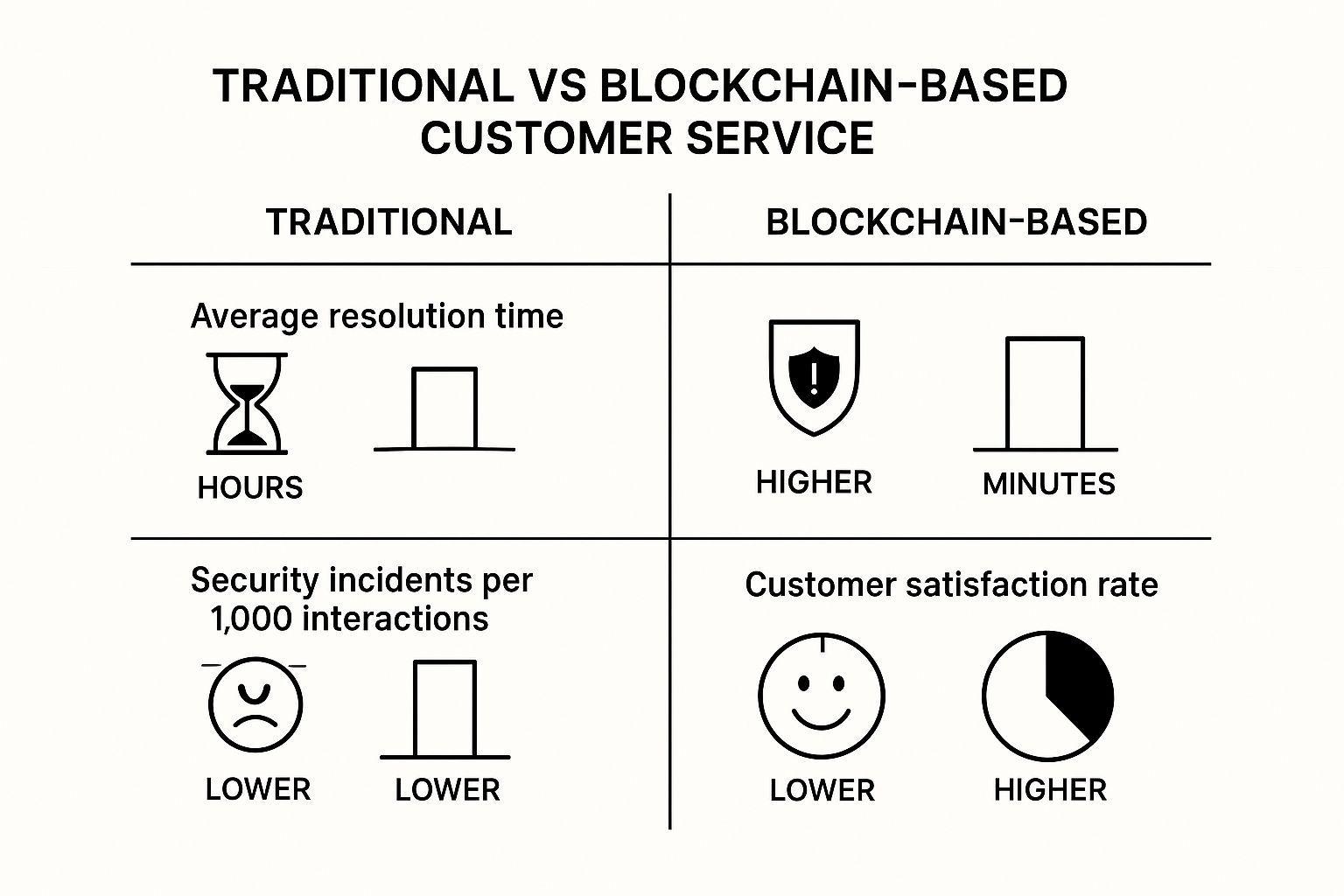
The numbers speak for themselves. Integrating blockchain doesn't just tighten security—it measurably improves efficiency and makes customers happier.
Supercharging Efficiency With Smart Automation
Beyond trust and security, blockchain delivers a serious boost to your team's efficiency, thanks to smart contracts. These are essentially self-executing agreements that run automatically when certain conditions are met, cutting out manual work and human error.
Here's what that looks like in the real world:
- Effortless Claims: Imagine a warranty claim being paid out the instant a technician verifies a product defect on the blockchain. No forms, no waiting, no agent needed.
- Instant Refunds: A smart contract can issue a refund the moment a returned package is scanned into the warehouse. The customer gets their money back in minutes, not days.
- One-and-Done ID Checks: Customers can use a single, secure digital ID to prove who they are, skipping the repetitive and annoying verification process every time they call.
This kind of automation frees up your support agents from mind-numbing administrative tasks. Instead of processing paperwork, they can focus their energy on solving complex problems and delivering the kind of high-touch, empathetic support that builds loyalty. As this technology changes the nature of support work, new roles are emerging. You can see how the field is evolving by checking out customer support jobs in the Web3 space. In the end, automation means faster answers for customers, lower costs for the business, and a far more responsive support experience.
Real-World Blockchain Use Cases for Customer Service

The theory behind using blockchain in customer service is one thing, but its real magic shines through in practical, everyday applications. Companies are already putting this technology to work solving actual customer headaches, moving well beyond abstract ideas to deliver concrete improvements. These examples show how a decentralized approach can build smoother, more reliable experiences for customers and support teams alike.
One of the most powerful applications is in decentralized identity management. Right now, we're stuck in a frustrating loop. Every time we sign up for a new service, we hand over sensitive personal data, creating yet another account. This leaves our information scattered across countless company servers, making it a prime target for data breaches.
Blockchain offers a much smarter way. A customer can create a single, self-owned digital ID that they control completely. Think of it like a digital passport. Instead of endlessly filling out registration forms, they can simply grant a company permission to verify specific details for a limited time. This cuts out the paperwork, bolsters security, and finally puts the customer back in the driver's seat of their own data.
Making Loyalty Programs Truly Valuable
Another area ripe for an upgrade is customer loyalty programs. Let's be honest, traditional reward points often feel hollow. Companies can change the rules, devalue your points, or even cancel the program on a whim, leaving you with nothing. Blockchain changes the game by giving those points real, verifiable substance.
When loyalty points are issued as tokens on a blockchain, they become genuine digital assets.
- Verifiable Ownership: Customers hold the tokens directly in their own digital wallets. This gives them undeniable proof of ownership that the company can't secretly change or revoke.
- True Scarcity: The total supply of points is recorded transparently on the public ledger. This prevents a company from quietly flooding the system and diluting the value of the points you've earned.
- Interoperability: These tokens can be designed to be traded or even used with partner brands, giving them real-world value that extends beyond a single business.
This shift turns loyalty from a simple marketing gimmick into a meaningful, asset-based relationship. It’s a core idea in the emerging digital economy. If you're new to these concepts, brushing up on the language can be a huge help. This comprehensive Web3 dictionary is a great resource for getting up to speed.
By recording rewards on an immutable ledger, companies prove that their loyalty points have genuine, protected value, building a deeper level of customer trust and engagement.
Automating Warranties and Proving Authenticity
Smart contracts, another key piece of blockchain tech, are perfect for streamlining some of the most tedious customer service processes—especially warranty claims. Forget the endless back-and-forth of finding receipts, filling out forms, and waiting for manual approval. A smart contract can manage the entire process on its own.
For instance, a product’s warranty could be issued as a unique token at the moment of purchase. If the item malfunctions, the smart contract kicks in. Once a certified technician verifies the defect and records it on the blockchain, the contract could automatically execute the remedy—whether that’s shipping a replacement part or issuing a refund. No delays, no hassle.
On top of that, blockchain provides undeniable product provenance. For high-value goods like luxury items or electronics, a support agent can simply scan a code to see an item's entire journey on the blockchain. From the factory floor to the warehouse to the retail store, every step is logged. This lets agents confirm authenticity in seconds or pinpoint exactly where damage might have occurred, turning a days-long investigation into a minutes-long resolution.
How Blockchain Builds Trust in an AI-Driven World
As we rely more on artificial intelligence for customer-facing tasks, a healthy dose of skepticism is understandable. For many people, AI decisions feel like they come from a mysterious "black box." When something goes wrong, they're left without clear answers or a way to challenge the outcome. This is precisely where combining AI and blockchain for customer service makes a world of difference.
Think of blockchain as a permanent, unchangeable receipt for every single decision an AI makes. It creates a powerful layer of accountability that's often missing from today's automated interactions, giving people a genuine reason to trust the systems they're dealing with.
This isn't just a feeling; the numbers back it up. A Pew Research study found that 52% of Americans are more concerned than excited about the growing role of AI in daily life, while a mere 10% feel the opposite. That concern often comes from the lack of transparency in how AI works, which is exactly the gap blockchain's verifiable records can fill. You can read more about how blockchain can build customer trust in AI in recent research.
Turning the Black Box Transparent
Let's make this real. Imagine a customer uses an AI chatbot to apply for a financing plan and gets denied. Typically, they'd get a vague, unhelpful rejection message. It’s a frustrating experience that chips away at trust.
Now, let's replay that scenario with blockchain in the mix. The AI’s entire thought process—based on approved, non-personal data points—is logged on an immutable ledger. The customer could then be shown this record, seeing the exact, step-by-step logic the AI used to arrive at its decision.
Blockchain provides a verifiable audit trail for AI actions, transforming automated decisions from mysterious decrees into transparent, auditable processes.
This immediately gives the customer a clear path forward. If they spot an error in the data or disagree with the logic, they have an unalterable record to back up their appeal. And it's not just a win for the customer. This system also protects the business by providing concrete proof that its process was fair and consistent. As more AI agents are deployed in customer service, building this kind of trust is no longer optional.
This partnership between AI and blockchain creates a system where:
- Decisions are accountable: Every step is recorded and can be reviewed by anyone with permission.
- Processes are fair: The rules are applied the same way every time, and the ledger proves it.
- Trust is inherent: Customers don't have to blindly trust the AI; they can verify it for themselves.
By laying this foundation of accountability, blockchain allows companies to embrace powerful AI tools without losing the confidence of the people they serve.
Getting Started with Blockchain in Your Support Strategy
Thinking about bringing blockchain into your customer service? It’s a smart move, especially now. With privacy rules tightening and the slow death of third-party cookies, the old ways of handling customer data are becoming obsolete. Blockchain gives you a chance to rebuild your customer engagement on a foundation of transparency and consent.
Picture this: instead of your company hoarding customer data, your customers hold the keys to their own secure data profiles. When they need support, they can grant you temporary access to specific information. In return, you give them truly personalized help. This isn't just about ticking a box for GDPR compliance; it's about fundamentally changing the relationship to one built on mutual respect.
When customers willingly share their information, the data you get is far more accurate and relevant. This leads directly to more meaningful service interactions and, ultimately, stronger, more loyal customer relationships.
A New Consent-Based Model
This shift also has a huge ripple effect on how you approach digital marketing. People are more aware than ever of data breaches and how their information is used (and misused). Blockchain offers a decentralized way to store data, which drastically reduces the risk of massive hacks. You can read more about how blockchain is revolutionizing digital marketing and what it means for privacy.
This consent-first framework completely changes the dynamic:
- Customer Empowerment: Users are firmly in the driver's seat, deciding exactly what data to share and who gets to see it.
- Enhanced Trust: When people see exactly how their data is used, it builds incredible confidence in your brand.
- Superior Personalization: You're no longer guessing. You're working with accurate, high-quality data that customers have willingly provided, which is the key to amazing experiences.
The real strategic shift here is moving from a data-collection model to a data-access model. It’s about building relationships on a foundation of mutual respect and verifiable trust.
Of course, blockchain is just one piece of the puzzle. To see how it fits into the bigger picture, it helps to explore other top digital customer service tools and understand how they can all work together.
Got Questions About Blockchain in Customer Service?
Whenever a new technology pops up, it’s natural to have questions. Let's be honest, blockchain can sound pretty complicated. So, let's cut through the noise and tackle some of the most common concerns business leaders have when they start thinking about this for their support teams.
Isn't Blockchain Too Slow for Live Support?
That's a fair question, especially if you're thinking about early public blockchains like Bitcoin. Those were definitely slow. But the game has changed completely.
Modern private or permissioned blockchains—the kind you'd actually use for business—are built for speed. They can process thousands of transactions per second for next to nothing. You wouldn't use it for every single chat message, but for the moments that matter? Things like instantly verifying a customer's identity or processing a warranty claim? For that, it's more than fast enough.
Do Our Customers Need to Be Crypto Experts?
Heck no. In fact, if your customers even know you're using blockchain, you're probably doing it wrong. The best technology is invisible.
They'll just notice that their experience is smoother, more secure, and surprisingly transparent. They don't need to understand the technical details, just like they don't need to know how TCP/IP works to visit your website. The system handles all the heavy lifting behind the scenes.
The whole point is to improve the customer journey, not give them a crash course in cryptography. The tech should just quietly make things better.
So, Where Do We Even Begin?
The best way to get started is to think small. Don't try to overhaul your entire customer service department overnight.
Instead, pick one specific, high-impact area where trust is a big deal. A loyalty rewards program is a great example, or maybe a more secure way to manage customer IDs. Find a good technology partner, build a small proof-of-concept, and see what happens. This lets you measure the results, learn what works (and what doesn't), and plan a smart, phased rollout.
Ready to take the next step in your Web3 career or find the perfect talent for your team? Find Web3 is your central hub for thousands of jobs in the blockchain, crypto, and DeFi sectors. Explore roles or post an opening today.