
Why DApp Architecture Changes Everything You Know About Apps
Imagine your favorite social media company suddenly deletes your account, wiping out years of photos and connections without any warning. Or think about a mobile game where the developers alter the rules overnight, making the items you worked hard to get completely useless. This is a common risk with traditional applications, which are built like centralized kingdoms where one company holds all the power. DApp architecture was created to completely dismantle this model.

From Centralized Control to Democratic Networks
Instead of depending on a single, company-owned server, dApps spread their operations across a peer-to-peer network. Think of it like this: a traditional app is like a single mainframe computer holding all of a company's data. If that one computer goes down, everything grinds to a halt. A dApp, however, is like a network of thousands of independent computers, each holding a synchronized copy of the data. If a few hundred of those computers disconnect, the system keeps running without interruption.
This basic shift is what enables platforms like Uniswap to handle billions of dollars in trades without a typical backend server or a CEO who can stop transactions. The rules of the application aren't locked away on a private server; they are written into transparent smart contracts that exist on the blockchain. These contracts function like impartial referees, executing code precisely as written and allowing anyone to review and confirm their logic. This isn't just a technical adjustment; it's a new way of thinking about digital trust and ownership.
Core Principles of a Decentralized Foundation
The concepts behind decentralized application architecture emerged in the early 2010s, sparked by foundational ideas for distributing control using programming languages like Solidity. The structure combines blockchain-based smart contracts for the backend logic with user interfaces that run on peer-to-peer networks. This design rests on four key pillars that give it its unique strength and openness:
- Open-Source Code: The application's fundamental logic is public, which allows for independent security reviews and helps build user confidence.
- Internal Cryptocurrency: DApps frequently use their own tokens to handle transactions and reward network participants, which builds a self-supporting ecosystem.
- Decentralized Consensus: Any changes to the application's state require agreement from the network, which prevents any single entity from making decisions on its own.
- No Central Point of Failure: By spreading its parts across a network, the application is very resistant to attacks or outages that would disable a centralized system. You can read the original research on dApp characteristics to see how these ideas developed.
The Three-Layer System That Powers Every Successful DApp
Every decentralized application, whether it's a straightforward NFT minting page or a sophisticated DeFi protocol, is built on a consistent three-layer framework. This modular structure is essential to a sound dApp architecture. Imagine it as a high-end restaurant: the front-end is the elegant dining area where customers interact, the smart contracts are the expert kitchen staff executing orders with precision, and the data storage layer is the well-stocked pantry ensuring every ingredient is on hand. Keeping these functions separate makes dApps more secure, simpler to manage, and easier to scale.
This infographic shows the specific roles of the application UI, smart contracts, and decentralized storage layers within the complete dApp architecture.
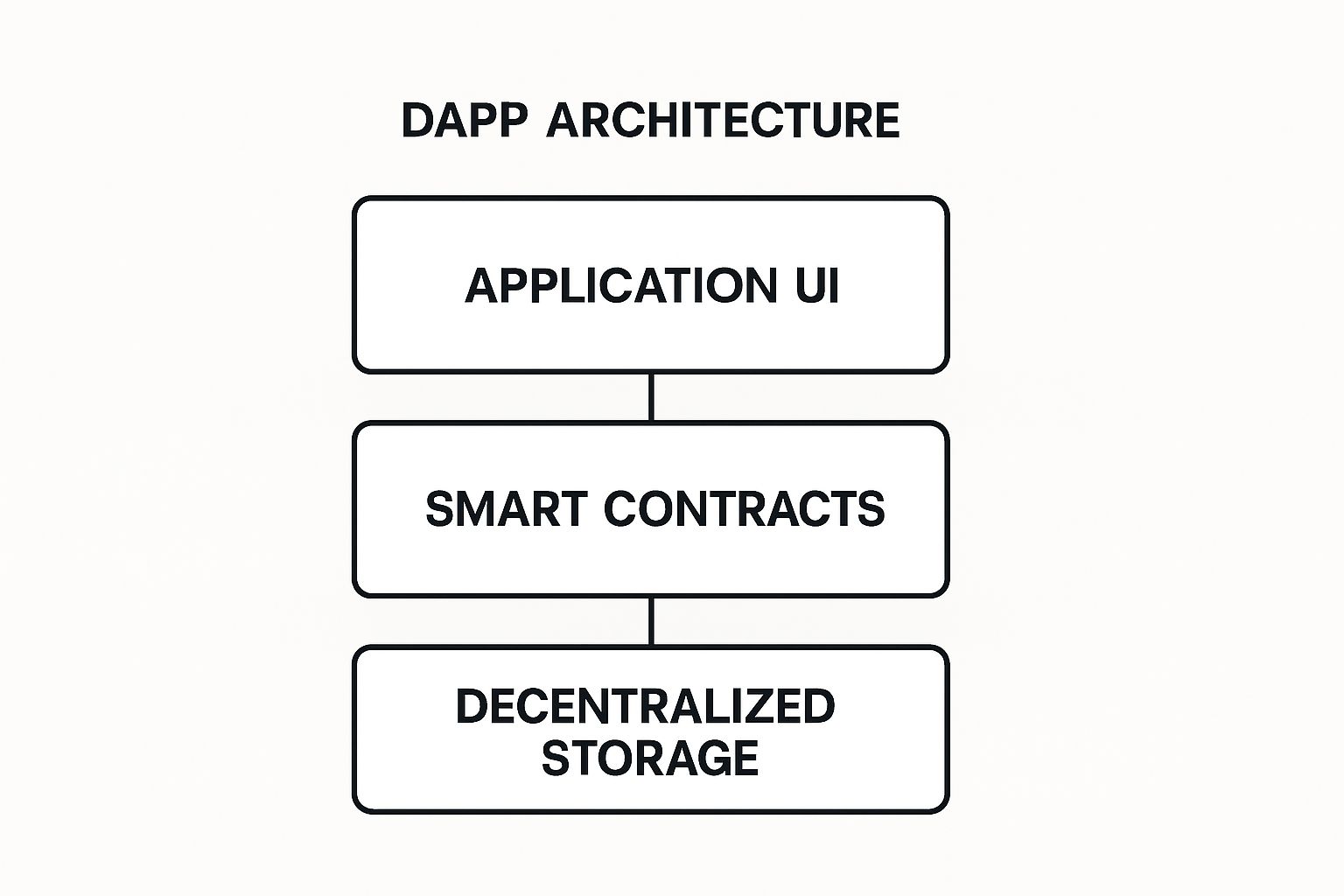
The diagram illustrates how user actions at the top layer connect to the smart contract logic, which then might communicate with a separate storage system.
To better understand how these layers work together, let's look at a comparison of their distinct roles and the technologies they use.
DApp Architecture Layers Comparison
| Layer | Primary Function | Key Technologies | Responsibilities | Security Level |
|---|---|---|---|---|
| Front-End (UI) | Provide a user-friendly interface for interacting with the dApp. | React, Vue.js, HTML, CSS, Ethers.js, Web3.js | Rendering blockchain data, building and sending transactions, wallet integration (e.g., MetaMask). | Low – Focuses on user experience; relies on wallet and blockchain for security. |
| Smart Contracts | Execute the core, immutable business logic of the application on the blockchain. | Solidity, Vyper, Rust (for Solana, etc.) | Defining rules, managing state changes, handling funds, ensuring transparent execution. | High – Code is immutable and directly controls assets and core logic. Audits are critical. |
| Data Storage | Store large files and off-chain data in a cost-effective, decentralized manner. | IPFS, Arweave, Filecoin, Swarm | Storing media (images, videos), documents, and application data not suitable for the blockchain. | Medium – Data is cryptographically secured and distributed, but not as tamper-proof as on-chain data. |
This table shows the clear separation of concerns in dApp architecture. The front-end is all about the user, the smart contract is the unchangeable logic, and the data layer handles the heavy lifting of storage.
The Front-End: The User's Window into the DApp
This is the part of the dApp that users see and interact with directly. It's constructed with standard web technologies like React, HTML, and JavaScript to create a clean user interface (UI). What makes it different from a regular website is its integration of special libraries like Ethers.js or Web3.js. These libraries act as a crucial link, connecting the user’s browser and their Web3 wallet (like MetaMask) to the blockchain itself.
This layer is responsible for several key tasks:
- Displaying information from the blockchain in a human-readable way.
- Creating transactions based on what the user wants to do.
- Prompting the user to approve and sign these transactions using their personal wallet.
The Smart Contracts: The Immutable Business Logic
At the core of every dApp are its smart contracts. These are programs that run on a blockchain and contain the application's fundamental business logic. Once a smart contract is deployed, its code typically cannot be altered, which creates a transparent and tamper-proof set of rules for everyone to follow.
For instance, a decentralized exchange’s smart contract will permanently define the exact mathematical formula for how token swaps are performed. This layer is the true "backend" of the dApp, managing all important state changes and logical operations directly on the blockchain. This design choice is what gives dApps their promise of zero downtime and resistance to censorship.
The Data Layer: Storing Information Efficiently
Blockchains are not very good at being databases. Trying to store large files, like the artwork for an NFT collection or detailed user profiles, directly on-chain is extremely expensive and slow. This is where the third layer, decentralized storage, becomes necessary.
A well-designed dApp architecture uses solutions like the InterPlanetary File System (IPFS) to hold large, static files off-chain. The smart contract then only needs to store a small, unique identifier—a hash—that points to the actual data on IPFS. This hybrid model offers the best of both worlds: the robust security of on-chain logic for critical functions and the cost-effective efficiency of decentralized storage for large data, all without compromising the dApp's decentralized principles.
Smart Contracts: Your Bulletproof Business Logic Engine
If the front-end is the dApp’s welcoming face, the smart contract is its incorruptible heart and brain. In any dApp architecture, this is where the core logic lives. Imagine a smart contract as a digital vending machine. You insert a specific coin (a transaction), and the machine is programmed to dispense a specific snack (an outcome), every single time, without fail. It doesn't need a human operator, it can't be persuaded to give out free snacks, and its rules are visible to everyone.

These self-executing programs are deployed directly onto a blockchain like Ethereum. Once they are live, their code is typically immutable, meaning it cannot be changed. This permanence is a double-edged sword; it guarantees that the application's rules are fair and transparent, but it also means bugs can be permanent and costly. A well-designed smart contract acts as the ultimate referee for everything from simple token transfers to complex financial agreements, executing its pre-defined functions without requiring trust between the participants.
Optimizing for Cost and Efficiency
Every single operation a smart contract performs—from a simple calculation to storing data—uses computational resources on the blockchain. This work requires a fee, commonly known as "gas." Inefficient code can lead to high gas costs, making a dApp too expensive for users to interact with. For example, storing large amounts of data directly on-chain is a classic mistake that can quickly drain a user's wallet.
Successful dApp developers obsess over gas optimization. Key strategies include:
- Minimizing State Changes: Only writing data to the blockchain when absolutely necessary, as this is one of the most expensive operations.
- Efficient Data Types: Using the smallest possible integer sizes (e.g.,
uint128instead ofuint256) when the full range isn't needed. - Smart Logic Patterns: Structuring functions to perform the least amount of work required to achieve the intended result.
When building and deploying smart contracts, developers must also consider fluctuating transaction costs, which can be monitored with tools like an Ethereum Gas Tracker. Keeping these costs low is essential for user retention.
Security and Upgradability in Smart Contracts
Given that smart contracts often control millions of dollars in user funds, security is the top priority. A single vulnerability can lead to catastrophic losses. This reality has created a high demand for developers with specialized skills, as seen in the growing number of DeFi jobs focused on contract security and auditing.
Best practices for securing smart contracts include:
- Using Audited Libraries: Building upon established, community-vetted code from providers like OpenZeppelin helps avoid reinventing the wheel and introducing new risks.
- Implementing Checks-Effects-Interactions: This pattern prevents a common vulnerability called a re-entrancy attack by performing internal checks and state changes before interacting with external contracts.
- Adopting Upgradeability Patterns: While contracts themselves are immutable, developers can use proxy patterns to separate logic from data. This allows the logic contract to be replaced with an updated version to fix bugs or add features, all without migrating user data. This foresight is a hallmark of a mature dApp architecture.
Solving The Data Storage Puzzle In Decentralized Systems
While standard applications store their data in centralized databases, a modern dApp architecture must solve a much trickier data storage problem. Putting large amounts of information directly on a blockchain is incredibly expensive and slow. This method is only practical for the most critical transaction logic and state information. This creates a puzzle: where do you keep all the large files that make an application useful—like images, videos, and user documents—without falling back on a central server that defeats the purpose of decentralization?
Imagine trying to run a library where the books are scattered across thousands of individual homes instead of a central building. The answer is a hybrid model that carefully separates what lives on-chain from what is stored off-chain. Developers must weigh the costs and benefits, as every byte of data on the blockchain has a real financial price. Only the absolute essentials, such as ownership records or the current state of a contract, should be written to the blockchain. Everything else is better suited for a decentralized storage solution.
Off-Chain Storage: The Decentralized Filing Cabinet
To handle bulky data, developers rely on decentralized storage networks. These platforms offer a resilient and affordable way to store files without a single point of failure. The most widely used solution in dApp architecture is the InterPlanetary File System (IPFS).
Instead of using a file's location (like a URL), IPFS uses content-addressing. It creates a unique cryptographic signature, or hash, for every file. This hash serves as a permanent, unchangeable address for that content. The smart contract on the blockchain doesn't hold the heavy file itself; it only stores this lightweight hash. When the dApp needs to show an image or document, it uses the hash to pull the correct file from the distributed IPFS network.
The screenshot below from the IPFS homepage captures its mission to build a distributed, peer-to-peer web.
This image highlights the move away from location-based addresses to a content-based system, which is fundamental to how dApps manage data securely. This approach ensures that the data linked from the blockchain is precisely what the user expects to see, because any alteration to the file would generate a completely different hash.
Balancing Ideals with Reality
This on-chain and off-chain model is the go-to approach for data-heavy dApps like NFT marketplaces and decentralized social media platforms. For instance, an NFT's smart contract holds the proof of ownership and a link (the IPFS hash) to the digital artwork. The actual image or video file resides on IPFS. This design strikes a practical balance:
- On-Chain: Secures immutable ownership and transaction rules.
- Off-Chain: Offers affordable and scalable storage for large media files.
By using decentralized storage, developers can stay true to the principles of decentralization while building applications that are both functional and affordable for users. This separation is a vital architectural choice that helps prevent costly performance issues and allows dApps to grow effectively.
Creating User Interfaces That Hide The Blockchain Complexity
Even the most impressive dApp architecture can fall flat if the user experience is clumsy and confusing. While developers are busy with smart contracts and data layers, the user only ever sees the front-end. The biggest challenge is often hiding the intimidating parts of blockchain, like connecting a wallet, approving transactions, and calculating network fees. A great dApp UI feels just like a regular web application, handling all the Web3 complexity behind the scenes.

This process of hiding the mechanics is essential for bringing dApps to a wider audience. Users shouldn't need a course on gas fees or block confirmation times just to use your app. Success comes from designing interfaces that guide people through unfamiliar steps with clarity. It's important to remember how web design impacts user confidence in crypto platforms, as a professional and easy-to-use design directly builds trust with your users.
Guiding the User Through Web3 Interactions
A well-designed dApp anticipates where users might get stuck and offers clear, contextual help. Instead of a generic prompt to "sign transaction," a better interface explains what the user is actually doing. For example, "Confirm your bid of 0.5 ETH for this artwork." This small tweak turns a technical command into a meaningful action.
Another common point of friction is the waiting time for transactions to be confirmed on the blockchain. Leaving a user staring at a loading icon with no explanation is a sure way to make them leave. The best dApps manage this "dead time" effectively:
- Provide Real-Time Status Updates: Show the transaction moving from "Pending" to "Processing" and finally "Confirmed" with clear visual signals.
- Offer Simple Explanations: A brief message explaining that the network is confirming their action can reassure anxious users.
- Allow Continued Interaction: If possible, let users continue to browse other parts of the dApp while their transaction is processed in the background.
Managing Wallets and Errors Gracefully
Connecting a wallet is the first major hurdle for any new dApp user, making a smooth onboarding flow critical. Rather than just presenting a list of wallet icons, the interface should try to detect which wallets are already installed and suggest the easiest connection method. This reduces friction right at the start. In fact, more than 50% of potential users might give up if the initial connection process is too complicated.
Just as important is how the dApp deals with errors. Blockchain transactions can fail for many reasons, from not having enough funds for gas fees to network congestion. A raw, technical error message is useless to the average person. A much better approach is to translate these errors into helpful advice.
| Technical Error | User-Friendly Message |
|---|---|
out of gas | "This transaction couldn't be completed due to high network fees. Please try again with a higher gas limit or wait for fees to decrease." |
user rejected | "You cancelled the transaction request in your wallet. If this was a mistake, please try again." |
RPC error | "We're having trouble connecting to the network right now. Please check your connection and refresh the page." |
By translating technical jargon into clear instructions, the dApp architecture can power a front-end that empowers people instead of frustrating them. This commitment to user experience is what separates niche tools from applications that achieve widespread adoption.
Choosing The Right Development Stack For Your Project
Selecting the right development stack is one of the most important decisions you'll make when defining your dApp architecture. This choice is about more than just personal preference; it directly influences your development speed, security, and the project's ability to adapt over time. Think of it like choosing the materials to build a house. You wouldn't use the same tools for a log cabin as you would for a modern skyscraper. Your tech stack must match your project's goals and your team's skills.
Picking an unsuitable stack can mean spending more time wrestling with tools than building your actual product. While the dApp development world is full of options, a few have emerged as go-to choices because of their reliability and strong feature sets.
Core Frameworks: The Foundation of Your DApp
The heart of any dApp stack is its core development framework. This is the tool that gives you the power to compile, test, and deploy your smart contracts. Two major players currently lead the pack in the Ethereum ecosystem:
- Hardhat: A JavaScript-based environment, Hardhat is celebrated for its flexibility and an impressive ecosystem of plugins. It offers a fantastic developer experience, especially with its local Ethereum network simulation, which makes testing and debugging much more manageable.
- Foundry: A newer, Rust-based toolkit, Foundry is rapidly gaining popularity for its sheer speed and native Solidity testing. It lets developers write tests directly in Solidity, a feature many find more direct than switching to JavaScript. This can dramatically reduce testing time, particularly for larger, more complex projects.
Your team’s existing expertise plays a huge role here. A team comfortable with JavaScript and TypeScript will likely find Hardhat easier to pick up. On the other hand, a team prioritizing raw performance and a Solidity-first testing workflow might lean towards Foundry.
Building a Complete and Cohesive Stack
A great dApp stack is more than just a core framework; it’s a collection of tools that work well together. For example, you’ll need a library to help your front-end application communicate with the blockchain. Ethers.js is a popular modern choice, praised for its straightforward design and powerful features. For blockchain infrastructure, platforms like Alchemy offer reliable access to blockchain nodes, saving you the considerable headache of running and maintaining your own.
To help you navigate these choices, here is a comparison of some popular dApp development frameworks. This table breaks down their primary uses, learning curves, and ideal project types.
DApp Development Framework Comparison
Comprehensive comparison of popular dApp development frameworks showing features, learning curve, and best use cases
| Framework | Primary Use | Learning Curve | Community Size | Best For |
|---|---|---|---|---|
| Hardhat | Smart contract development, testing, deployment | Low-to-Medium (for JS devs) | Large & Mature | Teams proficient in JavaScript/TypeScript looking for flexibility and a rich plugin ecosystem. |
| Foundry | High-performance smart contract testing & deployment | Medium-to-High (Rust/Solidity focus) | Growing Rapidly | Developers who prefer writing tests in Solidity and need maximum testing speed. |
| Truffle Suite | End-to-end dApp development, asset management | Medium | Large (Legacy) | Established projects or teams already familiar with its comprehensive suite of tools. |
| Brownie | Python-based smart contract development & testing | Low-to-Medium (for Python devs) | Medium | Python developers and projects focused on data analysis or scripting alongside smart contracts. |
This table shows that the "best" framework really depends on your specific needs. Hardhat offers a familiar environment for the vast community of JavaScript developers, while Foundry caters to those seeking peak performance and a pure-Solidity workflow.
As you piece together your stack, focus on how the different components integrate. The aim is to create a smooth, efficient workflow, not a patchwork of tools that don't communicate well. Understanding these tools and how they fit together is a fundamental skill for anyone serious about building in this space and a common requirement for high-level blockchain jobs. By thoughtfully choosing a stack that aligns with your project's vision and your team's strengths, you set the stage for a robust and successful dApp.
Learning From DApps That Handle Real Scale And Real Money
While theory gives you a solid foundation, the most valuable lessons in dApp architecture come from studying platforms that manage huge user loads and secure billions of dollars in value. The most successful dApps didn't get there by accident; they made smart architectural decisions that helped them grow securely without giving up on decentralization. By looking at these battle-tested systems, we can see what separates a production-ready application from a simple proof-of-concept.
Take Uniswap, a decentralized exchange that often handles thousands of trades every minute. Its core architecture is a perfect example of keeping things simple and efficient. Instead of a messy, multi-contract system, Uniswap's logic for swapping tokens is packed into lean, highly optimized smart contracts. This approach drastically cuts down on gas costs and shrinks the potential attack surface—a critical factor when dealing with high transaction volumes. Their upgrade strategy, which uses a factory pattern to launch new, separate pools, allows them to roll out features without touching the billions locked in existing ones.
Scaling Data-Heavy Operations
Another great case study is OpenSea, which had to figure out how to manage metadata for millions of NFTs. Putting all that data on-chain would be impossible and incredibly expensive. Their architecture neatly divides the work:
- On-Chain Logic: The core smart contracts handle only what's absolutely necessary: proving NFT ownership and facilitating transfers. This keeps blockchain interactions minimal and affordable.
- Off-Chain Management: A powerful off-chain system, including databases and APIs, takes care of the massive amount of metadata, like NFT images, descriptions, and collection info. This setup provides a fast, responsive user experience, much like a traditional website.
This hybrid model highlights a key principle: use the blockchain for what it's best at—secure, decentralized state verification—and use off-chain systems for everything else. This architectural pattern is essential for building scalable dApps that can support a large user base.
The Power Law of DApp Usage
The success of these top-tier platforms points to a major trend in the ecosystem. Even though thousands of dApps exist, a small number of them dominate the market. Public data shows that the top 10% of dApps frequently capture over 80% of the total transaction volume and active users. This uneven distribution shows just how important it is to build a strong and scalable dApp architecture from day one. Capturing even a small piece of the market requires serious technical capability. For a closer look, you can explore the latest Web3 statistics to see how these trends are shaping the field.
In the end, the industry leaders teach us that great dApp architecture is about making smart trade-offs. It involves optimizing for gas, designing for safe upgrades, and intelligently separating on-chain and off-chain tasks to deliver an application that is secure, scalable, and easy to use.
Your Practical Roadmap To Building Production-Ready DApps
Turning architectural theory into a dApp that people actually use is a step-by-step journey. This roadmap will help you transform your dApp architecture concepts into a reliable application that earns user trust. The work doesn't start with the first line of code; it begins with solid planning and validation. Before even touching blockchain-specific challenges, it's wise to get comfortable with the core ideas of a successful app development project plan.
Architecture Validation and Iteration
Before you commit your resources to a full-scale build, you need to test your architectural choices. This involves creating simple prototypes or proof-of-concept models to check your core assumptions. Can your data storage solution actually handle the user load you anticipate? Are your smart contract calls as gas-efficient as you think? Answering these questions early on prevents expensive and time-consuming redesigns later. Think of building in Web3 as a cycle of build, test, and refine.
This iterative approach is vital in a field where user behaviors can change quickly. A look at dApp usage from 2020 to early 2023 shows a dynamic but tough market. By March 2023, fewer than 10% of dApps showed positive trends in both user numbers and transaction activity. However, this same data reveals that dApps with strong, well-tested foundations are the ones that achieve lasting success. You can dive deeper into these dApp utilization trends to better understand the market.
A Phased Development Checklist
A structured process helps manage risks and keeps your project on course. By breaking the development work into clear phases, each with its own checklist, you can maintain momentum and ensure quality.
Phase 1: Smart Contract Development and Testing
- Write the core logic for your smart contracts using secure coding practices like the Checks-Effects-Interactions pattern.
- Create a thorough test suite that covers every function and potential edge case.
- Perform an initial gas cost analysis to spot and optimize any inefficient code.
Phase 2: Off-Chain and Front-End Integration
Phase 3: Security Audits and Deployment
- Hire a trusted third-party firm to conduct a complete security audit of your smart contracts. This is an absolute must-do step.
- Carefully fix all critical vulnerabilities found in the audit report.
- Deploy the contracts to a public testnet for a final round of testing in a live environment.
- Execute the mainnet launch while closely monitoring the first transactions for any issues.
Phase 4: Post-Launch Monitoring and Evolution
- Implement tools to monitor contract events and overall network performance.
- Have a clear strategy for future upgrades, using established patterns like proxies.
- Actively collect user feedback to guide your next development cycle and feature updates.
Following this structured roadmap helps turn your dApp architecture from a blueprint into a strong, user-focused application that's prepared for the real world.
Ready to use these skills and help shape the future of decentralized technology? The Web3 industry is looking for people who know how to build secure, scalable systems. You can explore thousands of roles from leading companies on the Find Web3 job board and begin your career in this dynamic field.