
Let's get right to it: a smart contract developer's salary typically falls somewhere between $120,000 and over $200,000 per year. Of course, top-tier talent working for major Web3 players can pull in significantly more. Across the board, the global average hovers around $140,000, which tells you just how much demand there is for people who can build secure, automated agreements on the blockchain.
What Exactly Does a Smart Contract Developer Do?

Think of a smart contract developer as a high-tech architect and locksmith, all rolled into one. Instead of building with steel and concrete, they build with code. They design and write self-executing contracts—agreements with the terms written directly into the code—that live on a blockchain. These aren't your typical legal documents gathering dust in a file cabinet; they are active, unchangeable programs that automatically carry out their duties without needing a lawyer, banker, or any other intermediary.
This unique skill set is the very engine powering the most exciting corners of Web3. Every time you swap tokens on a decentralized exchange, mint an NFT, or track a product on a transparent supply chain, there's a smart contract doing the heavy lifting in the background. It’s what ensures every digital transaction is secure, transparent, and final.
So, Why the Big Paycheck?
The impressive salaries come down to a classic case of supply and demand. The need for developers who can write solid, secure smart contracts is exploding, but the number of true experts is still surprisingly small. This isn't a field where you can afford mistakes. A single, tiny bug in a smart contract can—and has—led to the loss of millions of dollars in an instant.
It’s no wonder companies are willing to pay a premium for developers who can safeguard their digital assets and build applications that users can trust. The role is a fascinating blend of a software engineer's precision and a cryptographer's security-first mindset.
The salary landscape for smart contract developers reflects strong demand and significant variation depending on experience, location, and company. The average yearly salary for a smart contract developer globally hovers around $140,000, with reported minimums near $109,000 and maximums reaching up to $171,000, especially for remote positions. You can explore more detailed salary data from BeInCrypto.
A Glimpse at Global Pay Scales
Where you live (or where the company you work for is based) definitely plays a role in your potential earnings. Some regions simply have a higher concentration of Web3 companies and a higher cost of living, which pushes salaries up.
Here’s a quick look at how the paychecks can differ around the world.
Average Smart Contract Developer Salary by Region
The table below summarizes average annual salary ranges for smart contract developers, showing just how much pay can vary from one continent to another.
| Region | Average Annual Salary Range (Low End) | Average Annual Salary Range (High End) |
|---|---|---|
| North America | $126,000 | $187,000 |
| Oceania | $117,000 | $203,000 |
| South America | $84,000 | $150,000 |
As you can see, developers based in North America and Oceania tend to command the highest salaries. That said, the rise of remote work is starting to change the game, opening doors for talented developers everywhere to land top-paying roles, regardless of their physical location.
How Your Experience Level Shapes Your Salary
In smart contract development, your career isn't just a ladder—it's more like an apprenticeship. You start by learning the craft, and with every project, you're trusted with more responsibility and more valuable assets. As your ability to build secure, complex systems grows, your salary naturally follows suit. Think of it this way: your compensation is a direct reflection of the trust the market places in your skills.
To really map out your career path, you need to understand how your earning potential will change over time. The industry generally breaks this down into three stages: entry-level, mid-level, and senior. Each one comes with different expectations, unique challenges, and, of course, a different salary range.
A few things will shape this journey, like your specific hands-on experience, the demand for your skill set, and even where you’re based.
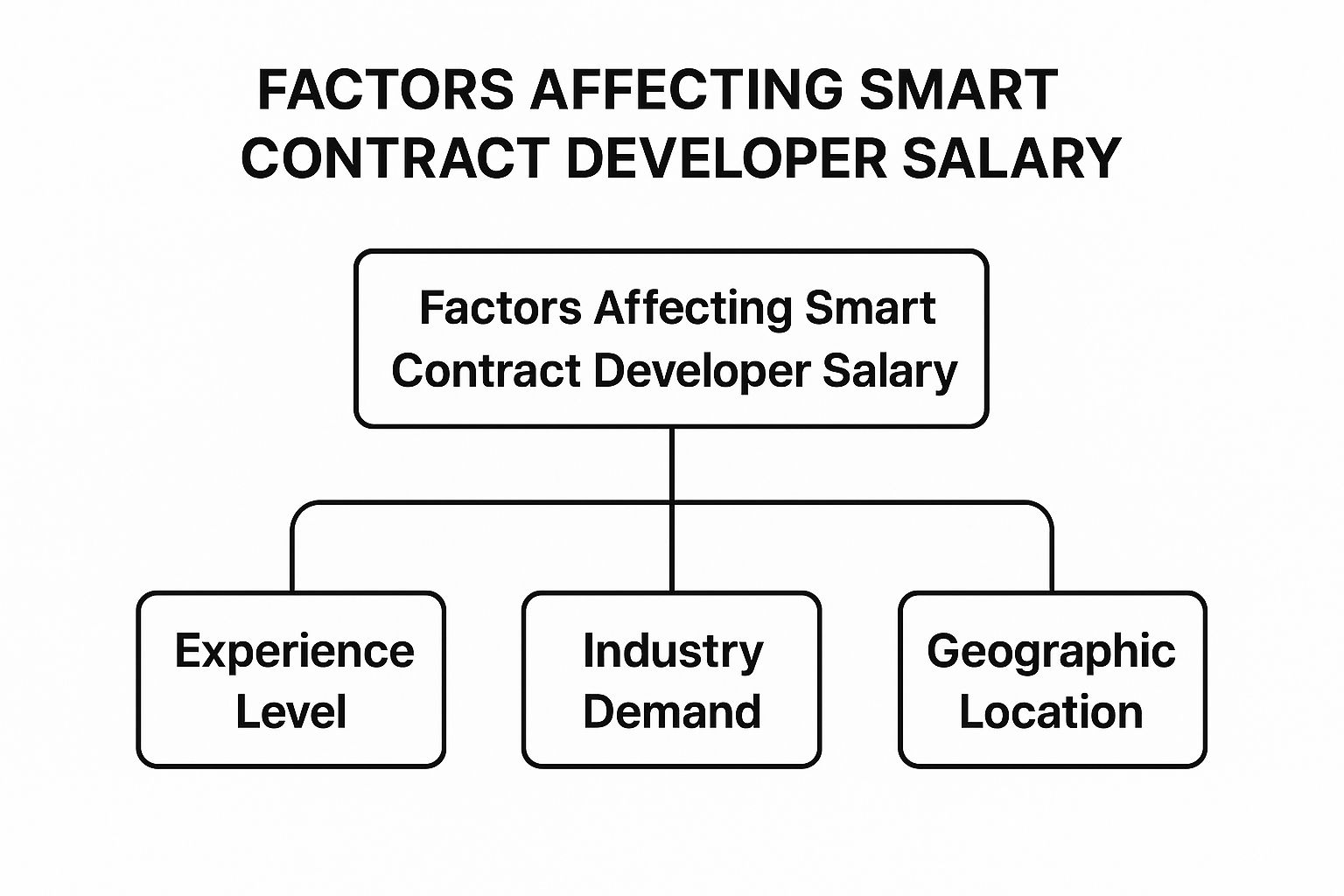
As you can see, your experience is the bedrock of your earning power, but other market forces play a big role, too.
The Entry-Level Developer (0-2 Years)
When you're just starting out, your main job is to soak up knowledge. You'll be focused on mastering the fundamentals of Solidity or another smart contract language and proving you can write clean, functional code. Most of your time will be spent on smaller, well-defined tasks, usually with a senior developer looking over your shoulder.
At this stage, your day-to-day might look like this:
- Writing and testing basic smart contracts.
- Jumping into existing code to debug and fix minor bugs.
- Helping senior developers by building out smaller pieces of a larger project.
- Learning the essentials of security and how to avoid common vulnerabilities.
You're building the foundation of your career here. You won't be architecting the next big DeFi protocol from day one, but you are a crucial part of the team, learning the ropes while helping get the project over the finish line.
The Mid-Level Developer (2-5 Years)
With a few years under your belt, you'll move into a mid-level role. This is where the training wheels come off. You’re expected to work much more independently, taking full ownership of entire features or modules. You’ve graduated from following instructions to actively shaping the design and implementation of more complex systems.
This jump in autonomy comes with a significant pay bump. An entry-level developer with less than two years of experience can expect to make between $80,000 and $120,000 a year. As you gain more experience, mid-level developers typically see that range climb to $120,000 to $180,000. Once you hit the senior level, where you're dealing with core protocol engineering and high-stakes security, salaries often push well past $200,000.
The Senior or Lead Developer (5+ Years)
After five or more years in the trenches, you're ready to step into a senior or lead role. You're no longer just a programmer; you're a strategist, a mentor, and a guardian of the project's security. Your focus shifts from simply writing code to architecting the entire system from a high level.
A senior developer's value isn't just in the code they write—it's in the catastrophic failures they prevent. Their deep expertise in security, gas optimization, and protocol design is what stands between a successful project and millions of dollars in lost funds.
As a senior developer, you're handed the most critical tasks:
- Designing protocol architecture: You’re the one drawing up the blueprints for entire decentralized applications.
- Leading security audits: You become the last line of defense against costly exploits.
- Mentoring junior and mid-level developers: You're responsible for cultivating the next wave of talent.
- Optimizing for gas efficiency and scalability: Your work ensures the protocol can grow without becoming impossibly expensive for users.
Reaching this level puts you in an elite group of professionals in the Web3 space. If you're ready to take that next step, you can find hundreds of open smart contract engineering jobs that fit your experience level.
Where You Live Determines How Much You Earn

The old real estate mantra—"location, location, location"—hits just as hard in the tech world. Your physical address can dramatically influence your paycheck, and that's especially true in the high-stakes field of smart contract development. Looking at the United States, a global center for blockchain innovation, gives us a crystal-clear picture of how geography shapes earning potential.
While we've touched on global averages, zeroing in on the U.S. market reveals some pretty stark regional differences. The national average salary for a smart contract developer is a great starting point, but it's just that—a start. The moment you look at specific tech ecosystems, you'll see those numbers start to climb.
The Power of Tech Hubs
So, why does a developer in Seattle or the Bay Area often pull in a much larger salary than one in a smaller city? It boils down to a mix of two powerful forces: a high concentration of Web3 companies and a much steeper cost of living. Major tech hubs act like magnets for talent and investment, creating a hyper-competitive job market where companies have to offer premium salaries to snag the best people.
This dynamic creates a feedback loop. Top-tier companies set up shop, which attracts skilled developers, which in turn encourages more startups to launch there to access that rich talent pool. Before you know it, certain cities become undeniable salary hotspots.
Focusing on the United States, a key market for this role, the average salary for a smart contract developer lands around $129,348 per year, which works out to about $62.19 an hour. This median figure sits within a wide pay band; the 25th percentile starts near $106,000, while top earners in the 75th percentile can clear $157,000 annually. In high-paying states like Washington, the average jumps to $147,202—a full 14% above the national median.
Smart Contract Developer Salary Comparison: US Hotspots vs. National Average
To truly see the impact of location, let's compare the average salaries in a few key US tech states against the national average. As the data shows, working in a major hub can give your earning potential a significant boost.
| Location | Average Annual Salary | Difference from National Average (%) |
|---|---|---|
| Washington | $147,202 | +13.8% |
| New York | $141,643 | +9.5% |
| California | $139,368 | +7.7% |
| US National Average | $129,348 | N/A |
The numbers speak for themselves. The premium paid in these states isn't just for show; it's a direct reflection of intense local competition and the high cost of living required to be at the epicenter of the industry.
To get an even more granular view of how your potential earnings stack up globally, you can check out country-specific salary comparison tools. These can help you benchmark your value with up-to-date market data.
The salary difference between a major tech hub and a smaller city isn't just about paying more for rent. It's about a company's investment in being at the epicenter of innovation, where deals are made, partnerships are forged, and the next big idea is born.
The Remote Work Revolution Changes Everything
But here’s a modern twist: the traditional link between a high salary and a high-cost city is starting to fray. The massive shift to remote work has completely shaken up the compensation game. Companies are no longer restricted to the talent in their zip code, and developers are no longer forced to move to expensive cities to land a top-tier job.
This is creating a more level playing field where your proven skills matter more than your address. While some companies still adjust pay based on an employee's location, a growing number are adopting location-agnostic pay scales. They offer the same competitive salary for a role, whether the developer is based in New York City or a quiet town in the Midwest.
This evolution is unlocking incredible opportunities. Talented developers from anywhere can now compete for premier roles that were once geographically off-limits. As you map out your career, you can explore thousands of remote and on-site crypto jobs on our platform to see exactly how this trend is playing out in the real world.
The High-Value Skills That Boost Your Pay
While your experience level and location lay the groundwork for your salary, it's your specific skillset that really makes you a top earner. Think of it this way: knowing the basics gets you in the door, but mastering the high-demand specialties is what gets you the corner office—metaphorically speaking, of course.
What separates a decent salary from a truly impressive one often boils down to the tools in your technical belt. It's like being a world-class chef. Anyone can follow a recipe, but a chef who masters a rare and complex cuisine is the one earning Michelin stars. In the Web3 world, those "Michelin star" skills are all about solving the industry's biggest headaches: security, scalability, and cost efficiency.
Foundational Versus High-Impact Skills
Every smart contract developer has to start with the fundamentals. This means getting really good at a core programming language. But to see a serious jump in your paycheck, you need to stack high-impact abilities on top of that foundation—skills that directly solve expensive problems for businesses.
Here's a look at what truly moves the needle:
- Core Languages: You absolutely have to know Solidity to work in the Ethereum ecosystem. It's the price of admission. But knowing Rust is quickly becoming a massive advantage, as it's the engine behind high-speed blockchains like Solana and Polkadot.
- Advanced Security Auditing: This might be the single most valuable skill you can possess. It’s the art of combing through code to find and squash vulnerabilities before they get exploited. A good audit prevents a project from becoming the next big headline for all the wrong reasons.
- Gas Optimization: Sloppy, inefficient contracts cost users a fortune in transaction fees, which can absolutely kill a project's momentum. If you can write lean, hyper-efficient code that keeps gas fees low, you're incredibly valuable. You're directly improving the user experience and making the dApp financially viable.
- Layer-2 Scaling Solutions: Blockchains like Ethereum can get jammed up. Layer-2 solutions like Optimism, Arbitrum, and Polygon are the express lanes that solve this problem. Having expertise here shows you're not just building for today; you're building for a future where dApps can handle millions of users, not just thousands.
The Undeniable Value of Security Expertise
In the world of smart contracts, security isn't just a nice-to-have feature; it's the bedrock of trust. One tiny mistake or oversight can lead to a multi-million dollar exploit that tanks a project's reputation forever. That's the kind of risk that keeps founders up at night.
This is precisely why developers with proven security chops command premium salaries. We're talking about more than just writing clean code. It means deeply understanding common attack vectors like reentrancy attacks, integer overflows, and front-running. A developer who can write a contract and then put on a white hat to audit it is playing in a completely different league. They're not just builders; they're guardians.
An expert security audit is the difference between a thriving DeFi protocol and a cautionary tale on Twitter. Companies will pay top dollar for the peace of mind that comes from knowing their digital vault is impenetrable.
This deep security knowledge sends a powerful signal to employers: you can be trusted with their most critical assets. If you're looking for roles that put a premium on this, you'll find hundreds of specialized blockchain jobs that demand strong security skills.
Embracing Next-Generation Technologies
Finally, the Web3 space moves at a breakneck pace. To maximize your earning potential, you have to stay ahead of the curve. The hot skill of today could be the standard expectation tomorrow.
For instance, getting a handle on Zero-Knowledge (ZK) proofs is becoming a huge differentiator. This technology unlocks new levels of privacy and scalability that were once just theoretical. Likewise, getting good with emerging technologies like AI code generation tools can also make you stand out and justify a higher salary by showing you can boost your own efficiency and output. By constantly learning and adding these advanced skills to your repertoire, you’re not just keeping up—you're positioning yourself as a leader in the field.
How to Confidently Negotiate Your Salary

Knowing your market value is the first step, but actually getting paid what you're worth? That takes a smart negotiation strategy. In the fast-moving world of Web3, developers who can clearly explain their value are the ones who walk away with the best compensation packages. The secret is to stop thinking of it as a confrontation. It's really just a collaborative discussion about what you bring to the table.
Your goal is to build a rock-solid case for the smart contract developer salary you deserve. This case needs to be grounded in hard data, your past performance, and a real understanding of what the company is trying to achieve. You need to walk into that conversation with more than just a number in your head; you need a story that shows how you directly contribute to security, efficiency, and innovation.
Prepare Your Arsenal Before the Conversation
Great negotiation starts long before you get an offer. It’s all about doing your homework and framing your value in a way that clicks with the business. Don't leave this to the last minute—start building your case from the moment you even think about applying.
Here’s what you need to do:
- Benchmark Your Worth: First things first, figure out the going rate for a developer with your specific skills, experience, and location (or for remote roles). A senior dev with deep knowledge of Rust and Layer-2 solutions shouldn't be using the same numbers as a junior Solidity coder just starting out.
- Research the Company: Dig deeper than their homepage. Look into their recent funding rounds, their mission, and the specific problems they're trying to solve. If they just landed a $30 million Series A to build a new DeFi protocol, you know they have both the need and the money for top-tier security talent.
- Build Your Impact Portfolio: Your GitHub is your technical resume, but your impact portfolio is your sales pitch. Document specific examples of how your work has made a real difference. Did you refactor a contract and save users 40% on gas fees? Did you catch a critical security vulnerability during a code review that saved the project from disaster? Put a number on your accomplishments whenever you can.
Frame Your Value During the Interview
Every question you answer in an interview is a chance to reinforce your value. When they ask about a past project, don't just list your tasks—explain why it mattered. Tie your technical abilities directly to business results.
The best negotiation tactic is to make your salary request feel like the obvious, logical next step. When you've spent the whole interview showing how you solve expensive problems, your number stops being a cost and starts looking like a smart investment.
Think in terms of solutions. Instead of saying, "I'm proficient in Solidity," try something like, "My expertise in Solidity let me architect a gas-efficient staking contract that boosted user retention by 15%." That second statement is so much more powerful because it connects your skill directly to the company's success.
Navigate the Offer and Counteroffer
Once an offer is on the table, the real negotiation kicks off. This is where all your prep work pays off. It's completely normal—and even expected—to take some time to review the offer and come back with a counter.
Here’s how to handle a few common situations:
- Handling a Lowball Offer: Don't get offended. A low first offer is often just their opening move. Respond professionally, say you're still excited about the role, and then present the market data and impact examples you've gathered. Frame your counter as a reflection of the market value for your proven skills.
- Discussing Token Compensation: In Web3, your pay is often a mix of cash and tokens. You need to ask smart questions. What’s the vesting schedule? What's the token's total supply? Is it coming from an employee options pool? Understanding the tokenomics is just as crucial as the dollar figure.
- Leveraging Competing Bids: If you have another offer, you can absolutely use it as leverage, but handle it with care. You're not trying to give an ultimatum; you're just signaling that you're in high demand. Something as simple as, "I do have another offer, but my preference is to join your team. Is there any way you can get closer to this number?" can work wonders.
When you approach the conversation with confidence, data, and a clear story about your value, you put yourself in the best position to negotiate a smart contract developer salary that truly reflects your expertise.
The Future Career and Salary Outlook
So, what does the road ahead look like? For smart contract developers, the future is incredibly bright. This isn't just a niche role anymore; it's quickly becoming a fundamental part of the modern digital economy. As more industries, from finance to logistics, embrace blockchain, the need for developers who can write solid, secure code is only going to get more intense.
This growing demand is a clear signal that salaries will likely continue to climb. But make no mistake, this field moves fast. The developers who command the highest paychecks will be the ones who stay on top of emerging trends. In this space, continuous learning isn't just a good idea—it's essential for staying relevant and boosting your long-term earning power.
Key Trends Shaping Future Salaries
A few major trends are already shaping the job market and what companies are willing to pay. If you can build skills in these areas, you'll be setting yourself up for the most rewarding opportunities.
Here’s what you should be watching:
The Multi-Chain Universe: We're moving beyond an Ethereum-only world. High-speed blockchains like Solana and Polkadot are carving out significant territory. This means developers who know more than just Solidity—especially those proficient in languages like Rust—have a serious edge. Being able to build on different platforms makes you far more versatile and valuable.
Security, Security, Security: The obsession with security is only going to get stronger. Think about it: with billions of dollars now locked in decentralized protocols, a single bug can be catastrophic.
This high-stakes environment makes developers with a deep understanding of security auditing and protocol design worth their weight in gold. That expertise translates directly into higher earning potential.
- The AI and Blockchain Crossover: A new frontier is opening up where Artificial Intelligence (AI) meets blockchain. Developers who can figure out how AI can improve smart contracts—whether by optimizing code, automating security audits, or creating more dynamic protocols—will be true pioneers. This unique combination of skills is poised to create a whole new class of top-tier, high-paying jobs.
Pursuing a career as a smart contract developer isn't just about landing a great job today. It’s about positioning yourself at the heart of a field that’s set for massive expansion.
Frequently Asked Questions
It's natural to have questions when you're mapping out your career, especially in a field as dynamic as smart contract development. Let's tackle some of the most common ones I hear from developers trying to understand their earning potential.
Do I Really Need a Computer Science Degree to Earn a Top Salary?
Honestly? No. While a formal CS degree can certainly give you a solid foundation, the Web3 world operates a bit differently. Here, your practical skills and what you've actually built carry far more weight than a piece of paper.
What really opens doors—and wallets—is a killer GitHub profile, a history of contributions to open-source projects, and a portfolio of dApps that show you can write clean, secure, and efficient code. When it comes down to it, proving you can solve real problems on-chain is what gets you hired for the big bucks.
In Web3, your code is your resume. A well-documented project that tackles a tough problem or a meaningful contribution to a major protocol speaks louder than any degree ever could.
What Kind of Money Do Freelance Smart Contract Developers Make?
Going freelance in Web3 is a path that offers incredible flexibility and, for many, a very healthy income. While it can fluctuate, freelance smart contract developers often see project-based rates ranging anywhere from $3,000 to over $10,000 per month.
If you specialize in high-stakes work, like DeFi protocols or security audits, you can command even more. Just remember that freelance income isn't as steady as a salary. Many freelancers also get paid in project tokens, which is a double-edged sword—it's risky, but the upside can be massive if the project takes off.
Is It All About Solidity, or Should I Learn Other Languages?
Solidity is the undisputed champion for Ethereum and other EVM chains, so you absolutely need to know it. But stopping there would be a mistake. Thinking that Solidity is the only language that matters is a surefire way to limit your career and your salary.
To really maximize your smart contract developer salary and become a more versatile candidate, you should seriously consider adding these to your toolkit:
- Rust: This is the powerhouse behind high-performance blockchains like Solana and Polkadot. Mastering Rust opens up an entirely different, and very lucrative, part of the job market.
- Vyper: A Python-like language that also targets the EVM. Its main selling point is a heavy focus on security and simplicity, which makes it an attractive skill for projects where safety is paramount.
- JavaScript/TypeScript: You can't escape it! This is essential for building the frontends that actually interact with your smart contracts using libraries like ethers.js or web3.js.
Being fluent in more than one blockchain language makes you a far more valuable asset to any team, directly bumping up your earning potential and giving you more options.
Ready to see what roles align with your skills and salary goals? Find Web3 gathers thousands of jobs from the best companies in the blockchain industry. Start exploring your next career move and see what's out there.