
Ready to Explore Web3? Your Blockchain Career Starts Here
Want to launch your career in the exciting world of blockchain? This listicle reveals seven in-demand blockchain entry level jobs ideal for breaking into Web3. Discover roles ranging from junior blockchain developer and blockchain analyst to content writer and QA tester. We'll cover expected salaries, required skills, and real-world examples for each position. This guide will help you find the perfect blockchain entry level job to match your talents and launch your Web3 career.
1. Junior Blockchain Developer
One of the most accessible blockchain entry level jobs is that of a Junior Blockchain Developer. This role offers a fantastic entry point into the exciting world of Web3. Junior developers work on the foundational elements of blockchain technology, building, testing, and maintaining the applications and smart contracts that power decentralized systems. They typically work under the guidance of senior developers, gaining practical experience while contributing to real-world projects. This mentorship is crucial for developing a deep understanding of blockchain architecture, development processes, and best practices. Their responsibilities range from implementing blockchain solutions and writing code for decentralized applications (dApps) to contributing to the development of blockchain protocols themselves. This makes it an ideal position for those looking to build a strong foundation in this rapidly evolving field.
Junior Blockchain Developers work with a variety of programming languages, including Solidity (specifically designed for Ethereum smart contracts), JavaScript, Python, and Go. They delve into the intricacies of smart contract development and testing, ensuring the security and efficiency of these self-executing agreements. Familiarity with various blockchain frameworks like Ethereum, Hyperledger, and Polygon is also essential, as different projects may utilize different platforms. Furthermore, they are expected to be proficient in version control systems like Git, enabling collaborative development within teams. A basic understanding of cryptography and consensus mechanisms, the core principles underpinning blockchain security and functionality, is also crucial.
Why does this role deserve a place on this list? Quite simply, the demand for skilled blockchain developers is exceptionally high. The industry is experiencing rapid growth, leading to competitive starting salaries ranging from $60,000 to $90,000. Junior developers have the opportunity to work on cutting-edge technology, shaping the future of decentralized systems. Moreover, remote work opportunities are widely available, offering flexibility and a broader range of potential employers. The current skills shortage in the blockchain sector also contributes to strong job security for those with the right expertise.
However, it's important to be aware of the challenges. There's a steep learning curve for blockchain-specific concepts, and the rapidly changing technology landscape necessitates continuous learning. The relatively nascent nature of the field means there are a limited number of senior mentors available, though this is improving. Finally, market volatility, particularly in the cryptocurrency space, can impact job stability at some companies, especially startups heavily reliant on token prices.
Companies actively hiring junior blockchain developers include ConsenSys, known for their work on Ethereum ecosystem projects; Chainlink Labs, focusing on decentralized oracle networks; IBM's blockchain division, utilizing Hyperledger for enterprise solutions; and Polygon Studios, developing Web3 gaming applications. These examples highlight the diverse opportunities available within the blockchain space.
Learn more about Junior Blockchain Developer
To give you a quick reference to some key data points for a Junior Blockchain Developer role, take a look at the infographic below:
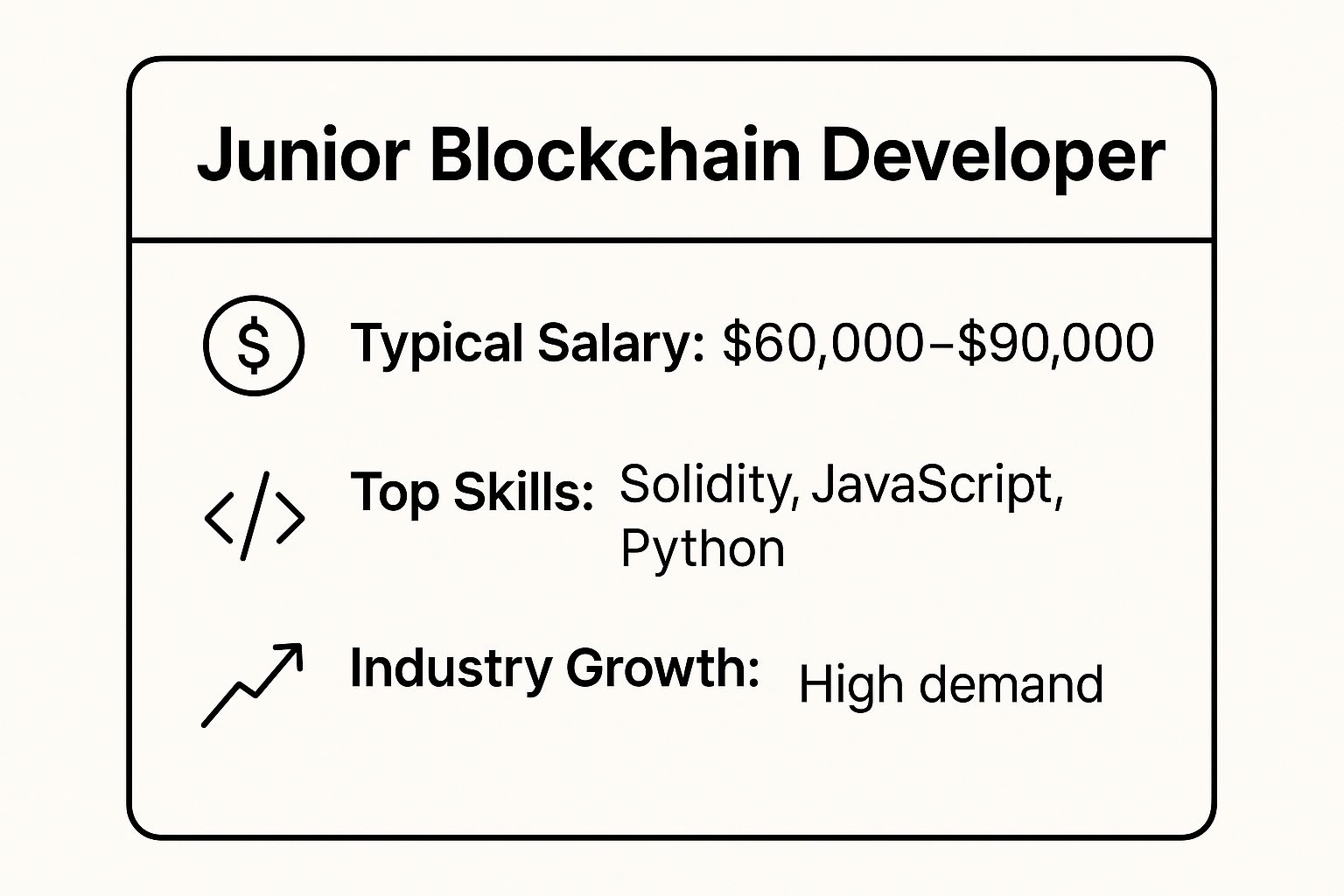
As the infographic summarizes, Junior Blockchain Developers can expect competitive salaries, high demand, and a need for core skills like Solidity, JavaScript, and Python. This combination of attractive remuneration, robust demand, and a clear skillset roadmap makes this role particularly appealing for newcomers to the blockchain industry.
So, how can you break into this exciting field? Here are some actionable tips: Build a portfolio showcasing smart contracts you’ve deployed on testnets, contribute to open-source blockchain projects on GitHub to gain practical experience and visibility, and complete blockchain development bootcamps or online courses to solidify your understanding of core concepts. Practicing building dApps using frameworks like Truffle or Hardhat will also give you valuable hands-on experience. Finally, immerse yourself in the community by joining developer forums like Ethereum Stack Exchange or relevant Discord channels. Key figures like Vitalik Buterin (Ethereum founder), ConsenSys Academy, the Chainlink Developer Relations team, and blockchain educators like Patrick Collins have all played a significant role in popularizing blockchain development and providing educational resources.
This video offers a valuable introduction to the world of blockchain development and can further assist aspiring junior developers in their journey. By following these tips and actively engaging with the blockchain community, you can significantly improve your chances of landing a rewarding Junior Blockchain Developer role and embarking on a successful career in this transformative industry.
2. Blockchain Analyst
The rise of cryptocurrencies and blockchain technology has created a surge in demand for professionals who can interpret the complex data generated by these systems. Enter the Blockchain Analyst, a critical role in navigating the intricacies of the blockchain world. These professionals delve into on-chain data, transaction patterns, and market trends to extract valuable insights for businesses, compliance teams, and investors. They act as detectives, uncovering hidden connections, identifying potential risks, and ensuring adherence to regulatory guidelines. This makes it an excellent entry-level job for those with strong analytical skills seeking a career in the burgeoning blockchain industry.

Blockchain analysts employ specialized tools like Chainalysis and Elliptic to trace cryptocurrency flows, identify suspicious activities, and generate compliance reports. They play a crucial role in anti-money laundering (AML) and know-your-customer (KYC) compliance, ensuring that businesses operate within legal boundaries. Their work extends beyond compliance, however. They also contribute to market research, analyzing cryptocurrency trends and providing data-driven insights for investment decisions. Their findings are often presented through data visualizations and detailed reports, making complex information accessible to stakeholders.
This role deserves its place on the list of blockchain entry-level jobs because it offers a tangible entry point for individuals with strong analytical skills, even without extensive programming experience. The work is intellectually stimulating and offers the opportunity to contribute to a rapidly evolving industry. The field also boasts competitive salaries, ranging from $55,000 to $85,000 for entry-level positions, with the potential for significant growth as experience accumulates.
Features and Benefits of a Blockchain Analyst Role:
- On-chain data analysis: Utilizing tools like Chainalysis or Elliptic to dissect blockchain data and uncover hidden patterns.
- Transaction monitoring and suspicious activity detection: Identifying potentially fraudulent or illicit activities on the blockchain.
- Compliance reporting and regulatory analysis: Ensuring adherence to AML/KYC regulations and other legal frameworks.
- Market research and cryptocurrency trend analysis: Providing data-driven insights for investment strategies and business decisions.
- Data visualization and reporting: Presenting complex information in an accessible and understandable format.
Pros:
- Growing demand: Financial institutions, law enforcement agencies, and cryptocurrency companies are actively seeking blockchain analysts.
- Good entry point: Strong analytical skills are prioritized over extensive programming knowledge.
- Career flexibility: Opportunities exist in both the private and public sectors.
- Competitive salaries: Attractive compensation packages for entry-level positions.
- Transferable skills: Skills developed in this role are applicable to traditional finance and data analysis.
Cons:
- Regulatory complexity: Requires a thorough understanding of evolving regulatory frameworks.
- Exposure to illicit activities: May involve investigating illegal activities and dealing with sensitive information.
- High attention to detail: Accuracy and precision are paramount in this role.
- Security clearances: Government positions may require security clearances.
Examples of Blockchain Analyst Roles:
- Chainalysis regularly hires analysts for cryptocurrency compliance.
- Elliptic recruits blockchain investigators to combat financial crime.
- Major banks like JPMorgan employ blockchain analysts for various purposes.
- Government agencies like the FBI employ cryptocurrency analysts for investigations.
- Cryptocurrency exchanges like Binance have compliance teams analyzing transaction patterns.
Actionable Tips for Aspiring Blockchain Analysts:
- Explore the blockchain: Familiarize yourself with blockchain explorers like Etherscan and Blockchain.info.
- Develop data analysis skills: Learn programming languages like Python, R, or SQL, which are essential for data manipulation and analysis.
- Understand regulations: Gain a comprehensive understanding of AML/KYC regulations and compliance frameworks.
- Practice transaction analysis: Analyze public blockchain transactions to develop practical skills.
- Obtain certifications: Consider certifications like CAMS (Certified Anti-Money Laundering Specialist) to enhance your credentials.
The rise of companies like Chainalysis, Elliptic, Crystal Blockchain Analytics, and TRM Labs has significantly popularized the field of blockchain analytics, creating numerous job opportunities for those interested in a career at the intersection of finance, technology, and law enforcement. For anyone with a sharp analytical mind and a fascination with the blockchain, a career as a Blockchain Analyst offers a rewarding and promising path.
3. Cryptocurrency Content Writer/Marketing Specialist
The burgeoning world of blockchain technology and cryptocurrencies relies heavily on effective communication to bridge the gap between complex technical concepts and a wider audience. This is where the Cryptocurrency Content Writer/Marketing Specialist comes in. These professionals are the storytellers of the blockchain revolution, crafting compelling narratives that explain, educate, and excite people about the potential of Web3. They are responsible for creating a wide range of content, from blog posts and articles to whitepapers and social media updates, all designed to engage target audiences and build communities around blockchain projects.

This role is a perfect entry point into the blockchain industry for individuals with a passion for writing and communication. Unlike many other blockchain jobs, it doesn't require a deep technical understanding of coding or cryptography. However, a genuine interest in the technology and a willingness to continuously learn are crucial. These writers and marketers act as a vital link between the developers building the technology and the users interacting with it. They explain complex concepts in accessible language, demystifying blockchain and making it understandable for a broader audience.
Cryptocurrency content writers produce various materials, including educational blog posts and articles, in-depth technical documentation, engaging social media content, and persuasive marketing copy. They might also be involved in creating whitepapers, which are essential documents that outline the technical details and vision of a blockchain project. A core aspect of this role involves community engagement. They foster online communities, manage social media channels, and respond to user inquiries, building trust and enthusiasm around the project.
This career path offers numerous advantages. The demand for quality crypto content is high, making it a viable entry point into the industry. Learn more about Cryptocurrency Content Writer/Marketing Specialist The role often offers flexible remote work arrangements and opportunities for freelance and consulting work. It provides a chance to work on cutting-edge projects and interact with innovative thinkers in the space. Examples of successful implementation include major crypto news outlets like CoinDesk hiring specialized journalists, exchanges like Coinbase creating educational materials for users, and DeFi protocols building dedicated content marketing teams to engage their communities. NFT marketplaces like OpenSea also rely heavily on content creators to promote their platforms and educate users about NFTs.
However, this career path also presents challenges. The rapid pace of technological change in the blockchain space requires constant learning and adaptation. The volatile nature of the crypto market can impact the demand for content services. Additionally, regulatory uncertainty around crypto advertising requires staying informed and compliant with evolving rules. The rise of AI-generated content also poses a potential challenge, requiring content writers to focus on providing unique insights and high-quality writing that stands out.
For those looking to break into this field, building a strong portfolio of crypto-related content is essential. Understanding different blockchain protocols and their use cases will enhance your credibility. Developing expertise in specific niches like DeFi or NFTs can give you a competitive edge. Networking with crypto influencers and thought leaders can open doors to opportunities, and staying updated with the latest news and trends is crucial for relevance. Inspired by figures like crypto journalist Laura Shin, content creator Anthony Pompliano, Coin Bureau's Guy, and Bitcoin educator Andreas Antonopoulos, aspiring content writers can find successful paths in the blockchain ecosystem. This role deserves a place on this list of blockchain entry-level jobs due to its relatively low barrier to entry, high demand, and potential for career growth within the exciting world of Web3. It offers a tangible way to contribute to the evolution of this transformative technology.
4. Blockchain Product Support Specialist
For those seeking blockchain entry level jobs that blend technical aptitude with customer service skills, a role as a Blockchain Product Support Specialist is an excellent entry point. This position bridges the gap between the complexities of blockchain technology and the everyday user, requiring a unique blend of technical knowledge, patience, and communication prowess. As the blockchain industry continues its rapid expansion, the demand for skilled support specialists capable of guiding users through this often-confusing landscape is growing exponentially. This role offers a fantastic opportunity to gain practical experience, learn diverse blockchain platforms, and contribute directly to the mainstream adoption of this transformative technology.
Essentially, Blockchain Product Support Specialists are the front-line representatives for companies operating within the blockchain ecosystem. They assist users with a variety of issues related to crypto exchanges, wallet applications, decentralized platforms, and other blockchain-based products. This support can range from troubleshooting simple transaction errors to educating users about complex security best practices. Imagine a user struggling to transfer cryptocurrency from their wallet to an exchange – the Blockchain Product Support Specialist would be their guide, patiently walking them through the process and resolving any technical roadblocks. Or perhaps a user has fallen victim to a phishing scam and needs help securing their account – the specialist would be there to provide support and guidance during a potentially stressful situation.
Learn more about Blockchain Product Support Specialist
Several features define the day-to-day responsibilities of a Blockchain Product Support Specialist: customer support for crypto exchanges and wallet applications; technical troubleshooting for blockchain transactions; user education on blockchain security best practices; documentation of common issues and solutions; and escalation of complex technical problems to the appropriate development teams. They are the vital link between the user base and the product development team, ensuring a smooth user experience and contributing valuable feedback for product improvement.
Successful implementation of blockchain product support is evident in the seamless user experience offered by major cryptocurrency exchanges like Coinbase and Binance. Their support teams play a crucial role in onboarding new users, addressing technical glitches, and maintaining customer satisfaction in a fast-paced and often volatile market. Similarly, wallet providers such as MetaMask and Trust Wallet, along with hardware wallet manufacturers like Ledger, invest heavily in user support, recognizing its importance in building trust and promoting widespread adoption. Even decentralized finance (DeFi) protocols, often characterized by their community-driven nature, rely on dedicated support teams to assist users navigating their complex platforms.
Pros:
- Good entry point into the blockchain industry: This role doesn't necessarily require extensive prior experience in blockchain, making it accessible to newcomers.
- Direct interaction with users and real-world problems: Provides a practical understanding of how blockchain technology is being used and the challenges users face.
- Opportunity to learn multiple blockchain platforms: Exposure to various exchanges, wallets, and protocols broadens your knowledge and skillset.
- Growing demand as crypto adoption increases: The need for skilled support professionals will only continue to grow as more people enter the crypto space.
- Potential for career progression to product management: This role can serve as a springboard to more senior roles within the product development team.
Cons:
- Can be stressful dealing with user funds and security issues: The responsibility of handling sensitive financial information can be demanding.
- Requires understanding of multiple complex systems: Keeping up with the ever-evolving blockchain landscape can be challenging.
- May involve working irregular hours due to global user base: Supporting users across different time zones might require flexibility in working hours.
- Emotional stress from users who have lost funds: Dealing with distressed users who have experienced financial losses can be emotionally taxing.
Tips for aspiring Blockchain Product Support Specialists:
- Learn to use multiple crypto wallets and exchanges.
- Understand common blockchain transaction issues.
- Develop strong communication and patience skills.
- Study cryptocurrency security best practices.
- Practice explaining complex concepts in simple terms.
For individuals interested in blockchain entry level jobs, a role as a Blockchain Product Support Specialist provides a valuable opportunity to gain practical experience, contribute to the growth of the industry, and position oneself for future career advancement. This is a particularly appealing option for those who enjoy problem-solving, helping others, and working in a fast-paced, dynamic environment.
5. Blockchain Quality Assurance (QA) Tester
For those with a keen eye for detail and a passion for ensuring flawless functionality, a career as a Blockchain Quality Assurance (QA) Tester presents a compelling entry point into the exciting world of blockchain technology. This role is crucial for maintaining the integrity and security of blockchain applications, smart contracts, and cryptocurrency platforms. As the blockchain industry continues to mature and expand, the demand for skilled QA testers is rising, making it an attractive option for those seeking blockchain entry level jobs.
Blockchain QA Testers are the guardians of quality in the decentralized realm. They meticulously examine every aspect of blockchain systems, from smart contracts and user interfaces to network performance and security protocols. Their primary objective is to identify and report any bugs, vulnerabilities, or performance bottlenecks before they can impact users or compromise the system. This involves rigorous testing, meticulous documentation, and a deep understanding of blockchain-specific challenges.
What does a Blockchain QA Tester do?
A typical day for a Blockchain QA Tester might involve tasks like:
- Testing Smart Contracts for Vulnerabilities and Bugs: Smart contracts, the self-executing agreements at the heart of many blockchain applications, are susceptible to various vulnerabilities. QA testers use specialized tools and techniques to identify potential exploits and ensure the contract logic functions as intended. This often involves scrutinizing the code for common vulnerabilities like reentrancy attacks, integer overflows, and logic errors.
- User Interface Testing for dApps and Crypto Platforms: Just like traditional software, decentralized applications (dApps) and cryptocurrency platforms need a user-friendly and functional interface. QA testers assess the usability, accessibility, and responsiveness of these interfaces across different devices and browsers.
- Performance Testing of Blockchain Networks: Blockchain networks need to handle a significant volume of transactions efficiently. QA testers conduct performance tests to evaluate the network's throughput, latency, and scalability under various load conditions.
- Security Testing and Penetration Testing: Security is paramount in the blockchain space. QA testers employ various security testing methodologies, including penetration testing, to identify vulnerabilities and assess the system's resilience against potential attacks.
- Documentation of Test Cases and Bug Reports: Meticulous documentation is essential for effective QA. Testers document their test cases, findings, and bug reports to facilitate communication with developers and ensure that issues are addressed promptly.
Why is Blockchain QA Testing important?
The immutable nature of blockchain technology makes QA testing even more critical. Once a smart contract is deployed, it cannot be easily modified. Therefore, identifying and fixing bugs before deployment is crucial to prevent costly errors and potential financial losses. This responsibility makes QA testers indispensable in the blockchain development lifecycle.
Pros and Cons of a Blockchain QA Tester Career:
Pros:
- Critical Role in Preventing Costly Smart Contract Bugs: QA testers play a vital role in safeguarding users' funds and preventing significant financial losses.
- Good Transition from Traditional Software QA: Existing software QA professionals can leverage their skills and experience to transition into blockchain QA.
- Growing Demand: As blockchain adoption increases, so does the need for skilled QA professionals.
- Opportunity to Work on Cutting-Edge Technology: Blockchain is a rapidly evolving field, offering QA testers the chance to work with the latest technologies and innovations.
- Competitive Compensation: The specialized skills required for blockchain QA often command competitive salaries.
Cons:
- High Responsibility: Bugs can have significant financial consequences, placing a high level of responsibility on QA testers.
- Requires Understanding of Blockchain-Specific Vulnerabilities: Testers need to be familiar with the unique vulnerabilities associated with blockchain technology.
- Need to Stay Updated with New Attack Vectors: The blockchain security landscape is constantly evolving, requiring testers to stay informed about new threats and vulnerabilities.
- Pressure to Thoroughly Test Before Immutable Deployment: The immutability of blockchain deployments adds pressure to ensure comprehensive testing before launch.
Examples of Blockchain QA in Action:
- ConsenSys Diligence and Trail of Bits conduct smart contract audits to identify potential security flaws.
- OpenZeppelin provides security testing services and develops tools for secure smart contract development.
- Major DeFi protocols employ dedicated QA teams to ensure the reliability and security of their platforms.
- Cryptocurrency exchanges rigorously test platform updates before deployment to minimize disruptions and security risks.
- NFT marketplaces rely on QA testers to ensure the smooth and reliable operation of their platforms.
Tips for Aspiring Blockchain QA Testers:
- Learn common smart contract vulnerabilities: Familiarize yourself with reentrancy attacks, integer overflows, and other common exploits.
- Practice testing on blockchain testnets: Gain hands-on experience by testing on public testnets like Rinkeby or Goerli.
- Understand different consensus mechanisms: Learn about Proof-of-Work, Proof-of-Stake, and other consensus algorithms.
- Develop skills in automated testing tools: Automation is increasingly important in QA, so learn tools like Truffle and Hardhat.
- Study previous smart contract exploits and failures: Analyze past incidents to understand how vulnerabilities were exploited and how they could have been prevented.
A career as a Blockchain QA Tester offers a unique opportunity to be at the forefront of this transformative technology. For those seeking blockchain entry level jobs with a focus on security and quality, this path offers both intellectual stimulation and significant career potential.
6. Blockchain Operations Coordinator
For those seeking blockchain entry level jobs that leverage organizational prowess and offer a broad overview of the industry, the role of Blockchain Operations Coordinator stands out as an excellent entry point. This position bridges the gap between technical teams and other business functions, ensuring the seamless execution of blockchain projects. If you thrive in a dynamic environment, enjoy coordinating diverse teams, and possess a keen interest in the blockchain space, this could be the perfect starting point for your Web3 career. This position is increasingly popular among blockchain startups, crypto funds, and enterprise blockchain implementation teams, making it a viable option for newcomers to the industry.
A Blockchain Operations Coordinator acts as the central hub for project activity, managing the day-to-day operational aspects of blockchain initiatives. They are responsible for coordinating between various departments, such as development, marketing, and business teams, to ensure projects stay on track and meet deadlines. This role requires a deep understanding of project management principles and the ability to effectively communicate complex technical concepts to both technical and non-technical audiences. Imagine a complex clockwork mechanism: the Blockchain Operations Coordinator is the one ensuring all the gears mesh smoothly and the clock keeps accurate time. They are essential for maintaining momentum and driving projects forward.
The features of this role encompass a wide range of responsibilities. These include:
- Project Management for blockchain initiatives: Developing project plans, tracking progress, managing resources, and mitigating risks.
- Coordination between development, marketing, and business teams: Facilitating communication, organizing meetings, and ensuring alignment between different departments.
- Documentation management and process optimization: Maintaining accurate records, streamlining workflows, and improving operational efficiency.
- Vendor management and partnership coordination: Liaising with external vendors, negotiating contracts, and managing partnerships.
- Compliance and regulatory documentation: Ensuring adherence to relevant regulations and maintaining compliance documentation.
Pros of becoming a Blockchain Operations Coordinator:
- Excellent entry point requiring organizational skills: This role prioritizes organizational skills and project management experience, making it accessible to those without a deep technical background. This makes it one of the most attainable blockchain entry level jobs.
- Exposure to all aspects of blockchain projects: You gain a holistic view of the blockchain industry, from development and marketing to legal and compliance.
- Opportunity to work with diverse teams and stakeholders: Collaboration is key in this role, offering the chance to network and build relationships across various departments and organizations.
- Potential for growth into project management roles: This position provides a strong foundation for advancement into more senior project management positions within the blockchain space.
- Less technical requirements compared to development roles: While technical understanding is beneficial, this role doesn't require deep coding or development expertise.
Cons to consider:
- May require working across different time zones: The global nature of the blockchain industry may necessitate working with teams located in different time zones.
- Need to understand complex technical concepts without deep expertise: You'll need to grasp the fundamentals of blockchain technology and be able to communicate these concepts effectively, even without being a technical expert.
- Pressure to coordinate multiple moving parts: Managing various teams and deadlines can be demanding and require strong organizational and time-management skills.
- Regulatory complexity can create operational challenges: The evolving regulatory landscape of the blockchain industry can present ongoing challenges and require constant adaptation.
Examples of Blockchain Operations Coordinator roles:
- Blockchain startups hiring operations coordinators to manage their rapidly evolving projects.
- Crypto funds overseeing the operations of their portfolio companies.
- Enterprise blockchain implementations requiring coordination between internal teams and external vendors.
- DAO (Decentralized Autonomous Organization) operations management, ensuring the smooth functioning of these decentralized entities.
- Blockchain consulting firms coordinating client projects and ensuring deliverables are met.
Tips for aspiring Blockchain Operations Coordinators:
- Develop strong project management skills: Formal training or certifications in project management can be highly beneficial.
- Learn blockchain terminology and basic concepts: Familiarize yourself with the fundamentals of blockchain technology, including key terms and concepts.
- Practice using collaboration tools and documentation platforms: Mastering tools like Slack, Asana, and other project management software is essential.
- Understand regulatory requirements for crypto projects: Stay updated on the latest regulations and compliance requirements in the blockchain industry.
- Build relationships across technical and business teams: Networking and building strong relationships with colleagues across different departments will be crucial for success.
This role offers an exciting gateway into the world of blockchain for individuals who are highly organized, enjoy collaborative environments, and are eager to learn about this transformative technology. If you possess these qualities, a career as a Blockchain Operations Coordinator could be the perfect starting point for your journey in the blockchain space. This particular position has been increasingly popularized by major blockchain consulting firms, crypto venture capital funds, enterprise blockchain adoption teams, and decentralized organization management platforms, solidifying its place as a sought-after entry-level role within the growing Web3 ecosystem.
7. Junior Blockchain Consultant
For those with a knack for business strategy and a fascination for blockchain technology, a Junior Blockchain Consultant role offers an exciting entry point into the Web3 world. This position bridges the gap between complex technical concepts and real-world business applications, making it ideal for individuals seeking blockchain entry level jobs with a focus on strategic advisory. It’s a dynamic role that requires a blend of technical understanding, business acumen, and strong communication skills.
Junior Blockchain Consultants act as advisors, guiding businesses through the often-confusing landscape of blockchain technology. They work closely with client companies, from startups exploring blockchain's potential to established enterprises seeking to integrate this transformative technology into their existing operations. Their primary function is to identify viable use cases for blockchain within a client's business model, recommend suitable blockchain platforms and technologies, and provide support throughout the implementation process. This can involve anything from conducting market research and assessing available technologies to developing comprehensive business cases and facilitating workshops to educate stakeholders. They also play a crucial role in developing implementation roadmaps and ensuring projects align with the client's overall business strategy. Think of them as translators, converting the technical jargon of blockchain into actionable business insights.
A typical project for a Junior Blockchain Consultant might involve working with a supply chain company looking to enhance transparency and traceability using blockchain. The consultant would begin by analyzing the company's current supply chain processes, identifying pain points, and exploring how blockchain could address these challenges. This might lead to recommending a specific blockchain platform, like Hyperledger Fabric or Corda, based on its suitability for supply chain management. The consultant would then work with the client to develop a proof-of-concept, demonstrating the feasibility of the solution and outlining the potential return on investment. Finally, they would assist with the implementation process, ensuring a smooth transition and providing ongoing support.
Several prominent companies actively recruit for these positions. Major consulting firms like Deloitte, PwC, IBM, and Accenture have established blockchain practices and regularly hire junior consultants. Specialized blockchain consulting boutiques also offer excellent opportunities for entry-level professionals. Enterprise blockchain solution providers, recognizing the need for implementation support, are another potential avenue for employment.
Features of a Junior Blockchain Consultant Role:
- Client consultation on blockchain strategy and implementation: Working directly with clients to understand their needs and develop tailored blockchain solutions.
- Market research and technology assessment: Evaluating the latest blockchain technologies and identifying the best fit for specific client requirements.
- Business case development for blockchain projects: Building compelling arguments for blockchain adoption, outlining potential benefits and return on investment.
- Workshop facilitation and stakeholder education: Conducting training sessions and workshops to explain blockchain concepts and build internal support for projects.
- Implementation planning and roadmap development: Creating detailed plans for blockchain implementation, outlining timelines, resources, and key milestones.
Pros:
- Exposure to diverse industries and use cases: Gaining experience across various sectors, from finance and healthcare to supply chain and logistics.
- Opportunity to influence major business decisions: Playing a key role in shaping a company's blockchain strategy and contributing to its digital transformation.
- High learning potential working with senior consultants: Benefitting from mentorship and guidance from experienced professionals.
- Potential for rapid career advancement: Quickly progressing to more senior roles within the blockchain consulting field.
- Travel opportunities and varied work environments: Experiencing different work settings and potentially travelling to client locations.
Cons:
- Requires strong business acumen beyond technical knowledge: The role demands a solid understanding of business principles and strategic thinking.
- Pressure to deliver client value and results: Consultants are expected to provide tangible benefits and demonstrate the value of blockchain implementations.
- May require extensive travel: Depending on the client base and project requirements, travel can be a significant part of the job.
- Need to stay current with rapidly evolving technology: The blockchain space is constantly changing, requiring continuous learning and adaptation.
Tips for Aspiring Junior Blockchain Consultants:
- Develop strong presentation and communication skills: Clearly articulate complex technical concepts to both technical and non-technical audiences.
- Understand business processes across different industries: Gain a broad understanding of how businesses operate in various sectors.
- Learn multiple blockchain platforms and their trade-offs: Familiarize yourself with different blockchain technologies and their strengths and weaknesses.
- Build case studies of successful blockchain implementations: Showcase your knowledge and understanding by researching and analyzing successful projects.
- Network with business leaders and technology decision-makers: Attend industry events and connect with key players in the blockchain space.
A Junior Blockchain Consultant role is an excellent pathway for individuals seeking blockchain entry level jobs that blend business strategy with cutting-edge technology. By developing the necessary skills and staying abreast of the latest advancements, aspiring consultants can position themselves for success in this exciting and rapidly growing field.
Entry-Level Blockchain Jobs Comparison
| Role | Implementation Complexity 🔄 | Resource Requirements ⚡ | Expected Outcomes 📊 | Ideal Use Cases 💡 | Key Advantages ⭐ |
|---|---|---|---|---|---|
| Junior Blockchain Developer | Medium – requires programming & blockchain knowledge | Moderate – coding tools, frameworks, mentors | High – build, test, and maintain dApps and smart contracts | Entry-level blockchain development projects | Cutting-edge tech, high growth, job security |
| Blockchain Analyst | Medium – data analysis & regulatory understanding | Moderate – analytics tools, compliance knowledge | Medium – actionable insights, compliance reports | Compliance, market trend analysis, investigative roles | Growing demand, transferable skills, less coding required |
| Cryptocurrency Content Writer / Marketing Specialist | Low – knowledge of blockchain & content creation | Low – writing tools, marketing platforms | Medium – educational & promotional materials | Crypto content creation, marketing, community engagement | Flexible work, lower technical barrier, freelance options |
| Blockchain Product Support Specialist | Low to Medium – customer service & tech troubleshooting | Low – support platforms, user knowledge | Medium – user issue resolution, education | Crypto wallets, exchanges, user support | Entry point into blockchain, direct user interaction |
| Blockchain Quality Assurance (QA) Tester | Medium to High – testing smart contracts & platforms | Moderate to High – testing frameworks, security tools | High – ensure platform & smart contract security & reliability | Security-critical blockchain applications | Critical for bug prevention, competitive pay |
| Blockchain Operations Coordinator | Low to Medium – project coordination & documentation | Low – project management tools, cross-team communication | Medium – smooth project flows and stakeholder management | Blockchain project operations and administration | Broad exposure, organizational growth, less technical |
| Junior Blockchain Consultant | Medium to High – business and tech strategy advisory | Moderate – research tools, client engagement | High – informed blockchain implementation decisions | Business blockchain adoption and strategy consulting | Diverse industries, rapid career advancement, travel |
Launch Your Web3 Career with Find Web3
This article explored seven promising blockchain entry level jobs, ranging from Junior Blockchain Developer and Blockchain Analyst roles to opportunities in marketing, product support, and quality assurance. Mastering the skills and knowledge required for these positions can be your key to unlocking a rewarding career in this rapidly expanding industry. Understanding the nuances of each role, from the technical demands of blockchain development to the client-facing aspects of support and consulting, will give you a competitive edge in the job market. These entry-level positions not only offer a strong starting point in the Web3 space but also provide a foundation for future career growth within the blockchain ecosystem.
For veterans transitioning into the civilian workforce and exploring Web3 as a career option, resources like Homefront Group offer valuable support and guidance in navigating this significant career shift. You can find valuable resources for this transition by reviewing their expert advice on transitioning from military to civilian jobs.
The blockchain industry offers a unique opportunity to be part of a transformative technology, and securing a blockchain entry level job is the first step. These roles allow you to contribute to innovative projects, work alongside passionate individuals, and shape the future of finance, technology, and more.
Ready to launch your Web3 career? Find Web3 is the perfect platform to discover a wide range of blockchain entry level jobs and connect with leading companies in the space. Start your search today on Find Web3 and explore the exciting opportunities that await you in this dynamic field!