
Let’s get one thing straight: Web3 remote contract work is more than just another freelance gig. It’s a completely different way for pros to plug into projects in a decentralized world. This model steps away from traditional employment, creating a flexible, global, and more resilient path for talented people.
The New Frontier of Remote Work in Web3
Think of a traditional job like a centralized server. It's often rigid, a bit hierarchical, and has a single point of failure. Remote contract work in Web3, on the other hand, acts more like a distributed network—it's fluid, borderless, and built on the ideas of autonomy and direct value exchange. This new playing field is sprouting roles that simply didn't exist a few years ago, opening up some incredible opportunities to get involved in groundbreaking projects.
This isn't happening in a vacuum; it’s part of a massive global shift. The move to remote work went into overdrive after 2020, completely reshaping how we think about jobs. In the U.S. alone, the number of people working entirely from home shot up to 26% by mid-2020, with another 20% going for a hybrid model. By 2025, over a quarter of the U.S. workforce is still working remotely, proving that flexibility isn't a perk anymore—it's an expectation. If you're curious about the data behind this transformation, you can dig into these remote work statistics from Everhour.
A Different Way to Work
What really makes Web3 contract work unique is its core philosophy. Instead of a single manager and a corporate ladder, you could find yourself contributing to a Decentralized Autonomous Organization (DAO). In that world, your "boss" is the community, and your tasks are guided by smart contracts and group voting.
Here are a few things that define Web3 remote contracting:
- Decentralized Collaboration: You're often working with global teams inside DAOs or on open-source projects without a traditional company calling the shots.
- Token-Based Compensation: It’s common to get paid in crypto or project-specific tokens, which gives you a real stake in the project's success.
- Verifiable Contributions: Your work is often recorded on the blockchain, creating a transparent and permanent record of your achievements.
- Permissionless Access: Opportunities are generally open to anyone with the right skills, no matter where they live or what their background is.
In the Web3 world, contracting lets you become a true owner of your work. Your contributions aren't just entries on a timesheet; they are on-chain actions that build a permanent, verifiable professional reputation.
This kind of environment demands a proactive mindset and the right tools to stay on top of your game. To really succeed on this new frontier, having an essential remote work toolkit can make a huge difference in your productivity and ability to collaborate effectively.
As we'll see, this career path puts you right at the edge of technological progress, letting you work on everything from DeFi protocols to the next big NFT platform. It’s really about building the future of the internet, one contract at a time.
Decoding the Web3 Contract Landscape

To really make it in Web3, you have to get a handle on how things work under the hood. This isn't about becoming a coding genius overnight. It's about understanding the core ideas that make remote contract work in this world so unique.
The whole system is built on concepts that flip the traditional power structure on its head, moving control away from big companies and into the hands of individuals. Things like DAOs, smart contracts, and token-based pay aren't just trendy jargon; they're the actual mechanics of how you'll find work, collaborate on projects, and ultimately get paid.
Smart Contracts: The Digital Handshake
At the very heart of Web3 agreements, you'll find the smart contract. The best way to think about it is like a high-tech vending machine. You put your money in (the input), and the machine automatically follows its programming to give you a snack (the output). There's no cashier, no haggling—just a set of rules that execute themselves.
A smart contract does the exact same thing for professional gigs. It’s a self-executing agreement where all the terms are baked directly into lines of code.
- You hit a project milestone (the input).
- The smart contract automatically confirms the work is done.
- It instantly releases your payment (the output).
This cuts out the middlemen—no more waiting on payroll departments or chasing invoices. It brings a level of speed and security that you just don't get in the traditional freelance world. For a solid starting point, you can find effective proposal and contract templates that can be tailored to this new, automated environment.
DAOs: Your New Boss is a Community
Many Web3 projects operate as a Decentralized Autonomous Organization (DAO). Try to ditch the mental image of a typical company with a CEO calling all the shots. A DAO is much more like a digital co-op, owned and run by its own members.
Decisions get made through community votes, and the rules are enforced on the blockchain by smart contracts. When you take on a contract for a DAO, you’re more than just a hired gun; you’re a genuine contributor to a community. Your efforts have a direct impact on a project that's guided by its users, which creates an incredible sense of shared ownership.
A DAO is an internet-native organization where the community holds the power. For a contractor, this means your client isn't a single boss but a collective of stakeholders aligned by a shared mission.
This model blows the doors open for global opportunities. If you have the skills, you can contribute and earn from anywhere in the world, no permission required.
Token Compensation: Earning a Real Stake in the Game
Finally, getting paid in Web3 often looks a little different. Sure, some contracts pay in stablecoins (crypto that’s pegged to something stable, like the US dollar), but many will offer you payment in the project's own native token.
This isn’t just a paycheck; it’s like getting equity. Imagine you’re a freelance designer for a new tech startup, and instead of just cash, they pay you partly in company stock. If that company takes off, the value of your shares could skyrocket. That's exactly how token compensation works.
This model changes the dynamic from a simple client-freelancer transaction to a genuine partnership. You're naturally motivated to do your absolute best work because you have a real, financial stake in the project's success. It’s a common setup you'll see in https://findweb3.com/jobs/crypto and other job boards in the space.
Getting your head around these three pillars—smart contracts, DAOs, and tokens—is the key. They represent a major shift toward professional relationships that are more transparent, fair, and self-governing.
Weighing the Risks and Rewards of Web3 Gigs
Jumping into a Web3 career is a thrilling move, but it pays to go in with your eyes wide open. You need a solid grasp of both the incredible opportunities and the potential traps. This isn't your standard freelance gig; the world of remote contract work in Web3 has its own unique rulebook, rewards, and risks.
On one hand, the upsides are hard to ignore. The earning potential can be massive, especially if you're paid in a project's native tokens. Suddenly, you're not just a contractor—you're an early stakeholder with a real financial incentive to see the project succeed.
And it’s not just about the money. You’re working on the bleeding edge of technology. One day you might be contributing to a DeFi protocol aiming to reinvent finance, and the next you could be building a community for a new NFT-related contract job. The work is anything but dull.
The Upside of Decentralized Work
The pull of Web3 contract work is powerful, and for good reason. It offers exactly what many modern professionals are looking for.
Let's break down the main perks:
- Serious Flexibility: You can contribute to projects from literally anywhere on the planet. Schedules are often asynchronous, letting you work when you're at your best, not when a clock tells you to.
- A Real Stake in the Game: Getting paid in project tokens gives you a tangible sense of ownership. When the project wins, you win.
- Truly Global Opportunities: Your passport doesn't matter, but your skills do. This opens up a worldwide talent pool where the best ideas can come from anywhere.
In Web3, your value isn’t judged by the logos on your resume. It's measured by your on-chain contributions and the real impact you have on a decentralized community.
Navigating the Inherent Challenges
Of course, this exciting frontier has its share of hazards. The very decentralization that provides so much freedom also brings instability and gets rid of the usual safety nets. Understanding these risks is absolutely critical before you dive in.
The biggest elephant in the room is cryptocurrency volatility. Your paycheck can swing wildly with the market. A payment worth $5,000 one week might be worth $3,500 the next, which can make budgeting a real headache.
You're also completely on your own for benefits. Forget about company-sponsored health insurance, retirement plans, or paid vacation. You are now the CEO of You, Inc., and that means managing your own financial security and personal well-being.
On top of that, you'll face some of the classic remote work challenges, often magnified by the global, decentralized nature of Web3 teams.
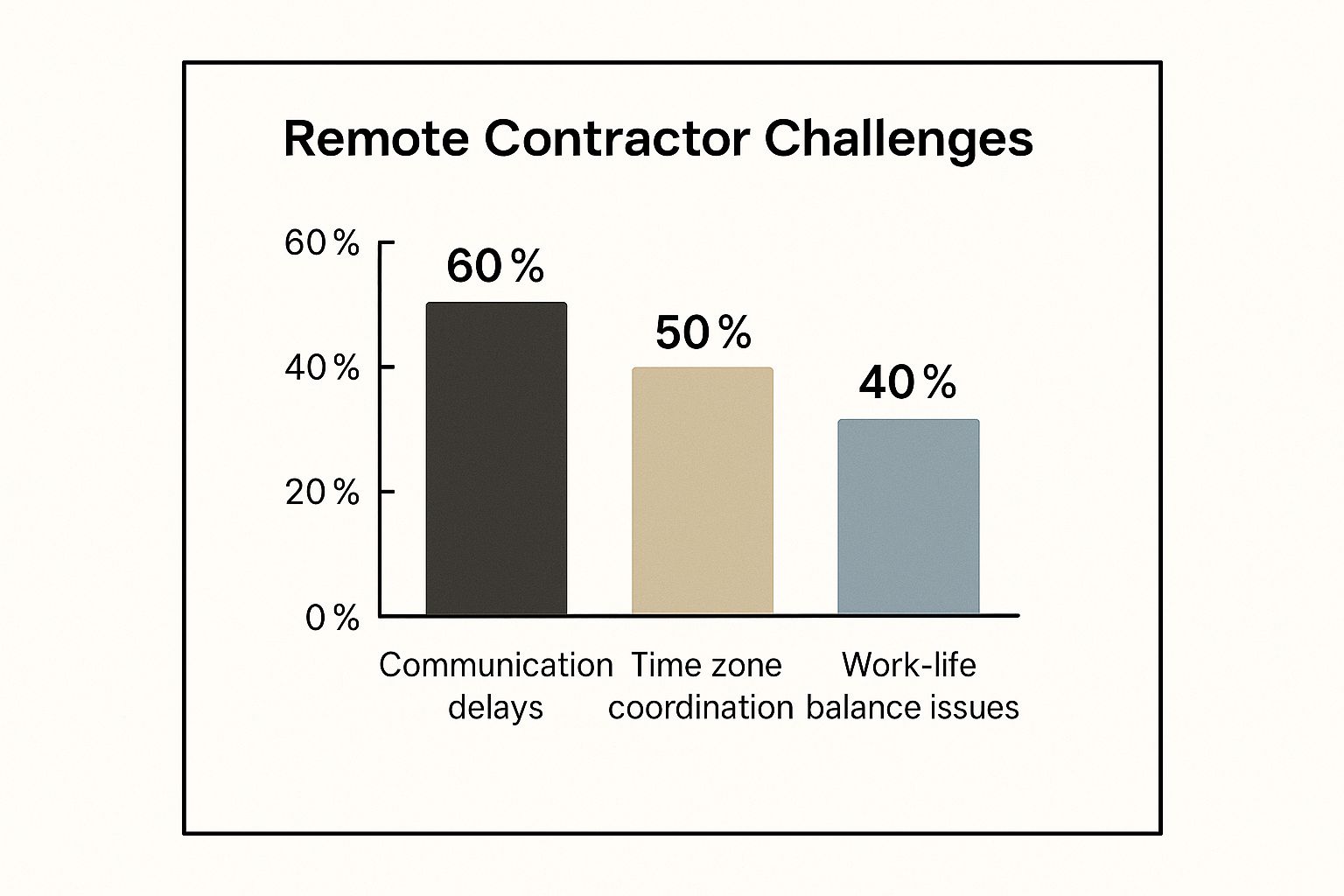
As the data shows, 60% of contractors run into communication delays, and half grapple with coordinating across different time zones. These are the day-to-day frictions you have to be prepared to manage.
Finally, the rules are still being written. The legal and tax side of earning and holding crypto is a maze that changes from country to country. Staying on the right side of the law takes work and often means hiring a professional who gets this space.
Web3 Contract Work vs Traditional Freelancing
To put it all in perspective, it helps to see how Web3 contracting stacks up against the more familiar world of traditional freelancing. While both offer freedom from the 9-to-5, the core experience can be quite different.
Here’s a side-by-side look:
| Aspect | Web3 Remote Contract Work | Traditional Remote Freelancing |
|---|---|---|
| Payment Structure | Primarily in cryptocurrencies or stablecoins; potential for high volatility and token-based equity. | Paid in fiat currency (USD, EUR, etc.); stable and predictable income. |
| Benefits & Security | No traditional benefits (health, retirement); you are entirely responsible for your own safety net. | Typically no employer-provided benefits, but income stability makes personal planning easier. |
| Legal & Tax | Complex, evolving regulations that vary by jurisdiction; requires specialized knowledge. | Well-established legal and tax frameworks; easier to navigate. |
| Ownership & Impact | Often includes token ownership, giving you a direct stake in the project's long-term success. | Purely a service-for-fee arrangement; no inherent ownership or equity. |
| Work Culture | Highly autonomous, asynchronous, and community-driven within DAOs or decentralized teams. | Varies by client, but often mimics traditional corporate structures and communication styles. |
| Market Risk | Directly exposed to crypto market volatility and the high-risk, high-reward nature of startups. | Insulated from market volatility; risk is tied to client stability and project pipeline. |
Ultimately, choosing between these paths comes down to your personal appetite for risk and how much you value the potential for outsized rewards and true ownership. Success in Web3 contracting is a game of managing autonomy and embracing uncertainty.
Managing Your Finances and Legal Requirements

Thriving as a remote contractor, especially in Web3, is about more than just shipping great code or designing killer UIs. You’re effectively running a business of one. That means you're not just the talent; you're also the accountant, the legal counsel, and the billing department.
It's a big shift. In a traditional job, HR handles your taxes and benefits. Now, that's all on you. Getting this part right is what turns a series of gigs into a sustainable, long-term career.
Structuring Your Professional Identity
First things first: how are you going to operate? The easiest on-ramp is working as a sole proprietorship. It's just you, doing business as yourself. While simple to set up, it offers zero liability protection, meaning your personal assets are on the line if the business gets into trouble.
Once you start earning consistently, it’s smart to look into forming a Limited Liability Company (LLC). An LLC creates a legal wall between your personal and business finances, which is a huge layer of protection. It takes a bit more paperwork and some fees, but the peace of mind is well worth it.
This decision sets the foundation for everything else, from opening a business bank account to filing your taxes correctly. It’s the first step in treating your freelance work like the serious business it is.
Crafting Bulletproof Contracts for Web3
In a decentralized world, a crystal-clear contract is absolutely essential. Even if a smart contract automates payments, you still need a traditional agreement that spells out the entire relationship. This document is your best defense against misunderstandings and scope creep.
Make sure your contract always includes:
- Scope of Work: Get granular. Define the exact tasks, milestones, and deliverables. Ambiguity is not your friend.
- Payment Terms: State the total fee, payment schedule (e.g., 50% upfront, 50% on completion), and the specific crypto or stablecoin to be used.
- Revisions and Feedback: Outline how many rounds of edits are included. Anything beyond that should trigger a conversation about additional payment.
- Ownership and Confidentiality: Make it clear who owns the intellectual property at the end of the project and include any necessary NDAs.
Think of your contract as the human-readable "source code" for your professional relationship. It should be so clear that it leaves no room for misinterpretation, protecting both you and the client.
Demystifying Crypto Taxes and Invoicing
Getting paid in crypto is one of the biggest draws of working in Web3, but it adds a wrinkle to your taxes. Tax authorities like the IRS treat crypto as property, not currency. This means every single payment you receive is a taxable event.
You have to record the fair market value of the crypto at the exact moment you receive it—that value is your income. If you hold onto it and its value changes before you sell or trade it, you’ll also have to account for capital gains or losses. Meticulous record-keeping isn't just a good habit; it's a legal necessity.
The move toward flexible work is massive. By 2025, it's projected that 36.2 million Americans will be working remotely. With 76% of workers saying they’d quit if remote options were taken away, it’s clear this isn't a passing trend. This global shift makes it vital for contractors to get a handle on their financial obligations.
To stay on the right side of the law, you need to send professional invoices, track every payment using blockchain transaction IDs, and—this is crucial—set aside a percentage of every payment for taxes. To get your financial house in order, check out these essential financial planning tips for freelancers and build a solid foundation for your career.
How to Find Your First Web3 Contract Role
Knowing the theory is one thing, but actually turning that knowledge into a paid gig is the real challenge. Landing your first remote contract work in Web3 isn't like a typical job hunt. It’s less about having a perfectly polished resume and more about proving your value directly to the decentralized communities and innovative startups that define the space.
The trick is to meet the ecosystem where it already lives—on-chain and inside digital communities. Your professional identity has to be more than just a PDF; it needs to be a living, breathing portfolio of your skills, contributions, and active engagement.
Building Your Web3-Native Profile
Before you even think about applying for roles, you need to build a presence that speaks the native language of Web3. A standard LinkedIn profile simply won't cut it. In this world, your reputation is built on verifiable actions and contributions that are publicly visible on the blockchain.
Start by putting together a profile that really showcases your skills in a decentralized way:
- Create a Professional Wallet: Your first step should be setting up a dedicated crypto wallet (like MetaMask) to act as your professional identity. Every on-chain move you make—from voting in a DAO to collecting a POAP (Proof of Attendance Protocol) token for an event—adds another layer to your public resume.
- Host Your Portfolio on IPFS: Instead of using a traditional web host, consider putting your portfolio on the InterPlanetary File System (IPFS). Using a decentralized storage solution like this shows that you don’t just talk the talk; you actually understand and use the core technology.
- Showcase Your GitHub: For developers, your GitHub is the ultimate calling card. Get involved and contribute to open-source Web3 projects. This creates a public, verifiable track record of your coding abilities and proves you can work well with others.
In Web3, your on-chain activity is your most authentic resume. It’s a transparent, immutable record of your engagement and expertise that no traditional CV can match.
Building this foundation proves you're not just a tourist passing through the space—you're an active participant. That’s a powerful signal to any potential client that you're genuinely invested and know what you're doing.
Finding Opportunities on the Right Platforms
Once your Web3 profile is in good shape, it’s time to start the hunt. While you might find some listings on generic freelance sites, you'll have much better luck on dedicated Web3 job boards. These platforms are goldmines, gathering opportunities specifically from crypto companies, DAOs, and blockchain projects that are actively looking for contract talent.
This screenshot shows the homepage for Find Web3, a platform dedicated to connecting talent with Web3 companies.
The platform immediately makes it clear that it aggregates thousands of jobs from top companies, which tells you it’s a focused and rich source for your search. To get started, you can explore the wide range of Web3 remote contract jobs and start filtering by your specific skills and interests.
Using specialized platforms is a game-changer because they cut through all the noise. They present you with relevant, pre-vetted opportunities where a Web3-native profile like yours will actually be understood and valued.
Mastering the Art of Networking and Proposals
In such a community-driven space, networking is absolutely everything. Your next contract is far more likely to come from a casual Discord conversation than a formal, buttoned-up application. The key is to immerse yourself in the communities of projects you genuinely admire.
- Engage in Discord and Telegram: Don't just be a lurker. Jump into the conversation, ask intelligent questions, offer helpful answers, and become a regular presence. Make yourself a recognized and valued member of the community.
- Contribute to a DAO: Many DAOs offer small bounties or grants for completing specific tasks. This is a perfect, low-risk way to get your foot in the door, show off what you can do, and get paid for your first contribution.
- Craft Value-Driven Proposals: When you do apply for a role, make your proposal sharp and to the point. Forget listing your past job titles. Instead, focus on what you can do for their project. Show them you've done your homework—reference their whitepaper, point out a specific challenge you've noticed, and propose a clear solution you can deliver.
By combining a strong on-chain presence with genuine community engagement and highly targeted proposals, you create a powerful strategy. It's a proactive approach that rewards authenticity and demonstrable skill above all else, which is exactly how you'll land that first Web3 contract.
Building a Thriving Career in Web3

So, you've landed your first gig. That's a huge win, but it's really just the starting line. A truly successful, long-term career in Web3 remote contract work is built on constant growth, a rock-solid reputation, and knowing how to scale your business. This space moves incredibly fast—what's hot today might be a footnote in six months. If you’re standing still, you're already falling behind.
Your journey has to be one of perpetual learning. This isn't about getting another formal degree. It’s about being deeply curious and nimble. Follow top developers on social media, dive into the technical chats on project Discords, and get your hands dirty experimenting with new protocols. Don't think of your skills as a fixed set of tools; see them as a living library you have to update every single week.
Cultivating an Unbeatable Reputation
In a world built on decentralized trust, your reputation is everything. It's your most valuable asset, hands down. Every single interaction, every piece of code you ship, and every on-chain action contributes to your professional brand. A great reputation doesn't just bring you more work; it brings you better, more rewarding opportunities where top-tier clients start seeking you out.
To build that kind of reputation, you need to nail these fundamentals:
- Radical Reliability: Hit your deadlines. Every time. If you think there’s even a chance of a delay, you need to communicate it early and be completely transparent. In an ecosystem where trust is the bedrock, simply being dependable is a superpower.
- Exceptional Communication: Send regular updates, ask smart questions to get clarity, and be an active voice in team discussions. Proactive communication kills misunderstandings before they start and shows you're genuinely invested in the project's success.
- Exceeding Expectations: Don't just check the boxes. Find ways to add that little bit of extra value. Maybe you spot a potential bug down the road or suggest a small tweak that improves the user experience. Going that extra mile is what turns a one-off gig into a long-term partnership.
Think of it this way: your career in Web3 is the sum of your contributions. Every successful project is like a permanent, verifiable block added to your professional chain, creating a public record of excellence that speaks louder than any resume ever could.
Scaling Your Freelance Operation
Once you have a few wins under your belt and your reputation is growing, you can start thinking bigger. It's time to scale your freelance business. The real goal is to shift from just trading your hours for dollars to building a more sustainable operation. This is all about getting strategic with your rates, the projects you take on, and the clients you work with.
Start by meticulously tracking your time and the results you deliver. This data is your ammunition for justifying higher rates. As more people want to work with you, you get to be more selective. You can start choosing projects that not only pay well but also push you in the direction you want your career to go.
This is how you make the leap from a task-doer to a trusted advisor for high-value clients, cementing your place as a key player in this new world of work.
Answering Your Top Questions About Web3 Contract Work
Jumping into the world of Web3 remote contracts can feel like stepping into a whole new territory. It's totally normal to have questions. Let's tackle some of the most common ones so you can move forward with a clear head.
How Do I Handle Volatile Crypto Payments?
This is the big one, isn't it? The thought of getting paid in a project's native token is exciting, but we all know how fast crypto markets can swing. The key is to have a solid game plan before the payment even hits your wallet.
A smart move is to decide on a fixed percentage you'll immediately cash out. For instance, you could plan to convert 70% of every payment into a stablecoin or fiat currency (like USD) to cover your bills and taxes. The other 30% can stay in the project's token as a longer-term bet on its success. This gives you financial stability while still keeping some skin in the game.
Your goal is to build a personal financial system that insulates you from market shocks. Don't ever leave 100% of your earnings in one volatile asset, no matter how much you believe in the project.
By taking this balanced approach, you turn what could be a gamble into a calculated financial decision. You're managing risk while still giving yourself a shot at that sweet, sweet upside.
Do I Need to Be a Developer to Succeed?
Not a chance. It’s a common myth that Web3 is only for coders. While developers are definitely in high demand, the ecosystem needs a whole army of different talents to actually function and grow.
Think about it—every great project needs more than just a smart contract. They need people to build and nurture a community, tell their story, and make their products usable.
We're seeing a huge need for non-technical roles like:
- Community Managers: The lifeblood of any project, keeping the conversation alive on Discord and Telegram.
- Content Creators & Marketers: Someone has to explain complex ideas in a simple way through articles, videos, and social media.
- Designers (UI/UX): Making dApps and websites that don't feel like you need a Ph.D. to use is a priceless skill.
- Operations & Project Managers: Keeping a decentralized, global team on track is a serious challenge that requires serious talent.
Your current skills are probably a lot more valuable to Web3 than you realize. It's all about learning how to apply them in this new, decentralized context.
Ready to stop searching and start applying? Find Web3 pulls together thousands of jobs from the best companies in the space. Explore the latest opportunities and land your next remote contract role today.