
Ready to Dive into the Crypto Job Market?
Looking for a career in crypto? This listicle highlights seven in-demand crypto jobs in 2025. Discover the skills needed, potential salary, and growth outlook for roles like Blockchain Developer, Crypto Security Analyst, Crypto Trader/Analyst, DeFi Product Manager, Crypto Community Manager, Crypto Compliance Officer, and Tokenomics Designer. Find your perfect fit in the exciting world of Web3 and explore these top crypto job opportunities.
1. Blockchain Developer
Blockchain developers are the architects and builders of the crypto world. They are software engineers specializing in designing, implementing, and maintaining blockchain protocols, smart contracts, and decentralized applications (dApps). These developers write the code that powers cryptocurrency transactions, creates new tokens, and builds the infrastructure that supports the entire crypto ecosystem. Their work is fundamental to the functionality and security of various crypto jobs and the industry as a whole. This makes blockchain development one of the most crucial and in-demand crypto jobs available.

A blockchain developer's skillset typically includes expertise in programming languages like Solidity, Rust, Go, and JavaScript. They possess a deep understanding of blockchain architectures (like Layer 1 and Layer 2 solutions) and consensus mechanisms (Proof-of-Work, Proof-of-Stake, etc.). Crucially, they're adept at writing and auditing smart contracts, ensuring their security and efficiency. Experience with Web3 libraries and frameworks is also essential for building decentralized applications.
Why Choose a Career as a Blockchain Developer?
This role sits at the top of many lists of desirable crypto jobs for several reasons. First, it offers some of the highest salaries in the industry, averaging $150,000-$200,000 or more. Demand for skilled blockchain developers remains high across startups, established companies, and large enterprises seeking to integrate blockchain technology. The work itself is intellectually stimulating, offering the chance to work on cutting-edge technology and shape the future of finance and the internet. Finally, the role often comes with location-independent flexibility, with abundant remote work opportunities.
Challenges and Considerations:
While the rewards can be significant, pursuing crypto jobs, particularly blockchain development, comes with its challenges. The field presents a steep learning curve, as the technology is constantly evolving. The work is often high-pressure and security-critical, demanding meticulous attention to detail. The inherent volatility of the crypto industry can also impact job stability. Continuous learning and adaptation are essential to staying current and competitive in this rapidly changing landscape.
Examples of Successful Blockchain Developers:
Influential figures like Gavin Wood (co-founder of Ethereum and creator of Polkadot) and Vitalik Buterin (Ethereum co-founder), as well as the anonymous Satoshi Nakamoto (Bitcoin creator), have significantly impacted the blockchain landscape. Teams at Consensys building Ethereum infrastructure and developers at Solana Labs creating high-performance blockchain solutions are further examples of impactful work in this field. Learn more about Blockchain Developer
Tips for Aspiring Blockchain Developers:
- Foundational Knowledge: Start with a solid foundation in computer science and cryptography.
- Build a Portfolio: Develop a portfolio of blockchain projects and showcase them on GitHub.
- Community Engagement: Participate in hackathons and contribute to open-source projects.
- Specialization: Focus on a specific blockchain ecosystem (Ethereum, Solana, etc.) to gain deeper expertise.
This career path is ideal for those seeking highly technical crypto jobs with the potential for significant impact and reward. While demanding, the opportunities for innovation and growth within the blockchain development space are immense.
2. Crypto Security Analyst
As the cryptocurrency market expands, so does the need to protect the digital assets, exchanges, and underlying blockchain infrastructure that power it. This is where Crypto Security Analysts come in. They are the guardians of the crypto world, working tirelessly to identify and mitigate vulnerabilities before malicious actors can exploit them. Their work involves a deep understanding of both traditional cybersecurity principles and the unique challenges presented by blockchain technology. They audit smart contracts for flaws, implement robust security protocols, and ensure compliance with industry best practices to prevent hacks, exploits, and other security breaches that could lead to significant financial losses.

A Crypto Security Analyst's responsibilities can range from penetration testing to incident response. They might analyze code for vulnerabilities, design secure architectures, or investigate past security incidents to learn how to prevent future ones. They are essential for maintaining the integrity and trustworthiness of the cryptocurrency ecosystem. This role deserves its place on this list of crypto jobs due to its crucial importance in safeguarding the future of digital finance and its high demand in the current job market.
Features of a Crypto Security Analyst role:
- Expert knowledge of cryptography and cybersecurity principles: A strong foundation in cryptography, network security, and security auditing is essential.
- Smart contract auditing capabilities: Proficiency in analyzing smart contracts for vulnerabilities is crucial. This involves understanding different programming languages like Solidity and Vyper.
- Penetration testing experience: The ability to simulate real-world attacks to identify system weaknesses is highly valued.
- Understanding of common attack vectors in crypto: Knowledge of specific attack vectors like 51% attacks, Sybil attacks, and reentrancy attacks is necessary.
Pros:
- High demand due to frequent security incidents in the industry: The constant threat of attacks creates a high demand for skilled security professionals.
- Competitive compensation ($120,000-$180,000+): The specialized skill set and high responsibility command a premium salary.
- Intellectual challenge of staying ahead of attackers: The ever-evolving threat landscape provides a constant intellectual challenge.
- Critical role with high visibility and impact: Security analysts play a vital role in protecting valuable assets and maintaining the integrity of the ecosystem.
Cons:
- High-stress environment with significant responsibility: The potential for large-scale financial losses can create a stressful work environment.
- Requires constant vigilance and updating of skills: The fast-paced nature of the industry requires continuous learning and skill development.
- Often on call for emergency response: Security incidents can occur at any time, requiring immediate attention.
- Mistakes can be extremely costly: Errors in judgment or oversight can have severe financial consequences.
Examples of Crypto Security Analyst Roles:
- Security teams at Trail of Bits conducting smart contract audits
- Security engineers at Coinbase protecting billions in customer assets
- Independent security researchers participating in bug bounty programs
Tips for Aspiring Crypto Security Analysts:
- Obtain relevant certifications (CISSP, CEH, OSCP): Industry-recognized certifications demonstrate expertise and credibility.
- Learn blockchain-specific security frameworks: Familiarize yourself with frameworks and tools designed for blockchain security.
- Practice with CTF (Capture The Flag) competitions: CTFs provide hands-on experience in identifying and exploiting vulnerabilities.
- Build expertise in both offensive and defensive security: Understanding both attack and defense strategies is essential for a well-rounded skill set.
Popularized By:
- Samczsun (prominent smart contract security researcher)
- Dan Guido (CEO of Trail of Bits)
- OpenZeppelin security team
This role is ideal for those with a strong technical background and a passion for cybersecurity who are looking to contribute to the rapidly growing crypto space. From protecting user funds on exchanges to ensuring the integrity of decentralized applications, Crypto Security Analysts are essential for the continued growth and adoption of blockchain technology. If you are looking for a crypto job with high impact and significant responsibility, this might be the perfect fit.
3. Crypto Trader/Analyst
Crypto trader/analyst roles represent a thrilling, albeit demanding, entry point into the crypto job market. These professionals are the pulse of the cryptocurrency world, constantly monitoring market trends, dissecting price movements, and executing trading strategies designed to capitalize on the market's inherent volatility. Their work environments vary, from the fast-paced floors of trading firms and hedge funds to the digital desks of cryptocurrency exchanges. Regardless of location, their core function remains the same: providing expert insights into market dynamics and uncovering lucrative investment opportunities. This role is vital to the crypto ecosystem because it ensures efficient market operation and helps investors make informed decisions.
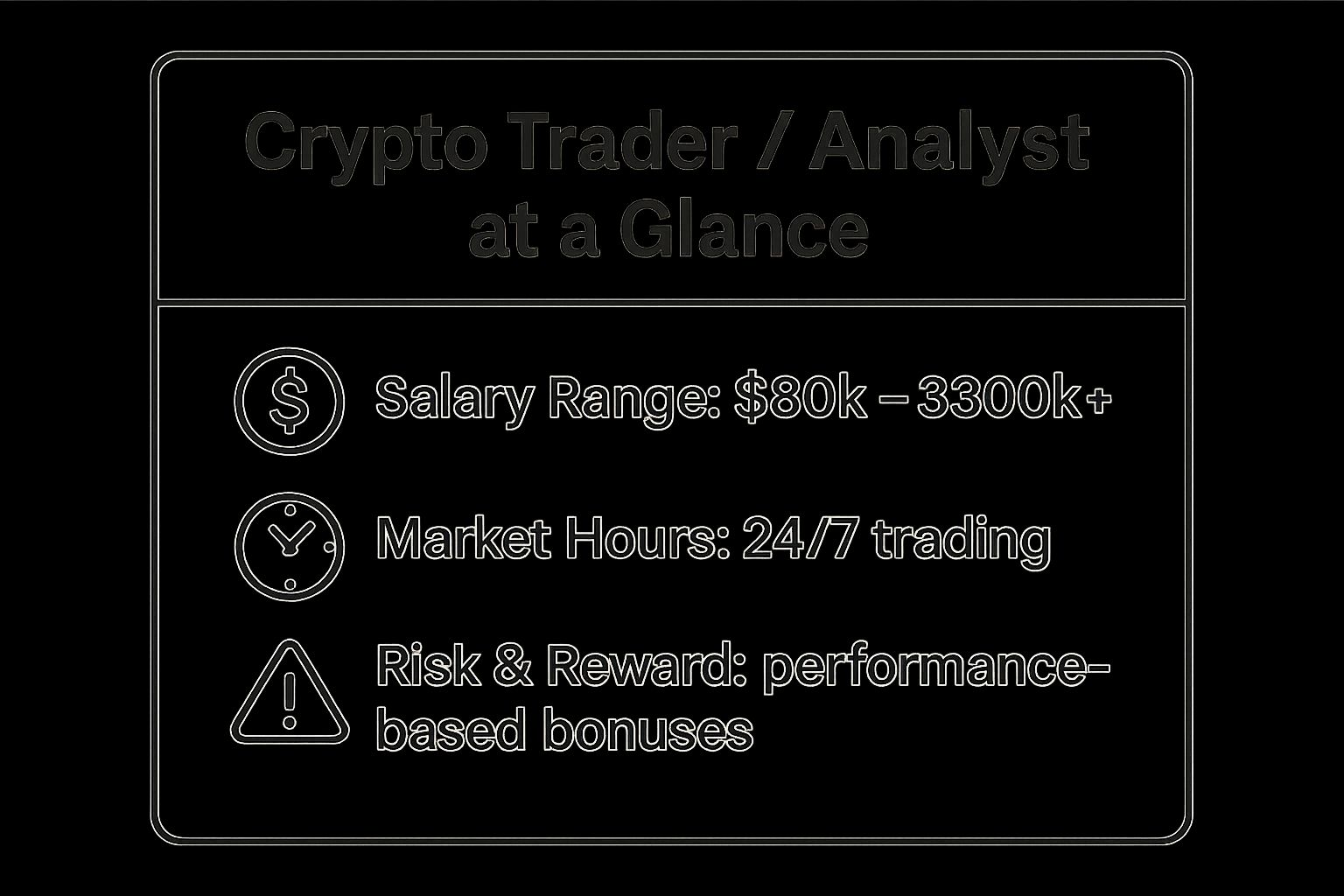
The infographic above provides a quick reference for the key skills and attributes needed to succeed as a Crypto Trader/Analyst. It visually highlights the blend of technical prowess, analytical thinking, and market understanding crucial for this demanding role. As the image shows, a successful trader/analyst needs to balance in-depth knowledge of technical and fundamental analysis with strong risk management skills and a keen awareness of market microstructure.
Crypto traders/analysts utilize both technical and fundamental analysis. Technical analysts delve into chart patterns, historical price data, and technical indicators to predict future price movements. Fundamental analysts, on the other hand, evaluate the underlying value of crypto projects by examining factors like team, technology, adoption rate, and market competition. These analyses inform trading strategies and investment recommendations. For instance, institutional traders at firms like Cumberland and DRW leverage these skills to manage large portfolios, while market makers at Jump Trading and Alameda Research provide liquidity and execute trades on exchanges. Research analysts at Messari and The Block contribute by publishing in-depth reports and analyses on various crypto assets.
So, when and why should you consider this crypto job? If you thrive in a fast-paced, dynamic environment, possess strong analytical skills, and have a deep interest in financial markets, this career path could be a great fit. The potential for high earnings based on performance is undoubtedly attractive. However, it's crucial to acknowledge the downsides: high stress, irregular hours due to the 24/7 nature of crypto markets, constant performance pressure, and job security linked to market cycles.
Here's a quick summary of the key takeaways for aspiring Crypto Trader/Analysts:
- Essential Skills: Technical Analysis, Fundamental Analysis, Risk Management, Market Microstructure Understanding
- Potential Employers: Trading Firms, Hedge Funds, Exchanges, Research Firms
- Pros: High Earning Potential, Dynamic Environment, Transferable Skills, Remote Work Opportunities
- Cons: High Stress, Irregular Hours, Performance Pressure, Market-Dependent Job Security
These points highlight the exciting yet demanding nature of this crypto job. Developing a robust trading framework and a disciplined risk management system is paramount for success in this volatile market. Building programming skills for algorithmic trading and data analysis can also provide a significant edge. Staying updated on evolving regulations and actively networking within trading communities are crucial for navigating the constantly changing crypto landscape. Figures like Sam Bankman-Fried (before his legal troubles), Su Zhu and Kyle Davies (Three Arrows Capital), and influencers like Willy Woo and PlanB popularized this career path, showcasing both the potential and the risks involved. This profession is not for the faint of heart, but for those with the right skills and temperament, it offers a unique opportunity to be at the forefront of the financial revolution.
4. DeFi Product Manager
Decentralized Finance (DeFi) is revolutionizing the financial landscape, and DeFi Product Managers are at the forefront of this transformation. These individuals are responsible for the development, launch, and growth of financial products built on blockchain technology. They act as a crucial bridge between the technical teams building the products, the business stakeholders defining the strategy, and the end-users interacting with the platform. This involves translating complex technical concepts into user-friendly products and features, ensuring the product aligns with market demands and regulatory requirements, and ultimately driving its adoption and success. This makes it one of the most exciting and impactful crypto jobs available.

DeFi Product Managers oversee the creation of innovative financial services like lending platforms (e.g., Aave), decentralized exchanges (e.g., Uniswap), and yield farming protocols (e.g., Compound). They work through the entire product development lifecycle, from ideation and market research to design, development, testing, launch, and ongoing iteration. Data-driven decision making is paramount, as they analyze market trends, user behavior, and performance metrics to optimize the product and identify new opportunities. User experience (UX) design skills are also crucial, ensuring that these often complex financial instruments are accessible and intuitive for a broad range of users.
Features of a DeFi Product Manager Role:
- Deep understanding of both traditional finance and DeFi mechanisms
- Expertise in the product development lifecycle
- Strong data-driven decision making capabilities
- Excellent user experience design skills
Pros:
- Opportunity to reinvent financial services using cutting-edge technology
- Competitive compensation ($120,000-$180,000+)
- Cross-functional role with broad exposure to different areas of the business
- Building products with global reach from day one
Cons:
- Navigating a complex and evolving regulatory environment
- The rapid pace of innovation necessitates constant learning and adaptation
- High stakes involved with user funds at risk
- Balancing the ideals of decentralization with practical business requirements
Examples of DeFi Product Manager Roles:
- Product managers at Aave overseeing lending protocol development
- Uniswap Labs team members designing decentralized exchange features
- Compound Labs PMs building governance and tokenomic systems
Tips for Aspiring DeFi Product Managers:
- Develop both technical knowledge of blockchain technology and financial expertise.
- Actively participate in DeFi protocols as a user to gain firsthand experience.
- Build a strong network in both traditional finance and the crypto space.
- Stay informed about regulatory developments and their impact on the DeFi landscape.
This role deserves a place on this list of crypto jobs because it sits at the intersection of finance, technology, and user experience. It's a critical role for the continued growth and maturation of the DeFi sector. Learn more about DeFi Product Manager roles and other opportunities in the Web3 space. This is an excellent career path for those looking to shape the future of finance. This area is particularly attractive to blockchain and crypto developers seeking specialized roles, designers and product professionals focused on the future of finance, and students and recent graduates eager to enter the exciting world of Web3.
5. Crypto Community Manager
For those seeking a less technical entry point into the exciting world of crypto jobs, becoming a Crypto Community Manager offers a compelling pathway. This role is crucial for any blockchain project aiming to thrive, making it a deserved addition to this list. Essentially, a Crypto Community Manager acts as the bridge between the project's development team and its users, fostering a thriving ecosystem. They are responsible for building and nurturing online communities, often across multiple platforms, crafting engagement strategies, moderating discussions, organizing events, and ultimately, helping to drive adoption. In the fast-paced and often volatile world of crypto, a strong community can be the difference between success and failure. Learn more about Crypto Community Manager
How does this role work in practice? Community Managers use a blend of marketing, communication, and technical understanding to cultivate positive sentiment around a project. They translate complex technical concepts into easily digestible content for mainstream audiences, manage social media presence, and address community inquiries, feedback, and concerns. This requires a deep understanding of the project's goals, its technology, and the specific needs and desires of its community members.
Successful Implementation Examples: Consider the dedicated Discord and Telegram managers for major DeFi protocols like Aave and Uniswap. These individuals play a crucial role in educating users, gathering feedback, and managing expectations, particularly during market fluctuations. Other examples include community leaders at the Ethereum Foundation and DAO facilitators and governance specialists who help shape the future direction of decentralized organizations.
Features of a Successful Crypto Community Manager:
- Social media management expertise: Proficiency in managing platforms like Twitter, Discord, and Telegram is essential.
- Strong communication and conflict resolution skills: Addressing community concerns and navigating disagreements requires diplomacy and tact.
- Understanding of token economics and incentives: A grasp of how tokenomics impact community behavior is crucial.
- Ability to translate technical concepts for mainstream audiences: Simplifying complex information is key for broader adoption.
Pros:
- Entry point into the industry with lower technical barriers: This role is ideal for those with strong communication skills seeking a foothold in the crypto space.
- Remote-friendly with flexible working arrangements: Many Community Manager positions offer remote work options.
- Opportunity to shape project direction through community feedback: Community Managers play a key role in conveying user sentiment to the development team.
- Building valuable industry relationships: Networking opportunities are abundant in this role.
Cons:
- 24/7 responsibility with global communities: Managing communities across different time zones can be demanding.
- Managing community expectations during market downturns: Maintaining morale during periods of volatility can be challenging.
- Dealing with scams, spam, and negative actors: Moderating online communities requires vigilance against malicious activity.
- Lower compensation than technical roles ($60,000-$120,000): While offering valuable experience, this role generally pays less than highly technical positions.
Actionable Tips for Aspiring Crypto Community Managers:
- Develop expertise in community platforms (Discord, Telegram, Twitter): Become proficient in the tools of the trade.
- Learn basic technical concepts to communicate effectively: A foundational understanding of blockchain technology is essential.
- Build conflict resolution and moderation skills: Practice navigating difficult conversations and resolving disagreements.
- Create content that educates and engages the community: Produce valuable content that resonates with your target audience.
Individuals like Richard Chen (1confirmation), Ameen Soleimani (Spankchain, MolochDAO), and Jinglan Wang (Optimism) have helped popularize and elevate the role of the Crypto Community Manager, demonstrating its importance in the broader crypto ecosystem. If you're passionate about crypto, possess strong communication skills, and enjoy building and nurturing online communities, this could be the perfect crypto job for you. This career path provides a unique opportunity to contribute to the growth and adoption of blockchain technology while building a valuable network within the industry. Consider this a vital option among the many crypto jobs available.
6. Crypto Compliance Officer
Navigating the evolving regulatory landscape of the cryptocurrency world is a complex but crucial task. This is where the Crypto Compliance Officer steps in, making this role a vital component of any successful crypto business and securing its place on this list of top crypto jobs. If you're detail-oriented, possess a strong understanding of financial regulations, and thrive in a fast-paced environment, a career as a Crypto Compliance Officer could be a rewarding path within the exciting world of crypto jobs.
A Crypto Compliance Officer ensures that cryptocurrency businesses operate within the legal boundaries of various jurisdictions. They are responsible for implementing Know Your Customer (KYC) and Anti-Money Laundering (AML) procedures, staying abreast of constantly evolving regulations, and guiding their companies through the intricate legal maze surrounding digital assets. This role is becoming increasingly critical as governments worldwide grapple with how to regulate this emerging industry. This growing demand makes it a stable and secure career path within the broader category of crypto jobs.
Features and Responsibilities:
- Expertise in Financial Regulations: A deep understanding of financial regulations across multiple jurisdictions is essential, encompassing everything from securities laws to data privacy regulations.
- Blockchain Analytics: Utilizing blockchain analytics tools like Chainalysis and Elliptic to monitor transactions and identify suspicious activity is a key aspect of this role.
- Risk Assessment and Mitigation: Proactively identifying and mitigating potential regulatory risks is paramount to protecting the company.
- Licensing Requirements: Navigating the complex world of licensing requirements for crypto businesses in various jurisdictions is a core responsibility.
Pros:
- Growing Demand: As regulatory scrutiny of the crypto industry intensifies, the demand for skilled Crypto Compliance Officers continues to rise.
- Stable Career Path: This role offers a stable career trajectory with skills transferable to traditional finance.
- Competitive Salary: Crypto Compliance Officers command competitive salaries, typically ranging from $100,000 to $180,000+ per year.
- Job Security: The critical nature of this role ensures a high level of job security.
Cons:
- Constantly Changing Regulations: Keeping up with the rapidly evolving regulatory landscape can be challenging.
- Decentralization vs. Compliance: Balancing the decentralized ethos of crypto with the need for compliance can create tension.
- High Responsibility: The role carries a high level of responsibility, with potential legal consequences for non-compliance.
- Limited Remote Work: Compared to other crypto jobs, there are often fewer opportunities for fully remote work in compliance.
Examples of Successful Implementation:
- Compliance teams at Coinbase implementing global regulatory frameworks.
- AML specialists at Chainalysis tracking illicit activities on the blockchain.
- Legal counsel at Kraken navigating international regulations for cryptocurrency exchanges.
Actionable Tips for Aspiring Crypto Compliance Officers:
- Obtain Relevant Certifications: Certifications like Certified Anti-Money Laundering Specialist (CAMS) and Certified Fraud Examiner (CFE) can significantly enhance your credentials.
- Stay Updated: Continuously monitor regulatory developments globally through specialized news sources, industry publications, and regulatory agency websites.
- Network: Build relationships with regulators and participate in industry compliance groups.
- Master Blockchain Analytics Tools: Become proficient with blockchain analytics tools like Chainalysis and Elliptic.
When and Why to Choose This Crypto Job:
This career path is ideal for individuals with a strong legal background, a keen interest in the crypto space, and a desire to contribute to the industry's maturation and adoption. If you are driven by the challenge of navigating complex regulatory environments and ensuring compliance, this could be the perfect fit within the diverse landscape of crypto jobs. Influential figures in this field include Marco Santori (Chief Legal Officer at Kraken), Hailey Lennon (Partner at Anderson Kill), and Katherine Wu (Ventures at Coinbase). Their contributions highlight the significance of this role in shaping the future of the crypto industry.
7. Tokenomics Designer
Tokenomics design is a critical aspect of any successful cryptocurrency project. This emerging field within the broader category of "crypto jobs" focuses on crafting the economic foundation of a blockchain network. A Tokenomics Designer is responsible for creating and implementing the economic model for a cryptocurrency or token, ensuring its long-term sustainability and value. This involves carefully balancing incentives among all network participants, including investors, developers, and users. This makes it a highly specialized and important role in the crypto space, deserving its place on this list of crypto jobs.
What a Tokenomics Designer Does:
Tokenomics designers create the rules governing how a token is generated, distributed, and utilized within its ecosystem. They consider factors like:
- Token Distribution: How will the initial tokens be allocated? Will there be a pre-sale, an ICO, or airdrops? What percentage will go to the team, investors, and the community?
- Inflation Schedule: Will the token supply be fixed, inflationary, or deflationary? What will be the rate of issuance over time?
- Governance Mechanisms: How will decisions be made about the future of the project? Will token holders have voting rights? What kind of governance system will be implemented?
- Utility Model: What purpose will the token serve within the network? Will it be used for accessing services, paying transaction fees, or participating in governance?
Successful Implementations:
Several projects showcase effective tokenomics design:
- Ethereum's EIP-1559: This upgrade introduced a fee-burning mechanism, making ETH deflationary under certain conditions. This model helps control inflation and potentially increase the value of ETH.
- Curve Finance's vote-escrowed CRV: By locking up CRV tokens, users gain veCRV, which grants them boosted rewards and voting power. This incentivizes long-term participation and strengthens the platform's governance.
- Olympus DAO's bonding mechanism: This innovative approach allows users to purchase discounted tokens in exchange for providing liquidity to the protocol, encouraging stability and growth.
Pros of a Tokenomics Designer Career:
- Highly specialized role with limited competition: This is a niche field with high demand, providing a significant advantage for skilled professionals.
- Competitive compensation ($120,000-$200,000+): The specialized nature and importance of this role command high salaries.
- Interdisciplinary work: This career combines economics, technology, and psychology, offering an intellectually stimulating environment.
- Opportunity to shape the future of economic systems: Tokenomics designers are at the forefront of innovation in decentralized finance and have the potential to influence future economic models.
Cons of a Tokenomics Designer Career:
- Outcomes difficult to predict due to market irrationality: The cryptocurrency market is volatile and unpredictable, making it challenging to model token behavior accurately.
- High stakes with significant financial implications: Design flaws can have severe consequences for a project's success and the value of its token.
- Limited formal education pathways for the role: The field is relatively new, and traditional educational institutions are still catching up.
- Responsibility for token value and community expectations: Designers face pressure to deliver on promises and maintain the trust of the community.
Tips for Aspiring Tokenomics Designers:
- Study successful and failed token models across different projects. Analyze why some projects thrived while others faltered.
- Develop simulation capabilities to test economic hypotheses. Tools like Python and R can be valuable for modeling token behavior.
- Build understanding of behavioral economics. Understanding how people make decisions in the context of incentives is crucial for effective token design.
- Participate in governance forums and token design discussions. Engaging with the community and learning from experienced professionals is invaluable.
Popularized By:
- Vitalik Buterin (Ethereum)
- Fernando Martinelli (Balancer)
- Michael Egorov (Curve Finance)
When and Why to Use This Approach:
Tokenomics design is essential for any project launching a new cryptocurrency or token. It lays the foundation for the economic viability and sustainability of the network. A well-designed token economy can incentivize desired behaviors, attract users and investors, and ensure the long-term success of the project. This role is particularly relevant for blockchain and crypto developers, designers focused on NFTs and metaverse experiences, and anyone involved in the financial aspects of Web3 projects. It also presents interesting opportunities for students and recent graduates looking to enter the exciting world of Web3. This is a high-impact crypto job with the potential to shape the future of decentralized finance.
Overview Comparison of 7 Crypto Job Roles
| Role | 🔄 Implementation Complexity | 💡 Resource Requirements | 📊 Expected Outcomes | ⚡ Ideal Use Cases | ⭐ Key Advantages |
|---|---|---|---|---|---|
| Blockchain Developer | High – requires advanced coding & deep blockchain knowledge | Advanced programming skills, continuous learning, specialized tools | Secure, scalable blockchain protocols & dApps | Building blockchain infrastructure, smart contracts, crypto platforms | Cutting-edge tech, high salaries, remote options |
| Crypto Security Analyst | High – rigorous auditing and testing processes | Security expertise, certifications, constant vigilance | Reduced vulnerabilities, secure assets & protocols | Security audits, penetration testing, vulnerability assessment | High demand, critical impact, intellectually challenging |
| Crypto Trader/Analyst | Medium – relies on analytics and rapid decision-making | Market data, analytical tools, programming for algo trading | Profit from market volatility, informed trading strategies | Trading desks, hedge funds, market analysis | High earnings potential, transferable skills |
| DeFi Product Manager | Medium-High – manages complex products and regulatory considerations | Cross-functional skills (finance, tech, UX), stakeholder coordination | Innovative DeFi products, user growth, regulatory compliance | Launching DeFi platforms, lending, DEXs, yield farming | Broad strategic role, global reach, competitive pay |
| Crypto Community Manager | Low-Medium – focuses on social engagement and moderation | Communication tools, social media savvy, community platforms | Engaged and growing communities, feedback loops | Project adoption, user engagement, ecosystem growth | Entry-level friendly, flexible work, networking |
| Crypto Compliance Officer | Medium-High – navigating complex, evolving regulations | Regulatory knowledge, legal frameworks, blockchain analytics | Regulatory adherence, risk mitigation, legal security | Compliance in crypto businesses, KYC/AML enforcement | Stable career, in-demand skills, job security |
| Tokenomics Designer | High – requires interdisciplinary economic modeling & analysis | Economics background, data modeling, governance understanding | Sustainable token ecosystems, aligned incentives | Designing token economies, governance models, incentive structures | Specialized niche, interdisciplinary work, high impact |
Find Your Perfect Crypto Job with Find Web3
From blockchain developers building the future of finance to community managers fostering vibrant Web3 ecosystems, this article has explored a diverse range of crypto jobs. We've highlighted key roles such as crypto security analysts safeguarding digital assets, DeFi product managers shaping decentralized finance, and tokenomics designers crafting innovative economic models. Mastering the skills and knowledge required for these positions is crucial for anyone seeking to make a meaningful impact in this rapidly evolving landscape. These roles not only offer exciting career paths but also contribute to the growth and adoption of blockchain technology, shaping the future of finance and technology.
For seasoned professionals seeking high-impact roles with greater flexibility, the burgeoning crypto space also offers interesting possibilities. If you're interested in exploring the flexible and high-impact world of fractional work, check out this resource: fractional executive jobs – Top Fractional Executive Jobs in 2025 | Flexible High-Impact Roles from Shiny. This can be an excellent way to leverage your expertise in a dynamic and evolving field.
Ready to embark on your Web3 career journey? Find Web3 simplifies the process of discovering your ideal crypto job. Explore thousands of opportunities from leading Web3 companies and connect with the future of finance and technology. Start your search today: Find Web3