
Diving into blockchain development often starts with theory, but true mastery comes from practice. This guide bridges that gap by providing a curated collection of Solidity smart contract examples, designed to accelerate your learning and practical application. We move beyond simple "Hello, World!" tutorials to dissect the code that powers real-world decentralized applications (dApps). By exploring these examples, you'll gain a deeper understanding of the core logic and architectural patterns essential for building robust, secure, and efficient on-chain solutions.
This article is your hands-on toolkit. Each section breaks down a specific contract type, from fundamental ERC-20 tokens and Multi-Signature Wallets to more complex systems like Automated Market Makers (AMMs) and Decentralized Autonomous Organizations (DAOs). For every example, we provide the complete source code, a strategic analysis of its mechanics, and actionable takeaways you can apply directly to your own projects. Whether you are a developer aiming for a specialized Web3 role or a product professional focused on the metaverse, these practical insights will equip you with the skills needed to build the next generation of decentralized technology. Let's start building.
1. ERC-20 Token Contract
The ERC-20 token standard is arguably the most influential of all solidity smart contract examples, serving as the blueprint for fungible tokens on the Ethereum blockchain. It defines a mandatory set of functions and events that a token contract must implement. This standardization ensures that different tokens can interact predictably with wallets, exchanges, and other smart contracts, fostering a vibrant and interconnected DeFi ecosystem.
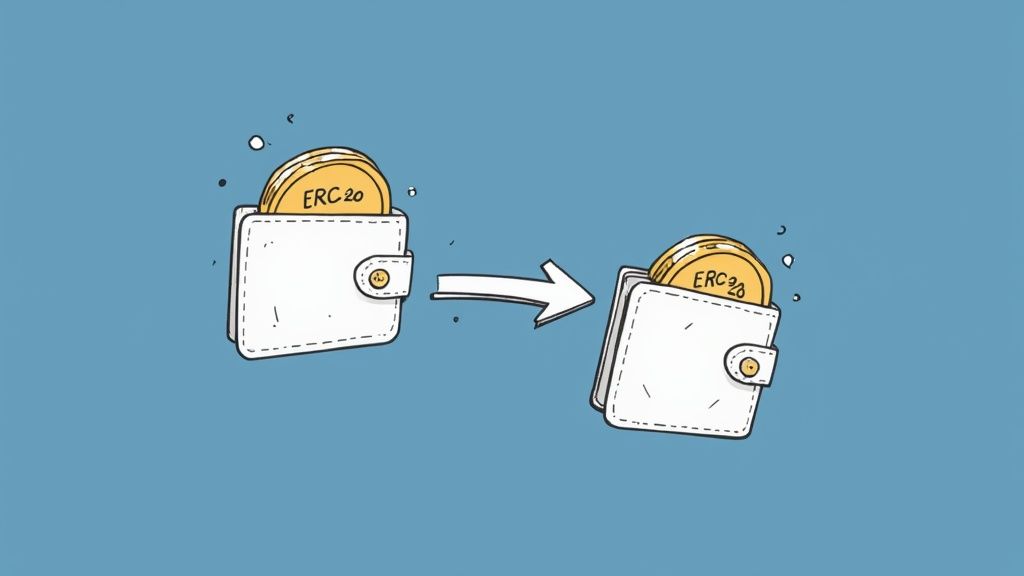
This standard is the engine behind many well-known cryptocurrencies, from stablecoins like USDT to governance tokens like UNI and oracle network tokens like LINK. By adhering to the ERC-20 interface, these diverse assets can all be managed through a standard wallet like MetaMask and traded on any decentralized exchange.
Strategic Analysis
An ERC-20 contract is more than just a ledger; it's a foundational component for building an entire economy. The core functions include transfer, approve, transferFrom, totalSupply, balanceOf, and allowance. These functions handle everything from simple peer-to-peer payments to complex, multi-step interactions where one contract is permitted to spend tokens on behalf of a user.
Key Insight: The
approveandtransferFromcombination is the tactical cornerstone of DeFi. It allows decentralized exchanges, lending protocols, and yield farms to programmatically move user funds with their permission, enabling automated financial strategies without giving the dApp direct control over the user's wallet.
Actionable Takeaways
When implementing an ERC-20 token, developers should prioritize security and reliability.
- Use Audited Libraries: Never write an ERC-20 contract from scratch. Leverage OpenZeppelin's extensively audited and battle-tested implementations. This minimizes the risk of introducing critical vulnerabilities.
- Built-in Overflow Protection: Use Solidity version 0.8.0 or higher. These versions include native overflow and underflow checks, eliminating an entire class of common arithmetic bugs that plagued earlier tokens.
- Implement Access Control: For functions that mint new tokens or change contract parameters, use an ownership pattern like
Ownable. This ensures only authorized addresses can perform administrative actions.
2. Multi-Signature Wallet Contract
A multi-signature (multisig) wallet is one of the most critical solidity smart contract examples for security, requiring multiple parties to approve a transaction before it can be executed. It acts as a digital safe, distributing control and eliminating a single point of failure. This mechanism is fundamental for protecting significant funds held by DAOs, corporations, and teams in the Web3 space.
This contract architecture is the gold standard for treasury management. The Ethereum Foundation, along with countless major protocols, uses multisig wallets to secure their treasuries. Gnosis Safe is the most prominent implementation, securing tens of billions of dollars in assets and showcasing the model's robustness and market trust.
Strategic Analysis
The core of a multisig wallet lies in its approval logic. Instead of a single private key authorizing a transaction, the contract requires a specific threshold of signatures, such as 3-out-of-5 owners, to agree. One owner proposes a transaction, and others must confirm it before the contract executes the call. This prevents unilateral actions, whether malicious or accidental.
Key Insight: A multisig contract decouples asset ownership from a single private key. This is a strategic shift from individual control to collective governance, making it the ideal foundation for DAO treasuries and enterprise-level asset management where trust must be distributed.
Actionable Takeaways
When securing assets with a multisig, operational security and configuration are paramount.
- Use Proven Solutions: Do not build a multisig from scratch for production use. Use established, heavily audited solutions like Gnosis Safe to avoid introducing subtle but catastrophic vulnerabilities.
- Balance Security and Usability: Start with a practical configuration like 2-of-3 or 3-of-5. This provides strong security against a single compromised key without creating excessive operational friction that could paralyze decision-making.
- Implement Failsafes: Secure each signing key with a hardware wallet to protect against online threats. Thoroughly test and document your key recovery procedures before depositing significant funds to ensure you can regain control if a key is lost.
3. Decentralized Autonomous Organization (DAO) Contract
A Decentralized Autonomous Organization (DAO) contract represents a paradigm shift in organizational governance, moving decision-making from a central authority to a distributed network of stakeholders. These solidity smart contract examples encode the rules of an organization directly into the blockchain, automating proposals, voting, and the execution of collective decisions. This creates a transparent and censorship-resistant framework for managing community-owned protocols and treasuries.
This model powers the governance behind many of DeFi's largest protocols, including MakerDAO, which manages the DAI stablecoin, and Uniswap, which oversees the leading decentralized exchange. By holding the protocol's governance token, users gain the right to vote on everything from treasury spending to critical software upgrades, shaping the future of the platform. For those interested in this space, you can explore more about DAO opportunities and roles.
Strategic Analysis
A DAO contract is fundamentally a system for managing trust and power in a decentralized environment. The core components typically include a governance token for voting power, a proposal mechanism for submitting ideas, and a voting system to reach consensus. The magic happens when these components are combined with a treasury and an execution engine, allowing the DAO to autonomously manage its own funds and upgrade its own smart contracts.
Key Insight: The true power of a DAO lies in its ability to execute decisions automatically via a Timelock contract. A successful proposal doesn't just represent an opinion; it queues a transaction that will be executed on-chain after a predetermined delay. This enforces the community's will without relying on a trusted multisig or administrator.
Actionable Takeaways
Building a robust DAO requires a careful balance between flexibility and security.
- Implement a Timelock: Never allow proposals to be executed immediately upon passing. A timelock provides a critical delay, giving the community time to review the pending transaction and react to any malicious or flawed proposal.
- Set Realistic Quorums: The quorum is the minimum percentage of votes required for a proposal to be valid. Set it high enough to prevent a minority from seizing control, but low enough that legitimate decisions can be made without requiring an impossibly high voter turnout.
- Plan for Emergencies: Include a mechanism, such as a security council or an emergency pause function, that can act swiftly to mitigate immediate threats. This provides a safety net while the broader governance process addresses the issue.
4. Automated Market Maker (AMM) Contract
An Automated Market Maker (AMM) is a core component of decentralized finance (DeFi) and one of the most powerful solidity smart contract examples. It replaces the traditional order book of a centralized exchange with a liquidity pool, enabling asset swaps through a deterministic algorithm. Instead of matching buyers and sellers, users trade directly against the pool, with prices set by a mathematical formula like the constant product formula (x * y = k).
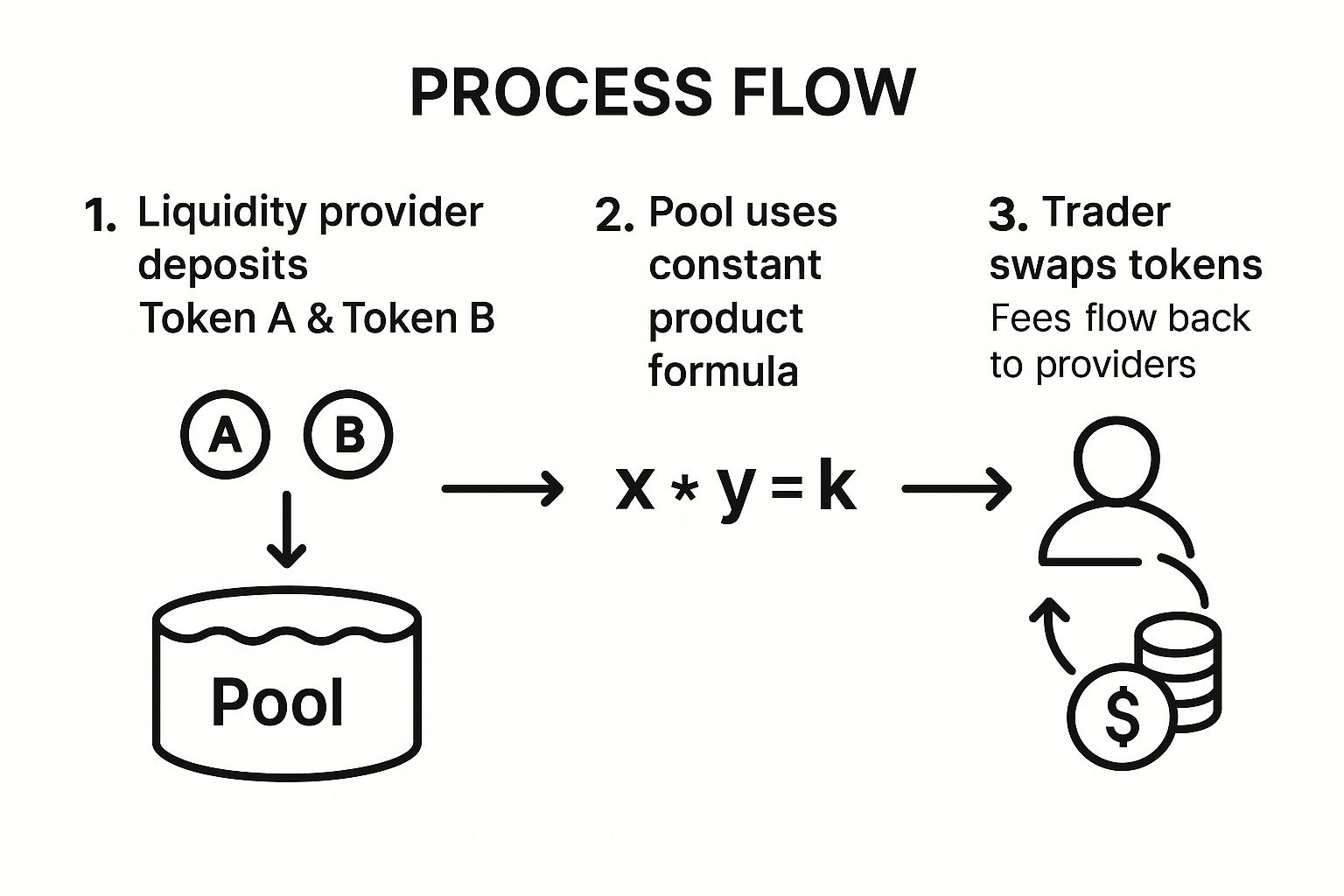
This process flow visualizes the core AMM lifecycle: liquidity provision, algorithmic pricing, and value accrual through trading fees. The constant product formula ensures that as one asset's supply in the pool decreases, its price relative to the other asset increases, creating a permissionless and automated trading environment. This model, pioneered by protocols like Uniswap and refined by others like Curve Finance, forms the backbone of on-chain trading.
Strategic Analysis
The strategic genius of an AMM lies in its capital efficiency and accessibility. It democratizes market-making, allowing anyone to become a liquidity provider (LP) and earn fees, a role traditionally reserved for large financial institutions. The core swap function calculates the output amount of one token based on the input amount of another, while maintaining the constant product k. Small trading fees, typically around 0.3%, are taken from each swap and added back to the pool, directly increasing the value of LP shares.
Key Insight: The AMM's core strength is its autonomous nature. The
x * y = kformula is a self-regulating price mechanism. Large trades cause "slippage," which creates arbitrage opportunities that incentivize traders to rebalance the pool back to market prices, effectively outsourcing price correction to the free market.
Actionable Takeaways
Building a robust AMM requires a deep focus on security, price accuracy, and user protection.
- Implement Slippage Protection: Swaps should include a
minAmountOutparameter. This allows users to specify the minimum amount of tokens they are willing to receive, preventing them from losing significant funds due to price volatility during transaction confirmation. - Use Time-Weighted Average Prices (TWAP): For price oracle functionality, do not rely on the instantaneous spot price, which is easily manipulated. Implement a TWAP oracle to provide a manipulation-resistant price feed for other dApps.
- Consider Dynamic Fees: A simple flat fee works, but advanced AMMs can implement dynamic fees that adjust based on market volatility. This can better compensate liquidity providers for risk during turbulent periods and attract more volume during stable times.
5. NFT (Non-Fungible Token) Contract
The NFT (Non-Fungible Token) contract, typically based on the ERC-721 or ERC-1155 standards, is a cornerstone of digital ownership and one of the most visible solidity smart contract examples. Unlike fungible tokens where each unit is identical, every token minted from an NFT contract is unique and non-interchangeable. This paradigm allows for verifiable on-chain ownership of distinct digital or physical assets.
This technology powers the entire digital collectibles market, from iconic profile picture projects like the Bored Ape Yacht Club to generative art platforms like Art Blocks and digital moments like NBA Top Shot. The NFT contract acts as an immutable deed of ownership, linking a unique token ID to a specific owner and associated metadata. The growing market has also created specialized NFT jobs on findweb3.com focused on building these unique digital economies.
Strategic Analysis
An NFT contract's primary function is to manage ownership and transfer of unique assets. The ERC-721 standard includes core functions like ownerOf, which identifies an asset's owner, and transferFrom, which allows for the secure transfer of that asset. Each token is tied to a tokenURI, a link to a JSON file containing the asset's metadata, such as its name, description, and image URL.
Key Insight: The strategic power of an NFT lies in its composability and the verifiable link between a token and its metadata. This allows other smart contracts to read an NFT's ownership and traits, enabling exclusive access to communities, in-game asset utility, and on-chain identity systems, transforming a simple JPEG into a key that unlocks digital experiences.
Actionable Takeaways
Building a secure and efficient NFT contract requires careful planning beyond the basic minting function.
- Decentralize Metadata: Store NFT metadata on decentralized file systems like IPFS (InterPlanetary File System). This ensures the art and traits associated with the token remain accessible and cannot be altered by a central party, preserving the asset's integrity.
- Optimize for Gas: For large-scale mints, use gas-efficient standards like ERC-721A. Developed by the team behind Azuki, this implementation drastically reduces the gas costs for minting multiple NFTs in a single transaction, making the process more affordable for users.
- Implement Royalties: Include the EIP-2981 NFT Royalty Standard. This provides a universal way for marketplaces like OpenSea to retrieve royalty information and automatically pay a percentage of secondary sales back to the original creator, creating a sustainable economic model.
6. Lending and Borrowing Protocol Contract
DeFi lending and borrowing protocols are among the most powerful and complex solidity smart contract examples, forming a cornerstone of the decentralized finance ecosystem. These protocols allow users to deposit crypto assets into a pool to earn yield (lending) or to use their deposited assets as collateral to borrow other assets. This entire process is automated by smart contracts, which manage interest rates, collateralization ratios, and liquidations without any central intermediary.
Pioneering platforms like Aave and Compound have demonstrated the immense potential of these protocols, locking billions of dollars in value and creating a permissionless money market. They enable capital efficiency on a global scale, allowing anyone with an internet connection to participate in financial activities once reserved for large institutions.
Strategic Analysis
A lending protocol's core logic revolves around managing risk and incentivizing liquidity. Contracts must algorithmically balance the interests of lenders, who seek a safe return, and borrowers, who need access to capital. Key functions handle deposits (supply), withdrawals (withdraw), borrowing (borrow), repayment (repay), and liquidations (liquidate).
The system’s stability depends on accurately pricing collateral and liquidating undercollateralized positions before they become bad debt. This makes the protocol's architecture a high-stakes environment where every function must be secure and economically sound. Exploring this area can lead to exciting opportunities in the DeFi job market.
Key Insight: The liquidation mechanism is the protocol's immune system. By offering a discount to third-party liquidators who repay risky debt, the protocol incentivizes external actors to constantly monitor its health. This decentralized enforcement ensures the system remains solvent even during extreme market volatility.
Actionable Takeaways
Building a secure lending protocol requires a defense-in-depth approach, focusing on risk management.
- Use Robust Price Oracles: Never rely on a single source for asset prices. Use a resilient oracle system like Chainlink, which aggregates data from multiple high-quality sources to prevent price manipulation attacks.
- Set Conservative Collateral Factors: Start with conservative loan-to-value (LTV) ratios and liquidation thresholds. This provides a larger safety margin to protect the protocol from sudden price drops in collateral assets.
- Implement an Emergency Pause: Include a multi-signature or governance-controlled function to pause critical operations like borrowing and withdrawals. This acts as a crucial circuit breaker in case a vulnerability is discovered.
7. Staking Contract
Staking contracts are the backbone of Proof-of-Stake (PoS) networks and DeFi yield generation, allowing users to lock up their digital assets to earn rewards. These sophisticated solidity smart contract examples automate the process of reward distribution, manage lock-up periods, and enforce network participation rules, all while maintaining on-chain transparency. By depositing tokens, users can contribute to network security, gain governance rights, or simply generate passive income.
Pioneering examples include the Ethereum beacon chain deposit contract, which secures the entire network, and liquid staking protocols like Lido and Rocket Pool. These platforms have demonstrated how staking can be made more accessible and capital-efficient, fundamentally changing how users interact with and earn from their crypto holdings. For real-world examples and potential platforms focusing on staking, you might explore resources like YieldSeeker's Staking section.
Strategic Analysis
A staking contract is a powerful economic tool designed to incentivize long-term holding and network participation. Its core logic revolves around a time-based reward system. Key functions include stake, unstake, and claimRewards. The design must carefully balance user incentives with network security, often incorporating slashing conditions to penalize malicious behavior and unbonding periods to prevent sudden capital flight that could destabilize the network.
Key Insight: The strategic genius of staking contracts lies in aligning the financial interests of token holders with the operational health of the protocol. By making users' capital a direct factor in the system's security and performance, it creates a powerful, self-regulating economic flywheel.
Actionable Takeaways
Building a secure and fair staking contract requires careful planning around its economic and security parameters.
- Fair Reward Distribution: Design a reward calculation mechanism that is predictable, transparent, and resistant to manipulation. Time-weighted rewards are a common and effective approach.
- Implement Slashing Conditions: For PoS networks, integrate logic to penalize validators for misbehavior, such as double-signing or extended downtime. This is crucial for maintaining network integrity.
- Plan for Emergencies: Include an emergency withdrawal function, callable only by an authorized admin or through a governance vote. This provides a safety net in case of a critical contract vulnerability, allowing users to recover their funds.
8. Escrow and Payment Contract
An Escrow contract is one of the most practical solidity smart contract examples, acting as a trustless, automated intermediary for transactions. It holds assets (like cryptocurrency) from one party and only releases them to another once specific, pre-agreed conditions are met. This eliminates the need for a trusted third party, making peer-to-peer transactions secure and reliable.
This mechanism is foundational for building secure marketplaces and service platforms on the blockchain. Use cases range from freelance platforms where payments are released upon milestone completion, to decentralized e-commerce where funds are released after delivery confirmation, ensuring both buyer and seller are protected.
Strategic Analysis
The core logic of an escrow contract revolves around a state machine managed by multiple parties: a payer, a payee, and often an arbiter. The contract locks funds until a consensus is reached or a condition is fulfilled. For instance, in a freelance gig, both the client (payer) and freelancer (payee) must agree that work is complete before funds are released. If they disagree, a designated arbiter can step in to resolve the dispute and direct the funds.
Key Insight: The true power of a smart contract escrow lies in its ability to automate conditional logic without bias. It codifies trust, ensuring that payment release is tied directly to verifiable actions or multi-party consensus, not on the goodwill of a single participant. This dramatically reduces counterparty risk in online transactions.
Actionable Takeaways
When building an escrow contract, the design must account for every possible outcome to avoid locking funds indefinitely.
- Define Clear States and Transitions: Your contract must have well-defined states such as
AwaitingPayment,AwaitingDelivery,FundsReleased, andInDispute. The functions to transition between these states should have strict access controls (e.g., only the payer can deposit funds, only the arbiter can resolve a dispute). - Implement Timeout Mechanisms: Include a function that allows funds to be reclaimed after a certain period of inactivity. This prevents funds from being permanently locked if one party abandons the transaction.
- Design a Fair Dispute Process: If an arbiter is involved, ensure their role is clearly defined and their decision is final within the contract's logic. Consider using established decentralized arbitration services for added neutrality.
Solidity Smart Contract Examples Comparison
| Contract Type | Implementation Complexity 🔄 | Resource Requirements ⚡ | Expected Outcomes 📊 | Ideal Use Cases 💡 | Key Advantages ⭐ |
|---|---|---|---|---|---|
| ERC-20 Token Contract | Moderate – standardized interface, well documented | Moderate gas costs (~21,000 gas per transfer) | Fungible tokens, widespread compatibility | Cryptocurrencies, utility tokens, wallet/exchange integration | Universal compatibility, extensive tooling, well-tested standard |
| Multi-Signature Wallet Contract | High – requires multi-party coordination and state management | High gas costs due to multiple signers | Enhanced security via distributed approvals | Corporate treasuries, DAOs, shared fund management | Enhanced security, eliminates single points of failure |
| Decentralized Autonomous Organization (DAO) Contract | High – complex governance mechanisms and voting logic | Variable, depends on proposal frequency | Decentralized governance, automatic execution | Protocol governance, decentralized fund management | Transparent governance, global participation, automated decisions |
| Automated Market Maker (AMM) Contract | High – complex pricing algorithms and liquidity management | High computational cost, liquidity provider incentives | Continuous decentralized trading, liquidity provision | Decentralized exchanges, token swaps | 24/7 liquidity, permissionless trading, composability |
| NFT (Non-Fungible Token) Contract | Moderate – unique token tracking and metadata handling | High gas costs for minting and transfers | Unique, non-interchangeable assets | Digital art, collectibles, gaming assets | Provable ownership, programmable royalties, interoperability |
| Lending and Borrowing Protocol Contract | High – requires dynamic interest rates, collateral checks | High due to oracles and liquidation processes | Access to liquidity, passive income | DeFi lending, borrowing, collateralized loans | Transparent rates, global access, composability |
| Staking Contract | Moderate to High – reward and penalty logic, validator management | Moderate gas based on reward distribution | Network security participation, passive rewards | Blockchain consensus, governance participation | Passive income, network security, liquid staking options |
| Escrow and Payment Contract | Moderate – multi-party condition checks and dispute resolution | Moderate with oracle integrations | Automated payment release, reduced disputes | Freelance payments, real estate, e-commerce | Eliminates intermediaries, transparency, automatic execution |
Building Your Future in Web3: What's Next?
We've journeyed through a comprehensive suite of Solidity smart contract examples, moving far beyond basic theory into the practical, strategic architecture that powers Web3. From foundational standards like ERC-20 tokens and NFTs to complex financial engines like Automated Market Makers and Lending Protocols, each example serves as a critical building block. The true value isn't just in copying the code; it's in understanding the "why" behind the design patterns, security considerations, and economic incentives.
The contracts we analyzed, such as the Multi-Signature Wallet and the DAO, highlight a fundamental shift in how trust and governance are managed. These aren't just lines of code; they are blueprints for decentralized systems that distribute power and automate agreements. Mastering these patterns is essential for any developer looking to build robust, secure, and truly innovative decentralized applications.
Your Path from Examples to Expertise
Understanding these Solidity smart contract examples is your first major step. Now, the goal is to transition from comprehension to creation. The key takeaway is that each contract, whether for staking, escrow, or governance, solves a specific problem by combining core Solidity features with strategic logic. Your next steps should focus on deepening this strategic understanding.
Here are actionable steps to build upon this foundation:
- Deconstruct and Rebuild: Take one of the contracts, like the Staking or Escrow example, and try to rebuild it from scratch without looking at the code. This forces you to internalize the logic, state variables, and function interactions.
- Combine Concepts: Challenge yourself to create a new contract by merging functionalities. For instance, can you design a DAO that uses an ERC-20 token for voting and includes a multi-sig wallet for its treasury? This is how real-world dApps are born.
- Focus on Security: Use tools like Slither or Mythril to analyze the provided examples for potential vulnerabilities. Practice writing comprehensive tests with frameworks like Hardhat or Foundry to ensure your code behaves exactly as intended under all conditions.
Strategic Insight: True expertise in smart contract development comes not from knowing every Solidity feature, but from knowing which pattern to apply to solve a specific business or community problem securely and efficiently.
The demand for developers who can architect these solutions is growing exponentially. If you're interested in turning these concepts into a career, learning more about how to become a smart contract developer can provide a clear roadmap from enthusiast to professional. Ultimately, the ability to write, deploy, and manage these powerful contracts is more than just a technical skill; it's your ticket to actively building the future of a more transparent and decentralized internet.
Ready to take the next step in your career? At Find Web3, we connect talented developers, designers, and professionals with top-tier companies in the blockchain space. Explore curated job listings and find your place in the Web3 revolution at Find Web3.