
Dive into the Hottest Remote Crypto Jobs of 2025
Want a career in crypto? This listicle reveals seven in-demand remote crypto jobs for 2025. Whether you're a blockchain engineer, DeFi analyst, or NFT product designer, discover the skills needed, potential salaries, and where to find these opportunities. From smart contract auditors to Web3 marketing specialists, this list provides valuable insights for anyone seeking remote crypto jobs. Find your perfect remote role in the exciting world of Web3.
1. Blockchain Developer
Blockchain Developers are the architects and builders of the cryptocurrency world. They are responsible for developing and maintaining the core infrastructure that powers cryptocurrencies, designing and implementing blockchain protocols, smart contracts, and decentralized applications (dApps). This role demands a strong technical foundation, particularly in programming languages like Solidity (Ethereum), Rust (Solana, Near), or Go (used in many enterprise blockchains). Furthermore, a deep understanding of cryptographic principles, consensus mechanisms, and distributed systems architecture is essential.
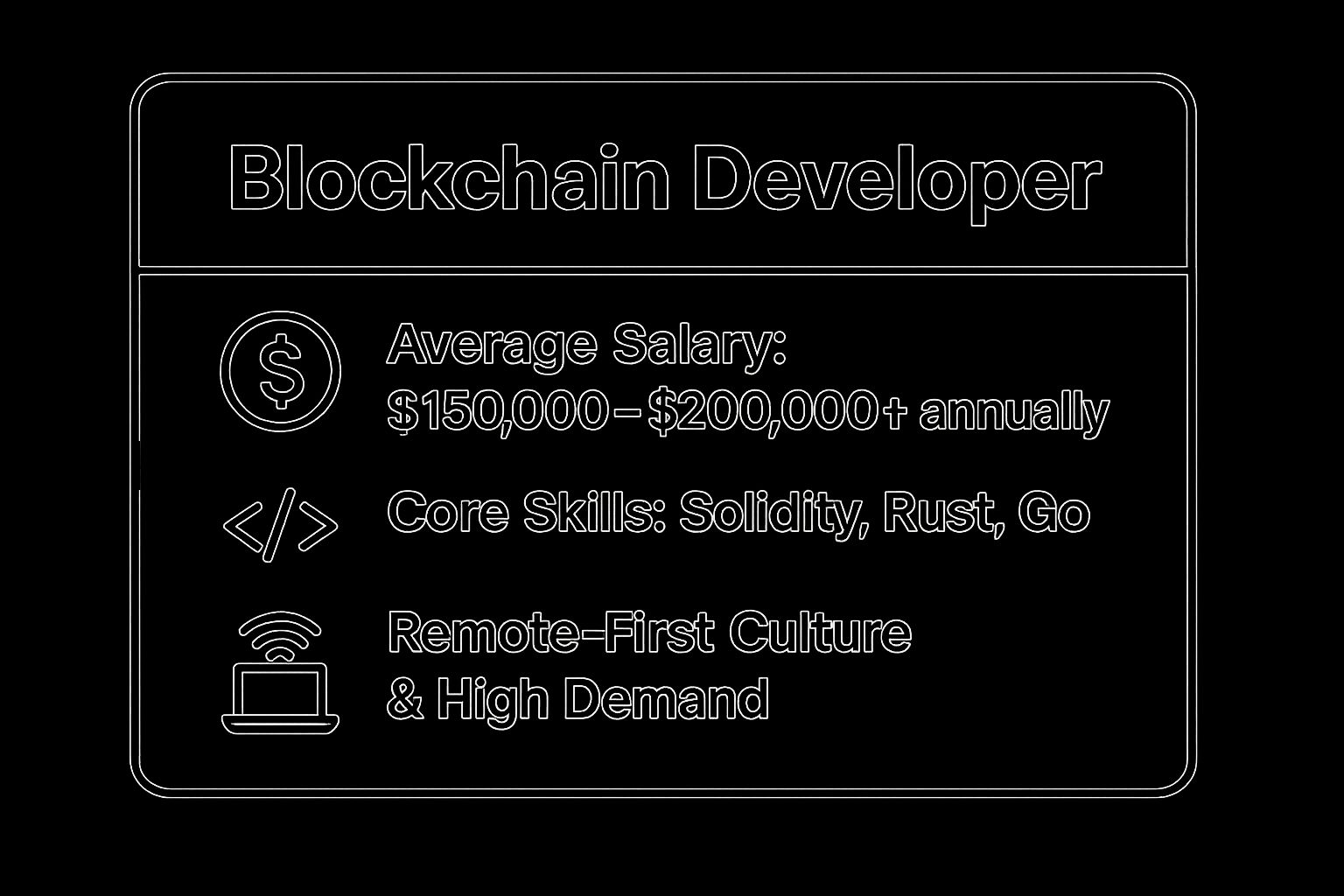
The infographic above summarizes key data points about a career as a Blockchain Developer, highlighting the in-demand skills, potential salary range, and core responsibilities. This quick reference provides a snapshot of what to expect in this fast-paced and evolving field. As you can see, the demand for skilled blockchain developers is high, reflected in the competitive salaries offered.
This high demand stems from the diverse applications of blockchain technology, impacting various sectors from decentralized finance (DeFi) and non-fungible tokens (NFTs) to gaming and enterprise solutions. Blockchain Developers are involved in everything from building the underlying blockchain protocols to creating the user interfaces for dApps. Specific tasks include core development of blockchain protocols and infrastructure, smart contract programming and auditing, full-stack development for decentralized applications, and implementation of cryptographic algorithms and security measures.
For those looking for crypto jobs remote, blockchain development is a perfect fit. The remote-first culture is standard in this industry. This allows for flexibility and global collaboration within the crypto space. Learn more about Blockchain Developer roles and opportunities.
The following infographic visualizes the key data about the role of a Blockchain Developer:
The infographic confirms that blockchain developers are in high demand and command high salaries, underscoring the importance of technical skills like Solidity and Rust. It also reinforces the remote-friendly nature of these roles, a major draw for many seeking "crypto jobs remote."
While highly rewarding, a career in blockchain development also has its challenges. The field is constantly evolving, requiring continuous learning and adaptation. The high stakes involved mean that code vulnerabilities can have significant financial repercussions. Long hours are common, especially during product launches or when addressing critical bugs. Finally, regulatory uncertainty in the crypto space can sometimes impact project viability.
Pros:
- Among the highest-paid roles in the crypto industry ($120,000-$200,000+ annually)
- High demand across DeFi, NFT, gaming, and enterprise blockchain sectors
- Significant intellectual challenge and opportunity for innovation
- Remote-first culture is standard in the industry
Cons:
- Requires continuous learning as blockchain technology rapidly evolves
- High stakes – code vulnerabilities can lead to major financial losses
- Long hours during product launches or when addressing critical bugs
- Regulatory uncertainty can impact project viability
Examples of Blockchain Developers at Work:
- Ethereum core developers maintaining and upgrading the blockchain
- Smart contract developers at Aave or Compound creating DeFi lending protocols
- Full-stack developers building NFT marketplace infrastructure at OpenSea
Tips for Aspiring Blockchain Developers:
- Start with contributing to open-source blockchain projects to build your portfolio.
- Specialize in a particular blockchain ecosystem (Ethereum, Solana, etc.).
- Obtain security certifications like Certified Blockchain Security Professional (CBSP).
- Stay active in developer communities on Discord, GitHub, and forums.
Popularized By:
Influential figures like Vitalik Buterin (Ethereum co-founder), Gavin Wood (Polkadot founder, former Ethereum CTO), and Andre Cronje (Yearn Finance developer), along with companies like Consensys, Alchemy, and Protocol Labs, have played a crucial role in popularizing and advancing the field of blockchain development.
2. Crypto Security Analyst
Crypto Security Analysts are the guardians of the digital asset realm, protecting blockchain applications, cryptocurrency exchanges, and protocols from vulnerabilities and attacks. They work tirelessly to ensure the safety and integrity of the blockchain ecosystem. Their work involves conducting comprehensive security audits of smart contracts and decentralized applications (dApps), performing penetration testing to identify weaknesses, and developing robust security practices to safeguard digital assets. This role is absolutely critical in the crypto industry where security breaches can result in irreversible financial losses and devastating reputation damage, making it a prime candidate for those seeking fulfilling and impactful crypto jobs remote.

A Crypto Security Analyst's responsibilities extend across multiple facets of blockchain security. Smart contract auditing is a core function, involving meticulous code review to identify vulnerabilities that could be exploited by malicious actors. They also develop security frameworks and best practices for organizations to follow, ensuring a proactive approach to threat mitigation. When a hack attempt or breach occurs, Security Analysts are at the forefront of the incident response, working to contain the damage and prevent further losses. Furthermore, they conduct risk assessments for new crypto projects and protocols, identifying potential security risks before they become exploitable vulnerabilities.
Examples of Crypto Security Analyst roles in action:
- Security engineers at companies like Trail of Bits or OpenZeppelin conducting protocol audits for decentralized finance (DeFi) platforms.
- Security teams at platforms like Immunefi managing bug bounty programs, incentivizing ethical hackers to discover and report vulnerabilities.
- Independent security researchers uncovering critical vulnerabilities in major DeFi projects, often preventing substantial financial losses for users.
Why choose this crypto jobs remote option?
- High compensation: Due to the specialized knowledge and high demand, Crypto Security Analysts command impressive salaries, typically ranging from $130,000 to $220,000+ annually.
- Critical role: This position carries significant responsibility and respect within the crypto community. You're directly contributing to the security and stability of the ecosystem.
- Impactful work: You have the opportunity to prevent major financial losses and protect users from malicious attacks.
- Flexibility: Many Crypto Security Analysts work remotely and have the flexibility to engage with multiple projects as consultants.
However, it's important to consider the downsides:
- High stress: The potential consequences of overlooking a vulnerability can be significant, leading to a high-stress environment.
- Constant vigilance: The landscape of blockchain security is constantly evolving, requiring continuous learning and adaptation to new attack vectors.
- On-call availability: Emergencies and attacks can occur at any time, requiring availability regardless of time zone.
- Complex technical challenges: The work involves a deep understanding of cryptography, game theory, and complex code analysis.
Tips for aspiring Crypto Security Analysts:
- Specialize in attack vectors: Develop expertise in common attack vectors like reentrancy, flash loan exploits, and oracle manipulation.
- Master code review: Cultivate a methodical approach to code review and testing.
- Participate in bug bounties: Join bug bounty programs to gain practical experience, build your reputation, and potentially earn rewards.
- Collaborate with developers: Understand the system architecture thoroughly before conducting audits by collaborating closely with developers.
The growing importance of blockchain security has been popularized by renowned security researchers like Samczsun, and cemented by the work of companies like ChainSecurity, CertiK, Trail of Bits, and SlowMist, all of which have played crucial roles in preventing major hacks and securing the crypto ecosystem. If you are passionate about security and thrive in a challenging environment, a remote career as a Crypto Security Analyst could be a highly rewarding path in the burgeoning world of Web3.
3. Crypto Product Manager
A Crypto Product Manager (CPM) is a crucial link between the technical intricacies of blockchain development and the business goals of a crypto company. This role is ideal for those seeking crypto jobs remote due to the decentralized nature of many blockchain projects. CPMs guide the creation of user-friendly crypto products, from decentralized exchanges (DEXs) and non-fungible token (NFT) marketplaces to wallets and innovative protocols. They're the architects of the user experience, defining the product vision, roadmap, and feature prioritization, all while keeping a keen eye on the ever-evolving crypto market. This is a prime example of a crypto job remote that offers both flexibility and significant influence.
How it Works:
A CPM dives deep into the world of their target users, understanding their needs and pain points within the blockchain ecosystem. They translate these insights into actionable product strategies, coordinating between engineering, design, and business teams. This involves market research, competitive analysis, and a deep understanding of blockchain technology fundamentals. They don't need to be coders, but they must grasp the technical constraints and possibilities to make informed decisions. A CPM is responsible for translating complex technical concepts into a product that is both powerful and accessible.
Examples of Successful Implementation:
- Product managers at Coinbase developing new trading features that simplify complex order types for retail investors.
- DeFi protocol PMs at Uniswap creating governance mechanisms that empower token holders to participate in platform decisions.
- Wallet product managers at MetaMask improving user onboarding, making it easier for newcomers to enter the world of Web3.
When and Why to Use This Approach:
A CPM is essential for any crypto project aiming to build a successful product. Their strategic thinking and ability to bridge the technical-business divide are invaluable, especially in a fast-paced and competitive landscape like the crypto industry. If a project involves building a user-facing application, platform, or protocol, a CPM is a must-have. This holds true whether the project is a new startup or an established player looking to expand its offerings. The demand for these roles makes it a promising avenue for those seeking crypto jobs remote.
Features and Benefits:
- Product strategy development for crypto applications: Defining the overall direction and roadmap for a product.
- Coordination between engineering, design, and business teams: Acting as the central hub for all product-related activities.
- Market research and competitive analysis in the crypto space: Staying ahead of the curve and identifying opportunities.
- User experience design for complex blockchain interactions: Making complex technology accessible to everyday users.
Pros:
- Well-compensated position ($110,000-$180,000+): Reflecting the high demand and impact of this role.
- Opportunity to shape innovative products in a cutting-edge industry: Be at the forefront of blockchain innovation.
- Combines technical knowledge with business strategy: A stimulating blend of different skill sets.
- Direct impact on product adoption and company success: Your decisions directly influence the project’s trajectory.
- **High potential for crypto jobs remote: Many companies in this space embrace remote work.
Cons:
- Challenging to balance technical constraints with user needs: Finding the sweet spot between feasibility and desirability.
- Must navigate regulatory uncertainty when designing features: Adapting to the evolving legal landscape of crypto.
- Rapidly changing competitive landscape requires constant adaptation: Staying ahead of the game requires continuous learning and adjustment.
- Success metrics can be ambiguous in emerging crypto categories: Defining and measuring success can be complex.
Tips for Aspiring Crypto Product Managers:
- Develop a deep understanding of your target users and their blockchain pain points: User-centricity is key.
- Build technical knowledge to effectively communicate with developers: A solid understanding of blockchain fundamentals is essential.
- Create clear documentation and specifications for complex features: Ensure everyone is on the same page.
- Establish measurable KPIs that align with both user and business value: Track progress and demonstrate impact.
Popularized By:
- Tether and stablecoin product teams, driving adoption of stablecoins for everyday transactions.
- MetaMask's product organization (ConsenSys), making Web3 accessible to millions of users.
- Product leaders at major exchanges like Binance and FTX, shaping the future of crypto trading.
This role is highly sought after, especially for those seeking crypto jobs remote, and offers the opportunity to be a key player in the future of finance and technology.
4. Crypto/Web3 Marketing Specialist
Crypto/Web3 Marketing Specialists are essential for the success of any project in the decentralized space. They bridge the gap between complex blockchain technologies and potential users, crafting narratives and campaigns that resonate with both seasoned crypto enthusiasts and newcomers. This involves developing and executing marketing strategies to promote a wide range of offerings, including blockchain projects, cryptocurrency exchanges, NFT collections, and DeFi protocols. Navigating the unique challenges of a decentralized ecosystem, these specialists build community and drive engagement across platforms like Discord, Telegram, and Twitter, while simultaneously educating potential users about often complex crypto products and services. This blend of traditional marketing expertise with deep crypto ecosystem knowledge and community management makes this a highly sought-after role in the remote crypto job market.

Crypto/Web3 Marketing Specialists wear many hats. Their responsibilities encompass community building and management across various social platforms, crafting content marketing strategies specifically tailored for crypto audiences, employing growth hacking techniques for token adoption and protocol usage, and even planning events for both virtual and in-person crypto conferences. Think of the marketing teams behind successful NFT launches like Bored Ape Yacht Club, the community managers at DeFi protocols like Compound or Aave, or the growth marketers at exchanges like Kraken and crypto data providers like CoinGecko. These are all prime examples of how crucial this role is for driving visibility and adoption in the crypto space. Learn more about Crypto/Web3 Marketing Specialist
The demand for skilled Crypto/Web3 Marketing Specialists is high, leading to competitive compensation packages often ranging from $80,000 to $150,000+ depending on experience. This career path offers the opportunity to work with cutting-edge projects and technologies in a highly creative role with considerable scope for innovative marketing approaches. However, this dynamic field also presents challenges. The rapidly changing regulatory environment significantly impacts permissible marketing claims, and the inherent volatility in project fortunes can affect job stability. Furthermore, the prevalence of scams in the crypto world requires careful navigation to avoid accusations and build trust, and the 24/7 nature of community management can lead to burnout.
To thrive in this fast-paced environment, aspiring Crypto/Web3 Marketing Specialists should focus on educating their audience by simplifying complex concepts for mainstream adoption. Building authentic community engagement rather than relying on hype is crucial, as is using data analytics to measure campaign effectiveness beyond simple price action. Developing crisis management skills is also essential for navigating volatile market conditions. The success of influential crypto marketing agencies like Lunar Strategy and Coinbound, along with the community-led marketing of projects like Dogecoin and Shiba Inu, and the sophisticated marketing operations of major exchanges like Crypto.com, underscore the importance and impact of skilled marketing in the crypto space. This role deserves a prominent place on this list because it represents a critical function within the broader Web3 ecosystem, offering significant career opportunities for those with the right blend of marketing acumen and crypto knowledge. This makes it an ideal crypto job remote opportunity for many.
5. DeFi/Crypto Analyst
For those with a keen eye for financial markets and a deep understanding of blockchain technology, a remote career as a DeFi/Crypto Analyst offers a challenging yet rewarding path. This role is increasingly crucial in the expanding world of decentralized finance, making it a prime opportunity among crypto jobs remote. DeFi Analysts research, evaluate, and provide actionable insights on decentralized finance (DeFi) protocols, tokenomics, and blockchain investments. They bridge the gap between financial analysis and technical understanding, assessing everything from protocol health and risk factors to yield opportunities and emerging market trends. Essentially, these professionals empower investors, Decentralized Autonomous Organizations (DAOs), and crypto companies to make informed, data-driven decisions in the complex and rapidly evolving DeFi landscape.
Learn more about DeFi/Crypto Analyst
DeFi/Crypto Analysts perform a variety of tasks, including fundamental analysis of blockchain protocols and their underlying economic models. This involves dissecting whitepapers, understanding the mechanics of token distribution, and evaluating the long-term sustainability of a project. They also conduct technical assessments of smart contract design and security, identifying potential vulnerabilities and risks. Furthermore, these analysts delve into yield strategy optimization across various DeFi platforms, helping investors maximize returns while minimizing risks associated with crypto lending, borrowing, and leverage.
This position deserves its place on this list due to the high demand for skilled analysts in the rapidly expanding DeFi space. The role offers significant intellectual stimulation, placing you at the forefront of financial innovation.
Examples of successful implementation:
- Research analysts at Messari providing in-depth protocol insights.
- DeFi strategists at Delphi Digital analyzing yield farming opportunities and developing sophisticated investment strategies.
- Token economists designing incentive structures for new protocols, ensuring aligned incentives and sustainable growth.
Pros:
- Well-compensated role: Salaries typically range from $90,000 to $180,000+ per year, often supplemented with performance bonuses.
- Intellectually stimulating work: This career constantly challenges you to learn and adapt at the intersection of finance and technology.
- Potential for profit participation: Some positions offer profit sharing in successful investment strategies.
- Flexibility: Enjoy the benefits of remote work, with the option to work independently or for institutions.
Cons:
- High-pressure environment: Market volatility can create stressful situations requiring quick thinking and decisive action.
- Continuous learning curve: New protocols and technologies emerge constantly, demanding continuous learning and adaptation.
- Rapidly evolving information: Research can become outdated quickly due to the fast-paced nature of the market.
- Responsibility for financial advice: The insights you provide directly impact investment decisions, carrying significant responsibility.
Actionable tips for aspiring DeFi/Crypto Analysts:
- Develop systematic frameworks for evaluating protocol fundamentals and tokenomics.
- Build your own financial models to assess the economic sustainability of DeFi projects.
- Maintain relationships with developers and community members to gain early insights into promising projects.
- Publish your research and analysis to build a strong reputation and demonstrate your expertise. This is particularly valuable in the context of finding crypto jobs remote.
When and why to pursue this career path:
Consider this career if you possess a strong analytical mind, a passion for decentralized finance, and a desire to work in a fast-paced, intellectually stimulating environment. This field is ideal for those seeking crypto jobs remote that offer both financial rewards and the opportunity to contribute to the evolution of the financial system. The increasing prominence of DeFi and the growing demand for skilled analysts make this an opportune time to enter this exciting field. Individuals popularizing this career path include research firms like Delphi Digital and Messari, individual analysts like Chris Burniske and Ryan Selkis, and DAO-employed analysts at BitDAO and other investment DAOs.
6. Crypto Compliance Specialist
For those seeking stability and impact within the volatile world of crypto, a career as a Crypto Compliance Specialist offers a compelling blend of challenge and opportunity. This is a particularly attractive option for those interested in crypto jobs remote, as many compliance roles can be performed remotely. This growing field focuses on navigating the increasingly complex regulatory landscape of digital assets, making it a vital component for any blockchain company operating globally.
Crypto Compliance Specialists essentially act as the bridge between the fast-paced innovation of the crypto industry and the evolving legal frameworks governing it. They are responsible for ensuring that blockchain companies adhere to Anti-Money Laundering (AML) and Know Your Customer (KYC) regulations, as well as a host of other compliance requirements that vary across jurisdictions. This involves developing and implementing comprehensive compliance programs, monitoring transactions for suspicious activity, conducting risk assessments for new tokens or features, and liaising with regulatory bodies. As institutional adoption of crypto continues to grow, so too does the critical role of these specialists in legitimizing the industry and fostering trust.
Features of a Crypto Compliance Role:
- Development of compliance frameworks for crypto businesses
- Implementation of KYC/AML procedures specific to digital assets
- Regulatory reporting and relationship management with authorities
- Risk assessment for new tokens, features, or jurisdictions
Pros:
- High Demand & Excellent Compensation: The increasing regulatory scrutiny of the crypto space translates to a growing demand for skilled compliance professionals. Salaries typically range from $90,000 to $160,000+, with significant potential for upward mobility.
- Career Stability: As regulation becomes non-negotiable for crypto companies, compliance roles offer a stable career path within a dynamic industry.
- Impactful Work: You'll have the opportunity to shape industry standards and best practices, contributing to the responsible growth of the crypto ecosystem.
- Transferable Skills: The skills acquired in crypto compliance are often transferable to traditional finance, providing valuable career flexibility.
Cons:
- Regulatory Uncertainty: The rapidly evolving regulatory landscape can create challenging and sometimes ambiguous working conditions.
- Balancing Act: You'll often be caught between the business objectives of the company and stringent regulatory requirements.
- Jurisdictional Complexity: Navigating different rules and regulations across various countries adds layers of complexity to the role.
- Global Demands: You may need to be available across different time zones to address global compliance issues, a common requirement for crypto jobs remote.
Examples of Crypto Compliance Roles:
- Compliance Officers at regulated exchanges like Gemini or Kraken
- AML Specialists monitoring transaction patterns at Chainalysis
- Regulatory Affairs Directors navigating new legislation at Coinbase
Tips for Aspiring Crypto Compliance Specialists:
- Stay updated on regulatory developments across key jurisdictions (e.g., the EU's MiCA regulation, US SEC guidelines).
- Build relationships with regulators and industry bodies when possible.
- Develop compliance solutions that balance robust security with a positive user experience.
- Create clear and comprehensive documentation of all compliance procedures for audit purposes.
Who Popularized This Role?
The demand for Crypto Compliance Specialists has been driven by:
- Regulatory compliance teams at major cryptocurrency exchanges.
- Specialized blockchain compliance firms like Elliptic and Chainalysis.
- Former regulators who have transitioned into crypto compliance roles, bringing their expertise to the private sector.
A career in crypto compliance offers a unique entry point into the crypto industry, particularly for those with a background in law, finance, or risk management. If you're seeking crypto jobs remote that combine analytical thinking, a passion for navigating complex challenges, and a desire to shape the future of finance, this career path deserves serious consideration.
7. Smart Contract Auditor
One of the most crucial, and potentially lucrative, crypto jobs remote is that of a Smart Contract Auditor. With the increasing value locked in decentralized applications (dApps) and the rise of high-profile hacks, the demand for skilled auditors has skyrocketed. This role offers a unique blend of technical challenge, financial reward, and the flexibility of remote work.
Smart Contract Auditors are the guardians of the blockchain world. They meticulously examine the code of smart contracts – the self-executing agreements at the heart of dApps – to identify vulnerabilities and security risks before they can be exploited. This involves a deep understanding of blockchain technology, programming languages like Solidity, and the ever-evolving landscape of attack vectors. Essentially, they act as a final line of defense against malicious actors seeking to drain funds or manipulate blockchain systems.
How does a Smart Contract Audit work? It typically involves a combination of:
- Manual code review: Auditors painstakingly review the code line by line, searching for logical errors, potential exploits, and deviations from best practices.
- Automated testing and formal verification: Utilizing specialized tools to automatically scan for common vulnerabilities and verify the contract's adherence to specific properties.
- Simulation of attack vectors and exploit scenarios: Auditors actively try to "break" the contract by simulating real-world attack scenarios, mimicking how a malicious actor might attempt to exploit weaknesses.
- Documentation of findings and remediation recommendations: A comprehensive report detailing identified vulnerabilities, their severity, and actionable recommendations for developers to fix the issues.
Examples of Smart Contract Auditors in action:
- Auditors at leading security firms like Trail of Bits are frequently engaged to review major DeFi protocols, ensuring the security of millions of dollars in user funds.
- Security teams at OpenZeppelin, a prominent smart contract development library, conduct pre-launch audits to safeguard their own code and that of projects using their tools.
- Independent auditors utilize platforms like Code4rena to participate in competitive audits, earning rewards for identifying vulnerabilities.
Why is this a top crypto job remote?
Smart Contract Auditing deserves its place on this list due to several compelling factors:
- Premium compensation: The specialized skills and high stakes associated with this role command premium salaries, ranging from $130,000 to $250,000+ per year.
- High demand: The increasing frequency and severity of smart contract exploits have made security a top priority for projects, driving demand for skilled auditors.
- Intellectually challenging work: The constantly evolving nature of blockchain technology and attack vectors provides a stimulating and intellectually engaging career path.
- Flexibility: Many Smart Contract Auditors work remotely as independent contractors or with audit firms, offering flexibility and autonomy.
Pros and Cons:
Pros:
- High earning potential.
- Strong job security due to high demand.
- Intellectually stimulating work.
- Remote work flexibility.
Cons:
- Extremely high stakes – missed vulnerabilities can lead to significant financial losses and reputational damage.
- Requires continuous learning to stay ahead of new attack vectors and vulnerabilities.
- Projects often have tight deadlines, demanding fast and efficient auditing.
- Potential legal and reputational risks if audited contracts are later compromised.
Tips for aspiring Smart Contract Auditors:
- Specialize in specific contract types: Focus on a niche area like ERC-20 tokens, lending protocols, or NFTs to develop deep expertise.
- Develop a systematic checklist: Create a comprehensive checklist of common vulnerabilities to ensure thorough audits.
- Build a personal library of test cases and attack vectors: Continuously expand your repertoire of testing strategies to identify a wider range of potential exploits.
- Consider professional liability insurance: Especially for high-value audits, insurance can protect you from potential legal repercussions.
Popularized By:
The importance of Smart Contract Auditing has been driven by the growth of reputable audit firms like Certik, Consensys Diligence, and Quantstamp, as well as competitive audit platforms like Code4rena and Immunefi. The contributions of prominent individual auditors who have identified major vulnerabilities have also highlighted the critical role of this profession. This career path within crypto jobs remote is ideal for those seeking a challenging, rewarding, and impactful role in the rapidly evolving blockchain landscape.
Top 7 Remote Crypto Job Platforms Comparison
| Role | 🔄 Implementation Complexity | 💡 Resource Requirements | 📊 Expected Outcomes | ⚡ Ideal Use Cases | ⭐ Key Advantages |
|---|---|---|---|---|---|
| Blockchain Developer | High – requires deep knowledge of blockchain protocols, cryptography, and multiple programming languages | Advanced programming skills (Solidity, Rust, Go), security certifications, active community involvement | Secure, scalable blockchain infrastructure & dApps with innovation potential | Developing core blockchain systems, smart contracts, NFT marketplaces | High pay, strong demand, remote culture, intellectual challenge |
| Crypto Security Analyst | Very high – deep security audits, vulnerability testing, continuous threat adaptation | Expert in audit tools, penetration testing, bug bounty participation | Prevention of critical security breaches and financial loss | Security audits, incident response, protocol risk assessments | Critical role, flexible consulting, high compensation, respected expertise |
| Crypto Product Manager | Medium – requires cross-functional coordination and market understanding alongside blockchain basics | Understanding of blockchain tech, agile tools, user research, data analysis | Well-defined product roadmaps, improved adoption and user experience | Managing crypto app features, exchange products, user onboarding | Leadership role, blends tech & business, direct market impact |
| Crypto/Web3 Marketing Specialist | Medium – marketing strategy with crypto-specific community engagement challenges | Strong marketing, community management tools (Discord, Twitter), analytics skills | Effective project visibility, engaged user communities, token adoption growth | Crypto project launches, NFT marketing, DeFi user education | Creative role, high demand, opportunity for innovation and growth |
| DeFi/Crypto Analyst | Medium to high – requires financial and technical protocol analysis, risk modeling | Data analytics platforms (Dune, Token Terminal), modeling skills, research output | Data-driven investment insights, protocol risk evaluation, yield optimization | Investment research, DAO strategy, financial model creation | Intellectual stimulation, flexible work, potential profit sharing |
| Crypto Compliance Specialist | Medium – navigating complex and evolving regulations globally | Regulatory knowledge, compliance program management, KYC/AML expertise | Regulatory adherence, risk mitigation, industry legitimacy | Compliance in exchanges, regulatory reporting, KYC/AML processes | Stable career, growing demand, transferable finance skills |
| Smart Contract Auditor | Very high – expert-level code review, testing, formal verification | Deep contract expertise, audit frameworks, high-stakes accountability | Identification and remediation of high-risk contract vulnerabilities | Pre-launch audits, security validation for DeFi and NFT contracts | Premium pay, flexibility, critical security gatekeeper role |
Launch Your Remote Crypto Career Today
The world of Web3 is rapidly expanding, and with it, the demand for skilled professionals across a diverse range of disciplines. From blockchain developers building the foundations of decentralized systems to marketing specialists spreading the word about innovative NFT projects, this article has highlighted several key remote crypto career paths. We’ve explored everything from highly technical roles like smart contract auditor and crypto security analyst to more business-focused positions like crypto product manager and DeFi analyst. Understanding the nuances of each role, including the required skillsets and potential career trajectories, is crucial for anyone looking to break into this exciting field.
One of the most valuable takeaways is the emphasis on continuous learning and adaptation. The crypto space is constantly evolving, so staying up-to-date with the latest trends and technologies is essential for success. For those looking to transition into a crypto career, especially support roles, understanding automation is key. Learn more about streamlining customer service with AI and other tools by exploring resources like this guide on how to automate customer service. Mastering these concepts not only enhances your individual career prospects but also contributes to the growth and maturation of the entire Web3 ecosystem.
Embracing a remote crypto career offers unparalleled flexibility and the chance to be part of a global community pushing the boundaries of innovation. Ready to take the next step? Find Web3 is the premier platform for discovering remote crypto jobs across various specialties. Connect with leading Web3 companies and launch your dream career today! Find Web3