Blockchain Developer Resume: Structure, Skills, Evidence
What crypto employers name in their own job adverts, how to structure a blockchain developer resume around it, and what applicant tracking systems really do.
What blockchain developer listings ask for
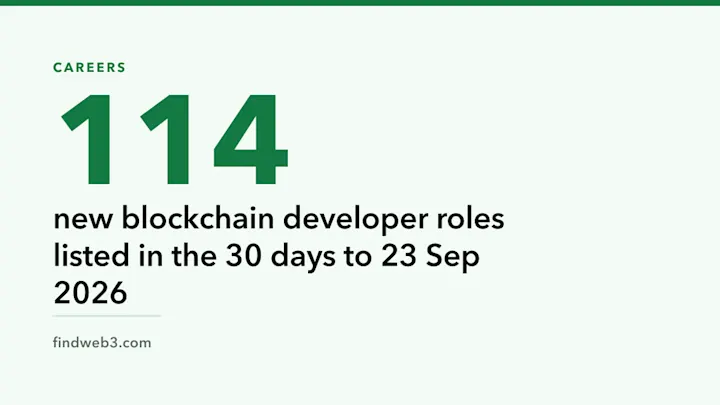
A resume is easier to write once you know what the adverts actually say. Find Web3 listed 114 new blockchain developer roles in the 30 days to 23 September 2026, from 58 companies, 71% of them fully remote (blockchain developer jobs, counted 23 September 2026).
That work splits three ways: on-chain code, off-chain infrastructure (nodes, indexers, APIs, data pipelines), and the application layer (wallet integrations, dapp front ends). A resume is clearer when it makes plain which of the three it is aimed at.
The words employers use are countable. The Web3 dictionary counts how often each of 78 crypto terms appears across 4,212 job adverts on this board, updated 23 September 2026:
| Term | Adverts containing it (of 4,212) |
|---|---|
| Web3 | 1,115 |
| wallet | 638 |
| DeFi | 626 |
| custody | 399 |
| smart contract | 246 |
| staking | 227 |
| EVM | 140 |
| layer 2 | 130 |
| Solidity | 97 |
| rollup | 61 |
| zero-knowledge | 58 |
| smart contract audit | 40 |
| multisig | 19 |
| gas | 9 |
Source: Find Web3 Web3 dictionary, counted across 4,212 adverts, 23 September 2026. Counts cover every advert on the board, including non-technical roles, so read them as how common a word is rather than how many engineering jobs need the skill.
Two things follow. The generic labels do not distinguish anyone — "Web3" appears in more than a quarter of all adverts, most of which are not engineering jobs. And a term's rarity tells you what an advert is likely to name, not what the job assumes. Gas appears in 9 adverts out of 4,212, while the blockchain developer salary page lists understanding gas among the baseline expectations — so gas optimization reads better as something you can demonstrate on a specific project than as the theme a resume is organized around. Naming a chain family and a language does more work.
The skills section
The blockchain developer listings page names Solidity, Rust, Go and TypeScript as the languages asked for most often, and the blockchain developer salary page describes the usual ask as one on-chain language on top of solid general backend engineering, a development framework, an understanding of transactions, gas and consensus, and testing habits suited to code that cannot be quietly patched after deployment.
| Language | Where it is used | What to put beside it |
|---|---|---|
| Solidity | Ethereum and other EVM chains | The chains you deployed to, your test framework, whether contracts held real funds |
| Rust | Solana programs, protocol and client software | Which network, and whether the work was application-level or on the client itself |
| Go | Node and backend infrastructure, several chain clients | What you operated or built: RPC, indexers, data pipelines |
| TypeScript | Dapp front ends, deployment scripts, contract tests | The library you used to talk to a chain, and the wallet flows you built |
Be specific about the chain. Solana is not EVM-compatible and its programs are usually written in Rust, so Ethereum experience does not carry across directly — the two families use different languages, tools and wallets. A resume that says "blockchain" and never names a network makes a reviewer guess.
Tools that date a resume
Several of the tools that standard blockchain resume advice still recommends are no longer maintained. Listing them as current skills dates the work:
- Truffle and Ganache. Consensys announced their sunset in September 2023; the codebases have been public archives since 20 December 2023, with Hardhat and Foundry named as the migration path.
- web3.js. ChainSafe sunset the library on 4 March 2025 and archived the repository, pointing users to Ethers.js and viem.
- Mining language for Ethereum. Ethereum has been secured by staked ether rather than mining since 15 September 2022. Any line describing Ethereum mining, or using "miner extractable value" rather than maximal extractable value, reads as out of date.
- Platform lists generally. Check them before the resume goes out: EOS, a fixture of 2021-era skills tables, rebranded to Vaulta in 2025 and shifted its positioning to Web3 banking.
Current equivalents are Foundry, Hardhat (version 3 is the current stable release, with Foundry-compatible Solidity tests), and Ethers.js or viem for reading and writing from an application.
Projects and public work
Public work is unusually easy to check in this field, because repositories and deployed contracts can be read by anyone. That is an advantage a blockchain developer resume has over most, and it is lost when projects are described rather than linked.
For each project, give a reviewer something they can open:
- A repository link. Not a GitHub profile — the specific repository, with a README that explains the design decisions rather than the file layout.
- A deployed address. A verified contract on a block explorer lets anyone read the source and the transaction history without asking you, which is worth more on a junior resume than another line of description.
- Your role, stated plainly. Which parts you wrote, and what was already there.
- What it does and who used it. One sentence. Testnet-only is fine, provided you say so.
Numbers on a resume
Quantifying contributions is good advice that goes wrong when the numbers are invented. Two rules keep it honest:
- Only use a figure the reader could check, or that you could defend in an interview. A gas reduction you can demonstrate from a before-and-after commit is evidence. A round percentage attached to a project nobody can see invites a question about how it was measured.
- When the figure is confidential, describe the change instead. "Rewrote the settlement path to batch transfers" tells a reviewer more than a percentage they cannot verify.
Security experience is worth stating explicitly rather than implying. Smart contract audit appears in 40 of the 4,212 adverts counted on this board, and the blockchain developer salary page says security experience — audit work, serious testing, or handling contracts that hold funds — counts for a lot, as does depth in one specific chain. If you have been through an audit from either side, say which firm, which contracts, and what came out of it.
What applicant tracking systems actually do
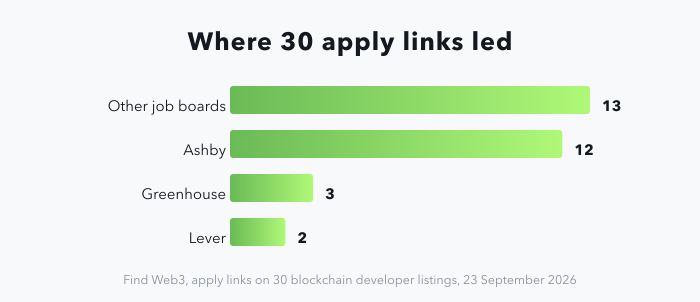
Much of the writing on this subject describes a keyword-scoring robot that nobody names. It is worth starting from where applications actually go. Following the apply link on 30 blockchain developer listings on Find Web3 on 23 September 2026, 17 led to a hosted applicant tracking system — 12 to Ashby, 3 to Greenhouse and 2 to Lever — and the remaining 13 to other job boards. Those are products with public documentation. Two of the three document the part people worry about:
- Greenhouse documents automatic rejection as a rule tied to the answer to an application question: an employer writes a knockout question, picks the disqualifying answer, and applicants who give it are rejected with a stated reason (Greenhouse Support, "Auto-reject"). The rule keys off the form, not off your resume text.
- Ashby describes its AI-Assisted Application Review as checking each resume against criteria the employer has written, returning a "meets" or "does not meet" judgment with citations to the part of the resume it came from, after which "it is up to the reviewer to advance or reject" (Ashby product update, 10 September 2024).
That changes the advice in a useful way. The knockout questions on the form — work authorization, location, years of experience, salary expectation — decide more than anything in the document, so answer them deliberately. And because the review step looks for evidence it can point at, a claim with a link or a specific beside it is easier to credit than a keyword sitting in a list.
Claims this article is not repeating
- "Recruiters spend six seconds on a resume." The figure comes from eye-tracking research TheLadders published in 2012 and updated in 2018, when it reported 7.4 seconds. It is a recruiting company's own study of how long people looked before deciding whether to keep reading, not a measurement of software, and it has been criticized for a small sample and a method that was never fully published.
- "75% of resumes are rejected by an ATS before a human sees them." This figure circulates without an identifiable source or method. Neither of the two systems documented above works that way.
Formatting, which is the part that matters
- One column, real text rather than an image or a screenshot of a resume.
- Ordinary section headings: summary, skills, experience, projects, education.
- A standard font at a readable size. Neither system documented above describes anything that turns on the typeface.
- PDF unless the form asks for something else, named with your name and the role.
- Links written out as text as well as hyperlinked, so they survive a parse.
Pay, and what to put in the salary field
Advertised pay for the title, from the blockchain developer salary page — 21 listings that state pay, posted in the 12 months to 23 September 2026:
| Group | Median | Listings |
|---|---|---|
| All blockchain developer listings | $170,000 (middle range $137,500-$205,000) | 21 |
| Senior | $200,000 | 11 |
| Mid-level | $147,500 | 10 |
| Fully remote | $155,000 | 15 |
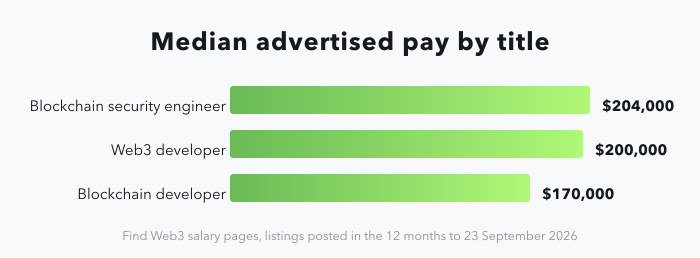
Title choice moves the number. On the same board, Web3 developer listings have a median of $200,000 across 278 listings and blockchain security engineer listings a median of $204,000 across 21, both from listings posted in the 12 months to 23 September 2026. If your experience genuinely fits a security or protocol title, applying under the one that describes the work is worth more than any wording change on the resume.
Two caveats from the salaries methodology: listings that state no pay are left out, so the figures lean toward employers who publish a range; and token grants and equity, common in crypto on top of base salary, are not included.
Mistakes worth avoiding
| Mistake | Why it costs you | Instead |
|---|---|---|
| Never naming a chain | Solidity and Rust roles are different jobs; a reviewer has to guess which you can do | Name the networks you deployed to and what you built there |
| Listing tools without evidence | Anyone can write a tool name; the list is not the claim, the work is | Put the repository, address or incident beside the tool |
| Archived tooling | Truffle and Ganache were sunset in 2023, web3.js in March 2025; all three date the work | State what you use now; mention old tools only as history on a specific project |
| Unverifiable metrics | Round percentages with no source invite a question you cannot answer | Use figures you can show, or describe the change in words |
| Keyword stuffing | Rejections at these systems come from people and from form answers, so density buys nothing and reads badly | Use the terms once, in the sentence that proves them |
| Jargon with no explanation | The first reader is often a recruiter rather than an engineer | One plain clause after each specialist term |
A checklist before you send it
- The chains, languages and frameworks you actually use are named in the first third of the page.
- Every project has a link a stranger can open.
- Every number is one you could source in an interview.
- No archived tools presented as current skills.
- The form's knockout questions are answered accurately, including location and work authorization.
- The file is a PDF with real text, named after you and the role.
- The title you are applying under matches the work you are describing.
Find Web3 lists blockchain developer jobs and engineering roles across crypto, along with what each role pays and the companies hiring.