Blockchain Development Platforms: How to Choose One
What a blockchain platform actually gives you, how public, private and hybrid chains differ, and a side-by-side look at the leading options.
What Blockchain Development Platforms Are
A blockchain development platform is the network an application runs on plus the tools for writing code that runs on it. Without one, every project would have to build, launch and secure its own chain before writing a single feature.
The Core Components for Building on a Blockchain
- Software development kits (SDKs): code libraries that handle the low-level work of talking to a specific chain — signing transactions, reading state, managing keys.
- Node access and APIs: an application has to reach the network somehow, either by running its own node or by using a hosted endpoint.
- Smart contract languages: the languages used to write on-chain code, such as Solidity for Ethereum or Rust for Solana.
- Test networks: separate copies of the chain, running with worthless tokens, where code can be deployed and broken without risking real funds.
The platform you pick sets what your application costs to run, how quickly transactions settle, who can see its data, and how many developers already know how to work on it. Those constraints are difficult to reverse: moving a live application to another chain means rewriting its contracts and migrating whatever they hold.
Making Sense of Core Blockchain Concepts
Three ideas do most of the work in blockchain development.
Smart Contracts
A smart contract is code stored on a blockchain that runs when someone calls it and enforces its own terms. A vending machine is the usual comparison: the condition is met, the outcome follows, and no one approves it in between.
The consequential part is what happens after deployment. A contract normally cannot be edited. Changing its behavior means deploying new code and moving users to it, and any bug in the original is live and public until they move. That is why audits and test coverage matter more here than in most software.
DApps
A decentralized application, or DApp, is an ordinary front end wired to contracts on a chain rather than to a company's servers. The interface looks familiar; the logic and the balances sit on a network no single party runs.
A ride-sharing DApp shows the difference. The fare rules live in a contract that anyone can read, and payment moves from rider to driver directly rather than through a company that sets the rate and takes a cut. The same pattern has been applied to lending, exchanges, marketplaces and social apps.
Consensus Mechanisms
With no central authority, a network needs a rule for deciding which transactions are real. That is the consensus mechanism. Two dominate:
- Proof of work (PoW): participants spend computing power competing to add the next block. Bitcoin still works this way. It is expensive to attack and expensive to run.
- Proof of stake (PoS): participants lock up the network's own token as collateral and lose part of it if they misbehave. It uses a fraction of the energy. Ethereum has run on proof of stake since September 2022, so ether is no longer mined.
The Web3 dictionary covers the rest of the vocabulary.
Choosing Your Blockchain Architecture
Before comparing specific platforms, decide what kind of network the project needs. The architecture determines who can join, who validates, and how much is visible.
Public Blockchains
Bitcoin and Ethereum are public chains: permissionless networks that anyone can read, transact on and help validate. That openness is the point for anything that has to survive without a gatekeeper.
- Cryptocurrencies, which need a network no single institution can switch off.
- NFTs, where the proof of ownership is only worth something if outsiders can check it.
- DeFi, which depends on anyone being able to interact with the same contracts.
The trade-off is capacity and privacy. Everyone shares the same block space, so fees rise with demand, and every transaction is permanently visible.
Private Blockchains
A private chain is permissioned. An administrator decides who joins and what each participant can do. A group of banks settling trades between themselves, or a retailer tracking a supply chain with its suppliers, gets the shared ledger and the tamper-evidence without publishing commercial data.
Validation is faster and cheaper because the validators are few and known.
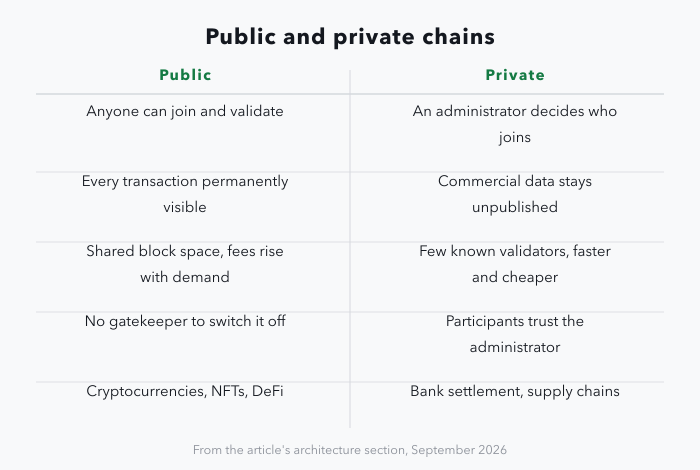
The sacrifice is decentralization. A private chain is not trustless; participants are trusting whoever administers the network.
Hybrid Blockchains
Hybrid designs keep operations on a private chain and use a public one for verification. A hospital can hold patient records privately and publish a cryptographic hash of them to a public chain, which proves the records existed at a point in time and have not been altered, without revealing anything about them.
Comparing the Leading Blockchain Platforms
Each of the major platforms was built for a different job, and the differences show up in how they reach consensus, what you write contracts in, and who is allowed to take part.
Top Blockchain Development Platforms Comparison
| Platform | Consensus Mechanism | Smart Contract Language | Network Type | Typical Use Case |
|---|---|---|---|---|
| Ethereum | Proof of stake | Solidity, Vyper | Public, permissionless | DeFi, NFTs, general DApps |
| Solana | Proof of stake, with Proof of History for ordering | Rust, C | Public, permissionless | Trading, gaming, micropayments |
| Cardano | Ouroboros (proof of stake) | Plutus, Marlowe | Public, permissionless | Identity, long-lived high-assurance systems |
| Hyperledger Fabric | Pluggable (Raft and others) | Go, Java, JavaScript | Private, permissioned | Enterprise, supply chain, consortium networks |
Transactions-per-second figures are left out of that table on purpose. The numbers usually quoted are ceilings the projects publish for themselves — Solana's whitepaper reaches 710,000 by dividing a 1 Gbps link by a 176-byte transaction — and they come from calculations, simulations and controlled benchmarks rather than from a loaded network. They are also not comparable: Cardano's own glossary calls raw TPS comparisons between protocols "rarely apples to apples".
Ethereum: The Trailblazer
Ethereum launched in 2015 and was the first chain to make general-purpose programmable contracts work at scale. Its advantage today is the ecosystem around it: the largest body of documentation, audited contract libraries, tooling and experienced developers, which is why most new smart contract work still starts there or on a chain that runs Ethereum's virtual machine.
The constraint is block space. Blocks arrive on a fixed schedule with a cap on the computation each can contain, so when demand rises, fees rise with it. The response has been to move activity to layer 2 networks that batch transactions and settle back to Ethereum; the Dencun upgrade in March 2024 gave those networks a cheaper way to post their data, which cut their fees substantially.
Solana: The High-Speed Challenger
Solana is built around throughput on a single chain rather than around layers on top of one. Proof of History is the distinctive piece: a verifiable record of the order and rough timing of events, which lets validators agree on sequence without passing messages back and forth about it, alongside proof of stake for choosing who produces blocks.
Low fees and fast confirmation make it a common choice for trading applications, games and anything involving very small payments. The costs are on the other side of the ledger: validators need substantial hardware, which narrows who can run one, and the network has suffered full outages that required a coordinated restart.
Cardano: The Methodical Academic
Cardano develops in the open through peer-reviewed research, with protocol changes published as papers before they ship. Ouroboros, its proof-of-stake protocol, came out of that process with formal security proofs attached.
It also handles state differently. Cardano uses an extended UTXO model, closer to Bitcoin's than to Ethereum's account balances, which makes the outcome of a transaction predictable before it is submitted but requires a different way of structuring contracts. The method ships slowly, which is the point for the kind of long-lived systems it targets.
Hyperledger Fabric: The Enterprise Solution
Hyperledger Fabric is a framework for building permissioned networks rather than a public chain. It is hosted by LF Decentralized Trust, the Linux Foundation body previously called the Hyperledger Foundation.
- Modular architecture: consensus, identity and membership services are components you choose rather than fixed parts of the protocol.
- Private data: transaction data can be shared with only the parties to it rather than the whole network.
- No native token: the network runs without a cryptocurrency, so operating it carries no exposure to a token price.
That combination suits supply chain tracking, trade finance and health records, where the participants are known to each other and the data cannot be public.
A Practical Framework for Platform Selection
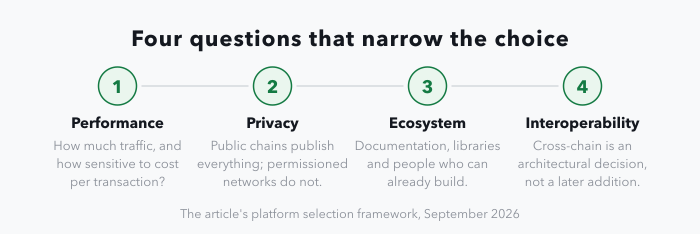
Four questions narrow the choice faster than comparing feature lists.
Evaluate Performance and Scalability
How much traffic does the application actually need to handle, and how sensitive is it to cost per transaction? An application that settles a small number of high-value transactions can live with Ethereum mainnet fees. One that charges a few cents per action cannot, and belongs on a high-throughput chain or a layer 2.
Assess Security and Privacy Needs
Public chains publish everything. If the data is commercially sensitive or regulated, a permissioned network such as Hyperledger Fabric is the realistic option. If the requirement is censorship resistance and open participation, a public chain is the only option. Few projects genuinely need both, and the hybrid designs above exist for those that do.
Consider the Developer Ecosystem
A platform is also its documentation, its libraries and the number of people who can already build on it. Ethereum and the chains compatible with it have the deepest talent pool, which affects how long it takes to hire and what it costs. Current Web3 engineering openings and the companies hiring show which stacks employers are actually staffing.
Analyze Interoperability Requirements
If the application needs to read state or move assets across chains, that is an architectural decision, not something to bolt on later. Ecosystems built for it, such as Cosmos and Polkadot, handle cross-chain messaging natively; on other chains it means relying on bridges.
What's Next for Blockchain Development?
Layer 2 Scaling Solutions
Layer 2 networks such as Arbitrum and Optimism execute transactions off the main chain, then post the results and the underlying data back to it. Users get much lower fees while the base chain remains the place disputes are settled. On Ethereum, starting a new application on a layer 2 is now a routine choice rather than an optimization applied later.
Cross-Chain Communication
Moving assets and messages between chains has shifted from bespoke bridges toward general messaging protocols:
- Cosmos: independent chains that connect through a shared communication protocol.
- Polkadot: specialized chains that plug into shared security.
- LayerZero: messaging that lets a contract on one chain call one on another.
This is also the riskiest part of the stack. Bridges hold large pooled balances and have been the target of some of the industry's largest thefts, so anything that crosses chains deserves more scrutiny than anything that does not.
Blockchain with AI and IoT
A recurring design pattern combines the three: sensors report data, a chain records it in a form no party can quietly revise, and a model acts on it. A shipment that logs its temperature to a ledger can have payment released by contract on safe arrival, or a claim raised automatically if the readings went out of range. Most of this remains at the pilot stage.
A Few Common Questions About Blockchain Platforms
What's the Toughest Part of Blockchain Development?
The shift in assumptions. Code is public, execution costs money, state is shared with adversaries, and a deployed contract usually cannot be patched. A bug that would be a hotfix in a web application can be an unrecoverable loss of funds on-chain. Most of the difficulty is in testing and security review rather than in the languages themselves.
Can I Build a Blockchain App Without Knowing How to Code?
Up to a point. No-code and low-code tools offer templates for tokens, NFT collections and simple contracts, which is enough for a prototype or a straightforward launch. Anything with custom logic, real money or a need for an audit ends up needing developers.
What's the Ballpark Cost to Build a DApp?
It depends on four things, and asking about them is more useful than any headline figure:
- Complexity: a token contract and a lending protocol are not comparable pieces of work.
- Platform: deployment and transaction costs differ by orders of magnitude between chains.
- Team: size, seniority and whether the work is in-house or contracted. Typical pay by role is on the Web3 salaries page.
- Security audits: essential for anything holding funds, and a significant line item on their own.
Find Web3 lists open roles at companies hiring across crypto and blockchain. Browse engineering jobs or see who is hiring right now.