8 Web3 Cover Letter Tips for Blockchain Job Applications
Mirror the job description's Web3 terms, open with something specific, quantify your work, and address gaps or a career switch head on.
A cover letter for a Web3 role does the same job as any other cover letter: it explains, in a few hundred words, why you are worth an interview. What changes is the evidence that counts. Teams are small, hiring decisions are made quickly, and much of the relevant work is public — a GitHub history, governance posts, a Discord you moderated, a protocol you audited. A letter that stays generic wastes the one chance you have to show you understand the project.
These eight tips cover what to research before you write, how to open, what to quantify, how to handle a gap or a career change, and how to close. They apply whether you are writing to a Solidity team, a DAO, or a growth lead at an exchange.
1. Decode the Job Description and Mirror Web3 Terminology
Tailoring means more than swapping in the company name. Read the posting for its technical vocabulary — the chain, the token standards, the consensus mechanism, the governance process — and use those terms where you honestly can. "Blockchain experience" says nothing. Naming the thing says you have worked with it.
The examples below are patterns, not lines to copy.
- For a DeFi protocol role:
"My experience in optimizing yield farming strategies and managing impermanent loss aligns with your goal of enhancing capital efficiency in your new V3 liquidity pools."
- For a DAO community manager:
"I have experience facilitating community proposals and Snapshot votes, which are central to [DAO Name]'s governance roadmap."
- For an NFT marketplace developer:
"Having built smart contracts compliant with the ERC-1155 standard, I'm interested in the creator royalty features you've outlined."
Where to find the language
- Read the whitepaper and the developer docs. Note the specific terms the team uses for its own architecture.
- Join the Discord or Telegram. Watch how the core team writes, and what they actually argue about.
- Follow the founders and lead developers on X. Their posts usually carry the roadmap before the blog does.
One caveat: only use a term you could defend in an interview. Mirrored jargon you do not understand is worse than plain English. For background on the vocabulary itself, see the Web3 dictionary, and for the teams currently hiring, the company profiles.
2. Start with a Compelling Opening Statement
The opening is the part most likely to be read, and "I am writing to apply for…" throws it away. Lead instead with the single strongest reason to keep reading: a result you produced, or a specific, researched reason you want this role.
- Leading with a result:
"As a marketing manager who increased qualified leads by 150% at my previous company, I am confident I can do the same for XYZ Company's expanding market presence."
- Leading with alignment:
"Your recent expansion into sustainable packaging matches my five years developing and launching eco-friendly consumer products."
- Leading with a technical match:
"Having architected and launched three mobile applications with over 100,000 downloads each, I'd like to bring that experience to your development team."
Rules for the opening
- Keep it to two or three sentences. It is a thesis, not a summary.
- Connect to something specific. A recent launch, a funding round, a problem named in the job post.
- Cut the stock phrases. "To whom it may concern," "I was excited to see," "I believe I am a good fit."
- Use the hiring manager's name whenever you can find it.
3. Use Specific Examples and Quantifiable Achievements
Listing responsibilities describes the job you held. Numbers describe what changed because you held it. In a small team working against a launch date, that difference is most of what a hiring manager is reading for.
- Marketing:
"By implementing a targeted content strategy across X and Farcaster, I grew the project's following from 10k to 25k and increased on-chain engagement with our dApp by 40% in six months."
- Business development:
"I negotiated and onboarded 12 new ecosystem partners in Q3, which contributed to a $500,000 increase in protocol revenue."
- Smart contract auditing:
"I identified and helped remediate 15 critical vulnerabilities across three DeFi protocols."
How to quantify without overreaching
- Use the STAR structure. Situation, task, action, result — it keeps each example to two or three sentences.
- Pick metrics the role cares about. Gas costs and transaction throughput for a protocol engineer; revenue, retention or acquisition for a commercial role.
- Add the timeframe. "In six months" is the part that makes a number mean something.
- Only use figures you can defend. Anything you cannot explain in an interview will come apart there.
4. Address Employment Gaps or Career Changes Proactively
Hoping a gap goes unnoticed leaves the explanation to the reader. Naming it in one or two sentences keeps the narrative yours, and career paths into crypto are rarely linear anyway — plenty of people arrive from fintech, gaming, security research or open source.
Keep the explanation brief, factual and forward-looking. Do not apologize, and do not over-explain.
- A gap for personal reasons:
"After a planned two-year break to care for a family member, I am returning to marketing. During that time I completed certifications in digital marketing and community growth."
- A career change:
"My move from teaching into corporate training brings curriculum development and the habit of making complex topics accessible — directly relevant to your onboarding programs."
- A startup that did not work out:
"Following a venture-backed startup that didn't find market fit, I have firsthand experience of agile development, rapid iteration and user feedback analysis under real time pressure."
Making the detour count
- Say what you gained, not what you lost.
- Point at evidence. Courses finished, code shipped, a DAO you contributed to, a testnet you ran.
- Connect it to this role. State plainly why the non-obvious route makes you better suited, not merely available.
5. Research and Address the Hiring Manager by Name
"To Whom It May Concern" signals a letter sent to fifty companies. Web3 hiring teams are small and usually public; finding the right name takes a few minutes and changes how the letter reads.
- For a role in a specific department, address the person who runs it — the Head of Engineering for a Solidity role, the Head of Community for a moderation role.
"Dear Ms. Chen, as the Head of Engineering at [Company Name], I was interested to see the opening for a Senior Solidity Developer…"
- When you cannot tell how someone is addressed, use the full name: "Dear Jordan Smith,"
- When no name is findable, address the team: "Dear [Project Name] Marketing Team," — still narrower than a generic greeting.
Where to look
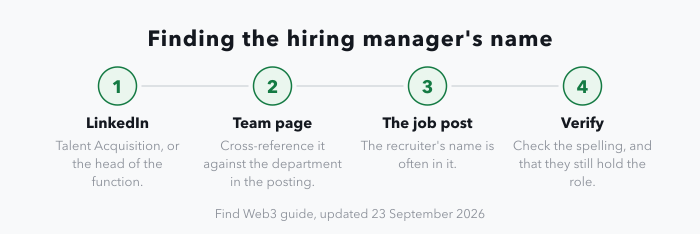
- LinkedIn, for titles like Talent Acquisition or the head of the relevant function.
- The company's team or about page, cross-referenced against the department in the posting.
- The job post itself. The recruiter's name is often in it.
- Check the spelling and confirm the person still holds the role.
6. Keep It Concise and Well-Formatted
A letter that is long or badly laid out gets skimmed at best. Clean formatting is not decoration — it is what earns the content a reading.
- Use a standard business layout: your contact details, the date, the recipient. A familiar structure is easier to process than an inventive one.
- Use a plain font — Arial, Calibri or Times New Roman — at 11 or 12 points.
- Send a PDF, so the formatting survives whatever software opens it.
Brevity and clarity
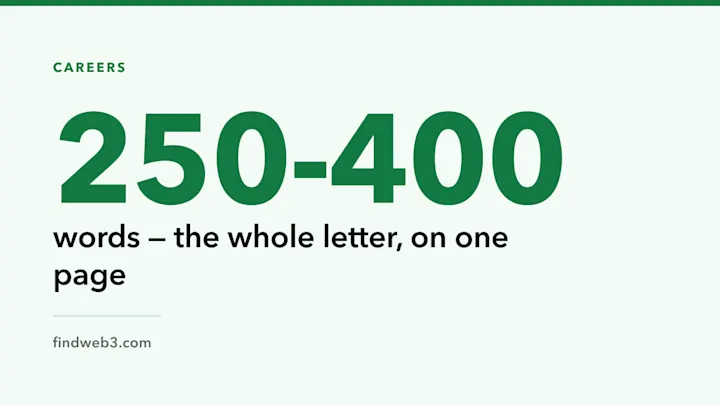
- Aim for 250 to 400 words. One page. The limit forces you to choose what matters.
- Leave white space. One-inch margins, single spacing inside paragraphs, a blank line between them.
- Use bullets sparingly — two or three, for your strongest results.
- Proofread for consistency in fonts, spacing and heading styles.
7. Show Enthusiasm and Cultural Fit
Qualifications get you compared with other candidates; fit is often what separates the ones who are equally qualified. In a sector where teams are assembled around a conviction about how systems should work, saying what you think of that conviction is not filler.
Do the research first, then draw an explicit line between what the team is building and what you have actually done.
- A mission-driven L1:
"[Company Name]'s work on financial access for the unbanked is the reason I'm applying. My volunteer work in financial literacy programs is where that interest started, and I'd like to put development skills behind it."
- A team with a distinctive working culture:
"Your policy of direct, documented feedback is the environment I've worked best in, and I'd expect to integrate quickly with your engineering pods."
- A project with strong community values:
"I'm an active participant in several gaming DAOs, so the community dynamics and player motivations behind a guild-based economy are familiar ground."
Keeping it authentic
- Read their values page and their blog. Note the words they use for themselves: transparency, community-first, credible neutrality.
- Watch an AMA or a conference talk. Founders describe the working environment more honestly in conversation than in a careers page.
- Name the niche if it is genuinely yours. Music NFTs, regenerative finance, zero-knowledge research — real interest is specific, and fake interest is obvious.
8. End with a Strong Call to Action
The last paragraph decides what happens next. A passive sign-off asks the reader to do the work of following up; a clear closing tells them exactly what you are proposing.
- Technical role:
"I'd like to discuss how my background in Substrate development supports your parachain launch timeline. I'm available for a technical conversation next week."
- Marketing or growth:
"I'd welcome the chance to share what I'd do to expand the project's reach in the APAC market."
- Operations or strategy:
"My experience scaling decentralized organizations lines up with what you've described, and I'd be glad to talk it through."
What a strong close contains
- Something specific you are interested in — the tokenomics, the rollup design, the way governance is structured.
- Your availability, stated plainly.
- One line restating your value. "I'd like to bring my work on zero-knowledge proofs to your team."
- A normal sign-off. "Sincerely" or "Best regards," then your full name.
Before You Send
Run the letter against four questions:
- Is it specific to this company? If the letter would work for a competitor with the name changed, it is not finished.
- Is the evidence checkable? Link the GitHub, the governance profile, the dashboard, the community you grew.
- Is it short? One page, 250 to 400 words, no paragraph longer than four lines.
- Is the enthusiasm real? Say what you actually think about what they are building, or leave it out.
Your cover letter sets the tone for everything that follows in the process. Get it specific, get it short, and make every claim in it one you would be happy to be asked about.
When the letter is ready, browse open roles in crypto, DeFi and NFTs on Find Web3. If you want to know what the work pays before you write, the salary medians are drawn from listings that state pay, and the Web3 jobs report tracks hiring by month and category.