Crypto Social Media Marketing: X, Discord and Reddit
Why ad-led playbooks stall in Web3, how to structure a community people stay in, and which of X, Discord or Reddit fits a project.
Crypto projects market on the platforms where the Web3 audience already sits: X (formerly Twitter), Discord, Reddit and Telegram. The work looks less like a sales funnel and more like running a community — publishing updates, answering questions in public, and being judged on transparency rather than polish.
Why Your Marketing Playbook Fails in Web3
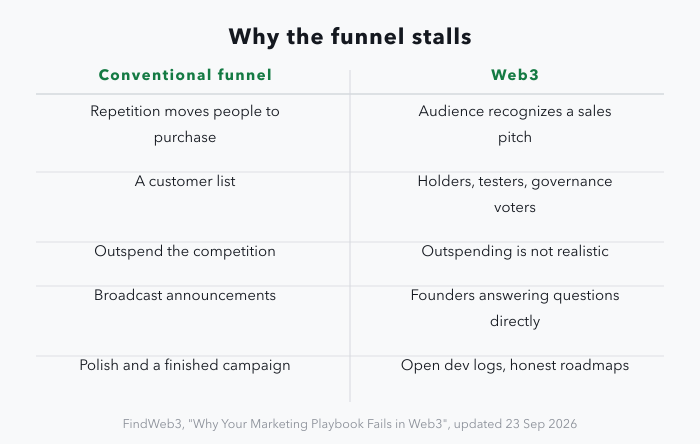
A conventional funnel assumes an audience that can be moved from awareness to purchase by repetition. The crypto audience skews toward tech-literate early adopters who recognize a sales pitch and react badly to one. Hype-filled announcements and "buy now" messaging tend to draw silence or public criticism rather than sign-ups.
The Community Is the Product
Community members are often also holders, testers and governance voters, so the relationship is not purely transactional the way a customer list is. Decentralization and shared ownership are part of what a project is offering, and marketing that ignores that reads as inconsistent with the product.
It also means being fluent in the culture, from the technical jargon to the meme-heavy humor. The Web3 dictionary covers the vocabulary.
Why Authenticity Trumps Ad Spend
The space is crowded and outspending competitors is not a realistic strategy for most projects. What the audience tends to reward instead:
- Transparency: open developer updates, honest roadmaps, and clear statements about what has gone wrong.
- Engagement: founders and core team answering questions directly rather than broadcasting.
- Educational value: explaining what the project does and how it works, in terms a newcomer can follow.
Without those, a polished campaign still reads as hollow.
How to Build a Crypto Community
In Web3 the community is not a support channel bolted onto the product — it is where the project's reputation is made. The people who stay through a downturn, give honest product feedback and answer other users' questions are the ones worth cultivating, and that takes time rather than campaigns.
Choosing Your Community's Home Base
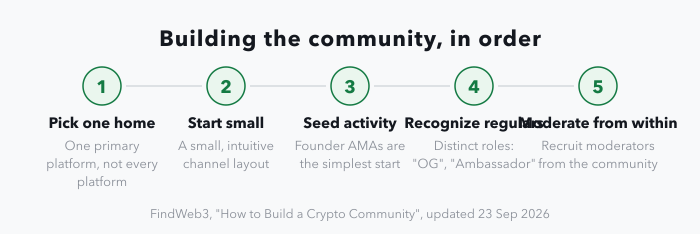
The first decision is where the community lives, and it shapes the kind of conversation you get. Pick one primary home rather than spreading across every platform at once.
- Discord: the default for most crypto and NFT projects. Its channel structure lets you separate technical support, developer chat, memes and official announcements. The Discord statistics page covers the platform's size.
- Telegram: fast and simple, good for rapid announcements and large group chats. The single-channel format gets chaotic as a group grows, and moderation is harder.
- Farcaster or Lens: building on a decentralized social platform signals commitment to Web3 principles and attracts a technical audience, on a much smaller user base.
Match the platform to the project. A DeFi protocol that needs separate channels for governance, bug reports and user support fits Discord. A memecoin running on virality may do better on Telegram.
Structuring for Genuine Conversation
A server with dozens of empty channels puts new members off. Start with a small, intuitive layout and add channels as the community grows into them.
Start With These Essential Channels:
- Welcome & Rules: the first stop for every new arrival.
- Announcements: read-only, for official updates.
- General Chat: the main social hub.
- Support & Questions: a dedicated space for users to get help.
- Memes & Off-Topic: somewhere for everything else to go.
Later you can add specialized spaces for developers, governance proposals, regional groups or specific product features.
Sparking and Sustaining Engagement
Activity needs seeding before it becomes self-sustaining.
Founder AMAs are the simplest place to start. Direct access to the core team, including on questions the team would rather not answer, does more for trust than any announcement.
Insider roles are the second lever. Giving active, helpful members a distinct Discord role — "OG", "Ambassador" — recognizes them publicly, and those members often become the people who welcome newcomers and set the tone.
Recruit moderators from inside the community rather than hiring someone to police the chat. A moderator who already cares about the project shapes the atmosphere; one who does not just removes spam.
Pick Your Platforms Wisely: Where Does Your Project Belong?
Spreading across a dozen platforms produces a weak presence on all of them. Choose based on where the specific audience sits — traders, NFT collectors or developers — and on what the project needs. A new dApp chasing users and a developer-focused Layer 2 building technical credibility need different strategies.
Crypto Social Media Platform Strategy Comparison
| Platform | Primary Use Case | Best For | Key Strategic Advantage |
|---|---|---|---|
| X (Twitter) | Real-time news, narrative building, and rapid engagement | Announcing partnerships, sharing alpha, and establishing thought leadership | Speed and reach for breaking news, and the place market narratives form. |
| Discord | Deep community building and direct user engagement | Nurturing active users, providing support, and organizing focused discussions (e.g., dev talk, governance) | An organized home for the community, split into channels by purpose. |
| Niche community engagement and building trust | Projects targeting specific subcultures (e.g., DeFi, Ethereum) that value technical depth | Access to skeptical, knowledgeable niche audiences that reward technical substance. |
X (Twitter): The Crypto Town Square
X is where crypto narratives form, where announcements land first, and where project reputations are argued over in real time. For most Web3 projects it is the one platform that is not optional.
It is the strongest channel for:
- Rapid-fire news: partnerships, protocol upgrades and security disclosures.
- Thought leadership: founders and engineers building a personal following through threads and market commentary, which lends credibility to the project.
- Memes: a large part of how crypto culture communicates, and not a sideshow.
The pace is relentless and the audience is unforgiving of corporate phrasing. The accounts that work mix substantive updates with native humor and actual replies. The X statistics page has the platform's usage figures.
Discord: The Community Citadel
If X is the broadcast channel, Discord is where sustained engagement happens. It suits projects that need detailed discussion and feedback — DeFi protocols, DAOs, anything with governance.
Inside a server you can host founder AMAs, run dedicated channels for developer collaboration, handle user support, and set up roles and rewards for active members.
Reddit: The Passionate Niche Hub
Reddit is a collection of hyper-specific communities rather than one platform. People arrive for deep dives, blunt reviews and peer-to-peer discussion, not for news.
Promotional posts get dismantled. What works is becoming a useful member of a relevant subreddit — r/ethereum, r/defi — over time:
- Answer questions in threads related to your niche without plugging your own project.
- Share educational content: tutorials and in-depth explanations with no sales pitch attached.
- Host transparent AMAs and answer the hostile questions honestly.
A reputation built that way drives more durable interest than an ad campaign.
Why Platforms Like Instagram Rarely Work
Knowing where not to spend time matters as much. Crypto discussion is text-heavy — technical arguments, governance debate, market analysis — which suits X, Discord, Reddit and long-form YouTube. Instagram and Facebook are built around visual lifestyle content, which fits a Web3 audience poorly. An NFT project with a strong visual component may find some use for Instagram; for most projects it returns little.
Creating Content That Web3 Users Actually Want
Generic "value-add" content is noise in crypto. The audience is skeptical, technically literate, and reading for signal. Repurposed press releases do not land.
What does land is translation: taking the whitepaper, the roadmap and the protocol design and making them understandable without talking down to anyone.
From Whitepaper to X Thread
Organize content around a few pillars so the calendar covers what the community cares about rather than whatever happened that week.
- Technical deep dives: take one mechanism of the protocol — the consensus design, the token model — and explain it with a concrete analogy.
- Ecosystem explainers: content about the wider space, not only about your project.
- Founder insights and vision: the reasoning behind the project and the principles guiding the team.
- Community-generated content: meme contests, community-built tools, user stories.
The Power of Radical Transparency
Transparency is underused as a content strategy. It means publishing developer logs, discussing roadblocks openly, and saying plainly when something has gone wrong — not only posting wins.
Rather than announcing a vague delay, explain the technical problem the team hit and the steps being taken to fix it. That treats the audience as participants rather than consumers, and it turns a bad week into evidence that the team is honest.
Actionable Content Formats That Actually Work
Format matters as much as the message. A wall of text in a Discord announcement gets ignored; the same information reshaped gets read.
- X threads: break a major update or complex concept into a thread with a clear opening, simple language and custom graphics or diagrams for the key points.
- Infographics: token distribution, roadmap milestones or an ecosystem map, rendered so someone can grasp it at a glance.
- Blog posts: the place for real depth. Social posts are the hook; the post is where the nuance goes, promoted with a summary thread.
- Builder AMAs and live streams: sessions on X Spaces or Discord that go past Q&A — a live coding session, or a product manager walking through a new feature.
Working With Influencers Without Getting Burned
Crypto influencer marketing is full of accounts that will promote anything for a fee. The audience recognizes a paid post, and a big account suddenly praising a project it has never mentioned usually produces skepticism rather than interest. Transactional deals tend to cost more trust than they buy.
Vetting Influencers Beyond Follower Counts
Follower count says little. An audience of bots and giveaway hunters produces nothing.
Look at engagement quality first: whether replies are actual questions and arguments, or a wall of "Great project!" and fire emojis. Then look at the content history.
- Niche alignment: do they consistently cover your corner of Web3 — DeFi, NFTs, Layer 2 scaling — or everything at once?
- Educational value: is the content informative, or a stream of price predictions?
- Project loyalty: do they move to whatever is hot each week, or stay with ecosystems over time?
Someone who has spent a year explaining zero-knowledge proofs to their audience is a better partner for a ZK project than a generalist with five times the following.
Structuring Partnerships for Authenticity
How the partnership is structured determines whether the output reads as an ad. Alternatives to paying for a post:
- Co-hosted educational events: an AMA on X Spaces or a technical session on YouTube, where their audience sees them question your team directly.
- Ambassador programs: a small hand-picked group with early access to updates, a direct line to the team and real input on feedback.
- Content collaborations: a tutorial, a detailed project review, or a thread breaking down one feature of the protocol.
Non-Negotiable Transparency Practices
Sponsored content has to be labeled. Require every partner to disclose with a clear #ad or #sponsored tag, placed where it is visible rather than buried. Undisclosed paid promotion is both a regulatory exposure and the kind of thing a crypto audience uncovers and publicizes.
Your Top Crypto Marketing Questions, Answered
How Do You Measure ROI on Community Building?
Tracing a straight line from a Discord conversation to a token purchase does not work. Measure the health of the ecosystem instead:
- Discord engagement: daily active users, and the message-to-member ratio. A high ratio means people are talking rather than lurking.
- On-chain actions: how many community members vote on governance proposals, use the testnet, or connect a wallet to the dApp. These are the signals that someone is actually using the thing.
- Support deflection: how often community members answer each other's questions. That saves operational cost and indicates the culture is working.
The return on a strong community is word-of-mouth, user-written tutorials and peer support — none of which can be bought directly.
What Are the Biggest Legal Risks?
Two risks dominate: securities law and deceptive advertising.
Never make price predictions or imply them. Language that sounds like a promise of profit is a factor regulators including the SEC weigh when assessing whether a token is an unregistered security.
Disclosure of paid promotion is the second. Every partner promoting the project should be tagging posts clearly. Rules differ by jurisdiction and change often, so have a lawyer who specializes in crypto review marketing materials before they go out.
Are Paid Social Media Ads Even Worth It for Crypto Projects?
Google and Meta both treat cryptocurrency as a restricted advertising category requiring advertiser approval, and crypto ad accounts are frequently rejected or suspended. X is more permissive, but costs vary and results are inconsistent.
For most projects the same budget goes further elsewhere:
- Community grants: paying developers and creators to build inside the ecosystem.
- Content: educational articles, video tutorials and technical deep dives.
- Partnerships: working with people and communities already invested in the space.
Those build something that survives a platform policy change.